
Implementation of Immigrant Eligibility Restrictions for ACA Marketplace Subsidies Under the 2025 Reconciliation Law: Issues to Consider
Introduction
The 2025 reconciliation law includes new eligibility restrictions for many lawfully present immigrants for federally funded health programs, including subsidized Affordable Care Act (ACA) Marketplace, Medicaid and the Children’s Health Insurance Program (CHIP), and Medicare coverage. Undocumented immigrants are already ineligible for federally funded health coverage under longstanding policy.
Beginning January 1, 2027, the 2025 reconciliation law will limit eligibility for Marketplace subsidies, including for all premium tax credits (PTCs) and cost-sharing reductions (CSRs), to lawfully present immigrants who are lawful permanent residents (LPRs or “green card” holders), Cuban and Haitian entrants, and people residing in the U.S. under Compacts of Free Association (COFA). These restrictions will eliminate eligibility for Marketplace coverage subsidies for many groups of lawfully present immigrants, including refugees and asylees without a green card and individuals on work visas, among others. The Congressional Budget Office (CBO) estimates that this provision will reduce federal spending by $91.4 billion and lead to an additional one million individuals becoming uninsured by 2035, with most of the coverage losses occurring in 2027, the year the provision takes effect. The law also eliminated access to subsidized Marketplace coverage for all lawfully present immigrants earning less than 100% of the federal poverty level (FPL) who were not eligible for Medicaid due to immigration status, including those in the five-year waiting period for coverage, beginning January 1, 2026. The CBO estimates that this provision will lead to an additional 200,000 individuals becoming uninsured and reduce federal spending by $27.3 billion over the 2026 to 2035 time period.
The Centers for Medicare and Medicaid Services (CMS) released guidance on how the federally facilitated exchange (FFE) will verify immigrant eligibility for subsidies during the 2027 plan year Marketplace Open Enrollment Period, which starts November 1, 2026. State-based exchanges (SBEs) are also required to implement the immigrant eligibility restrictions for subsidies, but outreach and immigration status verification procedures may vary from the FFE. Lawfully present immigrants who are no longer eligible for subsidies under the new restrictions can purchase Marketplace coverage at full cost. However, unsubsidized coverage will likely be unaffordable for many amid rising ACA Marketplace premiums due in part to the expiration of enhanced premium tax credits and other federal policy changes. Beyond those losing coverage due to ineligibility and cost, there may also be coverage losses among individuals who remain eligible for subsidies but have challenges understanding or responding to notices requesting information and documentation to verify their eligibility. This brief provides an overview of implementation of the immigrant eligibility changes for Marketplace subsidies and issues to consider for affected individuals and states.
Marketplace Subsidy Immigrant Eligibility Changes
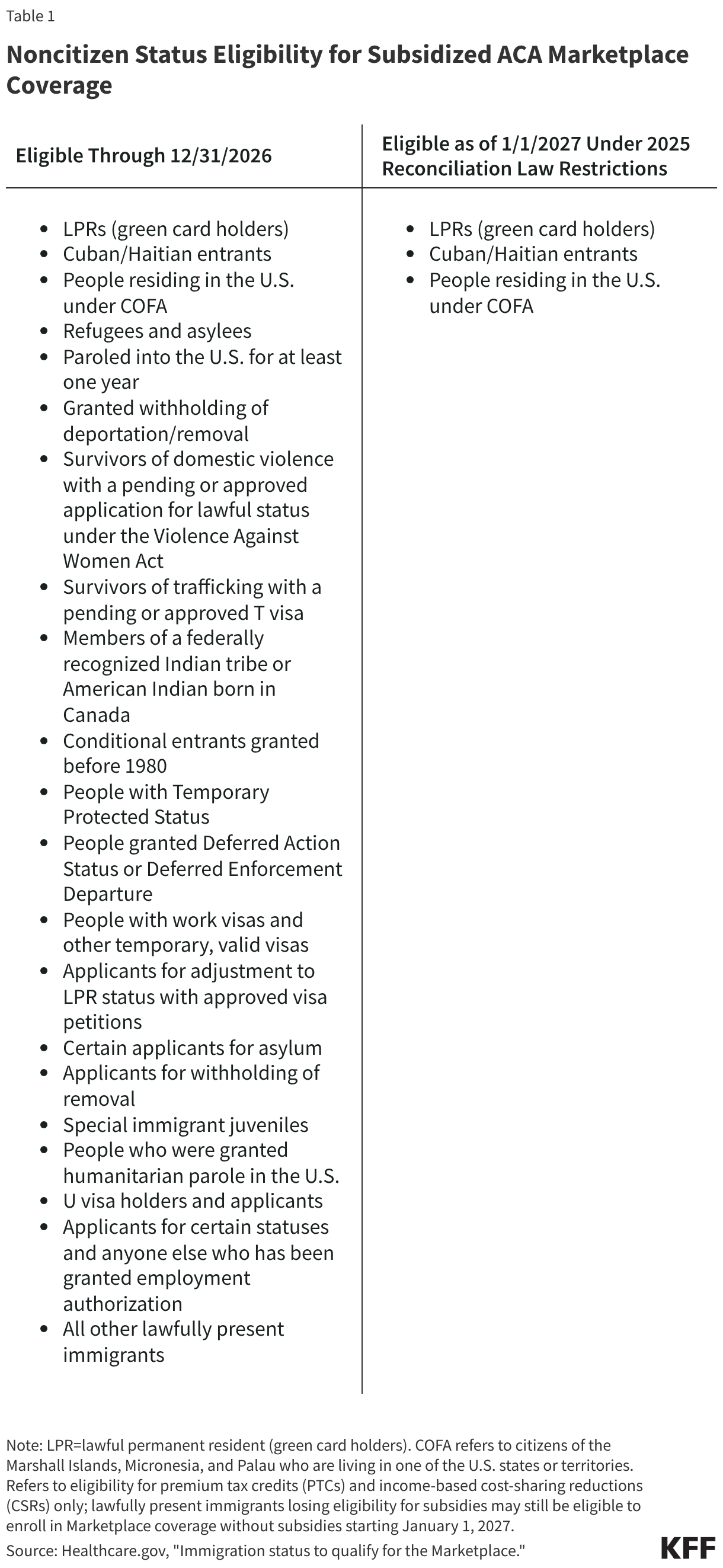
Starting January 1, 2027, the 2025 reconciliation law will restrict eligibility for PTCs and income-based CSRs to LPRs or “green card” holders, Cuban and Haitian entrants, and people residing in the U.S. under COFA (Table 1). The guidance refers to these groups as “eligible noncitizens.” The law eliminates eligibility for Marketplace subsidies for many other groups of lawfully present immigrants, including refugees and asylees without a green card and individuals on work visas, among others. The law also eliminated access to Marketplace subsidies for lawfully present immigrants earning less than 100% FPL who were not eligible for Medicaid due to immigration status, including those in the five-year waiting period for Medicaid coverage, beginning January 1, 2026. Lawfully present immigrants who do not have an “eligible noncitizen” status still may purchase a qualified health plan (QHP) through the Marketplace at full cost without subsidies if otherwise eligible. However, the coverage will likely be unaffordable for many without subsidies. Prior to the 2025 reconciliation law, undocumented immigrants were already ineligible for federally funded health coverage. Deferred Action for Childhood Arrivals (DACA) recipients are also ineligible to purchase ACA Marketplace coverage under recent federal regulation changes and the 2025 reconciliation law.
Implementation of Immigrant Eligibility Changes in the FFE
Starting with plan year 2027, the FFE will conduct eligibility determinations for current noncitizen enrollees and new applicants consistent with the new rules for Marketplace subsidies. In the 29 states that use the FFE or a state-based marketplace on the federal platform, the Open Enrollment Period for the 2027 plan year begins November 1, 2026. CMS encourages current noncitizen Marketplace enrollees to ensure their applications are updated with their most recent immigration status by the last day to enroll in or change plans. New noncitizen applicants applying for coverage through the FFE will be asked to attest to whether they have eligible noncitizen status when applying for subsidies or if they have a different lawfully present status that is not eligible for subsidies. Enrollees and applicants may need to provide updated documents or document information, such as their passport number, Permanent Resident Card, Employment Authorization Document (EAD), among others to help the FFE verify their immigration status.
The FFE will use immigration-document information and automated data matching to verify whether current noncitizen enrollees and new applicants meet the new subsidy eligibility requirements. The FFE will automatically verify immigration status through the Department of Homeland Security (DHS) Systematic Alien Verification for Entitlements (SAVE) system using existing information. Current noncitizen enrollees will continue to receive subsidies if the FFE can verify eligible noncitizen status using the information available in their enrollee profile or through a new SAVE verification, provided the enrollee remains otherwise eligible. New applicants determined to have an eligible noncitizen status will also be able to enroll in a plan with subsidies if they meet all other eligibility requirements. While CMS did not discuss potential issues with the SAVE system in this guidance, in previous guidance to states regarding immigrant eligibility restrictions in Medicaid, it noted that SAVE provides “point in time” verification and does not update prior verification responses when there is a change in immigration status or category. As such, potentially affected enrollees may have applied for and been granted adjustment to LPR status or may have another eligible status that is not reflected in SAVE.
Noncitizen enrollees and applicants who attest to having an eligible noncitizen status, but whose status cannot be automatically verified by the FFE, will receive a 95-day period to submit documentation from when the notice of the verification is sent by the FFE. Individuals may be eligible to enroll in subsidized Marketplace coverage during this time. Eligible documentation may include a Permanent Resident Card (also known as a “green card”), an EAD, or an arrival/departure record (I-94/I-94A). In addition to requesting documentation to resolve issues verifying eligible noncitizen status for subsidies, the FFE may also request additional documentation if it cannot verify that an individual is lawfully present. Enrollees will be required to repay any PTC received during the 95-day period in future tax filings if they are found to be ineligible for subsidies. Other proposed changes from the Internal Revenue Service (IRS) to implement provisions of the 2025 reconciliation law would eliminate income-based caps on such repayment amounts.
Current noncitizen Marketplace enrollees who do not take any action to update their applications by the plan selection deadline for coverage and whose eligible noncitizen status cannot be verified by the FFE will lose subsidies effective January 1, 2027. Re-enrolling consumers whom the FFE determines as no longer lawfully present will lose eligibility for Marketplace coverage entirely effective January 1, 2027. CMS does not provide any information as to whether determinations of individuals as no longer lawfully present will be used for immigration enforcement purposes.
The FFE will automatically re-enroll current enrollees who are determined lawfully present but ineligible for subsidies into a Marketplace plan without subsidies, and they will be responsible for paying the unsubsidized monthly premiums unless they cancel coverage. Enrollees can cancel their coverage through their online Marketplace account or by contacting the Marketplace Call Center. If enrollees do not cancel their plan, they will be responsible for paying the unsubsidized monthly premiums if they are auto-enrolled into a QHP without subsidies. If the enrollee does not pay the unsubsidized monthly premium, the enrollee would be subject to the grace period policy set by the plan issuer or applicable state laws, in contrast to the three-month grace period provided to those receiving subsidized coverage. Individuals who lose coverage due to nonpayment of premiums would have to wait until the next Open Enrollment Period to re-enroll in Marketplace coverage unless they qualify for a Special Enrollment Period. Individuals may also be able to appeal coverage cancellation decisions by plan issuers due to nonpayment of premiums.
The FFE updated Marketplace websites and platforms and is sending targeted notices about immigrant eligibility changes. Prior to the start of the 2027 plan year Open Enrollment Period, applications on HealthCare.gov and Enhanced Direct Enrollment partner platforms were updated to highlight that only U.S. citizens and certain lawfully present noncitizen statuses qualify for financial assistance. The FFE is sending several targeted notices to affected enrollees, including the following:
- Current enrollees whose eligible noncitizen status cannot be verified through DHS SAVE will receive tailored Marketplace Open Enrollment Notices (MOEN) explaining that they will lose PTCs and CSRs unless they update their application and submit documentation to confirm their eligible noncitizen status.
- Enrollees whom the FFE determines as no longer eligible for Marketplace subsidies will receive a Marketplace Eligibility Determination Notice explaining that they are ineligible for PTCs and CSRs due to their immigration status and their appeal rights.
- Enrollees whom the FFE determines as no longer eligible for Marketplace coverage due to immigration status will receive a notice explaining that their Marketplace enrollment will end, their appeal rights, and additional options available to them. If an enrollee in a multi-member household is found no longer eligible for Marketplace coverage, the FFE will designate another eligible household member as the primary plan subscriber.
SBEs used by 22 states, including DC, may use different outreach and verification procedures compared with the FFE. CMS notes that the guidance is specific to the FFE and that noncitizen enrollees and applicants in states that operate their own exchange should follow guidance issued by their SBE. States with SBEs are required to verify eligible noncitizen status for subsidies for all noncitizen enrollees and applicants during the 2027 plan year Open Enrollment Period, though states have varying Open Enrollment timelines. CMS indicates that SBEs will have access to the same immigration status verification system (Federal Data Services Hub Verify Lawful Presence service) used by the FFE and have a direct connection to DHS SAVE, in addition to technical assistance from CMS.
Issues to Consider
Lawfully present immigrants without an eligible noncitizen status would still be eligible to purchase Marketplace coverage at full cost, but it would likely be unaffordable. Premiums have increased due in part to the expiration of enhanced PTCs and other policy changes, which have coincided with Marketplace enrollment declines, and premiums are expected to keep rising in 2027. If an enrollee loses coverage due to nonpayment of premiums, they may be responsible for any medical bills incurred during the period of nonpayment. Providers may also request that individuals pay the full cost of care out of pocket, or they may not provide care until the premiums are paid.
Some individuals who remain eligible for subsidized Marketplace coverage may still lose coverage due to challenges verifying eligibility or fear and confusion. CMS noted in previous guidance to states regarding immigrant eligibility restrictions in Medicaid that SAVE may not be accurate as it provides “point in time” verification and may not reflect that potentially affected enrollees have since applied for and been granted adjustment to an eligible noncitizen status. As such, some individuals may have an eligible noncitizen status even if it is not verified through a data match through SAVE. However, they would need to submit documentation to verify that eligibility. Individuals may have difficulty understanding new eligibility rules and whether they remain eligible for subsidies. Eligible enrollees may also face challenges submitting required documentation to verify eligible noncitizen status. Confusion and fears about enrolling in coverage may be amplified by other immigration policies like public charge and other increased federal immigration enforcement actions.
Individuals who become uninsured will be left with limited options for comprehensive coverage and care. Individuals who become uninsured may visit community health centers for free or sliding fee scale health care services, but they may have access to a limited scope of services. Some states offer fully state-funded coverage programs for immigrants regardless of status, which may be a coverage option for those losing eligibility for subsidized Marketplace coverage. However, several states have recently scaled back state-funded coverage programs for immigrants or have reached enrollment caps due to budget pressures and higher than expected demand. New Mexico is using state funds to provide coverage with premium subsidies through a state-based exchange to lawfully present noncitizens losing subsidized ACA Marketplace coverage, as well as DACA recipients.
Broader changes to Marketplace coverage may also impact immigrant families. As noted, the elimination of caps on repayment amounts means that all enrollees, including immigrant enrollees, who received excess PTCs will need to repay excess amounts without any limit. Additionally, beginning in the 2028 tax year, all individuals who are eligible for PTCs will not be able to receive them until the Exchange verifies their eligibility, including household income, health coverage status or eligibility for coverage, place of residence, family size, and immigration status. As such, individuals will no longer be able to receive PTCs while this information is being verified and can choose to pay full price for their premium while the verification is in process or pending their plan selection. This could have a disproportionate effect on immigrants and may leave families with mixed immigration status to make a difficult decision between covering some family members but not others.
States operating SBEs may face increased administrative burden to conduct outreach, reverify enrollees, and update systems and other materials to reflect new immigrant eligibility rules. State pressures may be compounded since they are implementing these changes at the same time they are implementing Medicaid immigrant eligibility restrictions as well as work requirements and more frequent eligibility redeterminations for ACA expansion adults.