The U.S. Government’s Global Health Policy Architecture: Structure, Programs and Funding

Published: May 30, 2011

This report provides the first comprehensive look at the U.S. government agencies and programs involved in the nation’s global health response, including their funding and their approaches. Federal funding for such initiatives reached $9.6 billion in fiscal year 2008, more than double the amount just four years earlier.

The report also provides overviews of the large-scale global health initiatives of the U.S. government, information on which countries receive support from the U.S., and a review of the key laws governing U.S. global health policy and relevant Congressional committees.

Executive Summary (.pdf)

Report (.pdf)

Supplemental Exhibits:

Key U.S. Government Agency Positions and Officials in Global Health Policy & Related Areas (as of September 2016)

Major U.S. Global Health and Related Initiatives by Country (.pdf) (as of May 2012)

The Foundation also has issued a separate background report that provides a more detailed look at some of the research behind this report.

How Much Skin in the Game is Enough? The Financial Burden of Health Spending for People on Medicare

Published: May 30, 2011

How Much ” Skin in the Game ” is Enough? The Financial Burden of Health Spending for People on Medicare

Medicare extends health security and financial protection to seniors and younger people with disabilities. However, premiums, relatively high cost-sharing requirements, and gaps in the benefit package result in some beneficiaries spending a significant share of their income on health expenses.

This data spotlight examines the burden out-of-pocket expenses placed on Medicare beneficiaries between 1997 and 2006, and characteristics of those beneficiaries with the greatest financial burden relative to their income.

It is a product of the Foundation’s Project on Medicare’s Future.

Data Spotlight (.pdf)

News Release

Be Greater Than AIDS: Get Yourself Tested!

Published: May 26, 2011

NEWS RELEASEJune 21, 2011

Public and Private Sectors Join to Get Out the Word about HIV Testing

Five-City Concert Series, Free HIV Testing Events, Special Programming and More

Greater Than AIDS and GYT: Get Yourself Tested, two leading national campaigns committed to reducing the spread of HIV and other sexually transmitted diseases, are teaming up for a second year to encourage Americans to get tested and know their status. In the lead up to National HIV Testing Day (June 27), the scaled-up, month-long cross-promotion brings together major media and leading corporate brands with community organizations and state and local health departments to carry the message on air and on the ground across the nation.

“As we mark 30 years of AIDS, it’s worth noting the tremendous progress made in terms of the life-saving treatments now available, but to benefit from these advances one must first know their status,” said Tina Hoff, Senior Vice President & Director, Health Communication & Media Partnerships, Kaiser Family Foundation, a partner on both campaigns. “Be Greater Than AIDS: Get Yourself Tested is an empowering, uplifting message that makes getting tested an act of pride, not shame.”

“Our audience has never known a time without HIV, but through efforts like GYT, we’re committed to empowering them to forge a world where HIV doesn’t exist,” said Jason Rzepka, Vice President of Public Affairs, MTV. “We’re proud to join with this remarkable coalition and reinforce regular testing as one way America’s youth can be greater than AIDS.”

According to the U.S. Centers for Disease Control and Prevention (CDC), of the more than one million Americans living with HIV today, one in five of those infected don’t know their status. The CDC encourages all Americans between the ages of 13-64 to get tested on a routine basis as part of their overall health and well-being similar to cholesterol, blood pressure, and other screens.

Elements of the Be Greater Than AIDS: Get Yourself Tested Month promotion include:

  • Five-City Summer Concert Tour, in partnership with EMMIS Communications and Radio One, that integrates HIV/AIDS information and testing resources into some of this summer’s biggest concerts, including those sponsored by EMMIS and supported by Gilead Sciences in Chicago (Jamboree, 6/4), New York (Summer Jam, 6/5) Los Angeles (Powerhouse, 6/25), and sponsored by Radio One in Miami (SpringFest, 5/28) and Atlanta (Birthday Bash, 6/18). On air promotions in the lead up to the concerts, including DJ call outs and targeted public service ads, will promote testing. Giveaways and other special promotions will support listeners who get tested. An on-site information booth will offer more resources. Additionally, the “Road to the Chicago’s Jamboree Concert Testing Tour,” conducted in partnership with GYT, is providing free testing at six Chicago-area college campuses throughout May.
  • Mo’Nique hosts AIDS radio special and other special programming to promote testing as a routine part of health care. Academy Award winning actress, Mo’Nique, guest hosts a half-hour long radio show about AIDS in America that is being distributed to more than 90 Clear Channel Radio stations throughout the month as part of the company’s partnership with Greater Than AIDS. Additionally, MTV, a founding partner of GYT, and other media partners will air targeted public service messages to encourage testing.
  • Road to ESSENCE Music Festival: Testing Tour, coordinated by the Black AIDS Institute and Louisiana Department of Health will provide free testing at stops in six cities across the state culminating with three-days of testing at the ESSENCE Music Festival in New Orleans (July 1-3). The cities providing free testing on the Testing Tour include Shreveport (June 25th), Alexandria (June 26th), Lake Charles (June 27th), Lafayette (June 28th), Baton Rouge (June 29th), and New Orleans (June 30th).
  • Community resources and informational content distributed in coordination with the National Association of People Living with HIV/AIDS (NAPWA), Gilead Sciences, Orasure and others. Greater Than AIDS and GYT promote local HIV testing resources, information about HIV/AIDS and provide informational materials for health centers and organizations to help promote HIV testing via their online stores/toolkits through extensive web and social media platforms.

“NAPWA founded National HIV Testing Day in 1995,” said National Association of People With AIDS President Frank Oldham, Jr., “because we were already seeing that people with HIV who know their status sooner and start treatment with antiviral drugs sooner live longer, healthier lives. Today, 30 years into the HIV epidemic, there is more and more evidence that people with HIV who get tested every year and start treatment as soon as they know their status are also significantly less likely to infect others. It’s a tremendous win-win: when we know our status and get into treatment, we protect our own health and we protect the ones we love!”

bamp_logo_sm

The Greater Than AIDS movement responds to the AIDS crisis in the United States, in particular to the severe and disproportionate epidemic among Black Americans and other heavily affected groups. Through a national media campaign and community outreach, Greater Than AIDS aims to increase knowledge and understanding of HIV/AIDS and confront the stigma surrounding the disease among those most affected. Greater Than AIDS is coordinated by the Kaiser Family Foundation and the Black AIDS Institute. Additional financial and substantive support is provided by the Ford Foundation, Elton John AIDS Foundation, MAC AIDS Fund among others. http://www.greaterthan.org

Get Yourself Tested logo w URL

An extension of MTV and the Kaiser Family Foundation’s Emmy and Peabody-winning “It’s Your (Sex) Life” partnership, GYT: Get Yourself Tested campaign, developed with the U.S. Centers for Disease Control & Prevention, STD Division, and Planned Parenthood, focuses on reducing the spread of STDs, including HIV, among people 25 and younger. The GYT campaign includes on-air promotions and programming on MTV, targeted online and mobile information resources and on-the-ground activations. Gilead Sciences, Inc. provides support and resources for select elements of the campaign, including the Be Greater Than AIDS; Get Yourself Tested month. http://www.GYTNOW.org

# # #

News Release

14 Selected as 2011 Barbara Jordan Health Policy Scholars

Published: May 26, 2011

NEWS RELEASE

May 26, 2011

WASHINGTON, D.C. — The Henry J. Kaiser Family Foundation has selected 14 individuals as the 2011 Barbara Jordan Health Policy Scholars. These Scholars will have the opportunity to learn first-hand about health policy and the policymaking process during an eleven-week placement in a congressional office, where they will participate in seminars and site visits organized by the Foundation, and complete a health policy analysis project.

The Foundation established the Barbara Jordan Scholars Program in memory of former U.S. Congresswoman Barbara Jordan — the first African American woman elected to Congress from Texas and a member of the Foundation’s board of trustees when the modern day Kaiser Family Foundation was established in the early 1990s.

“These talented Scholars will have the opportunity to critically examine a variety of health policy issues, at a time of great debate about health care,” Foundation President and CEO Drew Altman said. “This group of students honors the legacy of Barbara Jordan with its passion and commitment excellence and to public service.”

The program introduces rising college seniors and recent graduates with an interest in issues affecting racial and ethnic minority and underserved communities to the federal legislative process and current issues in health policy. In addition to working on Capitol Hill, Scholars will have the opportunity to participate in seminars and site visits organized by the Foundation to broaden their knowledge of health care issues. Under the guidance of the Foundation’s staff, the Scholars will also write and present a policy memo that provides an in-depth analysis of a health care issue.

This year’s Scholars were chosen from more than 200 applicants. Cara James, Ph.D., is the director of the Barbara Jordan Scholars Program at the Foundation. The program operates in partnership with Howard University, which provides administrative support and houses the scholars in D.C.

More information about the Barbara Jordan Health Policy Scholars Program is available online.

The 14 Barbara Jordan Health Policy Scholars for 2011 are:

Jennica AllenHometown: Boston, MASchool: Tufts UniversityMajor: Child Development and Community Health

Cara BuchananHometown: Las Vegas, NVSchool: Columbia UniversityMajor: Hispanic Studies

Ashley CrawfordHometown: St. Louis, MOSchool: Davidson CollegeMajor: Biology

Alyzza DillHometown: Chicago, ILSchool: University of North Carolina, Chapel HillMajor: Health Policy and Management

Hannah GrowHometown: State College, PASchool: The Pennsylvania State UniversityMajor: Spanish and Health Policy & Administration

Jelani HarveyHometown: Miramar, FLSchool: Columbia UniversityMajor: History

Gary KerseyHometown: Charlotte, NCSchool: Morehouse CollegeMajor: Spanish

Deon PeoplesHometown: Spencer, OKSchool: University of Central OklahomaMajor: Community Health

Yvonne PerezHometown: Bronx, NYSchool: Brandeis UniversityMajor: Health: Science, Society & Policy

Jason ShererHometown: Lansing, MISchool: Hampton UniversityMajor: Cellular and Molecular Biology

Christina SwoopeHometown: Alpharetta, GASchool: The University of GeorgiaMajor: Genetics

Cheeduoa ThaoxaochayHometown: Fresno, CASchool: Stanford UniversityMajor: Anthropology

Denise VasquezHometown: El Paso, TXSchool: University of Texas, AustinMajor: Biology

Emanuel ZamoraHometown: Ontario, CASchool: Whittier CollegeMajor: Biology

News Release

Most Americans Oppose Converting Medicaid to a Block Grant in Order to Reduce the Federal Deficit

Published: May 25, 2011

New Poll Finds Support For Medicaid May Be Linked to Broad Ties To The Program, With Half of Americans Reporting A Personal Connection

1 in 5 Adults Has Received Medicaid Benefits Over Time, And For Most, Experiences Were Positive, Although One Third Of Them Report Having Had Problems Finding A Doctor

MENLO PARK, Calif. — Most Americans oppose the idea of converting Medicaid to block grant financing to reduce the federal deficit, and more than half want to see no reductions at all in Medicaid spending, according to the latest monthly tracking poll by the Kaiser Family Foundation.

The May Kaiser Health Tracking Poll finds that 60 percent of people say they would prefer to keep Medicaid as it is, with the federal government guaranteeing coverage and setting minimum standards for benefits and eligibility. Thirty-five percent would rather change the program so that the federal government gives states a fixed amount of money and each state decides who to cover and what services to pay for. Only 13 percent of Americans say they would support major reductions in Medicaid spending as part of Congress’ efforts to reduce the deficit, while 3 in 10 would support minor reductions and 53 percent want to see no reductions in Medicaid spending at all.

The findings come at a time of intense public debate in Washington about the future of entitlement programs such as Medicare and Medicaid as policymakers attempt to address rising public concerns about the federal deficit. While conventional wisdom and recent public opinion polling has suggested that dramatic changes in Medicare would be politically unpopular, the new poll findings illustrate that major alterations to Medicaid also could strike a negative chord with many Americans.

Support for maintaining the current program may be due at least in part to the public’s personal connections to Medicaid and a strong sense of the program’s importance. About half of Americans say they or a friend or family member has received Medicaid assistance at some point, and a similar share say the program is important to their family. Among the 20 percent of adults who personally have been covered by Medicaid, reported experiences are positive.

“If you watch the debate about the deficit and entitlements, you would think that almost everyone has a problem with the Medicaid program and wants to change it, or cut it — or both,” said Kaiser President and CEO Drew Altman. “The big surprise in this month’s tracking poll is that one group who does not want to cut Medicaid is the American people.”

“With about 69 million people expected to be covered by Medicaid this year, it is no longer the -welfare-linked program it once was,” Altman added. “Medicaid may not be the lower-hanging fruit that many who want to reduce federal entitlement spending have assumed it is.”

Experiences With Medicaid

About half of Americans (51%) report some personal connection to Medicaid, including having received health coverage, long-term care, or Medicare premium assistance from Medicaid themselves (20%), or having a friend or family member who has gotten this type of assistance (31%). In line with this, the poll finds that 49 percent of the public says Medicaid is “very” or “somewhat” important for them and their family.

Those who see the program as important cite a variety of reasons, including knowing that a safety net exists to protect low-income people (71% say this is a major reason) and feeling they or a family member may need to rely on Medicaid in the future (63%). Many who view the program as important also cite the fact that they or someone they know has received health coverage (58%) or long-term care services (43%) from Medicaid.

“Medicaid is a complex program that varies considerably from state to state, but the public’s initial reaction upon hearing about proposed spending reductions and structural changes is negative,” said Mollyann Brodie, a senior vice president and director of the Public Opinion and Survey Research group at the Foundation. “Such concerns reflect the fact that the program is important not only to those who have been directly enrolled in it but those with friends and family who have received Medicaid benefits as well.”

Among the one in five adults who have personally ever received Medicaid benefits, the vast majority (86%) say that their overall experiences with the program have been positive, including nearly half (45%) who say they were “very” positive. This is very similar to ratings of their current health plan among those covered by private health insurance (89% positive, including 44% “very” positive). As Medicaid is poised to expand under the Patient Protection and Affordable Care Act, eight in ten adults (81%) say that if they were uninsured, needed health care, and qualified for Medicaid, they would enroll in the program.

Despite overall positive ratings, some people do report having experienced problems with Medicaid. Roughly a third (32%) of adults who have ever been on Medicaid say they have had problems at some point finding a doctor or other health care provider willing to accept Medicaid patients. By comparison, 13 percent of those currently covered by private insurance say they’ve had problems finding a doctor who accepts their current plan. About a quarter (26%) of those who have ever been covered by Medicaid say they have experienced problems getting Medicaid to cover or pay for health care services, similar to the share of those with private insurance who say they have had this problem with their current health plan (22%). Although enrollment procedures have changed substantially in the past decade, one in five (21%) of those who have ever been on Medicaid say they have had problems when trying to enroll in the program.

Argument Testing, Partisan Differences

As with other policies tested in Kaiser tracking polls, public opinion about switching Medicaid to block grant financing is somewhat malleable when common arguments for and against it are presented. For example, when the 60 percent who initially oppose the idea are told that supporters say it will “help reduce the federal budget deficit and give states greater flexibility to tailor their Medicaid programs to match their residents’ needs and their own state budgets,” 14 percent of them changed their position, so that support for changing Medicaid climbs from 35 percent to 44 percent. That results in more mixed opinion overall: 44 percent support the block grant proposal and 49 percent prefer to keep Medicaid as it is.

On the other hand, when the 35 percent who initially supported the block grant proposal are told that opponents say it will “increase the number of uninsured, increase financial pressure on states and health care providers, and cause more low-income people to go without health care and long-term care services, particularly during tough economic times,” 26 percent of them changed their position, resulting in a rise in the share who want to keep Medicaid as is from 60 percent to 69 percent. In this scenario, the share supporting a block grant falls to 25 percent.

The poll findings reveal familiar partisan differences in the public’s reactions to questions about Medicaid funding and block grants. While seven in ten Democrats (69%) and more than half of independents (54 %) want no reductions in Medicaid spending to reduce the deficit, a plurality of Republicans (44%) say they would support minor reductions, and two in ten want major reductions. On the block grant question, eight in ten Democrats (79%) prefer to keep Medicaid as is, while a majority (57%) of Republicans favors the proposed change. Independents mirror the public overall, with six in ten preferring the current Medicaid system and 36 percent wanting to change it to a block grant.

Opinion of Health Reform Unchanged

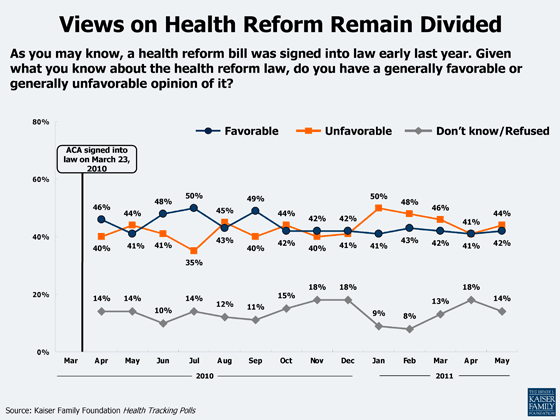
This month’s survey reveals little change in public opinion about the health reform law. Americans remain divided overall, with 42 percent having a favorable opinion of the law and 44 percent viewing it unfavorably. Three in ten continue to want to see the law expanded, while roughly one in five want it either kept as is (21%), repealed and replaced with a GOP alternative (19%), or repealed outright (19%).

The public by almost a two-to-one margin continues to disapprove of cutting off funding for the law’s implementation. And Americans remain divided on whether they themselves, the country as a whole, and seniors as a group will be better off or worse off under health reform. About 14 percent of Americans feel that they have personally benefited from the law, while 18 percent believe they have been personally harmed by it.

Methodology

This Kaiser Health Tracking Poll was designed and analyzed by public opinion researchers at the Kaiser Family Foundation led by Mollyann Brodie, Ph.D., including Liz Hamel, Sarah Cho, and Theresa Boston. The survey was conducted May 12 through May 17, 2011, among a nationally representative random sample of 1,203 adults ages 18 and older. Telephone interviews conducted by landline (801) and cell phone (402, including 197 who had no landline telephone) were carried out in English and Spanish by Princeton Survey Research Associates. The margin of sampling error is plus or minus 3 percentage points. For results based on subgroups, the margin of sampling error may be higher. Note that sampling error is only one of many potential sources of error in this or any other public opinion poll. This May tracking poll is focused on Medicaid and the full question wording, results, charts and a brief on the poll can be viewed online at here. The April poll focused on Medicare and is available at here.

May Kaiser Health Tracking Poll: Views of Health Reform Law Remain Unchanged

Published: May 25, 2011

This month’s Kaiser Health Tracking Poll reveals little change in public opinion about the health reform law. Americans remain divided overall, with 42 percent having a favorable opinion of the law and 44 percent viewing it unfavorably. Three in ten continue to want to see the law expanded, while roughly one in five want it either kept as is (21%), repealed and replaced with a GOP alternative (19%), or repealed outright (19%). Americans continue to be divided on whether they themselves, the country as a whole, and seniors as a group will be better off or worse off under health reform. The monthly poll also examined the public’s views and experiences with the Medicaid program, including a look at the deficit-reduction proposals impacting Medicaid. For more on those results, see the full report and topline.

Views on Health Reform Remain Divided

Pulling It Together: Predictions

Published: May 20, 2011

I usually don’t make predictions, unless they are backed up by the kind of statistical modeling we often produce.  But here are three predictions I am confident about that form the basis of this latest column.

GROUP HEALTH INSURANCE PREMIUMS WILL CONTINUE TO RISE AT HISTORICALLY MODERATE LEVELS, AT LEAST FOR THE NEXT FEW YEARS.  One reason for this is the lingering effect of the recession.  Employers will have little trouble attracting workers in the current economy without improving health benefits.  The other reason is the continued growth of high deductible health plans, which are holding down premium increases as employers switch to cheaper plans with higher cost-sharing, and also causing consumers to delay and forego care.  The steady growth of high deductible health insurance is changing the face of health coverage in the country and likely impacting utilization.  While attention is focused on Accountable Care Organizations and other small scale experiments and pilots in delivery and payment reform, high deductible health insurance is the default national cost containment strategy for health we don’t seem to know we have.

Last year employer premiums rose a very modest three percent; I expect a similar increase this year, far below the double digit increases in the group market we became accustomed to not so many years ago (the highest recorded increase was 18.9% in 1989).  Our comprehensive employer health benefits survey, which we put out every September, will give us an indication if this prediction is on track.  Keep in mind, even moderate increases in premiums by historical standards can be a serious burden for employers and employees when they are rising faster than inflation and much faster than wages.  For workers the concept of a “moderate increase” has little meaning if their overall out of pocket costs continue to go up and their incomes remain flat.

The smaller non-group market is, of course, an entirely different story.  In the individual market increases of 20% or more are not uncommon.  One claim is that this is largely because the recession drove healthier workers from the market leaving sicker and costlier ones behind and driving up rates.  There are no good independent data to substantiate this assertion.  Whatever the explanation, the practical effect is a market that is out of control and increasingly unaffordable for the roughly 14 million people who need to rely on it at any one time.

THE RETURN OF TIGHTER MANAGED CARE.  Recently in my home state of Massachusetts, reports surfaced about Blue Cross Blue Shield offering a more affordable insurance product by contracting selectively with less expensive community hospitals, requiring patients to pay more if they want to go to the state’s renowned and powerful major academic centers.  Other insurers in the state have also introduced tiered network plans that have higher patient cost-sharing for more expensive hospitals or exclude them altogether.  In the mid and late nineties, in what was called “the managed care backlash,” the American people revolted against tighter forms of managed care with limited provider networks and tough utilization review.  Looser forms of PPOs became the dominant mode for delivering health insurance in the country as a result.  Anecdotal evidence from around the country suggests the Massachusetts plan may be the canary in the coal mine.  What was not palatable in the late nineties may be more palatable today as people and employers accept tighter managed care as a less onerous alternative to ever increasing deductibles and cost-sharing.  Faced with higher and higher out of pocket payments, the public may be willing to accept limitations on what doctors they can see and which hospitals they can go to as well as stricter review of what services they use.  For many, compromising on provider choice and utilization review will be the lesser evil compared with a $5,000 deductible.

MEDICAID BLOCK GRANT: FUNDING CUT TRUMPS FLEXIBILITY.  States are all for greater flexibility when it comes to Medicaid. And they like the idea of block grants when they bring them more federal funding, as happened with the Medicaid block grant secured by the state of Rhode Island through a federal waiver.  But the block grant proposal adopted as part of the House budget framework reduces federal Medicaid matching payments to the states by $1.4 trillion over its first ten years, both by instituting a Medicaid block grant and repealing the Affordable Care Act. The effect of these reductions would vary by state but in every state they are significant, ranging from a 25% reduction in Washington to a 44% reduction in Florida.  A recent analysis by Kaiser and the Urban Institute shows that 31-44 million people could lose Medicaid coverage as a result of these reductions in federal funding, with most becoming uninsured. There could be as much as a one third reduction in Medicaid payments to hospitals over the ten year period. These projections are based on assumptions about likely state responses to reduced federal funding of this magnitude. For sake of argument, assume the study is off by as much as half (there is no reason to believe it is off at all); millions of people would still lose coverage. The study also looks at the impact of the block grant alone, uncoupled from repeal of the Affordable Care Act. This could mean a still sizeable loss in Medicaid coverage of 14-27 million people and $750 billion in federal funding to the states over ten years.

As a former state human services commissioner who oversaw a Medicaid program for a Republican governor, it certainly seems to me that consequences such as these will be too severe even for conservative governors and state legislators to accept. When their voices are heard in Washington the Medicaid discussion will move on to other ways to change Medicaid and reduce spending. Already battle lines have formed around new Medicaid issues, most notably, the proposal to repeal the so-called state “maintenance of effort” requirement, which would give states flexibility to make changes and cuts in Medicaid but potentially undermine the goal of expanding coverage. States will also turn to the federal waiver process to try to gain flexibility to make the changes they want to make in Medicaid without having to absorb big funding cuts from Washington. Several states are gearing up now to submit waiver proposals to HHS.

These three predictions are a comment on the times.  We have seen big health policy debates before but seldom has so much been up for grabs and in flux at the same time: health reform, Medicare, Medicaid, and the insurance and delivery systems themselves.  While the most politically charged issues – health reform and Medicare – get the greatest attention, potential changes to Medicaid and beneath the radar changes in the insurance system could have equal or even greater consequences for people.

News Release

A Medicaid Block Grant Would Reduce Federal Spending But Trigger Substantial Cuts in Medicaid Coverage in the States That Would Increase the Uninsured

Published: May 10, 2011

NEWS RELEASEMay 10, 2011

New State-By-State Analysis Shows House Budget Plan For Medicaid Would Reduce Enrollment By Tens of Millions Of People And Cut Funding For Hospitals And Other Medicaid Services

WASHINGTON, D.C. — Converting Medicaid into a block grant and repealing the health reform law as adopted by the House last month in a party-line vote would trigger major reductions in program spending and enrollment compared to current projections, a shift with big implications for states, hospitals and tens of millions of low-income Americans who likely would become uninsured, according to an analysis released today by the Kaiser Family Foundation’s Commission on Medicaid and the Uninsured.

Under the House Budget Plan, advanced by House Budget Committee Chairman Paul Ryan, projected federal spending on Medicaid for the period 2012 to 2021 would fall by $1.4 trillion, a 34 percent decline. In 2021, the end of the typical 10-year budget window used by Congress, states would receive $243 billion less annually in federal Medicaid funding than they would under current law, a 44 percent reduction, as shown in Figure 1. The plan’s two-pronged approach would curb Medicaid spending and enrollment by eliminating the Patient Protection and Affordable Care Act (ACA) and its major Medicaid expansion scheduled to begin in 2014, and by capping the amount of federal funding for Medicaid through a block grant.

051011_02kcmu

According to the new analysis of the plan conducted by researchers at the Urban Institute working with analysts at the Foundation, total federal Medicaid spending reductions over the next decade relative to current law would range from a 26 percent drop in Washington, Vermont and Minnesota, to 41 percent declines Oregon, Georgia and Colorado and a 44 percent decrease in Florida. The analysis also finds that hospitals could see their Medicaid payments fall by as much as 38 percent, relative to current projections, in 2021.

“Under the House Budget Plan, the Medicaid block grant would reduce and cap federal Medicaid spending, substantially reducing states’ ability to provide coverage to low-income Americans,” said Diane Rowland, Executive Vice President of the Foundation and Executive Director of the Kaiser Commission on Medicaid and the Uninsured. “The repeal of the ACA combined with the adoption of the Medicaid block grant would add millions more to the number of uninsured Americans and compromise Medicaid’s role as the health safety net in the next recession.”

The effect on enrollment in state Medicaid programs could vary widely. Under the House Budget Plan, between 31 million and 44 million fewer people would have Medicaid coverage relative to expected enrollment under current law, the new analysis finds, after examining three possible scenarios using different assumptions about how states might respond to lower federal funding. Most of those people, given their low incomes and few options for other coverage, would end up uninsured.

The House Budget Plan comes at a time of growing concern about the rising federal budget deficit. Under the current system, eligible low-income children and parents, people with disabilities and older Americans living in nursing homes are entitled to Medicaid coverage and states are guaranteed federal matching payments for this coverage with no cap. Under the block grant system in the plan, there would be no individual entitlement and federal funding would not be open-ended. Starting in 2013, states would get a fixed amount of federal money based on a formula rather than actual costs. That amount would increase annually with population growth and inflation and states could have more authority to cut back on eligibility levels or freeze enrollment.

Impact on enrollment

Because Medicaid is financed jointly by the states and the federal government, the impact of the House Budget Plan on program enrollment would depend in part on the spending and policy choices that states make in the face of diminished federal funding. The analysis examines three possible scenarios for state responses to the block grant which would produce decreases in Medicaid enrollment relative to current projections ranging from 31 million people to 44 million people nationally, as shown in Figure 2. Between 14 million and 27 million low income people would lose coverage due to the implementation of the block grant alone, the analysis finds.

051011_01kcmu

In terms of state-level impacts, one scenario, for instance, finds estimated Medicaid enrollment reductions relative to current projections ranging from 32 percent in Vermont to 56 percent in Oregon. To forestall these enrollment cuts, states would need to increase state spending by 45 percent to 71 percent to offset losses in federal spending, the analysis finds.

Impact on hospitals

Across the country, health centers, hospitals and safety-net facilities that serve low-income and uninsured people rely heavily on Medicaid revenues. By 2021, hospitals could see reductions in Medicaid funding of between 31 percent and 38 percent annually, or as much as $84.3 billion, under the House Budget Plan compared with projected funding under current law. The reductions would come at a time when millions more people would lack coverage, increasing the potential demand for uncompensated hospital care.

The full analysis, including an in-depth discussion of methodology and state-by-state data tables, is available online.

The Kaiser Family Foundation is a non-profit private operating foundation, based in Menlo Park, California, dedicated to producing and communicating the best possible information and analysis on health issues.

The Kaiser Commission on Medicaid and the Uninsured provides information and analysis on health care coverage and access for the low-income population, with a special focus on Medicaid’s role and coverage of the uninsured. Begun in 1991 and based in the Kaiser Family Foundation’s Washington, D.C. office, the Commission is the largest operating program of the Foundation. The Commission’s work is conducted by Foundation staff under the guidance of a bipartisan group of national leaders and experts in health care and public policy.

Medicaid Financing Issues: Provider Taxes

Published: May 2, 2011

Current law allows states to use revenue from provider taxes to help fund the state share of spending on Medicaid, a program that is jointly financed by the states and the federal government. Almost all states have at least one provider tax in place. This issue brief reviews the use of provider taxes by states as a mechanism for financing the state share of Medicaid spending. It also explores the implications of recent proposed changes in the federal rules that govern how states may design their provider tax structures.

Issue Brief (.pdf)