KFF designs, conducts and analyzes original public opinion and survey research on Americans’ attitudes, knowledge, and experiences with the health care system to help amplify the public’s voice in major national debates.
Kaiser Media Fellowships 2011 California Site Visits
The first site visit of 2011 focused on the implementation of the Affordable Care Act (ACA) in California. In May 2011, journalists with a strong focus on health policy, state health reform, and/or California-specific policy issues were invited to participate in a week-long program. Based initially in San Francisco and later in Sacramento, the program offered journalists the opportunity to meet with a variety of stakeholders concerned with the implementation of health reform, including officials from the California Health and Human Services Agency, health policy experts, physicians, community clinic staff members and legislative staff. The program focused on a range of issues including the establishment of the California health benefit exchange, the state’s “Bridge to Reform” 1115 Medicaid Demonstration Waiver, Healthy San Francisco, initiatives to improve the delivery of health care and reduce medical costs, and projects addressing physician shortages in the Medicaid program.
The Foundation has a fact sheet from the Kaiser Commission on Medicaid and the Uninsured that compares and contrasts key provisions of the California and Texas Section 1115 Medicaid demonstration waivers, while two other fact sheets summarize the health care landscape in Texas and California, including data on demographics, population health, the uninsured and the state Medicaid program. Also available are several existing resources on the two states and Section 1115 Medicaid demonstration waivers, including an issue brief that provides a focused overview of California’s waiver and another paper that examines key questions about Section 1115 Medicaid demonstration waivers more generally.
2011 Kaiser Media Fellowships Site Visit Participants
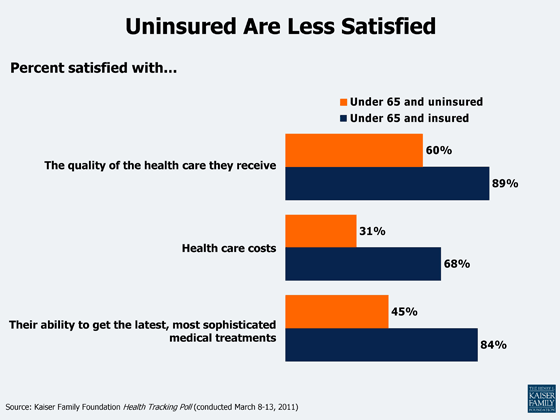
Given that people without health insurance have no protection from health care costs, it is not surprising that they are much less likely to say they are satisfied with costs than those with insurance (31 percent vs. 68 percent Majorities of both the uninsured and insured report being satisfied with the quality of care they receive, but the differences are still striking. Six in ten of the uninsured say they are satisfied with their quality of care, compared to almost nine in ten of those with insurance. For both cost and quality, the uninsured are about half as likely as the insured to report they are “very satisfied.” Additionally, the uninsured are less likely to report they are satisfied in their ability to access the latest, most sophisticated medical treatments than the insured (45 percent vs. 84 percent).
Most Americans oppose the idea of converting Medicaid to block grant financing to reduce the federal deficit, and more than half want to see no reductions at all in Medicaid spending. One in five adults has received Medicaid benefits over time, and for most, experiences were positive, although one third of them report having had problems finding a doctor.
The findings come at a time of intense public debate in Washington about the future of entitlement programs such as Medicare and Medicaid as policymakers attempt to address rising public concerns about the federal deficit. While conventional wisdom and recent public opinion polling has suggested that dramatic changes in Medicare would be politically unpopular, the poll findings illustrate that major alterations to Medicaid also could strike a negative chord with many Americans.
Support for maintaining the current program may be due at least in part to the public’s personal connections to Medicaid and a strong sense of the program’s importance. About half of Americans say they or a friend or family member has received Medicaid assistance at some point, and a similar share say the program is important to their family.
The May poll is the latest in a series designed and analyzed by the Foundation’s public opinion research team.
This fact sheet examines Medicaid’s role for Hispanic Americans. It includes data on Medicaid’s coverage of Hispanic Americans and the program’s impact on their access to care, as well as the impacts of the recent recession and the coming expansion of Medicaid under health reform on enrollment in Medicaid among Hispanic Americans. The fact sheet also has a chart showing state-by-state data on health insurance coverage of Hispanic Americans.
This fact sheet examines Medicaid’s role for black Americans. It includes data on Medicaid’s coverage of black Americans and the program’s impact on their access to care, as well as the impacts of the recent recession and the coming expansion of Medicaid under health reform on enrollment in Medicaid among black Americans. The fact sheet also has a chart showing state-by-state data on health insurance coverage of black Americans.
This updated fact sheet describes the nearly 8.9 million “dual eligibles,” the low-income elderly and persons with disabilities who are enrolled in both Medicare and Medicaid, why this population needs Medicaid, what services they receive from Medicaid, and what the new health reform law may mean for them.
The Women’s Health Care Chartbook presents findings from a national survey of women ages 18 to 64 and provides a look at the experience of women in the health care system. The chartbook includes data on insurance coverage, affordability of and access to care, use of health care services, prevention, and family health. The survey was conducted in 2008 and builds on data collected during previous women’s health surveys conducted by the Kaiser Family Foundation in 2001 and 2004.
The Kaiser Media Fellowships in Health: Site Visits and Events
Fellowship program site visits are a central part of the Kaiser Media Fellowships in Health Program. The site visits and events provide journalists with the opportunity for in-depth learning about specific topics in health policy, and aim to address timely policy questions which are both current and complex.
State Health Care and Reform Initiatives, Northern California—March 2008In March 2008, the Kaiser Media Fellows and invited journalists met in Northern California with state and local policymakers, migrant farm worker community representatives, and leaders from the business community for a week-long series of briefings on state and local health reform initiatives. Agenda
The Poynter Institute, St. Petersburg, Florida—November 2007In November 2007, the Kaiser Media Fellows met at the Poynter Institute for Media Studies in St. Petersburg, Florida, for a three day program on multimedia reporting including database work, blogging, and podcasting. The Kaiser Media Fellowships Program take a group of journalists to the Poynter Institute each year. Agenda
Multimedia Workshop with Amy Webb—Washington, D.C., September 24–27, 2007In September, 2007, the fellows met in Washington, D.C. with Amy Webb of Webbmedia Group, LLC, for a three day workshop on multimedia tools to help them in their fellowship projects and their reporting in general. During the workshop they also received briefings on funding for global health issues and health care concerns related to immigration. Agenda
Health Issues Post-Katrina: New Orleans, LA and the Gulf Coast Region—March 2007In March 2007, the Kaiser Media Fellows and invited journalists met in New Orleans, LA and travelled to Gulfport, MS and Baton Rouge, LA for a weeklong series of briefings with health experts, policymakers and health care providers on the changing health challenges in the Gulf Coast Region.AgendaReporting from New Orleans Site Visit
Quality of Care Issues Brifing: Washington, DC—February 2007In February 2007, the Kaiser Media Fellows met in Washington, DC, for a one-day seminar on evaluating and improving the quality of medical care. Agenda
Hospital Financing Seminar: Boston, MA—November 2006In advance of the 2006 Nieman Conference, some of the 2006 Kaiser Media Fellows attended a halfday-long seminar on hospital financing issues with Nancy Kane, Professor of Management in the Department of Health Management at the Harvard University School of Public Health. Agenda
The Poynter Institute, St. Petersburg, Florida—November 2006In November 2006, the Kaiser Media Fellows met at the Poynter Institute for Media Studies in St. Petersburg, Florida, for a three day program on computer-assisted health reporting. The Kaiser Media Fellowships Program take a group of journalists to the Poynter Institute each year. Agenda
THERE WERE NO SITE VISITS BETWEEN AUGUST 2005 AND NOVEMBER 2006 WHILE THE KAISER MEDIA FELLOWSHIPS PROGRAM WAS ON HIATUS.
The VA System: Washington, DC, Wilmington, DE, Coatesville, PA, Baltimore, MD—August 2005In August 2005, the Kaiser Media Fellows and invited journalists met in Washington, DC, and traveled to Coatesville, PA, Wilmington, DE, and Baltimore, MD, for a weeklong series of briefings on the VA health care system. Agenda
Washington, D.C. —May 2005In May 2005, the Kaiser Media Fellows met in Washington, DC for briefings on SARS and Medicare Part D, and also met with the national advisory committee to discuss fellows’ projects, fellowship program experiences, and lessons for future selections. AgendaFlorida’s Medicaid Program: Tallahassee & Miami, Florida – April 2005In April 2005, the Kaiser Media Fellows and invited journalists met in Tallahassee and Miami for a weeklong series of briefings focused on Governor Bush’s proposed changes to the State’s Medicaid program, and the potential implications of such reform. Agenda
The Poynter Institute, St. Petersburg, Florida—November 2004In November 2004, the Kaiser Media Fellows met at the Poynter Institute for Media Studies in St. Petersburg, Florida, for a three day program on computer-assisted health reporting. The Kaiser Media Fellowships Program takes a group of journalists to the Poynter Institute each year. Agenda
Washington, D.C.—September 2004In September 2004, the Kaiser Media Fellows met in Washington, DC for a series of briefings on the uninsured and the Medicare prescription drug benefit with Kaiser Foundation staff and CMS officials. Agenda
SARS & Prescription Drug Issues: Toronto & Ottawa, Canada—August 2004In August 2004, the Kaiser Media Fellows and invited journalists met in Toronto and Ottawa for a weeklong series of briefings on SARS and prescription drug issues in Canada, and to discuss the lessons to be learned for the U.S. Agenda
Minority Journalists’ Workshop, “Reporting on HIV/AIDS in the US,” Washington, D.C.—August 2004In August 2004 the Kaiser Media Fellowships Program held a workshop for minority journalists ahead of the UNITY: Journalists of Color, Inc. convention in Washington, D.C. Agenda
Racial Barriers to Health Care: Atlanta, GA—April 2004In April 2004, the Kaiser Media Fellows and invited journalists met in Atlanta, GA for a weeklong series of briefings that examined diversity issues and barriers to health care, and the implications for the city. Agenda“AIDS in America: The Forgotten Epidemic? A Conference for News Leaders,”Washington, DC—March 2004 In March 2004, The Kaiser Media Fellowships Program, in partnership with the Columbia Graduate School of Journalism, hosted “AIDS in America: A Forgotten Epidemic? A Conference for News Leaders,” a conference for editors and news directors.
The conference included presentations by David Satcher, M.D., former U.S. Surgeon General, Director of the National Center for Primary Care; Julie Gerberding, M.D., Director of the U.S. Centers for Disease Control; Anthony Fauci, M.D., Director of the National Institutes on Health, and others and a discussion of “AIDS at 21: Media Coverage of the HIV Epidemic 1981–2002,” a comprehensive Kaiser study published in the March/April edition of the Columbia Journalism Review.
The Poynter Institute, St. Petersburg, Florida—November 2003 In November 2003, the Kaiser Media Fellows met at the Poynter Institute for Media Studies in St. Petersburg, Florida, for a three day program on computer-assisted health reporting. The Kaiser Media Fellowships Program takes a group of journalists to the Poynter Institute each year. Agenda
Challenges to the County Public Health Care System: Los Angeles, CA—August 2003In August 2003, the Kaiser Media Fellows and invited journalists met in Los Angeles for a weeklong series of briefings focused on the challenges facing the Los Angeles County public health care system, including the services in place to provide care for the uninsured. Agenda
Brazil’s Response to HIV/AIDS: Brazil—May 2003 In May 2003, the Kaiser Media Fellows and a group of senior health/medical journalists visited Brazil for a weeklong series of briefings on Brazil’s response to HIV/AIDS. Agenda
Reporting from Brazil Site VisitSusan Dentzer, of the NewsHour with Jim Lehrer, joined the Kaiser Media Fellows in Brazil to report on the country’s HIV treatment and prevention programs.
Sue Valentine, editor of the South African news agency Health-e, joined the Kaiser Media Fellows on the sitevisit to Brazil and reported on Brazil’s response to HIV/AIDS.
Airlie House Reunion, Warrenton, VA – October 2002 In October 2002, the Kaiser Media Fellowships Program hosted a reunion at the Airlie Center in Warrenton, VA, that gave the Fellows an opportunity to meet and catch up with other Fellows, the advisory committee, and other invited health journalists. Agenda
Multicultural Health and Immigration Issues: Seattle, WA and Vancouver, Canada—August 2002In August 2002, the Kaiser Media Fellows and invited journalists met in Seattle, WA and Vancouver, Canada for a weeklong series of briefings on multicultural health and immigration issues. Agenda
XIV International AIDS Conference, Barcelona, Spain—July 2002Agenda
“Covering the Global AIDS Crisis,” Columbia University, New York, NY—May 2002Agenda
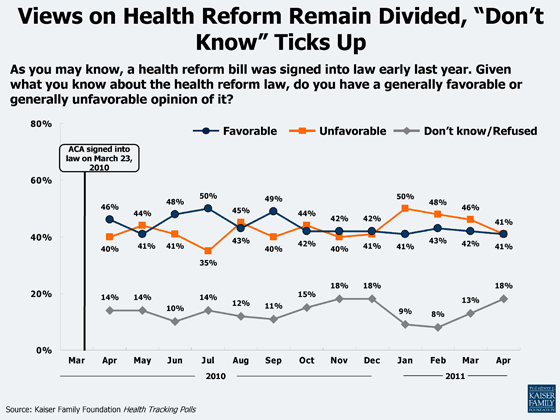
This month, public opinion on the health reform law continues to be remarkably steady. The April Kaiser Health Tracking Poll finds that four in ten feel favorably about the law and an equal share say they feel unfavorably. In recent months there has been a slight decline in the share with an unfavorable view of the law, with a corresponding uptick in the share who offer no opinion on the law. The rise in those who say they don’t know how they feel about the law seems to have been driven by seniors; this month nearly a quarter (24 percent) of those ages 65 and older declined to give an opinion of the law. This may reflect confusion stemming from the recent deficit-reduction proposals and their potential impact on Medicare and the health reform law. In addition, the partisan divisions over that landmark legislation remain: 74 percent of Republicans oppose the law and 64 percent of Democrats favor it, with independents occupying the middle ground.
Along with attitudes about the ACA, the April poll examined the public’s views of deficit-reduction proposals impacting Medicare. For more on those results, see the full report and toplines.
Personal experiences with the health care system are a key factor in Americans’ opinions on how the health care system should function and their expectations of how the Affordable Care Act (ACA) will change the system when fully implemented. In order to take a closer look at these personal experiences, this post explores findings from the March Kaiser Health Tracking Poll on Americans’ views of their health care and coverage, including health insurance ratings and satisfaction with cost, quality and access to new treatments. Overall, the data suggests that while most like their health insurance, there remain areas of dissatisfaction, primarily centered on cost.
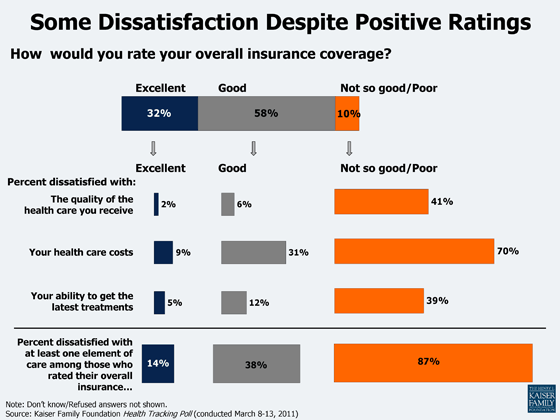
The vast majority of people with insurance rate their coverage highly, but even when the ratings are positive, they do not report being completely satisfied. Fully nine in ten say their health insurance is “excellent” (32 percent) or “good” (58 percent). While among those that say their coverage is “excellent,” just nine percent report being dissatisfied with health care costs. Dissatisfaction increases among those with “good” coverage, where almost a third (31 percent) report being dissatisfied with costs, 12 percent are dissatisfied with their ability to get the latest treatments, and six percent are dissatisfied with the quality of care they receive. Not surprisingly, 70 percent of those rating their health coverage as “poor” express dissatisfaction with costs, 41 percent report dissatisfaction with their quality of care, and 39 percent say they are dissatisfied with their access to new treatments.
Overall, while just 14 percent of those that rate their health insurance as “excellent” reported dissatisfaction to at least one of the questions on cost, quality or access to new treatments, closer to four in ten of those who rated their coverage as “good” report dissatisfaction. These findings demonstrate that positive health insurance ratings do not necessarily translate to fully satisfied consumers and suggest that public opinion of the ACA will be tied in part to their personal health care costs.