Medicaid Financing: An Overview of the Federal Medicaid Matching Rate (FMAP)

Published: Sep 30, 2012

Since its enactment in 1965, the Medicaid program has used the Federal Medical Assistance Percentage (FMAP) to determine the federal government’s share of the cost of covered services in state Medicaid programs. On average, the federal share has been 57 percent. Beginning in 2014, the Affordable Care Act (ACA) establishes highly enhanced FMAPs for the cost of services to low-income adults with incomes up to 138% of the Federal Poverty Level (FPL) who are not currently covered. The federal government will pick up 100 percent of such costs in 2014 through 2016, phasing down to 90 percent in 2020 and beyond. To place these new FMAPs in context, this primer provides an overview of the FMAP and temporary changes to the formula over the history of the Medicaid program.

Issue Brief (.pdf)

State Demonstrations to Integrate Care and Align Financing for Dual Eligible Beneficiaries: A Review of the 26 Proposals Submitted to CMS

Published: Sep 30, 2012

The Centers for Medicare and Medicaid Services (CMS) has proposed two models to align Medicare and Medicaid benefits and financing for dual eligible beneficiaries, one capitated model and one managed fee-for-service model. In the spring of 2012, 26 states submitted proposals to CMS seeking to test one or both of these models. CMS is presently reviewing the states’ proposals to determine which will be implemented.

This background paper examines the contents of the 26 states’ proposals in the areas of target population, implementation date, enrollment, financing, benefits, beneficiary protections, stakeholder engagement, and demonstration evaluation as set out in the states’ initial submissions to CMS. Negotiations between CMS and the states are ongoing and are likely to result in some changes from the states’ initial proposals.

Report (.pdf)

The Women, Girls, and Gender Equality Principle of the U.S. Global Health Initiative: How Have USG Programs Responded?

Published: Sep 30, 2012

This report examines how countries are responding to and implementing the women, girls, and gender equality principle of the U.S. Global Health Initiative (GHI). This principle, one of seven core principles of the GHI, aims to sharpen the focus on women and girls across U.S. government global health efforts.

Based on interviews conducted by the Foundation with representatives from 15 GHI country teams, this report identifies nine key themes and trends that could help inform U.S. policy discussions and the future directions of efforts related to the health of women and girls. While the experiences of the country teams varied widely, the analysis found that the principle has provided a supportive platform to those country teams that already had programming in the areas of women, girls, and gender equality, and prompted others to step up their efforts – though there were some challenges, such as limits on the flexibility of funding streams and the need for more technical assistance and other support.

Report (.pdf)

Transforming Medicare into a Premium Support System: Implications for Beneficiary Premiums

Published: Sep 30, 2012

This study illustrates why geography would matter for Medicare beneficiaries under a premium support system that relies on a competitive bidding process envisioned under several key Medicare reform proposals.

It examines potential changes in the premiums paid by Medicare beneficiaries under a payment approach that caps federal contributions per beneficiary based on the cost of the second lowest-bidding private plan or traditional Medicare, whichever is lower in their area.

Under this approach, beneficiaries can choose among competing plans, but if they enroll in a more costly plan, for whatever reason, they would pay the additional premiums themselves. This differs from the current Medicare system, in which beneficiaries generally pay the same Medicare premium regardless of where they live, whether they choose traditional Medicare or a private plan, or whether they live in a high-cost or low-cost area.

The analysis does not attempt to model any specific proposal, but is generally based on an approach included in House Budget Chairman Paul Ryan’s fiscal year 2013 budget plan, the proposal Chairman Ryan co-sponsored with Senator Ron Wyden of Oregon, and; in the plan put forward by former Senator Pete Domenici and Dr. Alice Rivlin. In the first two proposals, people who are at least 55 years old, including current beneficiaries, would be exempt from the new system. Republican presidential nominee Gov. Mitt Romney has supported a premium-support system along these lines.

To illustrate the potential effects on beneficiary premiums if such a system were fully implemented for all beneficiaries, the analysis layers the premium support proposal onto the current Medicare system reflecting beneficiaries’ current plan choices, traditional Medicare expenditures by county, and the costs of providing Medicare benefits under private Medicare Advantage plans (known as ‘bids’), drawing for actual data from 2010, the most recent year for which data are available.

Assuming full implementation of such a system, and assuming current plan preferences among beneficiaries, the study estimates that:

  • Nearly six in 10 Medicare beneficiaries nationally could face higher premiums for Medicare benefits, assuming current plan preferences, including more than half of beneficiaries enrolled in traditional Medicare and almost nine in 10 Medicare Advantage enrollees. Even if as many as one-quarter of all beneficiaries moved into a low-cost plan offered in their area, the new system would still result in more than a third of all beneficiaries facing higher premiums.
  • Premiums for traditional Medicare would vary widely based on geography under the proposed premium support system, with no increase for beneficiaries living in Alaska, Delaware, Hawaii, Wyoming and the District of Columbia, but an average increase of at least $100 per month in California, Florida, Michigan, New Jersey, Nevada and New York. Such variations would exist even within a state, with traditional Medicare premiums remaining unchanged in California’s San Francisco and Sacramento counties and rising by more than $200 per month in Los Angeles and Orange counties.
  • At least nine in 10 Medicare beneficiaries in Connecticut, Florida, Massachusetts and New Jersey would face higher premiums in their current plan. Many counties in those states have relatively high per-beneficiary Medicare spending, which would make it more costly to enroll in traditional Medicare rather than one of the low-bidding private plans in those counties. In contrast, in areas with relatively low Medicare per-capita spending, it could be more costly to enroll in a private plan.

This analysis does not attempt to model all aspects of any specific premium-support proposal, which would require more details than are currently available and assumptions about shifts in demographics, spending, and enrollment. The analysis also differs from Chairman Ryan’s most recent proposal by assuming full implementation in 2010 (rather than a phased-in implementation starting in 2023) and by not exempting everyone who is at least 55 years old now.

The analysis reflects actual plan bids and county-specific average traditional Medicare costs for 2010, the most recent year of data available. The analysis assumes that private plans would lower their bids by 5 percent across the board under the new payment structure, a reduction consistent with an earlier Congressional Budget Office assumption. In addition to the base analysis, the study also looks at how more or less aggressive bidding by private plans would affect the results and what might happen if significant shares of beneficiaries enroll in low-bidding plans.

Report (.pdf)
Explaining the State Integrated Care and Financial Alignment Demonstrations for Dual Eligible Beneficiaries

Published: Sep 30, 2012

This paper provides an overview of the joint efforts of states and the Centers for Medicare and Medicaid Services (CMS) to develop more integrated ways of paying for and delivering health care to the 9 million people who are eligible for both the Medicare and Medicaid programs. Dual eligible beneficiaries comprise many of the poorest and sickest people covered by either program, and they account for a disproportionately large share of Medicare and Medicaid spending. As an outgrowth of the Affordable Care Act, CMS is reviewing proposals from states to test two new models to align Medicare and Medicaid benefits and financing for dual eligible beneficiaries with the goal of delivering better coordinated care and reducing costs.

Report (.pdf)

The U.S. Department of Defense & Global Health

Published: Sep 29, 2012

This report provides the first comprehensive look at the Defense Department’s role in global health, examining its organizational structure, activities, strategy, policy, and budget for activities related to global health. The department has a long history of supporting health and medical activities internationally, though it does not typically define these efforts as “global health.” With its vast geographic reach, long-standing partnerships with foreign governments, ability to rapidly mobilize significant resources, and scientific and technical expertise, the Defense Department has significant resources for activities that impact the health of people around the world.

This report provides a full assessment of the department’s global health engagement across the entire organization and discusses key issues for policymakers and global health stakeholders at this time of transition in national security strategy and defense policy, as they consider how the Defense Department fits into the larger global health landscape.

Report (.pdf)

Technical Volume (.pdf)

This report is complemented by The U.S. Department of Defense and Global Health: Infectious Disease Efforts, a Kaiser Family Foundation report released the following fall that provides an overview of the department’s work pertaining to infectious diseases.

How Small Business Owners Get Health Insurance

Authors: , , and
Published: Sep 28, 2012

As with any economic policy issue, there has been much discussion of how the Affordable Care Act (ACA) will affect small businesses. But, there’s been very little focus on how the health reform law will affect the owners of those businesses as people.

As our recently released Employer Health Benefits Survey shows, small businesses are much less likely than larger businesses to offer health benefits to their workers. Half of businesses with 3-9 workers and 73% of firms with 10-24 workers provide health insurance. That contrasts with 98% of firms with 200 or more workers that offer health coverage.

The workers in these firms that do not offer coverage must rely on employer-based insurance through a family member, buying insurance in the individual market (assuming they can afford the coverage and do not have a pre-existing health condition), or in many cases going uninsured.

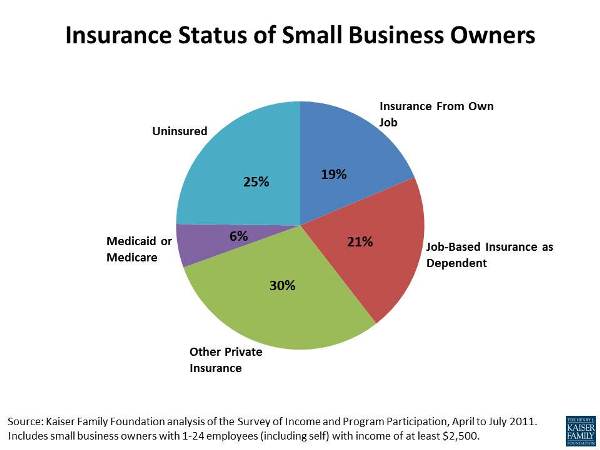
But what about the owners of these small businesses? They’re pretty much in the same boat. The following chart shows how small business owners with 1-24 employees now get insurance:

Policy-insights-small_biz_chart_092812

A few striking things emerge from this analysis:

  • About one in four small business owners is uninsured, roughly the same as for non-elderly adults generally.
  • Just 40% of small business owners get job-based insurance, either from their own job or through a family member. In contrast, almost six in ten non-elderly adults get their insurance through an employer.
  • Small business owners rely heavily on the individual insurance market, with 30% of them buying “other private insurance” (the vast majority of which is coverage purchased in the individual market).

This suggests that the biggest effects the ACA will have on small business owners may not be changes in the rules for the small business insurance market, but rather the changes in the individual insurance market: guaranteed access to coverage and no premium surcharges for people with pre-existing health conditions, limits on how much premiums can vary by age, a requirement that all insurers cover a set of “essential” benefits, the creation of health insurance exchanges, the requirement to be insured, and tax credits to make premiums more affordable. In fact, an estimated 60% of small business owners now buying insurance in the individual market have incomes up to 400% of the poverty level and would be eligible for tax credits in exchanges or Medicaid, and 83% of owners who are now uninsured would be eligible for subsidized coverage (split about equally between tax credits and Medicaid).

It may be that we can gain more insight into the implications of policy issues like health reform for small business by focusing less on the businesses themselves and more on the people who own them.

Putting Men’s Health Care Disparities On The Map: Examining Racial and Ethnic Disparities at the State Level

Published: Sep 27, 2012

This Kaiser Family Foundation report finds that men of color in almost every state continue to fare worse than white men on a variety of measures of health, health care access and other social determinants of health. It documents the persistence of such disparities between white men and men of color — and among different groups within men of color — on 22 indicators of health and well-being, including rates of diseases such as AIDS, cancer, heart disease and diabetes, as well as insurance coverage and health screenings. It also catalogues disparities in factors that influence health and access to care such as income and education. This new analysis complements an earlier study for women and provides state-level data for men of many racial and ethnic populations that have not been available before.

Full Report (.pdf)

Executive Summary (.pdf)

Introduction (.pdf)

Health Status (.pdf)

Access and Utilization (.pdf)

Social Determinants (.pdf)

Conclusion (.pdf)

https://www.kff.org/uninsured/fact-sheet/putting-mens-health-care-disparities-on-the/

https://www.kff.org/uninsured/report/putting-mens-health-care-disparities-on-the-2/

Visualizing Health Policy: Health Care Costs

Published: Sep 26, 2012

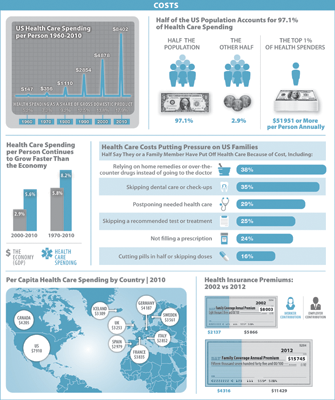
The September 2012 Visualizing Health Policy  infographic  examines health costs in the United States, including how costs have changed, how they compare to some other countries, and how they impact American families.

jama_infographic_costs_400px

See the full-size infographic at The Journal of the American Medical Association

View the related Slideshow

Visualizing Health Policy is a monthly infographic series produced in partnership with the Journal of the American Medical Association (JAMA). Each month’s infographic is freely available on JAMA’s website and is published in the print edition of the journal.