Health Coverage for the Hispanic Population Today and Under the Affordable Care Act

Published: Apr 9, 2013

The more than 50 million Hispanics living in the United States make up 17 percent of the total population and are the nation’s fastest growing racial or ethnic group. Many Hispanics continue to face disparities in health coverage and care, and they have the highest uninsured rate among racial/ethnic groups, with nearly one in three lacking coverage.

The Affordable Care Act (ACA) could help many uninsured Hispanics through the law’s expansion of Medicaid and the creation of new health insurance exchange marketplaces with tax credits to help moderate-income people purchase coverage. This brief provides an overview of the Hispanic population in the U.S., their health coverage today and the potential impact of the ACA coverage expansions.

icon_reports_studies.gif

 Fact Sheet (.pdf)

Medigap: Spotlight on Enrollment, Premiums and Recent Trends

Published: Apr 1, 2013

Medicare supplemental insurance, also known as “Medigap,” is an important source of supplemental coverage for nearly one in four people on Medicare. Traditional Medicare has cost-sharing requirements and significant gaps in coverage; Medigap helps make health care costs more predictable and stable for beneficiaries by covering some or all Medicare costs, including deductibles and cost-sharing.

This policy brief provides an overview of the Medigap market, national trends in enrollment and premiums, variations across plan types and states and by different beneficiary characteristics. Lastly, the brief examines whether Medigap policyholders are enrolled in the lowest-cost plans available in their states.

This brief, issued in April 2013, is a revision to an earlier brief from February 2013. The revisions reflect updated methods for estimating Medigap premiums and for comparing plans within states. It is authored by researchers at the Kaiser Family Foundation and the University of California at Los Angeles.

icon_fact_sheet

 Report (.pdf)

Updating the Ryan White HIV/AIDS Program For A New Era: Key Issues and Questions for the Future

Published: Apr 1, 2013

The Ryan White HIV/AIDS Program is a more than two-decade old federal effort that provides care and services to more than half a million people with and affected by HIV each year. With its current authorization set to expire in September, policymakers are weighing the program’s future at a time when scientific advances in antiretroviral treatment, the passage of the Affordable Care Act and the release of the country’s first comprehensive National HIV/AIDS Strategy have significantly altered the environment in which the program operates. The brief, Updating the Ryan White HIV/AIDS Program For A New Era: Key Issues & Questions for the Future, identifies key issues and questions facing the program and explores a range of potential changes for policymakers and others to consider. These fall into four broad, intersecting areas:

  • Supporting people with HIV at each stage of the treatment cascade, from diagnosis to viral suppression;
  • Building HIV care networks in underserved communities;
  • Integrating HIV care expertise into the mainstream health care system effectively and fairly allocating Ryan White resources.

How is the Affordable Care Act Leading to Changes in Medicaid Long-Term Services and Supports (LTSS) Today? State Adoption of Six LTSS Options

Published: Apr 1, 2013

Under the Affordable Care Act (ACA), states are afforded a number of new and expanded opportunities, including enhanced federal financing, to improve access to and delivery of Medicaid long-term services and supports (LTSS). This policy brief provides an overview of six key Medicaid LTSS options created or enhanced by the 2010 law and state adoption of these options to date. Nearly every state (47 states and DC) has taken steps forward with at least one of the six options.

icon_fact_sheet

Issue Brief (.pdf)

Medicare Health Plans and Dually Eligible Beneficiaries: Industry Perspectives on the Current and Future Market

Published: Mar 27, 2013

With federal and state governments now pursuing efforts to better coordinate care and reduce costs for people dually eligible for both Medicare and Medicaid benefits, this brief examines how insurers now serving these markets view the opportunities and challenges.

The brief is based on interviews with senior executives at 13 large firms that contract with the Medicare and Medicaid programs and finds almost all of the insurers expect dually eligible beneficiaries will become more important to their business over time. The brief also looks at how insurers currently serve dually eligible beneficiaries, particularly through Special Needs Plans that are part of the Medicare Advantage program.

The report is authored by researchers at Mathematica Policy Research and the Kaiser Family Foundation.

Global Health Diplomacy: Advancing Foreign Policy and Global Health Interests

Published: Mar 26, 2013

This article examines the growing attention to global health diplomacy and its future outlook as donor nations continue to face tight budgetary conditions. Authored by Joshua Michaud and Jennifer Kates of the Kaiser Family Foundation, the article was published in the inaugural issue of the Global Health: Science and Practice journal in March 2013.

Article

The Affordable Care Act: Three Years Post-Enactment

Published: Mar 26, 2013

On March 23, 2010, the Affordable Care Act (ACA) was signed into law. Although the date for full implementation of most provisions of the law is January 1, 2014, the ACA has already led to progress toward expanded coverage of the uninsured; improved access and better care delivery models; broader access to community-based long-term care; and more integrated care and financing for beneficiaries who are dually eligible for Medicare and Medicaid.

The brief provides an overview of the ACA’s early impacts on private insurance and exchanges; Medicaid coverage; access to primary and preventive care; Medicare; and dually eligible beneficiaries.

icon_fact_sheet

Issue Brief (.pdf)

The Flip Side of Higher Premiums: Better Coverage

Authors: and
Published: Mar 21, 2013

Time Magazine’s recent cover story on health care – “Bitter Pill” by Steven Brill – has focused attention on hospital prices, especially for people paying out of their own pockets. This is not a new issue, but certainly one that deserves attention.

However, what has been lost in the ensuing commentary on high hospital prices is that Brill’s article is as much about inadequate insurance, which is the reason why the patients he writes about were paying the bulk of their own hospitals bills. One of them was uninsured, but the rest had private insurance. The problem was that the insurance plans these policyholders had ultimately covered very little of their care.

The main culprit seemed to be caps on the dollar amount of coverage, such as

• A non-group plan that covered only up to $2,000 per day in a hospital.• An employer-sponsored plan through Cigna’s Starbridge subsidiary that capped coverage for any hospital stay at $2,500 total.• A union plan that limited annual benefits to $60,000.• A student policy that capped benefits at $50,000.

In some cases, these insurance plans with very limited coverage are referred to as “mini-med” plans. As we’ve written before, these are often provided to lower-wage hourly employees in restaurant chains and retail establishments, or they may be purchased as individual coverage.

Starting in 2014, the Affordable Care Act (ACA) generally prohibits annual dollar limits on the benefits any insurance plan provides. This requirement has been phased in, with plans currently prohibited from having an annual cap of less than $1.25 million this year.

However, a number of plans have received temporary waivers from this requirement in order to avoid disrupting coverage until the major elements of the ACA go into effect in 2014. In total about 3.9 million people are covered by plans that have received these waivers and therefore still may have limited coverage.

How limited is that coverage? To find out, we requested the waiver applications from the Department of Health and Human Services, but did not receive sufficient detail to assess the kinds of limits these insurance policies now have. As an alternative, we analyzed the financial information insurers file with state insurance departments, as compiled by Mark Farrah Associates. Among the insured mini-med plans purchased by small and large employers, the average amount of benefits paid out per enrollee was $747 in 2011. That was less than one-quarter of the average benefits paid out under more typical, comprehensive employer-sponsored insurance plans.

Much has been written lately about concerns over whether premiums will increase significantly for some people next year as the ACA prohibits discrimination against people with pre-existing conditions, limits age rating, and sets minimum coverage requirements (our analysis of that issue is here). There is no doubt that premiums will go up for the people with limited coverage that Brill writes about in his article. But the article also provides tangible evidence of the enhanced coverage and protections that people will get in exchange for those higher premiums.

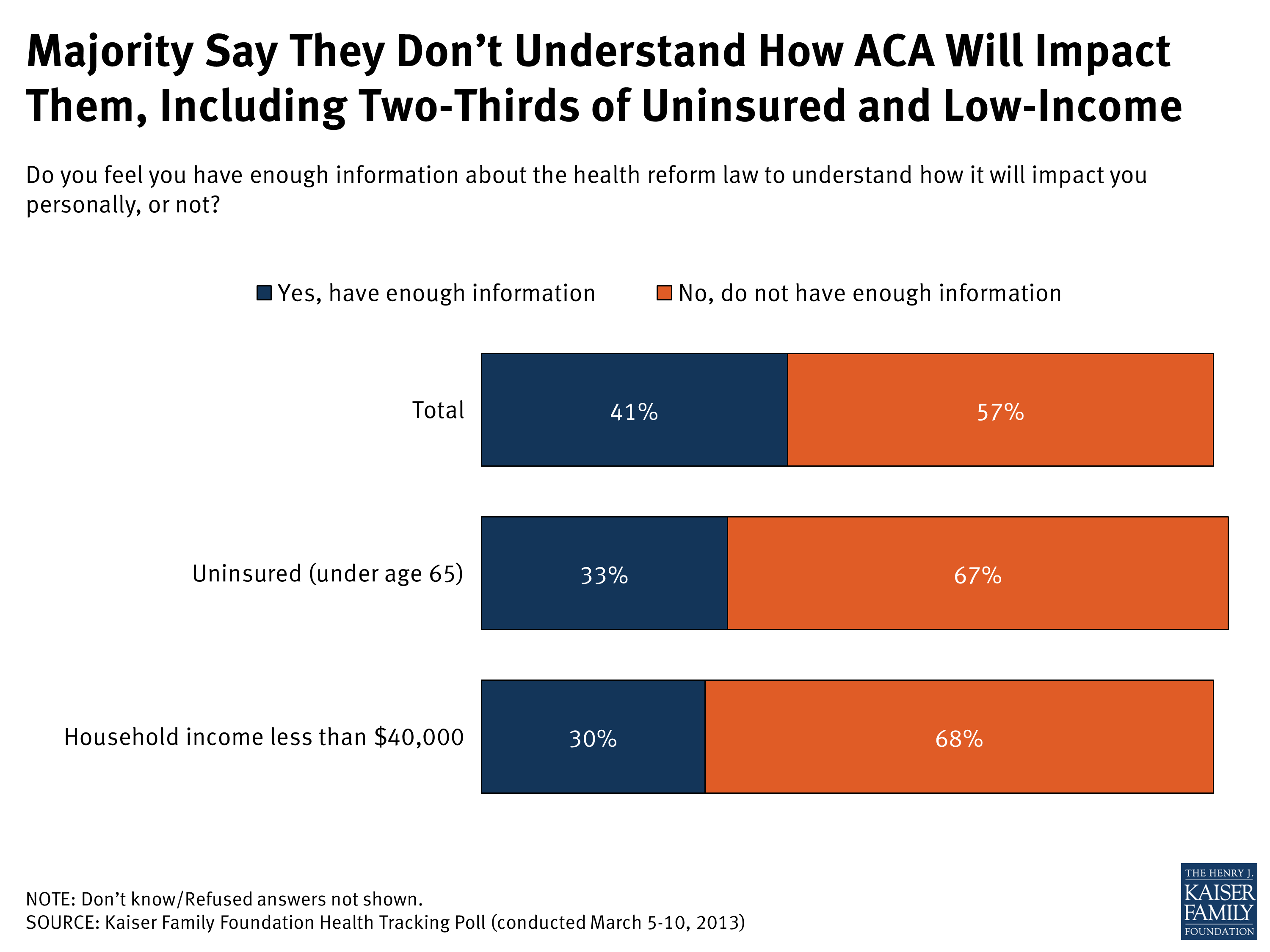
Majority Say They Don’t Understand How ACA Will Impact Them, Including Two-Thirds of Uninsured and Low-Income

Published: Mar 20, 2013

Source

Kaiser Family Foundation Health Tracking Poll (conducted March 5-10, 2013)