KFF designs, conducts and analyzes original public opinion and survey research on Americans’ attitudes, knowledge, and experiences with the health care system to help amplify the public’s voice in major national debates.
Based on the assumption of increased coverage and therefore reduced uncompensated care costs under the Affordable Care Act (ACA), the law calls for a reduction in federal Medicaid Disproportionate Share Hospital (DSH) allotments. The statute requires annual aggregate reductions in federal DSH funding from FY 2014 through FY 2020. To implement these annual reductions, the statute requires the Secretary of HHS to develop a methodology to allocate the reductions that must take into account 5 factors: impose a smaller percentage reduction on low DSH states; impose larger percentage reductions on states that have the lowest percentages of uninsured individuals; impose larger percentage reductions on states that do not target their DSH payments on hospitals with high volumes of Medicaid inpatients or with high levels of uncompensated care, and the methodology must take into account whether the DSH allotment for a state was included in the budget neutrality calculation for a coverage expansion approved under section 1115 as of July 31, 2009. The Centers for Medicare and Medicaid Services (CMS) released a final rule to allocate the reduction in the DSH allotments for FY 2014 and FY 2015 in September 2013. This brief provides some background in DSH payments, how DSH payments are affected by the ACA, the methodology for the DSH reductions across states for FY 2014 and FY 2015 and a look at the implications of the DSH reductions.
In California, as across the United States, the young uninsured are a key piece of the new Affordable Care Act (ACA) marketplace puzzle. Having a good-sized component of young people, with their generally more robust health and less frequent need for medical care and prescription drugs, in the newly created insurance pools would provide an important counterbalance to the incoming group of Americans who had previously been locked out of coverage because of preexisting health conditions.
In this data note, we take a closer look at a broadly defined ‘young invincible’ population using a recently released baseline survey of California’s uninsured population by the Kaiser Family Foundation (KFF). The representative, probability-based sample survey is the first of what is expected to be a series of four surveys that will track the views and experiences of the same group of people over the next two years.1 For the purposes of this analysis, we are defining the young uninsured as those Californians aged 19 to 34 that have not had insurance for at least two months and by their income and status as citizens or permanent residents should be eligible to participate in the ongoing insurance expansion under the 2010 health law. Overall, these young uninsured Californians make up nearly half (47 percent) of the state’s adult, eligible uninsured population.2
Who are California’s young uninsured?
The majority of the Golden State’s young uninsured are men – 59 percent are male, 41 percent are female – a distribution not significantly different than California’s eligible uninsured as a group, which tends to be disproportionately male due to Medi-Cal’s previous rules regarding eligibility. Roughly half are Latino, much like the state’s uninsured population as a whole. Compared to the state’s older uninsured population, the young uninsured are more likely to report being American born citizens: 78 percent say so, compared to about six in ten of those age 35 and over. Like the rest of the eligible uninsured, a large share live in very low-income households, with roughly half (48 percent) saying their household’s annual income is 138% or less of the Federal Poverty Level (FPL) Medi-Cal eligibility ceiling.3
Figure 1
19-34
35-49
50-64
Race/Ethnicity
White
29%
29%
42%
Black
7
6
7
Asian
13
5
5
Other
3
11
7
Hispanic
48
49
39
Were you born in the United States or in another country?
U.S.
78%
58%
62%
Another country
22
41
37
Eligibility Level
Medicaid target group (138% FPL or below)
48%
49%
42%
Exchanges subsidy target group (139% – 400% FPL)
41
37
43
More than 400% FPL
5
11
11
The 19 to 34 year olds are also different in predictable ways in terms of their stage of life: more than six in ten (63 percent) have yet to marry, compared to fewer than two in ten among older uninsured; roughly one in four (28 percent) have a dependent child at home, compared to more than half (55 percent) of those in the middle age group; and roughly one in eight (12 percent) are students.
Figure 2
19-34
35-49
50-64
Marital status
Married
21%
47%
45%
Living with partner
10
15
9
Previously married
6
20
29
Never married
63
17
18
Are you a parent of a child under age 19 living in your household?
Yes
28%
55%
18%
No
72
45
82
Employment status
Employed
64%
59%
49%
Unemployed, looking
17
22
22
Unemployed, not looking
3
4
7
Student
12
1
<1
Other
5
14
21
Education
Less than high school
13%
31%
27%
High school
34
26
21
Some college
37
30
38
College or more
15
13
14
Young, but not new to lack of coverage; Health insurance history differs from older groups
Though these Californians are relatively young, most of those aged 19 to 34 report that they have been uninsured for a significant length of time. Overall, six in ten among the young uninsured say they have been uninsured for at least two years. Four in ten have lost insurance within the past two years, compared to roughly three in ten among the older groups. As is true for the rest of the state’s uninsured, the main reason this group remains uninsured is cost-related: half (48 percent) say the main reason they don’t have health insurance is that it’s too expensive.
Figure 3
19-34
35-49
50-64
And how long have you been uninsured?
Less than two years (NET)
40%
27%
29%
2 months to less than a year
19
14
15
1 year to less than 2 years
21
13
14
Two years or more
60
72
71
This group does stand out as having a different past relationship with health insurance coverage compared to those 35 and older. While a majority of those aged 50 to 64, and nearly half of the middle-aged group, say that their previous source of health coverage was through an employer, only 22 percent of those under age 35 say the same. Newer to the workforce, their experience with employer-sponsored coverage is obviously more limited. Instead, one in four say that before they were uninsured they were on their parents’ health plan, and nearly as many (22 percent) say they were covered by Medi-Cal or another state’s Medicaid program (programs that have been required to cover low-income youth until they turn 19). Four in ten among this group have been on Medi-Cal at some point in the past. Note they are also the group least likely to have shopped for health insurance in the individual market: 20 percent have done so, roughly half as many as among older uninsured Californians. In this respect, the exchange experience will be even newer for this group than for other uninsured Californians.
Figure 4
19-34
35-49
50-64
Before you were uninsured, what was your main source of health insurance coverage?
Plan through your/your spouse’s employer
22%
47%
59%
Coverage under your parents’ plan
26
4
1
Medicaid/Medi-Cal
22
21
9
Never had insurance
23
21
17
Have you, yourself, ever received health insurance through Medi-Cal, or not?
Yes
40%
39%
27%
No
58
60
73
Have you ever tried to buy health insurance on your own, either for yourself or for your family, or not?
Yes
20%
37%
44%
No
80
63
56
The ‘benefits of youth’ are real, but limited: Half financially insecure and nearly as many say health needs not being met
This group of uninsured report experiencing at least two of the benefits of youth: They are less likely to report feeling financial stress than their older peers, and they are more likely to say they are in good health.
Across several fronts, the young uninsured report feeling less financial insecurity than those in the thick of child-rearing or in the pre-retirement years. Overall, half say they feel secure when it comes to their financial position, compared to roughly a third of those aged 35 and over. They report less worry about their income keeping up with rising prices and about having enough money for what must seem a far-distant retirement horizon.
Despite this comparatively optimistic picture, it’s important to keep in mind that this still leaves half among this group saying they do not feel financially secure at this point, an important consideration when it comes to evaluating any costs that might come with new insurance coverage.
Figure 5
19-34
35-49
50-64
All in all, how financially secure do you feel?
Secure
51%
38%
32%
Insecure
49
61
67
“Very worried” about not having enough money for retirement
51%
68%
68%
“Very worried” about income not keeping up with rising prices
50%
67%
68%
Those under age 35 are also more likely than older Californians without coverage to say they are in good health, with three in four saying so. They are also less likely to report having a disability, handicap or chronic disease. But while just over half in this group – 54 percent – say that their health needs are basically being adequately met at this point, the rest – 45 percent – say they are not getting the care they need.
Figure 6
19-34
35-49
50-64
In general, would you say your health is…
Excellent/very good/good
74%
63%
51%
Fair/poor
25
36
49
Does any disability, handicap, or chronic disease keep you from participating fully in work, school, housework, or other activities?
Yes
8%
15%
25%
No
91
85
75
Overall, how well would you say your health needs are being met today?
Very/somewhat well
54%
46%
48%
Not too/not at all well
45
54
51
California’s young uninsured report plenty of trouble getting and paying for the health care they need
Their overall good health, however, does not protect this group from incurring medical bills on occasion and then having trouble paying them.
Young people are just as likely as any other uninsured state resident to say they have had trouble paying medical bills over the past year. Overall, four in ten (39 percent) say so – and they report just as much worry about paying for health care going forward. Just over seven in ten of those aged 19 to 34 years say they are “very worried” about how they would pay for health care in the case of a serious accident or illness, putting their concern about a catastrophic medical event well within range of uninsured Californians of any age. They are somewhat less worried about not being able to cover the cost of routine health care services: 44 percent are very worried about this, compared to about 55 percent of older uninsured.
Figure 7
19-34
35-49
50-64
In the past 12 months, did you have any problems paying medical bills, or not?
Yes
39%
43%
42%
Used up all or most of your savings because of medical bills
18
18
24
Been contacted by a collection agency because of medical bills
20
20
18
Spent less on food because of medical bills
18
20
26
No
61
56
58
How worried are you about not being able to pay medical bills in the event of a serious illness or accident?
Very worried
73%
78%
77%
Somewhat worried
20
16
16
Not too worried
5
2
5
Not at all worried
2
4
3
How worried are you about not being able to pay medical bills for routine health care services?
Very worried
44%
56%
55%
Somewhat worried
32
25
26
Not too worried
19
14
13
Not at all worried
6
5
6
One way this generation deals with the problem of hard to pay medical bills is, like the rest of the uninsured population, by skipping health care, even when they feel they need it. Roughly six in ten (59 percent) in this population say that they’ve gone without needed health care since they’ve been uninsured because of the cost. This is somewhat lower than their older compatriots, but still a majority among a supposedly “invincible” population.
The large majority of young people – about eight in ten – say it is difficult for their family to afford health care, though they don’t express quite as much intensity on the issue as older uninsured Californians. For example, 42 percent of those aged 19 to 34 say their family finds it “very difficult” to afford health care, compared to 63 percent of those aged 50 to 64.
Figure 8
19-34
35-49
50-64
Percent who say they have done each of the following during the time that they’ve been uninsured because of the cost…
…gone without health care you thought you needed
59%
66%
72%
…put off or postponed preventive health services, such as a yearly check-up or routine test
65
68
75
…skipped dental care or checkups
68
72
75
In general, how easy or difficult is it for you and your family to afford health care?
Very easy
2%
4%
2%
Somewhat easy
16
8
4
Somewhat difficult
37
32
27
Very difficult
42
52
63
Majority of young uninsured say they feel the need for health coverage
Perhaps because of these worries and negative financial experiences involving medical bills, about three in four of California’s young uninsured say they feel the need to have health insurance. On the other hand, one in four say they feel healthy enough that they don’t really need coverage.
And the majority of young people – six in ten – say that health insurance is worth the cost.
Figure 9
19-34
35-49
50-64
Which of the following comes closer to your view?
Health insurance is something I need
74%
84%
85%
I’m healthy enough that I don’t really need health insurance
25
14
14
Would you say that health insurance IS or IS NOT worth the money it costs?
Health insurance is worth the money
61%
53%
53%
Health insurance is not worth the money
32
40
38
More positive views of the ACA, but low information
The uninsured 19 to 34 year olds look roughly the same as the rest of the state’s eligible uninsured population when it comes to general views of the health law: somewhat more positive toward the law than the American public nationwide,4 but even more likely to feel they don’t have enough information to understand how it will impact them personally. Overall, half of those under 35 have a favorable view of the ACA, 27 percent an unfavorable view and 21 percent don’t have any opinion. Though many have a sense of whether or not they like the law as a whole, at least at the end of the summer far fewer felt confident they understood how the law’s changes would affect their own lives. Overall, seven in ten (69 percent) said they don’t know what to expect in terms of personal impact. And as of the end of August, most had heard little or nothing about the Medi-Cal expansion (77 percent) or the creation of the Covered California insurance marketplace (88 percent), similar to their older peers.
Figure 10
19-34
35-49
50-64
As you may know, a health reform bill – sometimes called Obamacare – was signed into law in 2010. Given what you know about the health reform law, do you have a generally favorable or generally unfavorable opinion of it?
Favorable
51%
44%
49%
Unfavorable
27
30
35
Don’t know
21
26
17
Do you feel you have enough information about the health reform law to understand how it will impact you and your family, or not?
Yes
30%
26%
30%
No
69
73
69
Young people not immune to confusion regarding eligibility
Because of this limited exposure to recent information about the rollout of the insurance coverage expansions under the ACA, it is perhaps not surprising that as of late August, many young people in California were not aware of their potential eligibility for either subsidy assistance on the exchanges or inclusion in the expanded Medi-Cal program. Awareness of the availability of tax credit help when purchasing through Covered California was particularly limited at this early point. Overall, roughly seven in ten young people identified as in the appropriate income group either thought they would not be eligible for financial assistance (43 percent) or weren’t sure (26 percent).
Figure 11: AMONG THOSE IN EXCHANGE TARGET GROUP (>138% – 400% FPL)
19-34
35-49
50-64
As far as you know, will you personally be eligible to get financial assistance from the government to help pay for health insurance as a result of the health care law, or not?
Yes
32%
15%
28%
No
43
47
39
Don’t know
26
38
33
Uninsured Californians of all ages, including younger folks, were more likely to recognize their potential eligibility for the Medi-Cal program, a program they may be more familiar through previous exposure or family and friend networks. Still, roughly four in ten of the 19 to 34 year olds expected to be eligible for Medi-Cal were not aware of this eligibility as of August (25 percent in the target group thought they would not be eligible, and another 17 percent had no idea either way).
Figure 12: AMONG THOSE IN MEDI-CAL TARGET GROUP (≤138% FPL)
19-34
35-49
50-64
As far as you know, will you personally be eligible to get insurance through Medi-Cal as a result of the health care law, or not?
Yes
57%
54%
44%
No
25
26
28
Don’t know
17
20
29
What to expect in 2014
When told or reminded that “nearly all Americans [will be required] to have health insurance by 2014 or else pay a fine,” a clear majority of the youngest group of uninsured Californians – 58 percent – said they planned to get coverage next year. At least as of late summer, roughly a third thought they would remain uninsured.
Figure 13
19-34
35-49
50-64
As you may know, the health care law requires nearly all Americans to have health insurance by 2014 or else pay a fine. Do you think you will obtain health insurance in 2014, or do you think you will remain uninsured?
Will obtain health insurance in 2014
58%
48%
52%
Will remain uninsured
33
33
27
Depends on the cost
4
11
12
As is true in other age groups, a large majority of young people said that if they were told they were eligible for Medi-Cal, they would sign up.
Figure 14
19-34
35-49
50-64
If you were told you were eligible for Medi-Cal, would you want to enroll, or not?
Yes
82%
88%
84%
No
13
8
11
A note on process issues: Compared to older uninsured, the young are more involved in internet economy
Though there are many avenues for Californians to learn about the new insurance options, including in-person and phone opportunities, much of the shopping and learning is structured around the web. This is an advantage for younger state residents, as compared to the older uninsured population, the 19 to 34 year olds are more likely to have access to the internet overall, more likely to have internet access in their own home, and more likely to have at least occasionally bought things online. Still, it’s worth noting that just under half (44 percent) have rarely or never made an online purchase.
Figure 15
19-34
35-49
50-64
Percent who say they do NOT have internet access…
…at home
20%
31%
34%
…anywhere
5
18
24
How often do you use the Internet to buy a product online, such as books, music, toys or clothing, or not?
Very/somewhat often
28%
19%
14%
Just occasionally
27
20
20
Rarely/never
44
62
66
What Next
Most of California’s youngest uninsured residents report that they are healthy, but like the rest of the uninsured, most say they have skipped needed medical care because of cost during their period of uninsurance and they report a high degree of worry about what would happen if they were to become severely ill or be injured. Many have struggled to pay the health bills they have incurred. And perhaps because of all these reasons, most say that they feel the need for health insurance.
At the same time, in the months before open enrollment in California, this generation of the uninsured was just as likely as any other to feel they didn’t understand the health reform changes coming down the pike and to have heard little about the state marketplace or Medi-Cal expansions. And as a consequence, there likely remains a fair bit of eligibility confusion to sort out. Add to this the fact that half of this younger group feel financially insecure and only one in five have shopped for insurance before on their own, and it becomes clear that the open enrollment period will be a learning experience on all sides.
Over the next several months many of these young Californians will be learning more about the health coverage available to them via various ACA channels, and many will take steps to understand the costs and benefits such coverage will offer them. Beginning next spring, KFF will be back in the field revisiting these young people and asking them to reflect on their experiences – or lack of experience – with Medi-Cal and the exchanges.
Methodology
The survey of California’s uninsured population was designed and analyzed by public opinion researchers at the Kaiser Family Foundation. Fieldwork was conducted in English and Spanish via telephone by SSRS, an independent research company, from July 11 through August 29, 2013, among a representative sample of 2,001 adults ages 19 to 64 living in California, who reported having been without health insurance for at least two months at the time of the interview. Of the 2,001 respondents, 990 were interviewed via landline, and 1,011 via cell phone. The current data note is based on the 515 respondents that were between the ages of 19 and 34 at the time of the interview, and that qualified as being part of the ‘eligible uninsured’ (those who reported being U.S. citizens or permanent residents, and thus eligible for the health insurance expansion under the Affordable Care Act). The margin of sampling error including the design effect for the sample of eligible uninsured 19 to 34 year olds, on which most findings in this Data Note are based, is plus or minus 6 percentage points. Numbers of respondents and margin of sampling error for other age groups are show in the table below. To access a more detailed methodology, please see the online report.
Kaiser Family Foundation analysis of CMS data, downloaded from: https://data.cms.gov/dataset/The-Number-of-Estimated-Eligible-Uninsured-People-/pc88-ec56. For the purposes of this Data Note, the ‘eligible uninsured’ are California residents ages 19-64 who have been uninsured for at least two months, and would be eligible for participation in the ACA coverage expansion based on their self-reported status as a citizen, permanent resident, or lawfully present immigrant. ↩︎
Because eligibility for two of the law’s main components – the Medi-Cal expansion and the tax credits to help purchase insurance on the new exchanges – is based on an individual’s family income relative to the federal poverty level (FPL), in some cases we report survey results among the eligible uninsured by FPL categories. Those with incomes 138% FPL or less (roughly $32,000 a year for a family of 4) will be eligible for Medi-Cal coverage, while those with incomes greater than 138% and up to 400% FPL (roughly $32,000-$94,000 for a family of 4), will be eligible for subsidies to purchase insurance through Covered California, the state’s new marketplace. Those with incomes above 400% FPL will be allowed to buy insurance through Covered California, but will not be eligible for subsidy assistance. For convenience, we will sometimes refer to the group with incomes 138% FPL or less as the “Medi-Cal target group”, and those greater than 138% and up to 400% FPL as the “exchange subsidy target group”. ↩︎
Final update made on November 13, 2013 (no further updates will be made)
Establishing the Marketplace
On April 12, 2011, Governor Martin O’Malley (D) signed SB 182/HB 166 into law establishing the Maryland Health Benefit Exchange (MBHE).1 In May of the following year, Governor O’Malley signed additional Marketplace legislation (SB 372/HB 433) which addressed multiple Marketplace implementation and operational issues and was based on recommendations by the Board of Directors and advisory groups from 2011.2 In August 2012, the state announced that the name for the new insurance Marketplace would be Maryland Health Connection.
Structure: The legislation defines the MBHE as a quasi-governmental organization, specifically a “public corporation and independent unit of state government.”
Governance: The MHBE is governed by a nine-member board, including the Executive Director of Maryland’s Health Care Commission as the Chair, Secretary of Health and Mental Hygiene, Commissioner of Insurance, and six members appointed by the Governor and with consent from the Senate. Half of these members represent employers and individuals using the Maryland Health Connection and half provide specific knowledge and expertise. Board members cannot be affiliated with a carrier, insurance producer, third-party administrator, managed care organization, person contracting or in position to contract with the Marketplace, or any trade associations for these entities.
Current appointed Board members are:Darrell Gaskin (Vice Chair) Johns Hopkins Bloomberg School of Public HealthKenneth Apfel, University of Maryland, School of Public PolicyGeorges Benjamin, American Public Health AssociationJennifer Goldberg, Maryland Legal Aid BureauEnrique Martinez-Vidal, AcademyHealth and Robert Wood Johnson FoundationThomas Saquella, Maryland Retailers Association
The Board hired an Executive Director in mid-September 2011.
The MBHE is required by statute to maintain at least two standing advisory committees, though the subjects may change to support the decision-making for that particular year. Currently, the Board has five advisory committees to study particular topics: implementation, the Navigator program, continuity of care, plan management, and web-based entities.3 Staff from the MBHE and other state agencies will look to the Advisory Committees to make recommendations on policy options, not to vote on policy decisions.
Contracting with Plans: In the first two years of operation, Maryland Health Connection will act as a clearinghouse with any qualified health plan (QHP) in the state eligible to participate. Beginning in 2016, Maryland Health Connection will have the authority to employ an alternative contracting option or active purchaser strategy, such as competitive bidding or negotiations with carriers.
Each carrier must offer at least one QHP in each of the bronze, silver, and gold metal levels. Carriers may submit a single zero cost-sharing plan at the bronze level that is available to Native Americans. Carriers may only offer four benefit plan designs per metal level in the individual and SHOP Marketplaces. This count excludes benefit plan designs that carriers are required by legislation to offer (e.g. catastrophic plans). Carriers in Maryland Health Connection will be allowed to rate by age, geography (the state is divided into four rating regions), and tobacco use.4
Carriers participating in the individual Marketplace must offer at least one silver and one gold level plan in the individual market outside of the Marketplace (if the carrier offers any plans outside of the Marketplace). The same applies for the small group market. Carriers must offer at least one catastrophic plan on the Marketplace if the carrier offers catastrophic plans outside the Marketplace. Carriers must also offer a child-only plan that is rated for child-only coverage in Individual markets inside and outside of the Marketplace.5
Carriers with state market share above a certain threshold must sell QHPs in Maryland Health Connection. The minimumparticipation threshold for carriers is $20 million in the small group market and $10 million in the individual market.
The MBHE board approved plan certification policies related to: service area designation; licensure and solvency; benefit design standards and review; marketing standards; review of rate changes; transparency and quality data; and access to essential community providers. The Marketplace will perform annual reviews of all participating carriers and provide performance reviews that highlight areas for improvement.6 Carriers will be required to complete corrective action plans based on the issues in the annual review, and recertification will occur biennially.7
In the first year, insurers will “self-define” network adequacy standards and submit provider data to the CRISP (Chesapeake Regional Information System for our Patients) Provider Information Management System. Insurance carriers will be required to participate in the Maryland Health Care Commission’s existing quality and performance evaluation system. In addition, carriers will be required to provide the MBHE with data each quarter regarding the number and type of providers available, the ability of enrollees to access services, and utilization and complaint data. The MBHE will accept Medicaid or Commercial accreditation and allow a one year grace period for non-accredited insurers to become accredited. In the second year of operation, the MBHE will reassess accreditation requirements, appropriate standardized network adequacy requirements, and other possible changes to plan management policies.
The Maryland Insurance Administration has approved premium rates for the individual market in 2014. Six carriers are participating in Maryland Health Connection’s individual market statewide,8 and all are offering coverage in the state’s largest rating area.9 Consumers will have a choice of 45 medical QHPs.10 Maryland’s Insurance Commissioner reduced the proposed premium rates by every insurance carrier in the individual market in Maryland, including reducing proposed increases for a majority of carriers by more than 50%. An analysis conducted by the Marketplace estimated that three out of four individuals and families expected to enroll for coverage through Maryland Health Connection will qualify for tax credits to reduce their health insurance rates.11
On September 17, 2013, the Maryland Insurance Administration approved health insurance policies and premium rates for plans to be sold through the Small Business Health Options Program (SHOP) for small employers.12 Thirteen carriers filed to sell health benefit plans in the small group market. The opening of the SHOP Marketplace has been delayed until April 2013 due to problems with the website. Small businesses with one to 50 full-time equivalent employees are eligible may enroll. Coverage begins on or after March 1, 2014. 13
Dental and Vision Plans: In December 2012, the Board revised the interim plan management policies and procedures for adult and pediatric dental and vision plans.14 The MBHE anticipates requiring that all adult vision and dental coverage be offered through stand-alone plans with price disclosure to allow consumers to compare options. Pediatric vision coverage cannot be offered through stand-alone plans and must always be offered as part of the health benefit plan or as an additional benefit that can be purchased along with the health benefit plan. Pediatric dental coverage can be offered as part of the health benefit plan, as an additional benefit that can be purchased separately, or through a stand-alone plan.
Thirty-six of the 45 medical plans available on the individual Marketplace will include embedded pediatric dental benefits. Four carriers will be offering a stand-alone dental benefit. All stand-alone dental plans will be offered statewide.15 Stand-alone pediatric dental plans in Maryland Health Connection are required to use the same out-of-pocket maximums as those required on the Federally Facilitated Marketplace, set at $1,000 for one child and $2,000 for two or more children.16
Risk Adjustment, Reinsurance, and Risk Corridors: Maryland intends to use federal services to administer the state’s risk adjustment program but the MBHE will administer the state’s reinsurance program.
Consumer Assistance and Outreach: In April 2013, Maryland Health Connection launched its consumer assistance program. The Marketplace awarded $24 million in grant funds to six regional organizations to serve as Connector Entities. An estimated 300 new jobs will be created by the establishment of these Connectors, which will employ Navigators and In-person Assisters to help individuals and small employers through outreach and education, eligibility determinations, and enrollment into Medicaid and QHPs.
In addition to the six Connector entities, nearly 50 subcontractors will support the outreach, education, and enrollment efforts of Navigators and Assisters throughout the state. These organizations include health departments, hospitals, health clinics, community-based organizations, homeless shelters, workforce development centers and faith-based organizations. The intent of the regional approach is to ensure that all populations are reached including those with Limited English Proficiency, disabilities or those that may be in underserved communities.
Navigators must be trained and certified by Connector Entities, and will help counsel and enroll residents into QHPs and Medicaid through the Marketplace. In-person Assisters are not certified, but will be trained to provide information, assistance, and enrollment into Medicaid. Both Navigators and Assisters will provide information about eligibility requirements for federal premium subsidies and cost-sharing assistance, and assess eligibility requirements for Medicaid and CHIP. Navigators and Assisters will provide referrals to appropriate agencies, including the Attorney General’s Health Education and Advocacy Unit (HEAU) and the Maryland Insurance Administration (MIA) for applicants and enrollees with grievances, complaints, questions or the need for other social services through the Department of Health and Mental Hygiene and the Department of Human Resources (Social Services).17
There are separate Navigator programs for the small group and individual markets. SHOP Navigators are required to obtain a special license from the Insurance Commissioner and training/authorization from the MBHE. Outreach Entities are encouraged, but not required, to provide SHOP Marketplace Navigator services through direct employment or engagement with SHOP Navigators. Staff can be trained to serve as Navigators to both the individual and SHOP Marketplaces, but the funding for the two Marketplaces will be tracked separately.
Maryland will also have Certified Application Counselors (CACs), certified individuals who are employed by or volunteer with a sponsoring entity (which may be a community-based organization, health care provider, unit of state or local government, or other entities). CACs are subject to the same requirements, restrictions, conflict of interest rules, and oversight applicable to Navigators; are not compensated by the Marketplace, carriers, producers, or third-party administrators for consumer assistance services; do not impose fees for consumer assistance services; must disclose conflicts-of-interest; and must act in the best interest of the consumer. CACs may provide information to, and help consumers apply for and enroll in qualified health plans (QHPs) and qualified dental plans. They may also provide information on insurance affordability programs and help consumers determine eligibility for, and access, tax credits. They may provide uniform, factual, unbiased information approved by the state’s Medicaid program about all participating MCOs and providers, but may not express an assessment about, select, or counsel an applicant about an MCO.18
Licensed insurance producers can sell plans both inside and outside Maryland Health Connection, after receiving training and authorization by MHBE. Producers will receive instruction on the Marketplace, insurance plans, federal tax credits and cost-sharing reductions, and will be paid directly by carriers. MBHE will require carriers to retain information about policies and procedures used to determine producer compensation both inside and outside the Connection. The Maryland Insurance Administration and the MBHE will use this information to assess whether additional action is necessary beginning in the second year of operations. Maryland Health Connection estimates that 2,000 brokers will become authorized to sell plans through the Marketplace.19
As of September 27, 2013, 164 Navigators, 170 Assisters, and 1,236 caseworkers have been trained. As of October 3, 1,827 producers have been trained. More training sessions are scheduled.20
The Consolidated Service Center is the main entry point for questions related to Maryland Health Connection, Medicaid eligibility and enrollment, and any other question related to health insurance.21 The Center manages calls from individuals, employees, employers, Navigators, Assisters, and others.
The consumer portal for Maryland Health Connection, with the new branding strategy, first went live in August 2012. On October 1, 2013, it began accepting applications online. Maryland Health Connection offers a variety of resources on its website in Spanish, including fact sheets, FAQs, and videos. It is working to the make the full website available in Spanish. It also offers a Spanish version of its application for health coverage and financial assistance, and bi-lingual staff in call centers and Connector Entities.22
On September 3, 2013, Maryland Health Connection launched its advertising and outreach campaign. The integrated campaign includes advertising, social media and partnership strategies developed to provide consumers with the information they require to shop, compare and select health insurance through Maryland Health Connection. The statewide campaign includes television, radio, print advertising, out of-home and digital media. Central to the campaign is custom music that reinforces the key benefits of health coverage, including peace of mind, convenience, financial security and access to health care. The custom music has been produced in four musical genres: contemporary, Latin, country and urban.23
During the open enrollment period, Maryland Health Connection will partner with the Baltimore Ravens to help raise awareness of the importance of health insurance and the availability of coverage options. Research shows that 71 percent of the uninsured population in Maryland have watched, attended or listened to a Ravens game in the past 12 months. Maryland Health Connection will also partner with Giant Food and CVS Pharmacy throughout the state to provide information and literature on health insurance for consumers.24
Small Business Health Options Program (SHOP) Marketplace: In 2014 and 2015, the size of small employers in the SHOP Marketplace will be limited to an average of 50 or fewer employees. In addition, the individual and SHOP Marketplaces plan to be merged in 2016. The SHOP will offer two coverage models for employers: an employer choice model in which the employer can select an insurer and allow employees to choose among all plans offered by that insurer; and an employee choice model in which the employer selects a metal tier and allows employees to select among all QHPs available within that tier. In order for an employer to purchase through the SHOP, current rules require 75% of employees to participate. Employees covered under other group health plans, enrolled in public programs, or for whom the coverage does not meet the federal definition of “affordable,” will not be included in the minimum participation calculation employers must have a minimum participation.25 However, the Policy and Government Relations Department is still working on regulations covering SHOP minimum participation, in addition to SHOP eligibility appeals and individual eligibility.26
Currently, third party administrators and brokers play a key role in the selection, purchase, and administration of insurance for small businesses.27 For this reason, Maryland Health Connectionis certifying entities to service the small group market on behalf of the Health Connection if they
In August 2013, Maryland Health Connection announced the opportunity for third-party administrators (TPAs) to become certified to participate in the administration of the SHOP Marketplace. Nearly 70 percent of small businesses in Maryland utilize TPAs to enroll in health benefits, and small employers rely on their services. TPAs will be able to help employers and employees compare and select qualified health plans (QHPs), administer enrollment and eligibility changes, and perform premium billing and collections. TPAs will be allowed to use Maryland Health Connections or the TPA’s systems to present and administer QHP information. Organizations that wish to become TPAs business partners must complete a certification process.28 They must also meet the criteria of the ACA and state requirements, adhere to a rigorous set of performance measure and service levels, and be subject to oversight by the Marketplace. These certified entities will receive compensation on a per-employee-per-month basis commensurate with what the market pays for services today, currently estimated at 0.5% to 1.0% of premiums. The Marketplace selected six organizations to be SHOP third-party administrator (TPA) partners for January 1, 2014.29
Financing: Once Maryland Health Connection is operational, it is authorized to collect fees or assessments from participating plans, though not to the extent that the fees create a competitive disadvantage with plans offered outside the Health Connection.
In September 2012, a subcontractor providing analytic support to the Joint Committee recommended a financing model that blends multiple approaches rather than relying on a single revenue source.30 An example hybrid financing approach might include a combination of revenue collected from the non-group, small group, and large group markets, providers, and cigarette sales. In December 2012, the Joint Committee submitted a report to the Governor and General Assembly which included the following recommendations: the state should use a combination of at least two revenue streams; a transaction-based assessment on the whole non-group and small group market is preferable to an assessment applied only to plans inside Maryland Health Connection; and a broad-based assessment on the larger group market and/or an increase in the tobacco tax should be considered, while an assessment on hospitals should not be considered.
Basic Health Program (BHP): Maryland is considering establishing an optional coverage program available through the Affordable Care Act (ACA) which allows states to use federal funding to offer subsidized health insurance to adults with incomes between 139 and 200% of the federal poverty level (FPL) who would otherwise be eligible to purchase subsidized coverage through a Marketplace. The DHMH, together with a subcontractor, completed an analysis of the effect of a BHP in Maryland and found that it may redirect funds away from Maryland Health Connection. In addition, the state would have to bear expenses related to program administration and quality monitoring. In February 2012, the MBHE Board agreed with the Department’s recommendation that a decision on the BHP be deferred pending availability of additional federal guidance and information about rates and fiscal risks to the state.31
Essential Health Benefits (EHB): The Affordable Care Act requires that all individual and small-group plans sold in a state, including those offered through the Marketplace, cover certain defined health benefits. The Maryland Health Care Reform Coordinating Council formed an advisory committee to assist in selecting the state’s EHB benchmark plan. On December 17, 2012, the Council reevaluated possible benchmark plans in light of new federal guidance and selected the state’s largest small group plan, CareFirst of Maryland (Blue Cross Blue Shield)-HMO HSA Open Access plan. The Council also designated the GEHA Standard Option federal employee plan for the Maryland’s behavioral health benefit. Finally, the council designated the state’s current mandated habilitative services for individuals up age 19 and adopted the small group rehabilitative benefit for as the habilitative benefit for individuals over age 19.32
Marketplace Funding
The DHMH has received three federal grants: an Exchange Planning grant of $1 million; an Early Innovator grant of $6.2 million to develop a Marketplace IT infrastructure that could be replicated by other states; a Level One Establishment grant of $27 million to conduct data and policy analysis that will inform the technical and operational infrastructure of Maryland Health Connection and enable rapid implementation of the IT platform; and a Level Two Establishment Grant of $123 million to support continued policy development and consumer outreach, assistance, and education.33
In addition, Maryland, along with nine other states, is receiving technical assistance from the Robert Wood Johnson Foundation through the State Health Reform Assistance Network; this assistance includes help with setting up health insurance Marketplaces, expanding Medicaid to newly eligible populations, streamlining eligibility and enrollment systems, instituting insurance market reforms and using data to drive decisions.34
Next Steps
On December 7, 2012, Maryland received conditional approval from the U.S. Department of Health and Human Services (HHS) to establish a state-based Marketplace.35 The Maryland Health Connection Marketplace portal opened on October 1, 2013 and has begun enrolling qualified individuals and families into coverage. However, the opening of the SHOP has been delayed until April 2014.
As stakeholders gather for the 2013 International Conference on Family Planning in Ethiopia, a new Kaiser Family Foundation analysis finds donor governments provided about US$900 million in bilateral funding for family planning programs in 2012, and an additional US$432 million in core contributions to the United Nations Population Fund (UNFPA). The first of its kind, this report establishes a baseline level of donor government funding for family planning activities in 2012 that can be used to track total international assistance funding levels for family planning over time as well as commitments donor governments made at last year’s London Summit on Family Planning. Family planning services were defined to include counseling; information, education and communication activities; delivery of contraceptives; capacity building and training. The analysis finds the U.S. provided more than half of bilateral funding for family planning programs in 2012, providing US$485 million. It was followed by the U.K. (US$99.4 million), the Netherlands (US$65.5 million) France (US$49.6 million) and Germany (US$47.6 million).
Section:
0/0
Executive Summary
In July 2012, the U.K. Government and the Bill & Melinda Gates Foundation – in partnership with the United Nations Population Fund (UNFPA), civil society organizations, developing countries, donor governments, the private sector, and multilateral organizations – co-sponsored the London Summit on Family Planning, an effort to provide voluntary family planning services to an additional 120 million women and girls in developing countries by 2020 through new commitments. A key step in assessing progress towards these commitments is tracking expenditures for family planning. While all financing sources are critical to helping to scale-up the response, donor governments provide a significant share of global funding for family planning services.1
This analysis establishes a baseline level of funding in 2012 that can be used to track total international assistance funding levels for family planning over time as well as specific donor government progress in meeting London Summit on Family Planning commitments. It examines funding for family planning provided by the 24 governments who were members of the Organisation for Economic Co-operation and Development (OECD), Development Assistance Committee (DAC) in 2012. Of these, eleven made specific commitments at the Summit to increase funding for family planning including: Australia, Denmark, the European Commission, France, Germany, Japan, Korea, the Netherlands, Norway, Sweden, and the U.K.2 In addition, there are several other donor governments, particularly the United States and Canada, which, while not making specific commitments at the Summit, also provide funding for family planning activities. In general, family planning services are defined to include the following activities: counseling; information, education and communication activities; delivery of contraceptives; capacity building and training. In addition, family-planning-related activities funded in the context of other official development assistance sectors (e.g. education, civil society) are reflected in this analysis. Key findings include (also, see Table):
In 2012, donor governments provided US$899.8 million for bilateral family planning programs and an additional US$432.3 million in core contributions to the UNFPA.
The U.S. was the largest bilateral donor providing US$485.0 million and accounting for more than half (54%) of total bilateral funding in 2012. The U.K. (US$99.4 million, 11%) was the second largest bilateral donor followed by the Netherlands (US$65.5 million, 7%), France (US$49.6 million, 6%), and Germany (US$47.6 million, 5%).
The eleven who made specific commitments at the Summit accounted for US$371.8 million (41%) of total donor government disbursements for family planning in 2012.
Sweden (US$66.3 million) was the largest donor to UNFPA followed by Norway (US$59.4 million), the Netherlands (US$49.0 million), and Denmark (US$44.0).
While complete funding data for 2013 are not yet available, two donor governments (the U.K. and Norway) have already budgeted increased levels of funding for family planning in 2013; U.K. family-planning-specific funding is estimated to be approximately US$103 million, a 5% increase over prior year levels, and the Norwegian budget provides approximately $25 million in new family planning-specific funding. In addition, while family-planning-specific funding data is not yet available, the Netherlands increased budgeted funding in 2013 for “Sexual and Reproductive Health & Rights, including HIV/AIDS” to US$504.1 million. The increases by the U.K. and the Netherlands fulfill their London Summit commitments.
In the wake of the commitments made during the London Summit, timely and accurate tracking of donor financing for family planning takes on new urgency. The data presented in this analysis should be considered a work in progress as donor governments refine existing methodologies to track funding for family planning activities. As we continue to track donor government funding for family planning in future years, we will aim to provide additional detail and trend analyses.
Table: Donor Government Family Planning Disbursements, 2012
Country
Bilateral Disbursements(US$ millions)
UNFPA – Core Contributions(US$ millions)
Total (US$ millions)
Australia
$42.7
$14.9
$57.5
Canada
$41.5
$17.4
$58.9
Denmark
$13.0
$44.0
$57.0
France
$49.6
$0.5
$50.1
Germany
$47.6
$20.7
$68.3
Netherlands
$65.5
$49.0
$114.5
Norway
$3.3
$59.4
$62.7
Sweden
$41.2
$66.3
$107.5
U.K.
$99.4
$31.8
$131.2
U.S.
$485.0
$30.2
$515.2
Other DAC Countries
$11.0
$98.0
$109.1
Total
$899.8
$432.3
$1332.1
Report
Introduction
Access to family planning (FP) services has a significant impact on the health and wellbeing of women and girls, and on global health and development more broadly. Family planning – the ability of individuals and couples to determine their desired number of children as well as the timing of and spacing between births – can help prevent pregnancy-related health risks, reduce infant mortality, and help in the prevention of sexually transmitted diseases such as HIV/AIDS.3 Currently, it is estimated that more than 200 million women worldwide would like to delay or stop childbearing, but they do not have access to contraceptives.4 The international community has long recognized the importance of improving access to family planning services. In 1994, at the International Conference on Population and Development (ICPD), 179 governments committed to a 20-year plan of action aimed at providing, among other things, universal access to family planning and sexual and reproductive health services and reproductive rights. Additionally, in 2005, a specific target on reproductive health was added to Millennium Development Goal (MDG) 5, four years after the MDGs were first adopted by Member States of the United Nations. More recently, in July 2012, the U.K. Government and the Bill & Melinda Gates Foundation, in partnership with UNFPA, civil society organizations, developing countries, donor governments, the private sector, and multilateral organizations met at the London Summit on Family Planning and made commitments aimed at providing voluntary family planning services to an additional 120 million women and girls in developing countries by 2020 (see Box 1).
Box 1: International Conference on Population and Development (ICPD), Millennium Development Goals (MDGs), & the London Summit on Family PlanningInternational Conference on Population and Development (ICPD), 1994:
Provide universal access to family planning and sexual and reproductive health services and reproductive rights.
Millennium Development Goal (MDG) 5, 2000:
Reduce by three quarters, between 1990 and 2015, the maternal mortality ratio;
Achieve, by 2015, universal access to reproductive health (added in 2005).
London Summit on Family Planning, 2012: “By 2020, the goal is to deliver contraceptives, information, and services to a total of 380 million women and girls in developing countries so they can plan their families.”
Sustain coverage for the estimated 260 million women in the world’s poorest countries who are currently using contraceptives (as of June 2012); and
Provide family planning for an additional 120 million women in these countries.A key step in assessing progress towards these goals is tracking expenditures for family planning. While funding from all sources – domestic public and private spending, donor government bilateral assistance, multilateral organizations and private philanthropic (see Box 2) – is critical to helping fulfill international goals and commitments, donor governments provide a significant share of global funding for family planning services.[endnote 91389-6] Existing efforts to track donor government funding for family planning, however, do not necessarily provide the most recent available data and may not include all forms of assistance.5
Box 2: Other Sources of Funding for FP in Low- & Middle-Income Countries
While this report focuses on donor governments, there are three other major funding streams for FP assistance: multilateral organizations, the private sector, and domestic resources.
Multilateral Organizations: Provide assistance for FP using pooled funds from member contributions and other means. The primary multilateral organization addressing FP is the United Nations Population Fund (UNFPA). Contributions to multilateral organizations are usually made by governments, but can be provided by private organizations and individuals, as in the case of UNFPA. Some multilateral organizations are designed to address specific issues (such as UNFPA, which also finances reproductive health and other population related activities); donor government contributions to UNFPA are highlighted as part of the donor government’s financing effort in this analysis. Donor government contributions to multilateral organizations that are not specifically designed to address population activities, but may include such activities within their broader portfolio (such as the World Bank), are not included in this analysis.
Private Sector: Foundations (charitable and corporate philanthropic organizations), corporations, faith-based organizations, and international non-governmental organizations (NGOs) provide support for FP activities in low- and middle-income countries not only in terms of funding, but through in-kind support; commodity donations; and co-investment strategies with government and other sectors.
Domestic Resources: Including both spending by country governments that also receive international assistance for FP and by households/individuals within these countries, represent a significant and critical part of the response.
This analysis establishes a baseline level of funding in 2012 that can be used to track total international assistance funding levels for family planning over time as well as specific donor government progress in meeting London Summit on Family Planning commitments. It includes an analysis of funding provided by the 24 governments who were members of the Organization for Economic Co-operation and Development (OECD), Development Assistance Committee (DAC) in 2012.6 Of these, eleven made specific commitments at the Summit to increase funding for family planning.[endnote 91389-1] In addition, there are several other donor governments, particularly the United States and Canada, which, while not making specific commitments at the Summit, also provide funding for family planning activities.
Data for this analysis were collected directly from donor governments and supplemented by the OECD Creditor Reporting System (CRS). For purposes of this analysis, family planning services were defined to include the following activities as specified in the CRS: counseling; information, education and communication (IEC) activities; delivery of contraceptives; capacity building and training.7 Where bilateral family planning funding was included as part of broader reproductive and maternal health activities or other non-health-sector activities, we worked directly with donor governments to identify family planning specific amounts to the extent possible (see Methodology for more information).
Findings
Bilateral Assistance
Donor government bilateral assistance for family planning includes both actual funding amounts provided (e.g., cash transfers) as well as other types of transactions and activities (e.g., technical assistance) and products (e.g., commodities). In 2012, donor governments are estimated to have disbursed8 US$899.8 million in bilateral funding for family planning activities (see Table & Annex).
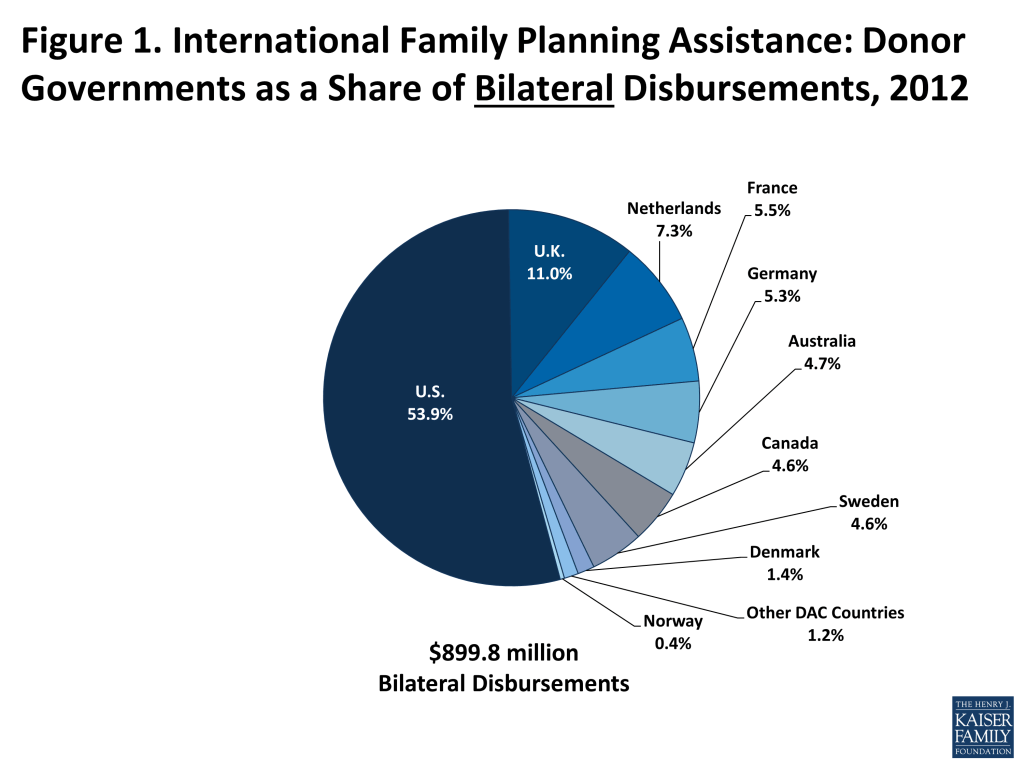
The United States (US$485.0 million) was the largest bilateral donor in 2012 accounting for more than half (54%) of total bilateral assistance (see Figure 1). The U.K. (US$99.4 million, 11%) was the second largest bilateral donor followed by the Netherlands (US$65.5 million, 7%), France (US$49.6 million, 6%), and Germany (US$47.6 million, 5%).
The eleven donor governments that made commitments at the London Summit on Family Planning (Australia, Denmark, the European Commission, France, Germany, Japan, Korea, the Netherlands, Norway, Sweden, and the U.K.) accounted for US$371.8 million (41%) of total donor government disbursements for family planning in 2012.
Figure 1: International Family Planning Assistance: Donor Governments as a Share of Bilateral Disbursements, 2012
Multilateral Assistance
While the majority of donor government assistance for family planning is provided bilaterally, donors also provide support for family planning activities through multilateral organizations, such as the United Nations Population Fund (UNFPA). Created in 1969, UNFPA supports sexual and reproductive health activities in many low- and middle-income countries and was a key partner in the London Summit on Family Planning (see Box 3).
Box 3: United Nations Population Fund (UNFPA) Mission, Goals, & London Summit on Family Planning Commitment
UNFPA Mission: Deliver a world where every pregnancy is wanted, every birth is safe, every young person’s potential is fulfilled.
UNFPA Goals:
Achieve universal access to sexual and reproductive health (including family planning);
Promoting reproductive rights;
Reducing maternal mortality; and
Accelerate progress on the ICPD agenda and MDG 5.
UNFPA London Summit on Family Planning Commitment: “UNFPA will double the proportion of its resources focused on family planning from 25% to 40 % based on current funding levels, bringing new funding of at least US $174 million per year from core and noncore funds. This will include a minimum of US $54 million per year, from 2013-2019, in increased funding for family planning from UNFPA’s core resources.”
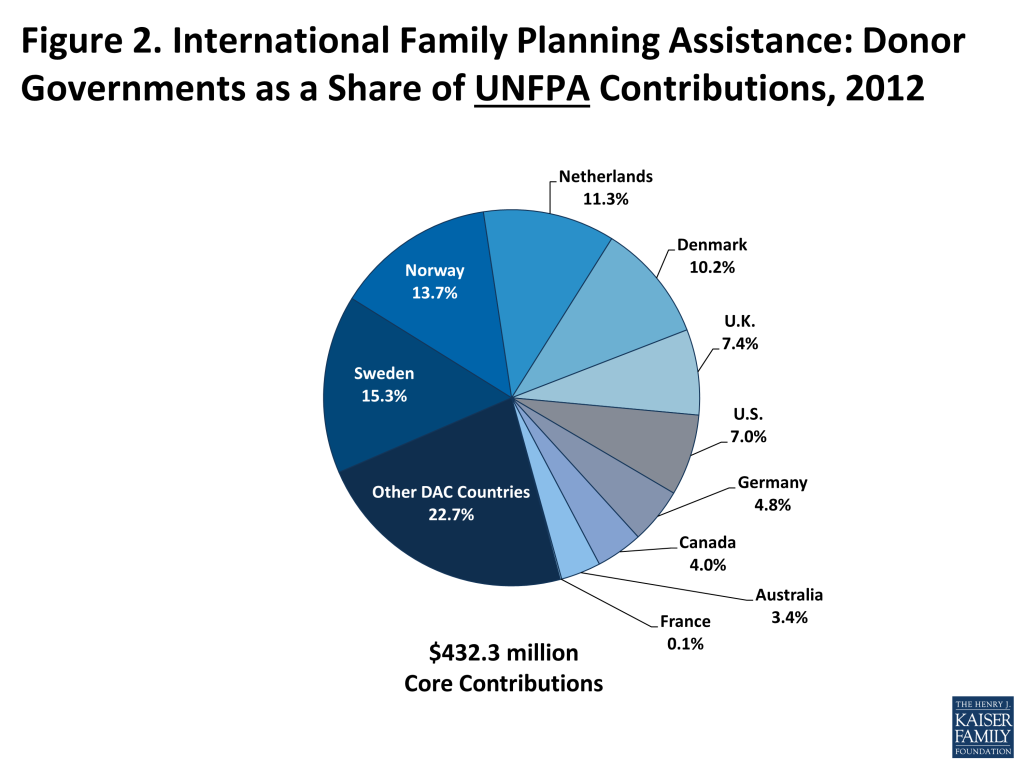
In 2012, donor governments provided US$432.3 million in core contributions to UNFPA.9 Sweden was the largest donor (US$66.3 million, 15%) followed by Norway (US$59.4 million, 14%), the Netherlands (US$49.0 million, 11%), Denmark (US$44.0 million, 10%), the U.K. (US$31.8 million, 7%), and the U.S. (US$30.2 million, 7%) (see Figure 2).
Figure 2: International Family Planning Assistance: Donor Governments as a Share of UNFPA Contributions, 2012
While it was not possible to calculate an adjusted “family planning share” of UNFPA’s 2012 budget and attribute a portion of a donor government’s UNFPA contribution to family planning specific activities,10 it is important to note the relative balance between a donor’s core-contributions to UNFPA and its bilateral funding for family planning. For instance, three of the ten donor governments profiled provided a larger contribution to UNFPA than their bilateral disbursement: Denmark, Norway, & Sweden.
The eleven donor governments that made commitments at the London Summit on Family Planning (Australia, Denmark, the European Commission, France, Germany, Japan, Korea, the Netherlands, Norway, Sweden, and the U.K.) accounted for US$311.7 million (71%) of total core-contributions to UNFPA in 2012.
Conclusion & Looking Ahead to 2013
The data provided in this analysis provide a baseline level of donor government funding for FP activities in low- and middle-income countries. At the London Summit on Family Planning donors made commitments totaling $2.6 billion in additional funding for family planning.11 While most donor governments have yet to finalize 2013 funding levels, preliminary data indicate two donor governments (the U.K. and Norway) have increased funding for family planning in 2013: U.K. family-planning-specific funding is estimated to be approximately US$105 million, a 5% increase over 2012 levels, and Norway has budgeted approximately $25 million in new family planning-specific funding. In addition, while family-planning-specific funding is not yet available, the Netherlands increased funding in 2013 for “Sexual and Reproductive Health & Rights, including HIV/AIDS” to US$504.1 million. The increases by the U.K. and the Netherlands fulfill their London Summit commitments. As donor governments conclude the 2013 fiscal year, it will be important to track funding for family planning activities in order to determine whether the London Summit commitments are being met.
Methodology
Bilateral and multilateral data on donor government assistance for FP in low- and middle-income countries were collected from multiple sources. The research team collected bilateral assistance data directly for 10 governments: Australia, Canada, Denmark, Germany, France, the Netherlands, Norway, Sweden, the United Kingdom, and the United States during the first half of 2013. Data represent the fiscal year 2012 period for all governments except for Denmark and Germany (data are from FY/CY 2011). Direct data collection from these donors was desirable because they represent the preponderance of donor government assistance for family planning and the latest official statistics – from the Organisation for Economic Co-operation and Development (OECD) Creditor Reporting System (CRS) (see: http://www.oecd.org/dac/stats/data – are from 2011 and do not include all forms of international assistance (e.g., funding to countries such as Russia and the Baltic States that are no longer included in the CRS database). In addition, the CRS data may not include certain funding streams provided by donors, such as FP components of mixed-purpose grants to non-governmental organizations. Where donor governments were members of the European Union (EU), the research team ensured that no double-counting of funds occurred between EU Member State reported amounts and EC reported amounts for international FP assistance. Data for all other OECD DAC member governments – Austria, Belgium, the European Union, Finland, Greece, Ireland, Italy, Japan, Korea, Luxembourg, New Zealand, Portugal, Spain, and Switzerland – who collectively accounted for less than 2 percent of bilateral family planning disbursements, were obtained from the OECD CRS and are from calendar year 2011.
For purposes of this analysis, funding was counted as family planning if it met the OECD CRS purpose code definition: “Family planning services including counselling; information, education and communication (IEC) activities; delivery of contraceptives; capacity building and training.” In addition, family-planning-related activities funded in the context of other official development assistance sectors (e.g. education, civil society) are reflected in this analysis. Project-level data were reviewed for Canada, Denmark, France, Germany, the Netherlands, Norway, Sweden, and the United Kingdom to determine whether all or a portion of the funding could be counted as family planning. Family-planning-specific funding totals for Australia and the United States were obtained through direct communications with government representatives. Funding attributed to the United Kingdom represents budgeted disbursements. Funding totals presented in this analysis should be considered preliminary estimates approved by representatives of the 10 donor governments who were contacted directly.
It was difficult in some cases to disaggregate bilateral family planning funding from broader reproductive and maternal health totals, as the two are sometimes represented as integrated totals. In addition, family-planning-related activities funded in the context of other official development assistance sectors (e.g. education, civil society) have in the past remained largely unidentified. For purposes of this analysis, we worked closely with the largest donors to family planning to identify such family-planning-specific funding where possible (see Annex for detailed data table).
Bilateral funding is defined as any earmarked (FP-designated) amount. U.S. bilateral “enacted” data, or “commitments”, correspond to amounts appropriated for the 2012 fiscal year. UNFPA contributions from all governments correspond to amounts received during the 2012 calendar year, regardless of which contributor’s fiscal year such disbursements pertain to.
With some exceptions, bilateral assistance data were collected for disbursements. A disbursement is the actual release of funds to, or the purchase of goods or services for, a recipient. Disbursements in any given year may include disbursements of funds committed in prior years and in some cases, not all funds committed during a government fiscal year are disbursed in that year. In addition, a disbursement by a government does not necessarily mean that the funds were provided to a country or other intended end-user. Enacted amounts represent budgetary decisions that funding will be provided, regardless of the time at which actual outlays, or disbursements, occur. In recent years, most governments have converted to cash accounting frameworks, and present budgets for legislative approval accordingly; in such cases, disbursements were used as a proxy for enacted amounts. In the U.S. case, both enacted and disbursement data were available for analysis.
UNFPA core contributions were obtained from United Nations Executive Board documents; however, we were unable to determine what share of these core contributions are attributable to family planning specifically (since such funding is also used to support broader reproductive health and related efforts). To date, UNFPA family planning activities have often been reported as part of broader categories, including reproductive health and maternal and child health, as well as part of larger multisectoral efforts, including those in education, human rights, and capacity building. It is expected that such disaggregation will be available in the future and UNFPA reports that it is currently working to develop such a methodology for doing so. Other than contributions provided by governments to UNFPA, un-earmarked general contributions to United Nations entities, most of which are membership contributions set by treaty or other formal agreement (e.g., the World Bank’s International Development Association or United Nations country membership assessments), are not identified as part of a donor government’s FP assistance even if the multilateral organization in turn directs some of these funds to FP. Rather, these would be considered as FP funding provided by the multilateral organization, as in the case of the World Bank’s efforts, and are not considered for purposes of this report.
The fiscal year period varies by country. The U.S. fiscal year runs from October 1-September 30. The Australian fiscal year runs from July 1-June 30. The fiscal years for Canada and the U.K. are April 1-March 31. Denmark, France, Germany, the Netherlands, Norway, and Sweden use the calendar year. The OECD uses the calendar year, so data collected from the CRS for other donor governments reflect January 1-December 31. Most UN agencies use the calendar year and their budgets are biennial.
All data are expressed in US dollars (USD). Where data were provided by governments in their currencies, they were adjusted by average daily exchange rates to obtain a USD equivalent, based on foreign exchange rate historical data available from the U.S. Federal Reserve (see: http://www.federalreserve.gov/). Data obtained from UNFPA were already adjusted by UNFPA to represent a USD equivalent based on date of receipts.
Appendix
Donor Government Family Planning Disbursements, 2012*
“plans to spend an additional AUD58 million over 5 years on family planning, doubling annual contributions to AUD53 million by 2016. This commitment will form a part of Australia’s broader investments in maternal, reproductive and child health (at least AUD1.6 billion over five years to 2015).”
$42.7
$14.9
$57.5
Australia identified US$44.6 in FY11/12 using the FP2020-agreed methodology, which includes a percentage of a donor’s core contribution to UNFPA. Australian bilateral funding was determined by adjusting its total funding level to take into account its UNFPA contribution.
Canada
(none)
$41.5
$17.4
$58.9
Bilateral funding is for family planning and reproductive health activities (including life skills education) in FY12.
Denmark
“an additional $13 million over eight years,”
$13.0
$44.0
$57.0
Bilateral funding is family planning specific in FY11, the most recent year available, and includes a specific contribution (in addition to its core contribution) to UNFPA’s “Reproductive Health Commodities Fund.”
France
“an additional €100m on Family Planning within the context of reproductive health through to 2015, in nine countries in francophone Africa.”
$49.6
$0.5
$50.1
Bilateral funding is for a mix of family planning, reproductive health and maternal/child health activities in FY12.
Germany
“€400m … to Reproductive Health and Family Planning over 4 years, of which 25% (€100m …) are likely to be dedicated directly to Family Planning, depending on partner countries priorities..”
$47.6
$20.7
$68.3
Bilateral funding is family planning specific in FY11, the most recent year available.
Netherlands
“€370 million in 2012 for sexual and reproductive health and rights, including HIV and health, and [plans] to extend this amount from €381 million in 2013 to €413 million in 2015.”
$65.5
$49.0
$114.5
The Netherlands provided a total of US$484.8 million in FY12 for “Sexual and Reproductive Health & Rights, including HIV/AIDS” of which an estimated US$65.5 million was for family planning specific activities. In FY13, the Netherlands increased funding for “Sexual and Reproductive Health & Rights, including HIV/AIDS” to US$504.1 million.
Norway
“doubling its investment from US $25 million to US $50 million over eight years.”
$3.3
$59.4
$62.7
Bilateral funding is family planning specific in FY12. For FY13, the Norwegian budget provides an estimated US$25 million in “new” (additional) family planning funding as well as a slight increase in its UNFPA contribution.
Sweden
… increasing “spending on contraceptives from its 2010 level of US $32 million per year to US $40 million per year, totaling an additional US $40 million between 2011 and 2015.”
$41.2
$66.3
$107.5
Bilateral funding is for family planning and reproductive health in FY12.
U.K.***
“. . . committing £516 million (US $800 million) over eight years . . .”
$99.4
$31.8
$131.2
Bilateral funding is family planning specific in FY12/13. Family planning specific funding is estimated to increase to US$103 million in FY13/14.
U.S.
(none)
$485.0
$30.2
$515.2
USAID stipulates that specified bilateral subtotal is family planning specific in FY12.
Other DAC Countries****
–
$11.0
$98.0
$109.1
Bilateral funding was obtained from the Organisation for Economic Co-operation and Development (OECD) Credit Reporting System (CRS) database and represents funding provided in 2011, the most recent year available.
Total
$899.8
$432.3
$1332.1
*A disbursement is the actual release of funds to, or the purchase of goods or services for, a recipient. Disbursements in any given year may include disbursements of funds committed in prior years and in some cases, not all funds committed during a government fiscal year are disbursed in that year.**All UNFPA core contributions are for FY 2012.***U.K. funding totals are budgeted disbursements.****Austria, Belgium, European Union, Finland, Greece, Ireland, Italy, Japan, Korea, Luxembourg, New Zealand, Portugal, Spain, and Switzerland. The Czech Republic, Iceland, and the Slovak Republic became members of the DAC in 2013 and therefore, were not included in the analysis.
Endnotes
UNFPA, Financial Resource Flows for Population Activities Report 2011, 2013. ↩︎
Family Planning 2020, London Summit on Family Planning: Summaries of Commitments, May 2013. ↩︎
WHO, Family Planning Fact Sheet, updated May 2013. ↩︎
Guttmacher Institute/UNFPA, Adding It Up: Costs and Benefits of Contraceptive Services Estimates for 2012, June 2012. ↩︎
While the OECD CRS database and the Resource Flows project, a joint collaboration between UNFPA and the Netherlands Interdisciplinary Demographic Institute (NIDI), both provide data on donor government funding for family planning activities, the latest available data from both sources is from 2011. Additionally, the CRS data, which is incorporated into the Resource Flows database, does not include all forms of assistance (e.g., funding to countries such as Russia and the Baltic States that are no longer included in the CRS database), and may not include certain funding streams provided by donors, such as family planning components of mixed-purpose grants to non-governmental organizations. ↩︎
Since 2012, 4 other governments have become DAC Members: The Czech Republic, Iceland, the Slovak Republic, and Poland. ↩︎
A disbursement is the actual release of funds to, or the purchase of goods or services for, a recipient. An enactment represents a budgetary decision that funding will be provided, regardless of the time at which an actual outlays, or disbursement, occurs. Therefore, disbursements in any given year may include funds committed (enacted) in prior years and in some cases, not all funds committed (enacted) during a government fiscal year are disbursed in that year. While most donor governments examined disburse enacted amounts within the same year, the U.S. government does not and may disburse enactments over multiple years. For instance, in FY 2012, U.S. bilateral enacted funding for family planning activities totaled $638.5 million, while disbursements totaled $485 million. ↩︎
UNFPA’s revenue in 2012 totaled $981.4 million, of which US$437.5 million was provided by donor governments as direct contributions in support of UNFPA’s core activities (core-contributions). An additional US$530.1 million was provided by donors in support of specific activities implemented by UNFPA (where this funding was provided by donor governments to UNFPA in support of specific family planning activities, it was counted as part of that donor government’s bilateral funding amount). ↩︎
At the time of publication, while the analytic team was able to identify specific family planning activities within bilateral programming (except as otherwise noted), it was not able to do so for UNFPA’s core annual funding. To date, UNFPA family planning activities have often been reported as part of broader categories, including reproductive health and maternal and child health, as well as part of larger multisectoral efforts, including those in education, human rights, and capacity building. It is expected that such disaggregation will be available in the future and UNFPA reports that it is currently working to develop such a methodology for doing so. ↩︎
UNFPA, World Population Day Marked with Renewed Push to Expand Family Planning Access Around the Globe, July 2012. ↩︎
Final update made on November 12, 2013 (no further updates will be made)
Establishing the Marketplace
On October 31, 2011, Governor Mark Dayton (D) signed Executive Order 11-30 which charged the Minnesota Health Care Reform Task Force with recommending strategies to improve overall health care delivery in Minnesota, including advising and overseeing an Exchange Advisory Task Force.1 Building on the work of the Advisory Task Force, on March 20, 2013, Dayton signed into law legislation creating the Minnesota Insurance Marketplace, which was branded MNsure.2
Structure: The legislation defines Minnesota’s Marketplace as a “board” or agency within the Executive Branch.
Governance: The Minnesota Marketplace will be governed by a seven-member board, including one ex officio member (or their designee): the Commissioner of Human Services. The Governor appoints six members with the advice and consent of the Senate and the House of Representatives. The six appointed members must include a representative of consumers eligible for individual coverage; a representative of consumers eligible for public coverage; a small employer; an expert in health administration or finance; an expert in public health, health disparities, public health care programs and the uninsured; and an expert in the individual and small group insurance markets. Appointed Board members will serve staggered four-year terms.
Board members cannot be affiliated with a carrier, institutional health care provider or other entity providing health care, navigator, insurance producer, or other entity in the business of selling items or services to or through the exchange. Board members must recuse themselves from discussion and voting on issues in which there is a conflict of interest.
Current appointed Board members are:
Brian Beutner, Independent Business Advisor, Chair
Thompson Aderinkomi, RetraceHealth
Pete Benner, Independent Consultant
Kathryn Duevel, OBGYN (retired)
Tom Forsythe, General Mills
Phil Norrgard, Fond du Lac Reservation
The Board will establish advisory committees to provide insurance producers, health care providers, the health care industry, consumers and other stakeholders the opportunity to advise the Board.
Contracting with Plans: The legislation specifies that the Marketplace will function as a clearinghouse in the first year of operation, accepting all plans that meet the minimum standards. Beginning in 2015, MNsure may consider issues such as affordability, quality and value, promotion of prevention and wellness, efforts to reduce health disparities, market stability, meaningful choices, and access in deciding which plans to make available.
In Minnesota, the Commissioner of Commerce enforces the state’s insurance laws, while the Commissioner of Health has authority over Health Maintenance Organizations (HMOs). To avoid duplication, existing regulatory structures within the Departments of Commerce and Health will be used to certify qualified health plans (QHPs). The Departments released QHP certification guidance in October 2012.3 The guidance requires QHPs to meet federal certification standards and existing state standards related to network adequacy and essential community providers.
On September 6, 2013, MNsure announced that five insurers will participate in the Marketplace and will offer some of the lowest rates in the nation.4 The five insurers will offer 141 plans in the individual Marketplace. Three insurers will participate in the SHOP marketplace and will offer 63 plans. Initially, residents in two Minnesota counties had a choice of plans from only one insurer; however, on October 30, 2013, the Department of Commerce announced that it had secured the participation of an additional insurer to provide residents of these counties with additional plan choices.5
Minnesota has also examined accreditation and quality measurements of QHPs. In July 2012, the Department of Commerce issued a Request for Proposals (RFP) for assistance with the development of a quality rating system and enrollee satisfaction survey system for insurance carriers and QHPs.6 This contract is expected to run from September 2012 to June 2013. Also in 2012, the plan certification subgroup released draft recommendation regarding certification requirements for carriers and QHPs and the measurement and reporting workgroup released proposed criteria for selection of a health plan quality rating system.7,8
Dental and Vision Benefits: In November 2012, the plan certification and adverse selection work groups released recommendations for certification criteria of stand-alone qualified dental plans (QDPs).9 The workgroups concluded that QDPs should be meet many of the requirements for dental plans that are already in state law, included those related to licensure, marketing, rating variation, and essential community providers. On February 4, 2013, MNsure released guidance on the certification requirements for stand-alone QDPs.10
Risk Adjustment, Reinsurance, and Risk Corridors: Based on recommendations from the workgroup focused on risk sharing and risk adjustment, Minnesota decided the federal government should operate the state exchange’s reinsurance program and the risk adjustment program for 2014 and 2015.11 The workgroup also recommended that the exchange should pursue obtaining authority to use the state’s existing all payer claims database and develop a risk adjustment methodology that could be implemented in the future.12
Consumer Assistance and Outreach: In January 2013, the state launched a consumer-friendly website for the Marketplace that includes a subsidy calculator with the branding MNsure. The state also released an RFP for a Public Awareness Marketing/Outreach Campaign to raise awareness of the Exchange and to promote enrollment.13 The campaign is expected to run from June 2013 to March 2014.
Navigators, In-person Assisters, and Certified Application Counselors, collectively known as Consumer Assistance Partners, will provide outreach and education and will assist consumers with enrolling in coverage through MNsure. All consumer assistance partners must complete an online training program and must be certified. For the first year of the Marketplace, the requirements of the Navigator program will be met by an existing outreach and assistance program operated by the Department of Human Services, the Minnesota Community Application Agent (MNCAA) program. Navigators will be paid $70 per successful enrollment into a QHP and into MinnesotaCare and $25 per successful enrollment into Medicaid.
MNsure will also run an In-person Assister program in addition to the Navigator program. In May 2013, MNsure issued an RFP for outreach and in-person assister grants. On August 23, 2103, MNsure announced 30 recipients of the consumer assistance partner grants. The 30 organizations will provide outreach and enrollment assistance to consumers throughout the state.14 In September, MNsure announced an additional $750,000 in Outreach and Infra structure grant funding would be available.15
Agents and brokers will also play a role in enrolling individuals and small employers into coverage. Agents and brokers must be certified by MNsure and must complete a three-hour online training program.
The MNsure Contact Center opened on September 3, 2013 to answer consumers’ questions about health insurance coverage and the Marketplace. Assistance will be available in English, Spanish, Hmong, and Somali and interpreter services will be available in an additional 140 languages. Staffing of the Contact Center will be adjusted throughout the open enrollment period to meet consumers’ needs.16
MNsure has developed a multi-pronged marketing and education campaign involving mass media, social media, and on-the-ground outreach. With a budget of $8.6 million, MNsure launched TV advertising in September 2013, featuring the folk hero, Paul Bunyan. MNsure also has a presence on social media, including Facebook, Twitter, Linked-In and YouTube. The education campaign is expected to last through the open enrollment period. For the Field Operations Program, MNsure has divided the state into Targeted Area Networks, where On-site Field Operations Liaisons will be available to provide outreach, distribute information about MNsure, and coordinate with enrollment assisters and agents and brokers.17
Small Business Health Options Program (SHOP) Exchange: Small employers with up to 50 employees can purchase coverage through the MNsure SHOP Marketplace. To purchase through the SHOP, employers must contribute at least 50% of the premium and at least 75% of eligible employees must participate. Employees who have signed a waiver declining coverage do not count toward the participation requirement. These contribution and participation requirements are waived during the Special Enrollment period that runs from November 15 through December 15, 2013. MNsure SHOP offers employers a choice of coverage options. Employers may choose a single plan, a metal level and offer choice of all plan within that tier, or a contribution level and allow employees full choice of plans.
Financing: In August 2012, the finance workgroup explored multiple long-term funding options for the Marketplace and compared different options, including a user fee, an assessment on premiums in the Marketplace, an assessment on fully-insured products sold by insurers, a broad-based health care tax, an appropriation, or some combination of these options. In October 2012, the workgroup released a report highlighting the results of subcontractors’ projections of budgetary needs and enrollment, and recommendations on financial transparency, accountability, flexibility, and timing.18
Prior to January 1, 2015, the authorizing legislation imposes a 1.5% user fee on individual and small group plans and dental plans sold through MNsure to fund operations. Beginning in January 2015, the user fee will increase to 3.5% of premiums.
Basic Health Program (BHP): Minnesota has considered establishing an optional coverage program available through the Affordable Care Act (ACA) that allows states to use federal funding to offer subsidized health insurance to adults with incomes between 139 and 200% of the federal poverty level (FPL) who would otherwise be eligible to purchase subsidized coverage through the Marketplace. Subcontractors provided Minnesota with an assessment of the impact of a BHP and implementation of other ACA provisions in April 2012.19
Although federal regulations implementing the BHP were delayed meaning states cannot officially set up a BHP until 2015, Minnesota announced that it will move forward with the BHP. For 2014, the state will continue its MinnesotaCare program, which will provide coverage to individuals with incomes 133-200% of the poverty level. The state made some changes to the MinnesotaCare benefit package to ensure it complies with the requirements of the ACA and eliminated some waiting periods for coverage.20 Beginning in 2015, the MinnesotaCare program will become the BHP.
Essential Health Benefits (EHB): The ACA requires that all non-grandfathered individual and small-group plans sold in a state, including those offered through the Marketplace, cover certain defined health benefits. In the summer of 2012, the access workgroup of the Health Care Reform Task Force compared multiple benchmark plan options and concluded that all are subject to Minnesota’s current state mandated benefits and therefore are very similar.21 Since Minnesota has not put forward a recommendation, the state’s benchmark EHB plan will default to the largest small-group plan in the state, Blue Cross Blue Shield Major Medical.22
Marketplace Funding
The Minnesota Department of Commerce received a federal Exchange Planning grant of $1 million in February 2011. The state has also received four Level One Establishment grants: $4.2 million in August 2011, $26 million in February 2012, $42.5 million in September 2012, and $39 million in January 2013 to support the development and implementation of the exchange. In addition, in October 2013, the state received a $41 million Level Two Establishment grant to support general operations, IT and related systems, technology-related costs including security training and system improvements, and to evaluate future quality rating systems and consumer satisfaction surveys. 23
In addition, Minnesota, along with nine other states, is receiving technical assistance from the Robert Wood Johnson Foundation through the State Health Reform Assistance Network; this assistance includes help with setting up health insurance exchanges, expanding Medicaid to newly eligible populations, streamlining eligibility and enrollment systems, instituting insurance market reforms and using data to drive decisions.24
Next Steps
On December 20, 2012, Minnesota received conditional approval from the U.S. Department of Health and Human Services (HHS) to establish a State-based Marketplace.25 The MNsure Marketplace opened on October 1, 2013.
For more information on Minnesota’s health insurance Marketplace, visit: http://www.mnsure.org/
State-level figures based on Urban Institute and Kaiser Family Foundation estimates of pooled 2012 and 2013 Current Population Surveys, U.S. Bureau of the Census.
State-level figures based on Urban Institute and Kaiser Family Foundation estimates of pooled 2012 and 2013 Current Population Surveys, U.S. Bureau of the Census.
State-level figures based on Urban Institute and Kaiser Family Foundation estimates of pooled 2012 and 2013 Current Population Surveys, U.S. Bureau of the Census.