Key Facts about the Uninsured Population

Authors: Jennifer Tolbert, Sammy Cervantes, Clea Bell, and Anthony Damico
Published: Apr 9, 2026

Executive Summary

Introduction

Copy link to Introduction

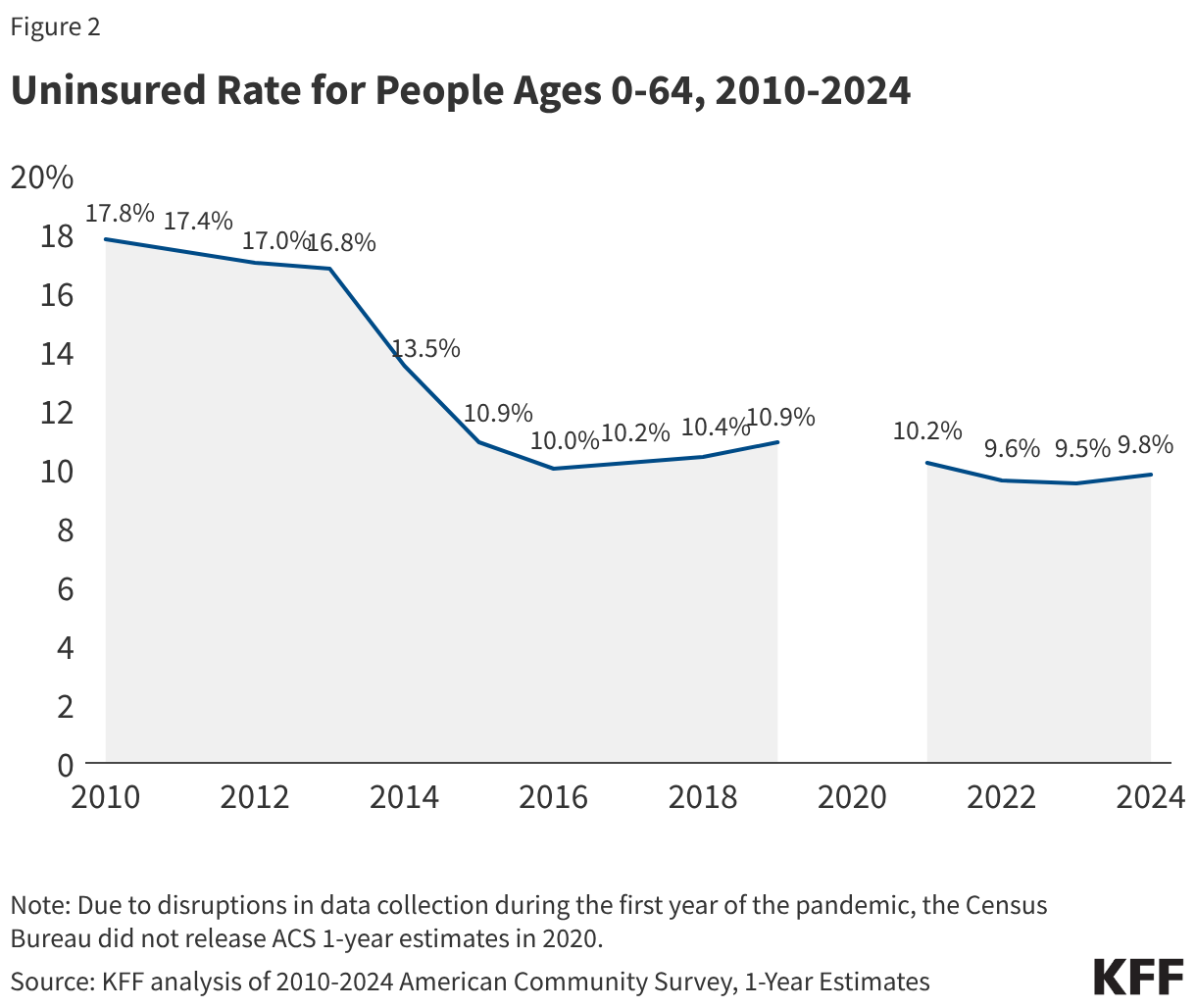
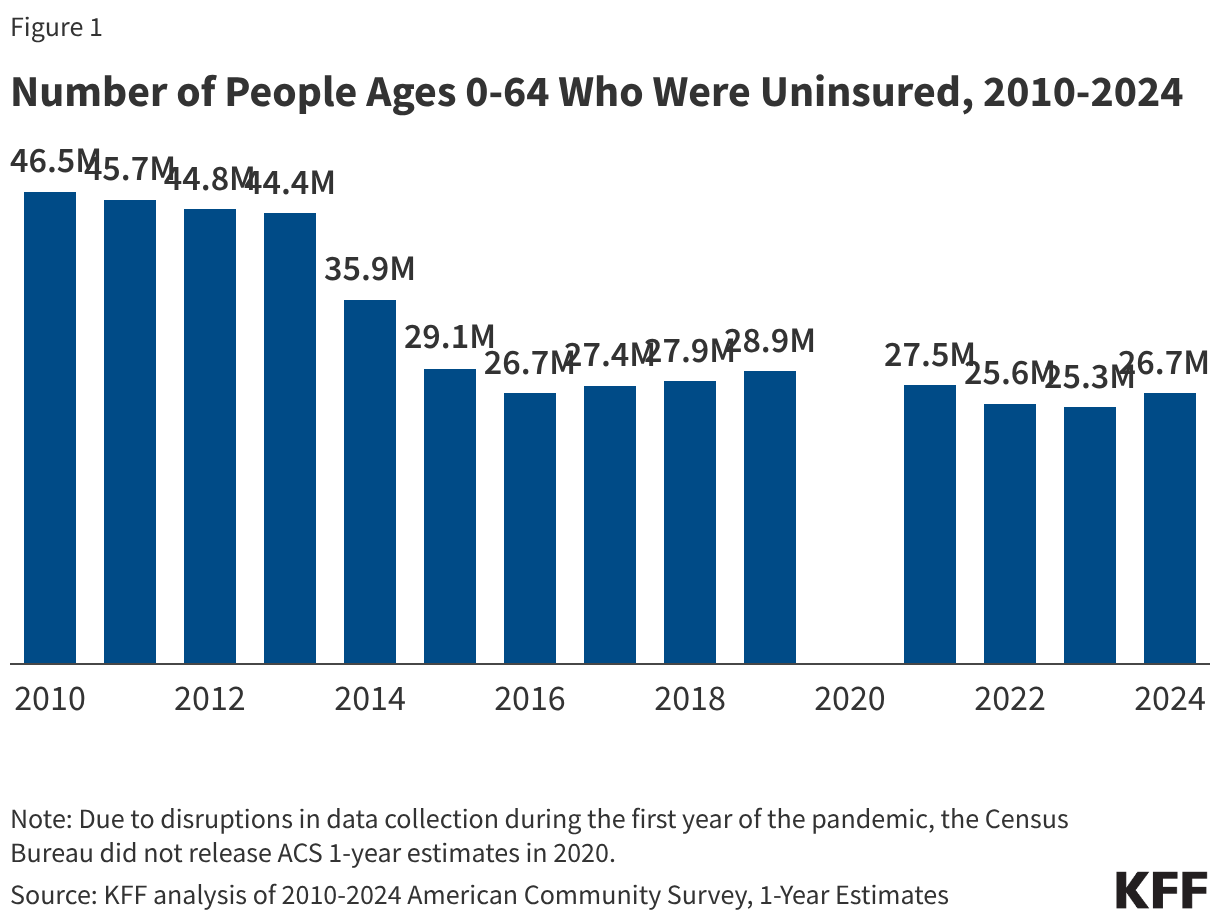
The high cost of private insurance and limited availability of public coverage for some individuals with low income—particularly in states that have not expanded Medicaid under the Affordable Care Act (ACA)—continued to leave millions of people without health coverage in 2024. Our fragmented and complex health insurance system also means some people fall through the cracks of coverage when they experience a change in circumstances. The end of continuous enrollment in Medicaid also affected health coverage trends in 2024. Starting in April 2023, states resumed disenrolling Medicaid enrollees, a process known as Medicaid unwinding, after a period of continuous enrollment during the pandemic. Nearly all states had completed renewals to verify eligibility for the program for all enrollees by the end of 2024, leading to the disenrollment of millions of Medicaid enrollees. Most individuals losing Medicaid do not have access to affordable job-based coverage, and while many transitioned to subsidized coverage through the Marketplace, even with enhanced Marketplace subsidies still in place during 2024, coverage was unaffordable for some. These coverage transitions and losses contributed to the first increase in the uninsured rate since 2019.

The number of people who are uninsured is expected to continue to increase in coming years because of changes to Medicaid and the ACA Marketplace included in the 2025 reconciliation law, the expiration of the Marketplace enhanced premium tax credits, and other administrative actions.  The Congressional Budget Office (CBO) projects that over 14 million more people will be uninsured in 2034 due to the combined effects of the Medicaid and Marketplace eligibility changes included in the reconciliation law and the expiration of the enhanced Marketplace subsidies. In addition to these potential coverage losses, the Trump administration’s increased immigration enforcement activities and policy changes are likely to have a broad chilling effect that could cause lawfully present immigrants who remain eligible to decide to disenroll or not enroll themselves or their children in health coverage programs. This anticipated coverage loss will have implications for access to care and financial stability among those losing coverage and could lead to a worsening of disparities in health outcomes.

This issue brief describes trends in health coverage through 2024, examines the characteristics of the uninsured population ages 0-64, and summarizes the access and financial implications of not having coverage. Using data from the American Community Survey (ACS), this analysis examines changes in health coverage from 2023 to 2024. The analysis focuses on coverage among people ages 0-64 since Medicare offers near universal coverage for the elderly, with just 491,000, or less than 1%, of people over age 65 uninsured. 
Key Takeaways

Copy link to Key Takeaways
How many people are uninsured?

For the first time since 2019, the number of people without health coverage and the uninsured rate increased in 2024. The total number of people ages 0-64 without health coverage increased by more than 1.3 million to 26.7 million in 2024, and the uninsured rate for the population under age 65 increased from 9.5% to 9.8%.

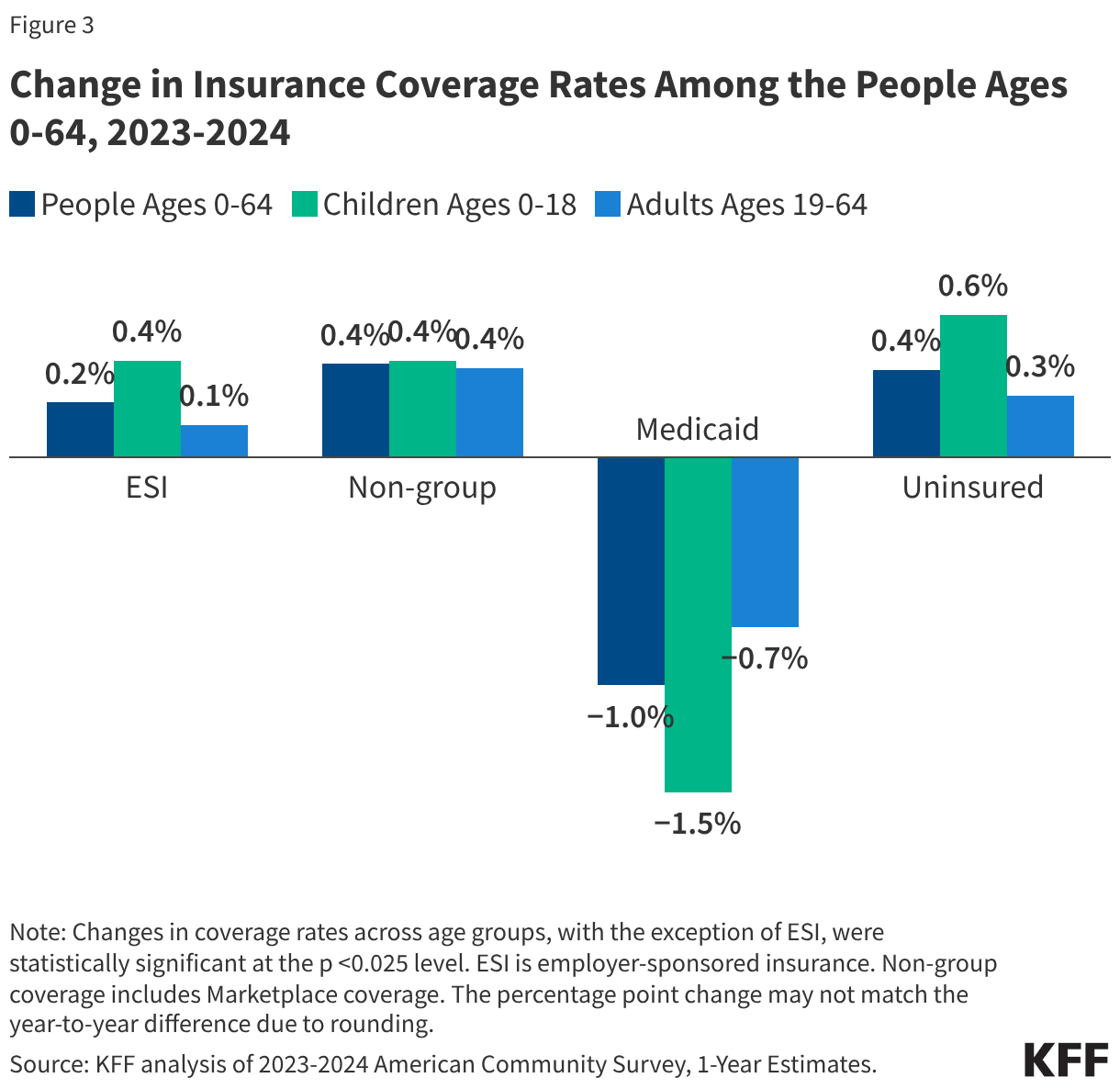
A decline in Medicaid coverage drove the increase in the uninsured rate in 2024. While non-group coverage, including ACA Marketplace coverage, increased from 2023 to 2024, the increase did not fully offset the drop in Medicaid coverage from 2023 to 2024 among both adults and children.

Who is uninsured?

In 2024, over eight in ten people who are uninsured were in low-income families (80.1%) and had at least one worker in the family (85.1%), and over six in ten were people of color (63.7%). Reflecting the more limited availability of public coverage in some states, adults ages 19-64 are more likely to be uninsured than children (11.3% vs. 5.9%). Despite coverage gains across groups over time, American Indian or Alaska Native, Hispanic, Black, and Native Hawaiian or Pacific Islander people were more likely to be uninsured than White and Asian people. 

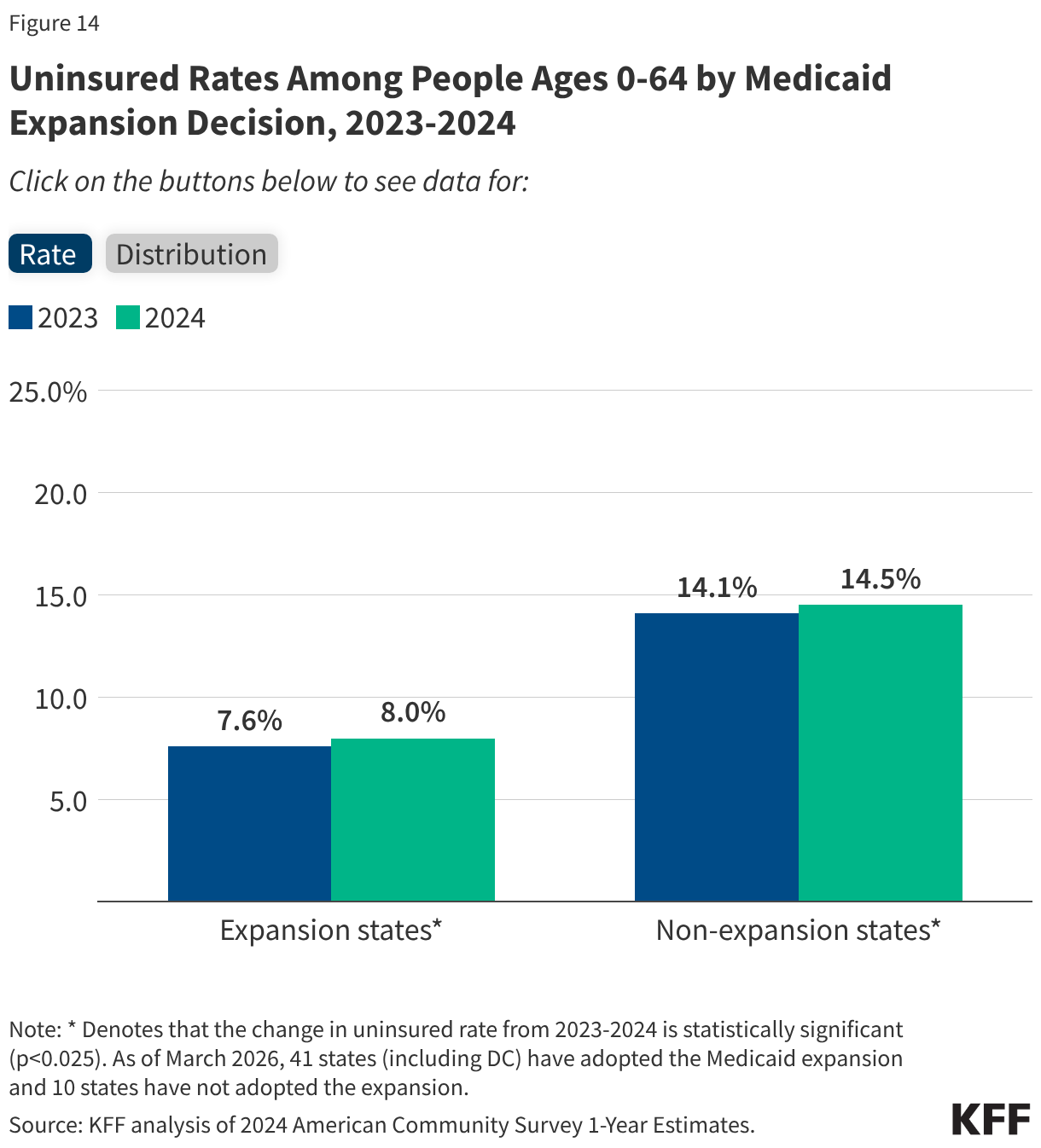
A disproportionate share of uninsured individuals under age 65 (42%) live in the ten states that have not expanded Medicaid. Individuals living in non-expansion states are nearly twice as likely as those in expansion states to be uninsured; the uninsured rate in non-expansion states was 14.5% compared to 8.0% in expansion states.

Why are people uninsured? 

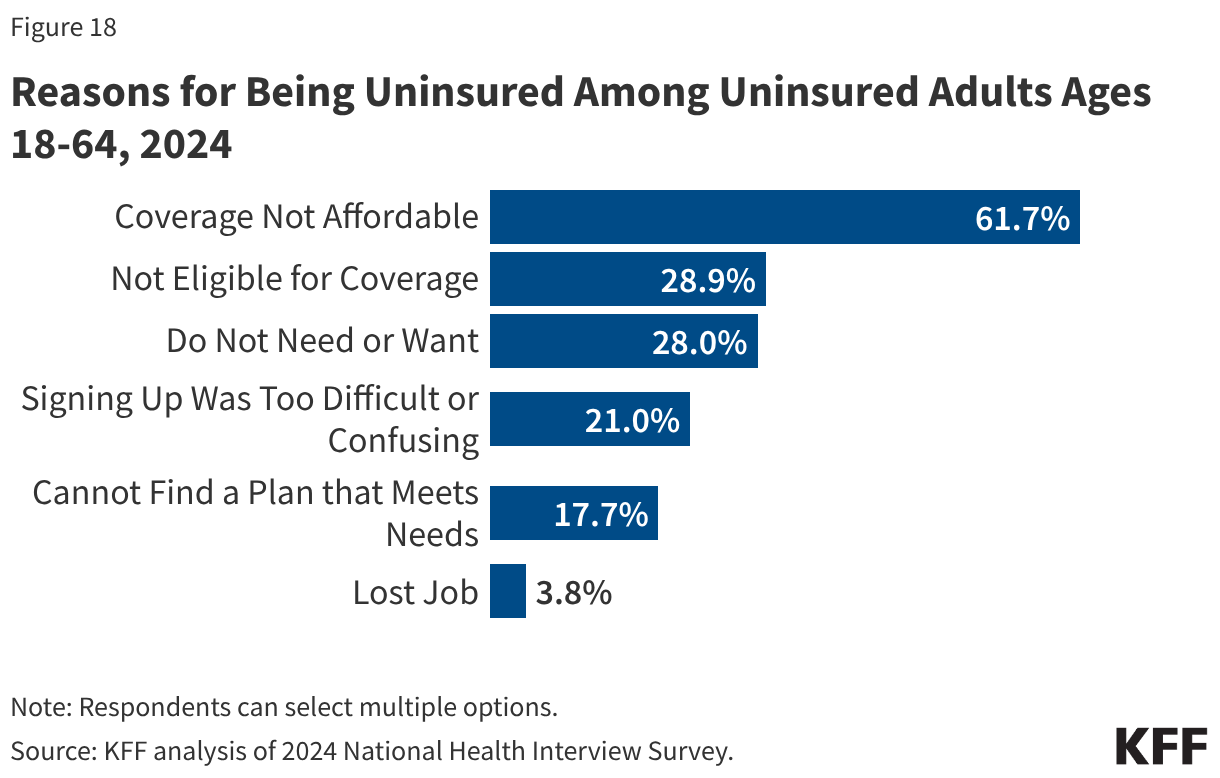
The high cost of insurance is the main reason many people are uninsured. In 2024, 61.7% of uninsured adults ages 18-64 said they were uninsured because coverage is not affordable. Many uninsured people do not have access to coverage through a job, and some people, particularly poor adults in states that have not expanded Medicaid, remain ineligible for public coverage. Among uninsured adults who were working, 71% were not offered or were not eligible for coverage from their employer in 2024.
About half (52.2%) of people who are uninsured may be eligible for Medicaid or subsidized coverage in the Marketplace. However, they may not be aware of these coverage options or may face barriers to enrolling. In addition, with the expiration of the enhanced premium tax credits, Marketplace coverage has gotten more expensive and may be unaffordable for some.

How does not having coverage affect health care access?  

People without insurance coverage are less likely to access care and more likely to delay or forgo care because of costs. In 2024, nearly four in ten uninsured adults (38.6%) reported delaying, skipping, or not getting needed care or medication due to cost, more than twice the share of adults with private coverage (17.0%) and those with public coverage (18.8%).  Among adults with chronic health conditions who need ongoing medical management, those without insurance coverage were three to four times more likely to delay or forgo needed medical care due to cost than adults with the same condition who were insured. Research demonstrates that gaining health insurance, particularly through Medicaid, improves access to care, utilization of services, and reduces mortality.

What are the financial implications of being uninsured? 

Uninsured adults are nearly twice as likely as insured adults to have difficulty paying health care costs. Nearly six in ten (59%) uninsured adults said they or someone living with them had problems paying for health care compared to 30% of insured adults. People who are uninsured are also more likely to experience measures of financial distress, including overdrawing their checking account, having been contacted by a debt collection agency, and having used pay day loans.

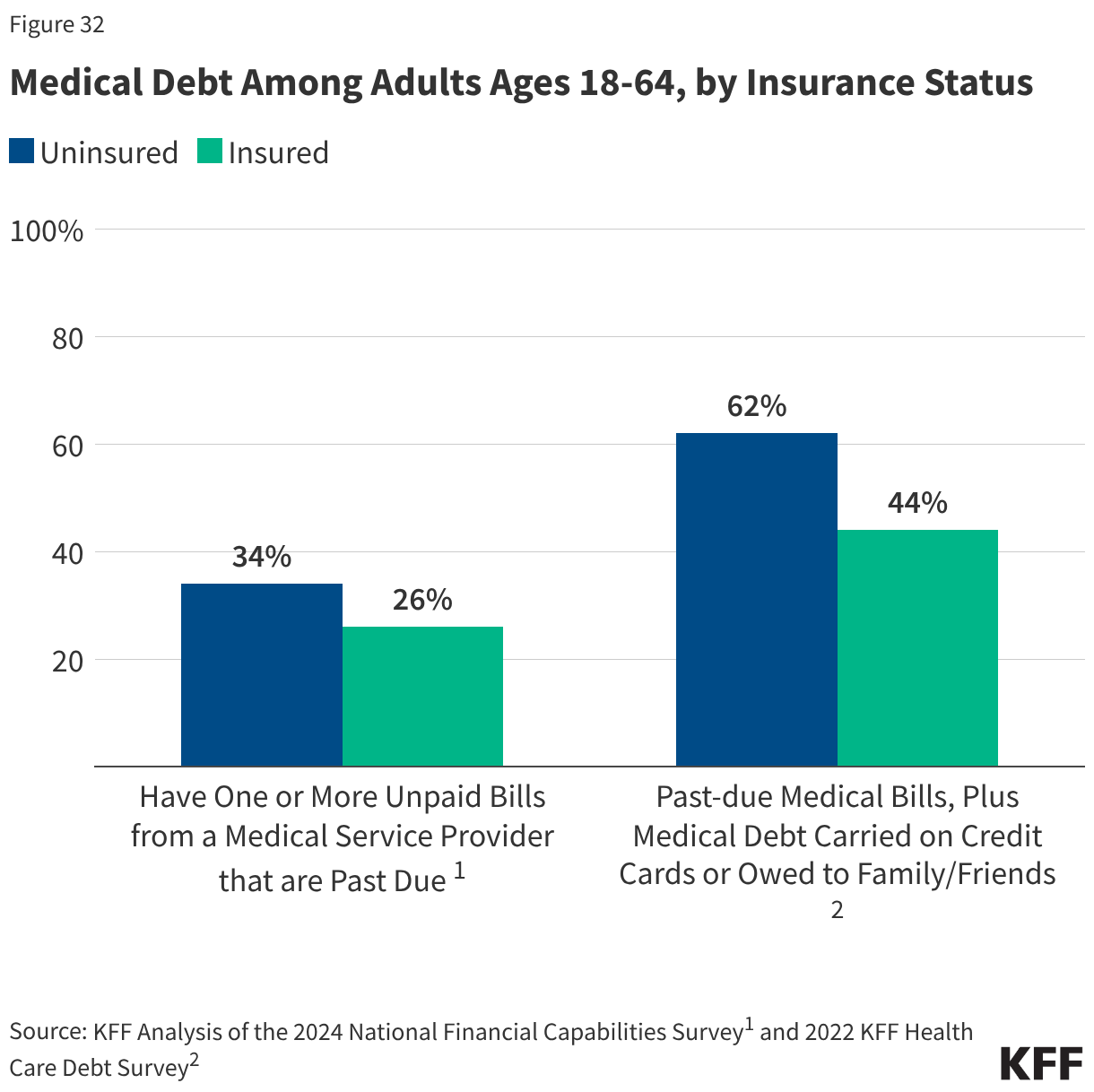
Unaffordable medical bills can lead to medical debt, particularly for uninsured adults. More than six in ten (62%) uninsured adults reported having health care debt compared to over four in ten (44%) insured adults. Uninsured adults are more likely to face negative consequences due to health care debt, such as using up savings, having difficulty paying other living expenses, or borrowing money.

Characteristics of the Uninsured Population

Age

Copy link to Age

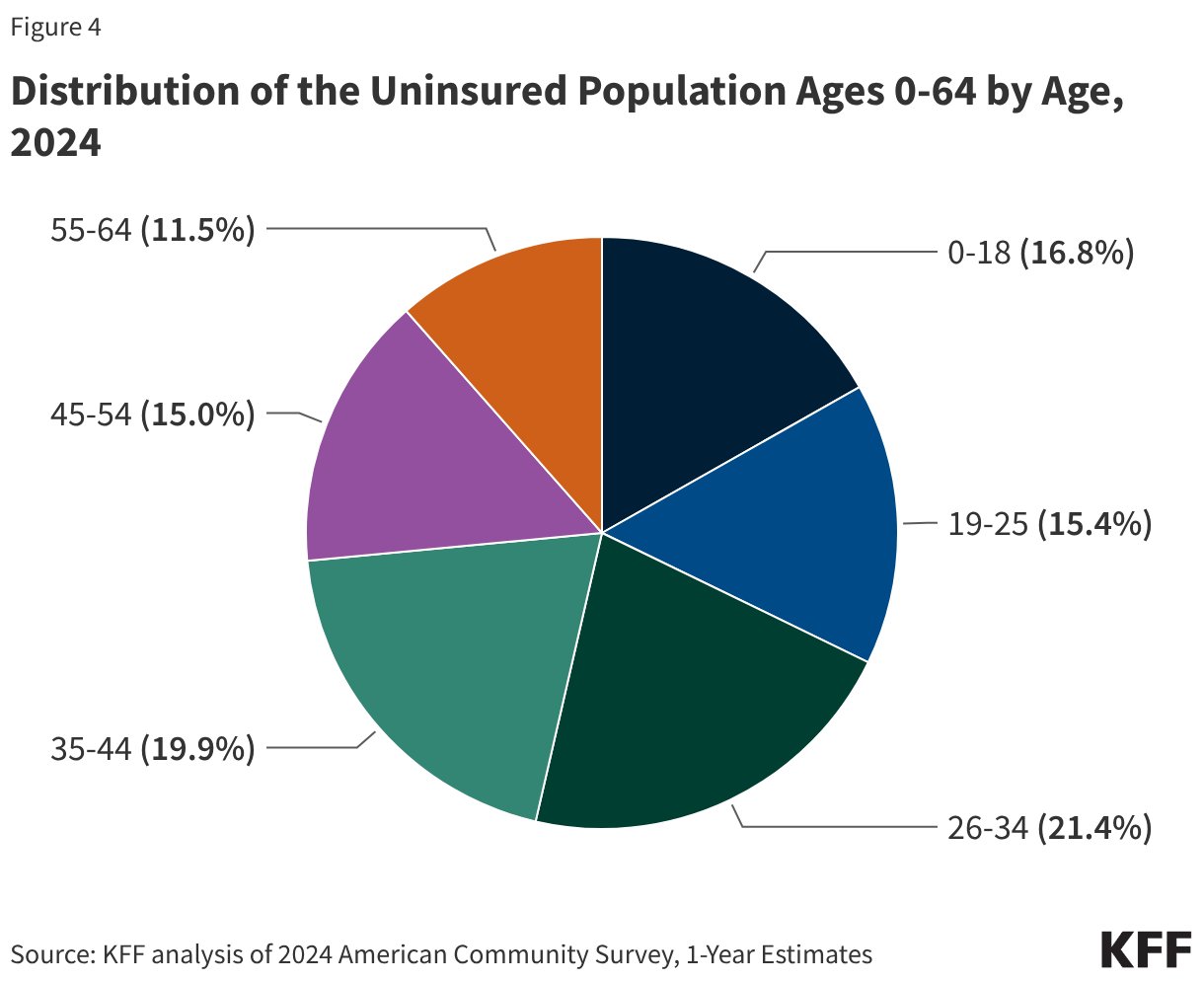
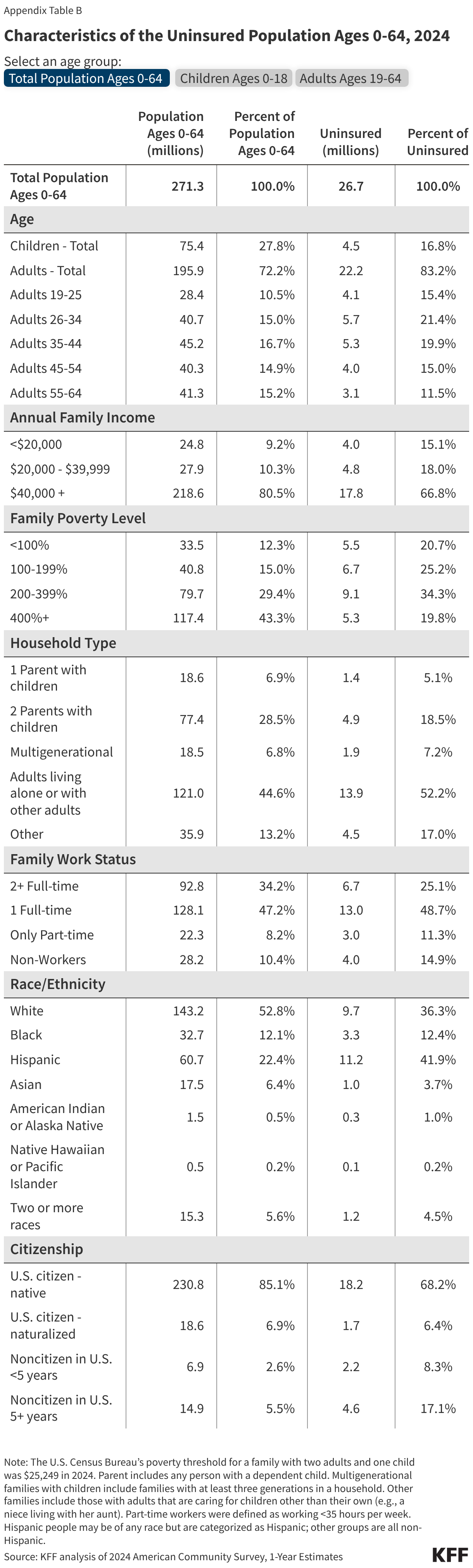
Over eight in ten (83.2%) individuals who were uninsured in 2024 were adults while 16.8% were children. Adults ages 19-44 make up more than half (56.7%) of the uninsured population under age 65. About one in four (26.5%) people who are uninsured are between the ages of 45-64 (Figure 4).

Distribution of the Uninsured Population Ages 0-64 by Age, 2024 (Pie Chart)

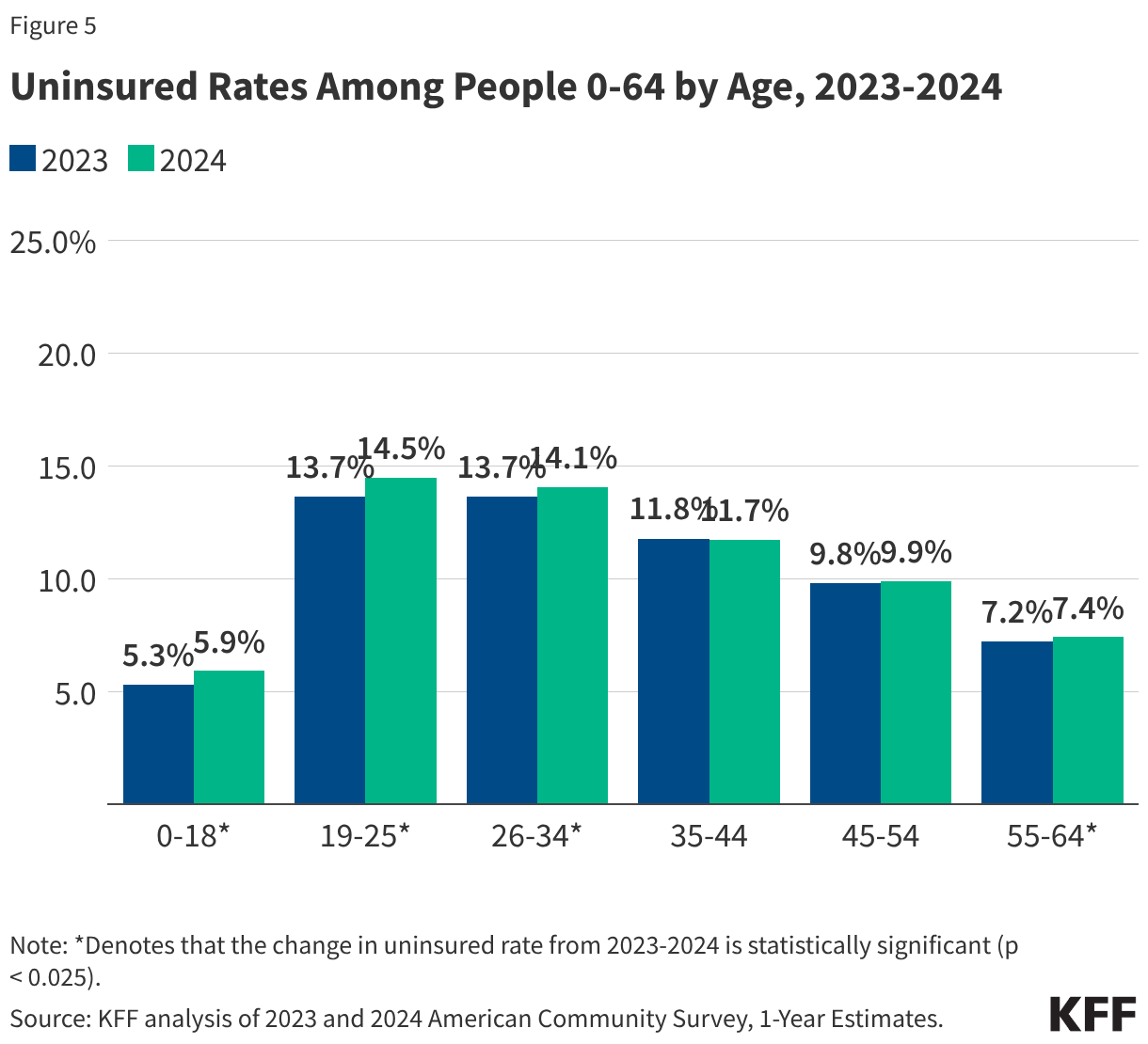
Adults are more likely to be uninsured than children. The uninsured rate for adults ages 19-64 was 11.1%, nearly twice the rate of 5.9% for children. The lower uninsured rate for children reflects, in part, broader eligibility for Medicaid and CHIP for children. As children age out of eligibility, uninsured rates rise sharply to 14.5% for young adults ages 19-25 and remain high for adults ages 26-34 (14.1%) as 26-year-olds lose coverage under their parent’s health plan. Uninsured rates begin to fall for adults starting at age 35 and are lowest for adults ages 55-64 at 7.4% (Figure 5). The increase in the uninsured rate from 2023 to 2024 was largest for children and young adults. The uninsured rate for children increased by 0.6 percentage points from 2023 to 2024, and the rate for young adults ages 19-25 increased by 0.8 percentage points. Adults ages 26-34 and those ages 55-64 experienced smaller increases (0.4 and 0.2 percentage points, respectively) while the uninsured rates for adults ages 35-44 and 45-54 did not change.

Uninsured Rates Among People 0-64 by Age, 2023-2024 (Grouped column chart)

Family Income

Copy link to Family Income

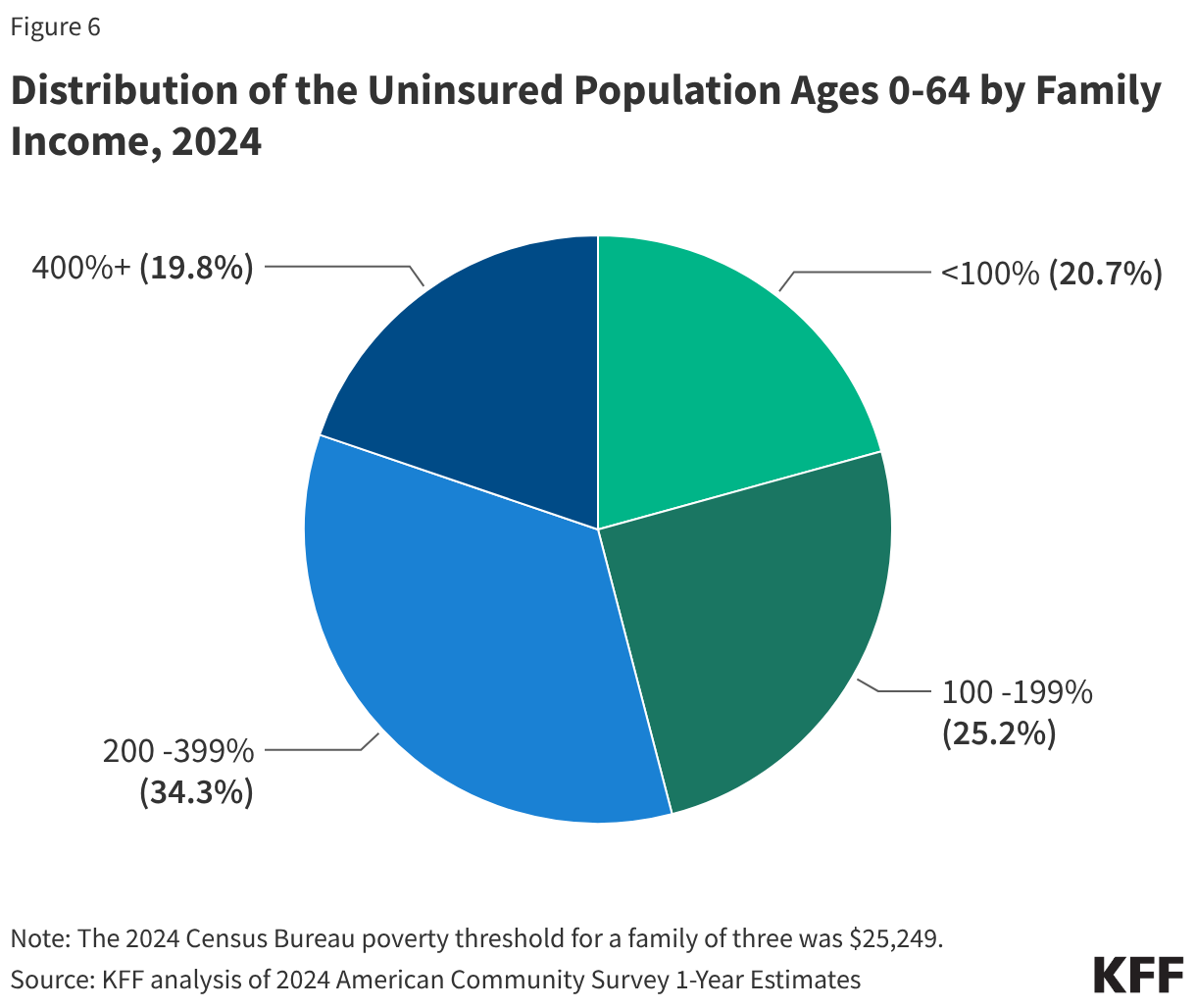
Eight in ten (80.2%) uninsured people under age 65 in 2024 were in families with incomes below 400% of the federal poverty level (FPL). Nearly half (45.9%) had incomes below 200% FPL while over one-third (34.3%) had family income between 200% and 399% FPL (Figure 6).

Distribution of the Uninsured Population Ages 0-64 by Family Income, 2024 (Pie Chart)

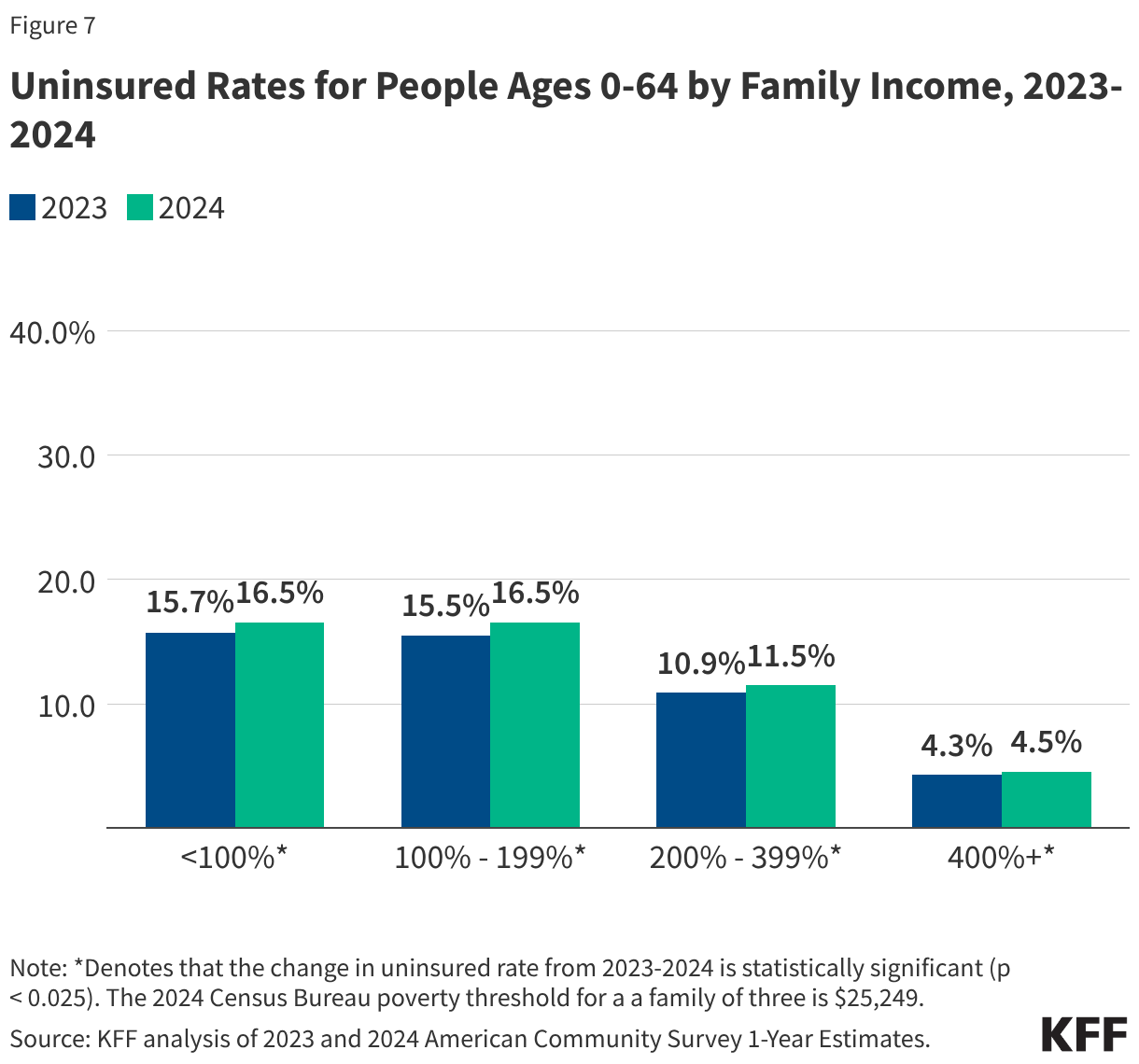
Individuals with incomes below 200% of the federal poverty level (FPL) are significantly more likely to be uninsured than those with higher income. One in six (16.5%) individuals under age 65 living in poverty and those in low-income families (incomes 100%-199% FPL) were uninsured in 2024 compared to fewer than one in twenty (4.5%) with incomes above 400% FPL (Figure 7).  Just over one in ten (11.5%) individuals with incomes from 200%-399% FPL were uninsured. While uninsured rates increased for families at all income levels, families with low income and those in poverty saw the largest increases. From 2023 to 2024, the uninsured rate for people ages 0-64 in families with incomes between 100-200% of the federal poverty level (FPL) increased from 15.5% to 16.5%, and the uninsured rate for families living in poverty also increased to 16.5% in 2024 from 15.7% in 2023.
Uninsured Rates for People Ages 0-64 by Family Income, 2023-2024 (Grouped column chart)

Family Work Status

Copy link to Family Work Status

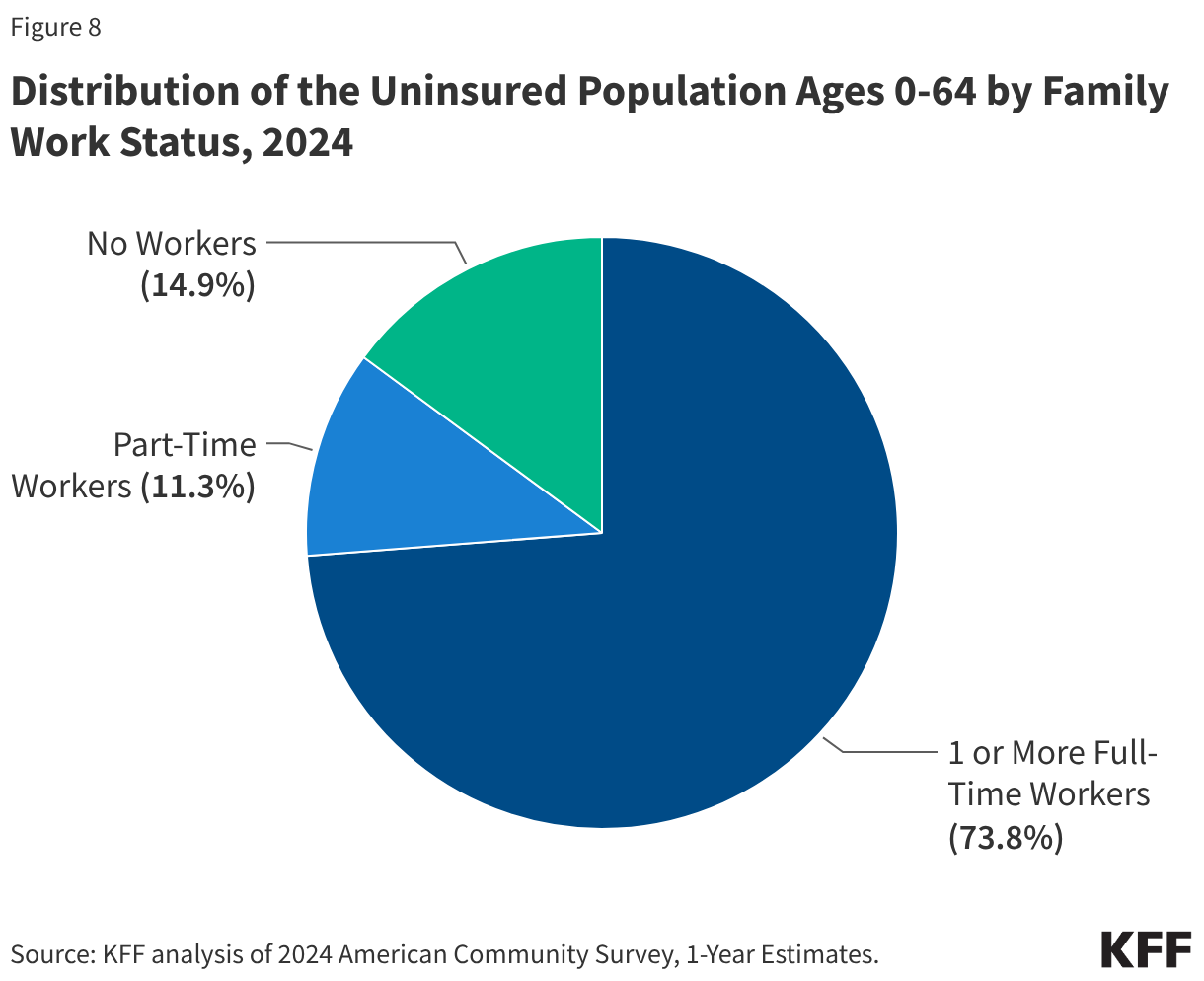
In 2024, most (85.1%) uninsured individuals lived in working families. Of the total uninsured population ages 0 to 64, nearly three in four (73.8%) had at least one full-time worker in their family, and 11.3% had a part-time worker in their family (Figure 8). Less than 15% of uninsured individuals were in families with no workers.

Distribution of the Uninsured Population Ages 0-64 by Family Work Status, 2024 (Pie Chart)

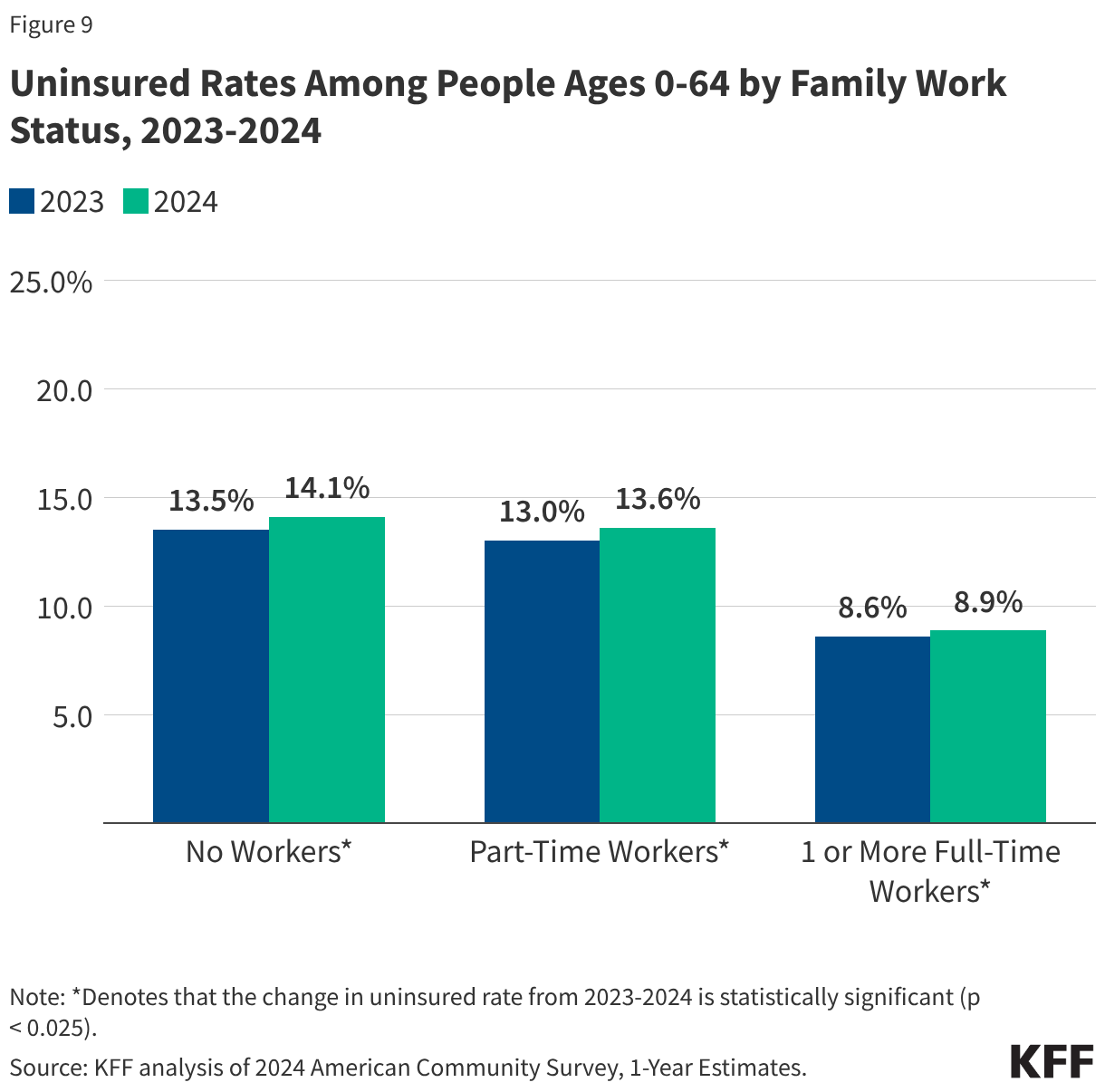
Because health insurance is tied to employment for many people in the U.S., individuals living in families with no workers or only part-time workers are more likely to be uninsured than individuals with full-time workers in the family. Individuals ages 0-64 in families with no workers or only part-time workers were nearly twice as likely to be uninsured (14.1% and 13.6% respectively) as individuals in families with multiple full-time workers (8.9%) (Figure 9). But working alone does not ensure access to health coverage. Over one in ten (10.1%) individuals in families with one full-time worker were uninsured in 2024. Although the uninsured rate increased for individuals in families with at least one full-time worker, the increases were larger for individuals in families with only part-time workers and those in families with no workers.

Uninsured Rates Among People Ages 0-64 by Family Work Status, 2023-2024 (Grouped column chart)

Race and Ethnicity

Copy link to Race and Ethnicity

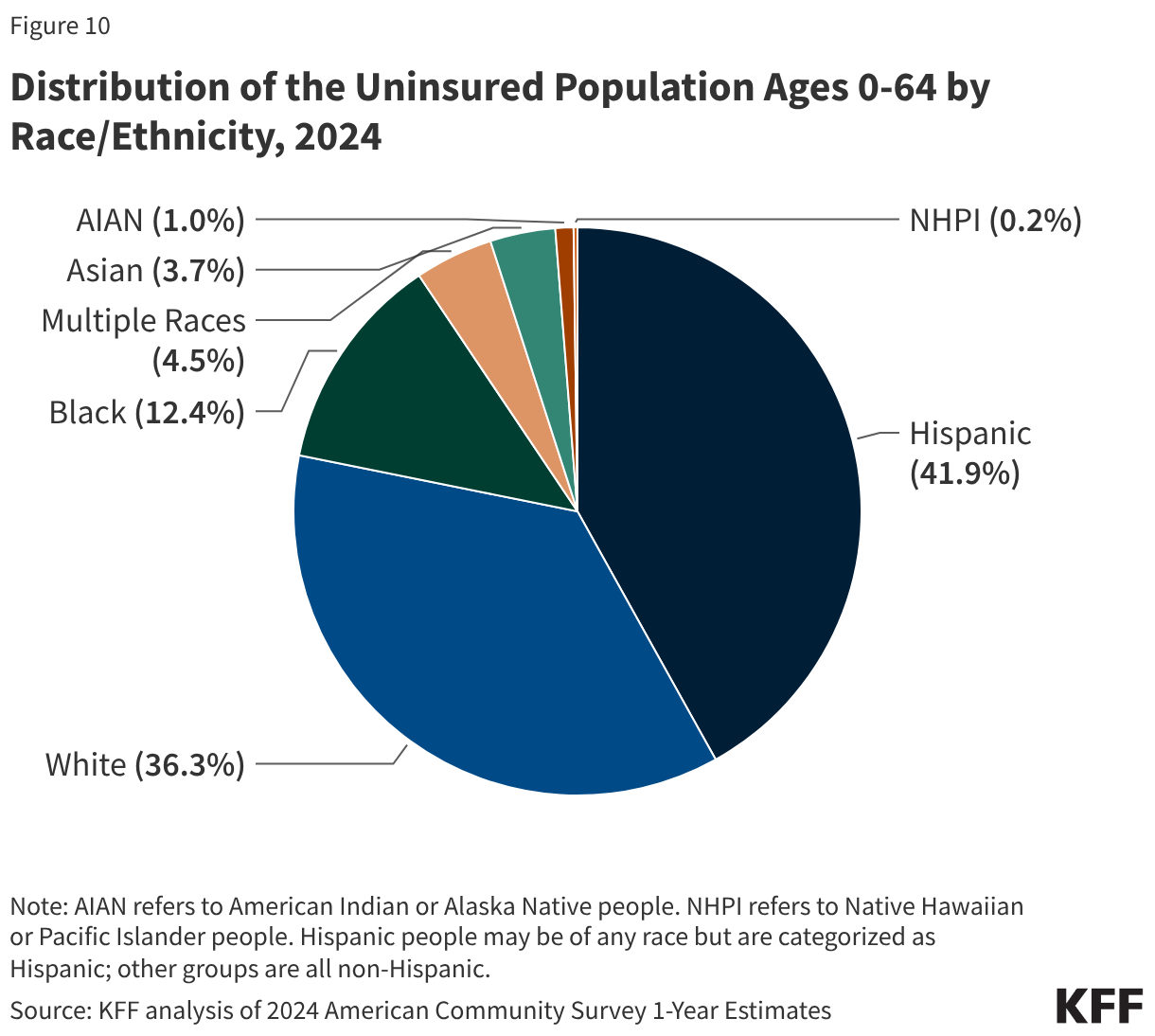
Nearly two-thirds (63.7%) of those without insurance in 2024 were people of color. Over four in ten (41.9%) uninsured people were Hispanic in 2024, while 12.4% were Black people and 3.7% were Asian people. American Indian or Alaska Native (AIAN) and Native Hawaiian or Pacific Islander (NHPI) people made up smaller shares, accounting for 1% and 0.2% of the uninsured population, respectively. White people comprised 36.3% of people who lacked insurance coverage in 2024 (Figure 10).

Distribution of the Uninsured Population Ages 0-64 by Race/Ethnicity, 2024 (Pie Chart)

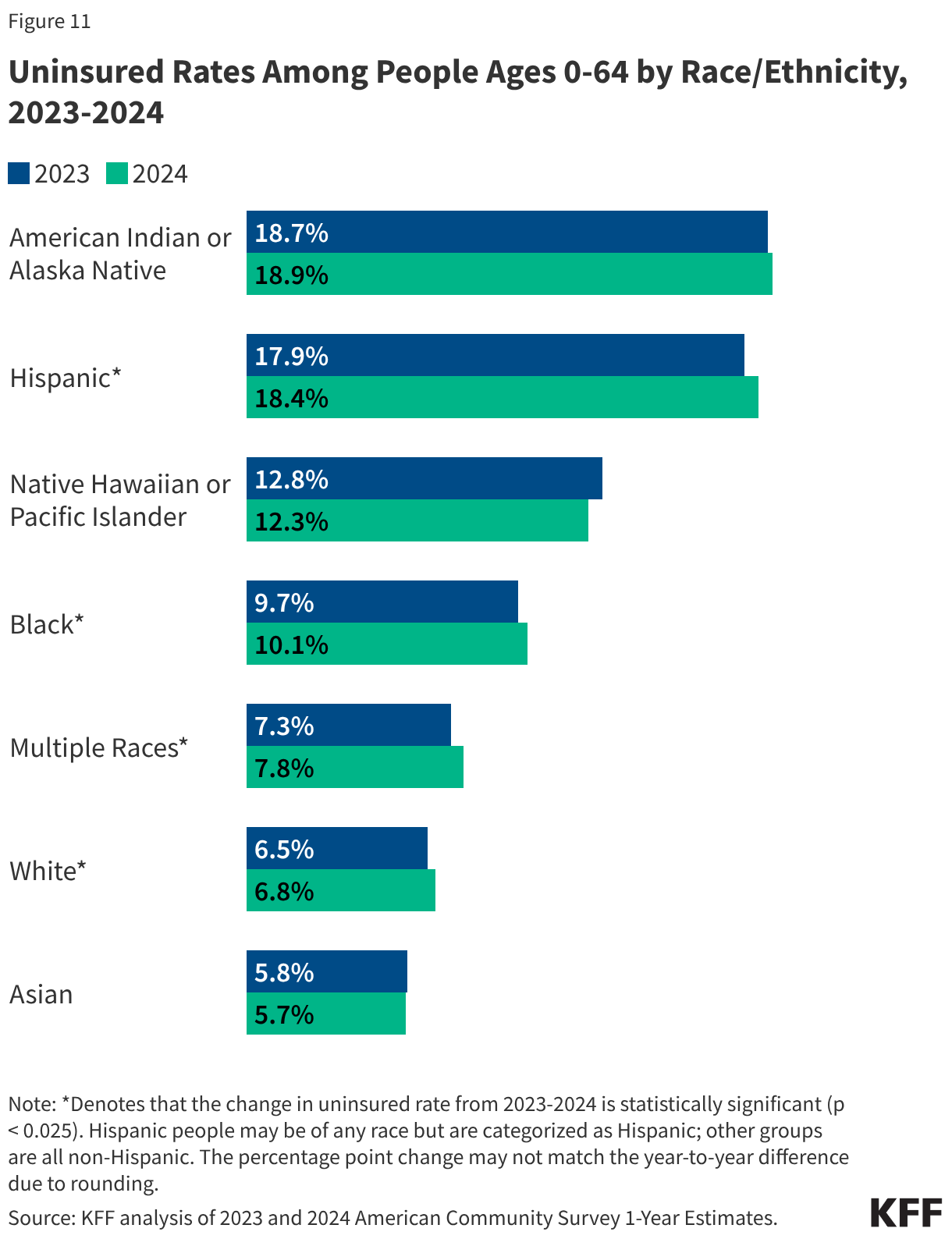
Reflecting ongoing disparities in health coverage, Hispanic, Black, AIAN, and NHPI people are more likely to be uninsured than White people. In 2024, AIAN and Hispanic people had the highest uninsured rates (18.9% and 18.4%, respectively). These rates were more than two and a half times the rate for White people (6.8%). The uninsured rates for Black people (10.1%) and NHPI (12.3%) were also higher than the rate for White people (Figure 11). Asian individuals under age 65 had the lowest uninsured rate at 5.7%. Hispanic and Black people ages 0-64 experienced the largest increases in uninsured rates in 2024, increasing 0.5 and 0.4 percentage points respectively from 2023. The uninsured rate for White people increased from 6.5% in 2023 to 6.8% in 2024, while the rates for American Indian or Alaska Native, Asian, and Native Hawaiian or Pacific Islander people did not change.

Uninsured Rates Among People Ages 0-64 by Race/Ethnicity, 2023-2024 (Grouped Bars)

Citizenship

Copy link to Citizenship

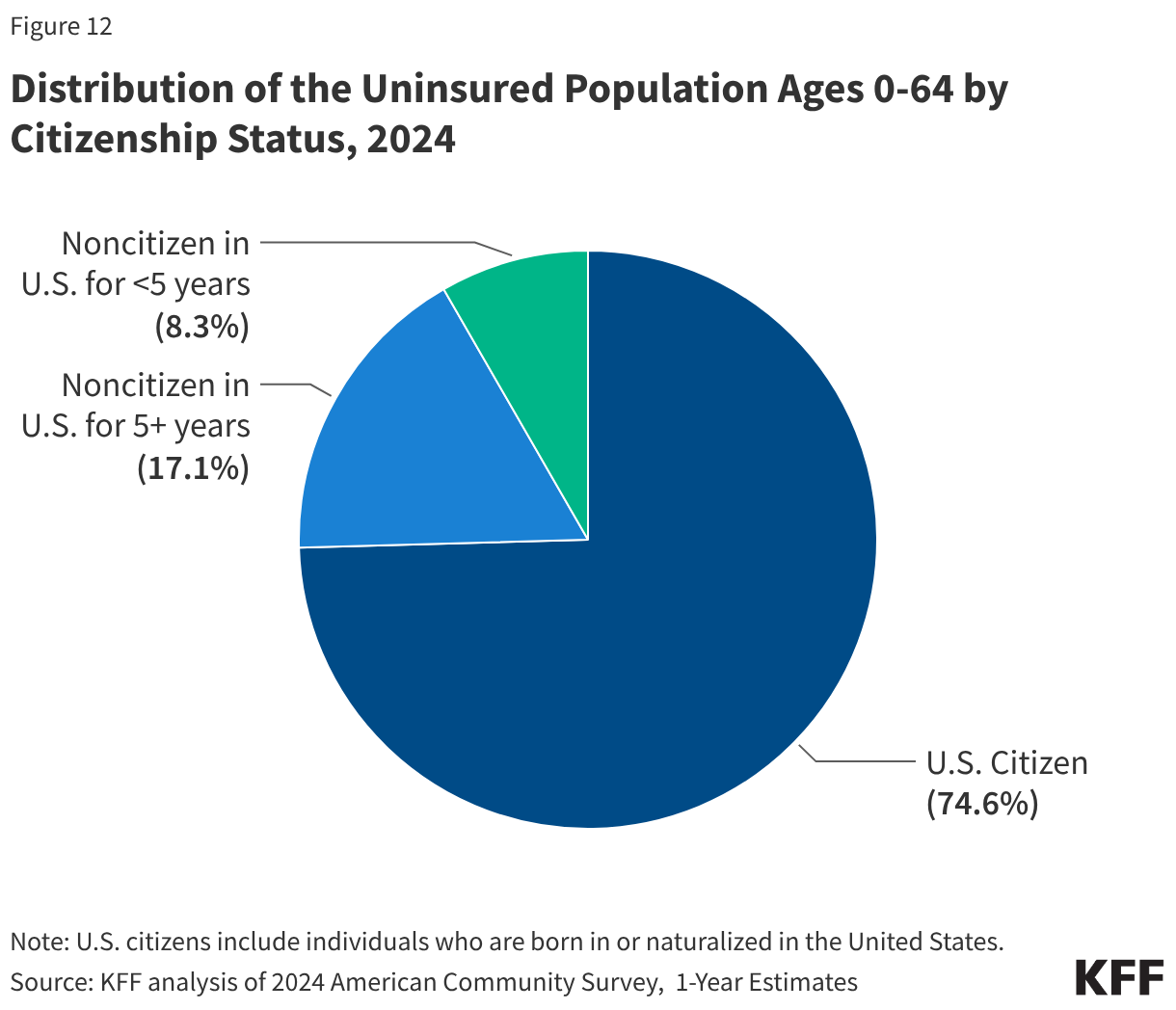
Most uninsured individuals ages 0-64 (74.6%) were U.S. citizens, while a quarter were noncitizens in 2024. About 8% of uninsured individuals were recent immigrants who have lived in the U.S. for less than 5 years while 17.1% were immigrants who have been in the U.S. for more than five years (Figure 12). An even greater share of uninsured children were U.S. citizens (85.2%), while 14.8% were noncitizens (Appendix Table B).

Distribution of the Uninsured Population Ages 0-64 by Citizenship Status, 2024 (Pie Chart)

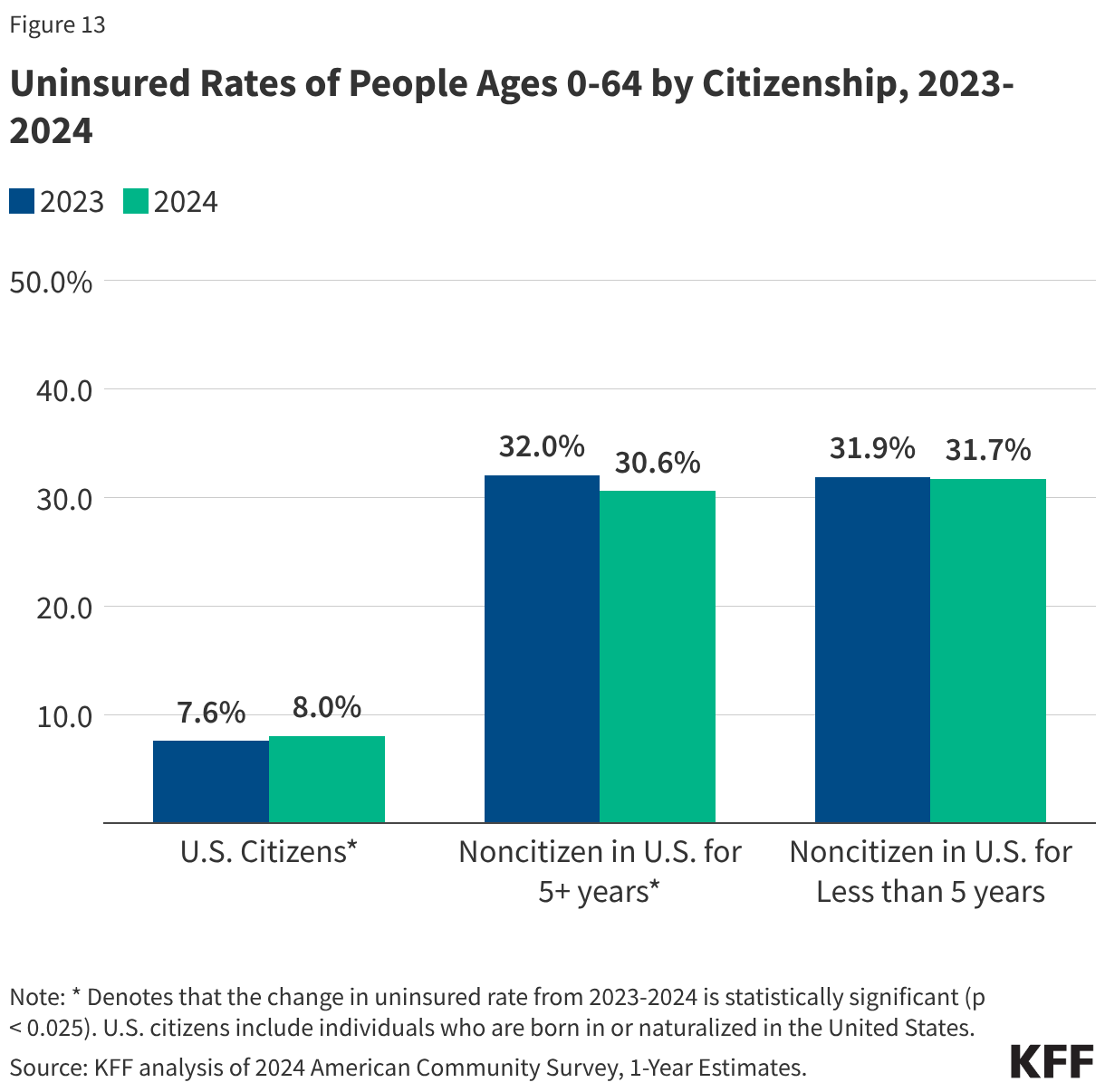
Noncitizens are more likely than citizens to be uninsured. Nearly one-third of noncitizen immigrants were uninsured in 2024, including 31.7% of those who have been in the U.S. for less than five years and 30.6% of those who have lived in the U.S. for more than five years. By comparison, the uninsured rate for U.S.-born and naturalized citizens was 8.0% in 2024 (Figure 13). The uninsured rate increased for U.S. citizens and decreased for noncitizens who have in the U.S. for five years or more, though noncitizens remain more than 3.5 times more likely to be uninsured than citizens overall. 
Uninsured Rates of People Ages 0-64 by Citizenship, 2023-2024 (Grouped column chart)

State Residency

Copy link to State Residency

Although most states have adopted the ACA Medicaid expansion, a disproportionate share of uninsured people under age 65 live in states that have not expanded Medicaid. As of 2024, 41 states including DC had expanded Medicaid to cover adults with incomes up to 138% FPL ($20,782 for an individual in 2024). In 2024, about four in ten (42.0%) uninsured people ages 0-64 lived in the ten non-expansion states, including states with large uninsured populations such as Texas and Florida, while nearly six in ten (58.0%) lived in states that expanded Medicaid (Figure 14).  Individuals living in non-expansion states are more likely to be uninsured than those living in expansion states. In 2024, the uninsured rate in non-expansion states (14.5%) was nearly twice the rate in expansion states (8.0%) (Figure 14). 

Uninsured Rates Among People Ages 0-64 by Medicaid Expansion Decision, 2023-2024 (Grouped column chart)

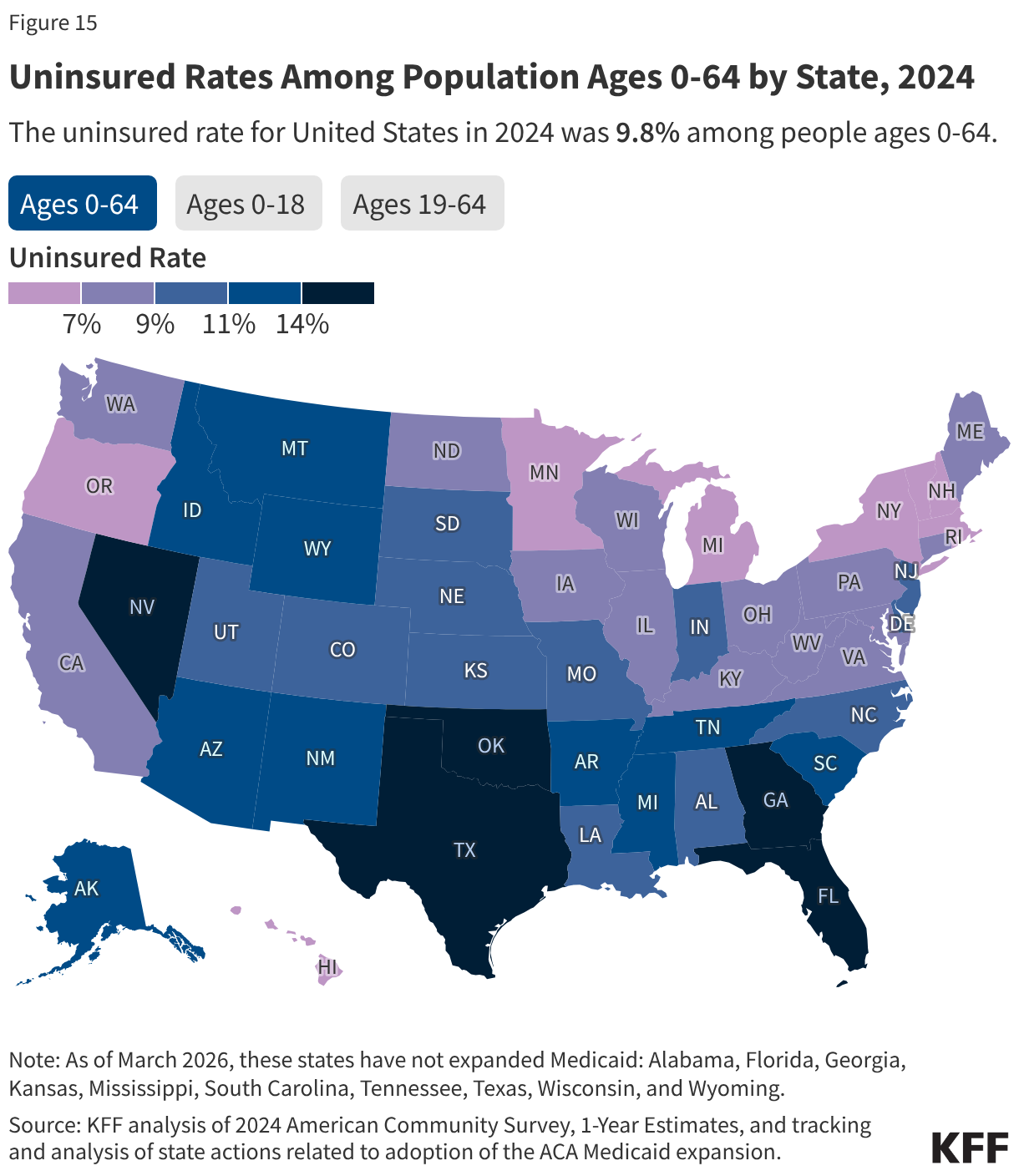
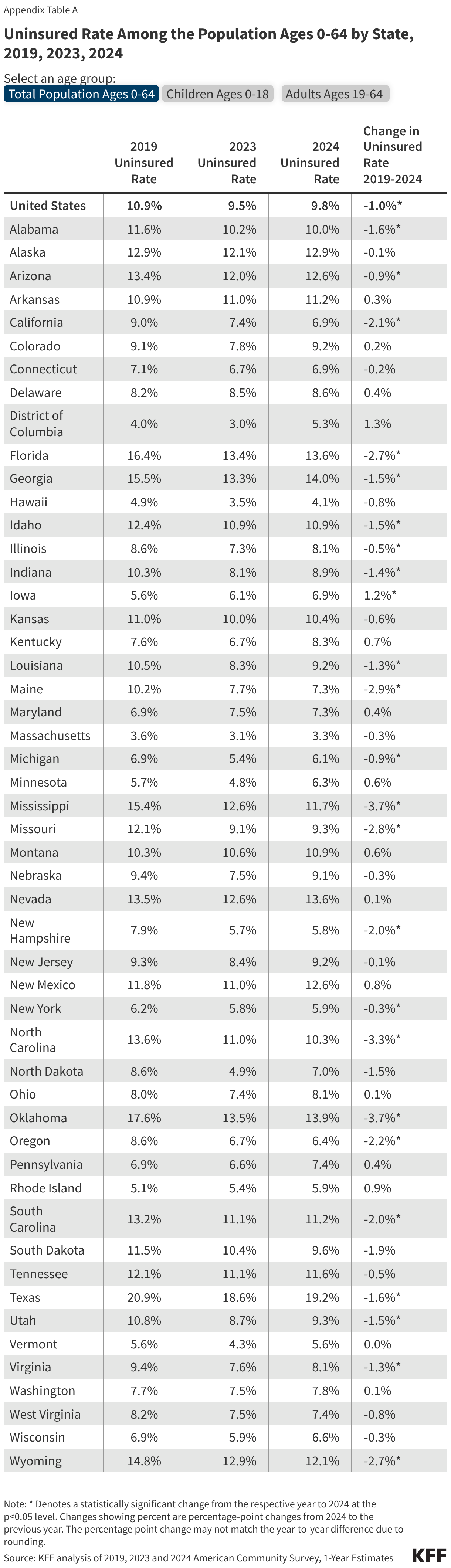
Uninsured rates vary across states. Texas had the highest uninsured rate at 19.2%, nearly double the national rate of 9.8%, while Massachusetts had the lowest rate at 3.3% (Figure 15). The variation in uninsured rates across states reflects differences in per capita income, access to employer coverage, and eligibility for public coverage.

Uninsured Rates Among Population Ages 0-64 by State, 2024 (Choropleth map)

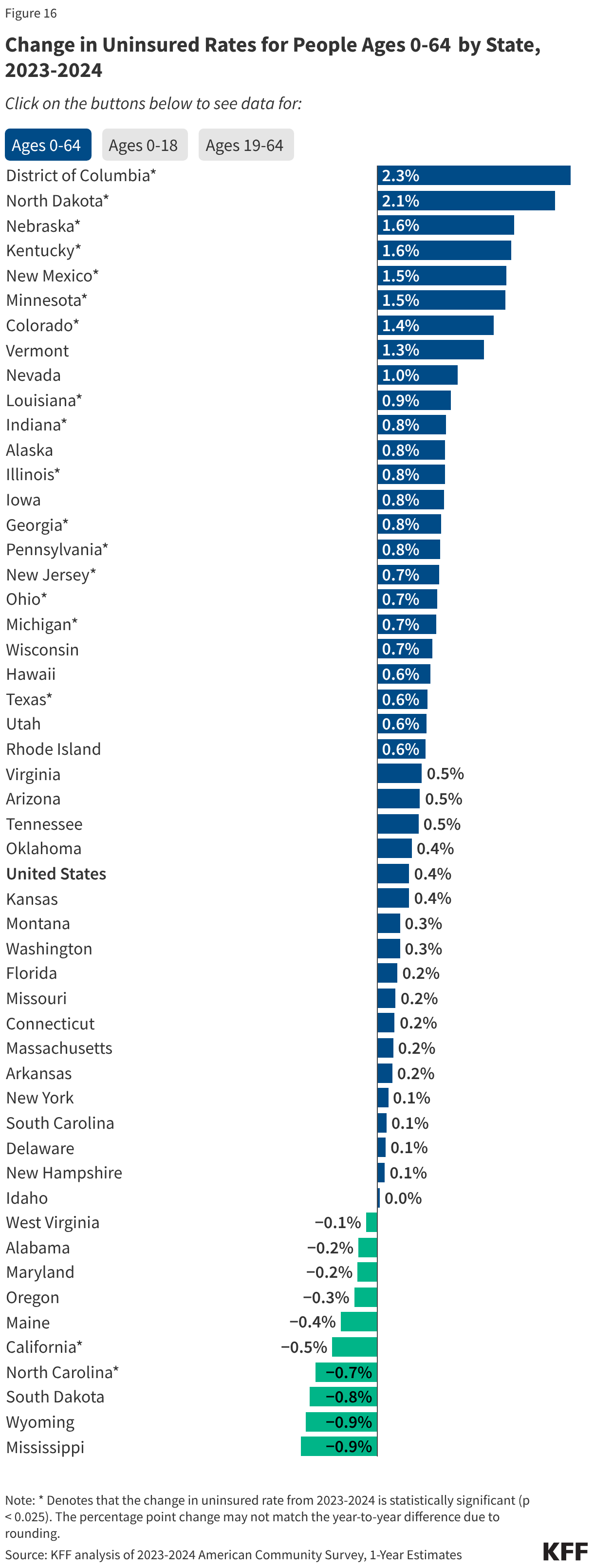
From 2023 to 2024, the uninsured rate for the population ages 0 to 64 increased in 16 states including DC and decreased in two states, California and North Carolina. The District of Columbia and North Dakota saw the largest increases in the uninsured rate for the population under age 65, though the rates remain below the national average in both states (Figure 16). The uninsured rate for children ages 0-18 increased in nine states (Colorado, Florida, Georgia, Kansas, Kentucky, Minnesota, Missouri, Oklahoma, Texas), while the uninsured rate for adults ages 19-64 increased in DC and fourteen states (Colorado, Illinois, Indiana, Kentucky, Louisiana, Michigan, Minnesota, Nebraska, New Jersey, New Mexico, North Dakota, Ohio, Pennsylvania, and Wisconsin) but declined in three states (California, Mississippi, and North Carolina). In three states (Colorado, Kentucky, and Minnesota), the uninsured rates increased for both children and adults ages 19-64.  

Change in Uninsured Rates for People Ages 0-64  by State,  2023-2024 (Bar Chart)

Length of Uninsurance

Copy link to Length of Uninsurance

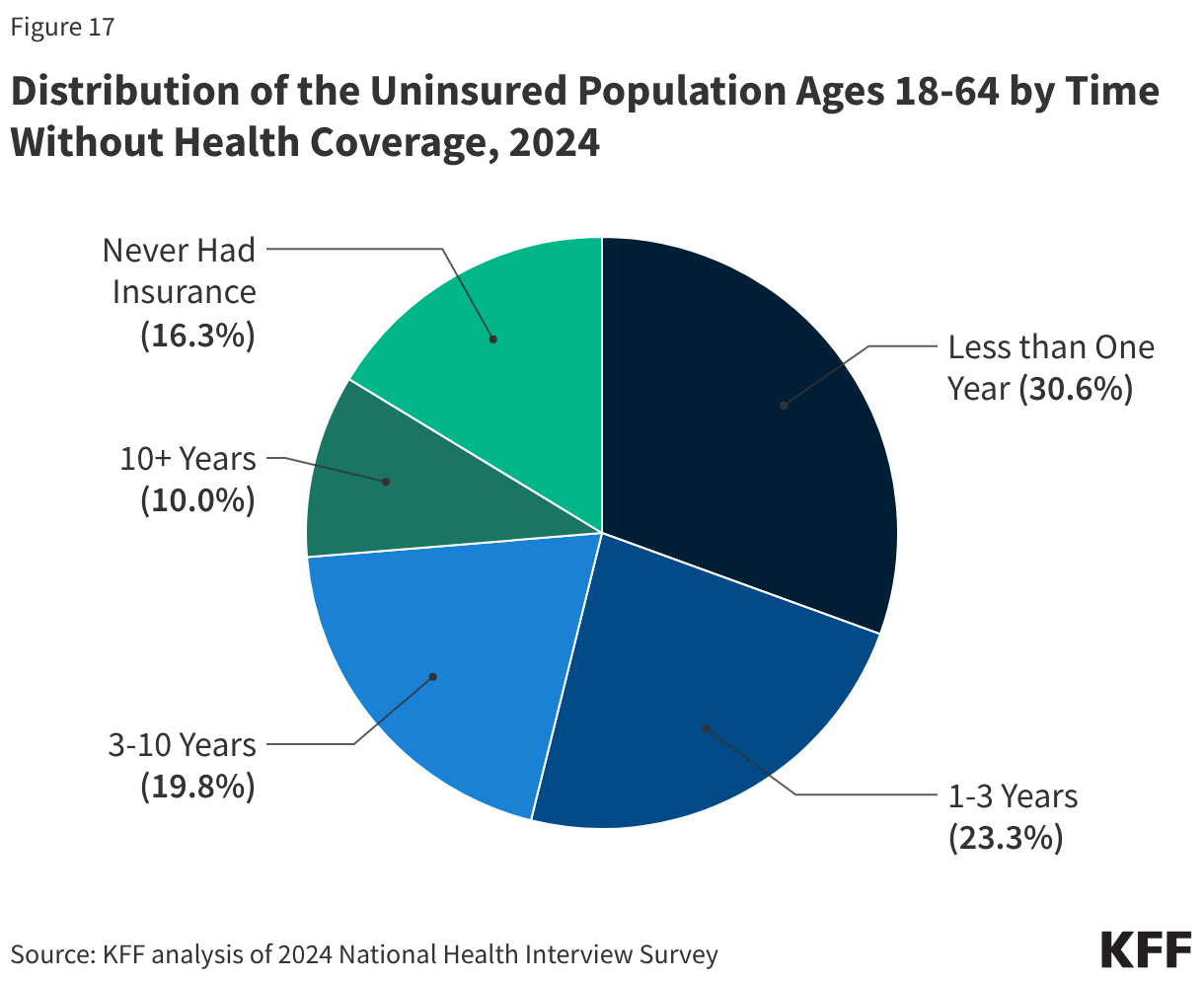
Most uninsured adults have been without health coverage for more than a year. Nearly seven in ten (69.4%) adults who were uninsured in 2024 had gone without health coverage for more than a year, including over a quarter who had been uninsured for ten or more years (10%) or had never been insured (16.3%) (Figure 17). People who have been without coverage for long periods may be particularly hard to reach through outreach and enrollment efforts. Just three in ten uninsured adults (30.6%) reported lacking coverage for less than one year. People who lacked insurance for less than one year may have experienced a short-term gap in coverage because of a job change or a change in income that resulted in the loss of employer-based coverage or Medicaid.

Distribution of the Uninsured Population Ages 18-64 by Time Without Health Coverage, 2024 (Pie Chart)

Barriers to Obtaining Health Care Coverage

Reasons for Being Uninsured

Copy link to Reasons for Being Uninsured

Inability to afford coverage is the most commonly cited reason for being uninsured. In 2024, 61.7% of uninsured adults ages 18-64 said they were uninsured because coverage is not affordable (Figure 18). Uninsured adults faced other barriers to obtaining coverage, including not being eligible for coverage (28.9%) and having difficulty signing up for coverage (21.0%). Over a quarter (28.0%) said they did not need or want coverage. 
Reasons for Being Uninsured Among Uninsured Adults Ages 18-64, 2024 (Bar Chart)

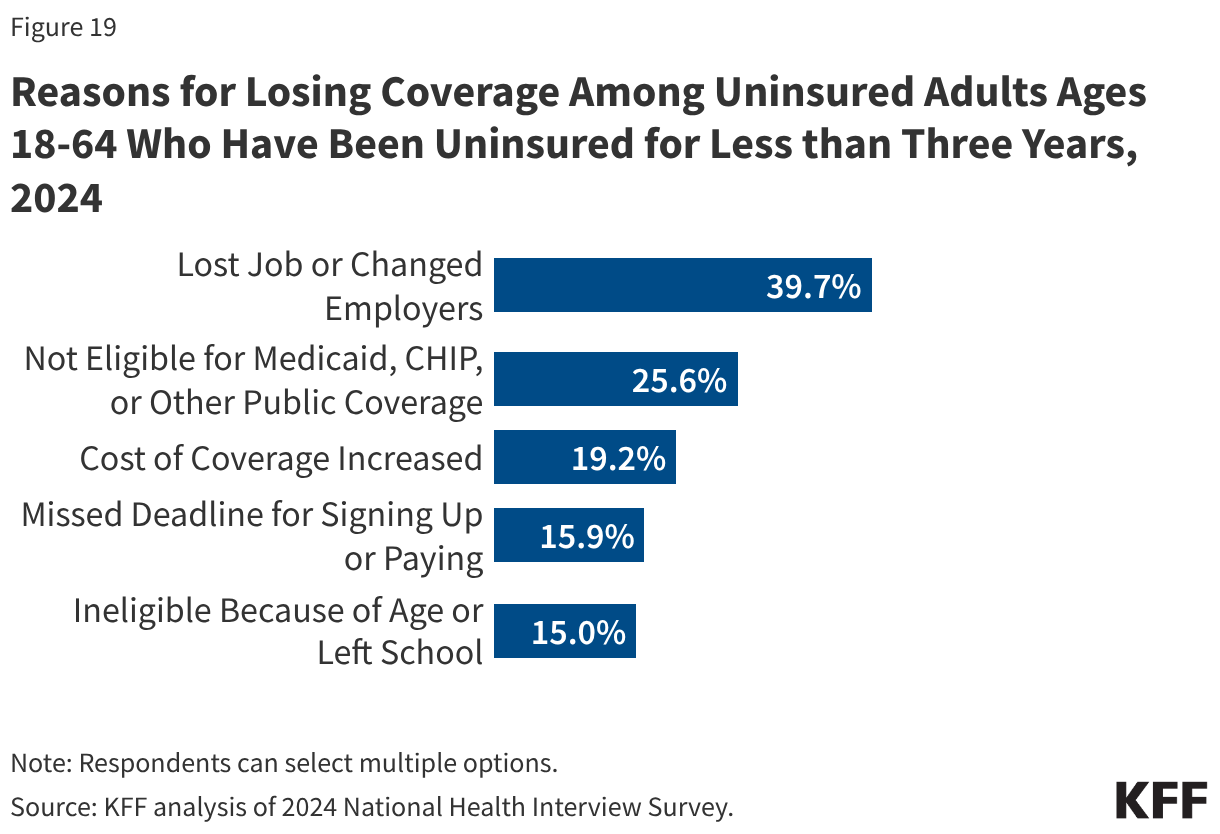
Losing a job or eligibility for public coverage can lead to people becoming uninsured. In 2024, 39.7% of adults who had not had health insurance in the last three years said they were uninsured because they lost their job or changed employers (Figure 19), and about a quarter (25.6%) said they lost coverage because they were no longer eligible for Medicaid, CHIP, or other public coverage. Other reasons for losing coverage included the cost of coverage increased (19.2%), missed the deadline for signing up or paying for coverage (15.9%), or lost eligibility due to age or leaving school (15.0%). 
Reasons for Losing Coverage Among Uninsured Adults Ages 18-64 Who Have Been Uninsured for Less than Three Years, 2024 (Bar Chart)

Barriers to Job-Based Coverage

Copy link to Barriers to Job-Based Coverage

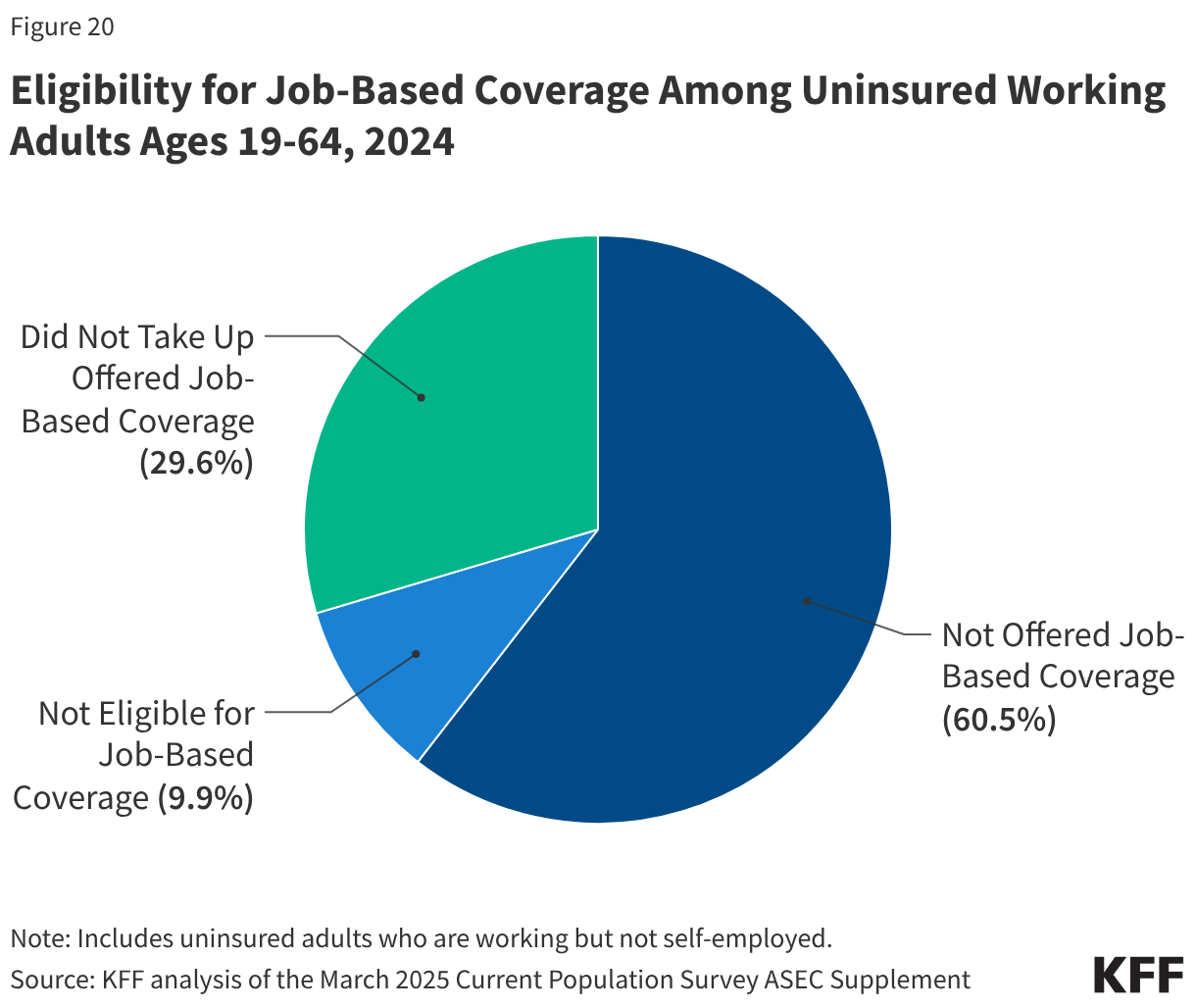
Not all workers have access to coverage through their job. In 2024, about 70% of uninsured adults who were working did not have access to health insurance through their employer. Six in ten (60.5%) uninsured adult workers worked for an employer that did not offer health insurance to its employees (Figure 20). A smaller share (9.9%) worked for an offering employer but were not eligible, often because they worked part-time or were a temporary or contract employee. 

Eligibility for Job-Based Coverage Among Uninsured Working Adults Ages 19-64, 2024 (Pie Chart)

Among uninsured workers who are offered coverage by their employers, cost is often a barrier to taking up the offer. From 2015 to 2025, total premiums for family coverage increased by 53%, outpacing wage growth, and the worker’s share increased by 37%. Low-income families with employer-based coverage spend a significantly higher share of their income toward premiums and out-of-pocket medical expenses compared to those with income above 200% FPL. Particularly among people working for small employers, premium contributions for dependents can be unaffordable. 

Limits on Medicaid Eligibility

Copy link to Limits on Medicaid Eligibility

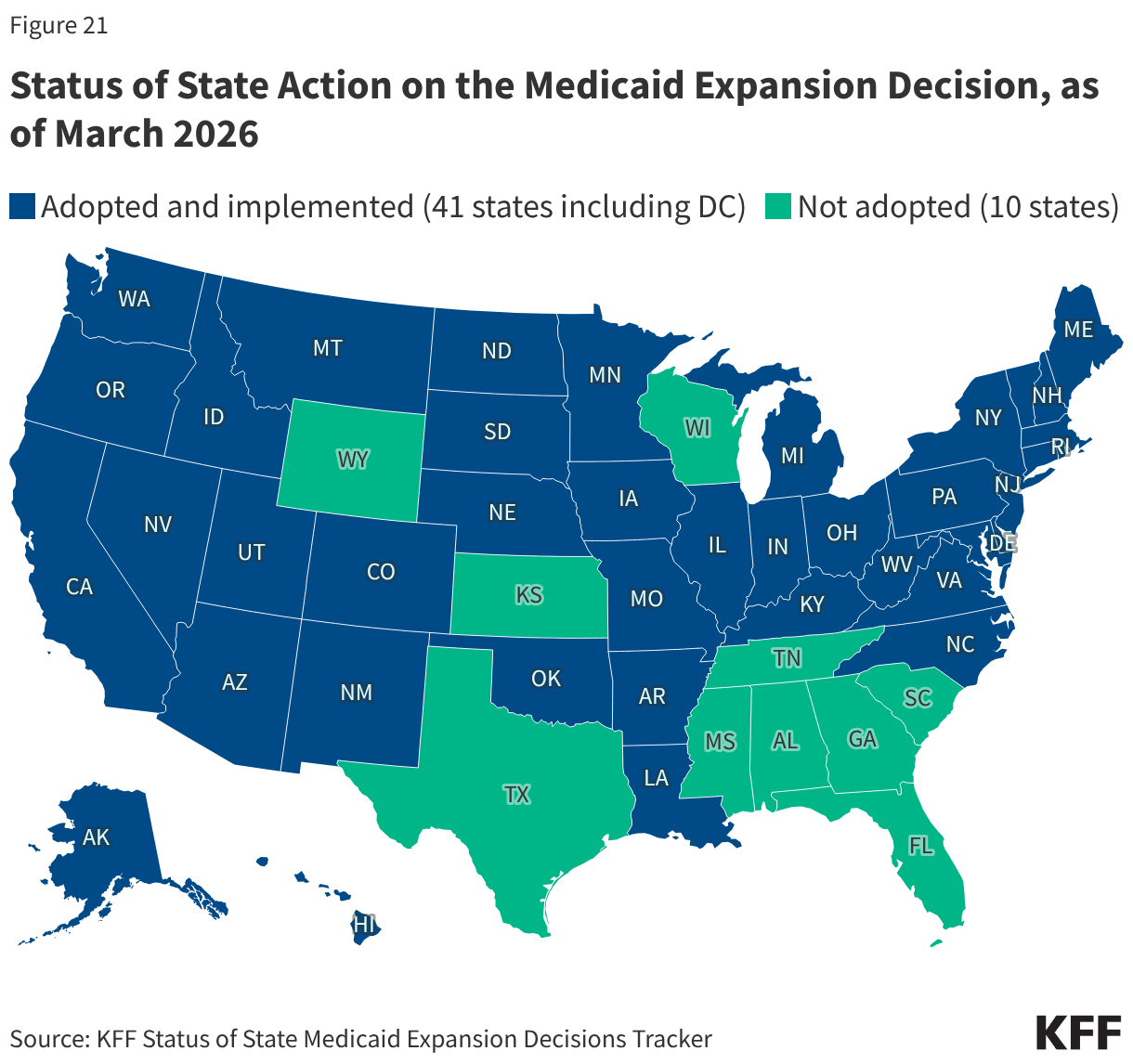
Medicaid eligibility varies across states, and eligibility for adults is limited in states that have not expanded Medicaid. As of March 2026, 41 states including DC had adopted the ACA Medicaid expansion (Figure 21). Two states implemented the expansion in 2023—South Dakota in July and North Carolina in December. In states that have not expanded Medicaid, the median eligibility level for parents is just 33% FPL, and adults without dependent children are ineligible in most cases. Additionally, in non-expansion states, millions of poor uninsured adults fall into a “coverage gap” because they earn too much to qualify for Medicaid but not enough to qualify for Marketplace premium tax credits. The 2025 reconciliation law makes changes to Medicaid eligibility for expansion adults by imposing new work requirements and more frequent eligibility determinations starting in January 2027.

Status of State Action on the Medicaid Expansion Decision, as of March 2026 (Choropleth map)

Barriers to Coverage for Immigrants

Copy link to Barriers to Coverage for Immigrants

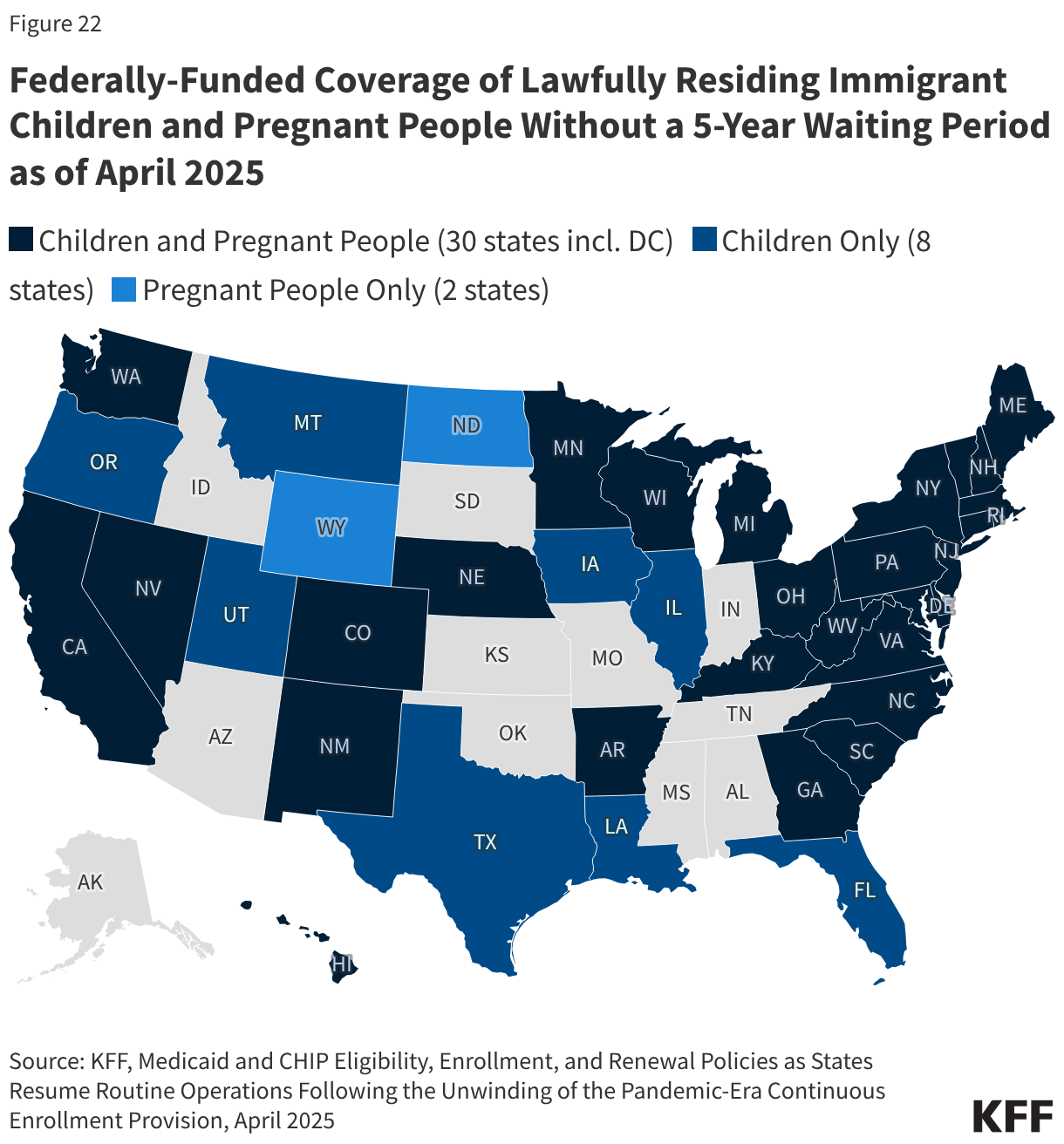
Immigrants face barriers to eligibility for public programs. Many lawfully present immigrants must meet a five-year waiting period after receiving “qualified” immigration status before they can enroll in Medicaid if they meet other eligibility criteria. States have the option to cover eligible lawfully present children and pregnant people without a waiting period, and as of April 2025, 38 states including DC have elected the option for children, and 32 states including DC have taken up the option for pregnant individuals (Figure 22). Undocumented immigrants are ineligible for federally funded coverage, including Medicaid or Marketplace coverage. Some states provide fully state-funded coverage to some groups of immigrants who are not eligible for federal coverage due to their immigration status but meet other eligibility requirements such as income.  The 2025 reconciliation law imposes new restrictions on immigrant eligibility for Medicaid and ACA Marketplace premium tax credits with some of the changes starting in 2026.

Federally-Funded Coverage of Lawfully Residing Immigrant Children and Pregnant People Without a 5-Year Waiting Period as of April 2025 (Choropleth map)

Eligibility for ACA Coverage Among Uninsured

Copy link to Eligibility for ACA Coverage Among Uninsured

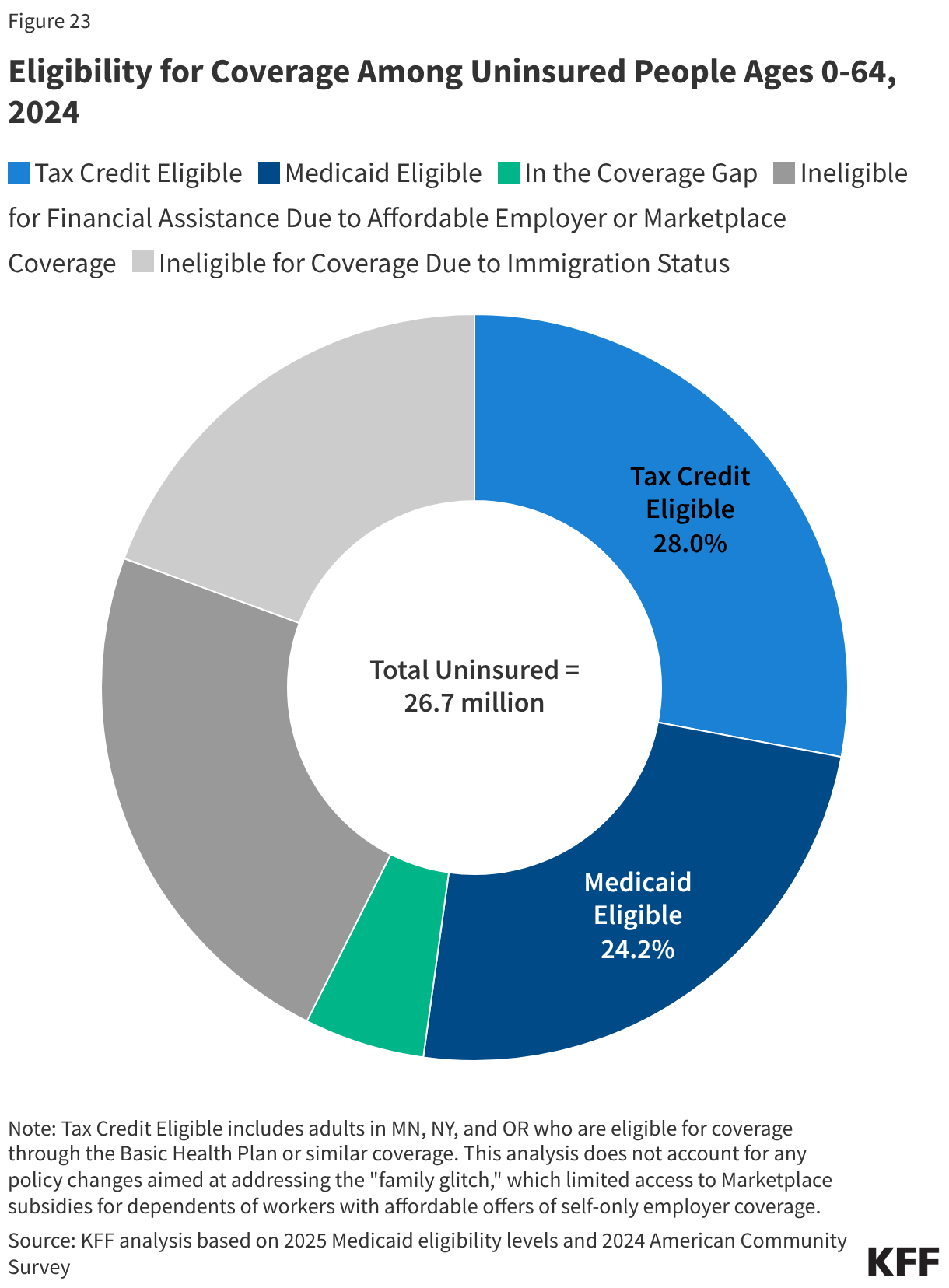
About half of the people who are uninsured may be eligible for financial assistance available under the ACA. Just over half (52.2% or 13.9 million) of uninsured individuals in 2024 were estimated to be eligible for financial assistance either through Medicaid or through subsidized Marketplace coverage (Figure 23). However, the remaining half of the uninsured population (47.8% or 12.8 million) were likely ineligible for free or subsidized coverage because their state did not expand Medicaid, their immigration status made them ineligible, or they were deemed to have access to an affordable Marketplace plan or employer coverage offer. 

Eligibility for Coverage Among Uninsured People Ages 0-64, 2024 (Donut Chart)

Barriers to Accessing Care for People Who Are Uninsured

Barriers to Care for Uninsured Adults

Copy link to Barriers to Care for Uninsured Adults

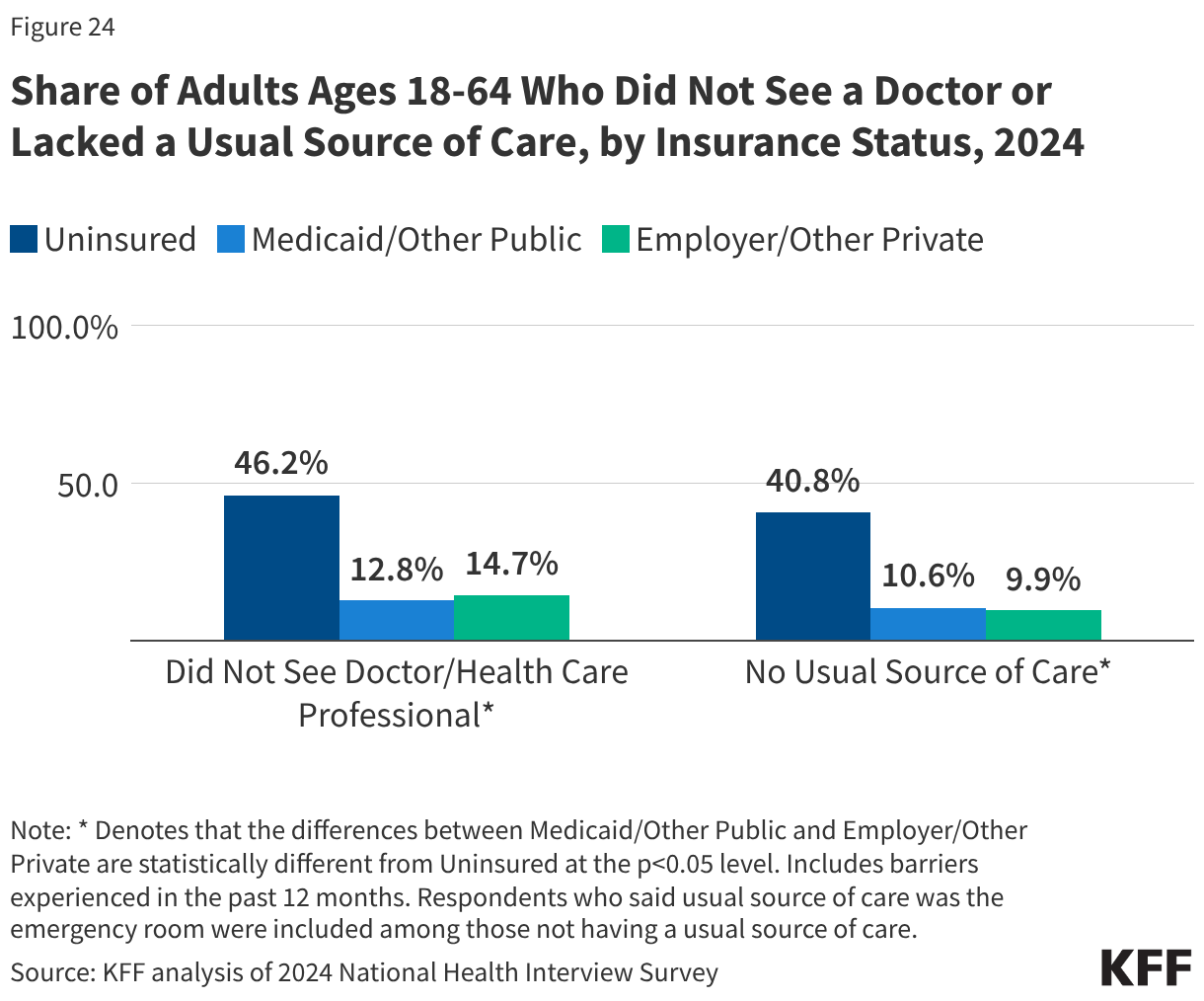
Uninsured adults are less likely than insured adults to have a usual place of care or to have seen a doctor in the past year. In 2024, nearly half (46.2%) of uninsured adults ages 18-64 reported not seeing a doctor or health care professional in the past 12 months compared to 14.7% with private insurance and 12.8% with public coverage. A main barrier to accessing care among uninsured adults is that many (40.8%) do not have a regular place to go when they are sick or need medical advice (Figure 24).

Share of Adults Ages 18-64 Who Did Not See a Doctor or Lacked a Usual Source of Care, by Insurance Status, 2024 (Grouped column chart)

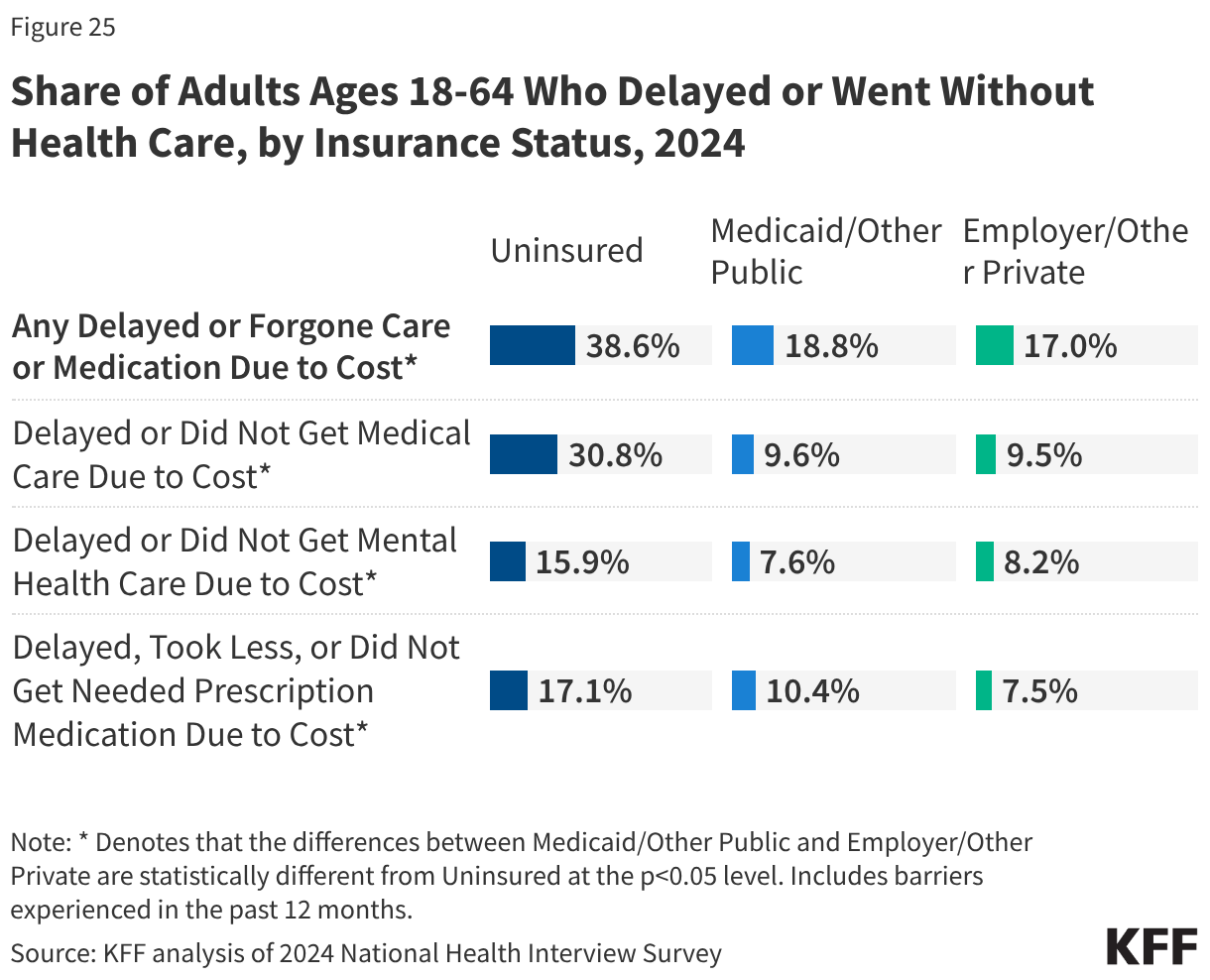
Uninsured adults are much more likely than their insured counterparts to delay or forgo needed care because of cost. In 2024, nearly four in ten uninsured adults (38.6%) reported delaying, skipping, or not getting needed care or medication due to cost, more than twice the share of adults with private coverage (17.0%) and those with public coverage (18.8%) (Figure 25). For many uninsured individuals, skipping or forgoing care can lead to worse health.  According to a KFF survey that found higher percentages of both uninsured and insured people delaying or forgoing needed care due to cost than reported above, four in ten uninsured adults (42.0%) reported that their health got worse after skipping or postponing care due to cost.

Share of Adults Ages 18-64 Who Delayed or Went Without Health Care, by Insurance Status, 2024 (Split Bars)

Barriers to Care for Uninsured Children

Copy link to Barriers to Care for Uninsured Children

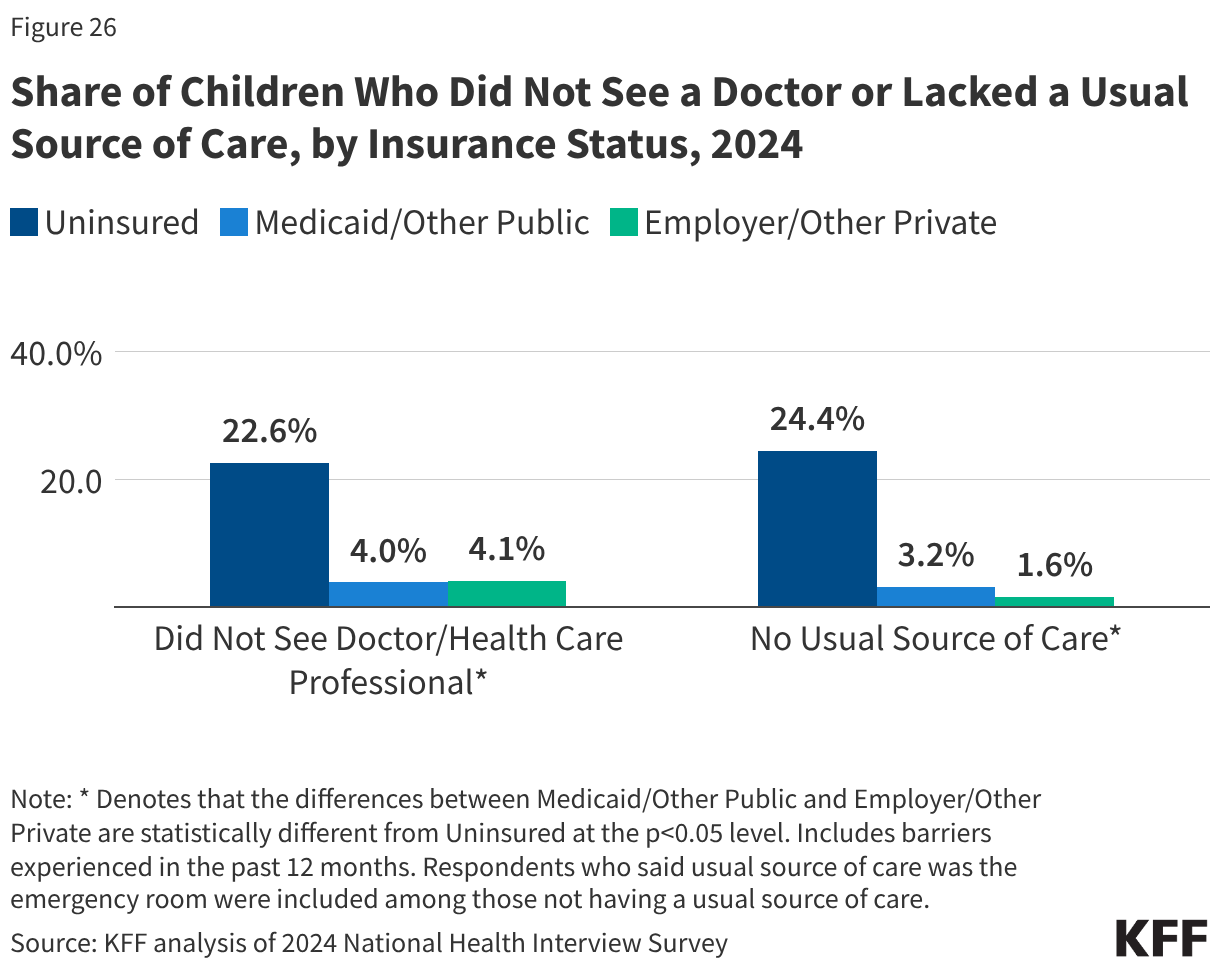
Compared to children with insurance coverage, uninsured children are less connected to the health care system. In 2024, about one in five (22.6%) uninsured children reported not seeing a doctor or health care professional in the past 12 months compared to 4.1% with private insurance and 4.0% with public coverage. Nearly a quarter (24.4%) of uninsured children did not have a regular place to go when they are sick or need medical advice (Figure 26).

Share of Children Who Did Not See a Doctor or Lacked a Usual Source of Care, by Insurance Status, 2024 (Grouped column chart)

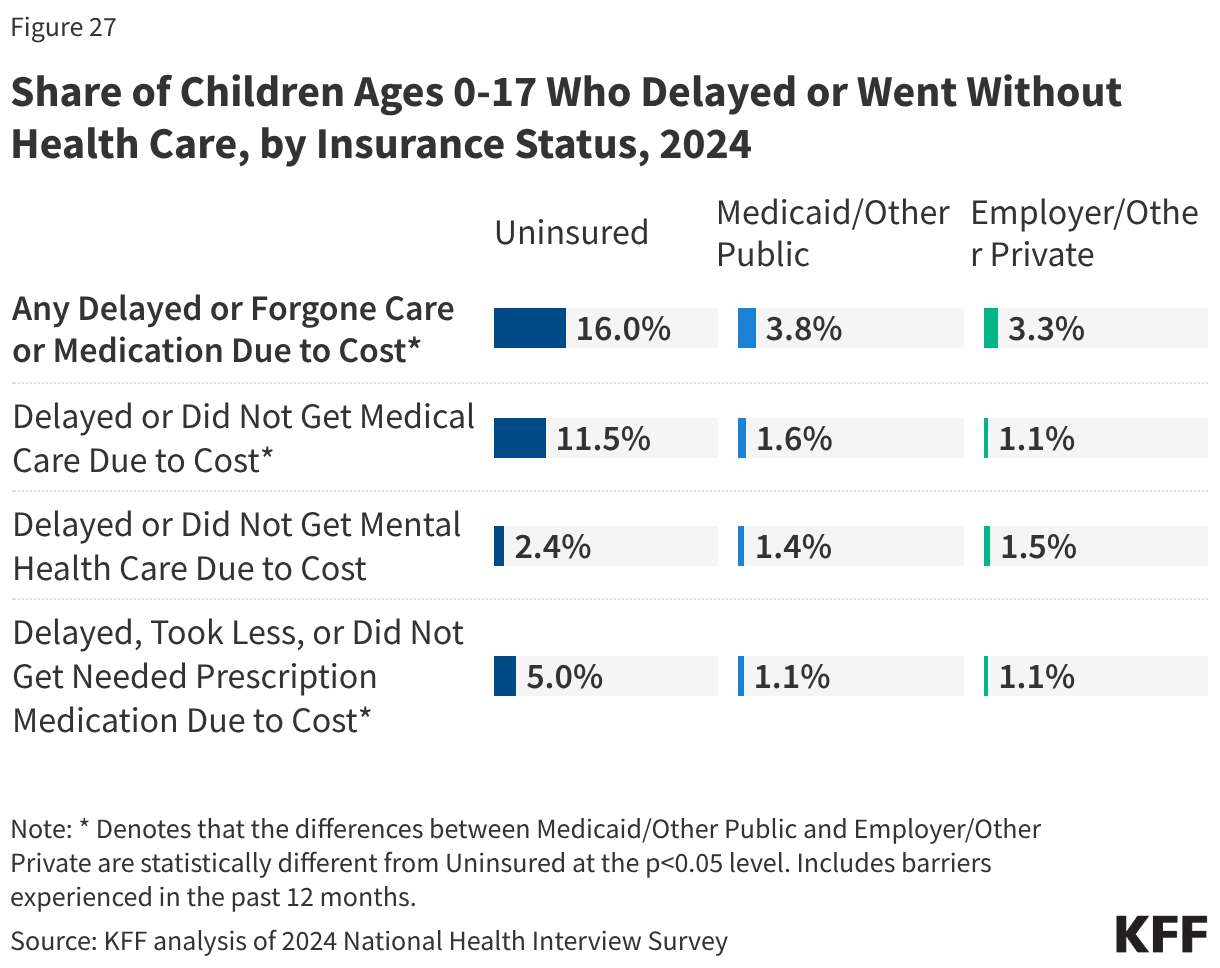
Uninsured children are also more likely than those with private insurance or public insurance to go without needed care due to cost. While children are less likely than adults to report not getting care, children without health coverage face greater access barriers than those with health coverage. In 2024, nearly one in six uninsured children (16.0%) reported delaying, skipping, or not getting needed care or medication due to cost compared to 3.3% of children with private coverage and 3.8% of children with public coverage (Figure 27). 

Share of Children Ages 0-17 Who Delayed or Went Without Health Care, by Insurance Status, 2024 (Split Bars)

Access to Care Among Uninsured Adults with Chronic Conditions

Copy link to Access to Care Among Uninsured Adults with Chronic Conditions

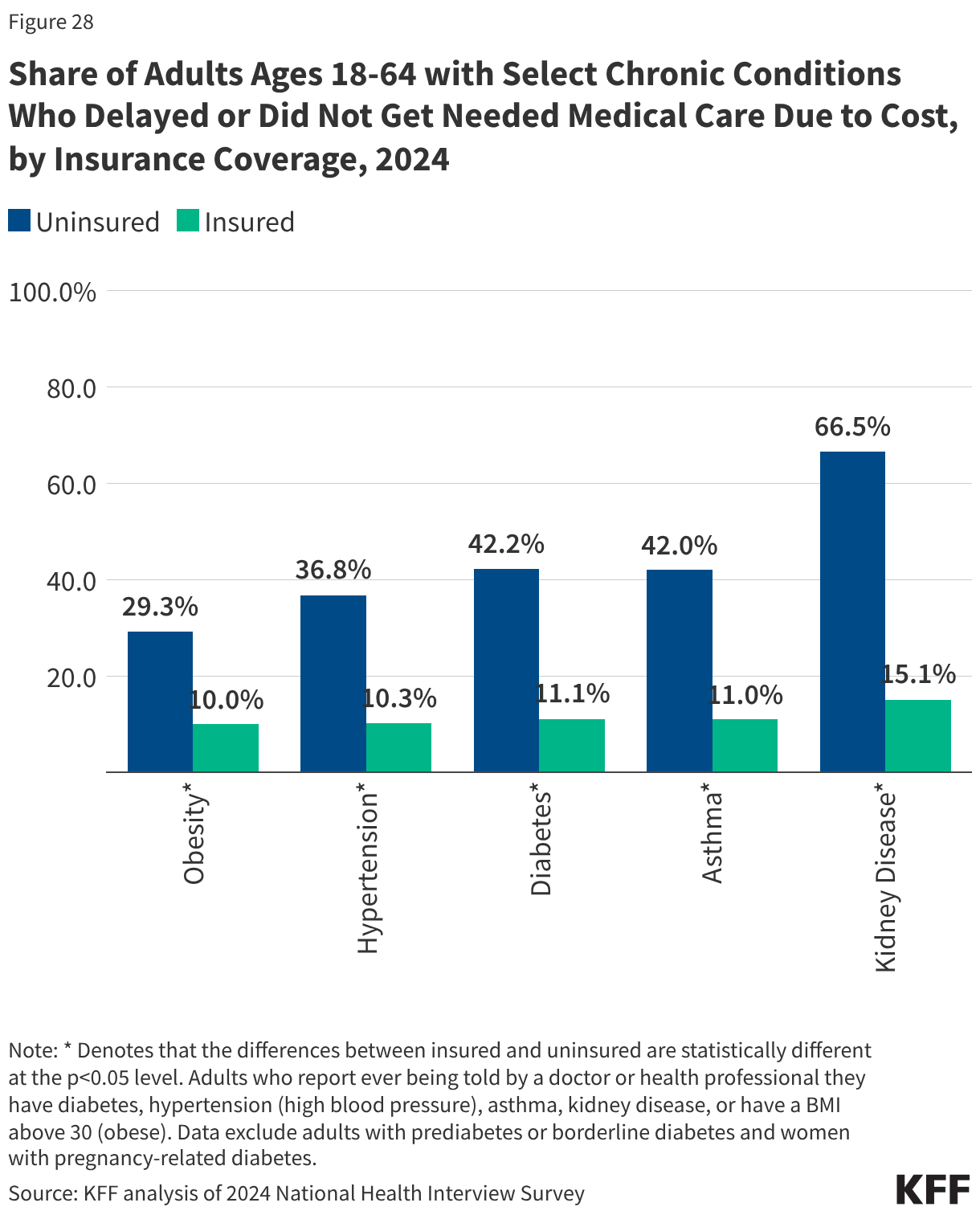
Uninsured individuals are less likely than those with insurance to receive services to treat chronic conditions. Among adults with chronic health conditions who need ongoing medical management, those without insurance coverage were three to four times more likely to delay or forgo needed medical care due to cost than adults with the same condition who were insured. For example, in 2024, over four in ten (42.2%) uninsured adults with diabetes delayed or did not get needed medical care because of cost compared to 11.1% of insured adults (Figure 28). Beyond forgoing needed care, many uninsured adults live with conditions that have never been diagnosed because they are less likely to see a health professional regularly. Gaining insurance is associated with higher rates of chronic condition diagnosis, demonstrating that many uninsured individuals live with undiagnosed chronic conditions due to their lack of access to care. People without health coverage are more likely to be hospitalized for avoidable health problems and to experience declines in their overall health as a consequence of having undiagnosed conditions and a lower likelihood of receiving preventive and chronic disease management care. When they are hospitalized, uninsured people receive fewer diagnostic and therapeutic services and also have higher mortality rates than those with insurance. 
Share of Adults Ages 18-64 with Select Chronic Conditions Who Delayed or Did Not Get Needed Medical Care Due to Cost, by Insurance Coverage, 2024 (Grouped column chart)

Research demonstrates that gaining health insurance improves access to health care considerably and diminishes the adverse effects of having been uninsured.review of research on the effects of the ACA Medicaid expansion finds that expansion led to positive effects on access to care, utilization of services, the affordability of care, and financial security among the low-income population. Medicaid expansion is also associated with increased early-stage diagnosis rates for cancer, lower rates of cardiovascular mortality, and increased odds of tobacco cessation.  Evidence also indicates that gaining health coverage through the Medicaid expansion saves lives. One recent study found a 2.5% reduction in mortality among low-income adults in Medicaid expansion states and concluded that Medicaid expansion reduced the risk of death by 21% among new enrollees, saving an estimated 27,000 lives from 2010-2022.

Access to Charity Care

Copy link to Access to Charity Care

While some uninsured individuals may be eligible for free or discounted health care services, not all uninsured individuals are able to access charity care programs. Public hospitals, community clinics and health centers, and local providers that serve underserved communities provide a crucial health care safety net for uninsured people. However, safety net providers have limited resources and service capacity, and not all uninsured people have geographic access to a safety net provider. Hospital charity care programs provide free or discounted services to eligible patients who are unable to afford their care, though eligibility criteria vary across hospitals. Not all eligible patients benefit from these programs because they may not be aware that charity care is available or do not think they are eligible. They may also have difficulty completing an application or may choose not to apply.

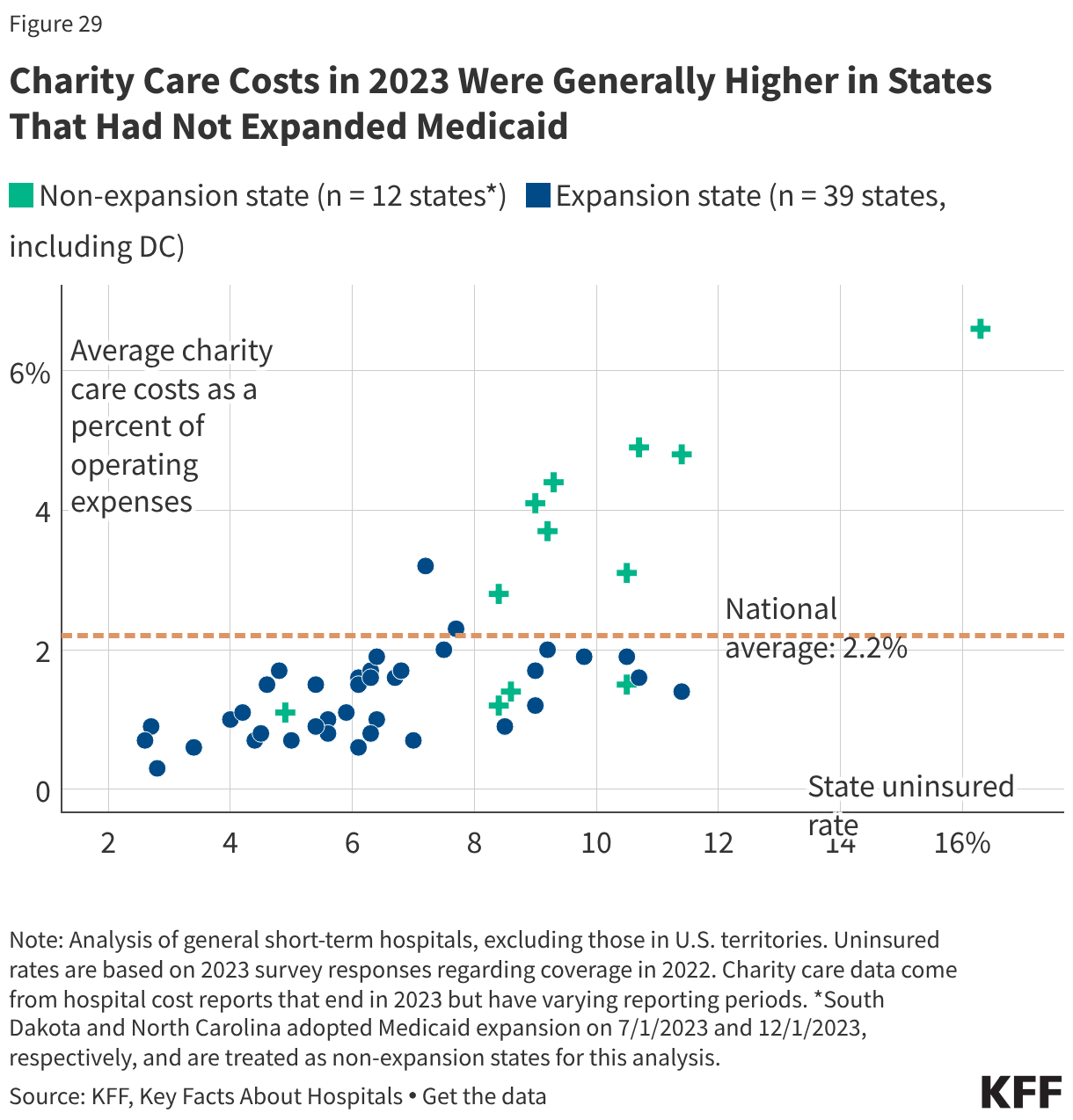
While charity care programs help uninsured patients afford care, they can strain hospital finances. Charity care as a percent of expenses varies widely across hospitals. Hospital charity care costs are generally higher in states that have not expanded Medicaid, which also generally have higher uninsured rates (Figure 29). Moreover, research indicates that Medicaid expansion is associated with reductions in uncompensated care costs and improved financial performance for rural hospitals and other providers.

Charity Care Costs in 2023 Were Generally Higher in States That Had Not Expanded Medicaid (Scatter Plot)

Financial Implications of Being Uninsured

Unaffordable Medical Bills 

Copy link to Unaffordable Medical Bills 

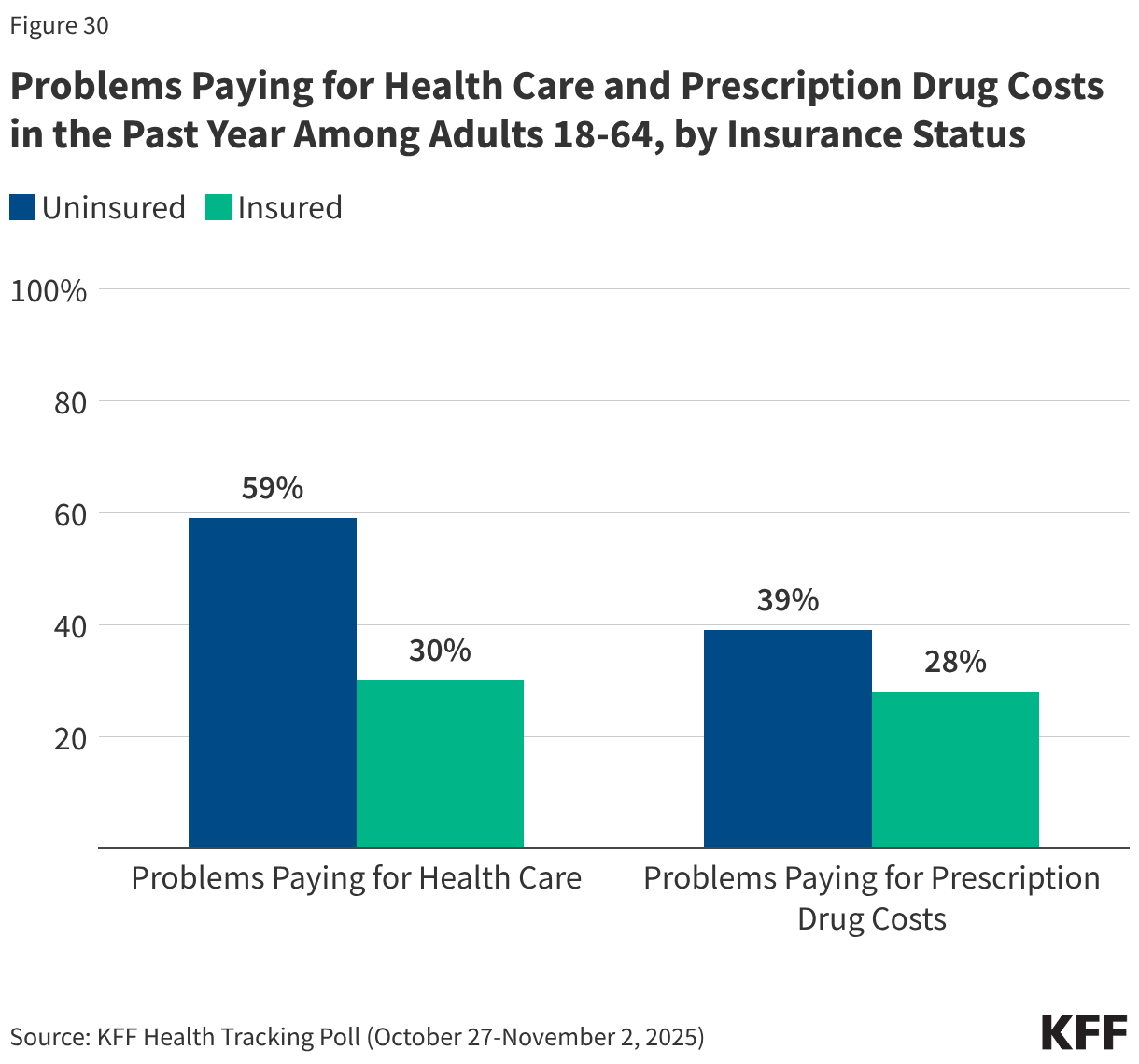
Adults who are uninsured are more likely to report difficulty paying for health care costs than adults with insurance coverage.  While affording health care costs can be challenging regardless of insurance status, uninsured adults are nearly twice as likely as insured adults to say that affording health care costs is difficult (82% vs. 42%). When it comes to paying health care costs, about six in ten (59%) uninsured adults said they or someone living with them had problems compared to 30% of insured adults, and about four in ten (39%) uninsured adults said that they or someone living with them had problems paying for prescription drug costs specifically compared to 28% of insured adults (Figure 30).  

Problems Paying for Health Care  and Prescription Drug Costs in the Past Year Among Adults 18-64, by Insurance Status (Grouped column chart)

Financial Insecurity

Copy link to Financial Insecurity

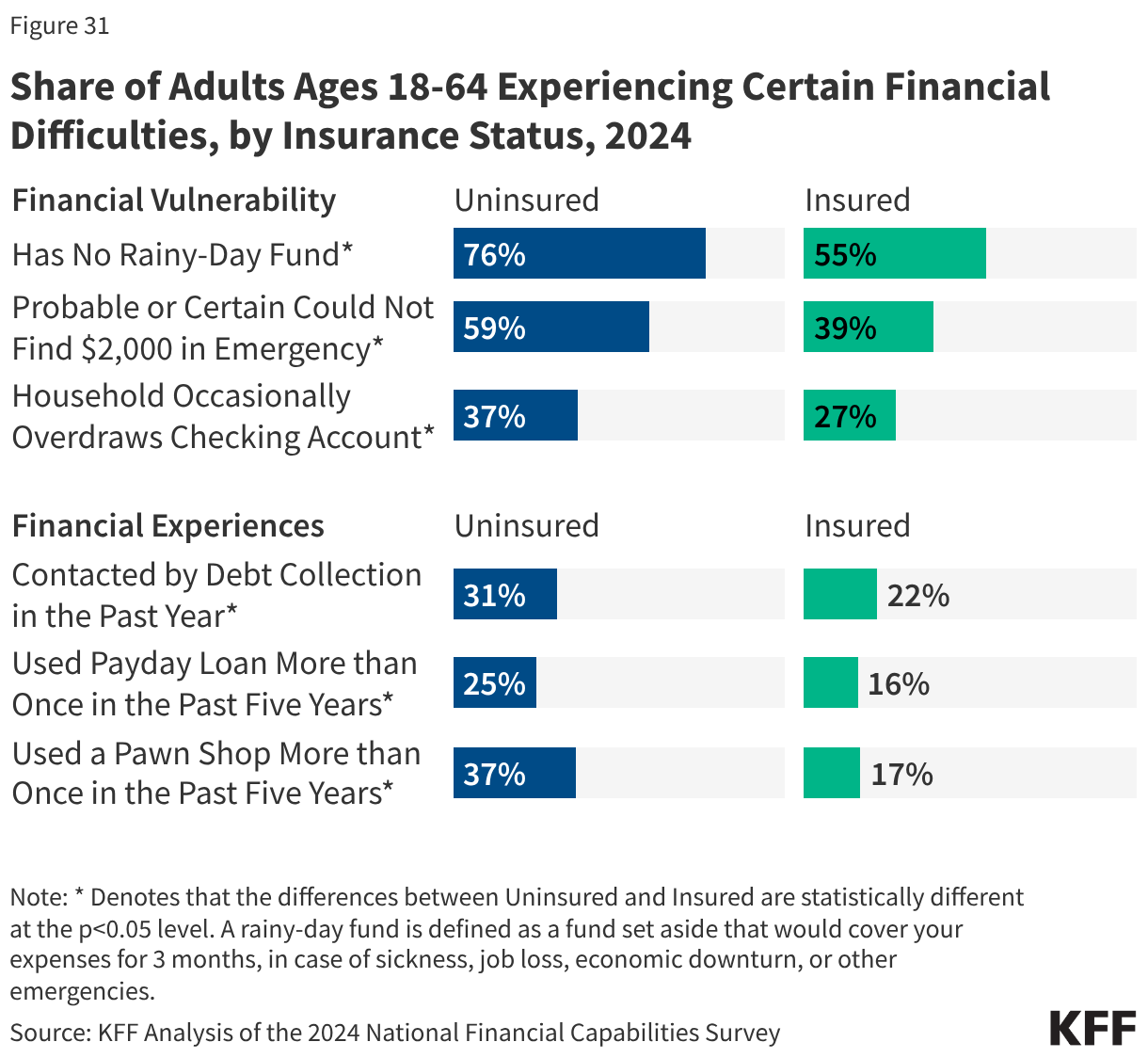
People who are uninsured are more likely to experience measures of financial distress, including overdrawing their checking account, having been contacted by a debt collection agency, and having used pay day loans. Because adults who are uninsured are more likely to have lower income than those with insurance, they are also more financially vulnerable. Almost six in ten (59%) uninsured adults ages 18-64 report that it is probable or certain that they could not find $2,000 if an unexpected need, such as a medical emergency, arose in the next month compared to four in ten (39%) insured adults (Figure 31). Adults who are uninsured also have more difficulty paying their bills. About three in ten (31%) reported being contacted by debt collection in the past year, and one quarter said they used payday loans in the past five years compared to 22% and 16% of insured adults, respectively.

Share of Adults Ages 18-64 Experiencing Certain Financial Difficulties, by Insurance Status, 2024 (Split Bars)

Research suggests that gaining health coverage improves the affordability of care and financial security among the low-income population. Multiple studies of the ACA found declines in trouble paying medical bills and reductions in medical debt in expansion states relative to non-expansion states.  More recent research found that Medicaid expansion decreased catastrophic health expenditures and was associated with greater increases in income among low-income individuals. 

Medical Debt

Copy link to Medical Debt

Medical bills can quickly translate into medical debt for people who are uninsured as many have low or moderate incomes and have little, if any, savings.  Unaffordable medical bills can lead to medical debt, particularly for uninsured adults.  More than one third (34%) of uninsured adults under age 65 have medical debt, meaning they have one or more unpaid bills from a medical service provider that are past due, compared to 26% of insured adults under age 65 (Figure 32). Using a broader definition of medical debt, which includes health care debt on credit cards or owed to family members, more than six in ten (62%) uninsured adults under age 65 report having health care debt compared to over four in ten (44%) insured adults under age 65. Uninsured adults are more likely to face negative consequences due to health care debt, such as using up savings, having difficulty paying other living expenses, or borrowing money.   

Medical Debt Among Adults Ages 18-64, by Insurance Status (Grouped column chart)

Appendix and Supplemental Tables

Appendix Tables

Copy link to Appendix Tables
Uninsured Rate Among the Population Ages 0-64 by State, 2019, 2023, 2024 (Table)
Characteristics of the Uninsured Population Ages 0-64, 2024 (Table)
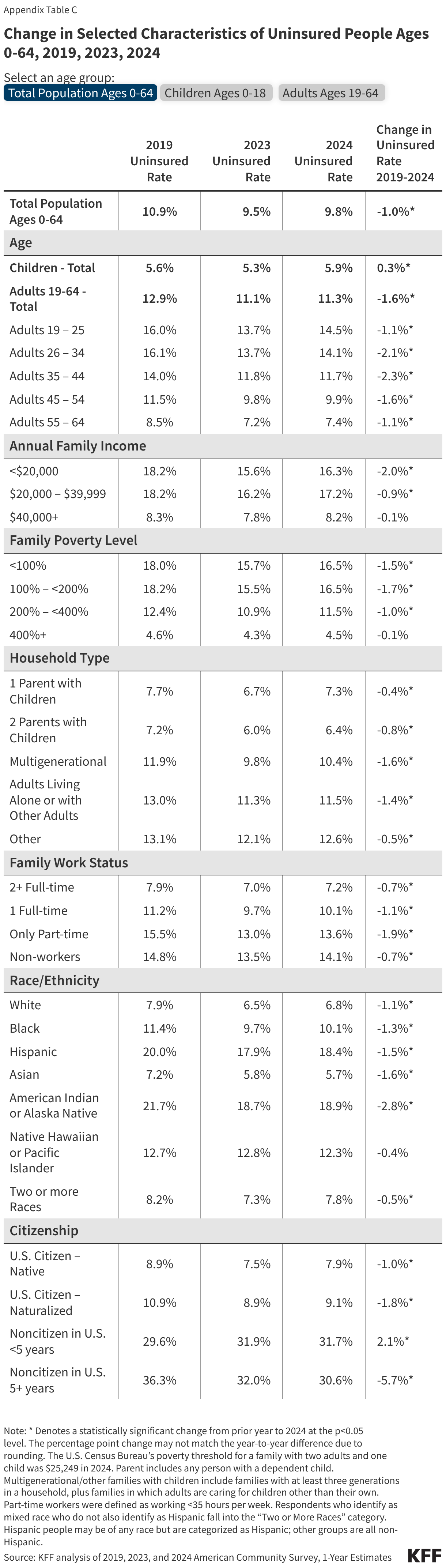
Change in Selected Characteristics of Uninsured People Ages 0-64, 2019, 2023, 2024 (Table)

Supplemental Tables

Copy link to Supplemental Tables
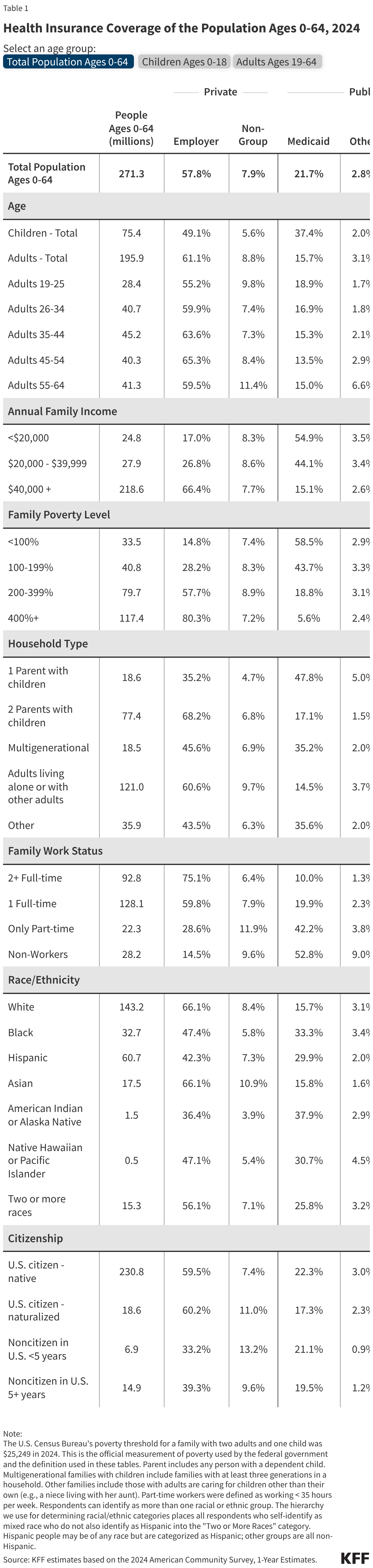
Health Insurance Coverage of the Population Ages 0-64, 2024 (Table)
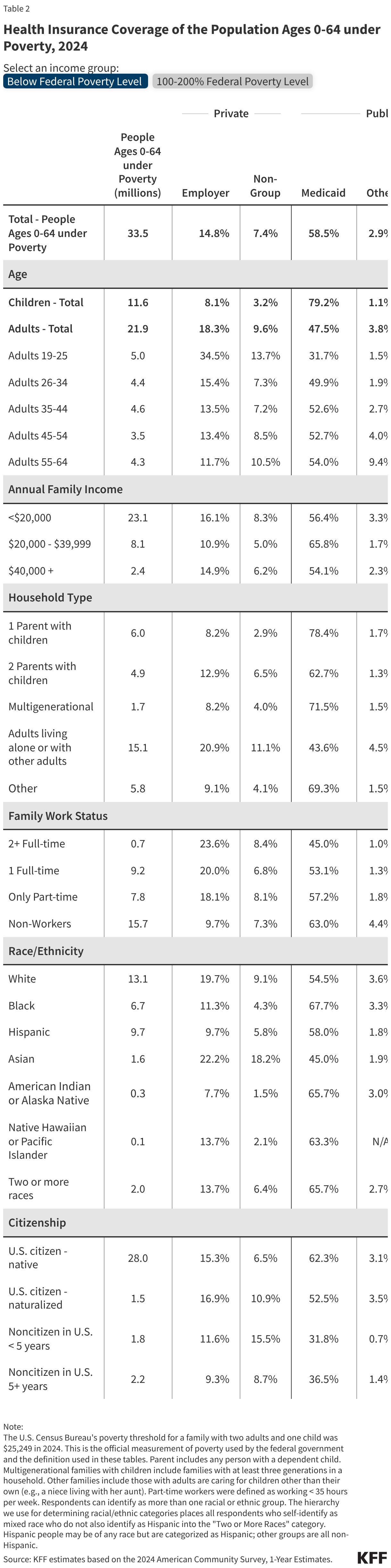
Health Insurance Coverage of the Population Ages 0-64 under Poverty, 2024 (Table)
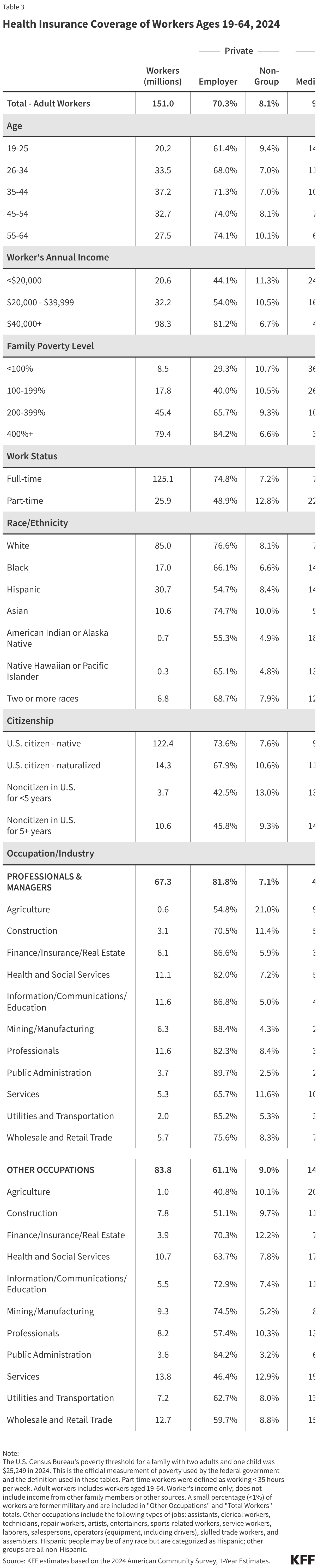
Health Insurance Coverage of Workers Ages 19-64, 2024 (Table)
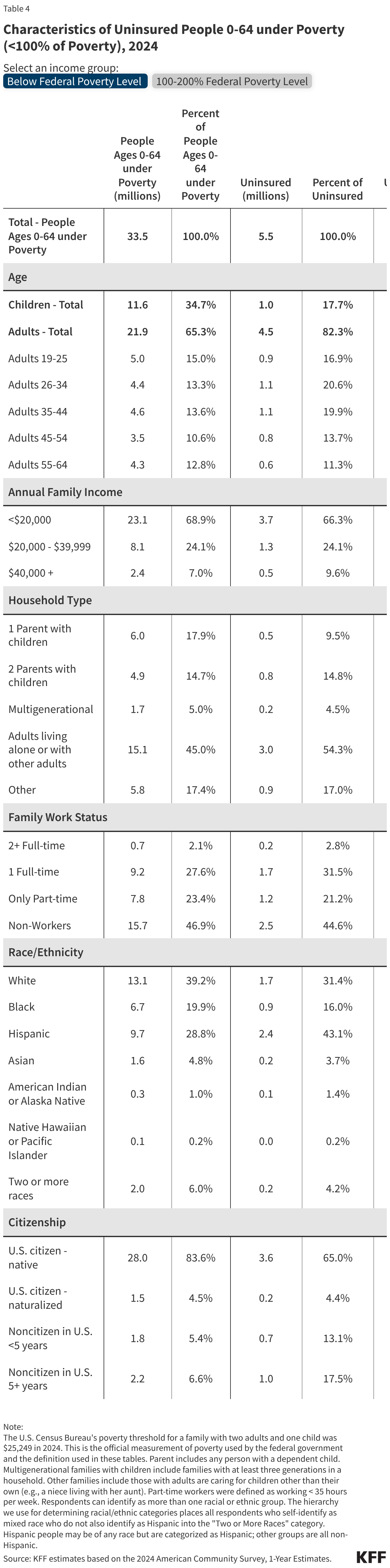
Characteristics of Uninsured People 0-64 under Poverty (<100% of Poverty), 2024 (Table)
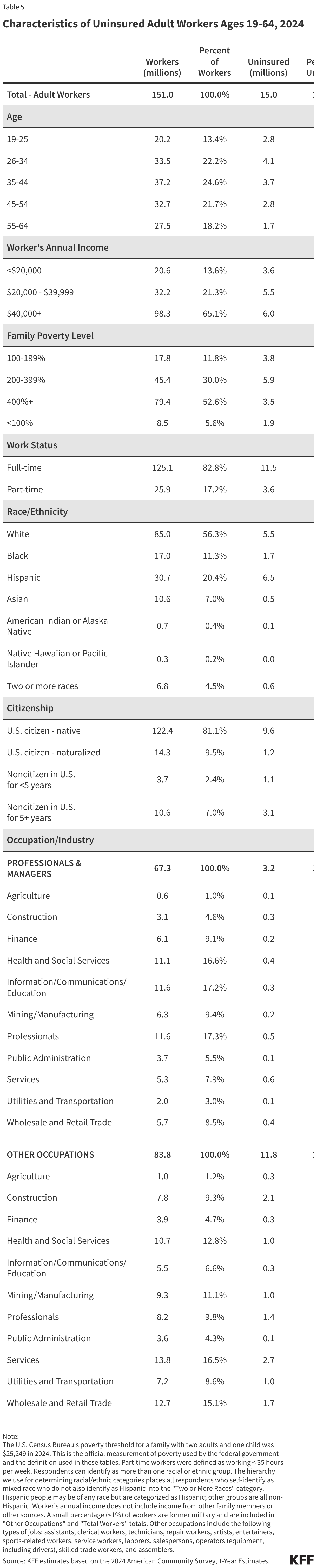
Characteristics of Uninsured Adult Workers Ages 19-64, 2024 (Table)