Medicare

Medicare Open Enrollment

Medicare Advantage Plan Availability Varies Widely by County for 2027

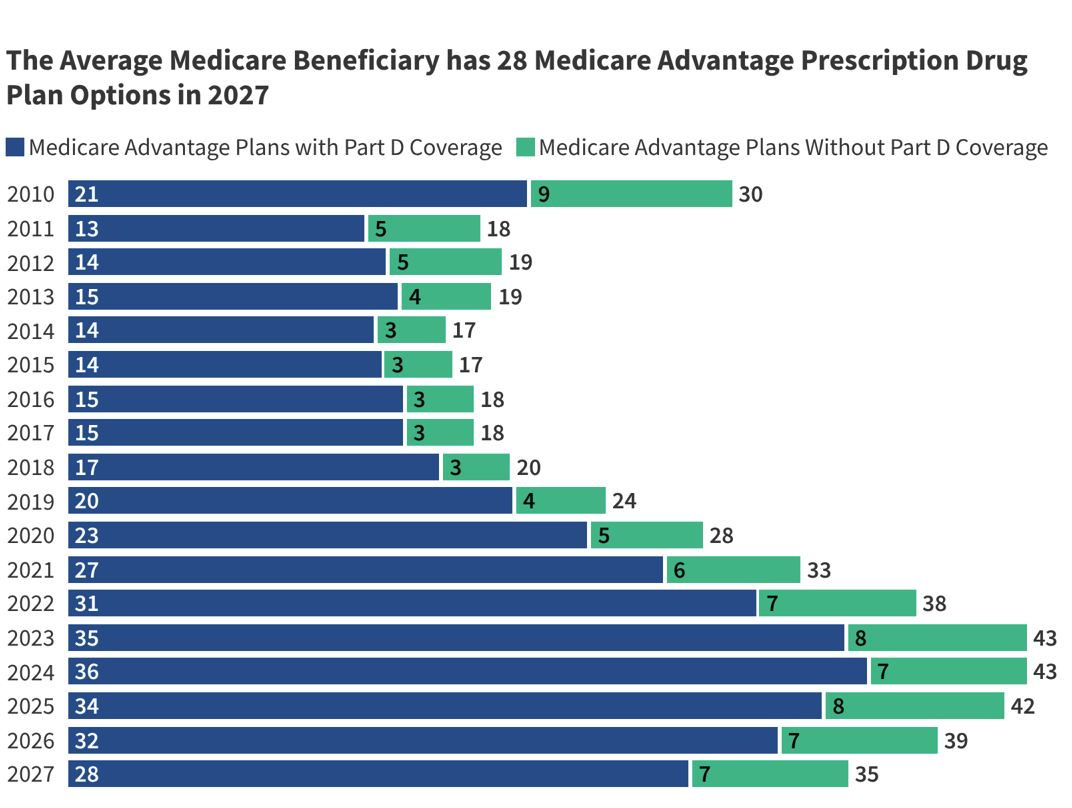
Medicare Advantage prescription drug plan (MA-PD) availability varies widely by county in 2027, with a modest reduction in the share of enrollees with more than 40 plans to choose from and some major insurers exiting many more counties than they are entering. 1 in 5 Medicare beneficiaries (20%) can choose from among more than 40 MA-PDs for 2027, down from 27% in 2026. 1% of all beneficiaries will have no plan option for 2027.
Medicare Open Enrollment and Coverage Options: Key Questions and Answers

Each year, Medicare beneficiaries have an opportunity to make changes to how they receive their Medicare coverage during the nearly 8-week annual open enrollment period, which runs from October 15 through December 7. This brief answers key questions about the Medicare open enrollment period and Medicare coverage options.

Medigap

Medigap Guaranteed Issue Requirements: An Overview of Federal and State Rules

This issue brief analyzes federal and state rules related to guaranteed issue requirements for Medigap policies and how they impact beneficiaries’ access to Medigap, including the implications for Medicare beneficiaries with pre-existing medical conditions and those under age 65 with long-term disabilities.

NEW AND NOTEWORTHY

Decoding Medicare Advantage Coding Intensity

Federal payments to Medicare Advantage plans, and adjustments for health status, have come under increased scrutiny. This brief answers key questions about coding intensity, recent steps taken by CMS, the effects on beneficiaries, and other proposals to improve payment accuracy.

Data Visualization

The Facts About Medicare Spending

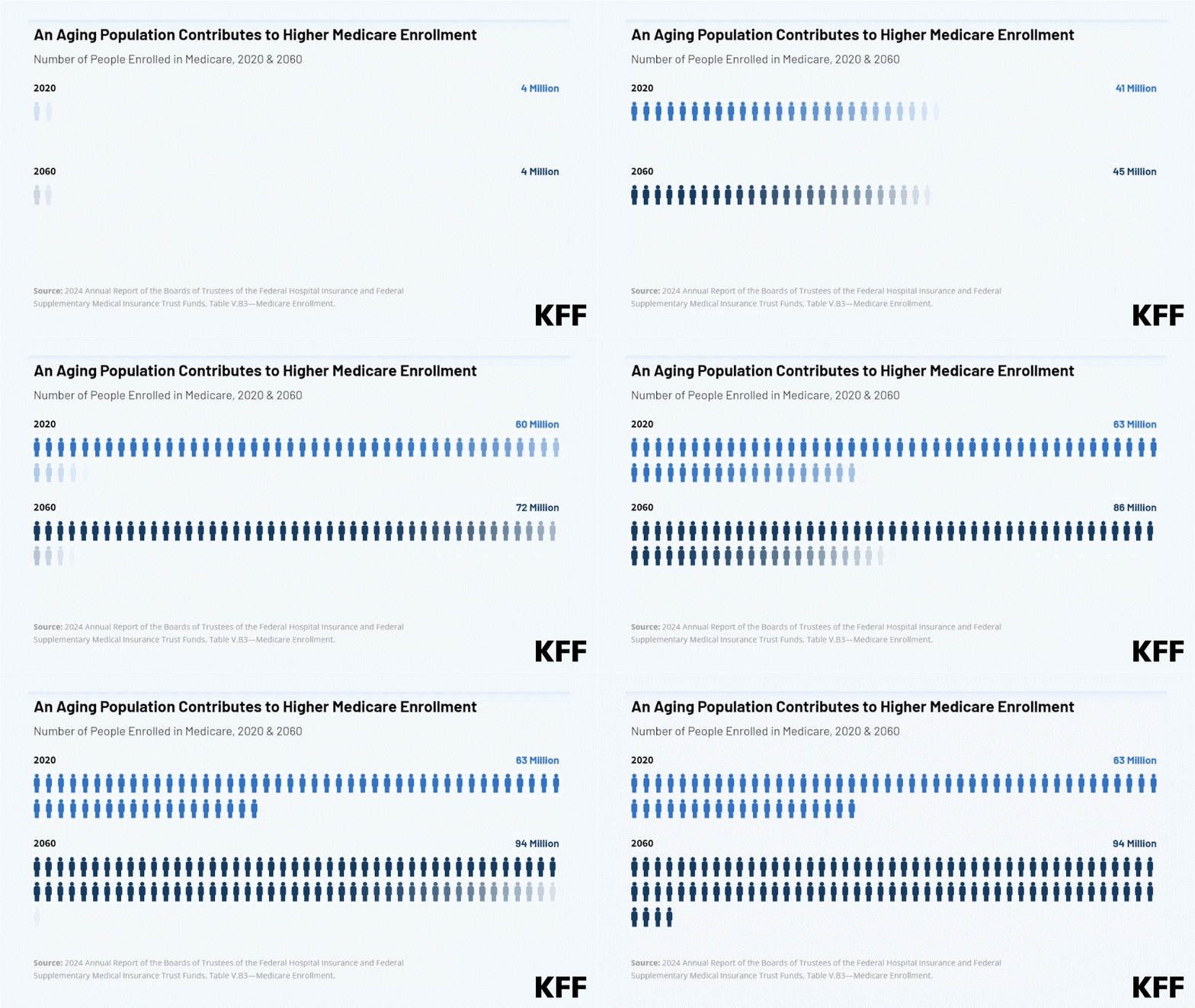
This interactive provides the facts on Medicare spending. Medicare, which serves 67 million people and accounts for 12 percent of the federal budget and 21 percent of national health spending, is often the focus of discussions about health expenditures, health care affordability and the sustainability of federal health programs. Explore data on enrollment growth, Medicare spending trends overall and per person, growth in Medicare spending relative to private insurance, spending on benefits and Medicare Advantage, Part A trust fund solvency challenges, and growth in out-of-pocket spending by beneficiaries.

Read More

Stay informed.

Stay informed.

Filter

701-710 of 1,623 results

  • Chartpack: The Public’s Health Care Agenda

    Poll Finding

    These charts highlight data from The Public’s Health Care Agenda for the New Congress and Presidential Campaign, conducted jointly by the Kaiser Family Foundation and the Harvard School of Public Health between November 9 and 19, 2006. The survey looks at the public’s priorities and views on health issues as a new Democratic majority takes the leadership of Congress and as the 2008 presidential campaign begins to take shape. Chartpack (.pdf)

  • Chartpack: Seniors and the Medicare Prescription Drug Benefit

    Poll Finding

    These charts highlight data from a poll on Seniors and the Medicare Prescription Drug Benefit, conducted jointly by the Kaiser Family Foundation and the Harvard School of Public Health between November 9 and 19, 2006. It included a nationally representative sample of 718 seniors, including 275 who reported being enrolled in a Medicare drug plan. The questions about experiences under the Medicare drug benefit were part of a larger survey of 1,867 adults on the…

  • Pulling it Together: 2012: The ACA, and More

    From Drew Altman

    What is remarkable about 2012 (and the current era in health policy) is how many big health policy issues and marketplace changes will be in play at the same time: HEALTH REFORM: There is the implementation of a historic but fragile health reform law, with a Supreme Court decision pending and so much hanging in the balance. MEDICARE AND MEDICAID: There are continuing debates about potentially big changes in Medicare and Medicaid, driven by the…

  • Medicare Restructuring: The FEHBP Model

    Report

    This report provides a comprehensive description of the Federal Employees Health Benefits Program (FEHBP) and compares the FEHBP and Medicare programs as they are currently structured. It reviews evidence on the performance of FEHBP and examines the implications of restructuring Medicare to conform to a FEHBP-based plan. Overall, the report suggests that FEHBP offers some promise as an approach for reforming Medicare, but important issues would have to be addressed to adapt the model to…

  • Medicare Restructuring: The FEHBP Model A Summary

    Other Post

    Medicare Restructuring: The FEHBP Model Executive Summary Part 2 How Well Does FEHBP work? FEHBP has been somewhat more successful than Medicare in controlling costs. However, recent trends indicate that FEHBP's competitive structure alone cannot guarantee cost control over the long term. Until recently, FEHBP experienced slightly lower growth in spending per enrollee than Medicare. Over the period 1987 to 1997, Medicare spending per beneficiary grew at an annual rate of 8.1 percent. FEHBP spending…

  • Medicare’s Role for Latinos

    Fact Sheet

    Medicare's Role for Latinos Fact Sheet: The Medicare Program: Medicare's Role For Latinos

  • Medicare Part D 2009 Data Spotlight: Premiums

    Report

    This Medicare Part D data spotlight analyzes the premiums charged by the 1,689 stand-alone Medicare Part D plans that will be offered in markets across the country in 2009. The analysis finds premiums charged for Part D plans range widely, from $10.30 per month to $136.80 per month. If current enrollees remain in their current plan for next year, the weighted average monthly premium for PDPs would increase by $7.40 per month, from $29.89 in…

  • Medicare Part D 2009 Data Spotlight: Low-Income Subsidy Plan Availability

    Issue Brief

    This Medicare Part D Data Spotlight focuses on the availability of drug plans for beneficiaries receiving the Part D low-income subsidy in 2009 and changes since 2006. For 2009, fewer than one in five plans qualify for automatic or facilitated enrollment of low-income subsidy beneficiaries, the lowest share since the inception of the Part D benefit. These plans have monthly premiums below a benchmark amount calculated for each region, enabling low-income subsidy beneficiaries to enroll…

  • Chartpack — The Public’s Health Care Agenda for the New President and Congress

    Poll Finding

    Chartpack -- The Public's Health Care Agenda for the New President and Congress This chartpack provides the key findings from the survey of the public's attitudes regarding the health care agenda for President Obama and the new Congress in 2009. It assesses the relative priority placed on health care by the American public as part of addressing the economic recession and as a large scale reform issue. The public's priorities for health care reform and…