Medicare

Medicare Open Enrollment

Medicare Advantage Plan Availability Varies Widely by County for 2027

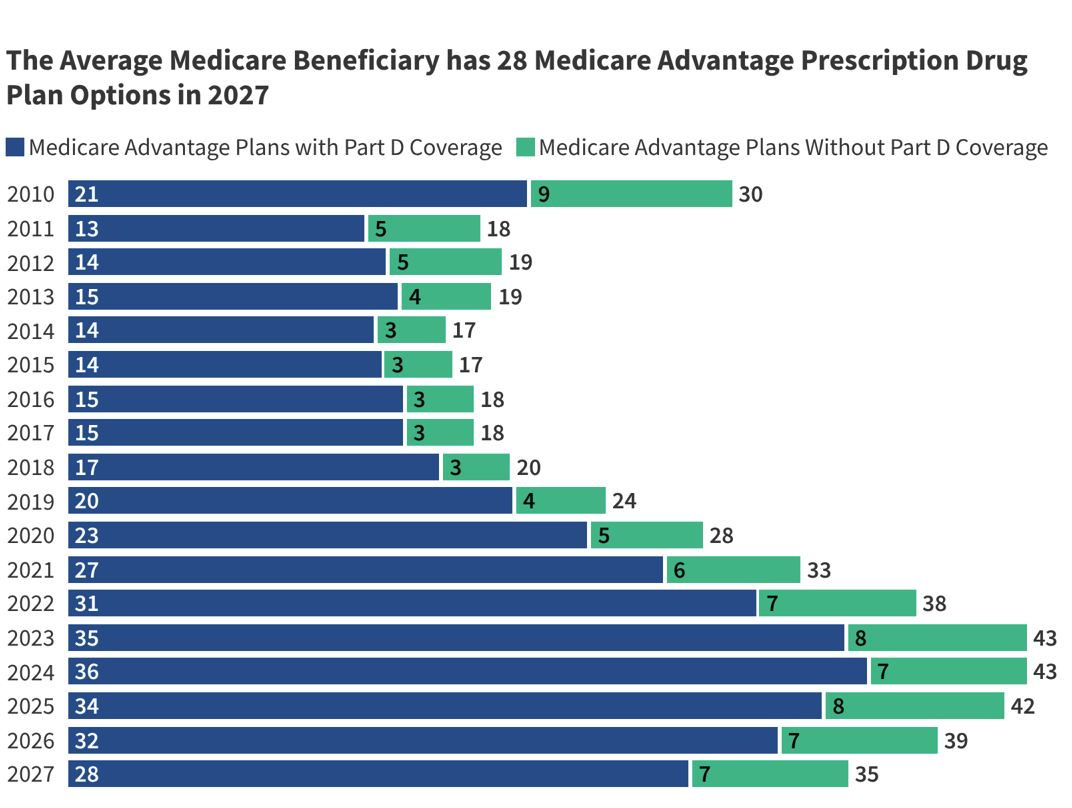
Medicare Advantage prescription drug plan (MA-PD) availability varies widely by county in 2027, with a modest reduction in the share of enrollees with more than 40 plans to choose from and some major insurers exiting many more counties than they are entering. 1 in 5 Medicare beneficiaries (20%) can choose from among more than 40 MA-PDs for 2027, down from 27% in 2026. 1% of all beneficiaries will have no plan option for 2027.
Medicare Open Enrollment and Coverage Options: Key Questions and Answers

Each year, Medicare beneficiaries have an opportunity to make changes to how they receive their Medicare coverage during the nearly 8-week annual open enrollment period, which runs from October 15 through December 7. This brief answers key questions about the Medicare open enrollment period and Medicare coverage options.

Medigap

Medigap Guaranteed Issue Requirements: An Overview of Federal and State Rules

This issue brief analyzes federal and state rules related to guaranteed issue requirements for Medigap policies and how they impact beneficiaries’ access to Medigap, including the implications for Medicare beneficiaries with pre-existing medical conditions and those under age 65 with long-term disabilities.

NEW AND NOTEWORTHY

Decoding Medicare Advantage Coding Intensity

Federal payments to Medicare Advantage plans, and adjustments for health status, have come under increased scrutiny. This brief answers key questions about coding intensity, recent steps taken by CMS, the effects on beneficiaries, and other proposals to improve payment accuracy.

Data Visualization

The Facts About Medicare Spending

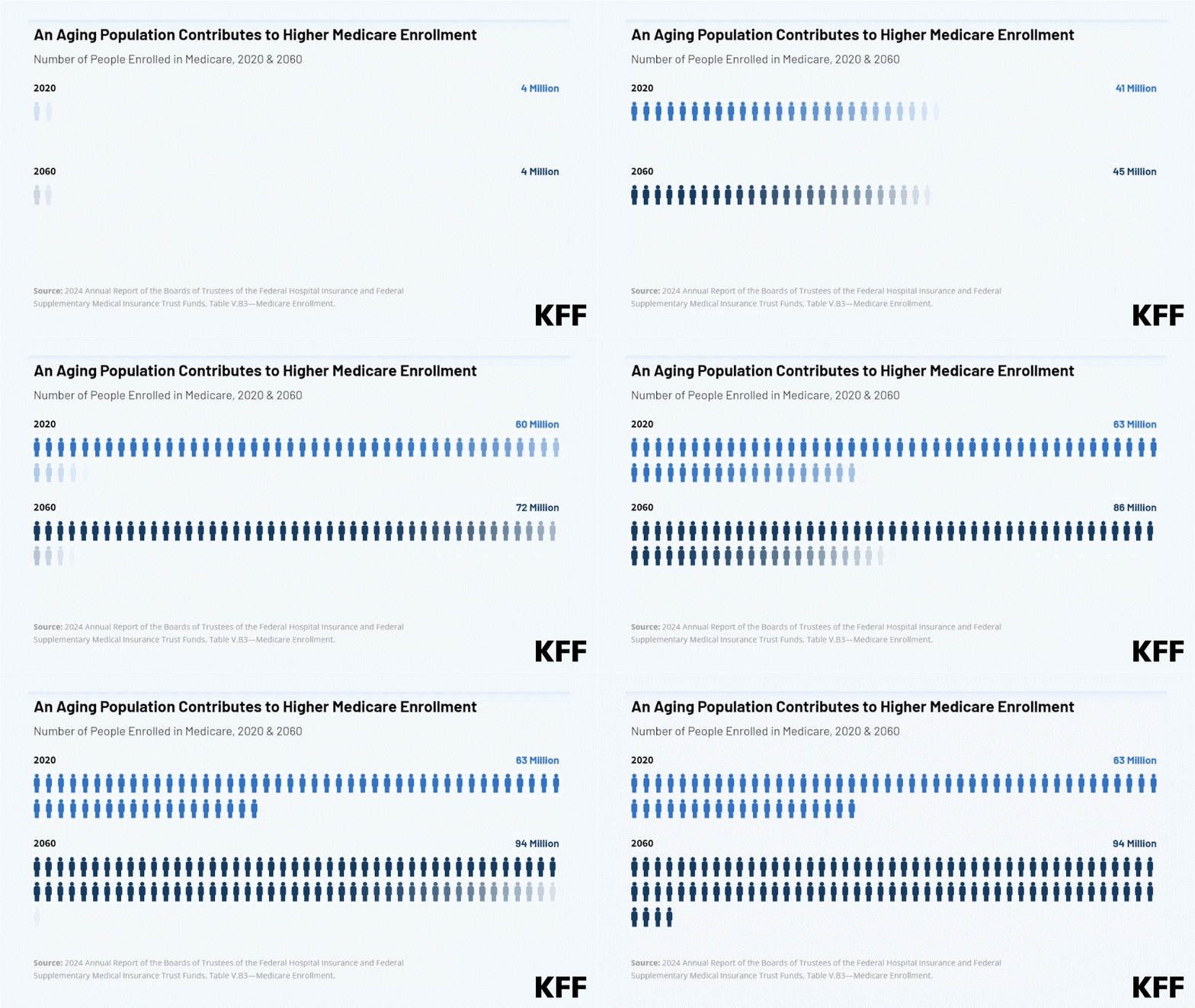
This interactive provides the facts on Medicare spending. Medicare, which serves 67 million people and accounts for 12 percent of the federal budget and 21 percent of national health spending, is often the focus of discussions about health expenditures, health care affordability and the sustainability of federal health programs. Explore data on enrollment growth, Medicare spending trends overall and per person, growth in Medicare spending relative to private insurance, spending on benefits and Medicare Advantage, Part A trust fund solvency challenges, and growth in out-of-pocket spending by beneficiaries.

Read More

Stay informed.

Stay informed.

Filter

561-570 of 1,623 results

  • Medicare Part D 2008 Data Spotlight: Ten Most Common Brand-Name Drugs

    Issue Brief

    This Medicare Part D Data Spotlight examines the variation in 2008 Part D plan coverage, cost sharing and utilization management tools for the 10 prescriptions most commonly used by Medicare beneficiaries, including treatments for cholesterol, cardiovascular health, osteoporosis, dementia, gastrointestinal reflux and ulcers. It looks at data from the 47 stand-alone prescription drug plans available nationwide in 2008. This data spotlight is one in a series analyzing key aspects of the 2008 Medicare Part D…

  • Medicaid and the Elderly

    Other Post

    Long-Term Care Spending In 1993, Medicaid spent $25.5 billion for long-term care services for elderly beneficiaries (Figure 5). This represents 58 percent of the $44 billion Medicaid spent on long-term care services for all population groups. The majority of spending was for care delivered in nursing facilities (84 percent) and ICFs-MR (2 percent). The remaining 14 percent of Medicaid long-term care spending went towards community-based care, including 3 percent for mental health services and 11…

  • Medicare Beneficiaries and HMOs: A Case Study of the Tampa-St. Petersburg Market

    Report

    This case study of the evolution of Medicare managed care in Tampa-St. Petersburg, Florida, is one of four in a series being prepared by Mathematica Policy Research, Inc., for the Kaiser Family Foundation to examine the growth and impact of Medicare managed care. The Medicare risk (HMO) program has developed at different rates and with different degrees of success across the country. The four unique market areas selected for the project include two with high…

  • Analysis of Benefits Offered By Medicare HMOs, 1999: Complexities and Implications

    Report

    This report analyzes supplemental benefits offered and premiums charged by Medicare HMOs nationwide in 1999, assessing the generosity of selected benefits, including prescription drugs. The study finds that the level of monthly premiums charged by Medicare HMOs, and the generosity of many supplemental benefits, especially prescription drugs, vary widely within and across markets. The study also finds that variations in benefits offered by Medicare HMOs can expose beneficiaries to complex choices and have a significant…

  • The Current State of Retiree Health Benefits: Findings from the Kaiser/Hewitt 2002 Retiree Health Survey

    Other Post

    The Current State of Retiree Health Benefits: Findings from the Kaiser/Hewitt 2002 Retiree Health Survey This report presents findings from a study of large private-sector employers conducted by researchers at Hewitt Associates and the Kaiser Family Foundation between July and September of 2002. The study is based on survey responses of 435 large private-sector firms (1,000+ employees) that currently offer retiree health benefits, and includes 36% of all Fortune 100 companies and 28% of all…

  • Resources on the Medicare Prescription Drug Benefit: Medicare Part D Data Spotlights

    Other Post

    To better understand the private plans providing drug coverage to Medicare beneficiaries under the Part D benefit, the Kaiser Family Foundation has issued a series of data spotlights analyzing key elements of Medicare's private drug plans. Each spotlight focuses on a key aspect of the drug plans available to Medicare beneficiaries each year and examines relevant trends since the Medicare drug benefit took effect in 2006. Medicare Part D 2013 Data Spotlights Medicare Part D…

  • Resources on Dual Eligibles and Issues Related to Their Transition to the New Medicare Drug Benefit

    Event Date:
    Event

    With the new Medicare prescription drug benefit available as of January 1, 2006, over 6 million low-income seniors and people with disabilities who are enrolled in both Medicaid and Medicare—also known as dual eligibles—have been transitioned from Medicaid drug coverage to new Medicare drug plans. While there are many policy issues related to the overall establishment of the new drug benefit, the mandatory transition of dual eligibles has created a special set of challenges for…

  • Pitching Private Medicare Plans: An Analysis of Medicare Advantage and Prescription Drug Plan Advertising

    Other Post

    This Kaiser Family Foundation report analyzes the content and frequency of television, print and radio advertisement for private Medicare plans that ran nationally or in one of three local media markets (Miami/Fort Lauderdale, Fla.; Phoenix, Ariz.; and Greensboro, N.C.) during the marketing and enrollment period for 2008 plan offerings. All ads were identified by VMS, a media monitoring service. The study finds that insurers last year placed three times more advertisements to promote Medicare Advantage…

  • e-Health and the Elderly: How Seniors Use the Internet for Health – Survey

    Poll Finding

    A national Kaiser Family Foundation survey of older Americans found that as the Internet becomes an increasingly important resource for informing decisions about health and health care options, less than a third (31%) of seniors (age 65 and older) have ever gone online, but that more than two-thirds (70%) of the next generation of seniors (50-64 year-olds) have done so. The differences among seniors and 50-64 year-olds are striking and indicate that online resources for…