Medicare

NEW AND NOTEWORTHY

What to Know About Medicare Coverage of Telehealth

Congress has repeatedly extended pandemic-era flexibilities around Medicare coverage of telehealth, but most such flexibilities remain temporary. This brief answers key questions about the current scope of Medicare telehealth coverage, including both temporary and permanent changes adopted through legislation and regulation, and future policy considerations.

Examining the Potential Impact of Medicare’s New WISeR Model

A federal initiative to establish new prior authorization requirements in traditional Medicare, called the Wasteful and Inappropriate Service Reduction (WISeR) model, is likely to have only modest impact in its first year.

State Profiles for Dual-Eligible Individuals

This data collection draws on Medicare and Medicaid administrative data to present national and state-level information on people who are covered by both Medicare and Medicaid, referred to as dual-eligible individuals (also known as dually-enrolled beneficiaries).

Data Visualization

The Facts About Medicare Spending

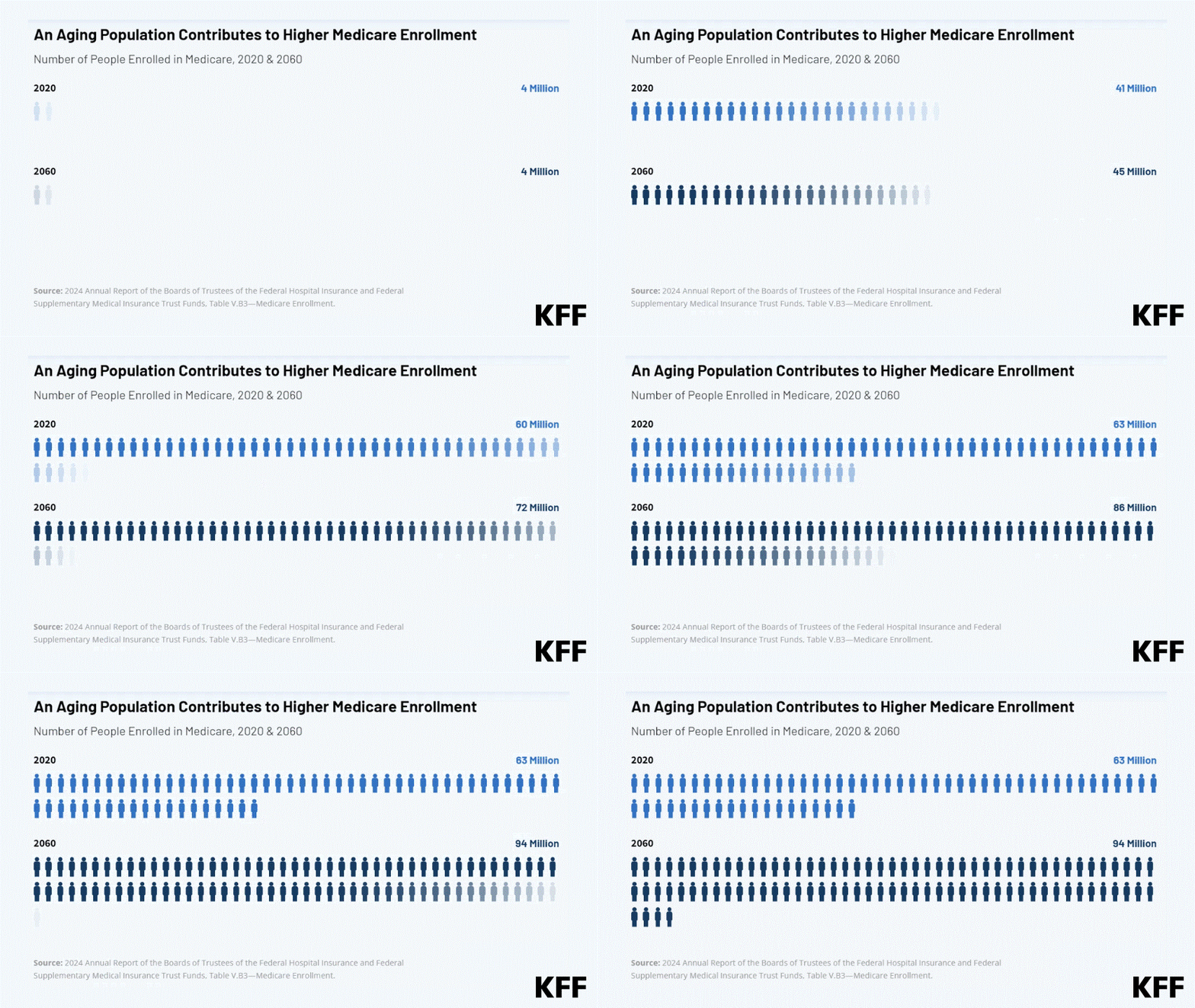
This interactive provides the facts on Medicare spending. Medicare, which serves 67 million people and accounts for 12 percent of the federal budget and 21 percent of national health spending, is often the focus of discussions about health expenditures, health care affordability and the sustainability of federal health programs. u003cbru003eu003cbru003eExplore data on enrollment growth, Medicare spending trends overall and per person, growth in Medicare spending relative to private insurance, spending on benefits and Medicare Advantage, Part A trust fund solvency challenges, and growth in out-of-pocket spending by beneficiaries.u003cbru003eu003cbru003eu003ca href=u0022https://www.kff.org/medicare/issue-brief/faqs-on-medicare-financing-and-trust-fund-solvency/u0022 data-type=u0022linku0022 data-id=u0022https://www.kff.org/medicare/issue-brief/faqs-on-medicare-financing-and-trust-fund-solvency/u0022u003eRelated:u003ca href=u0022https://www.kff.org/medicare/issue-brief/faqs-on-medicare-financing-and-trust-fund-solvency/u0022u003e FAQs on Medicare Financing and Trust Fund Solvencyu003c/au003eu003c/au003e

Read More

Stay informed.

Stay informed.

Filter

151 - 160 of 1,601 Results

  • Health Insurance Coverage for Older Adults: Implications of a Medicare Buy-In

    Issue Brief

    As the Senate debates comprehensive health reform legislation, the idea of a Medicare buy-in option for uninsured adults aged 55-64 has re-emerged as a potential component of a reform plan. This Kaiser Family Foundation policy brief provides an updated profile of the more than 4 million uninsured people between ages 55 and 64 and examines historical proposals to allow uninsured older adults to purchase Medicare coverage. It also examines barriers to securing affordable coverage in…

  • Medicare Spending and Use of Medical Services for Beneficiaries in Nursing Homes and Other Long‐Term Care Facilities: A Potential for Achieving Medicare Savings and Improving the Quality of Care

    Report

    Medicare Spending and Use of Medical Services for Beneficiaries in Nursing Homes and Other Long‐Term Care Facilities: A Potential for Achieving Medicare Savings and Improving the Quality of Care This report documents the relatively high rates of hospital stays, emergency room visits and skilled nursing facility admissions among long-term care facility residents. It finds that Medicare per capita spending for Medicare beneficiaries living in nursing homes, assisted-living centers and other long-term care facilities, $14,538 in…

  • Papers on Issues For People With Medicare Raised By Proposed Drug Benefit Regulations

    Issue Brief

    Papers on Issues For People With Medicare Raised By Proposed Drug Benefit Regulations The Kaiser Family Foundation has commissioned a series of papers to explore key issues that may be of concern for Medicare beneficiaries as the new Medicare drug benefit is implemented. These papers focus on specific areas of potential concern for people with Medicare. In addition, the Foundation also has produced a timeline of upcoming important dates leading up to the implementation of…

  • Kaiser Health Tracking Poll — October 2009

    Feature

    The October Kaiser Health Tracking Poll finds public support for health reform unchanged since last month, with more in favor than opposed. Fifty-five percent of Americans believe that it is more important than ever to take on health care reform now, while 41 percent say the country cannot afford it right now. The survey also shows about half of the public believes that if reform passes, help for the uninsured and changes in insurance market…

  • Key Findings: Kaiser Health Tracking Poll — September 2009

    Poll Finding

    This document contains the key findings from the September Health Tracking Poll. The survey was designed and analyzed by public opinion researchers at the Kaiser Family Foundation and was conducted September 11 through September 18, 2009, among a nationally representative random sample of 1,203 adults ages 18 and older. Telephone interviews conducted by landline (801) and cell phone (402, including 147 who had no landline telephone) were carried out in English and Spanish. The margin…

  • Kaiser Health Tracking Poll — September 2009

    Feature

    The September Kaiser Health Tracking Poll finds that public support for health reform ended its summer slide, reversed course and moved modestly upwards in September. The survey also finds initial majority support for taxing expensive health plans and imposing fees on insurers to pay for reform. Fifty-seven percent of Americans now believe that tackling health care reform is more important than ever—up from 53 percent in August. The proportion of Americans who think their families…

  • Seniors and the 2012 Presidential Election

    Feature

    This data note draws primarily on two national surveys, the September Kaiser Health Tracking Poll and the Kaiser 2012 National Survey of Seniors, to examine how health issues are playing as a 2012 election issue for seniors, how this politically important group feels about a variety of policy proposals related to Medicare, including the premium support model, and seniors' views of the 2010 Affordable Care Act (ACA). Data Note (.pdf)

  • Kaiser Health Tracking Poll — June 2011

    Feature

    The June Kaiser Health Tracking Poll examines the opinions of seniors and the public about Medicare and the federal budget deficit, a topic of heightened interest these days as policymakers in Washington focus on ways to bring down Medicare spending as part of efforts to reduce the deficit. The poll also provides an early look at the views of registered voters and the potential role health care might play in the upcoming presidential election cycle.…

  • Reaching for the Stars: Quality Ratings of Medicare Advantage Plans, 2011

    Issue Brief

    New: Medicare Advantage Plan Star Ratings and Bonus Payments in 2012 In 2012, Medicare Advantage plans will be awarded additional payments based on their quality ratings as a result of the 2010 health reform law. The Centers for Medicare and Medicaid Services has proposed a demonstration that would modify the quality-based payments for plans, providing additional payments for 2012 to 2014. This policy brief by the Kaiser Family Foundation examines the quality ratings of private…

  • The Public’s Health Care Agenda for the New President and Congress

    Poll Finding

      The Public's Health Care Agenda for the New President and Congress This survey captures the public's attitudes regarding the health care agenda for President Obama and the new Congress in 2009. It assesses the relative priority placed on health care by the American public as part of addressing the economic recession and as a large scale reform issue. The public's priorities for health care reform and their views on a range of other health…