Medicare

Medicare Open Enrollment

Medicare Advantage Plan Availability Varies Widely by County for 2027

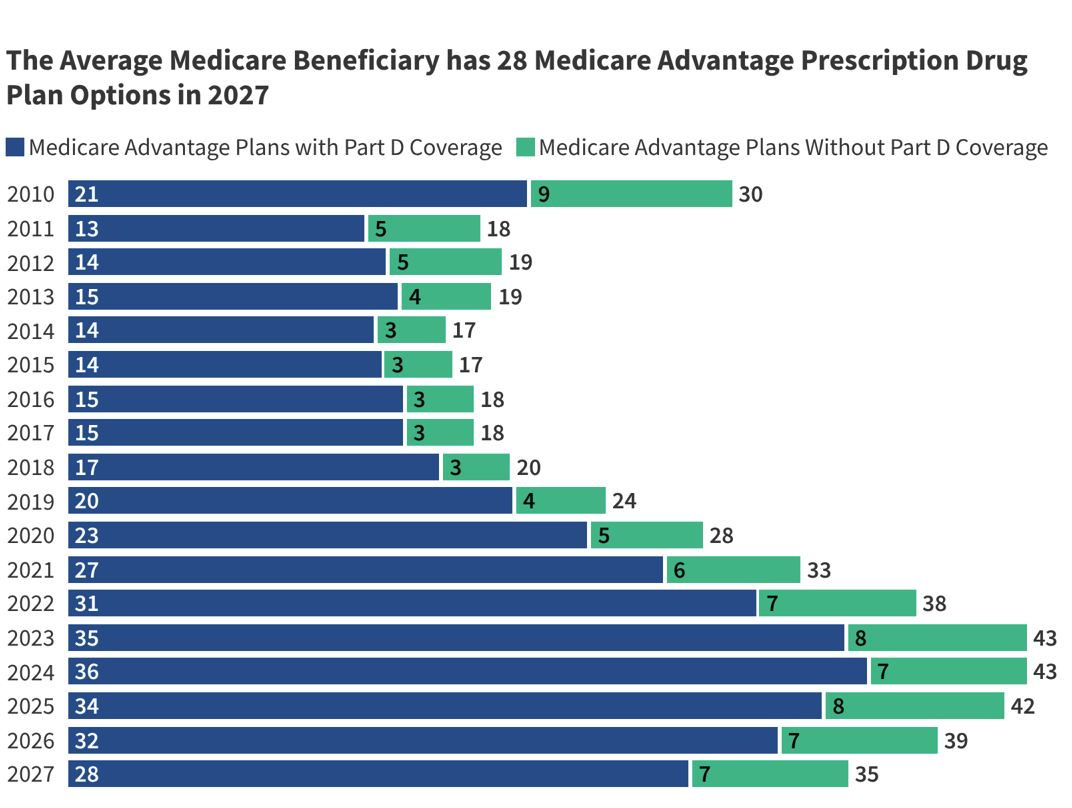
Medicare Advantage prescription drug plan (MA-PD) availability varies widely by county in 2027, with a modest reduction in the share of enrollees with more than 40 plans to choose from and some major insurers exiting many more counties than they are entering. 1 in 5 Medicare beneficiaries (20%) can choose from among more than 40 MA-PDs for 2027, down from 27% in 2026. 1% of all beneficiaries will have no plan option for 2027.
Medicare Open Enrollment and Coverage Options: Key Questions and Answers

Each year, Medicare beneficiaries have an opportunity to make changes to how they receive their Medicare coverage during the nearly 8-week annual open enrollment period, which runs from October 15 through December 7. This brief answers key questions about the Medicare open enrollment period and Medicare coverage options.

Medigap

Medigap Guaranteed Issue Requirements: An Overview of Federal and State Rules

This issue brief analyzes federal and state rules related to guaranteed issue requirements for Medigap policies and how they impact beneficiaries’ access to Medigap, including the implications for Medicare beneficiaries with pre-existing medical conditions and those under age 65 with long-term disabilities.

NEW AND NOTEWORTHY

Decoding Medicare Advantage Coding Intensity

Federal payments to Medicare Advantage plans, and adjustments for health status, have come under increased scrutiny. This brief answers key questions about coding intensity, recent steps taken by CMS, the effects on beneficiaries, and other proposals to improve payment accuracy.

Data Visualization

The Facts About Medicare Spending

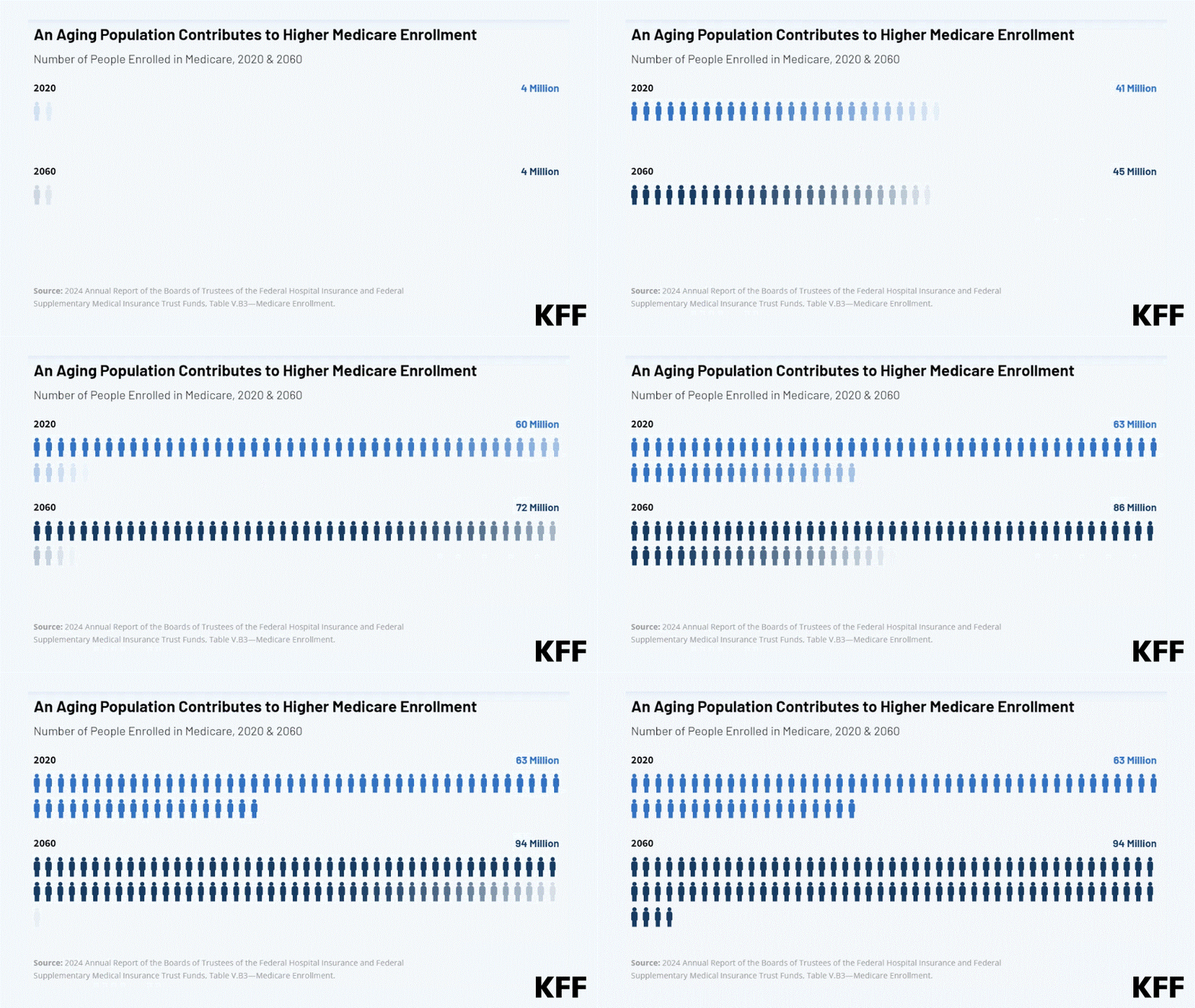
This interactive provides the facts on Medicare spending. Medicare, which serves 67 million people and accounts for 12 percent of the federal budget and 21 percent of national health spending, is often the focus of discussions about health expenditures, health care affordability and the sustainability of federal health programs. Explore data on enrollment growth, Medicare spending trends overall and per person, growth in Medicare spending relative to private insurance, spending on benefits and Medicare Advantage, Part A trust fund solvency challenges, and growth in out-of-pocket spending by beneficiaries.

Read More

Stay informed.

Stay informed.

Filter

1,081-1,090 of 1,623 results

  • I heard there have been changes to Medicare in recent years to help beneficiaries lower their out-of-pocket prescription drug costs or spread them throughout the year. How can these changes help me?

    FAQs

    Yes, changes have been made in recent years to improve the Part D benefit. In 2027, your annual Part D out-of-pocket costs will be capped at $2,400. Also, cost sharing for insulin is now capped at $35 per month per prescription, and you no longer have to pay any cost sharing for adult vaccines covered by your Part D plan, such as the vaccine for shingles. All Medicare Part D plans are also now required…

  • How Much Do People with Medicare Pay for Coverage?

    Issue Brief

    While Medicare covers a wide range of health care services, Medicare beneficiaries generally pay out-of-pocket for their monthly premiums, deductibles, and cost sharing for Medicare covered services. This brief provides an overview of the costs faced by Medicare beneficiaries in traditional Medicare, Medicare Advantage, and Medicare Part D, including premiums, deductibles, copays, and coinsurance, focusing on costs in 2026.

  • Medicare Advantage Plan Availability Varies Widely by County for 2027

    Issue Brief

    The analysis shows that plan level Medicare Advantage prescription drug availability varies widely across the country in 2027, with a modest reduction in the share of enrollees having more than 40 MA-PDs to choose from compared to 2026, and some major insurers exiting a much larger number of counties than they are entering.

  • Massachusetts and Washington: Financial Alignment Demonstrations for Dual Eligible Beneficiaries Compared

    Fact Sheet

    This fact sheet examines the similarities and differences between the five-year demonstrations in Massachusetts and Washington state to integrate care and align financing for people dually eligible for Medicare and Medicaid. The states finalized memoranda of understanding (MOUs) with the Centers for Medicare and Medicaid Services in fall 2012, and the demonstrations in each state are set to begin in April 2013. Fact Sheet (.pdf)

  • Prospects for Retiree Health Benefits as Medicare Drug Coverage Begins – Report

    Report

    Prospects for Retiree Health Benefits as Medicare Drug Coverage Begins:Findings from the Kaiser/Hewitt 2005 Survey on Retiree Health Benefits - Report This report assesses how large businesses that provide retiree health benefits to their workers are responding to the new Medicare drug benefit in 2006, their plans for the future, and the way these responses affect retirees. It also looks at the rising costs and changing benefits of retiree health coverage overall in 2005. Full…

  • An Implementation Perspective on Part D, the Medicare Prescription Drug Program

    Report

    This focus group of 12 state Medicaid officials conducted in November 2005 explores the current status and likely results of the Part D dual eligible transition efforts as well as other Part D-related issues of particular importance to states. It includes discussion of the transition of dual eligibles from Medicaid to Medicare drug coverage, evaluating Part D plan options, states’ role in the low-income subsidy program, the fiscal implications of Part D to states, and…

  • Key Findings: Kaiser Health Tracking Poll — September 2009

    Poll Finding

    This document contains the key findings from the September Health Tracking Poll. The survey was designed and analyzed by public opinion researchers at the Kaiser Family Foundation and was conducted September 11 through September 18, 2009, among a nationally representative random sample of 1,203 adults ages 18 and older. Telephone interviews conducted by landline (801) and cell phone (402, including 147 who had no landline telephone) were carried out in English and Spanish. The margin…

  • Explaining Health Care Reform: How Do Health Care Costs Vary By Region?

    Issue Brief

    Although regional variations in health spending have been studied for decades, there is renewed focus on this issue because of the role of health care costs in health care reform and the potential source of funds if addressing cost variations can yield savings. This explainer examines what is known about regional variations in health care costs and their relationship to quality of care, and addresses key questions about their role in health reform. Issue Brief…

  • Medicare Part D 2010 Data Spotlight: Benefit Design and Cost Sharing

    Report

    The Medicare Modernization Act established a defined standard drug benefit for Part D stand-alone Prescription Drug Plans (PDPs) and Medicare Advantage Prescription Drug (MA-PD) plans, while giving plans flexibility to offer alternative benefit designs. Only about one in 10 PDPs offer the standard benefit in 2010. Plan sponsors can offer alternative benefit designs that are, at a minimum, actuarially equivalent to the defined standard and can also offer enhanced benefits. This Medicare Part D data…

  • Hispanics and the New Medicare Drug Benefit

    Poll Finding

    In a few short weeks, Medicare will undergo big changes that will have a major impact on more than 3 million Hispanic seniors and younger people with permanent disabilities who rely on Medicare for their health coverage. More than one in three Hispanics with Medicare lack coverage for their prescription drugs for at least part of the year. Many others will need to make decisions about their existing coverage and the new Medicare benefit. Starting…