Medicare

Medicare Open Enrollment

Medicare Advantage Plan Availability Varies Widely by County for 2027

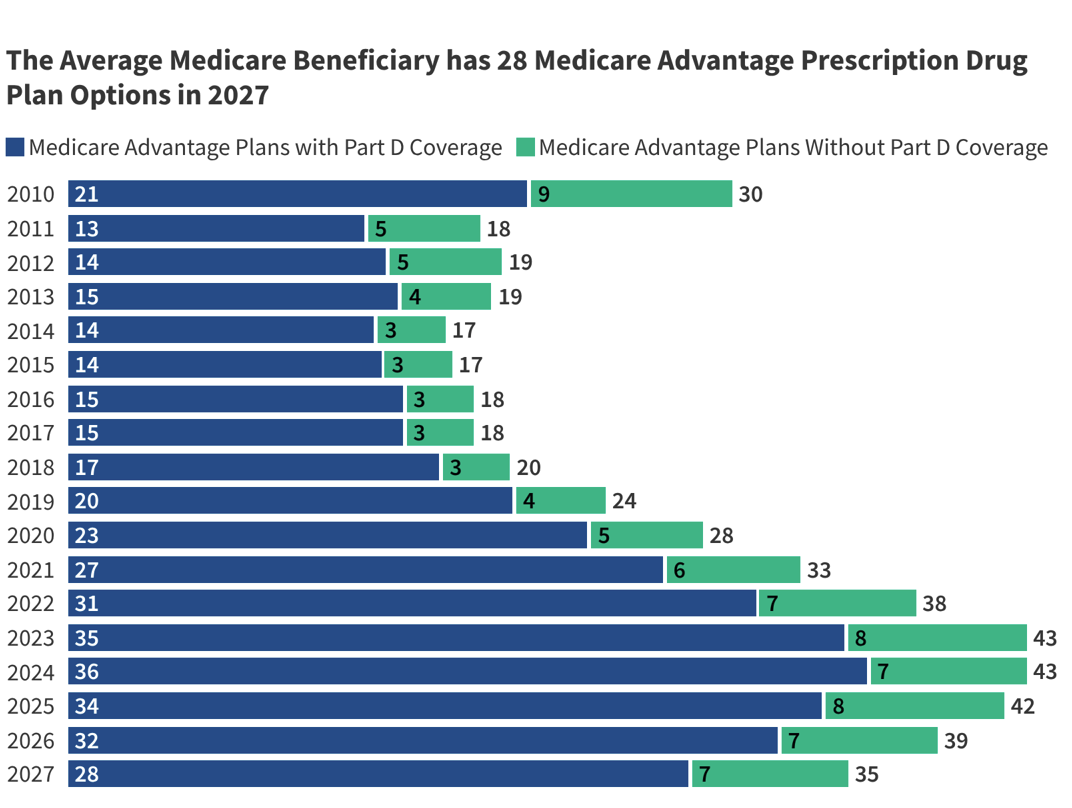
Medicare Advantage prescription drug plan (MA-PD) availability varies widely by county in 2027, with a modest reduction in the share of enrollees with more than 40 plans to choose from and some major insurers exiting many more counties than they are entering. 1 in 5 Medicare beneficiaries (20%) can choose from among more than 40 MA-PDs for 2027, down from 27% in 2026. 1% of all beneficiaries will have no plan option for 2027.
Medicare Open Enrollment and Coverage Options: Key Questions and Answers

Each year, Medicare beneficiaries have an opportunity to make changes to how they receive their Medicare coverage during the nearly 8-week annual open enrollment period, which runs from October 15 through December 7. This brief answers key questions about the Medicare open enrollment period and Medicare coverage options.

Medigap

Medigap Guaranteed Issue Requirements: An Overview of Federal and State Rules

This issue brief analyzes federal and state rules related to guaranteed issue requirements for Medigap policies and how they impact beneficiaries’ access to Medigap, including the implications for Medicare beneficiaries with pre-existing medical conditions and those under age 65 with long-term disabilities.

NEW AND NOTEWORTHY

Decoding Medicare Advantage Coding Intensity

Federal payments to Medicare Advantage plans, and adjustments for health status, have come under increased scrutiny. This brief answers key questions about coding intensity, recent steps taken by CMS, the effects on beneficiaries, and other proposals to improve payment accuracy.

Data Visualization

The Facts About Medicare Spending

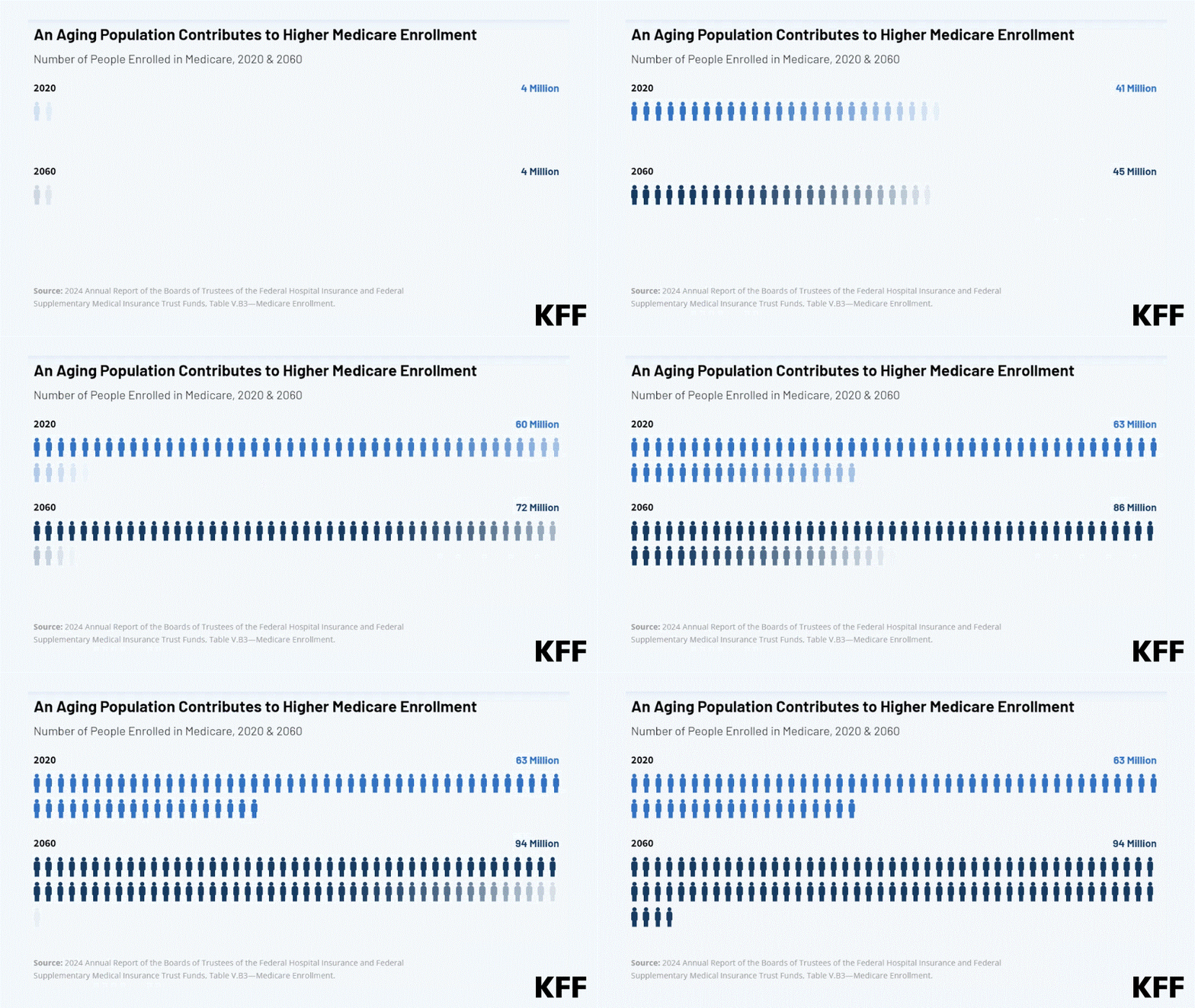
This interactive provides the facts on Medicare spending. Medicare, which serves 67 million people and accounts for 12 percent of the federal budget and 21 percent of national health spending, is often the focus of discussions about health expenditures, health care affordability and the sustainability of federal health programs. Explore data on enrollment growth, Medicare spending trends overall and per person, growth in Medicare spending relative to private insurance, spending on benefits and Medicare Advantage, Part A trust fund solvency challenges, and growth in out-of-pocket spending by beneficiaries.

Read More

Stay informed.

Stay informed.

Filter

1,011-1,020 of 1,623 results

  • Massachusetts and Washington: Financial Alignment Demonstrations for Dual Eligible Beneficiaries Compared

    Fact Sheet

    This fact sheet examines the similarities and differences between the five-year demonstrations in Massachusetts and Washington state to integrate care and align financing for people dually eligible for Medicare and Medicaid. The states finalized memoranda of understanding (MOUs) with the Centers for Medicare and Medicaid Services in fall 2012, and the demonstrations in each state are set to begin in April 2013. Fact Sheet (.pdf)

  • Washington’s Managed FFS Demonstration to Integrate Care and Align Financing for Dual Eligible Beneficiaries

    Issue Brief

    Washington is the first state to sign a memorandum of understanding (MOU) with the Centers for Medicare and Medicaid Services (CMS) to test a managed fee-for-service (FFS) financial alignment model for beneficiaries who are dually eligible for Medicare and Medicaid, beginning on April 1, 2013. Washington’s managed FFS demonstration uses Medicaid health home services to coordinate care for high risk/high cost dual eligible beneficiaries with chronic conditions. This policy brief summarizes key aspects of the…

  • Visualizing Health Policy: Medicare’s Role and Future Challenges

    Other Post

    November 2012 infographic in the Visualizing Health Policy series takes a look at Medicare—who it covers; the services its beneficiaries use; and the balance policymakers must strike between setting fair payments, keeping care affordable, and sustaining the program for future generations. See the full-size infographic at The Journal of the American Medical Association View the related Slideshow Visualizing Health Policy is a monthly infographic series produced in partnership with the Journal of the American Medical Association (JAMA).…

  • The News Media and “Entitlement Reform”

    From Drew Altman

    In the coming debate about the deficit, policymakers will struggle to craft a package of spending reductions and new revenues that both Democrats and Republicans can agree on, totaling as much as four trillion dollars over ten years.  Medicare, Medicaid and potentially the Affordable Care Act will have their turn on the operating table as policymakers look for savings.  It is unclear what reductions in Medicare and Medicaid spending policymakers will be able to agree…

  • Medicare Part D Prescription Drug Plan Availability in 2013

    Fact Sheet

    This fact sheet contains 2013 state-specific summary data about available Medicare drug benefit options, including premium ranges and the number of plans available at no cost to qualifying beneficiaries. Fact Sheet (.pdf)

  • Health Care on the Brink of the Fiscal Cliff

    Event Date:
    Event

    The Alliance for Health Reform and the Kaiser Family Foundation present a November 16 briefing to discuss the components of this key policy crossroads with a particular emphasis on the implications for health programs and the health care industry. Automatic cuts would not apply to Medicaid, but Medicare providers would experience 2 percent payment cuts. The reductions would likely be larger for discretionary health programs, such as those funded as part of the National Institutes…

  • The Budget Control Act of 2011: Implications for Medicare

    Issue Brief

    Beginning January 2013, Medicare spending will be subject to automatic, across-the-board reductions, known as “sequestration,” which is slated to reduce Medicare payments to plans and providers by up to 2 percent. This sequestration results from provisions in the Budget Control Act of 2011, which raised the debt ceiling and will reduce net federal spending by $2.1 trillion over ten years. The Act was a bipartisan compromise negotiated between the Administration and Congressional leaders, just before…

  • Kaiser Family Foundation Resources on Deficit-Reduction Debate

    Report

    These Foundation resources shed light on how the ongoing national debate about deficit reduction may affect Medicare, Medicaid and other health-care programs. These resources include analysis of specific savings proposals, polling on the public’s views of deficit-reduction options, summaries and comparisons of relevant elements of major deficit-reduction plans, and explanatory briefs and backgrounders describing key issues related to the debate. Drew Altman: The News Media and Entitlement Reform   Medicare-Specific Analysis Policy Options to Sustain…

  • Medicare Part D: A First Look at Part D Plan Offerings in 2013

    Report

    This data spotlight examines the stand-alone Part D drug plan options available to Medicare beneficiaries in 2013 during the open enrollment period, which runs from October 15 to December 7, 2012. The analysis is the first in a series of planned reports examining the private plan choices available to Medicare beneficiaries for 2013. It is authored by Jack Hoadley and Laura Summer of Georgetown University, Juliette Cubanski and Jennifer Huang of the Kaiser Family Foundation,…