Pulling It Together: Critical Path To Health Reform

Published: Mar 27, 2008

In this new section of our Web site, I pull together ideas and data from across the Foundation’s work to try to paint a bigger picture that hopefully helps to illuminate critical health policy issues. This is not a blog or a personal position statement. This second installment of the new Pulling It Together series lays out the steps that could lead to the first major national health reform debate since the early nineties. Other topics coming soon include a look at the states and health reform, and the difference between Democratic, Republican, and Independent voters on health.

PIT-slide1

My aim here is to provide a simple visual aid — called “The Critical Path to Health Reform” — for thinking about how momentum can build or still be knocked off track as the country moves toward a potential debate about health reform legislation in the new Congress in 2009. The series of charts and accompanying text illustrate the three primary stages and “make or break” decision points that could mark the path to a major health reform initiative.

Click for Stage One >>

Pulling It Together: Critical Path To Health Reform: Stage One

Published: Mar 27, 2008
PIT-Slide2_550

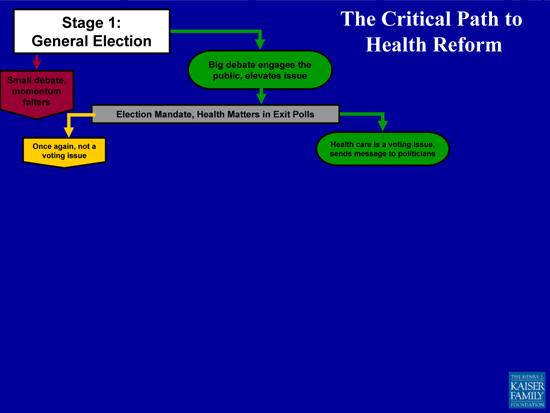
Will there be a big debate about health reform in the general election? If there is it will elevate the issue further, engage the public, and create momentum and a mandate for action by a new President and Congress. If, however, the debate about health is tepid or health is eclipsed by other issues such as the economy and Iraq, momentum could falter. One measure of the level of debate will be whether or not health registers in the exit polls as a factor in people’s voting decisions, a signal elected officials follow. Health did not register as a voting issue in 2004 or 2006. In the 1992 presidential election — leading up to our last big health reform debate — health care ranked third in the exit poll, behind the economy/jobs and the federal deficit. An equivalent result this time would be sufficient to keep the issue in play, and it seems entirely possible come November that health could end up as one of the top issues, particularly for some key voting groups. It could also emerge as a dimension of the public’s broader economic concerns, if pollsters ask the questions required to tease this out. But it’s also possible that the general election will focus more on the perceived leadership qualities of the two candidates than issues, and on other issues more than health. It is not at all certain that there will be a big, hot debate about health in the general election that will propel the issue forward.

<<  Previous Stage     Click for Next Stage >>

NEW ANALYSIS REVEALS WIDE DISPARITIES IN HEALTH COVERAGE AMONG ASIAN AMERICANS, NATIVE HAWAIIANS AND PACIFIC ISLANDERS, WITH UNINSURED RATES FOR SOME SUBGROUPS AMONG THE HIGHEST IN THE UNITED STATES

Published: Mar 21, 2008

Tuesday, April 1, 2008

For further information contact:Kirran Syed, Kaiser Family Foundation, ksyed@kff.org or (202) 347-5270 Deeana Jang, Asian & Pacific Islander American Health Forum, djang@apiahf.org or (202) 466-7772 x223

NEW ANALYSIS REVEALS WIDE DISPARITIES IN HEALTH COVERAGE AMONG ASIAN AMERICANS, NATIVE HAWAIIANS AND PACIFIC ISLANDERS, WITH UNINSURED RATES FOR SOME SUBGROUPS AMONG THE HIGHEST IN THE UNITED STATES

Breaking Down Data by Ethnicity Shows Korean Americans, Native Hawaiians and Pacific Islanders Are About Twice As Likely To Be Uninsured As Whites

Going beyond national studies that often treat Asian Americans as a homogenous and relatively healthy group, a new analysis by the Kaiser Family Foundation and the Asian & Pacific Islander American Health Forum finds that certain subgroups of the nation’s Asian American, Native Hawaiian and Pacific Islander populations are doing much worse than other subgroups in terms of health insurance coverage and access to health care.

Using data from two major government annual surveys, this analysis reveals substantial differences in the health care experiences of about a dozen subgroups of the nation’s estimated 13 million Asian Americans and more than half million Native Hawaiians and Pacific Islanders. For example, the analysis finds that Korean Americans and Vietnamese Americans face greater challenges than Asian Indian Americans and Japanese Americans for some key health measures. Other findings include:

• The proportion of nonelderly who are uninsured varies widely, ranging from 31 percent of Koreans, 24 percent of Native Hawaiian and Pacific Islanders, and 21 percent of Vietnamese to 12 percent of Japanese and Asian Indians and 14 percent of Filipinos. In comparison, 12 percent of nonelderly non-Hispanic Whites are uninsured.

• Nonelderly Koreans are the subgroup least likely to have employer-sponsored health coverage (49 percent), while Asian Indians have the highest rate of employer-sponsored coverage (77 percent).

• Vietnamese adults are twice as likely to report being in fair or poor health (15 percent) as the healthiest subgroup, Japanese adults (8 percent).

Some of this variation in health coverage may be due to how recently certain groups arrived in the United States, where they live geographically, the size of the firm where they work and income.

“It’s reasonably well known that African Americans and Latinos are much more likely to be uninsured than Whites, but I bet the public would be quite surprised to learn that certain Asian, Native Hawaiian and Pacific Islander groups also have such high uninsured levels. For this reason, these groups have a big stake in health reform debates,” said Kaiser Family Foundation President Drew E. Altman, Ph.D.

“As policymakers and health leaders consider how best to cover America’s uninsured and underinsured, this analysis is a timely reminder of the diverse health experiences and challenges within Asian American, Native Hawaiian and Pacific Islander populations that need to be carefully assessed to assure these communities’ needs are taken into account in the deliberations and development of any health care reform proposal,” added Ho Luong Tran, M.D., president and CEO of the Asian & Pacific Islander American Health Forum.

The analysis is based on data from the 2004, 2005 and 2006 National Health Interview Survey and Current Population Survey (CPS). CPS subgroups were generated based on the nativity of the individual and their parents.

Health Coverage and Access to Care for Asian Americans, Native Hawaiians and Pacific Islanders” is available online.

###

The Kaiser Family Foundation is a non-profit, private operating foundation dedicated to providing information and analysis on health care issues to policymakers, the media, the health care community, and the general public. The Foundation is not associated with Kaiser Permanente or Kaiser Industries.
Poll Finding

Toplines: Kaiser Health Tracking Poll: Election 2008 – March 2008

Published: Mar 6, 2008

This document contains the detailed toplines from the Kaiser Health Tracking Poll: Election 2008 – March 2008.

icon_reports_studies.gif

 Toplines (.pdf)

Poll Finding

Key Findings: Kaiser Health Tracking Poll: Election 2008 – March 2008

Published: Mar 6, 2008

This document presents key findings from the March 2008 Kaiser Health Tracking Poll: Election 2008, which tracks changes in the saliency of health as a political and policy priority, what the public’s priorities are for a health reform plan, and whether any candidates are breaking through with the public with their health reform plans.

icon_reports_studies.gif

 Key Findings (.pdf)

Poll Finding

Kaiser Health Tracking Poll: Election 2008 — March 2008

Published: Mar 5, 2008

Growing economic worries have led to a sharp rise in the economy as a campaign issue, eclipsing health on voters’ priority list, as well as Iraq. With economic concerns rising, where will health fit in the ongoing presidential campaign?  This March 2008 poll finds that health care plays a role in two ways: as an independent issue, and as part of the voters’ growing concerns about the economy.

Health care ranks third as the issue that they want presidential candidates to discuss during the campaign — named by 28% of voters, behind the economy (45%) and Iraq (32%).  Party differences exist, with health care ranking second for Democrats, third for independents, and fourth for Republicans. Overall, the share of registered voters picking the economy as the issue they want to hear the candidates talk about doubled since December.

The poll also probes deeper into how health care costs contribute to people’s economic anxieties, and finds that for at least some voters, the two issues are intertwined. In addition, it takes a closer look at political independents and those who name health care as one of the most important issues in their vote for president.  With the primary election season winding down — and big differences between Republican and Democratic candidates on the goals and details of their health reform plans — the views of these two groups of voters are of particular interest when assessing the role that health care might play in the 2008 presidential race.

The sixth in a series, the March 2008 poll was designed and analyzed by public opinion researchers at the Kaiser Family Foundation.  A nationally representative random sample of 1,770 adults who say they are registered to vote was interviewed by telephone February 7-16, 2008. The margin of sampling error for the survey is plus or minus 3 percentage points; for results based on subgroups, the sampling error is higher.


New Reports Examine Consumer Direction for Personal Assistance Services in Four States’ Medicaid Programs

Published: Mar 1, 2008

With a shift towards providing long-term services and supports in the community, policy interest in Medicaid consumer direction of personal assistance services (CD-PAS) has grown. Although overall enrollment in these programs is small, 42 states offered consumer direction in Medicaid in 2006. These programs allow Medicaid beneficiaries control over hiring, scheduling, training and paying of personal care attendants. The Kaiser Family Foundation’s Commission on Medicaid and the Uninsured has produced two new reports examining Medicaid’s role in providing CD-PAS in four states: California, Colorado, New York and Virginia.

Consumer Direction of Personal Assistance Services in Medicaid: A Review of Four State Programs

Consumer Direction of Personal Assistance Services Programs in Medicaid: Insights from Enrollees in Four States

Consumer Direction of Personal Assistance Services in Medicaid: A Review of Four State Programs

Published: Mar 1, 2008

Consumer Direction of Personal Assistance Services in Medicaid: A Review of Four State Programs

Medicaid consumer direction of personal assistance services (CD-PAS) is a growing trend. Although overall enrollment in these programs is small, 42 states offered consumer direction in Medicaid in 2006. These programs allow Medicaid beneficiaries control over hiring, scheduling, training and paying of personal care attendants.

This report is based on interviews with program administrators from the four states profiled: California, Colorado, New York and Virginia.

Report (.pdf)

Consumer Direction of Personal Assistance Services Programs in Medicaid: Insights from Enrollees in Four States

Published: Mar 1, 2008

Consumer Direction of Personal Assistance Services Programs in Medicaid: Insights from Enrollees in Four States

Medicaid consumer direction of personal assistance services (CD-PAS) is a growing trend. Although overall enrollment in these programs is small, 42 states offered consumer direction in Medicaid in 2006. These programs allow Medicaid beneficiaries control over hiring, scheduling, training and paying of personal care attendants.

This report is based focus groups with enrollees in CD-PAS programs in the four states profiled: California, Colorado, New York and Virginia.

Report (.pdf)

Five Basic Facts on Immigrants and Their Health Care

Published: Feb 29, 2008

As discussions on national health care reform move to the forefront, some have focused on the role of immigrants in the health care system, including their impact on the nation’s uninsured problem, their participation in public health coverage programs, and their use of hospital emergency rooms. To address questions about how immigrants use and affect the health care system, this brief draws on available research and data to highlight five key facts about immigrants’ health coverage and care from a national perspective.

Issue Brief (.pdf)

More Resources on Immigrants and Health Coverage