The Medicare Part D Low-Income Subsidy Program: Experience to Date and Policy Issues for Consideration

Authors: Laura Summer, Jack Hoadley, and Elizabeth Hargrave
Published: Sep 1, 2010

This policy brief examines the low-income subsidy program that provides premiums and cost-sharing assistance under Part D plans, documenting trends in both beneficiary and plan participation over time. With fewer plans available to low-income enrollees without having to pay a premium, and annual changes in those plans, the brief discusses challenges facing low-income Part D enrollees and strategies that could be used to increase the effectiveness of the subsidy program.

It was prepared for the Foundation by Laura Summer and Jack Hoadley of Georgetown University and Elizabeth Hargrave of NORC at the University of Chicago.

Policy Brief (.pdf)
Health Reform Roundtables: Charting A Course Forward

Published: Sep 1, 2010

Health Reform Roundtables: Charting A Course Forward is a series of discussions among federal officials, state officials and outside experts that provides an opportunity to share insights and explore key issues related to implementing a significant expansion of the Medicaid program as part of the new health reform law that will require most U.S. citizens and legal residents to obtain health coverage. States will be largely responsible for implementing the Medicaid expansion, which will provide coverage for lower income Americans through one of the largest enrollment efforts in the program’s history, and for establishing new health insurance Exchanges and coordinating Medicaid and Exchange coverage.

The roundtables are convened periodically by the Kaiser Family Foundation’s Commission on Medicaid and the Uninsured at the Foundation’s Washington, D.C. offices. Briefs highlighting key issues raised in each discussion will be posted here as they become available.

Ensuring Access to Care in Medicaid Under Health Reform

Medicaid Policy Options for Meeting the Needs of Adults with Mental Illness under the Affordable Care Act

Coordinating Coverage and Care in Medicaid and Health Insurance Exchanges

Expanding Coverage to Adults Through Medicaid Under Health Reform

Key Issues to Consider for Outreach and Enrollment Efforts under Health Reform

Expanding Coverage to Adults through Medicaid Under Health Reform: Key Issues to Consider for Implementation

Published: Sep 1, 2010

The Kaiser Commission on Medicaid and the Uninsured convened a roundtable discussion on June 23, 2010 with a group of federal and state officials and experts to discuss key issues related to reaching, enrolling and delivering care to adults in Medicaid under health reform. The discussion focused in particular on non-disabled adults without dependent children (often referred to as “childless adults”) who have historically been ineligible for the program. When the new coverage goes into effect in 2014, states will face one of the largest enrollment efforts in the Medicaid program’s history. Roundtable participants agreed that it was important for states to begin preparing and making necessary upgrades to their systems now, and also that federal guidance and support is key for helping them move forward.

Issue Brief (.pdf)

Medicare Part D 2010 Data Spotlights

Published: Aug 31, 2010

The Kaiser Family Foundation has issued a collection of analyses related to the Part D Medicare stand-alone drug plan options available to seniors for calendar year 2010.

Each of these spotlights focuses on a key aspect of the drug plans that will be available to Medicare beneficiaries in 2010 and examine relevant trends since the Medicare drug benefit took effect in 2006. They were prepared by a team of researchers at Georgetown University, NORC and the Kaiser Family Foundation.

Medicare Prescription Drug Plans In 2010 and Key Changes Over Five Years

Premiums

Benefit Design and Cost Sharing

A Comparison of PDPs Offering Basic and Enhanced Benefits

Part D Plan Availability in 2010 and Key Changes Since 2006

Coverage of Top Brand-Name and Specialty Drugs

Prices for Brand-Name Drugs in the Coverage Gap

The Medicare Part D Low-Income Subsidy Program: Experience to Date and Policy Issues for Consideration


>> Previous Medicare Part D Data Spotlights Available


Medicare Prescription Drug Plans In 2010 and Key Changes Over Five Years

Authors: Jack Hoadley, Laura Summer, Elizabeth Hargrave, Juliette Cubanski, and Tricia Neuman
Published: Aug 31, 2010

This brief summarizes key findings from the full collection of 2010 Part D Data Spotlights examining key trends in the private stand-alone drug plans available to Medicare beneficiaries.

The spotlight is one in a series analyzing key aspects of the Medicare Part D drug plans that will be available to beneficiaries in 2010. The analysis was conducted jointed by Jack Hoadley and Laura Summer of Georgetown University, Elizabeth Hargrave of NORC at the University of Chicago, and Juliette Cubanski and Tricia Neuman of the Kaiser Family Foundation.

Data Spotlight (.pdf)

Health Reform and Communities of Color: Implications for Racial and Ethnic Health Disparities

Published: Aug 31, 2010

This issue brief examines the key provisions of the 2010 health reform law that will expand health coverage and are likely to improve access to care for people of color, as well as some of the other provisions that will likely have either a direct or indirect impact on health disparities.

Issue Brief (.pdf))

Previous Version:

November 2009 (.pdf)

Medicare Part D 2010 Data Spotlight: Coverage of Top Brand-Name and Specialty Drugs

Authors: Elizabeth Hargrave, Jack Hoadley, Laura Summer, Juliette Cubanski, and Tricia Neuman
Published: Aug 31, 2010

This Part D Data Spotlight documents the wide variations across the private stand-alone drug plans with respect to coverage of drugs, what enrollees pay for those drugs, and restrictions and limitations placed on their use. These variations have potentially significant implications for beneficiaries’ access to medications and out-of-pocket costs.

The spotlight is one in a series analyzing key aspects of the Medicare Part D drug plans that will be available to beneficiaries in 2010. The analysis was conducted jointed by Jack Hoadley and Laura Summer of Georgetown University, Elizabeth Hargrave of NORC at the University of Chicago, and Juliette Cubanski and Tricia Neuman of the Kaiser Family Foundation.

Data Spotlight (.pdf)

Support for Health Reform Dips Back to May Levels in KFF August Tracking Poll

Published: Aug 31, 2010

Support for health reform fell over the past month, dipping from a 50 percent favorability rating in July to 43 percent now, while 45 percent of the public reported unfavorable views. The dip in favorability returned public opinion on the new law to the even split last seen in May before a modest uptick in support in June and July. But voters have a lot on their minds besides health reform.

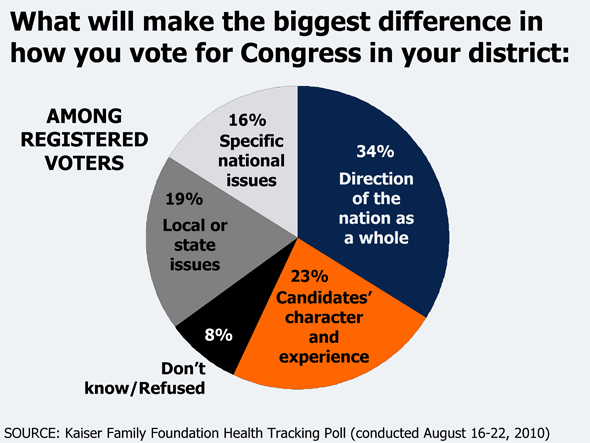
Asked what would make the biggest difference in their vote for Congress, the “direction of the nation as a whole” topped the list, named by 34 percent of voters, twice as many as the proportion who chose “specific national issues”. Roughly a quarter said the “candidate’s character and experience” would be the driving factors, and 19 percent named local or state issues.

Policy-insights-What_People_Say_Will_Influence_Their_Vote_homepage

Quality Ratings of Medicare Advantage Plans: Key Changes in the Health Reform Law and 2010 Enrollment Data

Published: Aug 30, 2010

NEW: Foundation brief looks at implications of 2011 quality ratings for Medicare Advantage plans.

This Kaiser Family Foundation issue brief examines the key changes in this year’s health reform law that will reward bonuses to private Medicare Advantage plans based on quality rating. Medicare currently rates plans on a five-star scale, with five stars representing the highest quality. The brief analyzes plans based on their quality rating for the current year and also examines enrollment in each of those plans.

The results indicate that private Medicare Advantage plans with high quality ratings are concentrated in certain states, leaving beneficiaries in some states with few if any options for choosing a highly-rated plan. States with more highly-rated plans, and higher enrollment in those plans, are likely to receive more bonuses and quality-based payments under health reform.

The Foundation previously examined quality ratings in relation to the characteristics of Medicare Advantage plans, including type of plan, length of time serving Medicare beneficiaries, and ownership status. That analysis is available online.

Issue Brief (.pdf)

Care and Coverage of the Nation’s Children: A Resource Page

Published: Aug 30, 2010

Medicaid and the Children’s Health Insurance Program (CHIP) are serving as an important safety-net for children during the current recession. These programs have contributed to a decrease in the uninsured rate for children, but many eligible children remain uninsured despite the availability of Medicaid and CHIP coverage today. Provisions to strengthen coverage for children are included in both the 2009 Children’s Health Insurance Program Reauthorization Act and the Patient Protection and Affordable Care Act of 2010. The Administration has made covering all eligible children a key priority through its Connecting Kids to Coverage initiative. This renewed effort to reach eligible but uninsured children will help prevent children from needlessly forgoing medical care.

The Kaiser Family Foundation has several resources that explain children’s health care coverage and can serve as helpful reference guides in understanding the crucial role that public coverage plays for this population. These materials include state level data on children’s coverage and background on Medicaid and CHIP, which together provide coverage for almost one-third of all children.