Medicare Advantage 2011 Data Spotlight: Plan Availability and Premiums

Published: Sep 30, 2010


This Medicare Advantage Data Spotlight provides an overview of recent changes made to the Medicare Advantage program and examines trends in plan participation, premiums and certain benefits. About 12 million people, or nearly a quarter of the Medicare population, are enrolled in Medicare Advantage, the privately administered plans that are an alternative to the traditional fee-for-service Medicare program.

The analysis was conducted by a team researchers at Mathematica Policy Research, Inc. and the Kaiser Family Foundation.

Spotlight (.pdf)

Also Available:

Financial Incentives in the Long-Term Care Context: A First Look at Relevant Information

Published: Sep 30, 2010

Financial Incentives in the Long-Term Care Context: A First Look at Relevant Information

This report reviews Medicare’s payment policies as they may affect medical care for residents in long-term care environments, including a look at the financial incentives that could play a role in hospital and skilled nursing facility admissions.

The report was prepared by Henry Desmarais at Health Policy Alternatives for the Foundation and released at an Oct. 12, 2010, policy briefing.

Report (.pdf)

To Hospitalize or Not to Hospitalize? Medical Care for Long-Term Care Facility Residents

Published: Sep 30, 2010

To Hospitalize or Not to Hospitalize? Medical Care for Long-Term Care Facility Residents

This report explores factors that appear to drive relatively high rates of hospitalizations, based on interviews with doctors, nursing home staff and families in four cities. Key factors include liability concerns, limited onsite staff capabilities, difficulty reaching residents’ physicians for care instructions on nights and weekends, better and more timely access to diagnostic tests in hospitals, and patient preferences. Physicians with patients in a long-term care facility say it is more convenient and potentially in their financial interest to see patients in the hospital, based on their understanding of coverage and payment policy.

The report, co-authored by researchers at Lake Research Partners and the Kaiser Family Foundation, was released at an Oct. 12, 2010 policy briefing.

Report (.pdf)

News Release

New Reports Find States Expecting 7.4 Percent Growth in Medicaid Spending In Fiscal Year 2011 As the Recession’s Lingering Effects Drive Up Enrollment

Published: Sep 30, 2010

States Face New Budget and Workforce Challenges As Temporary Federal Aid Nears End And Health Reform Planning Heats Up

WASHINGTON, D.C. – Due to the nation’s deep recession, states experienced rapid growth in their Medicaid enrollment and spending last year and expect additional growth, though at a slower pace, in fiscal year 2011, according to a survey of state Medicaid officials in all 50 states released today by the Kaiser Family Foundation’s Commission on Medicaid and the Uninsured (KCMU).

States reported an average increase in Medicaid spending of 8.8 percent across all states in fiscal year 2010, the highest rate of growth in eight years and well above their original projections of 6.3 percent growth.  Medicaid directors attributed the unexpected jump to higher-than-expected increases in eligible families due to the recession, which pushed the national unemployment rate above 10 percent and even higher rates in some states.

For fiscal year 2011 (which runs through June 2011), states budgeted for an average 7.4 percent increase in spending above fiscal year 2010 – a slightly slower rate of growth consistent with their expectations that enrollment growth will slow to 6.1 percent, according to the 10th annual survey of state Medicaid directors.

The American Recovery and Reinvestment Act of 2009 (ARRA) provided a temporary boost in the federal government’s share of Medicaid costs, providing an estimated $87 billion to states starting in October 2008.  ARRA’s increased federal Medicaid support was originally scheduled to end in December 2010, but in August, Congress enacted additional relief for states through June 2011 at a reduced level, providing $16 billion over six months.

“The recession swamped state budgets and Medicaid programs, but with the extra federal aid, Medicaid helped millions of additional people as intended during tough times,” said Diane Rowland, executive vice president of the Kaiser Family Foundation and executive director of the Kaiser Commission on Medicaid and the Uninsured. “Looking ahead, states will face new challenges as the federal aid winds down and as they prepare for health reform.”

A separate KCMU report released today finds that Medicaid enrollment increased by nearly 6 million people between the start of the recession in December 2007 and December 2009.  In December 2009, 48.6 million people were enrolled in state Medicaid programs, an increase of 1.6 million over June 2009 and 3.8 million over December 2008, an annual growth rate of 8.4 percent.* State-by-state totals included in the Medicaid enrollment report show every state experienced a year-to-year increase.

Federal relief helped states preserve eligibility, though most took steps to control costs

States report that the federal fiscal relief provided critical assistance to close Medicaid budget gaps in both fiscal years 2009 and 2010, as states experienced their sharpest decline in revenues on record, according to the 50-state survey report.

Even with the extra funds, nearly every state implemented at least one new policy to curb Medicaid spending in fiscal year 2010 (48 states) and most plan to do so in fiscal year 2011 (46 states).  States generally did not reduce Medicaid eligibility levels, as ARRA required states to maintain those efforts to receive the enhanced federal aid, but took actions in other areas:

  • A record 20 states implemented new restrictions on benefits in fiscal year 2010, and 14 states plan new restrictions in fiscal year 2011. This includes the elimination of some or all dental services in Arizona, California, Hawaii and Massachusetts. Other states limited benefits including imaging services, medical supplies, therapies or personal care services.
  • Thirty-nine states implemented a provider rate cut or freeze in fiscal year 2010, and 37 states plan similar action in 2011.
  • Eighteen states implemented utilization controls and other reductions on long-term-care services in fiscal year 2010, and 10 states plan to do so in fiscal year 2011.

In spite of the tight budget environment, many states reported acting to simplify or expand Medicaid eligibility and benefits –often for small populations, though a few states including Colorado and Wisconsin are implementing broader reforms and eligibility expansions. Some of those efforts to streamline enrollment could help states qualify for performance bonus payments enacted as part of the Children’s Health Insurance Program Reauthorization Act of 2009. States also continue to expand community-based long-term care services, focus on improvements to delivery systems and develop health information technology in Medicaid.

States see future budget, health reform implementation challenges

Even with an improving economy, state Medicaid directors expect the recession’s impact to linger, as the phase out of enhanced federal assistance will boost the state’s share of costs in fiscal year 2012 by 25 percent or more in some case, the survey finds.

In addition, Medicaid directors see preparing for the implementation of health reform as both an opportunity and a challenge.  Under health reform, Medicaid will be expanded to cover nearly all individuals with incomes below 133 percent of poverty resulting in a large expansion in most states, particularly among low-income adults without dependent children who historically have been excluded from coverage under the program. In addition, the law creates health insurance exchanges that will be established at the state level.

A third report released today provides an early look at state efforts to prepare for health reform, examining the experiences to date in five states (Connecticut, Michigan, Massachusetts, North Carolina and Washington). The report finds that the state political environment and expected leadership transitions create uncertainties and are already factoring into state strategies on health reform implementation. State leaders dealing with an aging workforce, hiring constraints, and the toll from the recession also see a need for additional staff and outside contractors to help with designing insurance exchanges, handling expanded enrollment for Medicaid and state exchanges and updating eligibility systems in the timeframe required under the reform law.

The three reports are: Hoping For Economic Recovery, Preparing For Health Reform: A Look At Medicaid Spending, Coverage And Policy Trends Results From A 50-State Medicaid Budget Survey For State Fiscal Years 2010 And 2011, authored by researchers at the Kaiser Family Foundation and Health Management Associates; Medicaid Enrollment: December 2009 Data Snapshot; and Health Reform and State Workforce Challenges: An Early Look at Five States, authored by researchers at the Foundation and the Center for State and Local Government Excellence.

They were released at a Washington, DC briefing and are available online.

*Enrollment figures in this sentence were corrected on Oct. 13, 2010 to reflect a change in one state.

The Kaiser Family Foundation is a non-profit private operating foundation, based in Menlo Park, California, dedicated to producing and communicating the best possible analysis and information on health issues.

The Kaiser Commission on Medicaid and the Uninsured provides information and analysis on health care coverage and access for the low-income population, with a special focus on Medicaid’s role and coverage of the uninsured. Begun in 1991 and based in the Kaiser Family Foundation’s Washington, D.C. office, the Commission is the largest operating program of the Foundation. The Commission’s work is conducted by Foundation staff under the guidance of a bipartisan group of national leaders and experts in health care and public policy.
U.S. Participation in International Health Treaties, Commitments, Partnerships, and Other Agreements

Authors: Jennifer Kates and Rebecca Katz
Published: Sep 30, 2010

This report provides a comprehensive look at U.S. participation in 50 significant international treaties and agreements that directly or indirectly touch on health issues.

The U.S. role in such agreements has attracted renewed policy attention as a result of the Obama Administration’s Global Health Initiative, which includes a focus on stronger multilateral engagement on global health and development issues. Such international agreements help to establish political and legal commitments, formalize international relationships, and coordinate roles and responsibilities internationally.

Medicare Part D Spotlight: Part D Plan Availability in 2011 and Key Changes Since 2006

Published: Sep 29, 2010

This initial analysis examines the private stand-alone Part D drug plans will be available to Medicare beneficiaries in 2011 and provides an early look at key trends in the options, premiums, and other plan characteristics.

It finds that the average Medicare beneficiary will have a choice of 33 Part D stand-alone prescription drug plans in 2011, despite a 30 percent reduction in the total number of stand-alone plans available nationwide. Monthly premiums for stand-alone prescription drug plans will rise by 10 percent, on average, to $40.72 in 2011 if beneficiaries stay with their 2010 plans.

The analysis is based on the 2010 Medicare drug plan information released in late September by the Centers for Medicare & Medicaid Services. The analysis was conducted jointly by researchers at Georgetown University, the Kaiser Family Foundation and the National Opinion Research Center at the University of Chicago.

Data Spotlight (.pdf)

Pulling it Together: A Primer on Health in the Election

Published: Sep 28, 2010

There is a lot of talk in polling and political circles and some speculation in the media about the role of health reform in the midterm elections. We regularly measure what the public thinks about health reform and you see reports from our monthly tracking polls about that. But whether those opinions will translate into an impact on people’s votes in the upcoming election is an entirely different question.

First, to understand what might happen in an election it is most useful to look at people who are actually going to vote, so we and others switch to samples of “likely voters” not the public in general or even registered voters as we get closer to an election. (It is important not to poll likely voters too early, before people have really focused on an upcoming election.) When we asked likely voters what one issue would be most important to their vote, no surprise, 38 percent picked the economy and jobs. Health reform was picked by 10 percent and was clumped with a number of issues as secondary concerns, including dissatisfaction with government and the budget deficit. The list was no different for seniors who tend to come out to vote in larger numbers in midterms or for independents.

Second, issues themselves, whether health reform or education or the environment or any of the major issues, are not the primary factor influencing voting decisions, especially in midterm elections where there are no presidential candidates to frame clear differences on national issues. We asked likely voters what big picture factors would influence their vote. In order of importance their answers were: the general direction of the nation (picked by 37 percent), specific national issues (21 percent), local and state issues (19 percent), and the candidate’s character and experience (19 percent). A candidate’s stance on issues are just one of many factors influencing voting in a midterm election. And even when it is a factor a candidate’s position on an issue is often more a proxy for voters of the candidate’s general world view (whether the candidate is for more government or less, for the little guy or pro business, and so forth). Most voters do not dissect candidates’ issue positions like experts or the media do.

We have seen many times in the past that our issue ranks second or third or fourth in polls on the public’s issue priority list but it has almost never been a factor in elections according to exit polls and other analyses. Think of it this way: if health reform (or the absence of it) truly influenced voting we probably would have seen action on health reform long before this year.

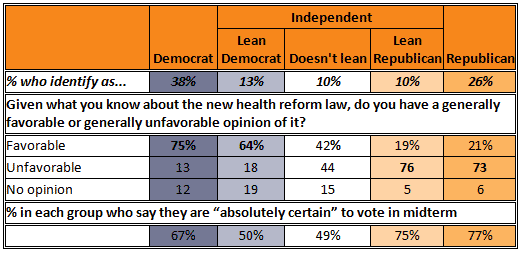
Third, there are relatively few votes left to sway with arguments about health reform in the next few months. Most Democrats currently support the law and most Republicans oppose it, and there are few independents remaining who are not already tilting Democratic or Republican to be moved with arguments about the health reform law. About a third of independents – a group which makes up about a third of the electorate – are closet Democrats; they tilt towards the Democrats and a strong majority of them support health reform. About a third of independents are closet Republicans; they lean Republican and oppose the law. That leaves a relatively small group of independents in the middle and they split about fifty/fifty on the health reform law. You can see this breakdown of independents from our September poll below.


PIT093010.gif

Source: Kaiser Family Foundation Health Tracking Poll (conducted September 14-19, 2010)

So how could health reform play a role in the election? Possibly by influencing turnout at the margin if health reform serves as a rallying point for larger complaints a slice of the electorate appears to have with Washington and government today. For some on the right health reform has become the kind of issue fluoridation once was – it is symbolic of bigger things they are worried about. (On this theme I recommend an old but great book called The Symbolic Uses of Politics by Murray Edelman).  We asked those who said they were angry about the law why they were angry and the vast majority (77 percent in September) answered that they were angry about the general direction in Washington; health reform was just one example of bigger things they are upset about.

To the extent that health reform influences the election this will be how. It will be used by Republicans and conservatives as a symbol of discontent with Washington to build enthusiasm among their base and encourage turnout.  But predicting turnout is notoriously difficult. Among likely voters we found a modest gap (41 percent vs. 30 percent) between the percentage of Republicans and Democrats who said health reform made them more interested in voting. Democrats overwhelmingly support the law, but some wanted it to go further, and it does not touch a deeper symbolic nerve for liberals as it does for conservatives – hence the modest health reform enthusiasm gap and its value as a rallying cry for conservatives.

As you can see in the chart, in our September poll we found a ten percentage point gap between the percentage of Republicans and Democrats who said they were “absolutely certain” to vote in November and a notable twenty-five percentage point gap between Republican-leaning independents and independents who lean towards the Democrats. It is impossible to say how much of a role health reform as a symbolic issue is playing in these differences or, with campaigns heating up, if they will still be there in November.

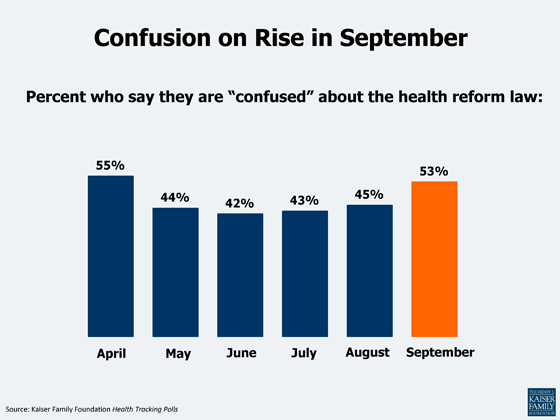
Health reform has become like World War One, with fixed lines not likely to move much any time soon. Democrats have a good case to make with voters because so many of the major provisions of the law are popular with the public, especially the early deliverables being rolled out now, although their message is muted by confusion about the law which our polls show has been rising.  But Republicans have weapons too because the requirement that people buy insurance remains unpopular even though it doesn’t take effect for over three years and the law can be used as a lightning rod for voter discontent with Washington. The overall result is the rough stalemate we see on health reform in the polls with the public about evenly split on the law along traditional partisan lines. As I have written elsewhere http://www.washingtonpost.com/wp-dyn/content/article/2010/09/22/AR2010092204604.html, ultimately the public verdict on the law will be based much more on people’s experiences with it and the experiences of their families and friends as implementation slowly unfolds, not the political argument and spin we see today surrounding the midterm election.

Health reform could have a small impact at the margin in this election, most probably on turnout, although even that is not certain. To the extent there is an anti health reform vote it appears that it will be more a referendum on Washington in bad economic times than on the substance of the law itself, and other factors, most notably general perceptions of the direction of the nation in a bad economy, issues specific to local elections, and voters feelings about the candidates themselves will decide local races as they almost always do in midterm elections.

KFF September Tracking Poll Looks at Health Reform and the Elections

Published: Sep 27, 2010

The tug of war for public opinion on health reform continues this month, with approval and disapproval remaining in the same relatively narrow band each has occupied since passage even as favorable views regain a small upper hand, 49 percent favorable vs. 40 percent unfavorable. Opinion is more closely divided among this fall’s likely voters (46 percent vs. 45 percent), and opponents of the law continue to hold their views more emphatically than supporters. Meanwhile, with five weeks left until the midterm elections, confusion over the new health law has risen to its highest point since April, with 53 percent of Americans now saying they are confused about health reform. Misperceptions about the law also persist: for example, three in ten seniors believe the law will permit government panels to make decisions about end-of-life care for Medicare recipients (often referred to as “death panels”). When it comes to voter turnout and vote choice, the September tracking survey suggests that, at least at this point, health reform is not playing a major role or providing a decisive advantage to one party’s position over the other.

Policy-insights-Confusion_on_Rise_in_September_source
News Release

Americans Remain Wary of “Foreign Aid” But Are More Supportive of Spending to Improve Health Abroad

Published: Sep 23, 2010

Latest Survey Probes Public’s Knowledge and Views of U.S. Role in Global Health

MENLO PARK, Calif. – While many Americans hold misconceptions and negative views of “foreign aid” in general, they are more supportive of such efforts when described more specifically as “improving health in developing countries,” according to a new survey by the Kaiser Family Foundation.

When it comes to U.S. foreign aid in general, six in 10 Americans (61%) say the U.S. spends too much, and four in 10 incorrectly think that foreign aid is one of the two biggest areas of spending in the federal budget. In comparison, when asked about “improving health in developing countries,” 28 percent say the U.S. spends too much, while nearly two thirds say such spending is too little (23%) or about right (42%).

“The old canard that most Americans do not support ‘foreign aid’ is a misunderstanding of how the public really feels,” said Kaiser President and CEO Drew Altman. “When the specific purposes of spending abroad are put before the public, Americans are more supportive of health and development funding.”

The 2010 Survey of Americans on the U.S. Role in Global Health is the third in a series that aims to illuminate the American public’s views and knowledge of U.S. efforts to improve health for people in developing countries. Other key findings include:

  • Priorities for aid. About half the public says improving education (53%) and helping out after natural disasters (50%) should be a top priority for the president and Congress for aid to developing countries overall. Improving health is seen as a top priority by 37 percent of Americans, similar to the shares who say the top priorities should include reducing poverty (40%), promoting the rights of women (39%) and protecting the environment and fighting climate change (37%).
  • Home vs. abroad. Half the public (49%) says the U.S. should spend its tax dollars on improving health in the U.S. and globally, while the other half (48%) says the U.S. should spend its tax dollars on improving health in the U.S. only. The public is also largely split on whether more spending from the U.S. and other developed nations will lead to meaningful progress in improving health in developing countries.
  • Perceptions of progress. When asked how much progress has been made over the past five years broadly on global health, most people think that U.S. spending has made at least a small difference in the lives of individual people (82%) and in changing the overall course of disease (79%) in developing countries, though fewer say it has made a “big difference” on either dimension (34% and 26%, respectively).
  • Positive and negative news coverage matters. The survey finds a relationship between the media coverage that people report seeing and their perceptions of whether more global health spending will lead to progress. Among those who say they have seen mostly positive news stories about global health efforts, more than half (57%) say that more spending from the U.S. and other developed countries will lead to progress in improving health in developing countries. Among those who say they have seen mostly negative stories, 52% say more spending won’t make much difference.
  • Preferences for how aid is distributed. A strong majority of the public favors the U.S. giving money to international organizations like the Global Fund to Fight AIDS, Tuberculosis and Malaria (75%), and smaller majorities favor giving money to local non-profits (51%) and religious organizations (53%) working to improve health in developing countries. By contrast, seven in 10 say the U.S. should not give money directly to developing country governments, perhaps in part because corruption is the biggest perceived barrier to progress (eight in 10 say corruption and misuse of funds is a major barrier, and 53% say it is the most important barrier).
  • What kind of aid is most effective? By a 2-to-1 margin, the public thinks that money donated by individuals and charities is more likely than money donated by governments to reach the people who need it most. Interestingly, the public is as likely to incorrectly believe most aid for improving health comes from charities and individuals as to correctly say most comes from the U.S. government and other developed nation governments (46% each).
  • Challenges facing women. At a time when the U.S. government is increasingly focusing its international efforts on women and girls, eight in 10 people say that women in developing countries are worse off than men when it comes to their legal rights (81%) and ability to get a good education (78%). More than six in 10 also say women in developing countries are worse off than men in terms of their likelihood of living in poverty (66%) and their ability to get needed health care (61%).

Methodology

The survey was designed and analyzed by the public opinion team at the Kaiser Family Foundation led by Mollyann Brodie, Ph.D., and including Liz Hamel, Carolina Gutierrez, and Theresa Boston. It was conducted August 3-16, 2010, among a nationally representative random sample of 1,213 adults ages 18 and older. Telephone interviews conducted by landline (812) and cell phone (401, including 185 who had no landline telephone) were carried out in English and Spanish. The margin of sampling error for the overall survey is plus or minus 3 percentage points. For results based on subgroups, the margin of sampling error may be higher. A report on the poll, along with full wording and results for all survey questions, can be viewed online at here.