Poll Finding

Kaiser Health Tracking Poll — October 2010

Published: Oct 18, 2010

With the November midterm elections just weeks away, Americans remain chronically divided over the Patient Protection and Affordable Care Act, but most say that their feelings – pro and con – about the health reform law are not a dominant factor in how they will vote for Congress or whether they will go to the polls.

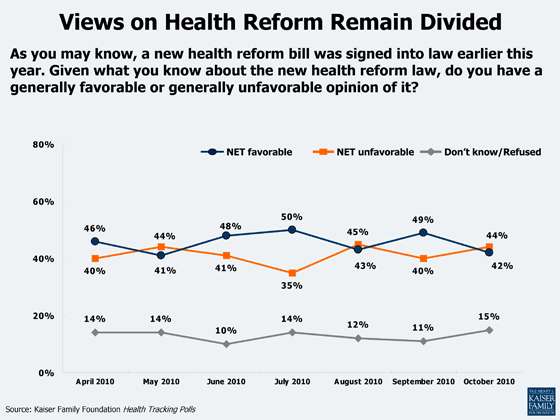
Views on health reform tightened up in October, with 42 percent saying they have favorable views of the new law, 44 percent holding unfavorable views and 15 percent not offering an opinion. This continues a familiar pattern seen over many months in which positive and negative views of the new law move within a relatively narrow band, reflecting a very divided public.

The October poll is the latest in a series designed and analyzed by the Foundation’s public opinion research team.

Findings (.pdf)

Chartpack (.pdf)

Toplines (.pdf)

New Tracking Poll Finds Americans Remain Divided Over Health Law

Published: Oct 18, 2010

With the November midterm elections just weeks away, Americans remain chronically divided over the Patient Protection and Affordable Care Act, but most say that their feelings – pro and con — about the health reform law are not a dominant factor in how they will vote for Congress or whether they will go to the polls, according to the new Kaiser Health Tracking Poll.

Views on health reform tightened up in October, with 42 percent expressing favorable views, 44 percent unfavorable views and 15 percent not offering an opinion. Likely voters are somewhat more negative: 39 percent hold favorable views of the new law, 49 percent hold unfavorable ones. Overall, this continues a now familiar pattern in which positive and negative views of the new law move within a relatively narrow band, reflecting a very divided public. In October, 28 percent said they would support immediate repeal of the law, similar to last month.

No matter what their views on the issue, however, health reform does not appear to be the main issue for most voters as we head into the November elections. Asked to name the most important issue in their vote for Congress, the economy tops voters’ list, named by just over a third (35 percent). Behind that are health reform and dissatisfaction with government, each named by 10 percent. In general, voters are twice as likely to say that the direction of the nation as a whole is more important to their vote than any specific national issue (35 percent vs. 16 percent), with another 21 percent saying their vote will turn on state or local matters and 23 percent saying they will focus more on the specific candidates.

Policy-insights-oct_tracking_poll_560pixels

KFF Explores Health Reform and the Tea Party Movement

Published: Oct 12, 2010

With much media discussion of the role that the Tea Party will play in the upcoming congressional midterm elections, the Kaiser Family Foundation took a closer look at Tea Party supporters using its most recent Health Tracking Poll data from September. While 57 percent of voters who do not support the Tea Party movement view the health reform law favorably, 57 percent of Tea Party supporters view the law “very” unfavorably, and another 11 percent “somewhat unfavorably.” At the same time, nearly two-thirds (63 percent) of Tea Party supporters say they feel “angry” about health reform, even though most (82 percent) of these say their anger is more widely targeted at Washington as a whole rather than specific to the reform law. Republican Tea Party supporters show a more intense opposition to the health reform law than their fellow Republicans who don’t back the Tea Party; in the latter group, 42 percent have intensely negative views of the law, compared to 70 percent of Tea Party Republicans.

News Release

A “Deciding Moment” for AIDS After 30 Years

Published: Oct 5, 2010

New National Media Campaign Inspires Black Americans to Take Action to Stem Spread of HIV

WASHINGTON, Tuesday, 5 October 2010 — Greater Than AIDS, a national movement supported by a broad coalition of public and private sector partners, today unveiled the latest phase of its campaign to mobilize Black Americans in response to the devastating epidemic which will mark its 30th year next June.  Black Americans account for nearly half of new HIV infections occurring annually in the United States, while representing 13 percent of the population.  In addition to being disproportionately affected by HIV/AIDS, Black Americans are also significantly more likely to die as a result as compared to other races and ethnicities in this country.

The cross-platform media campaign focuses on Deciding Moments, everyday opportunities to take a stand against HIV drawn from real-life stories of people from across the country — including those living with HIV.  Be it asking to be tested, buying (and using) condoms, correcting a piece of misinformation, or keeping up with one’s medications, these simple acts serve to challenge the stigma surrounding HIV and stem its spread.  These individuals opened up about their experiences in the hopes of inspiring others to do the same.  An interactive feature on the campaign’s website — www.greaterthan.org — allows visitors to post their own deciding moments.

“As we prepare to close three decades of HIV/AIDS, this is our collective Deciding Moment as a people,” said Phill Wilson, President and CEO of the Black AIDS Institute, a founding partner of Greater Than AIDS.  “Black Americans have borne the brunt of the HIV/AIDS epidemic and now is the time to come together and do our part to change the course of this epidemic.”

The Deciding Moments campaign begins rolling out outdoor, print and online public service advertising this month with television to follow later in the fall and will continue through next year. Leading media companies, including the American Urban Radio Network, CBS Outdoor and Radio, Clear Channel Communications, Ebony, ESSENCE Communications, the National Newspaper Publishers Association, and Radio One, among others, are providing significant donated media space to support the campaign as Greater Than AIDS partners.  A number of state health departments and AIDS offices have also embraced Greater Than AIDS and along with AIDS service organizations and other community groups are leveraging the national campaign to develop expanded targeted efforts in their local areas.

“It’s unprecedented to have such a broad cross-section of media, along with other private and public sector organizations, come together on an issue of such vital importance for Black Americans and the nation,” said Drew Altman, President and CEO of the Kaiser Family Foundation.

The “Deciding Moments” concept grew from research conducted by the Kaiser Family Foundation that reveal the deep-seated stigma that still exists around HIV/AIDS despite strong personal connections to the issue. The overarching message reinforces the core Greater Than AIDS ideals of unity, hope and empowerment by focusing on the power of individuals coming together to achieve a larger goal.  The individuals profiled in the campaign reinforce the range of actions promoted by Greater Than AIDS: knowledge, respect, communication, protection, testing and treatment and involvement.

Among those profiled include a young HIV-positive mother who speaks of her decision to seek treatment when she learned she was pregnant to ensure her baby would be born negative.  A mother who talks about her unconditional love for  her son who on the same day he told her was HIV positive also came out to her as gay.  The son, who has been living with HIV now for more than a decade, shares how his life and well-being has been strengthened by his mother’s support.  An HIV-negative woman discusses her experience living with her husband’s HIV diagnosis more than 20 years ago.  A woman describes going to get tested for herself when her partner would not.  A corresponding profile on the www.greaterthan.org/decidingmoments website provides more detail about each individual’s story and message.  Short video bios have been produced for each individual in the campaign on the website as well as on Facebook.com/greaterthanaids.

“When I was infected by HIV at age 19, I didn’t think I was greater than anything,” said Marvelyn Brown, an HIV activist and author profiled in the Deciding Moments campaign. “I think the Greater Than AIDS message is so important for young people because it’s about empowering us to stand up for ourselves and take control of our bodies and our health.  I hope my decision to be open with my story will help inspire others to take action in response to AIDS, and hopefully, to prevent my peers from becoming infected.”

For radio, Greater Than AIDS joined with up and coming artists to produce original pieces in different musical genres — from rap to hip hop to R&B — to lyrically express the idea behind Deciding Moments.  These works also reflect actual experiences of the participating artists.

The Deciding Moments concept and resulting executions were developed by the Kaiser Family Foundation and Black AIDS Institute working with GTM: Guerilla Tactics Marketing, a grassroots and marketing firm based in Atlanta, which also worked on the campaign’s first year of creative.

The Need

Of the more than 1.2 million people in the United States living with HIV today, half are Black Americans, far surpassing any other racial or ethnic group.  HIV/AIDS is a deeply personal issue with 43 percent of all Americans today — and  nearly 60 percent of Black Americans — now knowing someone who is living with or has died from the disease, for many a family member or close friend, according to a national survey on HIV/AIDS conducted by the Kaiser Family Foundation.

HIV/AIDS is both preventable and treatable — early diagnosis and care helps those with the disease live longer and healthier lives.  Yet, one in five Americans living with HIV today does not know it.   The U.S. Centers for Disease Control & Prevention (CDC) identifies stigma as a major contributor to the spread of HIV, keeping people from seeking information, speaking openly, using protection, getting tested and treated and otherwise acting to protect themselves and those they love.

About Greater Than AIDS

Greater Than AIDS is an unprecedented collaboration among a broad coalition of public and private sector partners united in response to the HIV/AIDS crisis in the United States, in particular among Black Americans and other disproportionately affected groups.  Through a national media campaign and targeted community outreach, Greater Than AIDS aims to increase knowledge and understanding about HIV/AIDS and confront the stigma surrounding the disease. 

The Kaiser Family Foundation – a leader in health policy and communications – provides strategic direction and day-to-day management, as well as oversees the production of the media campaign.  The Black AIDS Institute – a think tank exclusively focused on AIDS in Black America – provides leadership and expert guidance and directs community engagement.  Greater Than AIDS is developed in support of Act Against AIDS, an effort by the U.S. Centers for Disease Control and Prevention (CDC) to refocus attention on the domestic epidemic.  Additional, financial and substantive support is provided by the Elton John AIDS Foundation, Ford Foundation and MAC AIDS Fund, among others.
 

Coordinating Coverage and Care in Medicaid and Health Insurance Exchanges

Published: Oct 1, 2010

The Kaiser Commission on Medicaid and the Uninsured convened a roundtable discussion on August 31, 2010 with a group of national and state experts to discuss key issues related to coordinating coverage and care in Medicaid and the new Health Insurance Exchanges under health reform. The Patient Protection and Affordable Care Act requires states to create a coordinated, simple and technologically-supported process through which individuals may obtain Medicaid, Children’s Health Insurance Program and subsidized Exchange coverage. Coordinating delivery of care across these coverage types also will be important. A number of challenges must be addressed to achieve these goals, but the requirements also provide an opportunity for states to greatly simplify their Medicaid enrollment process and make large-scale upgrades to their eligibility systems. The discussion emphasized that it will be vital for states to begin taking steps now to have systems in place by 2014, when the reform coverage expansions will be fully implemented. Further, participants stressed the importance of immediate federal guidance and support to advance state efforts.

Issue Brief (.pdf)

Explaining Health Reform: Building Enrollment Systems That Meet The Expectations of the Affordable Care Act

Published: Oct 1, 2010

The new health reform law will require most U.S. citizens and legal residents to have health coverage by 2014. It provides new options for coverage by expanding Medicaid eligibility to more low-income people and creating a state-based system of health insurance Exchanges through which individuals can purchase coverage, with federal subsidies for many.

The success of the law in achieving near-universal health coverage will depend on the effectiveness of the enrollment and renewal processes that states put in place. The law establishes the expectation that systems should enroll individuals with the minimum possible burden and handle transitions seamlessly.

This brief explains the key enrollment-related provisions of the health reform law, discusses the elements of an enrollment system that would comply with the law’s requirements and offers strategies — and examples — of how to achieve such a system.

With a quickly approaching 2014 deadline, states must begin working together with federal agencies and stakeholders to put critical policies and systems in place. As states address the immediate challenge of designing and building an Exchange, coordination with Medicaid and CHIP at all points in the enrollment process — from application at the front-end, to data retrieval and verification at the back end — is a fundamental organizing principle.

This brief is a companion to Explaining Health Reform: Eligibility And Enrollment Processes For Medicaid, CHIP and Subsidies in the Exchange.

Issue Brief (.pdf)

Poll Finding

How Popular is the Idea of Repealing Health Reform?

Published: Oct 1, 2010

With a number of this fall’s candidates for public office advocating an overturn of the new health reform law, this Data Note takes a closer look at the variety of polls that have attempted to measure the public’s support for repeal.

Data Note (.pdf)

For an updated look on Americans’ views on repealing the Affordable Care Act, see: The Public, Health Care Reform, and Views on Repeal January 2011

Optimizing Medicaid Enrollment: Spotlight on Technology – Wisconsin’s ACCESS Internet Portal

Published: Oct 1, 2010

This brief examines how ACCESS, a web-based, self-service tool developed by the state of Wisconsin, helps Wisconsin residents find out whether they may be eligible for BadgerCare Plus and other public programs, as well as apply for benefits, check and renew benefits, and report changes to keep their eligibility current — all online. It is the second brief in a Spotlight on Technology series profiling several states’ innovative applications of technology to Medicaid enrollment efforts. The series illustrates a range of approaches that states can adopt to improve their systems now and to prepare for the expansion of Medicaid under health reform.

Issue Brief (.pdf)

Poll Finding

Role of Government Survey

Published: Oct 1, 2010

The Foundation, as part of The Washington Post/Kaiser Family Foundation/Harvard University partnership series, conducted a poll to examine the public’s views on the government and its role. The Role of Government Survey is the 20th in a series of surveys dating back to 1995 that have been conducted as part of this partnership project.

Toplines (.pdf)

Read The Washington Post articles on the survey:Beyond the tea party: What Americans really think of governmentEnergized GOP can thank the tea partyDemocrats have an older-voter problemMore special coverage from The Washington Post

Medicare Spending and Use of Medical Services for Beneficiaries in Nursing Homes and Other Long‐Term Care Facilities: A Potential for Achieving Medicare Savings and Improving the Quality of Care

Published: Sep 30, 2010

Medicare Spending and Use of Medical Services for Beneficiaries in Nursing Homes and Other Long‐Term Care Facilities: A Potential for Achieving Medicare Savings and Improving the Quality of Care

This report documents the relatively high rates of hospital stays, emergency room visits and skilled nursing facility admissions among long-term care facility residents. It finds that Medicare per capita spending for Medicare beneficiaries living in nursing homes, assisted-living centers and other long-term care facilities, $14,538 in 2006, is more than twice the average for all other beneficiaries that year.

The report by researchers at the Kaiser Family Foundation was released at an Oct. 12, 2010, policy briefing.

Report (.pdf)