Innovative Medicaid Initiatives to Improve Service Delivery and Quality of Care: A Look at Five State Initiatives

Published: Sep 1, 2011

A number of states have used the flexibility of the Medicaid program to develop innovative payment and delivery systems designed to coordinate and improve quality of care. This brief, based on site visits from November 2009 through March 2010, highlights care coordination and related efforts in five states: Alabama, Oklahoma, Oregon, Pennsylvania and Washington state. Such efforts by states to realign the provider payment and delivery systems are key to improving Medicaid and to successfully implementing coverage expansions under the health reform law.

Report (.pdf)

Managing Medicaid Pharmacy Benefits: Current Issues and Options

Published: Sep 1, 2011

This report examines reimbursement, benefit management and cost sharing issues in Medicaid pharmacy programs. The analysis, conducted by researchers from the Foundation’s Kaiser Commission on Medicaid and the Uninsured and Health Management Associates, focuses on the potential of several measures recently highlighted by Health and Human Services Secretary Kathleen Sebelius to reduce Medicaid pharmacy costs and is informed, in part, by the perspectives of a group of Medicaid pharmacy administrators convened by the Foundation in May 2011 to discuss current Medicaid pharmacy issues.

Report (.pdf)

Health Affairs Article: The Growth In Cost Per Case Explains Far More Of US Health Spending Increases Than Rising Disease Prevalence

Published: Aug 30, 2011

Health Affairs Article: The Growth In Cost Per Case Explains Far More Of U.S. Health Spending Increases Than Rising Disease Prevalence

This article examines national health spending across an all-inclusive set of diagnostic categories and medical conditions between 1996 and 2006, focusing on trends in cost of care per case and treated prevalence—or, the number of people receiving treatment for a particular condition. It also presents initial estimates of the impact of clinical prevalence on overall spending.

The study was published in the journal Health Affairs and authored by Charles Roehrig, director of the Center for Sustainable Health Spending at the Altarum Institute, and David Rousseau, a vice president and executive director of Health Policy Media & Technology at the Kaiser Family Foundation.

Article (free access until 9/5/2013)

Understanding The Effects of The Medicare Part D Coverage Gap in 2008 and 2009

Authors: Jack Hoadley, Laura Summer, Elizabeth Hargrave, and Juliette Cubanski
Published: Aug 30, 2011

This Kaiser Family Foundation study examines how the coverage gap in Medicare’s drug benefit known as the “doughnut hole” affects Medicare beneficiaries and their prescribing patterns.

Based on actual claims data from 2008 and 2009, before the 2010 health reform law began to close the gap, the study finds that most Part D enrollees with high drug costs who fall in the gap one year are likely to do so in future years. Enrollees who take drugs for certain conditions, including breast cancer and Alzheimer’s drugs, are more likely to reach the gap than other beneficiaries.

The report analyzes retail pharmacy claims data compiled by IMS Health, and was conducted jointly by Jack Hoadley and Laura Summer of Georgetown University, Elizabeth Hargrave of NORC at the University of Chicago, and Juliette Cubanski of the Kaiser Family Foundation.

August Kaiser Health Tracking Poll: The Uninsured and the Health Reform Law

Published: Aug 29, 2011

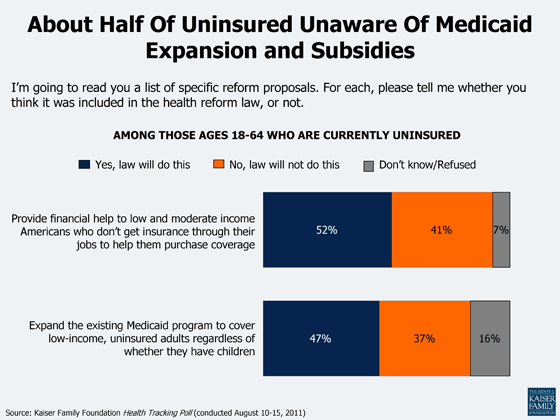
The August Kaiser Health Tracking Poll finds that even though 32 million uninsured Americans will gain health insurance under the ACA, only about half of non-elderly Americans currently without coverage say they are familiar with the chief components in the law designed to achieve this goal. Fifty-two percent of the uninsured say they are aware the law will provide subsidies to help low- and moderate-income people without insurance purchase it. And 47 percent are aware that Medicaid will be expanded to cover more low-income adults.

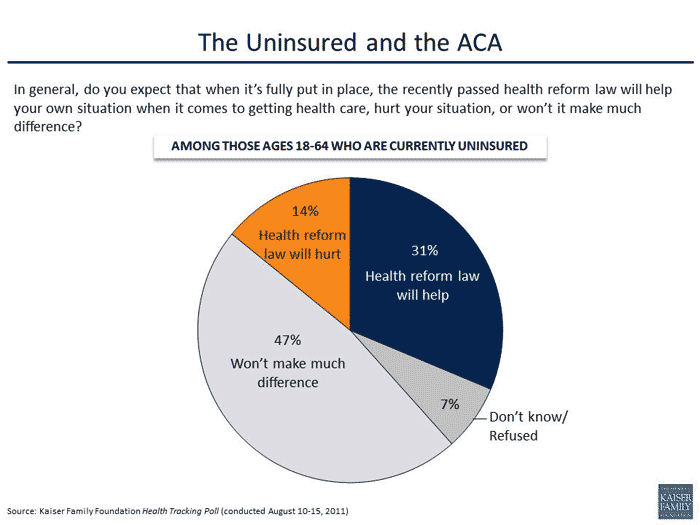
Perhaps because awareness of these coverage expansions is low, nearly half of the uninsured do not expect to be affected at all by the health reform law, either positively or negatively. But three in ten do say it will help them get health care. Fourteen percent expect to be hurt by the law, mainly because they worry they will be required to buy coverage they cannot afford.

On another health policy issue in the news, two-thirds of Americans say they support the recent decision by the Department of Health and Human Services to require health insurance plans to pay for the full cost of birth control and other preventive services for women under the new law. Support is roughly equal between women and men. Find more on this month’s tracking poll and a companion data note that focuses on individuals with employer-sponsored health insurance online.

About Half of Uninsured Aware of  Medicaid Expansion and Subsidies

Pulling It Together: Uninsured But Not Yet Informed

Published: Aug 26, 2011

If there is one thing there is general agreement on when it comes to the Affordable Care Act (ACA) it’s that it will help the uninsured.  The estimates are that 32 million people will gain coverage under the law through an expansion of Medicaid and tax credits, which will help low- and moderate-income people purchase coverage through the new insurance exchanges.

Therefore, it was a real surprise in our latest tracking poll to learn that most of the uninsured don’t know how much the law will benefit them.  About half of the uninsured (47%) don’t think they will be affected much at all by the ACA, either positively or negatively.  Fourteen percent think it will affect them negatively (their main reason is that they are worried about being forced to buy insurance they cannot afford).  We know from survey after survey that the uninsured want insurance coverage.  And we know that the main reason they don’t have it is that they cannot afford it.  Experts who have advocated for expanded coverage for decades probably envision the uninsured sitting around the kitchen table anxiously awaiting the implementation of coverage expansions under the ACA.  But surprisingly, only three in ten of the uninsured say the ACA will help them get health care.  As I have discussed in a previous column, it is possible that some of the uninsured will be faced with choices in the exchanges they don’t like (for example, plans with very high deductibles), and a small number may resent being required to buy health insurance, but the vast majority of the eligible uninsured will benefit from the coverage expansions under the law.

pit082911_1.gif

What’s going on here?  For starters, most people who are uninsured are very busy supporting their families and getting through the day, and they simply do not know much about the ACA, at least not yet.  Nearly half (48% of the uninsured) do not know about the tax credits low- and moderate-income people will get under the ACA (including 41% who not only did not know, but incorrectly said, that the law does not provide tax credits).  And 53 percent did not know about the Medicaid expansion, which covers low-income adults regardless of whether they have children (including 37% who said that the law does not expand Medicaid).

Some may see this as a communications failure.  Certainly it is always possible to get the word out more effectively, but I don’t think that is the issue here.  People who are busy in their everyday lives (and who are being bombarded by a highly spun, confusing political debate about the ACA), will only understand what a complex law like this does when it is tangible for them – when they either get the benefits themselves, see family members and friends benefiting, or see news reports about how the law is working after it is implemented.  When there is real insurance coverage available for people who don’t have it, they will be more aware of it, and they will be able to render a judgment about whether coverage is affordable for them.  These benefits will technically be available in 2014, but outreach and enrollment takes time.  It will be 2015 or 2016 before there is a real test of awareness and affordability.

Experts see the entire law and form a judgment either for it or against it, or come out in the middle.  People will more likely see only pieces.  They may see a Medicaid expansion that touches them (and is likely to carry the name of their state’s Medicaid program), or they may be touched by an insurance reform that they may not even know came from the ACA.  The ACA is not at all like Medicare, which is a single program, with a name, serving a defined population with similar benefits who know they are in it and can form a public judgment about it as a whole.  To predict how the public is likely to react to a real law, we have only one bit of empirical evidence to go on so far.  In my home state of Massachusetts, where they put a similar program in place, our polls and others show that once the people of the Commonwealth experienced the program, they liked it.

Measuring the Affordability of Employer Health Coverage

Published: Aug 24, 2011

A recent draft regulation issued by the Treasury Department describes who is eligible for premium tax credits to help them afford coverage offered through health insurance exchanges beginning in 2014. Tax credits will be available to people with incomes between 100 and 400 percent of the poverty level who are not eligible for public coverage such as Medicaid or Medicare and who are not offered affordable health coverage by an employer. The approach that the regulation proposes for measuring the affordability of employer coverage could have significant financial consequences for a modest number of lower- and middle-income families.

Here’s the issue:

Starting in 2014, the health reform law generally requires people to have health insurance and provides tax credits to help them afford it. Those who are offered health insurance through a job, however, are expected to take that coverage and generally are not eligible for premium tax credits. This includes both the worker and any family members who are eligible to enroll in the job-based coverage. There is an exception to this rule, though: if people are offered coverage by an employer that has patient cost-sharing above a certain level or is unaffordable, they are permitted to forgo the employer plan and apply for a tax credit that can be used for coverage in an exchange. Job-based coverage is considered unaffordable if the amount of the out-of-pocket premium for the employer coverage exceeds 9.5% of that person’s income.

While it’s clear how this applies to a single worker without any dependents, determining a family’s eligibility for premium tax credits is far less clear in the law. One way would be to look at what the family would have to pay for coverage based on its size and compare that to its income. A second way, which the Treasury Department has proposed, would judge affordability for the entire family based solely on whether the employee’s contribution for single coverage would exceed 9.5% of family income, regardless how much it would cost the entire family to enroll in job-based coverage. A third hybrid approach is also possible: affordability for the worker could be determined based on the required contribution for single coverage while affordability for the remaining family members would be based on the required contribution for family coverage.

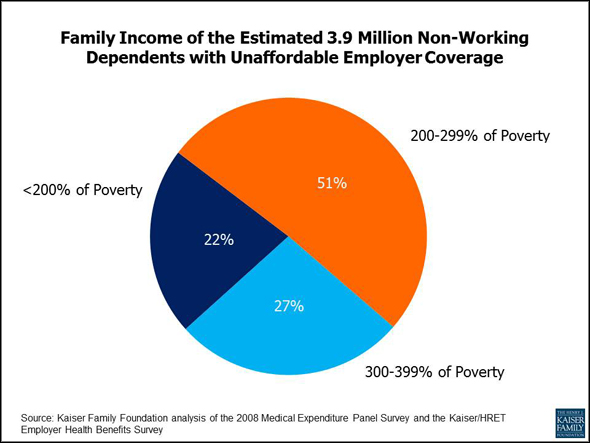
What would this mean for families? We estimated the effect based on coverage in 2008 using demographic and insurance data from the Medical Expenditure Panel Survey and employee premium contribution information from the Kaiser/HRET Employer Health Benefits Survey. The analysis – which assumes no behavior changes by employers in response to the health reform law – suggests that there are about 3.9 million non-working dependents in families (technically, “health insurance units”) in which the worker has access to affordable employer-sponsored coverage but the family does not. Under the draft regulation, these family members would be excluded from getting federal tax credits to help them buy coverage in health insurance exchanges. On average they’d have to pay 14% of their income to opt into the employer coverage, substantially more than what they would pay in an exchange. (Kaiser’s subsidy calculator illustrates what families would pay in exchanges, after taking tax credits into account.) The lowest income workers would generally be eligible for Medicaid, and the higher income workers are unlikely to have to pay more than 9.5% of income for insurance, so people affected the most have incomes under three times the poverty level ($67,050 for a family of four in 2011).

Family Income of the Estimated 3.9 Million Non-Working Dependents with Unaffordable Employer Coverage

In the draft regulation, the Treasury Department indicated that it expects to exempt these family members from the requirement to buy insurance, so they won’t be penalized if they choose to forego coverage. Some of these families would probably still decide to enroll in their employer coverage even though they would have to pay a large percentage of income for it; that would likely be the case even if they were permitted to buy subsidized insurance in an exchange. People value insurance, and they particularly value employer-provided benefits.  But, some of these family members would undoubtedly remain uninsured.

As implementation of the health reform law proceeds and regulations and guidance are issued, this is one of many seemingly technical issues that may have significant implications. It is the nature of insurance that in many cases – this one included – there may be large consequences for a relatively small number of people. Navigating these tradeoffs is what Kaiser President and CEO Drew Altman described in a recent column as the “art of implementation.”

—Larry Levitt and Gary Claxton (with analysis by Anthony Damico)

News Release

Kaiser/UNAIDS study finds drop in overall disbursements for AIDS response in 2010, seven out of 15 governments report reductions

Published: Aug 15, 2011

NEWS RELEASEMonday, August 15, 2011

GENEVA/MENLO PARK, Calif. — Funding disbursements from donor governments for the AIDS response in low- and middle-income countries fell in 2010, dropping 10% from the previous year’s level, according to an annual funding analysis conducted by the Kaiser Family Foundation and the Joint United Nations Programme on HIV/AIDS (UNAIDS).

The study found that donor governments disbursed US$ 6.9 billion in 2010 for HIV prevention, treatment, care and support–US$ 740 million less than in 2009. The decrease was due to a combination of three main factors: actual reductions in development assistance, currency exchange fluctuations, and a slowdown in the pace of U.S. disbursements, which was not a budget cut.

Of the 15 governments surveyed, seven–Australia, Germany, the Netherlands, Norway, Spain, Sweden and the United States–reported a year over year decrease in their disbursements as measured in their own currencies. The figures presented in the report are in US dollars, consistent with international standards and other reporting mechanisms.

Due to currency fluctuations, when measured in US dollars, Australia showed a slight increase in its AIDS funding contribution even though it contributed less in its own currency. Conversely, there was a slight decrease in Denmark’s contribution despite the country’s increased funding level in its own currency.

“AIDS is a smart investment even in this difficult economic environment. We have to look beyond the near-term costs and recognize the long-term benefits,” said Michel Sidibé, Executive Director of UNAIDS. “Donors need to make and follow through on commitments today to reduce costs in the future.”

The overall drop in disbursements was primarily attributed to a reduction in disbursements by the United States, the largest donor nation, which accounted for 54% of total donor disbursements in 2010. While the United States Congress appropriated similar levels of funding for the AIDS response in 2010 as in 2009 (approximately US$ 5.5 billion in each year), disbursements from the United States declined from US$ 4.4 billion in 2009 to US$ 3.7 billion in 2010. This slowdown stems from new requirements established by Congress for the United States President’s Emergency Plan for AIDS Relief (PEPFAR). Some funds appropriated in 2010 will be disbursed in later years.

“With U.S. funding delayed but not eliminated to this point, this year’s drop in spending may be a temporary blip, though its impact on services may be real,” said Drew Altman, Kaiser Family Foundation President and CEO.

To reach universal access goals towards HIV prevention, treatment, care and support, UNAIDS estimates that an investment of at least US$ 22 billion will be needed by 2015. Raising this level of funding could avert more than 12 million new HIV infections and more than seven million deaths, according to UNAIDS.

At the United Nations High Level Meeting on AIDS in June 2011, UN Member States committed to bold new targets for the AIDS response which include increasing investments for AIDS to between US$ 22-24 billion by 2015.

According to the latest estimates from UNAIDS, 34 million [30.9 million-36.9 million] people were living with HIV at the end of 2010 and nearly 30 million [25 million-33 million] have died from AIDS-related causes since AIDS was first reported 30 years ago.

The Kaiser Family Foundation is a non-profit private operating foundation, based in Menlo Park, California, dedicated to producing and communicating the best possible analysis and information on health issues.

UNAIDS, the Joint United Nations Programme on HIV/AIDS, is an innovative United Nations partnership that leads and inspires the world in achieving universal access to HIV prevention, treatment, care and support. Learn more at unaids.org.
Proposed Models to Integrate Medicare and Medicaid Benefits for Dual Eligibles: A Look at the 15 State Design Contracts Funded By CMS

Published: Aug 12, 2011

This brief summarizes 15 states’ preliminary proposals to better coordinate care for people who are in both the Medicare and Medicaid programs. The design contracts, funded by the federal Center for Medicare and Medicaid Innovation (CMMI), are an outgrowth of new efforts under the health reform law to develop service delivery and payment models that integrate care for the nation’s nearly 9 million “dual eligibles,” whose medical needs and health care costs typically exceed those of other Medicare and Medicaid beneficiaries.

The concepts contained in these initial proposals are expected to change and develop as states progress through the design process, and the Centers for Medicare and Medicaid Services determines which proposals will be implemented. The brief summarizes proposals from California, Colorado, Connecticut, Massachusetts, Michigan, Minnesota, New York, North Carolina, Oklahoma, Oregon, South Carolina, Tennessee, Vermont, Washington, and Wisconsin.

Issue Brief (.pdf)

Financing the Response to AIDS in Low- and MiddleIncome Countries: International Assistance from Donor Governments in 2010

Authors: Jennifer Kates, Adam Wexler, Eric Lief, Carlos Avila, and Benjamin Gobet
Published: Aug 8, 2011

Introduction

The last decade saw a dramatic rise in resources devoted to addressing the HIV epidemic in low- and middle-income countries, contributing to significant scale up of treatment and prevention efforts. In marking the 30th year of the epidemic, UNAIDS recently reported that treatment access had increased more than 20 times and new infections fell by nearly 25% over the decade.1

While resources from all sectors – multilateral institutions; the private sector; and low and middle income country governments and the households and individuals within them – have been key to this scale-up, international assistance by donor governments has been one of the most critical, accounting for most of the funding for HIV in many hard hit countries. Donor governments provide assistance through both bilateral aid and contributions to the Global Fund to Fight AIDS, Tuberculosis and Malaria (the Global Fund) and other financing channels such as UNITAID (the international drug purchase facility).

Despite the rise in resources, UNAIDS estimates a resource gap of US$6 billion annually.2 Additionally, the decade of funding increases by donors to combat the HIV/AIDS epidemic appears to be over in the wake of the global economic crisis. After flattening for the first time in 2009, donor government funding for HIV/AIDS fell in 2010. While some of decline is due to exchange rate fluctuations, there were real decreases by several donors. This raises questions about the future of the response to the epidemic, and will be important to monitor over time.

Each year, UNAIDS and the Kaiser Family Foundation collect and analyze data to document international assistance for AIDS in low- and middle- income countries.3 This latest report provides data from 2010, the most recent year available. As such, it represents funding levels reflecting budgeting decisions that occurred during the aftermath of the global economic crisis. The analysis is based on data provided by governments – including the Group of Eight (G8), Australia, Denmark, Ireland, The Netherlands, Norway, Spain, Sweden, and other donor government members of the Organisation for Economic Co-operation and Development (OECD)’s Development Assistance Committee (DAC) – as well as from the European Commission (EC). It includes bilateral assistance and contributions to the Global Fund and UNITAID.

Key Highlights

Funding for international AIDS assistance provided by donor governments declined by 10 percent over the 2009- 2010 period, marking the first time year-to-year support has fallen in more than a decade of tracking efforts:

  • Disbursements (actual resources available in a given year) were US$6.9 billion in 2010, compared to $7.6 billion in 2009 (see Chart 5).The decrease primarily reflects reductions in direct bilateral funding by several governments as well as currency fluctuations.
  • The drop in funding for the AIDS response between 2009 and 2010 comes after years of significant increases.Disbursements rose by more than six-fold between 2002 and 2008 before leveling in 2009, and dropping in 2010 (see Chart 5).
  • In 2010, funding provided to the Global Fund totalled US$2.9 billion, of which US$1.6 billion (or 56%) represents an adjusted “AIDS share” (see Chart 8). Funding for UNITAID totalled US$318 million, of which US$173 million (54.4%) represents an adjusted “AIDS share”.

As has been shown in prior year reports, most international assistance to combat the epidemic is provided bilaterally, although funding channels vary by donor.

  • Bilateral assistance as identified for purposes of this analysis (which includes funding earmarked for AIDS through multilateral instruments, such as UNAIDS), accounted for 74% of disbursements in 2010 (US$5.1 billion, see Chart 7); the remainder was provided multilaterally through the Global Fund and UNITAID.
  • Funding channel patterns vary significantly by donor (see Chart 9).
  • Other international financing sources include multilateral institutions such as U.N. agencies, multilateral development banks such as the World Bank, and the private sector.
  1. UNAIDS, AIDS at 30: Nations at the crossroads, June 2011.  ↩︎
  2. UN General Assembly, Political Declaration on HIV/AIDS: Intensifying our Efforts to Eliminate HIV/AIDS, A/RES/65/277, June 2011.  ↩︎
  3. See, Kaiser Family Foundation, http://www.kff.org/hivaids/7347.cfm↩︎