Explaining Health Care Reform: Medical Loss Ratio (MLR)

Published: Feb 29, 2012

The Affordable Care Act (ACA) includes several provisions that change the way private health insurance is regulated in an effort to provide better value to consumers and increase transparency. One such provision – the Medical Loss Ratio (or MLR) requirement – limits the portion of premium dollars health insurers may spend on administration, marketing, and profits. Under health care reform, health insurers must publicly report the portion of premium dollars spent on health care and quality improvement and other activities in each state they operate. Insurers failing to meet the applicable MLR standard must pay rebates to consumers beginning in 2012.

MLR Standards under the ACA

Health insurers collect premiums from policyholders and use these funds to pay for enrollees’ health care claims, as well as administer coverage, market products, and earn profits for investors. The Medical Loss Ratio provision of the ACA requires most insurance companies that cover individuals and small businesses to spend at least 80% of their premium income on health care claims and quality improvement, leaving the remaining 20% for administration, marketing, and profit.0  The MLR threshold is higher for large group plans, which must spend at least 85 percent of premium dollars on health care and quality improvement.

An analysis by the Government Accountability Office (GAO) found that the majority of insurers with credible claims experience would have met or exceeded the ACA’s MLR rebate standard in 2010 if it had been in effect.0  However, MLR compliance varied substantially by market, with less than half of insurers in the individual market meeting the standard, compared to 70% in the small group market and 77% in the large group market.1 
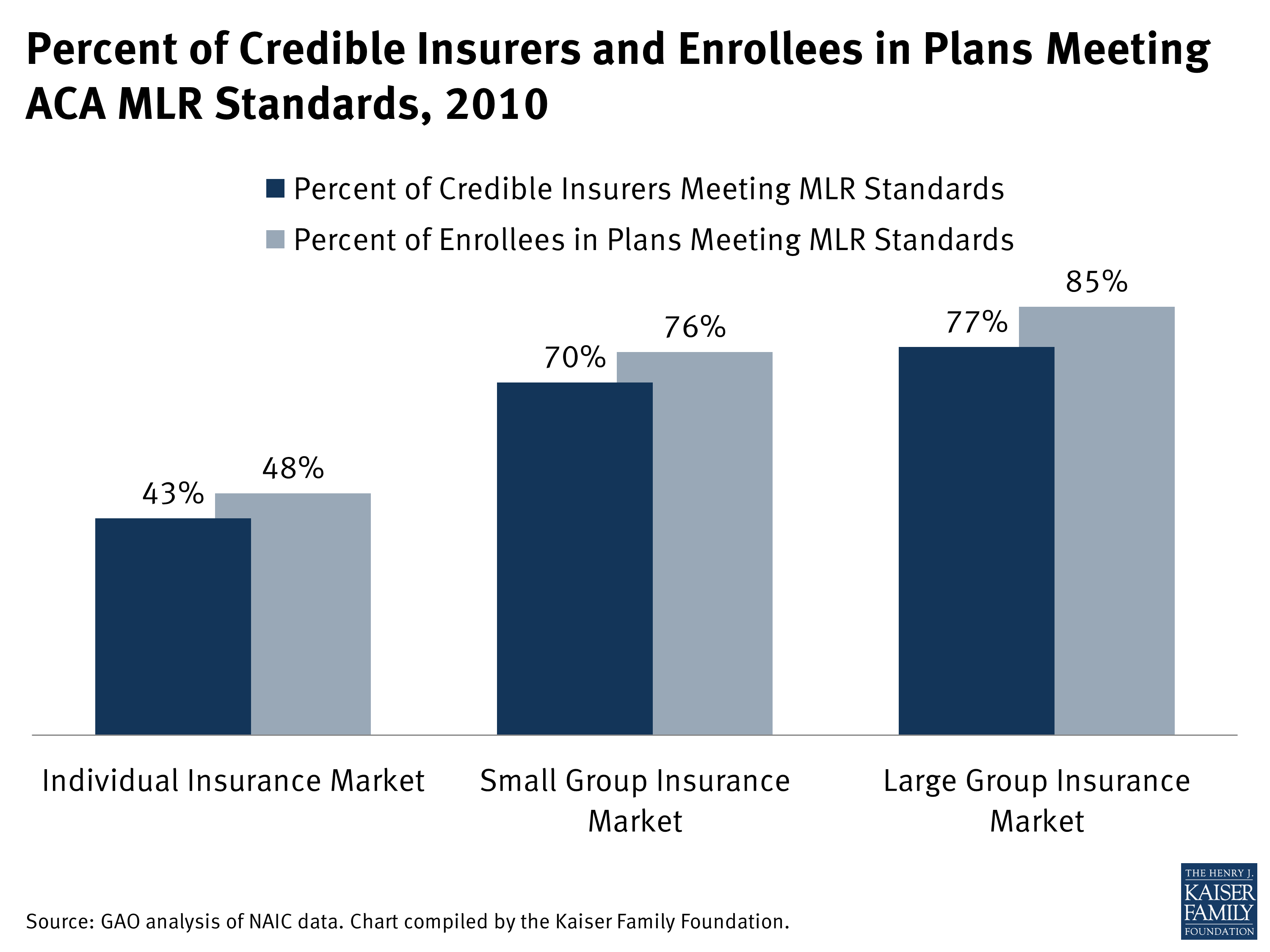
Percent of Credible Insurers and Enrollees in Plans Meeting ACA MLR Standards 2010

The MLR provision of the ACA applies to all types of licensed health insurers, including commercial health insurers, Blue Cross and Blue Shield plans and health maintenance organizations.  The provisions apply to all of an insurer’s underwritten business (i.e. when risk is transferred to the insurer in exchange for premium), including plans that were grandfathered under the ACA.  Health insurance provided by an insurer to an association or to members of an association is subject to the MLR provision.

Self-funded plans (i.e. where the employer or other plan sponsor pays the cost of health benefits from its own assets) are not considered insurers and are therefore not subject to the MLR provision. The MLR standard does not apply even when an insurer administers the self-funded plan on behalf of an employer or other sponsor.

Public Reporting of Financial Data and Rebate Information

Beginning in 2011, all health insurers are required to publically report aggregated state-level financial data, including income from premiums and expenditures on health care claims, quality improvement, taxes, licensing, and regulatory fees. Under the ACA, insurers report their MLR based on state-level data, across all of their plans, in each market segment in which they operate (i.e., individual, small group, and large group).2 

If an insurer fails to meet the MLR standard and is required to issue a refund, it must notify enrollees of any rebates they will receive and how the rebate will be administered. HHS is considering amending the MLR rule in such a way that would require all insurers — regardless of whether a rebate is issued — to notify enrollees of the insurer’s MLR each year and also include information on the prior year’s MLR.3 

Calculating the Medical Loss Ratio

Before the health reform law passed, many states had medical loss ratio and other reporting requirements in place, but these varied quite a bit from state to state.4  Traditionally, MLR is defined as the portion of premium income insurers pay out in the form of health care claims (claims divided by premiums). But under the ACA, insurers can make adjustments for quality improvement activities and expenditures on taxes, licensing and regulatory fees. The figure below illustrates the difference between traditional MLR calculations and the formula under health reform.
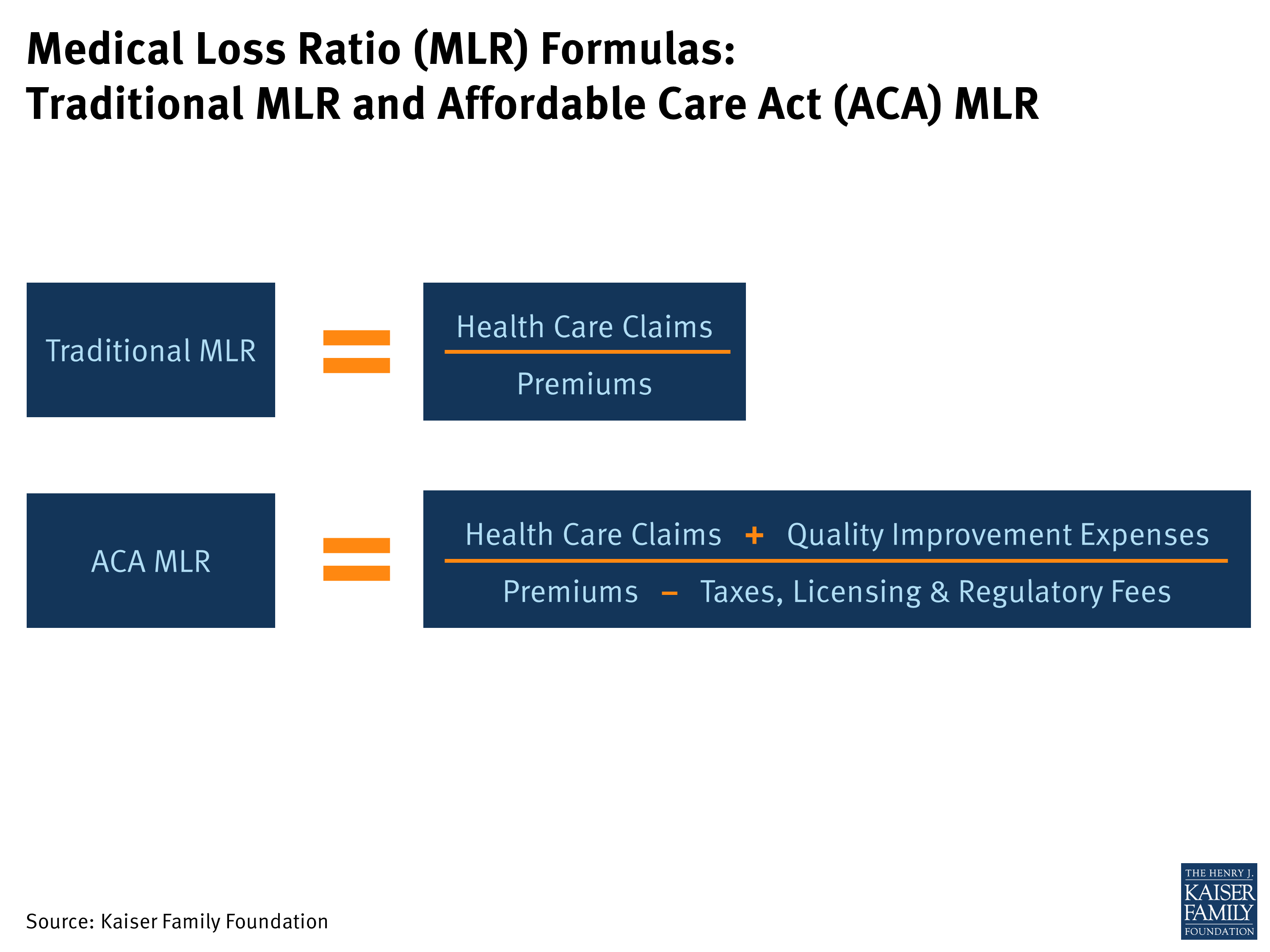
Medical Loss Ratio (MLR) Formulas: Traditional MLR and Affordable Care Act (ACA) MLR

Components of the ACA-MLR Equation

Premiums: All premiums earned from policyholders, including those from state and federal high risk pool programs.

Claims: Payments made by insurers for medical care and prescription drugs.

Quality Improvement: To be included in this category, health improvement activities must lead to measurable improvements in patient outcomes or patient safety, prevent hospital readmissions, promote wellness, or enhance health information technology in a way that improves quality, transparency, or outcomes. Provider credentialing is also included as a health care improvement activity under the ACA. However, insurance broker and agent compensation is not considered an expense relating to health improvement under current law, and is therefore counted as an administrative expense in the ACA MLR.5  The same is true for fraud prevention activities.6 

Taxes, Licensing and Regulatory Fees: Includes federal taxes and assessments, state and local taxes, and regulatory licenses and fees. Taxes on investment income and capital gains are not included. Not-for-profit insurers, which are subject to different tax requirements by state, may either deduct state premium taxes or community benefit expenditures (up to a maximum of the highest state premium tax in their state), whichever is greater.7 

Credibility and Special Circumstances Adjustments

Health insurers with relatively few policies in a market segment may have less predictable claims expenses. The ACA permits insurers with low enrollment to account for this variability by making “credibility” adjustments to their MLRs. MLR adjustments are also allowed for plans with certain special circumstances.

Credibility Adjustments

Credibility adjustments raise an insurer’s MLR, making it easier to meet the threshold. Credibility adjustments are determined by enrollment levels on a state-by-state basis in each market segment. Insurers are grouped into the following categories:

Noncredible: Insurers with fewest enrollees (less than 1,000 life years) are called “noncredible” and are therefore presumed to be in compliance with ACA’s MLR requirements.8 

Partially Credible: Insurers with moderately low enrollment (1,000 to less than 75,000 life years) are called “partially credible.” These insurers receive an adjustment that increases their MLR (by adding 1.2 to 8.3 percentage points to the reported MLR). Insurers with partially credible experience that have higher average deductibles receive further upward adjustments. This deductible factor adjusts the MLR by increasing the insurer’s credibility adjustment by a multiplier (ranging from 1.0 to 1.736).

For example, an insurer with a reported enrollment of 1,000 life years and an MLR of 71.7% would receive a base credibility adjustment of 8.3 percentage points, bringing its MLR up to 80% (because 71.7% + 8.3% = 80%). If the same insurer had an average deductible of $2,500, its credibility adjustment would be increased by a factor of 1.164, bringing its MLR up to 81.36% (because 71.7% + 8.3% * 1.164 = 81.36%).

Fully Credible: Insurers with 75,000 life years or more are considered “fully credible” and are held to the normal MLR standard (80% for the individual and small group market and 85% for the large group market).

Adjustments for Special Circumstances

Expatriate Plans: Insurance policies sold to Americans working abroad may have higher administrative expenses than other policies and therefore receive an adjustment (by multiplying the numerator of the MLR by 2.0). This means that an expatriate plan with a reported MLR of 40%, for example, would meet the 80% threshold in the small group or individual markets after the adjustment is applied (because 40% * 2 = 80%).

“Mini-Med” Plans: Insurance plans with annual benefit limits of $250,000 or less – which typically have lower MLRs because medical claims are low relative to administrative costs – will receive temporary MLR adjustments for the years leading up to the opening of insurance exchanges in 2014. Mini-Med plans may use a multiplier of 1.75 in 2012, decreasing to 1.5 in the year 2013, and 1.25 in 2014. After 2014, these plans will no longer receive an adjustment as annual limits will no longer be allowed in most plans.

Newer Plans: As new insurance plans tend to have fewer claims in their first year, applying the MLR standard to these plans could create a barrier to entry into the insurance market. The ACA therefore allows a one-year deferral for insurers with a high proportion of new plans (representing at least half of their business in a given state).

State Adjustments to Individual Market MLR Standard

The ACA permits adjustments to the MLR requirements in a state if it is determined by the federal government that the 80% MLR requirement could destabilize the state’s individual insurance market. At the time of this publication, HHS has approved MLR adjustments for seven states (Georgia, Iowa, Kentucky, Maine, Nevada, New Hampshire, and North Carolina) and denied requests from eleven states and territories.9  MLR adjustments in 2011 ranged from 65% to 75%, phasing up to 65% – 80% in 2012. By 2014, the individual market MLR standard in each state is expected to reach 80%.
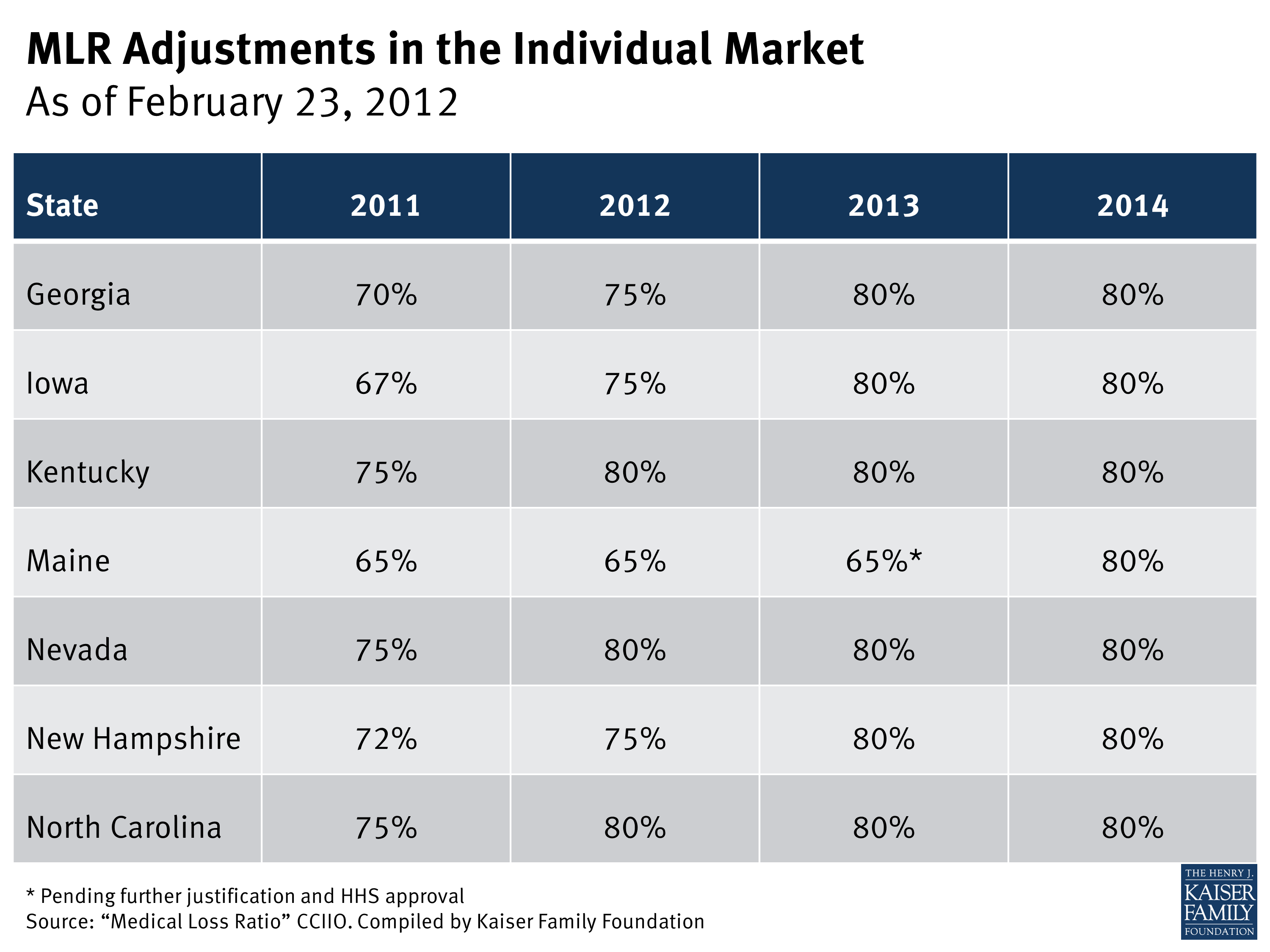
MLR Adjustments in the Individual Market

Note that under the ACA, states have the flexibility to set higher MLR standards than the federal threshold of 80% in the small group and individual markets or 85% in the large group market. 

Consumer Rebates

Beginning in 2012, insurers failing to meet the applicable MLR standard for the prior year must issue rebates to consumers proportionate to the amount in premiums paid by each consumer.10  As medical loss ratios are calculated using aggregate data, rebates are not based on the experience of an individual enrollee or group. Instead, MLR rebates are based on an insurers’ overall compliance with applicable MLR standards in each state it operates. Over time, rebates will be based on cumulative data over three-year periods. All rebates must be issued to consumers by August 1st of the year following the applicable MLR reporting period (i.e., August 2012 for the 2011 reporting period).

In the case of employer-sponsored insurance plans, the cost of coverage is often split between the employer and employees. Therefore, for many employer-sponsored plans, the handling of refunds to employers and employees may depend on the plan’s contract and the manner in which the policyholder and participants share premium costs. Insurers will be responsible for ensuring that rebates benefit consumers proportionally to the amount they contributed toward premiums. In some cases, rebates may be provided in the form of a discount on premiums instead of a cash rebate. If the amount of the rebate is exceptionally small ($5 for individual rebates and $20 for group rebates), insurers are not required to process the rebate, as it may not warrant the administrative burden required to do so.

  1. Private Health Insurance: Early Indicators Show That Most Insurers Would Have Met or Exceeded New Medical Loss Ratio Standards. U.S. Government Accountability Office, Oct 2011. http://www.gao.gov/new.items/d1290r.pdf ↩︎
  2. For more information on insurer filings, see the Supplemental Health Care Exhibit, available at: http://www.naic.org/documents/committees_e_app_blanks_10_blanks_revisions_101026_supp_hc_ex_1_health.pdf ↩︎
  3. Medical Loss Ratio: Getting Your Moneys Worth on Health Insurance. U.S. Center for Consumer Information and Insurance Oversight, Dec 2011. Available at: http://cciio.cms.gov/resources/factsheets/mlrfinalrule.html ↩︎
  4. Haberkorn, Jennifer. Updated: Medical Loss Ratios. Health Policy Briefs. Health Affairs, Nov 2010. http://www.healthaffairs.org/healthpolicybriefs/brief.php?brief_id=33  ↩︎
  5. Cox, Cynthia, and Larry Levitt. Insurance Brokers and the Medical Loss Ratio – Kaiser Health Reform. Kaiser Family Foundation, Dec 2011. http://healthreform.kff.org/notes-on-health-insurance-and-reform/2011/december/insurance-brokers-and-the-medical-loss-ratio.aspx ↩︎
  6. Medical Loss Ratio Requirements Under the Patient Protection and Affordable Care Act. 76 Federal Register 234 (Dec 2011) pages 76574 – 76594. Available at: http://www.gpo.gov/fdsys/pkg/FR-2011-12-07/pdf/2011-31289.pdf ↩︎
  7. Ibid. ↩︎
  8. Life years is a measurement of enrollment referring to the total number of months of coverage for all enrollees, divided by 12 months.  ↩︎
  9. Medical Loss Ratio Adjustments – Kaiser State Health Facts. State Health Facts. Kaiser Family Foundation, Feb 2012. http://www.statehealthfacts.org/comparetable.jsp?ind=940 ↩︎
  10. As the 2011 MLR reporting year will not have sufficient data to use the three-year reporting period, the MLR will be calculated using only 2011 data. In calculating the 2012 MLR, credible plans will use only 2012 data, but partially credible plans will use MLR data from 2012 and 2011. ↩︎

Private Insurance Benefits and Cost-Sharing Under the ACA

Authors: Larry Levitt, Gary Claxton, and Karen Pollitz
Published: Feb 28, 2012

The Department of Health and Human Services (HHS) recently released guidance on the two key components that determine the level of protection that private insurance plans will provide to consumers under health reform. The first involves the services that insurance plans must cover, and the second involves how much patients must pay out-of-pocket for those services.

The Affordable Care Act (ACA) establishes new rules for what insurers must provide for both components starting in 2014. This requires balancing sometimes competing goals of standardizing plan design — which provides certain guarantees to consumers no matter where they live or what plan they choose and facilitates comparisons across insurers – and permitting more diversity of choices in the marketplace. With recent guidance issued by the federal government on benefits and patient cost-sharing, how insurance options could vary by plan and by state has become quite a bit clearer.

Covered Services: The ACA requires HHS to identify essential health benefits for insurance plans offered in the individual and small group markets. The covered benefits must include at least 10 categories: ambulatory patient services; emergency services; hospitalization; maternity and newborn care; mental health and substance use disorder services, including behavioral health treatment; prescription drugs; rehabilitative and habilitative services and devices; laboratory services; preventive and wellness services and chronic disease management; and pediatric services, including oral and vision care.

While quite comprehensive, these 10 categories also leave some room for variation, including specifically what services within a category are covered and whether there are limits on those services (e.g., caps on the number of visits for physical therapy or home health care, both of which are quite common today). Rather than specify a complete standard benefit package, the federal guidance would let each state determine those specifics by choosing a benchmark plan. This is similar to the approach used for the Child Health Insurance Program. Options available to states for the benchmark include: one of the three largest small group products in the state, one of the three largest plans offered to state employees, one of the three largest national plans offered to federal employees, or the largest Health Maintenance Organization (HMO) in the state. States would need to augment the chosen benchmark if it does not provide coverage for one of the required categories (e.g., habilitative services). Benchmarks will certainly vary from state to state, but the covered benefits will likely look relatively similar.

The guidance also allows insurers within a state to vary what services they cover. The federal guidance uses the concept of “actuarial equivalence,” meaning that plans can trade one benefit for another so long as the coverage overall provides the same value on average for consumers. The guidance offers two options for plans to make these benefit trades. One would allow equivalent substitutions only within each of the 10 overall categories. The other would allow substitutions across categories as well, providing plans with greater flexibility. The HHS bulletin indicates that further guidelines will be issued so that insurer substitutions will not result in discrimination against enrollees or applicants with health conditions.

Insurers will also have flexibility in how they actually cover certain benefits. For example, all plans will have to include prescription drug coverage, but the formularies that specify which drugs are covered will vary. The federal guidance requires only that plans cover at least one drug in each class (e.g., antidepressants, drugs to lower cholesterol, protease inhibitors for HIV, etc.). This is somewhat different from federal standards for Medicare prescription drug plans. Medicare plans must cover at least two drugs in each class, and for six protected categories – antidepressants, antipsychotic drugs, anticonvulsant drugs, cancer drugs, immunosuppressant drugs used by transplant patients, and antiretroviral drugs used by patients with HIV – all or substantially all licensed drugs must be covered. Plans also will have different networks of providers and different ways of managing access to providers and covered services.

Cost-Sharing: How much patients must pay out-of-pocket for covered services is determined by a measure called “actuarial value” (AV), which is the percentage of health care expenses a plan would cover on average for a standard population. For example, a plan with an actuarial value of 70% would be expected to cover on average 70% of health care expenses, with enrollees paying the remaining 30% through some combination of deductibles, copays, and coinsurance.

Some amount of diversity in cost-sharing is built into the statute itself, with plans required to offer coverage in any of four standardized “metal tiers:” bronze (AV of 60%), silver (AV of 70%), gold (AV of 80%), and platinum (AV of 90%). (To put this in perspective, current employer-based plans have an average actuarial value between gold and platinum, and current individually-purchased plans have an actuarial value between bronze and silver.)

Within each tier, insurers could design a wide range of options with varying deductibles, copays, and coinsurance to meet the specific actuarial value. The only cost-sharing element specified for all plans is a cap on total annual out-of-pocket costs, equal to the out-of-pocket limit in Health Savings Account qualified plans (currently $6,050 for an individual and $12,100 for a family).

Lower-income enrollees who buy coverage through a health insurance exchange would have lower out-of-pocket caps and be eligible to enroll in plans with lower cost-sharing levels. For example, enrollees with incomes between 150% and 200% of the poverty level ($34,575 to $46,100 for a family of four) would have an out-of-pocket maximum equal to one-third of the standard level (e.g., a little over $2,000 per person) and receive coverage with an actuarial value of 87%.

The recent federal guidance indicates that actuarial values will be determined using a standard calculator developed by the federal government, rather than allowing insurers to use their own data and assumptions. This means that two plans from different insurers with the same plan design will have the same actuarial value. This approach could mitigate one potentially large source of variation across insurers in the cost-sharing they require of patients within a given tier. Last year, for example, Kaiser commissioned three consulting firms to estimate the cost-sharing that would be required in 2014 to meet the actuarial value thresholds in the ACA using their own data and some common assumptions. The results varied tremendously. For a silver plan with 20% coinsurance, the estimated deductible for a single person ranged from $1,850 to $4,200.

The guidance notes, however, that the calculator may not be able to provide results for some complicated plan configurations, such as tiered networks or donut hole designs. Insurers may be able to adjust the way they use the calculator in these situations, introducing more subjective actuarial judgment into the calculation. States would also be given flexibility to customize the actuarial value calculator using local data, which could result in some variation across states in what cost-sharing is required.

There are still a number of outstanding questions about how the rules governing benefits and cost-sharing will work. For example, will plans be prevented from discriminating against very high-cost patients by imposing substantial cost-sharing or limiting coverage for specialty drugs and other services affecting a small number of people? Will consumers be able to readily recognize and understand variations in plan benefit and cost-sharing designs, and evaluate the differences in protection they offer?

But, the basic approach for how this will all work is now coming into view. Individual consumers and small businesses will be able to choose from a very wide range of options, from bronze plans offering essentially catastrophic coverage to platinum plans with much lower cost-sharing (and higher premiums). Deductibles and other cost-sharing features will vary somewhat from plan to plan and state to state, but a bronze, silver, gold, or platinum plan should provide approximately the same degree of protection everywhere. Benefits may vary somewhat across the country, depending on the benchmarks that states choose, and across insurers as well. That variation is likely to be more around limits on the number of days or visits that are covered rather than outright exclusions for entire categories of services, and coverage will certainly vary less than it does today.

Different people, of course, will come to different judgments about how this approach balances the goals of ensuring minimum protection for consumers, comparability, and diversity of choice.

Insurance Coverage of Contraceptives

Published: Feb 21, 2012

The last several weeks have been a roller coaster ride for those interested in insurance coverage of contraceptives. In this post, we answer some of the key questions about the new contraceptive coverage policy generally, and more specifically, how it will be applied to religious organizations.

Why is contraceptive coverage part of health reform?When the Affordable Care Act was passed, it included considerable attention to preventive care, for the first time stipulating that new private plans cover a wide range of recommended clinical preventive services to plan holders without cost-sharing. Specifically, this section of the law (2713) requires that private plans cover services that receive a strong recommendation from the U.S. Preventive Services Task Force (USPSTF); vaccines recommended by the Advisory Committee on Immunization Practices (ACIP); preventive services for children recommended by Bright Futures guidelines for pediatric preventive care; and “with respect to women,” new services that will be identified by the Health Resources and Services Administration (HRSA). In 2010, the Department of Health and Human Services (HHS) requested that the Institute of Medicine (IOM) convene a committee of experts in women’s health and prevention to identify gaps for women in the current preventive recommendations.

The IOM committee identified eight new preventive services for women, including screening for intimate partner violence, well woman visits, breastfeeding supports as well as the inclusion of contraceptive services and supplies, including all methods approved by the Food and Drug Administration. These recommendations were adopted by HHS in August 2011. Contraception is also recommended as a part of health care for women by the nation’s leading health care professional associations, including the American Medical Association, the American Congress of Obstetricians and Gynecologists, the American Academy of Pediatrics, and the American Public Health Association.

This new provision has significant implications for access to contraception and affordability for millions of women. It is estimated that half of pregnancies in the U.S. are unintended, among the highest rate among developed nations. The vast majority of women in the U.S. have used a contraceptive at some point in their lives to prevent unintended pregnancy, plan future pregnancies, or space childbearing. Cost-sharing requirements, such as co-payments and co-insurance, have been shown to curtail utilization of preventive services.

How much do contraceptives cost and aren’t they already covered by insurance?The costs of contraceptives can vary widely, depending on the type of contraceptive a woman uses. Condoms are generally inexpensive, but other forms that are more effective (such as implants and IUDs) can be quite costly and also require a visit to a health care provider for insertion or prescriptions.

Coverage for prescription contraceptives is generally widespread, but not universal, in the private and public sectors. Most women in the U.S. receive coverage through private plans, and the 2010 Kaiser/HRET survey of employers reports that 85% of large firms cover prescription contraceptives in their largest health plans, although they may charge cost-sharing which can vary greatly by employer and type of plan. Currently, 28 states require insurance plans sold in the state to cover contraceptives, with a wide range of specific requirements and exemptions among these mandates. These laws, however, do not affect self-insured employer plans, which are regulated by the federal Employee Retirement Income Security Act (ERISA) and are exempt from state rules. These are plans that are funded directly by the employers and 60% of covered workers are in these plans. In 2000, a ruling by the Employment Equal Opportunity Commission found that employers that cover preventive prescription drugs and services, but do not cover prescription contraceptives are in violation of the Civil Rights Act. Contraceptive coverage is also typically included in most major government programs, including the Federal Employees Health Benefits Plan (FEHBP), Medicaid, the Indian Health Service, and TRICARE (which covers military families).

How will the final federal rule on contraceptive coverage affect insurance coverage of contraceptives?

The new federal rule will be effective August 1, 2012 and states that the full cost of all prescribed FDA-approved contraceptives and related services must be covered in new private plans, including individual, small group, large group, and self-insured employer plans. This new rule applies to all new plans, except for plans sponsored by certain non-profit religious employers who object to the use of birth control. Existing plans that have “grandfathered” status are not required to provide this coverage regardless of the employers’ religious affiliation. Originally, the exemption was limited to religious employers that included only houses of worship. Some religious leaders called for a broader definition of religious employers to include religiously-affiliated institutions, such as faith-based hospitals and universities, even if they employ and serve people with a wide range of religious tenets. Others disagreed, saying that the type of insurance coverage that women have should not be defined by their employers’ religious beliefs. This exemption has been the focus of much of the current debate.

Who will be required to cover contraceptives and who is exempt?

The Administration issued a Final Rule on February 10, 2012 addressing the religious exemption. In essence, the exemption has two levels: One that exempts churches, synagogues, and other houses of worship from the coverage requirement completely. It also grants other nonprofit employers who hold religious objections to contraceptives a one-year grace period (until August 2013), during which they do not have to comply with the regulation. By the end of this one-year period, HHS will issue rules requiring the insurance companies that sell plans to these religiously-affiliated employers to offer contraceptive coverage without cost-sharing directly to any employees and their dependents who desire it. Therefore, religiously-affiliated employers that oppose birth control will not have to spend their funds on contraceptive coverage, but their employees and their dependents will still be able to obtain full coverage for contraceptives directly from the insurer. During the transition year, the Administration plans to put forth more details on this portion of the regulation and to specify requirements for self-insured plans, where the employer and the insurer are the same entity. It is currently unknown how many religiously-affiliated insurers are self-insured.

The Administration put forth this rule with the intention of relieving employers with religiously-based objections with the obligations of using their funds toward contraceptive coverage, which may violate their religious tenets, while still assuring that women have access to contraceptive coverage without cost-sharing.

This final policy is based on the contraceptive coverage mandate and exemption in Hawaii. In Hawaii, an employer that invokes a religious exemption to the mandate is required to provide enrollees, in writing, a list of the contraceptive services that the employer refuses to cover as well as information on how to access the services. It is the insurer who must then to provide this coverage to the workers. The Hawaii statute also recognizes that women may use contraceptives for many health conditions, and states that coverage must include “prescription contraception that is necessary to preserve the life or health of the enrollee.” Under the federal rules it is not yet clear how employees will be notified of the policy, whether there will be a similar protection for the other medical uses of contraceptives, and how the new rule will affect self-funded employer plans that have been exempted from state laws. This could be clarified over the next year.

What is the cost impact of this provision?The specific short- and long-term costs and savings for plans of this new policy are not known. The National Business Group on Health recommends that employers include coverage of contraceptives in their plans, finding that the short-term costs may be modest and will likely be offset rapidly by long-term saving in preventing costs associated with pregnancy. An HHS brief on cost implications of prior expansions of contraceptive coverage concluded: “Evidence from well-documented prior expansions of contraceptive coverage indicates that the cost to issuers of including coverage for all FDA-approved contraceptive methods in insurance offered to an employed population is zero.” When coverage of contraceptives was added to FEHBP in 1999, it did not increase premium costs. Finally, a key difference between prior research and the current policy is that the ACA provision eliminates cost-sharing, and it is not clear how much this would affect plan costs as this expense is currently borne by workers and their families.

What’s next?While the rule issued by HHS is final, this issue is likely to remain in play. Over the coming year, HHS has indicated that it will further clarify how this exemption will be structured. In the meanwhile, some legislators in Congress who are not satisfied with the present religious exemption have introduced legislation to change this rule and other organizations have filed legal challenges. These bills and lawsuits aim to either broaden the exemptions from the mandate to a wider group of employers with objections to contraceptives and other elements of the health reform law, or repeal the contraceptive coverage provision from the law.

Key Issues to Consider for Outreach and Enrollment Efforts under Health Reform

Published: Feb 1, 2012

The Affordable Care Act will significantly expand health coverage opportunities through an expansion in Medicaid and the creation of new health insurance exchanges in 2014. Effective outreach and enrollment efforts will be vital for assuring the expansions translate into increased coverage. Based on a discussion with federal and state officials and experts, this report identifies key issues to consider with regard to outreach and enrollment under reform.

The discussion was part of an ongoing series of Health Reform Roundtables that explore key issues related to implementing the expansion of Medicaid under health reform.

Report (.pdf)

Health Insurance Coverage in America, 2010

Published: Feb 1, 2012

Over 49 million people in the United States had no health insurance coverage in 2010—more than one in every six (18.5%) of the population under age 65. Having a clear picture of who the uninsured are is fundamental to addressing this nation-wide problem.

This slideshow provides figures and tables on the uninsured and health insurance coverage for the following subpopulations: nonelderly, children, nonelderly adults and working adults. Figures are provided for important social, economic, and health status determinates of health insurance coverage, including age, gender, family income and work status, education, race/ethnicity, household type, citizenship and health status.

Online Slideshow

Medicaid and Managed Care: Key Data, Trends, and Issues

Published: Feb 1, 2012

This brief provides a snapshot of the Medicaid program’s use of managed care to deliver services to beneficiaries. It examines the prevalence of managed care in state Medicaid programs; the various approaches states have used, including primary-care case management; managed care for long-term services and for beneficiaries dually eligible for Medicaid and Medicare; and evidence of cost-savings.


People with Disabilities and Medicaid Managed Care: Key Issues to Consider

Published: Feb 1, 2012

As many states expand their use of managed care in Medicaid, a growing number of beneficiaries with disabilities are being enrolled in risk-based managed care arrangements for at least some of their care. Further growth in managed care is expected in 2014, when the Affordable Care Act expands Medicaid eligibility to many uninsured low-income adults, including those with disabilities.

This issue brief looks at issues related to the development and implementation of managed care programs with the capacity to serve Medicaid beneficiaries with disabilities. Drawing on existing research on Medicaid managed care and people with disabilities, the brief highlights policy considerations related to setting plan payment rates, developing adequate provider networks and delivery systems, and ensuring sufficient beneficiary protections and plan oversight.

The brief considers the wide range of intensive and specialized medical and long-term care needs facing Medicaid beneficiaries with disabilities that may include spinal-cord and traumatic-brain injuries, cerebral palsy, autism, Alzheimer’s disease and severe mental illness, and the challenges states face in designing effective managed care programs that successfully meet those needs.

Issue Brief (.pdf)

State Adoption of Coverage and Enrollment Options in The Children’s Health Insurance Reauthorization Act of 2009

Published: Feb 1, 2012

The Children’s Health Insurance Reauthorization Act of 2009 (CHIPRA) extended and expanded the Children’s Health Insurance Program (CHIP), which was originally enacted in 1997. Together Medicaid and CHIP cover more than 32 million children, providing them access to needed care, including ongoing preventive and primary care that is key for children’s health and development and financial protections for their families.

CHIPRA added $33 billion in federal funds for children’s coverage through 2013 and included provisions designed to increase and strengthen coverage for children in both Medicaid and CHIP. This fact sheet provides an overview of new coverage options, enrollment tools, and incentives provided by CHIPRA and state adoption of these options to date.

Fact Sheet (.pdf)

News Release

Black Celebrities Unite In Response To AIDS

Published: Feb 1, 2012

NEWS RELEASEEmbargoed for release until:February 6, 2012

New Greater Than AIDS PSAs and Social Media Messages Mark National Black HIV/AIDS Awareness Day (Feb. 7)

More than 60 Black celebrities have united with Greater Than AIDS to bring attention to the severe and disproportionate epidemic facing Black Americans and reduce the stigma surrounding the disease. Black Americans account for half of the approximately 1.1 million people living with HIV/AIDS in this country today – and 44 percent of new infections – while representing just 12 percent of the population. Blacks are also more likely to die of AIDS as compared to other racial and ethnic groups.

Coinciding with National Black HIV/AIDS Awareness Day (Feb. 7), Greater Than AIDS is debuting new public service ads (PSAs), coordinated social media posts and other messages from popular Black television and film actors, directors, producers, and others in Hollywood about the devastating effect of HIV/AIDS in the Black community. Many of the participating talent spoke about people they knew who are living with or have died from the disease. Participating talent will be supporting the campaign’s themes of unity, hope and empowerment through their own Facebook, Twitter and other social media platforms and through personal appearances. (A list of participating celebrities is attached.)

“This is an unprecedented response from the Black Hollywood community to an issue that has touched so many of our lives,” said Phill Wilson, President and CEO, Black AIDS Institute. The Black AIDS Institute is a co-founding partner with the Kaiser Family Foundation of Greater Than AIDS. “Our voice is one of the most powerful tools we have in combating the ignorance and stigma that still surrounds this disease.” The celebrities featured in this campaign are all members of the Black AIDS Institute’s Black Hollywood Task Force on AIDS, which works to engage the Hollywood community in an effort to fight HIV/AIDS. “The artists and executives who have joined us in this campaign realize that no matter the celebrity, they are also members of the Black community, and they are trying to do their part.”

“HIV/AIDS is a deeply personal issue for many Black Americans, yet the issue is too often silent in many communities,” said Tina Hoff, Senior Vice President and Director, Health Communication and Media Partnerships, Kaiser Family Foundation. According to a national survey by the Kaiser Family Foundation, more than 60 percent – three in five – Black Americans know someone living with HIV/AIDS or who has died from the disease; for most, a family member or close friend.

The Kaiser Family Foundation and the Black AIDS Institute are executive producers. Linda Jones of The Mass Appeal produced, and Vanessa Williams (SOUL FOOD) with Quincy LeNear and Deondray Gossett (THE DL CHRONICLES, THE VOICE) directed.

Black Hollywood Task Force GREATER THAN AIDS PARTICIPATING TALENT:

• Laila Ali, professional athlete /actress /spokesperson• Tatyana Ali, actress (THE FRESH PRINCE OF BEL-AIR/NBC, LOVE THAT GIRL!/TV ONE)• Anthony Anderson, actor (LAW & ORDER/NBC, THE BERNIE MAC SHOW/FOX, K-VILLE/FOX, THE SHIELD/FX NETWORK, THE DEPARTED, TRANSFORMERS)• Robb Armstrong, nationally syndicated cartoonist (JUMPSTART)• Essence Atkins, actress (ARE WE THERE YET/TBS, HALF AND HALF/UPN, SMART GUY/THE WB)• Rochelle Aytes, actress (THE FORGOTTEN/ABC)• Obba Babatunde, actor (PRIVATE PRACTICE/ABC, HALF & HALF/UPN)• Alimi Ballard, actor (NCIS/CBS, NUMB3RS/CBS)• Denise Boutte, actress (MEET THE BROWNS/TBS, WHY DID I GET MARRIED)• RaVaughn Brown, singer/actress (COLUMBIA RECORDS)• Rhyon Brown, actress (LINCOLN HEIGHTS/ABC FAMILY)• Yvette Nicole Brown, actress, (COMMUNITY/NBC)• Anthony Burrell, actor (THE SKINNY)• Tracy “Twinkie” Byrd, casting director (SPARKLE, JUMPING THE BROOM, NOTORIOUS, STUMP THE YARD 1 & 2)• Affion Crockett, actor/comedian (IN THE FLOW WITH AFFION CROCKETT/FOX)• Leah Daniels, casting director (PRECIOUS, LOVE THAT GIRL!, ATL, THE WAYANS BROS, THE PAPERBOY)• Gary Dourdan, actor (CSI/CBS, JUMPING THE BROOM)• Bill Duke, filmmaker/director/actor• Nadine Ellis, actress (LET’S STAY TOGETHER/BET)• Jennia Fredrique, actress (THE SKINNY)• Jennifer Freeman, actress (MY WIFE AND KIDS/ABC)• Jason George, actor (GREY’S ANATOMY/ABC, OFF THE MAP/ABC)• Lance Gross, actor (TYLER PERRY’S HOUSE OF PAYNE/TBS)• Dennis Haysbert, actor (24/FOX, THE UNIT/CBS)• Samuel L Jackson, actor/producer (JUNGLE FEVER, PULP FICTION, CAPTAIN AMERICA, STAR WARS III, IRON MAN 2, KILL BILL 2, CHANGING LANES, SHAFT, A TIME TO KILL)• Carlon Jeffery, actor (ANT FARM/DISNEY)• Jill Marie Jones, actress (GIRLFRIENDS/UPN & THE CW)• Orlando Jones, actor/comedian (MAD TV/FOX, THE EVIDENCE/ABC)• Tamala Jones, actress (CASTLE/ABC)• Kenny Lattimore, award winning musical artist• Robinne Lee, actress (HOUSE OF PAYNE/TBS, SEVEN POUNDS)• Nia Long, actress (THIRD WATCH/NBC, THE FRESH PRINCE OF BEL-AIR/NBC)• MC Lyte, musical artist (President of the L.A. Chapter of the Grammys Recording Academy)• Eva Marcille, model/actress (AMERICA’S NEXT TOP MODEL/THE CW, THE YOUNG AND THE RESTLESS/CBS)• Christopher Massey, actor (ZOEY 101/NICKELODEON)• Kyle Massey, actor (THAT’S SO RAVEN/DISNEY, CORY IN THE HOUSE/DISNEY, DANCING WITH THE STARS/ABC)• Dr. Lisa Masterson, MD, host (THE DOCTORS/CBS)• Elizabeth Mathis, actress (TRON: LEGACY)• Rashad McCants, NBA player• Nicki Micheaux, actress (LINCOLN HEIGHTS/ABC FAMILY)• Tia Mowry, actress (THE GAME/BET)• Naturi Naughton, actress/musical artist (NOTORIUS, FAME, 3LW, PLAYBOY CLUB/NBC)• Michaela Pererira, anchor (KTLA NEWS)• James Pickens, Jr., actor (GREY’S ANATOMY/ABC)• Isa Rahman, actor/model• Gina Ravera, actress (THE CLOSER/TNT)• REBORN, gospel hip hop artist• Robi Reed, Vice President of Talent and Casting (BET)• Dominique Reighard, model (AMERICA’S NEXT TOP MODEL/THE CW)• Shaun Robinson, ACCESS HOLLYWOOD• J Rome, musical artist (COLUMBIA RECORDS)• B. SCOTT, celebrity online blogger• Tasha Smith, actress (TYLER PERRY’S FOR BETTER OR WORSE/TBS)• Jurnee Smollett, actress (FRIDAY NIGHT LIGHTS/NBC, THE DEFENDERS/CBS, THE GREAT DEBATERS, GRIDIRON GANG)• Jussie Smollett, Actor (THE SKINNY)• Chelsea Tavares, actress (UNFABULOUS/NICKELODEON, JUST JORDAN/NICKELODEON)• Tamara Taylor, actress (BONES/FOX)• Bobb’e J. Thompson, actor (30 ROCK/NBC , TYLER PERRY’S FOR BETTER OR WORSE/TBS, BOBB’E SAYS/CARTOON NETWORK, THAT’S SO RAVEN/DISNEY ROLE MODELS)• Tammy Townsend, actress (LINCOLN HEIGHTS/ABC FAMILY, SHERRI/LIFETIME TV, ROCK ME, BABY/UPN, FAMILY MATTERS)• Brian White, actor (MEN OF A CERTAIN AGE/TNT, GOOD DEEDS)• Michael Jai White, actor (TYLER PERRY’S FOR BETTER OR WORSE/TBS)• Jesse Williams, actor (GREY’S ANATOMY/ABC)• Oren Williams, actor (REBOUND, COLD CASE/CBS)• Tyler James Williams, actor (EVERYBODY HATES CHRIS/THE CW)• Vanessa Williams, director/actress (MELROSE PLACE/FOX, SOUL FOOD/SHOWTIME)• Zachary Williams, actor (ROMEO!/NICKELODEON , LINCOLN HEIGHTS/ABC FAMILY)• Zo Williams, radio personality (HOST OF THE VOICE OF REASON/FOXX HOLE SATELLITE RADIO)• Camille Winbush, actress (SECRET LIFE OF THE AMERICAN TEENAGER/ABC FAMILY, THE BERNIE MAC SHOW/FOX)• Blake Young-Fountain, actor (THE SKINNY, TWO BROKE GIRLS/CBS)

###

About Greater Than AIDS

Greater Than AIDS is an unprecedented collaboration among a broad coalition of public and private sector partners united in response to the HIV/AIDS crisis in the United States, in particular among Black Americans and other disproportionately affected groups.Through a national media campaign and targeted community outreach, Greater Than AIDS aims to increase knowledge and understanding about HIV/AIDS and confront the stigma surrounding the disease.

The Kaiser Family Foundation – a leader in health policy and communications – provides strategic direction and day-to-day management, as well as oversees the production of the media campaign. The Black AIDS Institute – a think tank exclusively focused on AIDS in Black America – provides leadership and expert guidance and directs community engagement.Greater Than AIDS is developed in support of Act Against AIDS, an effort by the U.S. Centers for Disease Control and Prevention (CDC) to refocus attention on the domestic epidemic.Additional, financial and substantive support is provided by the Elton John AIDS Foundation, Ford Foundation and MAC AIDS Fund, among others.

A Guide to the Supreme Court’s Review of the 2010 Health Care Reform Law

Published: Jan 30, 2012

With the Supreme Court preparing to hear oral arguments about challenges to the 2010 Affordable Care Act in March 2012, this Kaiser Family Foundation brief serves as a primer on the pending case, which challenges the constitutionality both of the law’s individual mandate that requires most Americans to obtain health insurance and of provisions requiring states to expand eligibility for their Medicaid programs.

The brief provides an overview of the pending case, the key constitutional questions, and the legal arguments made by the parties involved. It also outlines how the Court could decide each of the issues and the potential implications of the Court’s decisions. A separate report examines the Medicaid arguments in the case in more detail.

Report (.pdf)

SEE ALSO: Read about the outcome in A Guide to the Supreme Court’s Affordable Care Act Decision