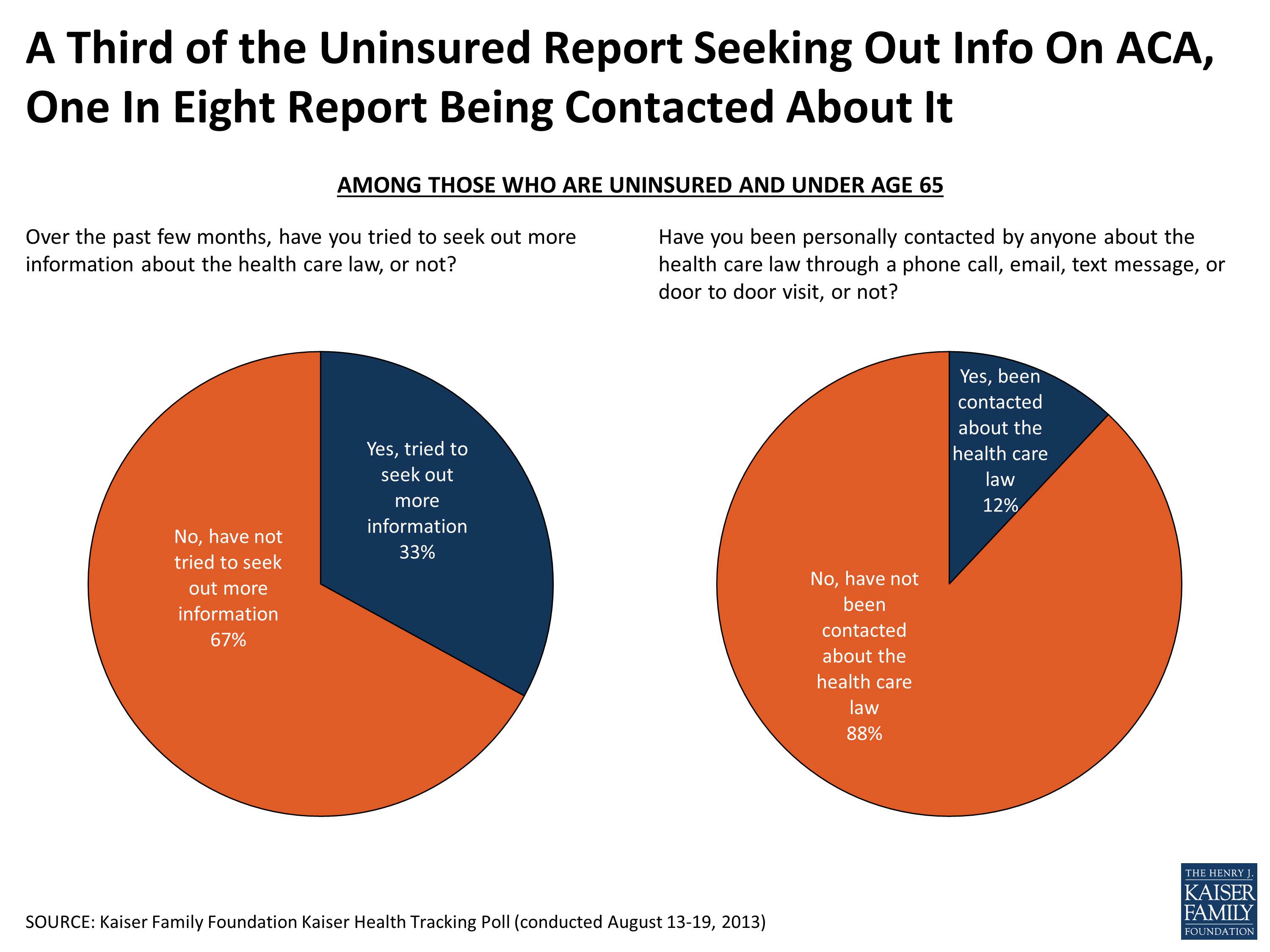
Percent of the Uninsured Who Were Contacted About ACA or Sought Out Info
The independent source for health policy research, polling, and news.
The August 2013 Visualizing Health Policy infographic provides an informational snapshot of long-term services and support (LTSS) for seniors in the United States. This includes information about the number and proportion of seniors who will need LTSS because of physical and cognitive impairment, the role of unpaid family caregivers in providing the majority of LTSS, the role of Medicaid (not Medicare) as the primary payer for LTSS, the shifting of Medicaid spending from institutional-based care toward community-based care, and the fact that 35% of US adults 40 years or older say they have set aside money for their long-term needs.
Visualizing Health Policy is a monthly infographic series produced in partnership with the Journal of the American Medical Association (JAMA). The full-size infographic is freely available on JAMA’s website and is published in the print edition of the journal.
The Grammy Award-winning artist joins with local residents and leaders, the music and faith communities, and elected officials to come together to tackle HIV’s disproportionate impact in communities of color.
NEW YORK, Aug. 22, 2013 — Grammy Award-winning artist and advocate Alicia Keys rallied with community leaders and residents of Harlem today, hosting a community conversation aimed at tackling the issue of HIV/AIDS. Hosted by Harlem Hospital together with Greater Than AIDS, Ms. Keys was joined by Congressman Charlie Rangel (D-NY); Denise Soares, the Executive Director of Harlem Hospital; Minister Vin Baker of the Abyssinian Baptist Church in Harlem; Dr. Helene Gayle; Russell Simmons; and Greater Than AIDS ambassador Stephanie Brown, in an open and honest discussion with residents of Harlem about HIV/AIDS, its impact in the community, and the stigma that often surrounds the disease.
In Harlem, as nationally, people of color have been disproportionately affected by HIV/AIDS. The large majority of people living with HIV in Harlem are Black or Hispanic. In 2011, the most current year data is available, the rate of HIV diagnosis per 100,000 population was 4 to 5 times higher in Harlem as compared to the nation overall.
Speaking to an energetic crowd of over 400 at Harlem Hospital, the speakers stressed the urgency of addressing HIV/AIDS in communities of color. The event brought together different parts of the community– faith and political leaders, social and health care advocates, artists and young people – to break down the barriers of stigma, fear and ignorance and promote HIV testing and treatment for those who are positive. Following the community conversation, Alicia Keys, Congressman Rangel and Dr. Gayle joined with community residents to get tested as part of a free on-site HIV screening being offered by Harlem Hospital.
“There are serious misconceptions out there that keep HIV/AIDS in the shadows,” said Keys. “Each and every one of us has to come together to change that. There is no reason that Black and Hispanic people should continue to be affected like this. By talking about HIV/AIDS honestly and openly, we can overcome stigma and fear and start a real dialogue that allows us to know, learn and share the truth.” Earlier this year, Ms. Keys joined with Greater Than AIDS to launch EMPOWERED, a new campaign to reach women in the U.S. about HIV/AIDS and highlight their power in changing the course of the epidemic.
“We cannot sit idly as this epidemic continues to spread,” said Congressman Rangel. “In fact, the fight against HIV/AIDS is one of my highest priorities in Congress. Recently I introduced the Communities United with Religious Leaders for the Elimination of HIV/AIDS (CURE) Act. It would authorize the U.S. Department of Health and Human Services and the National Institutes of Health to provide grants to health agencies, and community and faith-based organizations for education, outreach, research, and testing activities related to HIV/AIDS prevention. I urge my colleagues in Congress to put politics aside and act on this important issue. But all of us, from all corners of society, need to do more. I will continue to fight for those afflicted with HIV/AIDS and will work tirelessly until the day we have a cure.”
“We know AIDS is caused by a virus that attacks the immune system. But societal factors are among the leading reasons why some populations are more impacted by HIV than others,” said Dr. Helene Gayle, president and CEO of CARE USA. “We know there are a variety of reasons why communities of color are disproportionately affected by HIV and AIDS. They are some of the same reasons that our communities are disproportionately impacted by other diseases—social and economic factors, including poverty. For example, African Americans are more likely than whites to be uninsured, less likely to be privately insured and have access to high quality services, and are more likely to postpone medical care due to lack of transportation resources and other competing needs. But these types of underlying societal factors can be changed. They must be changed, by all of us.”
“The faith community plays a crucial role in this conversation,” said Vin Baker, a former NBA all-star who is now a minister at Abyssinian Church in Harlem. “We need to encourage our families to talk about HIV and AIDS, to remove the unnecessary stigma around it. And most importantly, we need to support our brothers and sisters who live with it.”
“We have a responsibility to ourselves, to our friends, and to our community to become educated on the impacts of HIV/AIDS,” said Russell Simmons, hip-hop icon and co-founder of Def Jam Recordings. “And the hip-hop community has an important role to play in that. We have to make sure we promote love and tolerance, not fear and stigma. We have to stand in solidarity with our HIV positive brothers and sisters. As Alicia said, artists have a responsibility we’ve got to fight for others.”
EMPOWERED, the cross-platform public information campaign Ms. Keys developed with Greater Than AIDS, speaks to both those affected by HIV/AIDS and allies in the fight about what can be done to change the course of the disease. It includes outreach through public service ads, social media and community programs. With a particular focus on women, EMPOWERED encourages increased knowledge and understanding about HIV and AIDS, open communications with family and friends, use of protection, regular testing and adherence to treatment for those living with the disease.
“When I got infected, I wasn’t educated at all about HIV,” said Stephanie Brown, an artist and advocate who serves as an ambassador for Greater Than AIDS and EMPOWERED. Stephanie, who learned she was HIV positive at 19, joined the campaign earlier this year. “It was rough. Thinking about the idea that nobody wants you, it was like this whole new life I had to start living. At first I didn’t even want to start treatment. But it was what I had to do. What made me start fighting back though was the silence, the fact that no one was talking about it. That’s when I decided to share my experience and speak up for myself and for others who can’t. That’s why I joined EMPOWERED. Sympathy needs to be taken out of HIV. We need to start getting mad about it.”
During the 90-minute forum, audience members were encouraged to engage with panelists and ask questions about HIV/AIDS and the launch of the campaign. One audience member asked Keys: “What do you hope will come out of this campaign?”
“I want HIV to become something we talk about often and openly. I want it to be something that’s not awkward. I want the next generation of kids to grow up and wonder why it ever was,” she responded.
Keys is also leading the EMPOWERED Community Grants program, administered by AIDS United, to give up to $25,000 grants to community-level projects that focus on women and HIV. She is co-founder and Global Ambassador of Keep a Child Alive, which provides AIDS treatment, food and other support to children and families affected by HIV and AIDS in Africa and India.
For more information about the EMPOWERED campaign, visit www.greaterthan.org/campaign/empowered.

In June 2012, the number of children enrolled in the Children’s Health Insurance Program (CHIP) reached 5.5 million. From June 2011 to June 2012, an additional 206,000 children enrolled in CHIP programs across the country, a rate of growth (3.9 percent), a slight uptick from the prior annual period (3.5%) but still well below the program’s recessionary peak of 10% growth from June 2007 to June 2008.
In June 2012, Medicaid enrollment reached 54.1 million as high unemployment and falling incomes led many families to turn to Medicaid for coverage. However, as economic conditions improved, enrollment growth in Medicaid slowed. An additional 1.3 million people enrolled in Medicaid between June 2011 and June 2012 (a growth rate of 2.5 percent) compared to the program’s most recent peak at the height of the recessionary period, where nearly 3.5 million additional people enrolled each period (growth rates of 7.8 and 7.2 percent).
The issue brief provides further analysis of enrollment trends across all 50 states and DC as well as within select eligibility groups such as Families, the Aged & Disabled, as well as adult expansions of non-disabled, non-elderly adults.
Annual Family Premiums Now Top $16,000 On Average, With Workers Paying Nearly $4,600
Menlo Park, Calif. – Annual premiums for employer-sponsored family health coverage reached $16,351 this year, up 4 percent from last year, with workers on average paying $4,565 toward the cost of their coverage, according to the Kaiser Family Foundation/Health Research & Educational Trust (HRET) 2013 Employer Health Benefits Survey released today. During the same period, workers’ wages and general inflation were up 1.8 percent and 1.1 percent respectively.
This year’s rise in premiums remains moderate by historical standards. Since 2003, premiums have increased 80 percent, nearly three times as fast as wages (31 percent) and inflation (27 percent).
“We are in a prolonged period of moderation in premiums, which should create some breathing room for the private sector to try to reduce costs without cutting back benefits for workers,” Kaiser President and CEO Drew Altman, Ph.D., said.
“Ensuring that workers have access to affordable coverage is important for our health care system and slower premium growth is supporting that,” said Maulik Joshi, Dr.P.H., president of HRET and senior vice president for research at the American Hospital Association. “Wellness programs are an exciting component of this process with employers offering resources to employees that help improve their overall health – our ultimate goal.”
The 15th annual Kaiser/HRET survey of more than 2,000 small and large employers provides a detailed picture of the status and trends in employer-sponsored health insurance costs and coverage. In addition to the full report and summary of findings being released today, the journal Health Affairs is publishing a Web First article with select findings.
The survey shows that firms with many lower-wage workers (at least 35 percent earning $23,000 or less annually) require workers to pay $1,363 more on average toward family premiums than workers at firms with fewer lower-wage workers ($5,818 vs. $4,455 annually). The lower-wage firms on average offer less costly coverage too, creating a large disparity in the share of the premium that their workers pay (39 percent vs. 29 percent).
This year, 78 percent of all covered workers face a general annual deductible, up from 72 percent in 2012. Workers typically must pay this deductible before most services are covered by their health plan. The average deductible this year for worker-only coverage is $1,135, similar to the $1,097 average deductible in 2012.
The survey also finds that large deductibles of at least $1,000 or more are common in employer-sponsored plans, especially among workers of smaller firms. This year, 38 percent of all covered workers face such a deductible. At small firms, 58 percent of covered workers now face deductibles of at least $1,000, including nearly a third (31 percent) who face deductibles of at least $2,000, up from 12 percent in 2008.
Wellness Programs and Financial Incentives
Employee wellness programs are a popular strategy for employers trying to control costs. In 2013, 35 percent of employers say they are a very effective strategy for controlling costs, a larger share than says the same about any other strategy, including disease management (22 percent), consumer-driven health plans (20 percent) or higher cost sharing (17 percent).
Nearly all large employers (at least 200 workers) offer at least one wellness program, which can take many forms and target a wide range of conditions. More than a third (36 percent) of large employers who offer wellness programs offer some kind of financial incentive for workers to participate, such as lower premiums or a lower deductible, receiving a larger contribution to a tax-preferred savings account, or gift cards, cash or other direct financial incentives.
Among large firms offering health benefits, more than half (55 percent) offer some kind of biometric screenings to measure workers’ health risks. Of these, 11 percent reward or penalize workers financially based on whether they achieve specific biometric outcomes.
Implications for the Affordable Care Act
The Affordable Care Act (ACA) includes provisions that allow broader use of financial incentives to encourage workers to improve their health status and outcomes.
“This will be an important issue to watch next year, as employers will have more flexibility and could ask workers to pay more because of their lifestyles and health conditions,” said Kaiser Vice President Gary Claxton, the study’s lead investigator and director of the Foundation’s Health Care Marketplace Project.
The survey also finds that 36 percent of covered workers are in “grandfathered” plans as defined by the ACA, down from 48 percent last year. The shift means a rising share of workers will benefit from some of the health law’s reforms affecting the employer market, such as covering preventive benefits without cost sharing and offering an external appeals process. Grandfathered plans, which were in place before the law’s passage, are exempt from these provisions. Plans lose their grandfathered status if they make significant changes to reduce benefits or raise workers’ costs.
The slow growth in premiums also means that fewer employer plans are likely to be subject to the ACA’s high-cost plan tax that takes effect in 2018. The Congressional Budget Office recently reduced its estimate of the number of plans that would trigger the tax, and a continued low growth rate could further reduce the impact of this provision.
For the first time, the survey also asked large employers about their interest in private health insurance exchanges, a relatively new concept that pulls together a wide range of insurance plans which participating employers can offer to their workers to choose from. Though relatively few chose this option in 2013, 29 percent of those with at least 5,000 workers say they are considering offering benefits through a private exchange in the future. These jumbo firms employ almost 40 percent of all covered workers, so their interest could portend a significant shift in the way many people get their health insurance in the future.
Offer rates
Offer rates have remained relatively stable. This year, the survey finds 57 percent of firms offer health benefits to their workers – statistically unchanged from the 61 percent in 2012 and 60 percent in 2011. As in the past, the larger an employer is, the more likely they are to offer health benefits — with nearly all firms with at least 200 workers offering health benefits to at least some of their workers.
Since most firms in the country are small, variation in the overall offer rate is driven primarily by changes in the percentages of the smallest firms (3-9 workers) offering health benefits (45 percent in 2013, similar to the 50 percent which did so in 2012). Also, firms with many low-wage workers are significantly less likely to offer health insurance than firms with few low-wage workers (23 percent and 60 percent, respectively).
The annual survey is a joint project of the Kaiser Family Foundation and the Health Research & Educational Trust. The survey was conducted between January and May of 2013 and included 2,948 randomly selected, non-federal public and private firms with three or more employees (2,067 of which responded to the full survey and 881 of which responded to a single question about offering coverage). A research team at Kaiser, HRET and NORC at the University of Chicago, led by Kaiser’s Gary Claxton, designed, conducted and analyzed the survey. For more information on the survey methodology, please visit the Survey Design and Methods Section at https://www.kff.org/EHBS .
The Kaiser Family Foundation, a leader in health policy analysis, health journalism and communication, is dedicated to filling the need for trusted, independent information on the major health issues facing our nation and its people. The Foundation is a non-profit private operating foundation, based in Menlo Park, California.
Founded in 1944, the Health Research & Educational Trust (HRET) is a private, not-for-profit organization involved in research, education, and demonstration programs addressing health management and policy issues. An affiliate of the American Hospital Association (AHA), HRET collaborates with health care, government, academic, business, and community organizations across the United States to conduct research and disseminate findings that shape the future of health care. For more information about HRET, visit http://www.hret.org.
Health Affairs is the leading journal at the intersection of health, health care, and policy. Published by Project HOPE, the peer-reviewed journal appears each month in print, with additional Web First papers published periodically and Health Policy Briefs published twice monthly at http://www.healthaffairs.org. The full text of each Health Affairs Web First paper is available free of charge to all website visitors for a one-week period following posting, after which it switches to pay-per-view for nonsubscribers. You can also find the journal on Facebook and Twitter. Read daily perspectives on Health Affairs Blog. Download our podcasts, including monthly Narrative Matters essays, on iTunes. Tap into Health Affairs content with the new iPad app.
