All Eyes on the Supreme Court: More than Birth Control at Stake

Published: Mar 6, 2014

Among the most polarizing elements of the Affordable Care Act (ACA) has been the requirement that plans include coverage for all prescribed FDA-approved contraceptives. This debate will culminate, but perhaps not end, when the Supreme Court rules on the cases of two for-profit corporations, Hobby Lobby and Conestoga Wood Specialties, that are claiming that this requirement violates their religious rights. While on its face, this case is about the ACA and birth control, the scope is potentially far broader than coverage and contraception. These cases raise fundamental issues of religious rights for employers and workers, as well as constitutional and corporate law. Scores of interested parties have filed briefs in support of either the government or the plaintiffs. In this brief we highlight three questions raised by some of the friend of the court briefs that have been submitted to the Supreme Court.

Background

When the Affordable Care Act was passed, it included considerable attention to preventive care, for the first time stipulating that new private plans cover a wide range of recommended clinical preventive services without cost-sharing. These services now include all prescribed FDA approved contraceptives and services (including barrier methods, hormonal methods, emergency contraceptives, implants, and sterilizations for women) as well as education and counseling. There is an exemption to this rule for houses of worship1  that object to the contraceptive coverage requirement, and their workers and their dependents will not have contraceptive coverage included in their plans. The Obama Administration has also crafted an accommodation relieving nonprofit religiously affiliated employers such as faith-based hospitals and universities from providing contraceptive coverage if they have religious objections. The accommodation is intended to release nonprofit religiously-affiliated employers that oppose birth control from the requirement of paying for contraceptive coverage, and assure that the employees and their dependents are still able to obtain full coverage for contraceptives directly from the insurer as they are entitled to under the law. Some of these non-profits2 , however, argue that the accommodation is not adequate to address their religious objections to contraception.

No exemption or accommodation, however, is available to for-profit employers. In most cases, for-profit corporations are required to provide their workers with insurance plans that cover all prescribed FDA approved contraceptives without a copayment or face paying a hefty fine. All for-profit employers who provide insurance to their workers must provide the contraceptive coverage unless they offering coverage through a grandfathered plan.

On March 25th, the Supreme Court will hear two cases brought by for-profit corporations challenging the ACA’s contraceptive coverage rule. These two corporations are Hobby Lobby, a national chain of craft stores owned by a Christian family and Conestoga Wood Specialties, a cabinet manufacturer, owned by a Mennonite family. In their complaints, both corporations and owners state they object on religious grounds to including coverage for Ella, Plan B, (emergency contraceptives) and related counseling and education in their plans. Hobby Lobby’s owners also object to insurance coverage for IUDs and related counseling and education.

Hobby Lobby and Conestoga Woods are claiming a violation of the Religious Freedom Restoration Act of 1993 (RFRA). They are claiming that a corporation should have same religious protections as a “person.” Under RFRA, the federal government may not substantially burden a person’s free exercise of religion unless the government has used the least restrictive means to further a compelling interest. For the first time, the Supreme Court will be considering whether for-profit corporations can exercise religion with the same protections that are given to individuals.3 

The response by the legal community to these cases has been notable. Eighty-four amicus (friend of the court) briefs have been filed by a diverse group of advocacy groups, legislators, states, corporate and constitutional law scholars, religious leaders, and women health experts. While most of the amicus briefs reinforce either the government’s position or the corporations’ position within the context of RFRA, some of the amicus briefs present new legal arguments, provide a broader context for the case, or raise questions that may shape corporate law, civil rights and religious protections for years to come.

Can a For-Profit Corporation be Considered a “Person” Capable of Exercising Religion?

The first threshold question that must be met in these cases is: Can a for-profit corporation be defined as a “person” capable of religious expression under RFRA? The government’s position is that a for-profit corporation is not protected by RFRA. The plaintiff corporations offer a “pass through” theory – asserting that the religious views of the owners pass through to the corporation. Numerous groups, many relying on state corporate law, weighed in on the question of whether a for-profit corporation can be considered a “person” under the law and capable of exercising religion.

Corporate Perspectives

Historians and Legal Scholars write in an amicus brief that “corporations have always been treated as artificial entities under U.S. Law, and that it would be inconsistent with historical practice to extend the same liberty interests to for-profit business corporations as natural persons enjoy.”4  Some corporate law scholars also urge the court to respect the legal distinction between shareholders and the corporation. They state that shareholders rely on the corporation’s separate existence to shield them from personal liability and that this separation is essential to promote investment, innovation, job generation and the orderly conduct of business. This position is also supported by the U.S. Women’s Chamber of Commerce and the National Gay and Lesbian Chamber of Commerce whose founding corporate partners include Wells Fargo, IBM, Aetna and J.P. Morgan Chase.5 

The Christian Legal Society has a different perspective and contends that, “Protecting for-profit corporations is consistent with larger traditions of religious liberty. State and federal conscience legislation has often protected for-profit businesses. The most relevant example here is the widely enacted conscience legislation with respect to abortion.”6  The corporations that have weighed in this case are similar to Hobby Lobby and Conestoga Wood Specialties in that they are privately held and controlled by people with strong religious convictions. National Religious Broadcasters, representing the interests of Christian broadcasters, contend, “The corporate status of a closely-held business, as a legal fiction, should not eclipse the seminal fact here: closely held, for-profit employers that are faith-based can be, and often are, the instruments for, and conduits of the religious mission and beliefs of the owners, and as such, are entitled to free exercise protection.” In their brief, the Ethics and Public Policy Center, argues that allowing for-profit corporations to exercise religion will not open the flood gate to publicly traded for-profit corporations claiming a religion, because the corporation itself would need to demonstrate its sincerely held religious beliefs through action or inaction, a standard, they posit, not easily met by publicly traded companies.

Many commentators are comparing this case to the Supreme Court’s decision in Citizens United v. Fed. Election Comm’n, ruling that corporations have protections for political speech under the First Amendment that are similar to those provided to individuals. While both cases involve attributing personhood to corporations, the question now is whether for-profit corporation also have religious liberty. The Supreme Court has not previously addressed the religious rights of for-profit corporations.

Enforcement of State Law

Many states and attorneys general have also weighed in regarding the implications of allowing corporations to exercise religious rights and they are divided on their issue. CA, MA, and 14 other states are concerned that allowing a for-profit corporation to assert religious rights would override settled principles of state corporate law, and could interfere with enforcement of state and federal laws that provide important rights and protections for all state residents. But in their brief, MI, OH and 18 other states contend that the corporate form is not inconsistent with exercising religion; nonprofit corporations can exercise religion, and it is untenable to conclude that for-profit corporations do not have the same religious rights.7  These states “seek to foster a robust business climate in which diverse employers can succeed to the benefit of all: the States have a very real interest in the businesses and jobs that the harsh penalties of the HHS mandate threaten to eradicate.”8  The effects of the decision in this case on enforcement of state law and the ability of states to attract of a variety of businesses may play out for a long time to come.

How Can Freedom of Religion be Balanced with Workplace and Civil Rights Protections?

At the heart of this case is a fundamental question of whether it is possible to resolve the tensions between recognizing the religious beliefs of the corporations’ owners while not imposing their religious beliefs on third parties – the employees and their dependents. Some religious leaders submitted briefs contending that corporate leaders must fully integrate their religious views into their businesses. A brief signed by the Southeastern Baptist Theological Seminary, and other Protestant pastors and theologians, argues: “The Christian doctrine of vocation teaches that all work—whether overtly sacred or ostensibly secular—is spiritual activity, that Christians are called by God to specific occupations and businesses, and that Christians must conduct themselves in their vocations in accordance with their Christian beliefs.”9  Other faith-based organizations representing a variety of religious traditions however, submitted a brief supporting the Government’s position and the religious rights of workers contending: “RFRA should be interpreted in a manner that respects religious diversity, including the religious diversity of the nation’s workforce. The United States is a pluralistic society with an “increasingly diverse religious landscape.”10 

The ACLU, NAACP Legal Defense and Educational Fund, Inc. and the National Coalition of Black Civic Participation amicus brief provides a historical lens through which to view this tension. The brief has a yet a different perspective, documenting how religion has been historically used in our country to justify discrimination including: slavery, Jim Crow laws, and bans on interracial marriage. Eventually our laws changed, and religion could not be used as a legal basis to opt out of anti-discrimination laws. They also find that religion has similarly been used to thwart gender equality for women in the public debates on a women’s role in society, access to birth control, and employment discrimination. There is well established legal precedent to protect individuals from workplace discrimination. The challenge for the Court is to balance the rights of deeply religious business owners while protecting civil rights of all people.

How Does the First Amendment’s Establishment Clause Affect the Application of the Religious Freedom and Restoration Act?

While not raised by the parties in the case, several of the amicus briefs discuss the constitutionality of RFRA under the First Amendment’s Establishment Clause. The Establishment Clause comes from the sentence in the U.S. Constitution that reads: “Congress shall make no law respecting an establishment of religion,” and has been interpreted to prohibit the government from favoring one religion over another or over nonbelievers. An amicus brief from the Freedom From Religion Foundation and other organizations, calls on the Supreme Court to declare RFRA unconstitutional, as it allows religious entities to be favored over nonbelievers, giving them political advantage and financial benefits. Other scholars have posited related arguments but do not go as far as arguing that RFRA is always unconstitutional, but the Establishment Clause takes precedent over RFRA. They argue that the Establishment Clause prevents employers from claiming a RFRA violation that results in the employers imposing their beliefs on their workers.11 

Without taking a position on whether RFRA protects for-profit corporations or whether either corporation in this case has a valid RFRA claim, other constitutional law scholars contend that RFRA, when properly applied, does comply with the Establishment Clause. RFRA allows the government to substantially burden a person’s religion only if the government is using the least restrictive means to further a compelling interest. This brief states that “precedent strongly supports the constitutionality of statutory religious accommodations, like RFRA, that allow courts to weigh the government’s “compelling” interests against claimant’s interest in religious exercise.”12  Therefore, they conclude, the Court will need to consider the resulting burden on the employees and their dependents as a part of the balancing test between serving the government’s “compelling interest” while doing it the ‘least restrictive” manner under RFRA.13 

In 1997, the Supreme Court struck down RFRA as it applied to state laws in City of Boerne v. Flores, but it was responding to a different legal question. That decision was not based on the Establishment Clause, rather upon Congress’s limited authority to pass laws regulating the states under the Fourteenth Amendment. RFRA’s constitutionality as applied to federal laws was not at issue in that case. While the Supreme Court may not address the constitutionality of RFRA as applied to federal laws in these cases, it will have to decide whether for-profit corporations can make a claim under RFRA, and how a burden shifted onto third parties, in this case paying for contraceptives, impacts an employer’s claim to exercise religious rights.

What’s at Stake?

While the focus of most of the amici briefs have been on religious rights, whether those of the owners or of the workers, one of the challenges facing the court will be how to rule on this case without disrupting a long history of precedent in civil rights and protections against workplace discrimination. The 84 amicus briefs submitted make it clear that many people are watching this case and have much at stake in its outcome. These cases have broad implications for not only health insurance coverage of contraceptives –but for civil rights protections, religious rights, and corporate law.

It is difficult to overstate the impact of the Court’s decision on the religious protections offered to corporations. In February 2014, the Arizona state legislature passed a bill allowing corporations to refuse service to people who are gay and others if the owner believes doing so violates the practice and observance of his or her religion. While the governor vetoed this legislation in Arizona, fourteen other states14  have recently considered similar legislation. The Court’s decision in Hobby Lobby will likely also influence the fate of state laws such as those. At the end of the day, the Court will need to speak to the intersection of two fundamental legal protections, those that honor religious beliefs and freedom and those that protect civil rights.

  1. 26 CFR 54.9815–2713A, 29 CFR 2590.715– 2713A, 45 CFR 147.131 ↩︎
  2. Over forty religiously affiliated nonprofit corporations are also challenging the contraceptive coverage requirement claiming that the accommodation for religiously affiliated nonprofits is insufficient and still burdens their religious rights. It is likely that some of these nonprofit cases will request the Supreme Court to review these cases in future sessions. ↩︎
  3. For an explanation of the legal analysis under RFRA please see Kaiser Family Foundation, A Guide to the Supreme Court’s Review of the Contraceptive Coverage Requirement, Dec. 2013. ↩︎
  4. Brief of Amici Curiae Historians and Legal Scholars Supporting Neither Party, January 28, 2014, page 7 ↩︎
  5. National Gay and Lesbian Chamber of Commerce Corporate Partners ↩︎
  6. Brief of Christian Legal Society, American Bible Society, Anglican Church in North America, Association of Christian Schools International, Association of Gospel Rescue Missions, The Church of Jesus Christ of Latter-Day Saints, The Ethics & Religious Liberty Commission of The Southern Baptist Convention, The Lutheran Church – Missouri Synod, Prison Fellowship Ministries, and World Vision, Inc. as Amici Curiae Supporting Hobby Lobby and Conestoga Wood, et al., January 28, 2014, page 3 ↩︎
  7. Brief of Amici Curiae States of Michigan, Ohio, and 18 Other States for Conestoga, Hobby Lobby, Mardel, January 2014, page 3 ↩︎
  8. Brief of Amici Curiae States of Michigan, Ohio, and 18 Other States for Conestoga, Hobby Lobby, Mardel, January 2014, page 2 ↩︎
  9. Brief for National Religious Broadcasters as Amicus Curiae in Support of the Respondents, January 27, 2014, page 4 ↩︎
  10. Brief of Religious Organizations as Amici Curiae Supporting the Government, January 28, 2014, page 12 citing Pew Forum on Religion and Public Life, U.S. Religious Landscape Survey 2 (2008) ↩︎
  11. The Center for Inquiry and the Brenan Center for Justice  also contend that allowing a RFRA exemption in this case would violate the Establishment Clause. ↩︎
  12. Brief of Constitutional Law Scholars as Amici Curiae in Support of Hobby Lobby and Conestoga, et al, January 28 2014, page 2 ↩︎
  13. Brief of Constitutional Law Scholars as Amici Curiae in Support of Hobby Lobby and Conestoga, et al, January 28 2014, page 10 ↩︎
  14. The other states  that have considered similar bills are: Kansas, Idaho, Utah, Oregon, Tennessee, South Dakota, Ohio, Hawaii, Oklahoma, Maine, Mississippi, Georgia, Indiana and Missouri. Lawmakers in all of these states except Oregon, Oklahoma and Missouri have recently voted down the legislation or blocked further consideration of the legislation. ↩︎

Testimony: Income Security and the Elderly: Securing Gains Made in the War on Poverty

Author: Tricia Neuman
Published: Mar 5, 2014

On March 5, 2014, Kaiser Family Foundation Senior Vice President Tricia Neuman testified before the U.S. Senate Special Committee on Aging as part of its hearing entitled Income Security and the Elderly: Securing Gains Made in the War on Poverty.   As part of her testimony, she presented segments from a Foundation-produced video that highlights what it means to be old and poor in our country.  The video, Old and Poor: America’s Forgotten, serves as a companion to a report released by the Foundation last year and illuminates the daily challenges facing seniors who live in poverty and struggle to make ends meet.

Old and Poor: America’s Forgotten

Published: Mar 5, 2014

While the Census Bureau’s official poverty measure shows 9 percent of seniors nationally live in poverty, the share climbs to about one in seven seniors (15 percent) under the Bureau’s alternative Supplemental Poverty Measure, which takes into account out-of-pocket health expenses and geographic differences in the cost of living. Produced by the Kaiser Family Foundation, Old and Poor: America’s Forgotten provides a portrait of seniors who are living in poverty, in both urban and rural areas across the United States.

This video shows the difficult challenges that low-income seniors face in making ends meet; every day, they juggle the costs of health care, safe housing, transportation and food. Featuring first-hand interviews with low-income seniors living in Baltimore, rural West Virginia, and Los Angeles, the video provides context for ongoing discussions about policy changes to Medicare, Medicaid, Social Security, and Supplemental Security Income (SSI).

Watch and share this video to learn more about seniors living in poverty and the challenges they face. Additional research and analysis on seniors and their financial resources can be found at kff.org/medicare.

Abridged Version

The video below debuted at a Senate Special Committee on Aging hearing on March 5, 2014: Income Security and the Elderly: Securing Gains Made in the War on Poverty, as part of testimony by Foundation Senior Vice President Tricia Neuman, director of the Foundation’s Program on Medicare Policy.

Health Affairs Blog: The ACA And People With HIV: The ACA’s Impact And The Implications Of State Choices

Published: Mar 3, 2014

A blog post by Jennifer Kates and Rachel Garfield examining the impact of the Affordable Care Act (ACA) on people with HIV/AIDS is now available on the Health Affairs Blog.

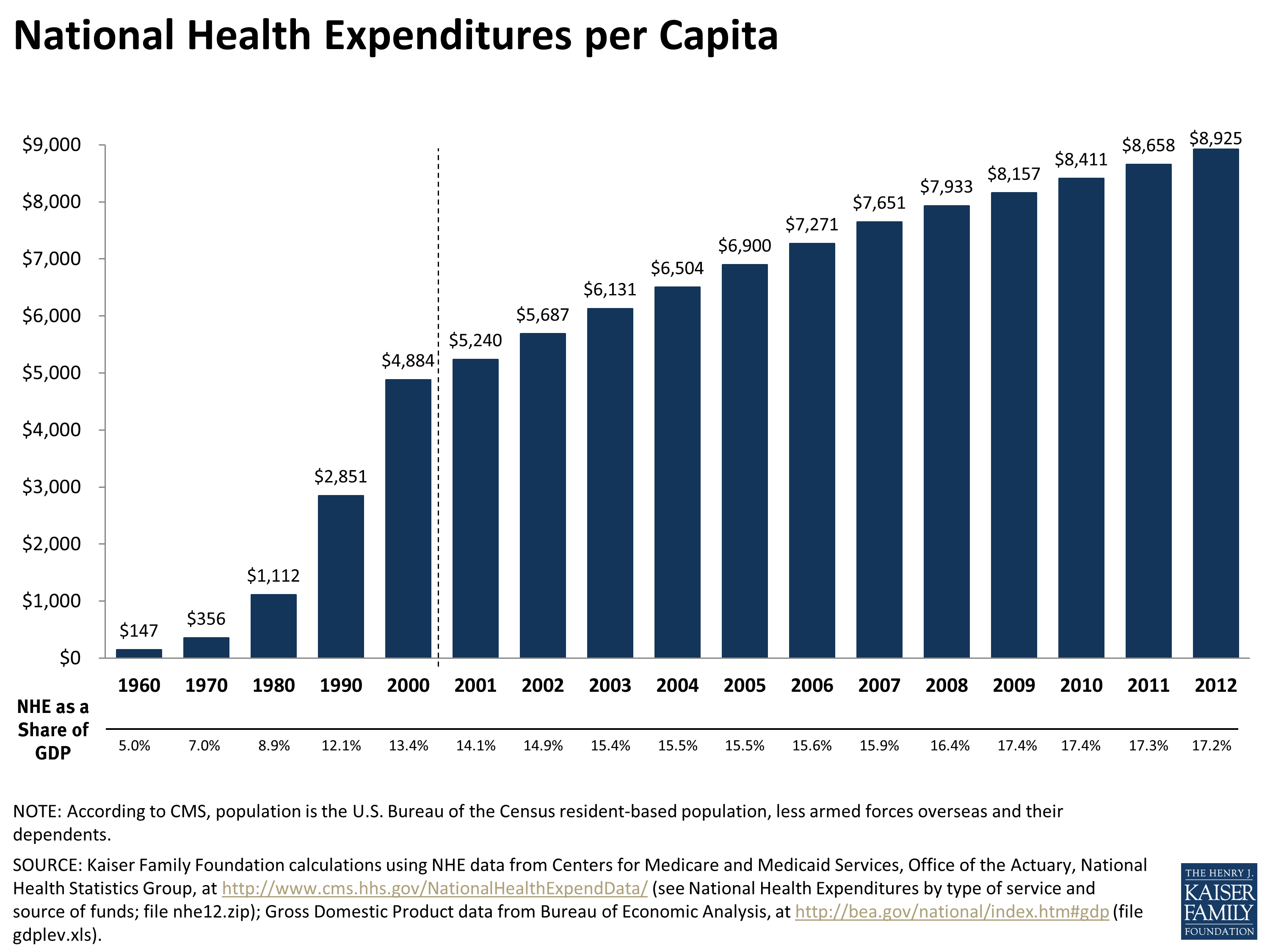
National Health Expenditures per Capita

Published: Feb 28, 2014

Source

Kaiser Family Foundation calculations using NHE data from Centers for Medicare and Medicaid Services, Office of the Actuary, National Health Statistics Group, at http://www.cms.hhs.gov/NationalHealthExpendData/ (see National Health Expenditures by type of service and source of funds; file nhe12.zip); Gross Domestic Product data from Bureau of Economic Analysis, at http://bea.gov/national/index.htm#gdp (file gdplev.xls). 

Adding an Out-of-Pocket Spending Maximum to Medicare: Implementation Issues and Challenges

Published: Feb 27, 2014

Issue Brief

In an effort to simplify Medicare’s cost-sharing requirements, provide beneficiaries with catastrophic protection, and achieve program savings, some have proposed to restructure Medicare’s benefit design.  Several recent proposals would create a unified deductible for Medicare Parts A and B, simplify cost-sharing requirements above the deductible, and add an annual limit on beneficiary out-of-pocket spending—a benefit feature typical of larger employer plans, but lacking in traditional Medicare.  Within this context, some have also proposed to vary the out-of-pocket maximum, based on a beneficiary’s income.

Adding an out-of-pocket maximum to traditional Medicare would strengthen financial protections under Medicare for the beneficiary population and mitigate beneficiaries’ need for supplemental coverage.  Varying the out-of-pocket maximum by income could achieve the policy goal of targeting resources to those most in need, but at the same time would add to the complexity of administering Medicare benefits.  This brief describes the options for adding an out-of-pocket spending limit to Medicare and examines the operational issues that could arise in implementing both a uniform and an income-based out-of-pocket spending limit.  Because the implementation of an income-related out-of-pocket maximum would pose somewhat greater complexity for Medicare, the operational issues associated with this approach are discussed in greater detail.  The brief does not examine the implications of this proposal for federal, state, or beneficiary out-of-pocket spending, nor does it address other policy issues that may be important to consider, including the potential effects on Medicare participation by high-income beneficiaries.

Background

Medicare’s Current Cost-Sharing Structure

Under the current cost-sharing structure of traditional Medicare, there are separate cost-sharing requirements for services covered under Medicare Parts A and B that vary by the type of service, with no limit on annual or lifetime out-of-pocket spending.  The traditional Medicare program provides less generous coverage on average than typical large employer health plans—including the most common plan offered under the Federal Employees Health Benefits Program (FEHBP)—largely due to Medicare’s relatively high Part A deductible, the lack of a spending limit for Part A and Part B services, and less generous drug coverage.1 

Most people with Medicare have some type of supplemental insurance to help cover Medicare’s cost-sharing requirements.  In 2010, more than a quarter of beneficiaries enrolled in traditional Medicare (26%) had a Medigap policy as a source of supplemental coverage and 40 percent had an employer-sponsored supplemental plan (these numbers include the 5 percent of beneficiaries with both types of coverage).2   More than one fourth of the Medicare beneficiary population is enrolled in a Medicare Advantage plan rather than traditional Medicare, such as a Medicare HMO or PPO, and all Medicare Advantage plans are required to include a limit on out-of-pocket spending.3   Additionally, nearly 10 million low-income beneficiaries are enrolled in Medicaid and receive help paying Medicare’s premiums and/or cost-sharing requirements.4 

Prior to the enactment of the Medicare Modernization Act of 2003 (MMA) and the implementation of the Medicare drug benefit in 2006, Medicare’s cost-sharing obligations applied uniformly to all people on Medicare, without regard to beneficiaries’ income, with the exception of Medicare beneficiaries with low incomes and assets who may have qualified for wrap-around assistance under Medicaid.  With the introduction of the Medicare drug benefit in 2006, Medicare offered additional financial protections for low-income enrollees in Part D plans, reducing both premiums and cost-sharing obligations for individuals with incomes below 150 percent of the federal poverty level.  The MMA also introduced income-related Part B premiums for higher-income beneficiaries that went into effect in 2007.  The 2010 Affordable Care Act (ACA) included an income-related Part D premium for higher-income enrollees in Medicare drug plans that took effect in 2011.  Thus, previous legislation has established a precedent for reducing Medicare’s cost-sharing obligations for low-income beneficiaries and increasing cost-sharing obligations for higher-income beneficiaries that some proposals would build upon, including proposals to restructure Medicare’s benefit design.

Options to Restructure Medicare’s Benefit Design and Add an Out-of-Pocket Spending Maximum

Recently, many policymakers and expert groups have endorsed changes to Medicare’s benefit design that would simplify the program’s cost-sharing requirements, provide greater protection against very high out-of-pocket spending, and reduce the need for supplemental insurance.5   Some, but not all, of the proposals to restructure Medicare’s benefit design also seek to reduce federal spending.  For example, one option described by the Congressional Budget Office (CBO) would combine the Part A and Part B deductibles, establish a uniform coinsurance rate for most Medicare-covered services, and create an out-of-pocket spending limit.6   CBO has estimated that this proposal would achieve 10-years savings of $52 billion between 2014 and 2023.

Some proposals to cap beneficiaries’ annual cost-sharing liabilities would add a single spending limit that would apply uniformly to all people on Medicare.  Other proposals would add an out-of-pocket spending maximum that would be adjusted higher or lower depending on a beneficiary’s income (see Appendix A for an overview of recent proposals that include an income-related out-of-pocket spending maximum).  Each of these approaches—the uniform out-of-pocket spending maximum and the income-related maximum—has relative merits, but each would also involve additional operational and administrative tasks to be undertaken by the Centers for Medicare & Medicaid Services (CMS), supplemental payers, and other agencies.

Adding a Uniform Out-of-Pocket Spending Maximum to Medicare

Adding a uniform out-of-pocket spending maximum to traditional Medicare would strengthen financial protections under Medicare for the beneficiary population and mitigate beneficiaries’ need for supplemental coverage.  Adding a limit to traditional Medicare would also affect other payers that coordinate with Medicare in providing supplemental coverage to Medicare beneficiaries, namely Medicaid, Medigap insurers, and employers providing retiree health benefits.7   Fewer claims would be submitted to these plans, resulting in savings for them, while Medicare program expenditures would increase.

To implement a uniform out-of-pocket maximum in traditional Medicare, certain administrative changes would be needed in the claims payment process.  Today, the payment of provider claims for people in traditional Medicare is typically handled as follows (see Appendix B for details):

  • The provider, such as a hospital or physician, submits a claim to Medicare.
  • Medicare reviews the claim, calculates the amount it owes, and pays the provider accordingly.
  • Medicare coordinates claims payment with supplemental payers, at which time the supplemental payer calculates any benefits it owes and pays the provider accordingly.
  • Providers bill the beneficiary for any remainder.
  • Medicare notifies the beneficiary of claims payments.

To implement a new, uniform limit on out-of-pocket spending in traditional Medicare, some additional administrative procedures would be required in traditional Medicare.  CMS would need to notify beneficiaries in traditional Medicare in advance what their out-of-pocket maximum would be for the year, and likely would need to modify its existing tracking systems to monitor beneficiaries’ out-of-pocket costs, so that Medicare could begin paying the full amount for services for the remainder of the year once a beneficiary’s cost sharing reached the out-of-pocket maximum.  Existing notifications to beneficiaries through quarterly mailings and MyMedicare.gov could be modified to reflect a beneficiary’s status with respect to the annual out-of-pocket maximum.

Adding an out-of-pocket maximum to traditional Medicare (either uniform or income-related) also could require modifications in Medicare’s payments to and regulations for Medicare Advantage plans if the limit also applied to Medicare Advantage plans.8   Under current law, Medicare Advantage plans are required to provide a limit on their enrollees’ out-of-pocket spending for services covered under Medicare Parts A and B of no more than $6,700 in 2014, with higher limits allowed for a combination of in-network and out-of-network providers for plans that cover services obtained out-of-network.9   Medicare Advantage plans that adopt lower spending limits (at or below $3,400 in 2014 for in-network services) are given more flexibility by CMS in establishing cost-sharing amounts for Parts A and B services than those that do not elect the lower spending limit.10 ,11   In 2013, nearly half of all Medicare Advantage enrollees were in plans with an out-of-pocket maximum that was at or below $3,400.12   Medicare Advantage plans are required to demonstrate to CMS that they have the capacity to ensure the correct calculation and tracking of enrollees’ out-of-pocket costs for all Medicare-covered benefits.  Plans are also responsible for alerting their enrollees and providers when an enrollee reaches the annual out-of-pocket maximum.

If traditional Medicare included an out-of-pocket spending maximum for services covered under Parts A and B, and the out-of-pocket maximum applied to Medicare Advantage as well, some issues would need to be addressed in the administration of Medicare Advantage plans and plan payments to conform to the policy change; for example, whether to allow plans to modify (increase) the out-of-pocket maximum for enrollees who go out-of-network, or allow plans to offer a lower out-of-pocket maximum than that offered under traditional Medicare.

Adding a uniform out-of-pocket spending maximum to traditional Medicare would enhance the benefit package for people in traditional Medicare.  While only a small share of beneficiaries would have spending high enough to reach the new out-of-pocket spending maximum in any given year, over a longer period of time, a larger share of beneficiaries would likely benefit from this added financial protection.13   A uniform spending maximum, however, would not target resources in the most efficient way possible to help the most financially vulnerable people on Medicare, in contrast to an income-related out-of-pocket spending maximum.

Under the proposal to add an income-related out-of-pocket spending maximum to Medicare, a lower spending limit (or limits) would apply to lower-income beneficiaries, and a higher spending limit (or limits) may also apply to higher-income beneficiaries.  Varying the out-of-pocket maximum by income could achieve the policy goal of targeting resources to those most in need, but at the same time this proposal would add to the complexity of administering Medicare benefits.  For example, CMS would need to obtain income information for each beneficiary to administer an income-based out-of-pocket limit—information that CMS does not currently collect or use to determine eligibility for Medicare nor to adjudicate claims under traditional Medicare. (As discussed below, CMS currently uses income information for a subset of the Medicare population to administer low-income subsidy benefits under Part D and the income-related premium under Parts B and D).  This is in contrast to the Medicaid program, which ties eligibility to income and therefore requires each applicant to provide income information or demonstrate that they have attained eligibility for certain other benefit programs—information which must then be reviewed and verified to determine Medicaid eligibility status.  For this reason and others, implementing an income-related out-of-pocket spending limit would be more administratively complex than implementing a uniform out-of-pocket spending limit.

Several additional administrative activities would be required to vary an out-of-pocket maximum based on beneficiary income, including: determining the income of all Medicare beneficiaries to identify the appropriate out-of-pocket maximum to assign to each beneficiary in a given year; providing advance notice to beneficiaries so they are aware of the applicable out-of-pocket maximum, and establishing a process for appeals; integrating out-of-pocket maximums that vary by beneficiary into Medicare Advantage plans; coordinating the administration of income-related out-of-pocket maximums with supplemental insurers, including Medigap and employer-sponsored retiree health plans, and between CMS and other administering agencies; and addressing issues related to beneficiary privacy.  These administrative issues are discussed in greater detail below.

Determining Beneficiaries’ Incomes and Assigning Out-of-Pocket Maximums

To implement a beneficiary-specific, income-related out-of-pocket maximum in Medicare, CMS would need to develop and implement new procedures for determining the income of all beneficiaries (or the subset of beneficiaries for whom it does not currently use income data) in order to assign the appropriate out-of-pocket maximum each year.  The administrative complexity of assigning beneficiaries the appropriate income-related out-of-pocket maximum would depend to some extent on the policy choices made regarding the structure of the income thresholds, including the number of income categories and the definition of income that are used, and the frequency of income determinations.

One key consideration, for example, is whether to set a standard uniform out-of-pocket maximum with one lower amount that applied to lower-income beneficiaries and one higher amount for higher-income beneficiaries, or whether to establish a sliding-scale range of out-of-pocket maximum amounts for several different income groups.  From the standpoint of administering claims, it would not matter how many maximums or income categories were used.  Having a larger number of income categories would minimize the “cliff” effect (described below), but could also increase the likelihood of beneficiaries being assigned to a category that was inappropriate due to a change in circumstances, and who therefore might be faced with having to appeal their initial maximum amount.

Another key consideration that would have implications for administering an income-related out-of-pocket maximum is which definition of income to use.  For ease of administration in determining the applicable out-of-pocket maximum, CMS could employ the modified adjusted gross income definition that is used to apply the Part B and Part D income-related premiums (for a higher limit); the alternative income definition used to establish eligibility for the Part D LIS (for a lower limit); or the modified adjusted gross income definition used to determine eligibility for premium tax credit subsidies for the non-Medicare eligible population under the Affordable Care Act; taxable income; or some other definition.  Key differences among these definitions include the extent to which Social Security benefits are counted as income, whether foreign earnings or other tax-exempt income are counted, and whether some earnings are excluded.14 

If existing definitions and thresholds are not used, a new system would need to be developed to ascertain each beneficiary’s income and assign the appropriate out-of-pocket maximum.

Basing the out-of-pocket maximums on income thresholds currently used in Medicare

In conjunction with the Social Security Administration, CMS currently uses income to determine which beneficiaries are required to pay the income-related Part B and Part D premiums (applied to higher-income beneficiaries) and which beneficiaries are eligible for low-income subsidies under the Medicare Part D prescription drug benefit (the low-income subsidy program, or LIS) (see Appendix C for details on Medicare’s current income-related features).  One approach to establishing an income-related out-of-pocket maximum would be to use the income-related premium thresholds (currently above $85,000 annually for individuals) to determine the income at which to apply a higher out-of-pocket maximum.  Then, the Part D LIS eligibility threshold (incomes below 150 percent of poverty, or $17,235 per year) could be used to identify people who would qualify for a lower out-of-pocket maximum amount.  All other beneficiaries would receive a standard out-of-pocket maximum.

One issue that could arise if current income thresholds based on LIS eligibility are used to determine who qualifies for a lower maximum amount is the potential to create a fairly steep cliff between out-of-pocket maximum amounts that would apply to beneficiaries with incomes just above and below the thresholds.  For example, if the standard out-of-pocket maximum is $5,500 and a lower $3,000 maximum applies to lower-income enrollees who meet the LIS eligibility requirements, then a beneficiary with an income at 160 percent of poverty would face a maximum amount that is $2,500 higher than a beneficiary with an income below 150 percent of poverty.  Another limitation of using this approach to establish the lower-income out-of-pocket maximum amount is that many beneficiaries who might qualify for the Part D LIS do not apply for this assistance.  As of 2009 (the last year for which data are available), only 40 percent of the estimated 3.8 million people who had to apply on their own for Part D LIS enrolled in the program.15   Some of these unenrolled beneficiaries may not be aware of their eligibility, despite extensive outreach efforts on the part of the Medicare program, beneficiary organizations, and other stakeholder groups.  Others may be discouraged from applying by the complexity of the eligibility determination process.16   If otherwise-qualified beneficiaries do not apply for the lower out-of-pocket maximum, they would be subject to a higher maximum and thus exposed to higher out-of-pocket costs.

Certain steps could be taken to improve the share of eligible beneficiaries who actually apply for and obtain the lower out-of-pocket maximum.  For example, CMS could send notices to beneficiaries as they approach the lowest out-of-pocket maximum amount to inform them that they may be eligible for this lower limit.  Because few beneficiaries would reach the out-of-pocket maximum in a given year, this type of outreach would be targeted to the people who would benefit from the lower maximum amount.  CMS also could encourage providers to reach out to their patients who may be eligible for the lower maximum amount.  Having no asset test for the income-related spending maximum could simplify the cost and administrative burden associated with determining eligibility and also could expand the reach of the lower out-of-pocket maximum to a larger share of the low-income population.17   In addition, the application process would be less complex if beneficiary income only and not assets were considered for purposes of eligibility for any given out-of-pocket maximum amount.

Several proposals would implement a sliding-scale out-of-pocket maximum, using income thresholds that do not align with current income-based policies in Medicare.  Implementing an income-related out-of-pocket maximum using thresholds other than those currently used for existing purposes in Medicare would first require that CMS develop a mechanism for determining beneficiaries’ incomes.  In doing so, policymakers and program administrators would need to make several key administrative decisions, such as how to define income for this purpose and collect income information and how frequently to reassess beneficiaries’ incomes.

Information from federal income tax returns could be used to identify the appropriate income-related out-of-pocket maximum to apply to people on Medicare, although a separate process would be needed to ascertain the income of non-filers if maximums were created for income levels that fall below the filing thresholds.  The 2013 filing thresholds are $10,000 for individuals under age 65, $11,500 for individuals age 65 and older, $20,0000 for married couples under age 65 filing jointly, and $22,400 for joint-filing married couples who are each age 65 and older.18   One option would be to allow beneficiaries who do not file tax records to attest that their income for a given year fell below the filing threshold.  IRS data would be used to verify that no tax return was filed, or that the beneficiary filed a return and their income was below the filing threshold.  Alternatively, rather than having a process under which a large number of beneficiaries must attest to their income, CMS could assume that if no IRS data are available for a beneficiary for a year, they are presumed to meet the criteria as a non-filer and subject to the lowest out-of-pocket maximum.  (IRS penalties apply to individuals who are required to file a return but fail to do so, and an individual who willfully fails to file a return may be subject to criminal prosecution.)   Because there would be a lag between IRS income data and the calendar year to which the out-of-pocket maximum applied, CMS would need to develop a process for beneficiaries to appeal income determinations that are used to determine the out-of-pocket maximum (discussed below).

If federal income tax return information is used, CMS could potentially employ the same system that has been developed for administering the income-related premium subsidies available under the Affordable Care Act.  Under that process, health care Marketplaces (also known as Exchanges) are able to access a data hub that allows them to make near real-time queries of the IRS tax return data and other government data sources in order to determine whether an individual is eligible for advance payment of the premium subsidy and cost sharing subsidies, including the applicable annual limitation on cost sharing.19   CMS could potentially access the IRS data through the data services hub to determine the appropriate out-of-pocket maximum for each Medicare beneficiary that files a tax return.

Notifying Beneficiaries and Establishing Procedures for Appeals

Once CMS identifies each beneficiary’s income-related maximum, it would need to communicate that information so that beneficiaries could anticipate their benefit package for the coming year.  CMS could establish a new process for providing this information or it could use existing means of communicating with beneficiaries, such as through the quarterly Medicare Summary Notices (MSN), through the online claims history provided to beneficiaries through MyMedicare.gov, or as part of annual notices sent by the SSA to Medicare beneficiaries related to their Social Security benefits and Medicare premium amounts for the coming year.  In addition, CMS could routinely contact beneficiaries who incur cost-sharing amounts that are nearing the lowest out-of-pocket maximum amount and give them an opportunity to apply at that time for the lower amount.

Because tax information in the data services hub will necessarily be at least one year old, it may not reflect the ability of a beneficiary to pay for their Medicare cost sharing in the upcoming year.  In order to better capture beneficiaries’ current income levels, CMS could establish an appeals process similar to the one used for determining the income-related premium that would allow a beneficiary to request a review if they believe they have been assigned an incorrect income-related out-of-pocket maximum.  To be most helpful for beneficiaries’ planning purposes, they would be able to appeal their out-of-pocket maximum amount in advance of the year to which it would apply.  CMS would then also need procedures for informing beneficiaries when their out-of-pocket maximum has been reduced during the course of a year as the result of a successful appeal.  In these cases, CMS would need to revise data in the Common Working File to take into account the new maximum.  CMS also would need to establish a system for reprocessing claims and reimbursing beneficiaries and supplemental payers in cases where these groups paid for care that should have been covered by Medicare based on the corrected out-of-pocket maximum.

CMS may also want to establish a process for redetermining subsidy eligibility during a calendar year or making retroactive eligibility changes, and collecting any underpaid cost sharing from beneficiaries or supplemental payers in cases where a beneficiary is found not eligible for the lower out-of-pocket maximum they may have received in a given year.  However, such collections could pose financial challenges for beneficiaries with modest resources.

Applying an income-related out-of-pocket maximum for Medicare Advantage plan enrollees would require a number of policy decisions and administrative changes.  Medicare Advantage plans would need to obtain information from CMS to apply the appropriate income-based out-of-pocket maximum amount to each enrollee.  Such information could be obtained by the Medicare Advantage plan as part of its data transaction with CMS (or a CMS contractor) when a beneficiary first enrolls in the plan.  In this way, Medicare Advantage plans would know the broad ranges of their enrollees’ incomes, but not the specific amounts for each individual, thereby reducing the possibility of inappropriate disclosure and perhaps mitigating privacy concerns to some extent (discussed below).  Once the enrollee’s maximum amount was provided to the plan, CMS or the plan would need to inform the beneficiary of their specific out-of-pocket maximum.  This communication could also be required as part of plan enrollment materials sent to new and current enrollees.  The plan would then track the enrollee’s cost sharing in the same way as it does today.  A process also would need to be established for handling cases in which an enrollee’s out-of-pocket maximum was changed during the course of a year as a result of a successful appeal of the initially assigned maximum.  CMS would also need to adjust the monthly capitation payments to Medicare Advantage plans to account for the differences in expected plan expenditures for each group of enrollees by income, which may be similar to the current process of paying plans based on enrollees’ health status (the risk adjustment process).

Coordinating with Supplemental Insurers: Medicaid, Medigap, and Retiree Health Plans

Compared with a uniform out-of-pocket maximum, income-relating the out-of-pocket maximum would add a layer of complexity for the Medicare program and Medicaid, employers, and other supplemental insurers.  Retiree health plans and Medigap plans currently do not have or need the income of their enrollees to administer plan benefits.  For beneficiaries in traditional Medicare, CMS may need to create a process for informing supplemental insurers of the applicable income-related out-of-pocket maximum, and would need new procedures for reprocessing Medicare claims and possibly repaying supplemental insurers and beneficiaries in situations where a beneficiary has successfully appealed for a lower out-of-pocket maximum after the beginning of the year.

Although Medicare’s income-related premiums are determined in advance and the financial impact is predictable, the financial effects of the out-of-pocket maximum would be by definition more variable since they are tied to claims experience in a given year.  Therefore, establishing an income-related out-of-pocket maximum would likely necessitate additional communications between all supplemental payers and enrollees, both through formal written communications and through call centers responding to beneficiary inquiries.

In terms of information sharing, it is unclear precisely what information CMS would need to provide to Medigap insurers or sponsors of retiree health plans.  These plan sponsors may not need to know their enrollees’ incomes or their applicable out-of-pocket maximum in order to pay claims because no action would be required of them when the maximum was reached.  That is, the addition of an out-of-pocket maximum as a standard Medicare benefit would mean that for the small share of beneficiaries who reach the maximum, CMS would no longer forward claims to the supplemental carrier.  Nevertheless, these plans may still have an interest in knowing when a beneficiary reached their out-of-pocket maximum; that is, when the plan no longer had any liability for Medicare-covered benefits for that enrollee for that year, particularly to address questions that might arise about claims for costs above the out-of-pocket maximum for which the plan had no liability.  This would be true for state Medicaid programs as well.  Therefore, supplemental payers may want to know each of their enrollees’ out-of-pocket maximums in advance both to verify that CMS (or its contractors) handled claims accurately and, perhaps more importantly, to anticipate future liabilities.  For Medigap insurers, accurately predicting enrollee expenditures is important both for setting plan premiums and for ensuring compliance with federal and state minimum medical loss ratio requirements.  For retiree plans, having an accurate projection of current and future expenditures is necessary for meeting reporting and accounting rule requirements of the Federal Accounting Standards Board and the Governmental Accounting Standards Board.  In the absence of enrollee-specific income information, these plans would have to make actuarial estimates in the first year of implementation based on income information on the general Medicare-age population and then subsequently adjust their expenditure projections based on actual claims experience.

Clarifying Retiree Health Plan Nondiscrimination Rules

Under an income-related out-of-pocket maximum, employer-sponsored retiree health plans that wrap around Medicare would potentially provide greater assistance to higher-income enrollees, given that such beneficiaries would receive more from the employer plan because they are getting less from Medicare until the point when they reached their higher Medicare out-of-pocket maximum.  Regulatory guidance from agencies other than CMS (for example, the IRS) may be needed to clarify that retiree health plans coordinating with Medicare would not be in potential violation of federal nondiscrimination rules which apply a tax penalty in situations where a self-insured plan (or a fully-insured plan under pending regulations) discriminates in favor of highly-compensated employees with respect to either eligibility or benefits.  These regulatory issues could presumably be anticipated and addressed in the underlying legislation establishing a Medicare income-related out-of-pocket maximum.

Under an income-related out-of-pocket maximum, privacy of income information could be a concern to some beneficiaries.  While Medicare Advantage and supplemental plans would not need to know their enrollees’ specific incomes, knowing a beneficiary’s out-of-pocket maximum—either because CMS provided it for all enrollees or because CMS provided notice regarding those who reached the limit—would disclose to insurers the approximate magnitude of their enrollees’ income.  A greater number of narrow income categories would be more revealing of personal information than a small number of broad income categories.  To address privacy concerns, it has been suggested that beneficiaries who did not want their income category shared with supplemental insurers could be given the option to elect to have the highest out-of-pocket maximum apply to them regardless of the out-of-pocket maximum amount to which they might otherwise be entitled based on their actual income.20 

Coordinating Activities among Administering Agencies

CMS, which oversees the Medicare program, is the logical agency to have primary responsibility for assigning beneficiary out-of-pocket maximums, either directly or indirectly through a contractor.  Requisite administrative functions for this purpose might include: coordinating with the IRS for the purposes of obtaining beneficiary-specific income information; managing an application process to the extent that IRS data are not used for determining beneficiary income; determining the appropriate out-of-pocket maximum for each beneficiary; communicating that information to beneficiaries; and handling requests for redeterminations.

Other agencies may also need to play a significant role, particularly in carrying out functions relating to income determinations and appeals.  As described above, CMS may need to obtain income tax information from the IRS.  Depending on how the program is designed, CMS might also coordinate efforts with the SSA, which withholds Medicare premiums from beneficiaries’ Social Security checks and administers the income-related Part B and Part D premiums and the Part D LIS.  Assigning additional Medicare-related functions to the SSA for the income-related out-of-pocket maximum would add to the SSA’s administrative caseload.

Applying a “TrOOP” Cost Methodology to the Medicare Out-of-Pocket Maximum

A limit on out-of-pocket spending, whether uniform or income-related, could be designed in a manner that would count only the direct contributions from beneficiaries toward the out-of-pocket maximum, excluding any payments made on behalf of the beneficiary by a supplemental payer.  Under this so-called “true out-of-pocket” (TrOOP) methodology, a version of which is used in Medicare Part D, cost-sharing amounts covered by a supplemental insurer on behalf of a beneficiary would not count toward the beneficiary’s annual out-of-pocket maximum.21 

Using the TrOOP approach, federal expenditures associated with a new out-of-pocket spending limit for Medicare would be lower than they would otherwise be if third-party payments were taken into account.  This is because beneficiaries who have some or all of their cost-sharing liabilities covered by supplemental payers would not reach the out-of-pocket maximum at the same spending level as beneficiaries without supplemental coverage, delaying the point at which Medicare becomes fully liable for their costs.

While federal savings would be greater under the TrOOP approach to the out-of-pocket maximum, administering the out-of-pocket maximum using this approach, whether uniform or income-related, would be more complicated for CMS, supplemental insurers, and beneficiaries.  CMS would need to develop and use systems to track not only the beneficiaries’ cost-sharing requirements, but also how much of those liabilities were paid by the beneficiary and how much by other payers.  When Medicare forwards a claim to a supplemental payer, the payer would need to inform Medicare of the payments they are making to providers on a beneficiary’s behalf.  This would need to be done quickly so that Medicare claims systems properly recognize at all times whether a beneficiary has reached the out-of-pocket maximum, and so that beneficiaries could be promptly notified of their status with respect to the maximum.  Within Part D, for example, there is a TrOOP facilitation process that functions in real time when beneficiaries submit a prescription to be filled at a pharmacy.22 

Setting up a similar process for receiving information on supplemental payments made to the myriad medical providers of non-drug benefits would conceivably be much more complex and challenging.  It also would add more administrative cost burdens to retiree health and Medigap plans for a process that would in fact prevent these plans from realizing significant savings from the out-of-pocket maximum.  If similar real time interactions between Medicare and supplemental payers are not practical, CMS might have to reconcile claims for beneficiaries as they reach the TrOOP maximum.  That is, if a beneficiary has in reality reached the TrOOP but Medicare systems do not record that event because the correct amount covered by supplemental payers has not yet been reported, Medicare would not be paying the full amount that it should.  This could result in confusion for beneficiaries as to their out-of-pocket liability, as well as payment reconciliations with providers and supplemental payers.  With respect to unassigned claims, such payment reconciliations may involve beneficiaries as well.

Processing claims for individuals who reach the out-of-pocket maximum would therefore be more administratively complex under the TrOOP approach, and could further discourage employers and unions from offering retiree health benefits—even more than with a new out-of-pocket maximum by itself.  Under the TrOOP cost method, supplemental insurers, including Medicaid and employer plans, would continue to be liable for cost sharing beyond the point at which their Medicare enrollees would have exceeded the Medicare out-of-pocket maximum.  Thus, the TrOOP approach reduces the incentive among supplemental insurers, particularly employers and unions offering retiree health plans, to cover cost sharing for Medicare services because their contributions would not count toward the limit.  Some have speculated that employers would respond by modifying benefits to ensure that retirees’ high-end expenses were covered by Medicare, rather than the employer plan; by moving toward facilitated purchases of individual Medicare Advantage plans, stand-alone prescription drug plans, or Medigap policies to supplement traditional Medicare, or by dropping retiree coverage altogether.  In contrast, an out-of-pocket maximum that does not use the TrOOP methodology would be expected to reduce the liability of third-party payers since Medicare would assume liability for costs above the maximum.

Conclusion

Some policymakers and analysts have expressed interest in modifying Medicare by adding a limit on beneficiary out-of-pocket spending.  Adding an out-of-pocket maximum to Medicare would align Medicare with many large employer plans, provide beneficiaries with financial protection against catastrophic medical expenses, and potentially reduce the demand for supplemental coverage among beneficiaries.  In adding a uniform out-of-pocket spending limit to Medicare, CMS would have relatively few new administrative tasks to implement.  Adding a uniform out-of-pocket spending limit alone would require new federal expenditures for Medicare, however, absent other changes in Medicare’s benefit design or unless other cost offsets were implemented concurrently.

One way to target resources to those with the greatest need would be to implement an income-related out-of-pocket maximum, rather than a uniform maximum.  On the one hand, income-relating the out-of-pocket maximum, with lower maximum amounts for lower-income people, higher maximum amounts for higher-income people, or both, would provide greater protection against high medical expenses for those with limited incomes, thereby targeting federal dollars to beneficiaries with the greatest financial need.  On the other hand, creating an income-related benefit structure would require new administrative procedures that might pose challenges for Medicare, supplemental payers, and beneficiaries.  As recent experience with implementation of the ACA suggests, it would be important to consider these administrative issues carefully and establish procedures that would ensure smooth implementation prior to rolling out this new benefit.

This issue brief was prepared by Juliette Cubanski and Tricia Neuman from the Kaiser Family Foundation and Zachary Levinson, a former policy analyst at the Foundation.

Technical support in preparation of this brief was provided by Health Policy Alternatives, Inc.
Appendix

Erskine Bowles and Former Senator Alan Simpson (April 19, 2013).  Would replace current Medicare cost sharing with a unified deductible, and uniform coinsurance up to an initial out-of-pocket maximum, with 5 percent coinsurance required for expenses between the initial limit and the out-of-pocket maximum.  Would make the modifications to the benefit package such that the average out-of-pocket costs (including premiums) are held constant.  Out-of-pocket maximums would be income-adjusted and low-income beneficiaries would have lower deductibles than higher-income beneficiaries. Source: Moment of Truth Project, “A Bipartisan Path Forward to Securing American’s Future,” April 19, 2013

Senator Richard Burr and Senator Tom Coburn (February 16, 2012). Would unify Parts A and B with combined annual deductible of $550; set coinsurance rate equal to 20 percent up to an annual out-of-pocket total of $5,500 and coinsurance rate equal to 5 percent for out-of-pocket expenses between $5,500 and $7,500 per year; and establish an annual out-of-pocket maximum at $7,500.  The out-of-pocket maximum would be greater for beneficiaries with incomes greater than $85,000/individual, $170,000/couple (ranging from $12,500 and $22,500).  Includes a higher unified deductible for beneficiaries with incomes exceeding $1 million. Source: Senator Richard Burr and Senator Tom Coburn, “The Seniors’ Choice Act,” February 16, 2012.

Center for American Progress (November 13, 2012).  Would set annual out-of-pocket limits, ranging from $5,000 per year to $10,000 per year, based on beneficiaries’ incomes.  Would direct the Institute of Medicine to recommend additional improvements to align incentives with high-quality care.  Would implement the changes such that average cost-sharing would not increase and the value of the benefit package would not decrease. Source: Center for American Progress, “The Senior Protection Plan,” November 13, 2012.

Commonwealth Fund (May 2013). Proposes a new option called Medicare Essential, which would combine Medicare’s hospital, physician, and prescription drug coverage into an integrated benefit with an annual limit on out-of-pocket expenses for covered benefits.  The standard limit of $3,400, would be reduced to $2,000 for individuals with incomes below 150 percent of the FPL. Source: Karen Davis, Cathy Schoen, and Stuart Guterman, “Medicare Essential: An Option to Promote Better Care and Curb Spending Growth,” Health Affairs, May 2013 32(5):900–9.

The Hamilton Project at the Brookings Institution (February 26, 2013).  Would unify Parts A and B with a combined annual deductible of $525 and set the coinsurance rate above the deductible equal to 20 percent up to an annual out-of-pocket maximum.  The maximum would vary by income, ranging from $1,983 for beneficiaries with incomes between 100 percent to 200 percent of the FPL to $5,950 for beneficiaries with incomes above 400 percent of the FPL.  Deductibles for beneficiaries with incomes below 200 percent of the FPL would be reduced to $250. (Proposal authored by Jonathan Gruber) Source: The Hamilton Project, “15 Ways to Rethink the Federal Budget,” February 26, 2013.

Robert Berenson, John Holahan, and Stephen Zuckerman of the Urban Institute (March 7, 2013). Would set a maximum on beneficiaries’ out-of-pocket expenses that would vary by income.  Would reduce premiums and deductibles for beneficiaries with incomes below 300 percent of the FPL. Source: Robert Berenson, John Holahan, and Stephen Zuckerman, “Can Medicare Be Preserved While Reducing the Deficit?” March 2013.

Appendix B:  Medicare’s Current Claims Payment Process

Today, the payment of provider claims for people in traditional Medicare is typically handled as follows:

  1. The provider, such as a hospital or physician, submits a claim to Medicare.  A physician or supplier who does not “accept assignment” is not required to submit the claim to Medicare, in which case the beneficiary pays the provider and submits the claim.  (Fewer than 1 percent of Medicare claims are unassigned.23 )
  2. Medicare reviews the claim, calculates the amount it owes, and pays the provider accordingly.  Medicare contractors record and process claims and track beneficiary cost sharing (e.g., a beneficiary’s spending towards the Part B deductible) in the electronic “Common Working File.”
  3. Medicare coordinates with supplemental payers.  The Common Working File contains information on beneficiaries’ supplemental coverage (provided by beneficiaries and providers on Medicare claims and supplemented by information from insurers and Medicaid under a Coordination of Benefits Agreement).  If a beneficiary has supplemental coverage, the Common Working File prompts the Medicare contractor to forward adjudicated claims to the Coordination of Benefits Contractor, which in turn transmits the information to supplemental payers.24    Alternatively, if a claim is first submitted to a beneficiary’s retiree plan, the claim will be transmitted by the plan to Medicare.
  4. Supplemental payers wrap around Medicare coverage.  After receiving an adjudicated claim from Medicare, the supplemental payer calculates any benefits it owes and pays the provider accordingly.  (This discussion assumes that Medicare is the beneficiary’s primary health coverage.  That is generally the case, but is not true for beneficiaries who are working and covered by an employer health plan, or covered by an employer health plan as a dependent.  In that case, and some others, Medicare is the secondary payer, and pays claims after the group health plan.)  Supplemental payers have various methods for wrapping around Medicare’s coverage:
    • Medicaid covers Medicare’s cost-sharing requirements for “full duals” and some “partial duals,” although cost sharing is only covered up to the amount Medicaid pays at states’ discretion.25 
    • The majority of Medigap policyholders are enrolled in either Plan C or Plan F, both of which cover all beneficiary cost sharing for Medicare-approved charges under Medicare Parts A and B.26 
    • The vast majority of employer-sponsored retiree health plans that pay benefits directly coordinate with Medicare through the “carve-out” approach, under which the employer first calculates the benefit it would pay if the enrollee did not have Medicare, and then subtracts or “carves out” the Medicare payment.  The result under this method is that retirees still have out-of-pocket obligations unless they reach the retiree plan’s out-of-pocket maximum.27 
  5. Providers bill the beneficiary for any remainder.  The beneficiary owes the provider either the full Medicare cost-sharing amount if they do not have supplemental coverage or the balance if their supplemental coverage does not cover the full cost-sharing amount.  For an unassigned claim, the beneficiary pays the provider and is reimbursed by Medicare and any supplemental insurer.
  6. Medicare notifies the beneficiary of claims payments.  Medicare beneficiaries may review claims status through MyMedicare.gov, and receive a quarterly Medicare Summary Notice (MSN) through the mail or online.

Under Part B and Part D, Medicare beneficiaries are subject to higher premium amounts if their modified adjusted gross income (MAGI) exceeds a certain threshold.  In 2014, the income-related thresholds are $85,000 for an individual and $170,000 for a couple.  The Part B income-related premium ranges from 35 percent to 80 percent of total Part B per capita costs; the Part D income-related premium amounts are based on similar percentages.

The Social Security Administration (SSA) determines which beneficiaries are required to pay the income-related premium each year based on income tax data provided electronically by the Internal Revenue Service (IRS).  When doing so, SSA relies on information from two to three years prior to the year in which the premium is being applied.  For example, when determining the Part B and Part D income-related premiums in 2013, SSA relied on 2012 tax returns (reflecting 2011 income) or 2011 tax returns (reflecting 2010 income) if 2012 returns were unavailable.  If a beneficiary is required to pay an income-related premium, SSA will send a notice informing them of the amount of the premium and how the premium was determined.   SSA does not apply an income-related premium to beneficiaries who do not file income taxes.   Such “non-filers” are mostly individuals who are not required to file tax returns because their incomes fall below certain thresholds.

The use of lagged tax return data means that actual beneficiary income for the year in which the income-related premium is applied may be lower or higher than it was during the year from which the electronic data base is available.  No reconciliation is made on subsequent tax returns.  However, under certain circumstances, an individual may request to base the determination of income on more recent income information.  For example, if the beneficiary believes that the IRS has more recent information, the beneficiary may seek a correction from the IRS.  Additionally, if a beneficiary can provide evidence that a qualifying life-changing event—such as the death of a spouse or retirement—significantly reduced his or her MAGI, the SSA will determine the Part B or Part D income-related monthly adjustment based on data from a more recent tax year.28 

How Medicare Determines Eligibility for the Part D Low-Income Subsidy

The Part D Low-Income Subsidy (LIS) program assists enrollees with premiums and cost-sharing requirements under a Part D prescription drug plan.  Beneficiaries can receive LIS benefits through either:

  • Automatic eligibility.  Beneficiaries may be automatically eligible for Part D LIS benefits if they already receive Supplemental Security Income benefits, full Medicaid coverage, or partial Medicaid coverage through the Medicare Savings Programs.
  • Application.  Medicare beneficiaries who are not automatically eligible may still receive LIS benefits if they have incomes below 150 percent of the federal poverty level and resources below a certain threshold.29   In this scenario, beneficiaries need to apply annually through their state Medicaid agency or with the Social Security Administration (SSA).

Endnotes

  1. Kaiser Family Foundation,” How Does the Benefit Value of Medicare Compare to the Benefit Value of Typical Large Employer Plans: A 2012 Update,” April 2012. ↩︎
  2. Estimates from Kaiser Family Foundation analysis of the Centers for Medicare & Medicaid Services Medicare Current Beneficiary Survey 2010 Cost and Use file. ↩︎
  3. Marsha Gold, Gretchen Jacobson, Anthony Damico and Tricia Neuman, “Medicare Advantage 2014 Spotlight: Plan Availability and Premiums,” Kaiser Family Foundation, November 2013, https://modern.kff.org/medicare/issue-brief/medicare-advantage-2014-spotlight-plan-availability-and-premiums. ↩︎
  4. Kaiser Family Foundation, “Medicaid’s Role for Dual-Eligible Beneficiaries,” August 2013, https://modern.kff.org/medicaid/issue-brief/medicaids-role-for-dual-eligible-beneficiaries/. ↩︎
  5. For an overview of recent Medicare deficit reduction proposals, see Kaiser Family Foundation, “Medicare and the Federal Budget: Comparison of Medicare Provisions in Recent Federal Debt and Deficit Reduction Proposals,” October 2013, http://modern.kff.org/medicare/issue-brief/medicare-and-the-federal-budget-comparison-of-medicare-provisions-in-recent-federal-debt-and-deficit-reduction-proposals/. For an analysis of the distributional implications of a restructured Medicare benefit design, see Kaiser Family Foundation, “Restructuring Medicare’s Benefit Design: Implications for Beneficiaries and Spending,” November 2011, http://modern.kff.org/medicare/report/restructuring-medicares-benefit-design/. ↩︎
  6. Congressional Budget Office, Options for Reducing the Deficit: 2014 to 2023, November 2013, http://www.cbo.gov/budget-options/2013/44687. ↩︎
  7. A Medicare benefit redesign that puts in place a limit on combined Parts A and B cost sharing would also need to address the treatment of individuals who are not enrolled in both Parts A and B. Currently, about 4.2 million, or 8.3% of beneficiaries have Part-A only coverage and 330,000 or 0.6% have Part B only coverage.  Individuals who are enrolled in Part A only often have employer-based coverage that is primary to Medicare. Unless all Medicare beneficiaries were treated as if they are enrolled in both parts, different out of pocket maximum amounts would need to be applied to these individuals.  Data on numbers of enrollees from CMS, Medicare and Medicaid Statistical Supplement, 2013 Edition, “Table 2.1: Medicare Enrollment: Hospital Insurance and/or Supplementary Medical Insurance Programs for Total, Fee-for-Service and Managed Care Enrollees as of July 1, 2012,” http://www.cms.gov/Research-Statistics-Data-and-Systems/Statistics-Trends-and-Reports/MedicareMedicaidStatSupp/2013.html. ↩︎
  8. Even if the out of pocket maximum for traditional Medicare was not applied to the Medicare Advantage program, changes would be needed to account for the increased actuarial value of the Part A and Part B benefit packages. This is because Medicare Advantage plans must provide benefits that are equal to those benefits. ↩︎
  9. A higher “combination” amount of $10,000 applied in 2013 in the case of Medicare Advantage plans that are not closed network HMOS where beneficiaries may obtain covered services from out of network providers. ↩︎
  10. Medicare Advantage plans cannot count Medicaid coverage of cost sharing towards the spending limit, meaning that enrollees with such coverage rarely reach the limit.  Whether the limit applies to all Medicare Part A or B services received out-of-network as well as in-network depends on the type of Medicare Advantage plan. ↩︎
  11. The Medicare Advantage annual maximum spending limits are based on a beneficiary-level distribution of Parts A and B cost sharing for individuals enrolled in traditional Medicare. The mandatory spending limit represents approximately the 95th percentile of projected beneficiary out-of-pocket spending for Calendar Year (CY) 2013. That is, five percent of traditional Medicare beneficiaries are expected to incur $6,700 or more in Parts A and B deductibles, copayments and coinsurance in CY 2013. The CY 2013 voluntary spending limit is $3,400. This level is based on the 85th percentile of projected traditional Medicare out-of-pocket costs. “Announcement of Calendar Year (CY) 2013 Medicare Advantage Capitation Rates and Medicare Advantage and Part D Payment Policies and Final Call Letter”, Centers for Medicare & Medicaid Services, April 2012, http://cms.gov/medicare/health-plans/healthplansgeninfo/downloads/2013-call-letter.pdf. ↩︎
  12. Marsha Gold et al., “Medicare Advantage 2013 Spotlight: Plan Availability and Premiums,” December 2012 https://modern.kff.org/medicare/report/medicare-advantage-2013-plan-availability-and-premiums/. ↩︎
  13. Kaiser Family Foundation/Medicare Payment Advisory Commission, “An Analysis of the Share of Medicare Beneficiaries Who Would Benefit from an Annual Out-of-Pocket Maximum Over Multiple Years,” June 2013. ↩︎
  14. For example, the modified adjusted gross income definition used for determining eligibility for a premium tax credit under the ACA counts all Social Security benefits. (See Internal Revenue Code §36B(d)(2)(B).) This is not true of the definition of adjusted gross income used for income tax reporting, or for the modified adjusted gross income definition used to determine Medicare’s income-related premium.  In those definitions, some or all Social Security benefits are excluded, depending on the individual’s income level.  At most, 85 percent of benefits are counted as income for these purposes. See Internal Revenue Service, “Are Your Social Security Benefits Taxable?”, http://www.irs.gov/uac/Are-Your-Social-Security-Benefits-Taxable%3F. ↩︎
  15. Laura Summer, Jack Hoadley, and Elizabeth Hargrave, “The Medicare Part D Low Income Subsidy Program, Experience to Date and Policy Issues for Consideration,” The Henry J. Kaiser Family Foundation, September 2010, https://modern.kff.org/medicare/issue-brief/the-medicare-part-d-low-income-subsidy. ↩︎
  16. Laura Summer, Jack Hoadley, and Elizabeth Hargrave, “The Medicare Part D Low Income Subsidy Program, Experience to Date and Policy Issues for Consideration,” The Henry J. Kaiser Family Foundation, September 2010, https://modern.kff.org/medicare/issue-brief/the-medicare-part-d-low-income-subsidy. ↩︎
  17. A report by the U.S. Government Accountability Office (GAO) examining requirements to increase enrollment in the Medicare Savings Programs (MSPs) for low-income beneficiaries cited the historically low level of participation in MSPs, attributable to lack of awareness about the programs and cumbersome enrollment processes through state Medicaid programs.  The GAO report suggested that differences in how income and assets are counted for Medicare’s LIS and MSPs can require additional work by implementing agencies at the state and federal level and can present a hurdle to applicants. See Medicare Savings Programs: Implementation of Requirements Aimed at Increasing Enrollment, September 2012, http://www.gao.gov/products/GAO-12-871. ↩︎
  18. Other thresholds may apply.  See Internal Revenue Service, “Exemptions, Standard Deduction, and Filing Information For use in preparing 2013 Returns”, Publication 501, Dec 3, 2013. http://www.irs.gov/pub/irs-pdf/p501.pdf. ↩︎
  19. Oral Statement of Danny Werfel, Principal Deputy Commissioner, on the Affordable Care Act Before the House Ways and Means Committee, August 1, 2013. http://www.irs.gov/uac/Newsroom/Oral-Statement-of-Danny-Werfel,-Principal-Deputy-Commissioner,-on-the-Affordable-Care-Act-Before-the-House-Ways-and-Means-Committee. ↩︎
  20. Jonathan Gruber, “Proposal 3: Restructuring Cost Sharing and Supplemental Insurance for Medicare,” The Hamilton Project, 15 Ways to Rethink the Federal Budget, February 26, 2013. ↩︎
  21. In Part D, costs paid by a beneficiary or on behalf of the beneficiary by certain entities count towards TrOOP, but not payments by group health plans or other forms of insurance.  For more information about how TrOOP works in Part D, see Centers for Medicare & Medicaid Services, “Understanding True Out-of-Pocket Costs,” November 2012, http://www.cms.gov/Outreach-and-Education/Outreach/Partnerships/downloads/11223-P.pdf. ↩︎
  22. For additional detail about coordination of benefits and the TrOOP facilitation process in Part D, see Centers for Medicare & Medicaid Services, “Medicare Prescription Drug Benefit Manual, Chapter 14 – Coordination of Benefits,” http://www.cms.gov/Medicare/Prescription-Drug-Coverage/PrescriptionDrugCovContra/downloads/PDMChapt14COB.pdf. ↩︎
  23. CMS, CMS Data Compendium, 2011, “Table VI.7: Medicare Assigned Claims Selected Fiscal Years” http://www.cms.gov/Research-Statistics-Data-and-Systems/Statistics-Trends-and-Reports/DataCompendium/2011_Data_Compendium.html. ↩︎
  24. A Medicare beneficiary who has a Medigap policy may authorize a Medicare-participating physician, provider, or supplier of services to file a claim on his or her behalf and to receive payment directly from the insurer instead of through the beneficiary. ↩︎
  25. Gretchen Jacobson, Tricia Neuman, and Anthony Damico, “Medicare’s Role for Dual Eligible Beneficiaries,” Kaiser Family Foundation, April 2012, https://modern.kff.org/medicare/issue-brief/medicares-role-for-dual-eligible-beneficiaries. ↩︎
  26. However, Plan C doesn’t pay the 15% cost sharing that some providers charge over and above the Medicare-approved charge.  See Jennifer T. Huang et al., “Medigap: Spotlight on Enrollment, Premiums and Recent Trends,” Kaiser Family Foundation, April 2013, http://modern.kff.org/medicare/issue-brief/medicares-role-for-dual-eligible-beneficiaries. ↩︎
  27. For most retiree plans, the carve-out method has replaced the standard coordination of benefits method used in the past under which retirees would generally pay no cost sharing. Under the standard method, the plan pays the balance due the provider after Medicare has paid, up to a limit equal to the total the plan would ordinarily pay. Of the 57% of retiree plans that pay claims directly, only 5% use the standard coordination of benefit method; 53% use the carve-out method and 1% use the exclusion method, under which the retiree obligation falls somewhere in between. Other forms of employer retiree coverage include providing Medigap plans (25%), Medicare Advantage plans (7%), individual plans (3%), and health care accounts (6%). See Dale H. Yamamoto, “Employer-Sponsored Retiree Health Coverage,” April 2013, http://nhpf.org/uploads/Handouts/Yamamoto-slides_04-12-13.pdf. ↩︎
  28. To appeal a SSA determination related to the income-related monthly adjustment amount (IRMAA), the beneficiary or his or her representative must file a request for reconsideration within 60 days of receipt of an IRMAA determination notice. For requests received outside of the allowable timeline, SSA or HHS (for appeals beyond reconsideration) determines whether to establish good cause for late filing.  Social Security Online, Overview of the Appeals Process for the Income-Related Monthly Adjustment Amount, https://secure.ssa.gov/apps10/poms.nsf/lnx/060114000. ↩︎
  29. 42 CFR 423.773(b)(2)(ii). ↩︎
News Release

Julie Rovner Chosen as Robin Toner Distinguished Fellow

Published: Feb 27, 2014

Award-Winning NPR Journalist Will Join Kaiser Health News

WASHINGTON, D.C. – The Kaiser Family Foundation has named NPR health policy correspondent Julie Rovner as the Robin Toner Distinguished Fellow.

Rovner is an award-winning journalist and noted expert on health policy issues.  While at NPR she reported on all aspects of health policy and politics in Washington and around the country.  Rovner has also served as NPR’s lead correspondent covering the passage and implementation of the Affordable Care Act. She is the author of Health Care Policy and Politics A-Z, published by CQ Press. Rovner will begin her fellowship in May and work as a Senior Correspondent with Kaiser Health News (KHN) and its news partners, covering health policy and politics and doing enterprise reporting for a variety of platforms.

The fellowship honors the late Robin Toner, The New York Times‘ long-time health and politics reporter whose work so often framed the public debate on health issues and the intersection of these debates with the politics of Washington and the nation. She died of cancer in 2008 at the age of 54.

“Julie Rovner exemplifies the type of reporting Robin Toner was known for, the ability to explain health policy in the context of the politics and history that shape it.  We are thrilled to have her join KHN,” said Kaiser Family Foundation President and CEO Drew Altman.

The Robin Toner Distinguished Fellowship was established in 2010 and was first awarded to Marilyn Werber Serafini.  The fellowship continues the Kaiser Family Foundation’s longstanding commitment to health care journalism, recognizing the critical role the media plays in explaining complex health issues to the nation. This commitment has included media fellowship and internship programs on health, survey partnerships with media organizations, and the establishment of the Foundation’s non-profit news service, KHN.

Poll Finding

Kaiser Health Policy News Index: February 2014

Authors: Liz Hamel, Jamie Firth, and Mollyann Brodie
Published: Feb 27, 2014

The Kaiser Health Policy News Index is designed to help journalists and policymakers understand which health policy-related news stories Americans are paying attention to, and what the public understands about health policy issues covered in the news. This month’s Index finds that the implementation of the Affordable Care Act (ACA) was the most-closely followed health policy news story this month, ranking behind news of the U.S. economy, but ahead of news about the Winter Olympics and President Obama’s State of the Union address in late January. The survey also finds that the news media is by far the public’s top source of information on the ACA, and that more say their impression of the law is based on what they’ve heard in the media than on their own experiences or those of their family and friends. The public continues to say that the media’s coverage of the law has focused more on politics and controversies than the impact on people. A plurality feel coverage is balanced but more feel it is biased against the law than for it.

Six weeks after the start of new coverage options under the ACA, news about the implementation of the law tops the list as the health policy news story followed most closely by the public, with nearly six in ten (58 percent) saying they followed the implementation “very” or “fairly” closely. More specifically, 56 percent say they closely followed the announcement that some employers will have an extra year to comply with the health care law’s insurance mandate. In comparison, about seven in ten Americans (69 percent) say they closely followed news about the condition of the U.S. economy. Nearly half of the public reports closely following two other health policy stories this month:  the pharmacy chain CVS’s decision to stop selling tobacco products and a Congressional Budget Office report about the health care law’s impact on employment (48 percent each); these are similar to the shares who say they followed news about the Winter Olympics and Congressional debates about immigration reform (47 percent each). Slightly fewer report closely following coverage of state lawmakers’ decisions whether to expand Medicaid and discussion of the health care law in the 2014 midterm elections (43 percent each). The least closely-followed health policy news story this month was the Republican-proposed alternative to the health care law (35 percent).

Figure 1

Not only did the public follow the implementation stories, but the news media was far and away the public’s top source of information about the ACA, with nearly seven in ten (68 percent) saying they heard “a lot” or “some” about the law from the media in the past month. Just under half (46 percent) say they have heard “a lot” or “some” about the law from their family and friends (46 percent), while about one in five report hearing about the law from an employer (21 percent), federal and state agencies (21 percent), or their doctor or health care professional (18 percent). Fewer say they have gotten information from a health insurance company (16 percent) or a non-profit or community group (13 percent). Even among the uninsured – a group much more likely to need practical information about the law at this point – the news media is by far the top source of information about the ACA (64 percent), and few report hearing about the law from other sources such as a federal or state agencies (18 percent), health insurance companies (13 percent), and non-profit or community groups (13 percent).

Figure 2

In addition to being the main source of information about the health care law, a plurality of the public say their impression of the law is based mainly on what they’ve seen or heard on television, radio and in newspapers (44 percent), compared with just under a quarter (23 percent) who say their impression is based on their own experience and 18 percent who say it’s based on what they’ve learned from friends and family.

Figure 3

When it comes to evaluating the media coverage of the ACA, half the public (50 percent) say that coverage has been mostly about politics and controversies, while fewer than one in ten (8 percent) say it’s been mostly about how the law might impact people, and about a third (35 percent) say it’s been a balance of the two. More think the news media coverage they’ve seen is biased against the health care law (30 percent) than think it is biased in favor (19 percent), though the largest share (42 percent) say the coverage is mostly balanced.

Figure 4

NOTE: These questions were asked as part of the February 2014 Kaiser Health Tracking Poll. For more results from that survey, including methods, see: Kaiser Health Tracking Poll: February 2014

Poll Finding

Kaiser Health Tracking Poll: February 2014

Authors: Liz Hamel, Jamie Firth, and Mollyann Brodie
Published: Feb 26, 2014

Amid the recent media focus on “narrow network” health insurance plans, the latest Kaiser Health Tracking Poll finds that those who are most likely to be customers in the Affordable Care Act (ACA)’s new insurance exchanges (the uninsured and those who purchase their own coverage) are more likely to prefer less costly plans with narrow networks over more expensive plans with broader networks. Narrow network plans are a tougher sell among those with employer coverage, who tend to pay less of their health care costs directly since their employers pick up much of the cost. Overall opinion of the ACA remains about the same as it has been since November, with just under half the public viewing the law unfavorably (47 percent this month, 50 percent in January) and just over a third having a favorable view (35 percent this month, 34 percent in January). Still, more Americans want Congress to keep the law in place and work to improve it rather than repeal it. Among those who are currently uninsured, unfavorable views of the law continue to outnumber favorable ones by a large margin as they did in January. Lack of awareness about key aspects of the law also continues among the uninsured – just about a quarter are aware of the March 31st deadline to sign up for coverage, and just over six in ten say they know little or nothing about the ACA’s health insurance exchanges.

Overall, more prefer expensive broad-network plans over cheaper narrow-network plans, but potential ACA exchange customers lean in the opposite direction

There has been a lot of discussion in the news recently about “narrow network” health insurance plans that limit the range of doctors and hospitals their customers can visit, or charge them more for visiting providers outside the network. While the concept of narrow network plans pre-dates the ACA, attention has been drawn to the issue as many consumers are weighing their options on the health insurance exchanges and choosing between narrower network plans, which typically have lower premiums and cost-sharing, and plans with broader networks that are usually more expensive.

The latest Kaiser Health Tracking Poll finds that, in general, the public leans towards more expensive plans with broader networks. About half (51 percent) say they would rather have a plan that costs more money but allows them to see a broader range of doctors and hospitals, while just under four in ten (37 percent) prefer a plan that is less expensive but allows them to visit a more limited range of providers. While older individuals and those with higher incomes exhibit a clearer preference for more expensive plans with broader networks, younger adults and those with lower incomes are more evenly divided in their preferences. But those who are either uninsured or currently purchase their own coverage – a group that is most likely to be in a position to take advantage of new coverage options under the ACA – are more likely to prefer less costly narrow network plans over more expensive plans with broader networks (54 percent versus 35 percent). Those who currently get their insurance through an employer (and are more protected from the cost of coverage) have the opposite preference: 55 percent prefer a more expensive plan with a broader network, while 34 percent would rather have a cheaper narrow network plan.

 Figure 1: Preferences For Narrow Versus Broad Network Plans
 Which type of health insurance plan would you rather have?
A plan that costs less money but has a more limited range of doctors and hospitals you are allowed to seeA plan that costs more money but allows you to see a broader range of doctors and hospitalsNeither of these/Don’t know/Refused
Total public37%51%12%
By age
18-2947475
30-4941509
50-64325215
65+265420
By annual household income
Less than $40,000444412
$40,000-$89,999345413
$90,000 or more30628
By insurance type (ages 18-64)
Employer-sponsored345510
Uninsured or purchase own insurance543510

Those who prefer narrow network plans may be less likely to prefer them if it means they can’t see their usual providers. When those who prefer a less costly narrow network plan are presented with the possibility that they would not be able to visit the doctors and hospitals they normally use, the share who continue to prefer this option drops from 37 percent to 23 percent among the public overall, and from 54 percent to 35 percent among the uninsured and those who buy their own insurance.

On the other hand, when those who initially prefer a more expensive plan with a broader network are told that they could save up to 25 percent on their health care costs1 , the share continuing to prefer the more expensive option drops from 51 percent to 37 percent among the public overall, and from 35 percent to 22 percent among those the uninsured and those with non-group coverage.

Figure 2

Overall opinion on the ACA holds steady, but most want the law kept in place rather than repealed

Overall public opinion on the ACA in February looks much like it has since last November, with nearly half (47 percent) having an unfavorable view of the law and just over a third (35 percent) viewing it favorably. A plurality of the public (44 percent) say their impression of the law is based mostly on what they’ve seen in the media, while smaller shares say it’s based on their own experience (23 percent) or what they’ve heard from friends and family (18 percent).

Figure 3

While most Americans (54 percent) continue to say they haven’t been impacted by the law one way or another, the share saying they’ve been negatively affected has inched up in recent months (29 percent in February, up from 23 percent last October) and continues to outpace the share saying they’ve personally benefited from the law (17 percent).

Figure 4

When it comes to next steps on the law, a majority say it should be kept in place, including 48 percent who want Congress to work to improve it and 8 percent who say it should be kept as is. Fewer say Congress should repeal the law and replace it with a Republican-sponsored alternative (12 percent) or repeal it and not replace it (19 percent). Like opinions on the law overall, views about next steps are deeply divided by political party identification, with most Democrats preferring to keep the law in place and a majority of Republicans wanting to see it repealed. Among independents, more than half want Congress to keep the law as is or work to improve it, while a third prefer to see it repealed.

Figure 5

The uninsured continue to view the law unfavorably

Last month’s tracking poll found a negative shift in opinion of the ACA among those who are currently uninsured, and that trend continues in February, with 56 percent of the uninsured having an unfavorable opinion of the law and 22 percent a favorable one. As more Americans gain coverage under the law, we can expect the group who remain uninsured to change over time, and some changes in opinion may be attributable to changes in who remains uninsured, rather than a shift in opinion among individuals.

Figure 6

Lack of awareness continues among the uninsured

Among those who report being uninsured in February, confusion and lack of awareness continue. Half (50 percent) say they don’t have enough information to understand how the law will impact their own families. Nearly two-thirds say they know only a little (37 percent) or nothing at all (26 percent) about the ACA’s health care marketplaces, and just a quarter (24 percent) are aware that the deadline to sign up for coverage and avoid paying a penalty is at the end of March.

Figure 7

Forty-four percent of the uninsured say they have tried to seek out more information about the ACA over the past few months, and 15 percent say they have been personally contacted by someone about the law through a phone call, email, text message, or door-to-door visit. Similar to last month, 39 percent of the uninsured say they have tried to get insurance for themselves in the past 6 months, and half (49 percent) say they plan to get coverage this year.

Hospital prices and health care fraud top the public’s reasons for rising costs

Last month’s Kaiser Health Tracking Poll found that half of Americans believe national health care costs have been rising faster than usual over the past few years, despite a recent CMS report to the contrary.

This month’s poll finds that on a more personal level, a majority of the public (55 percent) says their own family’s health care costs have been going up over the past few years, while 37 percent say they have been staying about the same and just 3 percent say they’ve been going down.

When asked about the reasons behind rising health care costs, the public finds plenty of sources to blame. At the top of the list are high hospital charges (73 percent say this is a “major reason” for rising costs), followed by fraud and waste in the health care system (68 percent). About six in ten see other major reasons including rising costs in general (63 percent), drug and insurance companies making too much money (62 percent and 60 percent, respectively), and expensive advances in medical technology (58 percent). Other factors are seen as major reasons for rising costs by about half the public, including the aging of the population (50 percent), the cost of defending against medical malpractice lawsuits (48 percent), people getting more tests and services than they really need (48 percent), and high charges by doctors (46 percent).

Similarly, about half the public (48 percent) believes the ACA is a major contributor to rising health care costs. Not surprisingly, there are partisan differences in views on this question. Two-thirds (67 percent) of Republicans and about half (52 percent) of independents say the law is a major factor in rising costs, while just about a quarter (26 percent) of Democrats agree.

Figure 8

This Kaiser Health Tracking Poll was designed and analyzed by public opinion researchers at the Kaiser Family Foundation (KFF) led by Mollyann Brodie, Ph.D., including Liz Hamel, Bianca DiJulio, and Jamie Firth. The survey was conducted February 11-17, 2014, among a nationally representative random digit dial telephone sample of 1,501 adults ages 18 and older, living in the United States, including Alaska and Hawaii (note: persons without a telephone could not be included in the random selection process). Computer-assisted telephone interviews conducted by landline (750) and cell phone (751, including 415 who had no landline telephone) were carried out in English and Spanish by Princeton Data Source under the direction of Princeton Survey Research Associates International (PSRAI). Both the random digit dial landline and cell phone samples were provided by Survey Sampling International, LLC. For the landline sample, respondents were selected by asking for the youngest adult male or female currently at home based on a random rotation. If no one of that gender was available, interviewers asked to speak with the youngest adult of the opposite gender. For the cell phone sample, interviews were conducted with the person who answered the phone. KFF paid for all costs associated with the survey.

The combined landline and cell phone sample was weighted to balance the sample demographics to match estimates for the national population using data from the Census Bureau’s 2012 American Community Survey (ACS) on sex, age, education, race, Hispanic origin, nativity (for Hispanics only), and region along with data from the 2010 Census on population density. The sample was also weighted to match current patterns of telephone use using data from the January-June 2013 National Health Interview Survey. The weight takes into account the fact that respondents with both a landline and cell phone have a higher probability of selection in the combined sample and also adjusts for the household size for the landline sample. All statistical tests of significance account for the effect of weighting.

The margin of sampling error including the design effect for the full sample is plus or minus 3 percentage points. Numbers of respondents and margin of sampling error for key subgroups are shown in the table below. For results based on other subgroups, the margin of sampling error may be higher. Sample sizes and margin of sampling errors for other subgroups are available by request. Note that sampling error is only one of many potential sources of error in this or any other public opinion poll.

Group

N (unweighted)

M.O.S.E.

Total

1,501

±3 percentage points

Insurance Status (age 18-64)


Uninsured

137

±9 percentage points

Employer-Sponsored Insurance

606

±4 percentage points

Uninsured or purchased own insurance

210

±7 percentage points

Party Identification


Democrats

432

±5 percentage points

Republicans

333

±6 percentage points

Independents

546

±5 percentage points

Age


18-29

221

±7 percentage points

30-49

376

±5 percentage points

50-64

457

±5 percentage points

65+

443

±5 percentage points

Household Income


Less than $40,000

565

±5 percentage points

$40,000-$89,999

459

±5 percentage points

$90,000 or more

316

±6 percentage points

Endnotes

  1. Rough estimate of 25% cost savings using narrow network plan is based on McKinsey Center for U.S. Health System Reform report, Hospital networks: Configurations on the exchanges and their impact on premiums: http://www.mckinsey.com/~/media/mckinsey/dotcom/client_service/healthcare%20systems%20and%20services/pdfs/hospital_networks_configurations_on_the_exchanges_and_their_impact_on_premiums.ashx ↩︎