KFF designs, conducts and analyzes original public opinion and survey research on Americans’ attitudes, knowledge, and experiences with the health care system to help amplify the public’s voice in major national debates.
Following Midterms, Both Democrats and Republicans Expect Washington to Continue to Debate the Affordable Care Act, But the Public Is Splintered Over What Congress Should Do
About Half of Uninsured Expect To Find Coverage in the Coming Months, Though Another Quarter Say They Won’t Because They Do Not Believe They Can Find an Affordable Plan
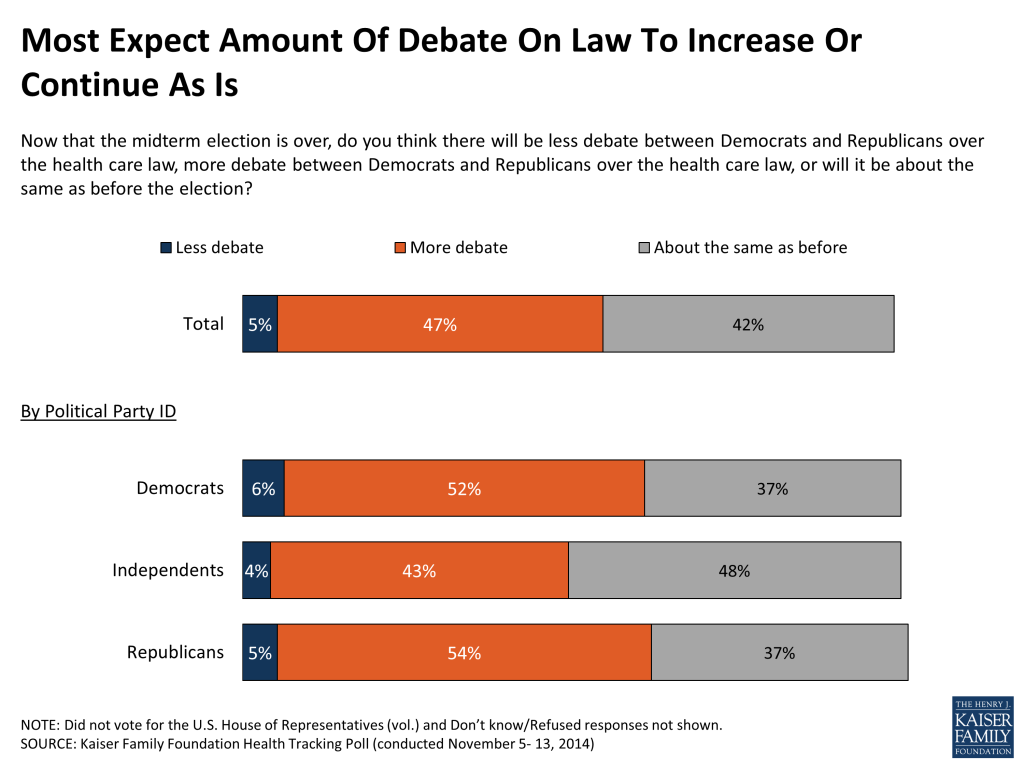
Following the Nov. 4 midterm elections that saw Republicans seize control of the Senate and expand their House majority, nearly half of Americans (47%) expect increased debate between the two parties over the Affordable Care Act, according to the Kaiser Family Foundation’s latest tracking poll. In comparison, 42 percent say the amount of debate will not change, and very few (5%) say it will decrease.
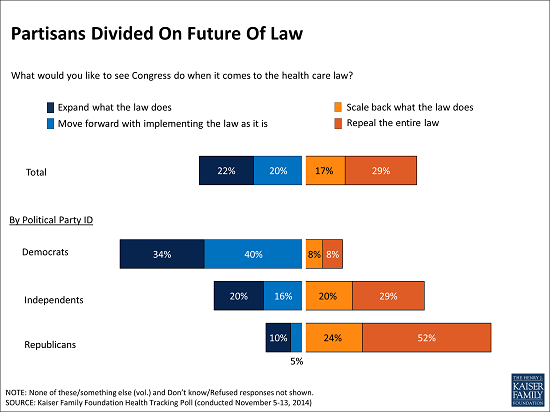
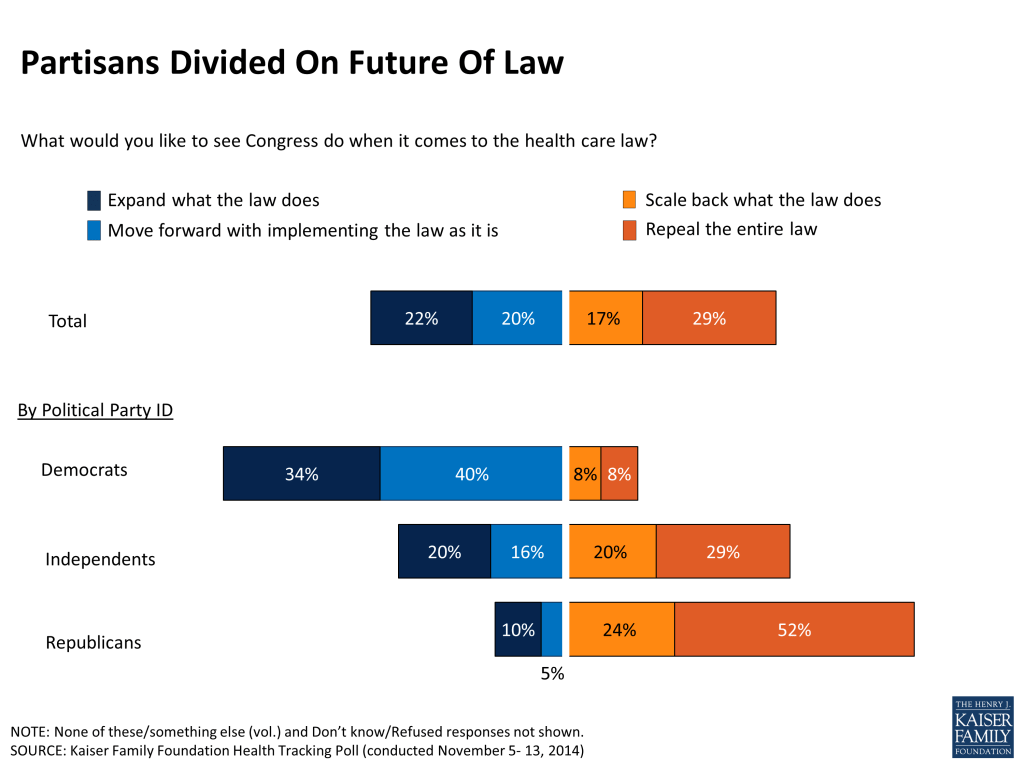
Majorities of Democrats (52%) and Republicans (54%) each expect the debate to increase, but Americans’ opinions are all over the map about what Congress should do next: 29 percent of the public supports repealing the law outright, 17 percent supports scaling the law back, 20 percent supports moving ahead with it as is, and 22 percent supports expanding the law.
As always on the ACA, the poll shows deep partisan differences on what’s next for the law. Republicans are more likely to favor repealing the law outright (52%) or scaling back the law (24%), while Democrats are more likely to favor moving ahead with it as is (40%) or expanding it (34%). Independents fall in between, but lean toward repeal or scaling back.
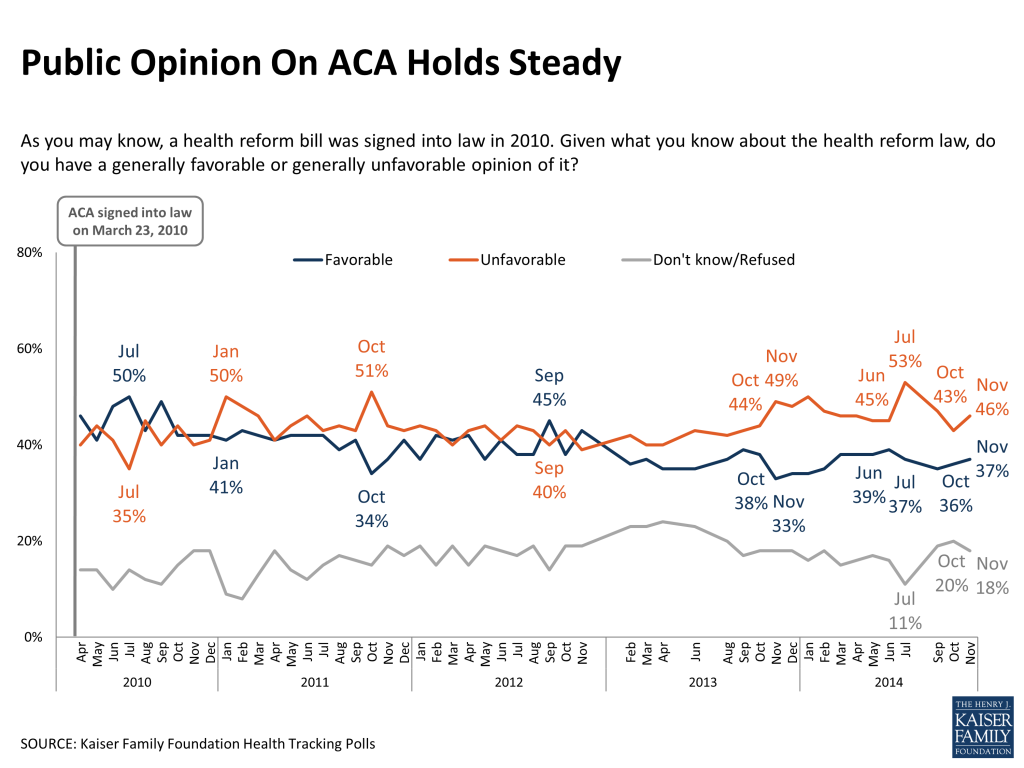
The poll finds little change in the public’s overall view of the ACA, with 46 percent saying they have an unfavorable view and 37 percent saying they have a favorable view. This also reflects sharp partisan differences, with three quarters (74%) of Republicans reporting an unfavorable view and two thirds (67%) of Democrats reporting a favorable view. Independents fall in the middle, but more tilt negative.
Conducted just prior to Saturday’s start of the ACA’s second open enrollment season, the poll also probes the views of people without health insurance, one of the key target groups for outreach and enrollment efforts.
It finds the uninsured remain largely unaware of the renewed opportunity to purchase or enroll in health insurance through the marketplaces over the next few months. About 9 in 10 (89%) don’t know when open enrollment starts, similar to the share who didn’t know in the October poll.
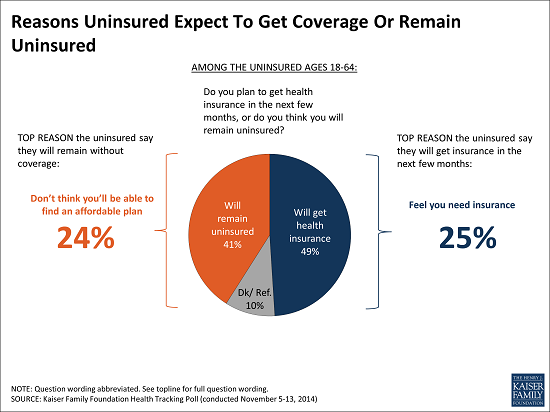
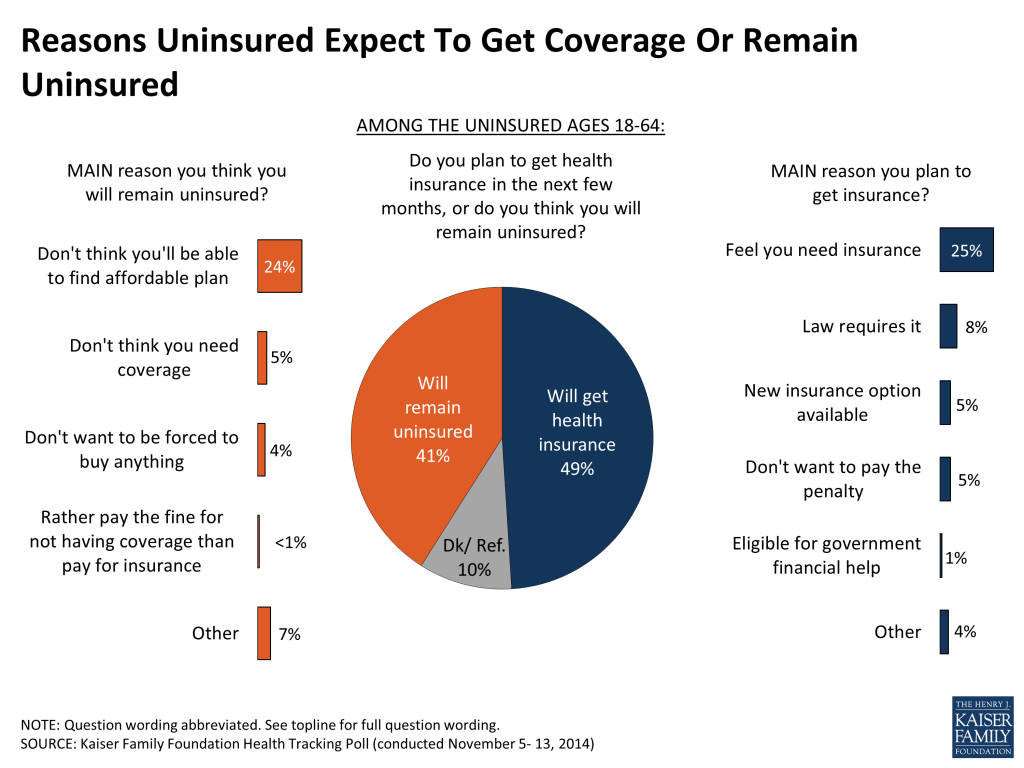
Even so, about half of the uninsured (49%) say they plan to get coverage during the coming months, and 41 percent say they do not expect to obtain coverage, including about a quarter (24%) of all uninsured who say they do not believe they can find a plan that they can afford.
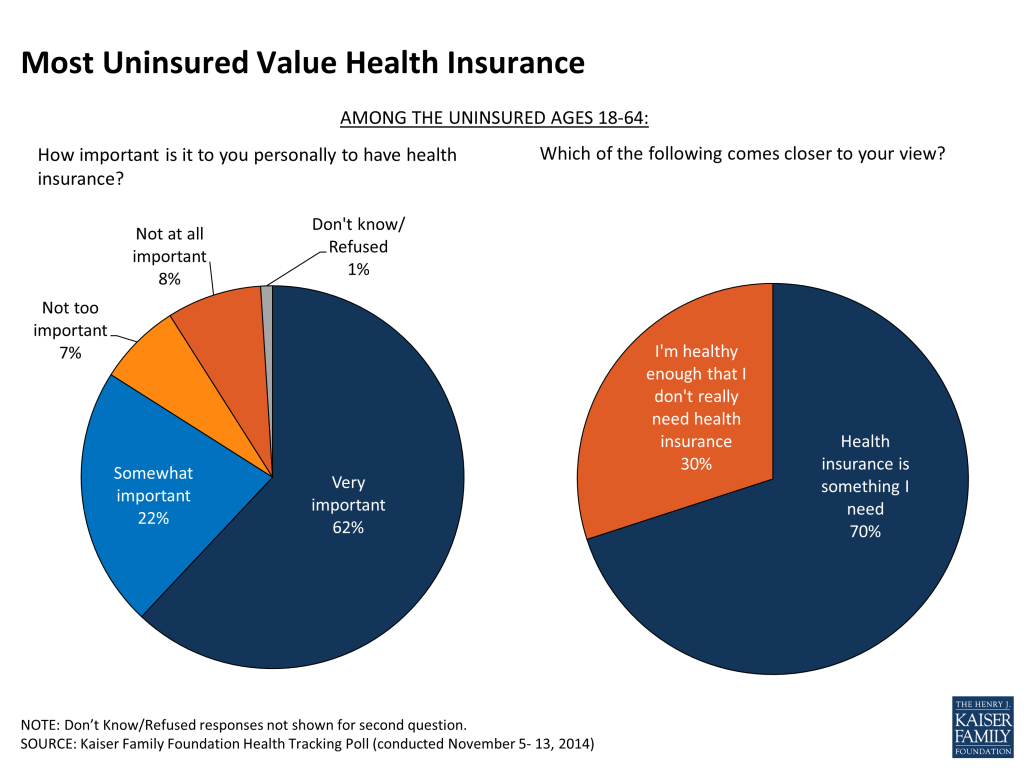
Still more than eight in 10 of the uninsured (84%) say that it is at least somewhat important to them to have health insurance (including 62% who say it is “very important”). Similarly, seven in 10 say health insurance is something they need; more than twice the share who chose “I’m healthy enough that I don’t really need health insurance.”
Other findings from the poll include:
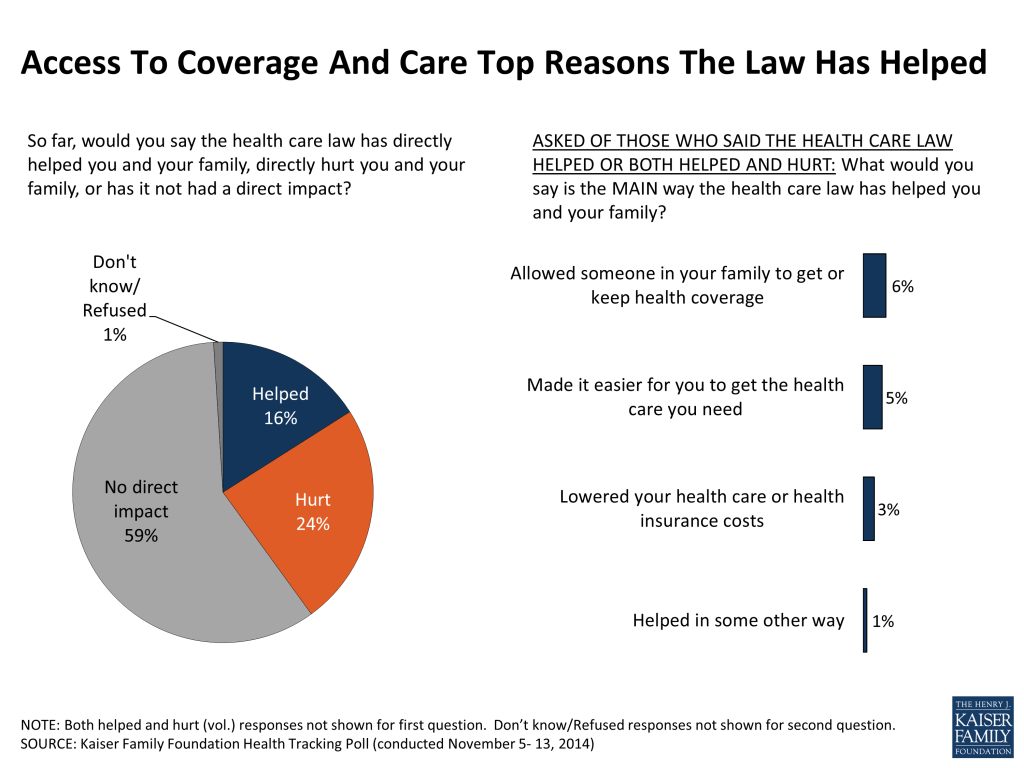
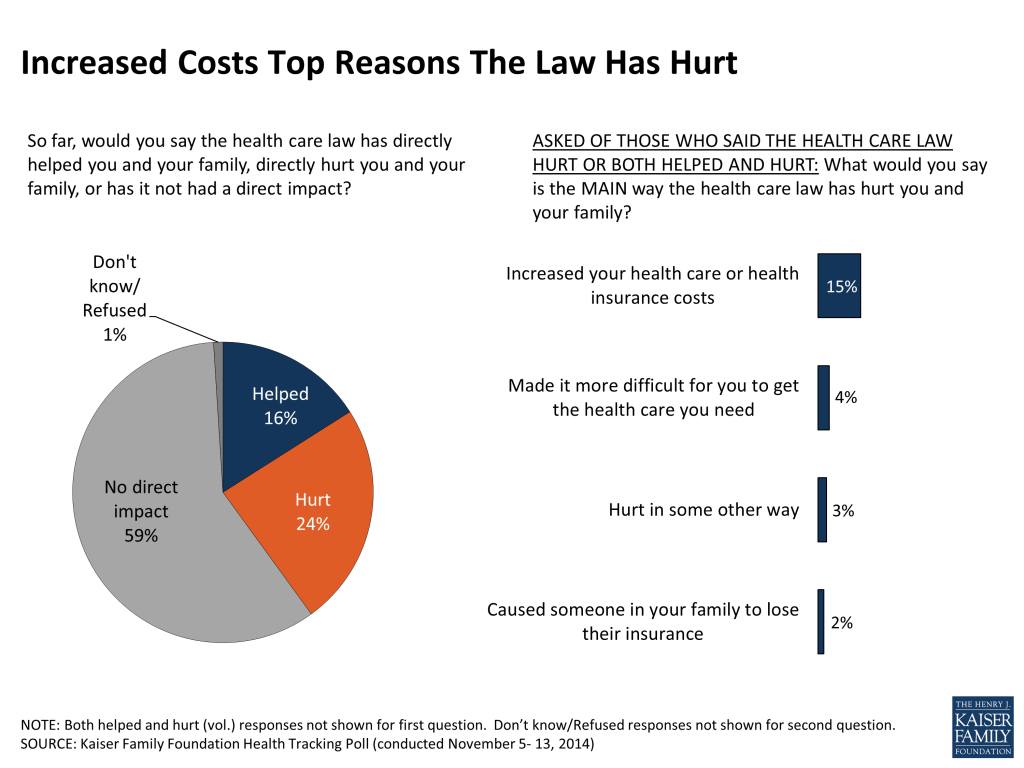
Most of the public says that their families haven’t been directly impacted by the health care law, though more say they have been hurt (24%) than have been helped (16%). Republicans are more likely to say they have been hurt (42%) while Democrats are more likely to say they have been helped (30%). Independents again fall in between, with more saying they have been hurt than helped (22% vs. 12%).
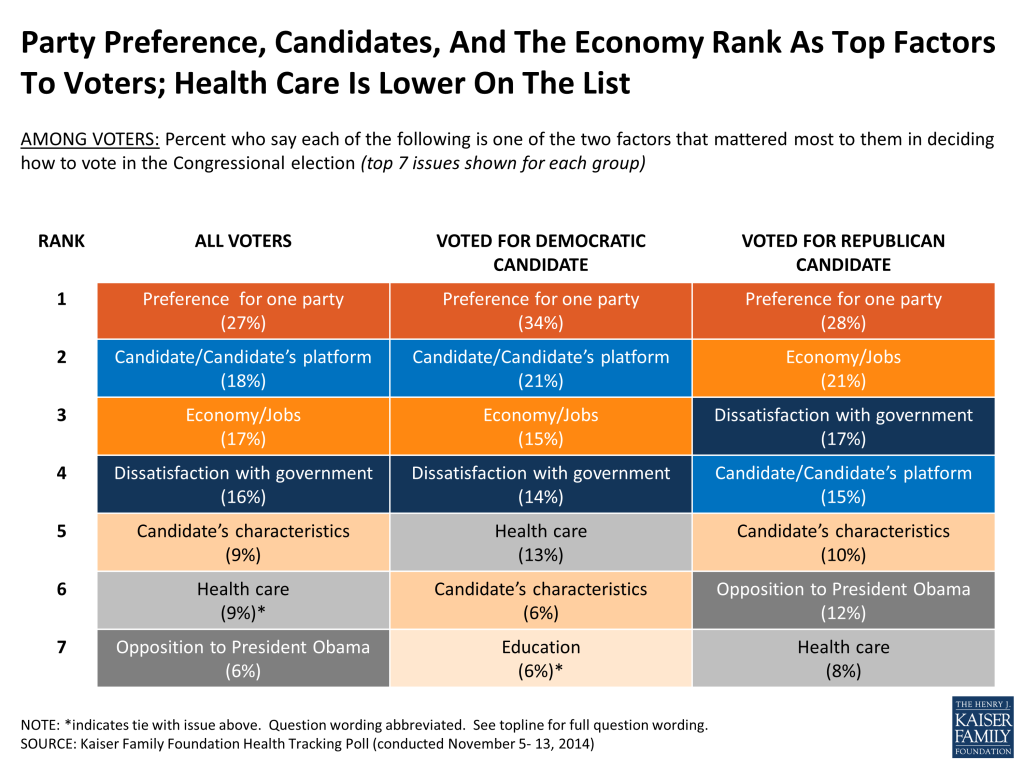
Asked to name in their own words the two most important factors in their vote for Congress, the top answer among those who report voting in this month’s midterm election was party loyalty (27%). Somewhat smaller shares named a candidate’s platform or track record (18%), the economy and jobs (17%) and dissatisfaction with government (16%). Fewer still cited health care (9% of voters, including 6% who specifically named the Affordable Care Act or Obamacare).
This month’s Health News Index finds nearly eight in 10 Americans say they closely followed coverage of the Ebola outbreak both in the United States and in West Africa, making it the most followed news story this month and one of the most closely followed stories of the year.
METHODOLOGY
The latest tracking poll was designed and analyzed by public opinion researchers at the Kaiser Family Foundation and was conducted from November 5-13, 2014 among a nationally representative random digit dial telephone sample of 1,501 adults ages 18 and older. Interviews were conducted in English and Spanish by landline (751) and cell phone (750). The margin of sampling error is plus or minus 3 percentage points for the full sample and plus or minus 9 percentage points for the uninsured. For results based on other subgroups, the margin of sampling error may be different.
The Kaiser Health Policy News Index is designed to help journalists and policymakers understand which health policy-related news stories Americans are paying attention to, and what the public understands about health policy issues covered in the news. According to this month’s index, the public remains captivated by news coverage of the Ebola virus, with nearly eight in ten Americans saying they “very” or “fairly” closely followed the story in the United States and abroad. Fewer, but still substantial shares, report following the conflicts in Iraq and Syria (71 percent) and the results of the midterm elections (64 percent). The public paid much less attention to other non-health policy news stories this month; just over a third (36 percent) say they closely followed the crash of a Virgin Galactic commercial aircraft and 27 percent say they closely followed the Major League Baseball World Series. And a quarter or fewer report following health policy stories about preparations for the health care law’s second open enrollment period (25 percent) and a settlement requiring the nursing home chain Extendicare to pay $38 million after providing substandard care to residents (17 percent).
Figure 1
This month, news coverage of Ebola cases in the United States and in West Africa continue to top this list of stories followed “very” or “fairly” closely by the public, ranking among the most closely followed stories for the past three consecutive months. Even after multiple cases of Ebola were diagnosed in the United States, the public is equally attentive to news about Ebola in West Africa as it is to coverage about the U.S.
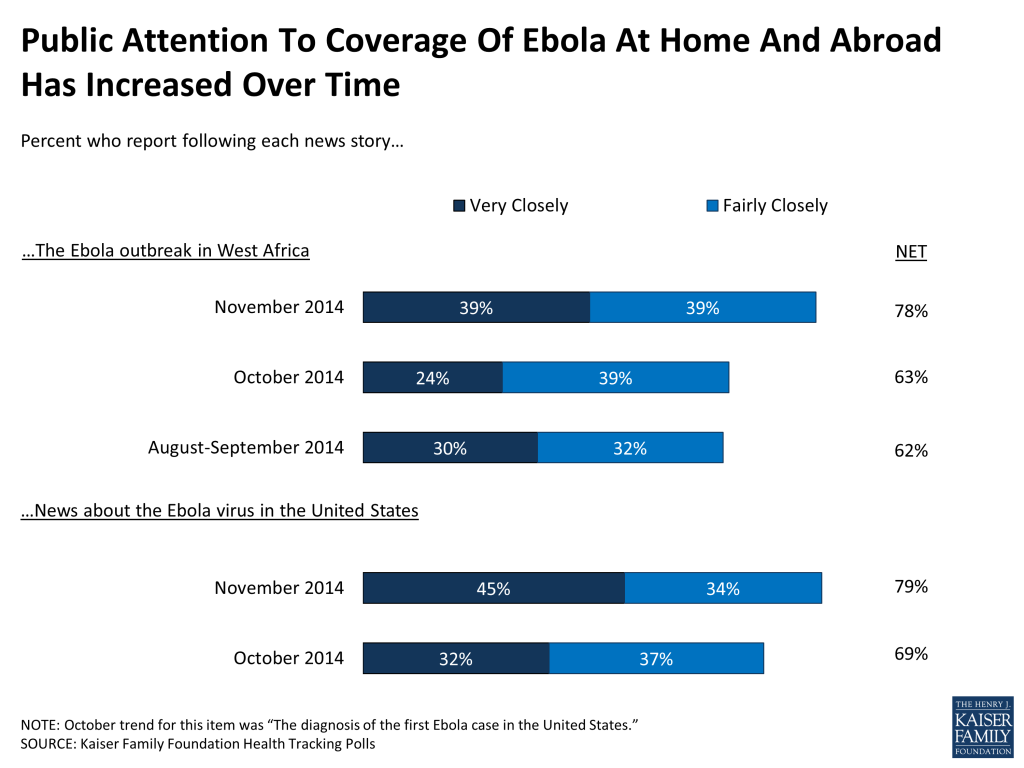
In November, more Americans report following news of the Ebola outbreak than a few months ago. In the August-September Health Policy News Index, about six in ten Americans (62 percent) reported following the story closely. Since then, the share has increased substantially, to nearly eight in ten Americans (78 percent), closely following news of the outbreak abroad. Attention to news of Ebola in the U.S. has also increased, from about seven in ten (69 percent) in October to about eight in ten (79 percent) in November.
Figure 2
This month, news coverage of Ebola cases in the United States and in West Africa continue to top this list of stories followed “very” or “fairly” closely by the public, ranking among the most closely followed stories for the past three consecutive months. Even after multiple cases of Ebola were diagnosed in the United States, the public is equally attentive to news about Ebola in West Africa as it is to coverage about the U.S.
In November, more Americans report following news of the Ebola outbreak than a few months ago. In the August-September Health Policy News Index, about six in ten Americans (62 percent) reported following the story closely. Since then, the share has increased substantially, to nearly eight in ten Americans (78 percent), closely following news of the outbreak abroad. Attention to news of Ebola in the U.S. has also increased, from about seven in ten (69 percent) in October to about eight in ten (79 percent) in November.
NOTE: These questions were asked as part of the November 2014 Kaiser Health Tracking Poll. For more results from that survey, including methods, see: Kaiser Health Tracking Poll: November 2014.
Kaiser Health Tracking Poll: November 2014 Findings
The latest Kaiser Health Tracking Poll finds that just prior to the Affordable Care Act (ACA) open enrollment beginning this past Saturday, the uninsured remained largely unaware of its start, although about half of the uninsured expect to get health insurance in the next few months and seven in ten say that health insurance is something they need. Opinion on the law remains similar to past months – 46 percent say they have an unfavorable view of the law and 37 percent say they have a favorable view. Americans are divided as to what Congress should do next on the law – 29 percent say they support repealing the law entirely, 17 percent say they support scaling back what the law does, 20 percent support moving ahead with the law as is, and 22 percent feel that the law should be expanded. But like opinion on the law overall, partisans fall on opposite ends of the spectrum. The public has no expectation that debate on the ACA will die down soon; a finding that Democrats and Republicans agree on. Most say that now that the midterm elections are over the amount of partisan debate will increase or stay about the same. Finally, on the heels of the midterm elections, few voters (9 percent) named health care as one of the two most important factors in their vote, ranking 5th behind partisan control of Congress (27 percent), a candidate’s platform (18 percent), the economy and jobs (17 percent), dissatisfaction with government (16 percent) and similar to a candidate’s personal characteristics (9 percent).
The Uninsured And Open Enrollment Round Two
Many Uninsured Are Unaware Of Open Enrollment Period
As the second open enrollment period under the Affordable Care Act (ACA) began this month, the uninsured remained largely unaware of the renewed opportunity to purchase or enroll in health insurance. Similar to last month, about 9 in 10 (89 percent) are unsure of when open enrollment starts, including about three quarters (77 percent) who say they don’t know and 12 percent who gave an answer other than November 2014.
Figure 1
Visibility Of Outreach And Advertising
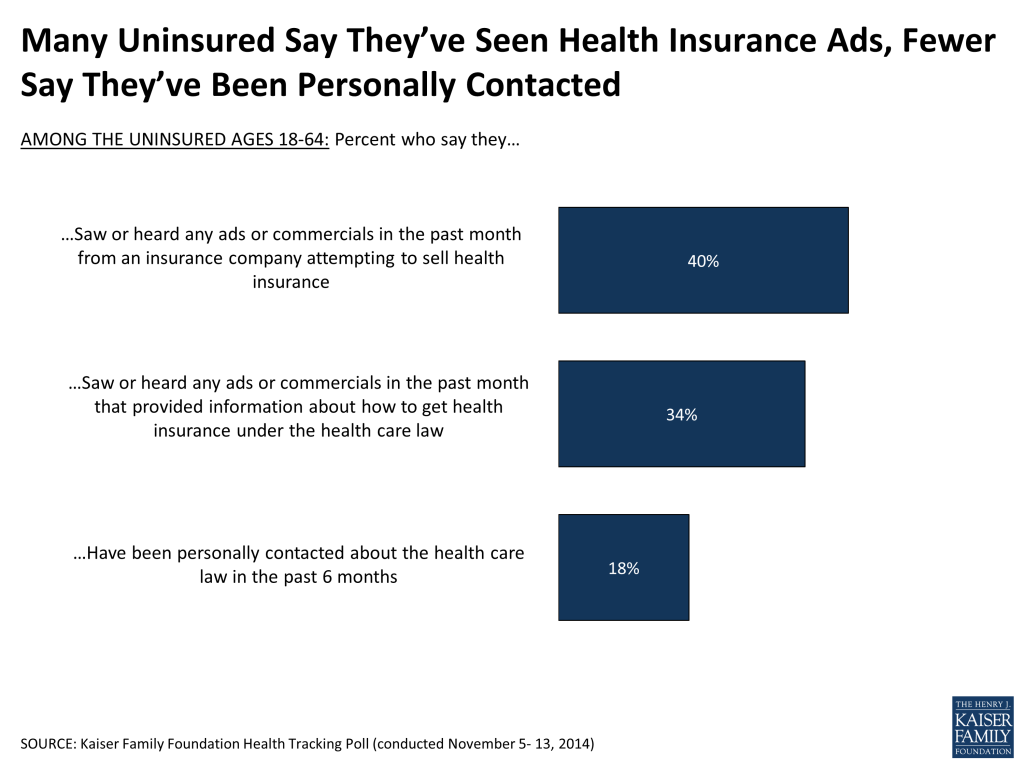
At this early point in the open enrollment season, about 1 in 5 uninsured (18 percent) say they have been personally contacted in the last six months about the health care law.
Many more uninsured, however, report seeing advertising about how to enroll in health coverage or health insurance products more generally. Four in 10 (40 percent) of the uninsured say they have recently seen or heard an ad from an insurer about health insurance. About a third (34 percent) of the uninsured say they have seen or heard an ad in the past month that provided information about how to get insurance under the health care law. These shares are similar to reports among the uninsured in the October tracking poll.
Figure 2
Plans To Get Coverage
Looking ahead, the uninsured are divided on whether they plan on getting insurance in the next few months — 49 percent say they think they will obtain coverage and 41 percent say they think they will remain uninsured while 10 percent aren’t sure. The most common reason the uninsured say they will obtain health insurance is because they feel it is something they need (25 percent among all uninsured), while many fewer say that the law’s requirement to have health insurance (8 percent) or the penalty for not having coverage (5 percent) is the main factor. Those who expect to remain uninsured are most likely to say the main reason they won’t get insurance is because they don’t think they will be able to find an affordable plan (24 percent among all uninsured).
Figure 3
Uninsured Value Insurance
While the uninsured are split on whether they will get health insurance in the next few months, large majorities of the uninsured say that having health insurance is important to them and is something they need. More than 8 in 10 (84 percent) of the uninsured say that it is at least “somewhat important” to them to have health insurance, including over 6 in 10 (62 percent) who say it is “very important.” And, 7 in 10 (70 percent) of the uninsured say health insurance is something they need; more than twice the share who chose “I’m healthy enough that I don’t really need health insurance.”
Figure 4
Who Are The Uninsured?
Characteristics common among the uninsured can often make this group difficult to reach and enroll in health insurance. About 4 in 10 (38 percent) of the uninsured are under age 30 and 63 percent report family income of less than $30,000 a year. Many (59 percent) say they have been uninsured for 2 years or more and about 3 in 10 (29 percent) report being in only “fair” or “poor” health. In addition, a third (33 percent) identify as Hispanic and 15 percent chose to take the survey in Spanish.
Overall ACA Opinion
Opinion On ACA Remains Steady
Opinion on the law continues to tilt negative. Forty-six percent say they have a negative view of the law and 37 percent report a favorable view, similar to last month. Opinion continues to be closely tied to partisanship with about three-quarters (74 percent) of Republicans reporting an unfavorable view of the law, including just over half (53 percent) who say they have a very unfavorable opinion, compared to two-thirds (67 percent) of Democrats reporting a favorable view of the law. Independents fall in the middle, but tilt more negative toward the law.
Figure 5
The Public Is Divided On Future Of Law
Americans express a variety of opinions about what Congress should do next when it comes to the health care law. About 3 in 10 (29 percent) say they’d like Congress to repeal it outright and another 17 percent say they support scaling the law back. In addition, about 1 in 5 each support moving ahead with the law as is (20 percent) and expanding the law (22 percent).
But like opinion of the law overall, views on what should come next vary greatly across party. At opposite ends of the debate are Democrats with a third (34 percent) saying they support expanding what the law does and Republicans with about half (52 percent) saying they favor repealing the law entirely. Independents have more mixed views, but still 2 in 10 (20 percent) say they want it expanded while about 3 in 10 (29 percent) say they want the law repealed entirely.
Figure 6
Most Expect Debate About Law To Increase Or Hold Steady
Now that the midterm election is over, about half (47 percent) of the general public expects there will be more debate between Republicans and Democrats over the health care law, about 4 in 10 (42 percent) say the amount of debate will be about the same as before the election, and very few (5 percent) say it will decrease. Democrats and Republicans agree that they expect more debate over the law (52 percent of Democrats and 54 percent of Republicans).
Figure 7
Views Of Personal Impact Divided By Party
Most of the general public (59 percent) reports that their families haven’t been directly impacted by the health care law. For those who say they have been impacted, more say they have been hurt by the law than say they have been helped (24 percent vs. 16 percent). Republicans are more likely to say they have been hurt by the law (42 percent) while Democrats are more likely to say they have been helped (30 percent). Independents fall in the middle but more say they have been hurt than helped (22 percent vs. 12 percent).
Figure 8
Most of those who report having been helped by the law say it allowed someone in their family to get or keep health coverage (6 percent), made it easier to get the health care they need (5 percent), or lowered their health care costs (3 percent).
Figure 9
On the other hand, 15 percent say they have been hurt by the law because it increased their health care or health insurance costs. Others say it made it more difficult to get the health care they need (4 percent) or caused someone in their family to lose their health insurance (2 percent).
Figure 10
ACA And The 2014 Midterm Election
ACA Was Not A Top Issue To Voters In 2014 Midterm Election
Figure 11
When asked to name in their own words what the two most important factors were in their vote for Congress, party loyalty rises to the top. About a quarter (27 percent) of voters responded that what mattered most to them was voting for their preferred party and party control in the House and Senate. After party loyalty, similar shares named factors such as a candidate’s platform or track record (18 percent), the economy and jobs (17 percent), dissatisfaction with government (16 percent). Further down the list was health care with 9 percent of voters naming it as an important factor in their vote, including 6 percent who specifically referenced the Affordable Care Act.
Similar shares of people who voted for the Democratic candidate and those who voted for the Republican candidate mentioned health care as one of their two top voting issues (13 percent and 8 percent, respectively). Five percent of voters who report choosing the Republican candidate specifically mentioned opposition to the ACA, while 3 percent of Democratic voters specially referred to the ACA in a positive way.
Those who feel their families have personally benefited from the law are more likely to say health care was a major factor in their vote – 1 in 5 voters compared to 7 percent of those voters who say they have been hurt by the law or haven’t been impacted.
Kaiser Health Tracking Poll: November 2014 Methodology
This Kaiser Health Tracking Poll was designed and analyzed by public opinion researchers at the Kaiser Family Foundation (KFF). The survey was conducted November 5-13, 2014, among a nationally representative random digit dial telephone sample of 1,501 adults ages 18 and older, living in the United States, including Alaska and Hawaii (note: persons without a telephone could not be included in the random selection process). Computer-assisted telephone interviews conducted by landline (751) and cell phone (750, including 456 who had no landline telephone) were carried out in English and Spanish by Princeton Data Source under the direction of Princeton Survey Research Associates International (PSRAI). Both the random digit dial landline and cell phone samples were provided by Survey Sampling International, LLC. For the landline sample, respondents were selected by asking for the youngest adult male or female currently at home based on a random rotation. If no one of that gender was available, interviewers asked to speak with the youngest adult of the opposite gender. For the cell phone sample, interviews were conducted with the adult who answered the phone. KFF paid for all costs associated with the survey.
The combined landline and cell phone sample was weighted to balance the sample demographics to match estimates for the national population using data from the Census Bureau’s 2012 American Community Survey (ACS) on sex, age, education, race, Hispanic origin, nativity (for Hispanics only), and region along with data from the 2010 Census on population density. The sample was also weighted to match current patterns of telephone use using data from the July-December 2013 National Health Interview Survey. The weight takes into account the fact that respondents with both a landline and cell phone have a higher probability of selection in the combined sample and also adjusts for the household size for the landline sample. All statistical tests of significance account for the effect of weighting.
The margin of sampling error including the design effect for the full sample is plus or minus 3 percentage points. Numbers of respondents and margin of sampling error for key subgroups are shown in the table below. For results based on other subgroups, the margin of sampling error may be higher. Sample sizes and margin of sampling errors for other subgroups are available by request. Note that sampling error is only one of many potential sources of error in this or any other public opinion poll. Kaiser Family Foundation public opinion and survey research is a charter member of the Transparency Initiative of the American Association for Public Opinion Research.
Most health plans require enrollees to pay a portion of the cost of care when they seek services. While there are lots of forms of cost sharing — deductibles, copayments, coinsurance – people often focus on the deductible amount because it often provides the simplest indication of how generous a plan may be. A deductible is the amount that an enrollee must pay toward the cost of covered services before the plan will start paying for most types of care covered by the plan. Certain preventive services must be covered without cost sharing in all plans in the Affordable Care Act’s Marketplaces, and insurers sometimes pay towards other services, usually physician office visits or prescription drugs, before the enrollee has met his or her deductible. Still, people need to be prepared for the fact that they may need to pay the entire deductible amount out of pocket if they need a significant amount of care during a year.
The slide show provides an initial look at the deductibles for medical care and the specific deductibles applied to prescription drugs for the plans offered in the federally facilitated and partnership Marketplaces available healthcare.gov. The amounts are simple averages of the plans available (see Methods). The amounts are shown separately by metal level (“Bronze,” “Silver,” “Gold,” and “Platinum”). Deductible amounts are shown separately for plans where medical spending and prescription drug spending are both subject to the same deductible (called “combined) and for plans where there are separate deductibles for medical spending and prescription drug spending (called “separate”). Not surprisingly, deductibles tend to decrease as one moves from the levels with lower actuarial values (“Bronze” and “Silver”) to the higher levels.
The slides do not show the deductibles for silver plans that provide reduced cost sharing for people with low incomes (e.g., people receiving cost-sharing subsidies). Many people in Marketplace plans receive these subsidies, and would not be subject to the deductible amounts shown in the slides. We will be releasing a more complete analysis that has information for these plans and for the other types of cost sharing (e.g., copayments, coinsurance amounts) in the near future.
Methods
Information on plan cost sharing provisions was downloaded from Healthcare.gov for the plans offered in federally-facilitated and partnership exchanges. Because many plans are offered in multiple rating areas within a state, we reduced the number of plans so that each benefit package was counted only once for each state. The averages and distributions are simple averages of the plans that are available and are not weighted by enrollment because we do not have enrollment for each plan.
Medicaid, the nation’s publicly funded health coverage program for low-income Americans, is a primary source of coverage, access, and health care financing, as well as a key component of the expansion of coverage in the Affordable Care Act.
How much do you know about Medicaid, the role it plays in the lives of many Americans, how program dollars are spent and how Medicaid eligibility is changing under health reform?
In his latest column for The Wall Street Journal’s Think Tank, Drew Altman explains why 2015 enrollment in the Affordable Care Act’s marketplaces is very hard to predict.
All previous columns by Drew Altman are availableonline.
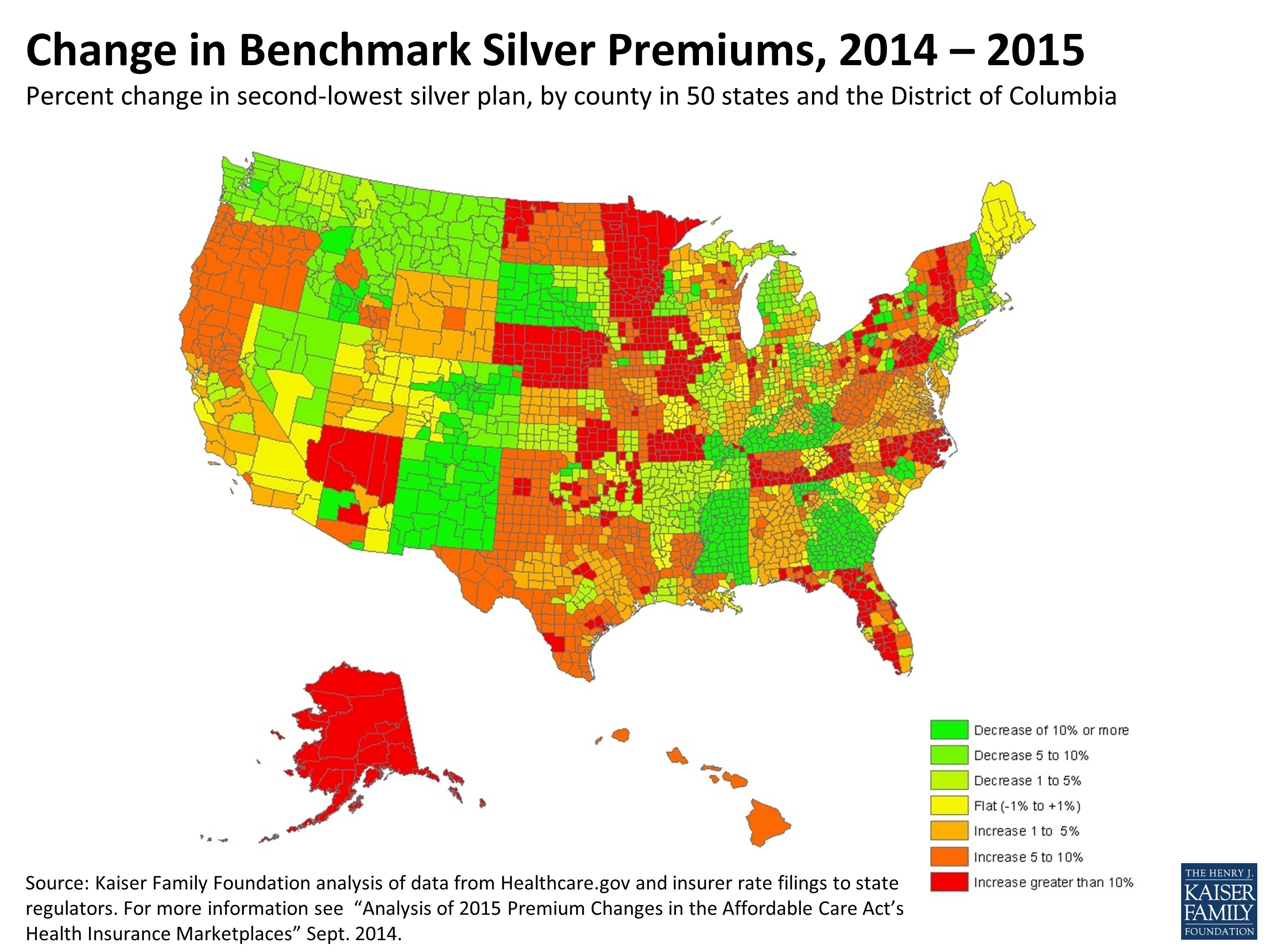
Kaiser Family Foundation analysis of data from Healthcare.gov and insurer rate filings to state regulators. For more information see “Analysis of 2015 Premium Changes in the Affordable Care Act’s Health Insurance Marketplaces” Sept. 2014.
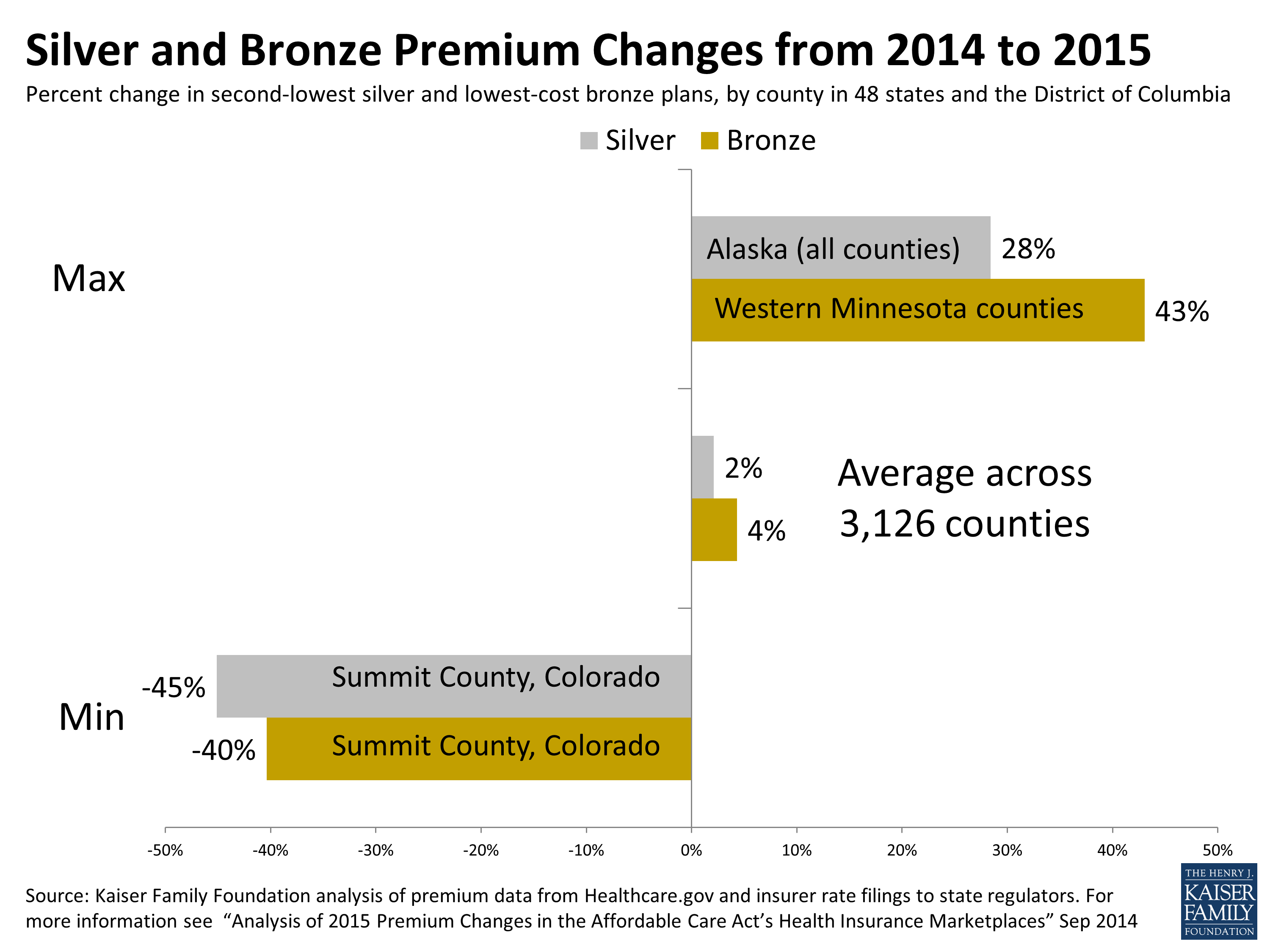
Kaiser Family Foundation analysis of premium data from Healthcare.gov and insurer rate filings to state regulators. For more information see “Analysis of 2015 Premium Changes in the Affordable Care Act’s Health Insurance Marketplaces” Sep 2014
Delivery system reforms continue to play a significant role in shaping state Medicaid programs, including initiatives focused on beneficiaries who need long-term services and supports (LTSS). A growing number of states are enrolling seniors and people with disabilities in Medicaid managed care and implementing initiatives aimed at better coordinating and integrating Medicare and Medicaid services for dual eligible beneficiaries, often through capitated managed care arrangements. In addition, a significant number of states report that incentives built into their managed long-term services and supports (MLTSS) programs are expected to increase beneficiary access to home and community-based services (HCBS) in lieu of institutional care.
This issue brief examines key themes in 19 capitated Medicaid MLTSS waivers approved to date by the Centers for Medicare and Medicaid Services (CMS), including § 1115 demonstrations in 12 states (AZ, CA, DE, HI, KS, NJ, MN, NY, RI, TN, TX, VT) and § 1915(b)/(c) waivers in six states (FL, IL, MI (2 waivers), MN, OH, WI). MLTSS programs provided under these authorities are the subject of CMS’s 2013 best practices guidance to states. Key themes in the capitated MLTSS waivers include the following:
Covered Populations and Services in Capitated MLTSS Waivers
State interest in MLTSS is increasing, with over half (11 of 19) of these waivers approved in 2012, 2013, or 2014.
All 19 MLTSS waivers include seniors and non-elderly adults with physical disabilities, while five include people with intellectual/developmental disabilities. All include dual eligible beneficiaries.
Most (15 of 19) of the waivers are or will be providing MLTSS statewide.
Most (17 of 19) of the waivers require beneficiaries to enroll in managed care to receive LTSS.
Most (14 of 19) of the waivers cover or will soon cover a comprehensive set of benefits, including nursing facility (NF) services, HCBS, acute and primary care, and behavioral health services.
MLTSS Waiver Provisions Aimed at Increasing Beneficiary Access to HCBS
Four states use MLTSS waivers to increase access to HCBS by expanding Medicaid financial eligibility criteria.
Seven states use or are seeking MLTSS waiver authority to provide HCBS to people at risk of institutionalization.
Two states use MLTSS waiver authority to allow beneficiaries to employ spouses as paid caregivers as part of their option to self-direct HCBS.
Three waivers include financial incentives for health plans that provide increased HCBS, and two waivers include provisions for increased state HCBS funding.
Three waivers include requirements for health plans regarding NF to community transitions or NF diversion.
Beneficiary Protections in Capitated MLTSS Waivers
Eight waivers include provisions for independent enrollment options counseling to assist beneficiaries with choosing a health plan.
Eleven waivers provide for an ombudsman program as part of their MLTSS programs.
Six waivers include provisions that expand beneficiaries’ right to change health plans outside of open enrollment, such as when a residential or employment supports provider leaves the plan network.
Seven waivers require the state to maintain a managed care advisory group to provide input on the MLTSS program, and six waivers require health plans to establish beneficiary advisory groups.
Quality Measurement and Oversight in Capitated MLTSS Waivers
Eight waivers mention quality of life measures, although generally little detail is provided.
Five waivers require reporting on LTSS rebalancing and community integration measures.
Five waivers provide for beneficiary satisfaction surveys.
Four waivers require reporting of health plan encounter data.
Three waivers require state monitoring of service decreases proposed by health plans.
Three waivers require state monitoring and reporting on grievances and appeals.
Looking Ahead
State interest in capitated MLTSS waivers is growing, with 11 out of 19 waivers approved in the last three years. While various Medicaid state plan authorities enable states to expand beneficiary access to HCBS, states also are using § 1115 or § 1915(b)/(c) waiver provisions aimed at increasing community integration. MLTSS waivers also include some beneficiary protections in addition to those required by the underlying Medicaid managed care authority. CMS’s 2013 MLTSS guidance offers best practices to states in these areas, although some elements are recommended but not required, and states retain flexibility to design specific program features. An area important to beneficiaries who need LTSS is disability accessibility and compliance with the Americans with Disabilities Act, which is not addressed by the guidance or in detail in the waiver terms and conditions. Work also is needed to further develop MLTSS quality measures, such as those related to quality of life, LTSS rebalancing, and community integration, so that policymakers and other stakeholders have the information necessary to oversee and evaluate these programs to ensure that beneficiaries are well-served.
Issue Brief: Introduction
Delivery system reforms continue to play a significant role in shaping state Medicaid programs, including initiatives focused on beneficiaries who need long-term services and supports (LTSS). From 2004 to 2012, the number of states with managed long-term services and supports (MLTSS) programs doubled from eight to 16, and the number of beneficiaries receiving MLTSS grew from 105,000 to 389,000.1 The Centers for Medicare and Medicaid Services (CMS) notes “increasing interest from states in the form of concept papers, waiver applications and requests for technical assistance” in this area,2 as a growing number of states enroll seniors and people with disabilities in Medicaid managed care and implement initiatives aimed at better coordinating and integrating Medicare and Medicaid services for dual eligible beneficiaries, often through capitated managed care arrangements.3 In addition, while most states continue to rely on § 1915(c) waivers to expand home and community-based services (HCBS), a significant number of states (13 in FY 2014 and 16 in FY 2015) report that incentives built into their MLTSS programs are expected to increase beneficiary access to HCBS in lieu of institutional care.4
In addition to the potential opportunity to expand beneficiary access to HCBS, Medicaid MLTSS programs seek to improve health outcomes and care quality through increased care coordination. At the same time, because these programs by definition serve beneficiaries with relatively high medical and LTSS needs, there is the potential risk of disrupting existing care arrangements, especially for the HCBS on which beneficiaries rely to meet essential daily needs and live independently in the community.5 Also, because many states and health plans have relatively limited experience serving people with disabilities and administering LTSS through capitated managed care arrangements,6 Medicaid MLTSS programs may introduce new service delivery concepts, such as person-centered planning, self-direction, and independent living, which health plans may not have encountered while providing acute and primary care services to relatively healthy parents and children.7
Given the increased state interest in and implementation of Medicaid MLTSS programs, this issue brief examines key themes in 19 capitated Medicaid MLTSS waivers approved by CMS to date. These include § 1115 demonstrations in 12 states (AZ, CA, DE, HI, KS, NJ, MN, NY, RI, TN, TX, VT) and § 1915(b)/(c) waivers in six states (FL, IL, MI (2 waivers), MN, OH, WI). While states also may implement Medicaid managed care through § 1932 state plan authority or § 1915(a) waivers with voluntary enrollment, many states are using § 1115 demonstrations or § 1915(b)/(c) waivers to implement capitated MLTSS programs, often with mandatory enrollment. MLTSS programs under § 1115 and § 1915(b) authority are the subject of CMS’s 2013 guidance to states.8 This brief analyzes capitated § 1115 and § 1915(b)/(c) MLTSS waivers with a focus on covered populations and services, provisions aimed at expanding beneficiary access to HCBS, beneficiary protections, and quality measurement and oversight in Medicaid MLTSS programs.
Issue Brief: Background
Medicaid MLTSS Authorities
Medicaid MLTSS involves combining authority for delivering services through Medicaid managed care with authority for providing Medicaid LTSS. The various authorities available to states are described below and summarized in Table 1.
Medicaid Managed Care Authorities
Federal Medicaid law allows states to choose among different managed care arrangements. These include managed fee-for-service models, such as primary care case management (excluded from this analysis), and capitated models, such as managed care organizations (MCOs), prepaid inpatient health plans (PIHPs), and prepaid ambulatory health plans (PAHPs). Unlike PIHPs and PAHPs, MCOs have a comprehensive risk contract with the state Medicaid agency. In exchange for a capitated payment, MCO contracts include at least one of the following services in addition to inpatient hospitalization, or three or more of the following services if inpatient hospitalization is not included: outpatient hospital, rural health clinic, federally qualified health center, other laboratory and x-ray, nursing facility, Early Periodic Screening Diagnosis and Treatment, family planning, physician, and home health services. PIHPs and PAHPs contract with the state Medicaid agency to provide specified medical services, which do not meet the scope of services required for a comprehensive risk contract, in exchange for a capitated payment; PIHPs include inpatient hospital or institutional services, while PAHPs do not.
Federal Medicaid law allows states to choose to deliver Medicaid benefits through one of these managed care arrangements and to require most beneficiaries to enroll in such programs, provided that certain beneficiary protections are met, by submitting a § 1932 state plan amendment. However, § 1932 does not allow states to require children with special health care needs, dual eligible beneficiaries, and certain Native Americans to enroll in Medicaid managed care. Examples of states using § 1932 Medicaid state plan managed care authority to establish capitated MLTSS programs include South Carolina, Virginia, and Washington. These states are using § 1932 authority concurrent with § 1115A waivers to implement capitated financial alignment demonstrations for dual eligible beneficiaries that include MLTSS.9
Section 1932 and its implementing regulations at 42 C.F.R. Part 438 provide the basic framework for Medicaid managed care and include a number of beneficiary protections for managed care enrollees, including provisions regarding enrollment and disenrollment, network adequacy, beneficiaries with special health care needs, grievances and appeals, plan marketing, utilization controls, and the content, format, and accessibility of beneficiary notices.
States also may implement Medicaid managed care programs through various waiver authorities. Section 1915(a) waivers allow states to establish managed care programs with voluntary enrollment, while states can require Medicaid managed care enrollment, with CMS approval, through § 1915(b) waivers or § 1115 demonstrations. Section 1915(b) waivers are targeted to Medicaid managed care arrangements and allow CMS to waive state compliance with certain provisions of federal Medicaid law, such as those that otherwise require benefits to be provided statewide, comparability of benefits among different Medicaid populations, and beneficiaries’ free choice of provider.
In contrast to § 1915(b) waivers, § 1115 demonstration waivers that authorize Medicaid MLTSS programs often include other provisions, such as those aimed at other delivery system and financing reforms or eligibility or benefits for other populations, which may not be directly related to MLTSS. Section 1115 demonstration waivers authorize “experimental, pilot, or demonstration projects” that, in the view of the Health and Human Services Secretary, “promote the objectives” of the Medicaid program. Section 1115 allows CMS to waive state compliance with certain provisions of federal Medicaid law and also may include expenditure authority through which states can receive federal matching funds for costs that otherwise would not qualify for Medicaid funding.10 Newly proposed and applications to extend § 1115 waivers require public notice and comment periods,11 and under long-standing CMS policy, all § 1115 waivers must be budget-neutral to the federal government.
Medicaid HCBS Authorities
Similar to the Medicaid managed care authorities, federal Medicaid law allows states to provide HCBS through state plan or waiver authorities.12 With the exception of home health services for beneficiaries who qualify for nursing facility services, Medicaid HCBS are provided at state option.13 (Independent of their Medicaid Act obligations, states also must comply with the community integration mandate under the Americans with Disabilities Act (ADA) and the Olmstead decision.14 ) In addition to the traditional state plan HCBS (listed in Table 1), the Affordable Care Act (ACA) created Community First Choice (CFC), a new state plan option to provide attendant care services and supports with enhanced federal matching funds.15 States also can elect to offer beneficiaries the option to self-direct their HCBS.
Section 1915(c) waiver authority allows states to provide HCBS to beneficiaries who qualify for an institutional level of care and would be financially eligible for Medicaid if institutionalized. Under § 1915(c) waivers, states can target services to particular populations and provide services that are not strictly medical in nature (see Table 1). The Deficit Reduction Act of 2005 established § 1915(i), new authority for states to provide HCBS through their Medicaid state plans instead of a waiver. Section 1915(i) also allows states to provide HCBS to beneficiaries who meet functional eligibility criteria that are less stringent than the state’s institutional level of care criteria. While enrollment can be capped in § 1915(c) HCBS waivers, states cannot limit the number of beneficiaries served or establish waiting lists under § 1915(i). However, if a state exceeds its projected number of individuals expected to receive § 1915(i) HCBS, the state can then further restrict its § 1915(i) functional eligibility criteria with 60 days advance notice, provided that the previous criteria continue to apply to beneficiaries already receiving services. The ACA expanded § 1915(i) to include state plan authority for all of the same HCBS available to states under § 1915(c) waivers.16 In addition to these authorities, states also may choose to provide HCBS through a § 1115 demonstration waiver, instead of or in addition to state plan or § 1915(c) waiver authority.
CMS has been moving toward increased standardization across all Medicaid HCBS programs. For example, it issued regulations establishing person-centered planning and home and community-based setting requirements that apply uniformly to HCBS provided under the CFC, § 1915(i), and § 1915(c) authorities.17 CMS also has indicated that it will share elements from the universal needs assessment being developed by states in the Balancing Incentive Program with other states as an example for use in CFC and other HCBS programs that require functional needs assessments.18
Table 1:Medicaid MLTSS Authorities
Authority Type
Managed Care
HCBS
State Plan
§ 1932 state plan amendment
Home health servicesPersonal care servicesPrivate duty nursing servicesPhysical therapy and related servicesProsthetic devicesOther rehabilitative servicesCase management services§ 1915(i) HCBS state plan services*§ 1915(j) self-direction optionCommunity First Choice attendant care services and supports
Waiver
§ 1915(a) managed care waiver§ 1915(b) managed care waiver§ 1115 demonstration waiver
§ 1915(c) HCBS waiver§ 1115 demonstration waiver
NOTE: *Section 1915(c) and (i) services include, at state option, case management, homemaker/home health aide and personal care, adult day health, habilitation, respite care, other services approved by the HHS Secretary, and day treatment/partial hospitalization, psychosocial rehabilitation, and clinic services for individuals with chronic mental illness.
CMS’s MLTSS Waiver Guidance to States
In May 2013, CMS issued guidance to states using § 1115 demonstrations or § 1915(b) waivers for MLTSS programs. This guidance is based on CMS’s site visits and reviews of existing MLTSS programs as well as stakeholder input. The guidance contains 10 “best practice” elements “inherent in a strong MLTSS program,” which CMS will use in its review, approval, and oversight of MLTSS programs under these authorities.19 Although CMS “expects to see [the 10 elements] incorporated into new and existing state Medicaid MLTSS programs,” it also notes that states have “many different options for how they address these elements” and that CMS’s evaluation of how the program features are met will be individual to each state.20
The 10 elements include:
Adequate planning and transition strategies for the design and implementation of MLTSS programs.
Stakeholder engagement in the planning, implementation, and oversight of MLTSS programs.
Enhanced provision of HCBS that offer the “greatest opportunities for active community and workforce participation” and operate consistently with the ADA, the Olmstead decision, and CMS’s home and community-based setting requirements.
Alignment of payment structures with MLTSS programmatic goals, such as community integration, and the inclusion of performance-based incentives and/or penalties.
Support for beneficiaries, including conflict-free choice counseling, independent advocacy or ombudsman services, and enhanced opportunities for disenrollment.
Person-centered processes, including needs assessments, service planning and delivery, and supports for self-direction.
A comprehensive integrated service package, including physical, behavioral health, institutional, and HCBS.
Qualified providers, including adequate capacity and expertise to provide services that support community integration.
Participant protections, including safeguards to prevent abuse, neglect and exploitation and fair hearings with continuation of services pending appeal.
Quality, including quality of life measures.
Issue Brief: Key Themes
Covered Populations and Services
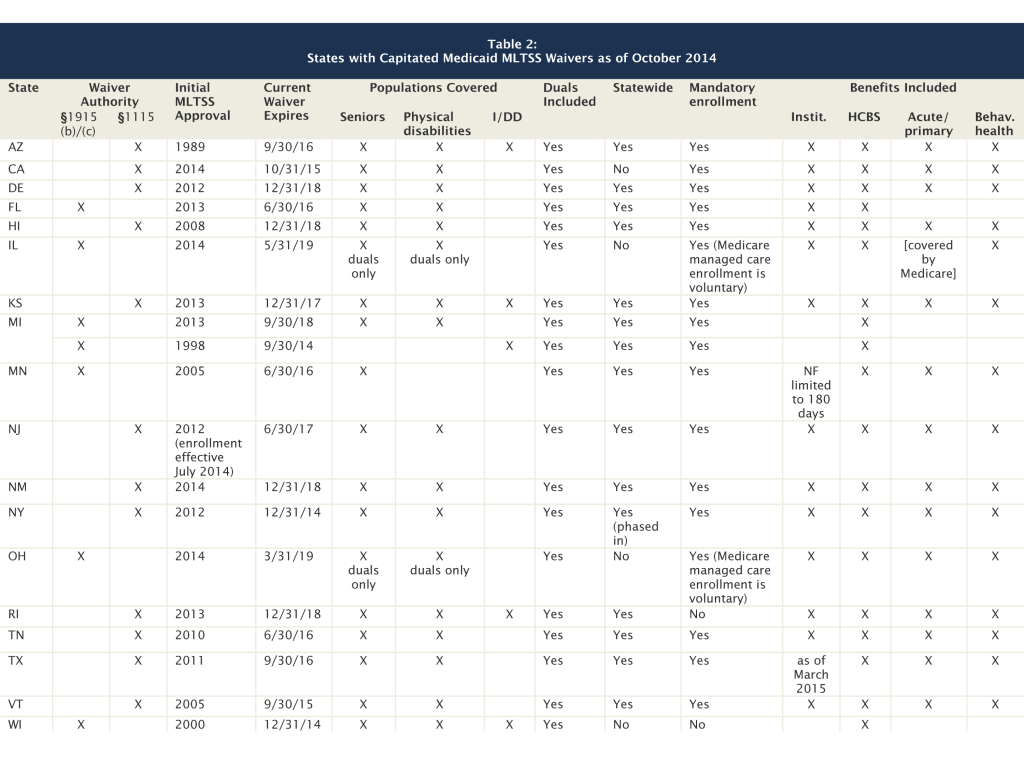
Given increased state interest and CMS’s 2013 guidance focused on § 1115 and § 1915(b) MLTSS waivers, this issue brief analyzes the special terms and conditions for 19 capitated MLTSS waivers approved to date. Basic features in these waivers are summarized in Table 2. Additional details about program features may be contained in the contracts between the state Medicaid agency and health plans or state regulations or policy guidance, which are not part of this analysis.
Key findings about the populations and services covered by current MLTSS waivers include the following:
State interest in MLTSS is increasing, with over half (11 of 19) of these waivers approved in 2012, 2013, or 2014.21 By contrast, one state (AZ) has a long-standing MLTSS waiver, first approved in 1989.
Twelve waivers use § 1115 demonstration authority for MLTSS, while seven waivers use combination § 1915(b)/(c) authority. (One state (KS) uses combination § 1115/1915(c) authority.) As noted above, while § 1915(b)/(c) waivers are focused on MLTSS, § 1115 MLTSS waivers often include additional features, such as other delivery system and financing reforms or eligibility or benefits provisions affecting other populations, as a result of the additional waiver and expenditure authorities available under § 1115.
All 19 MLTSS waivers include seniors and non-elderly adults with physical disabilities, while five (AZ, KS, MI, RI, WI) include people with intellectual/developmental disabilities. All of the MLTSS waivers include dual eligible beneficiaries (for purposes of their Medicaid benefits), with two (IL and OH) limited exclusively to dual eligible beneficiaries. Six states (CA, IL, MI, NY, OH, TX) have concurrent § 1115A authority for financial alignment demonstrations that integrate Medicare and Medicaid benefits for dual eligible beneficiaries.
Most (15 of 19) of the waivers are or will be providing MLTSS statewide. Four waivers (CA, IL, OH, WI) are limited to certain geographic areas in the state, and one state (NY) is in the process of phasing in statewide MLTSS.
Most (17 of 19) of the MLTSS waivers (all except RI and WI) require beneficiaries to enroll in managed care to receive LTSS. This is accomplished primarily through passive enrollment in which beneficiaries are automatically assigned to a health plan if they do not affirmatively select one. For waivers that serve dual eligible beneficiaries and operate concurrently with § 1115A authority, enrollment in Medicare managed care (for primary care and other services for which Medicare is the primary payer) is voluntary.
Most (14 of 19) of the waivers cover or will soon cover a comprehensive set of benefits, including nursing facility (NF) services, HCBS, acute and primary care, and behavioral health services. Minnesota’s waiver includes limited NF services, and Texas’ waiver will incorporate NF services as of March 2015. CMS’s 2013 guidance identifies a comprehensive integrated service package among MLTSS best practices and notes that including both institutional and HCBS in MCO capitation rates supports LTSS rebalancing.22 All of the comprehensive MLTSS waivers use private MCOs, with the exception of Vermont, in which the state operates as an MCO, and Illinois, which uses PIHPs. (IL’s waiver is limited to dual eligible beneficiaries, for whom Medicare is the primary payer for services such as acute and primary care.) One waiver (FL) uses PIHPs to cover only LTSS (NF and HCBS), with other services provided by other Medicaid managed care arrangements. Three waivers (2 in MI, WI) cover only HCBS through PIHPs or PAHPs.
Table 2: States with Capitated Medicaid MLTSS Waivers as of October 2014
Table 2 Notes and Sources
NOTES: Many of the § 1115 waivers include additional provisions not directly related to MLTSS.
California: MLTSS include in-home supportive services, community-based adult services, multipurpose senior services, and NF services but not other § 1915(c) waiver services.
Delaware: MLTSS also includes those with HIV/AIDS, TEFRA children, and working people with disabilities who buy-in to Medicaid; the managed care behavioral health benefit has a limited number of visits with the remainder covered FFS.
Kansas: § 1115 waiver operates concurrently with § 1915(c) waivers.
Hawaii: provides capitated acute and primary care services to people with I/DD, with ICF/IDD services and home and community-based waiver services provided FFS under separate § 1915(c) authority; MCOs provide standard behavioral health services, with specialized behavioral health services provided through a separate managed care carve out.
Illinois: § 1915(b)/(c) waiver does not include acute/primary care services but operates in conjunction with a § 1115A dual eligible financial alignment demonstration (in which Medicare managed care enrollment is voluntary). Also operates mandatory managed care for seniors and people with disabilities, including MLTSS, under § 1932 state plan authority.
Michigan: MLTSS waiver serving people with I/DD also includes people with serious mental illness.
New Jersey: also includes people with TBI and AIDS; LTSS for people with I/DD, those in the medication assisted treatment initiative, and children with SED at risk of institutionalization are FFS; beneficiaries in NFs as of July 1, 2014 will remain in FFS; anyone newly eligible for Medicaid and in a NF after July 1, 2014 will receive MLTSS.
New Mexico: transitioned its MLTSS program from a § 1915(b)/(c) waiver to a § 1115 waiver; also includes working people with disabilities eligible for buy-in, people with HIV/AIDS and those who are medically frail (initially for acute care only, with waiver services to be phased in from Jan. to July 2015); people receiving § 1915(c) I/DD waiver services are included in managed care for acute and behavioral health only.
New York: has a pending § 1115 waiver request seeking extension through December 2019; provides institutional and HCBS through mainstream Medicaid MCOs and MLTSS for beneficiaries who need more than 120 days of community-based LTSS (duals and NF eligible non-duals); pending waiver amendment to transition behavioral health state plan services to MCOs and include § 1915(i)-like services for people with significant behavioral health needs through specialized MCOs for those at risk of institutionalization.
Texas: transitioned its MLTSS program from a § 1915(b)/(c) waiver to a § 1115 waiver.
Vermont: pending waiver extension seeking to combine its MLTSS waiver with its §1115 managed care waiver in which the state serves as MCO and include all § 1915(c) waiver services, including I/DD. Under VT’s § 1115 waiver, which includes a global cap, the state’s primary care case management program operates as if it were a public sector risk-bearing MCO.
Provisions Aimed at Increasing Beneficiary Access to HCBS
As noted above, a number of states expect that incentives built into their MLTSS programs will increase beneficiary access to HCBS. Historically, the Medicaid program has had a structural bias toward institutional care because state Medicaid programs must cover NF services, while, as noted above, most HCBS are provided at state option. While states can choose to offer HCBS as Medicaid state plan benefits, the majority of HCBS are provided through waivers, which, unlike state plan benefits, can have enrollment caps, resulting in waiting lists when the number of people seeking services exceeds available funding.23 Over the last several decades, states have been working to rebalance their LTSS systems by devoting a greater proportion of spending to HCBS instead of institutional care, as a result of beneficiary preferences for HCBS, the fact that HCBS are typically less expensive than comparable institutional care, and states’ community integration obligations under the Americans with Disabilities Act and the Olmstead decision. In addition, CMS’s 2013 guidance provides that MLTSS waivers should provide the “greatest opportunities for active community and workforce participation.”24
Table 3 summarizes MLTSS waiver provisions aimed at increasing beneficiary access to HCBS, including those that expand Medicaid financial eligibility criteria, provide HCBS to people at risk of institutional care, permit beneficiaries to include spouses as paid caregivers under the self-direction option, offer financial incentives for health plans to increase HCBS, and require health plans to implement certain features related to LTSS rebalancing.
Financial Eligibility Expansions
Four states use MLTSS waivers to increase access to HCBS by expanding Medicaid financial eligibility criteria:
New Jersey streamlines financial eligibility for those who meet a NF level of care by using a projected spend-down that qualifies beneficiaries for Medicaid “home and community-based waiver-like services” if their monthly income exceeds annual average nursing facility costs.25 New Jersey’s waiver also eliminates the five year asset transfer look-back period for applicants seeking LTSS with income at or below 100% FPL ($11,670 per year for an individual in 2014).
New York applies a special income standard when determining financial eligibility for people who are discharged from a nursing facility and would be eligible for HCBS via a spend down but for the spousal impoverishment rules. Specifically, New York determines financial eligibility for this population by subtracting 30% of the Medicaid income limit for an individual (considered to be available for housing costs) from the HUD average fair market rent for the geographic region.
Rhode Island allows applicants who meet functional eligibility criteria and self-attest to financial eligibility criteria to receive a limited package of LTSS up to 90 days while a final financial eligibility determination is pending. The limited benefit package includes personal care/homemaker services up to 20 hours per week and/or adult day services up to 3 days per week and/or limited skilled NF services. Rhode Island’s waiver also increases the personal needs allowance by $400 for those in NFs for 90 days who are transitioning to the community and who would be unable to afford a community placement without the increased funds.
Vermont increases the asset limit to $10,000 for single beneficiaries in the “highest” and “high” need groups who own and reside in their own homes and receive HCBS but are at risk of institutionalization. Vermont’s waiver also provides an entitlement to both nursing facility and HCBS to beneficiaries in the “highest” need group, with services available to all who meet the eligibility criteria, without a waiting list.
HCBS for People at Risk of Institutionalization
Seven states use or are seeking MLTSS waiver authority to provide HCBS to people at risk of institutionalization. (States also can provide HCBS to beneficiaries who meet functional criteria that are less strict than those required to meet an institutional level of care under § 1915(i) state plan authority.) NJ’s waiver also provides HCBS to at risk groups, although those beneficiaries are exempt from MLTSS enrollment.
Arizona includes a “transitional program” that provides institutional services limited to 90 days per admission plus acute, behavioral health, HCBS, and case management services to beneficiaries who are not at “immediate risk” of institutionalization when eligibility is redetermined.
Delaware provides HCBS to beneficiaries at risk of institutionalization for those with incomes below 250% of the Supplemental Security Income federal benefit rate (SSI FBR, $21,630 per year for an individual in 2014).
New York is seeking a waiver amendment that would allow it to offer Medicaid state plan, health home, and § 1915(i)-like HCBS (such as behavioral supports in residential, day, and home settings) to adults with behavioral health diagnoses who meet certain risk factors and targeting and functional criteria.
Rhode Island provides HCBS to beneficiaries at risk of institutionalization, including seniors and adults with dementia with income at or below 250% FPL ($29,175 per year for an individual in 2014) and adults with disabilities with income at or below 300% SSI FBR ($25,956 per year for an individual in 2014) who have income and/or assets otherwise above Medicaid eligibility limits.
Hawaii, Tennessee, and Vermont also provide HCBS to beneficiaries at risk of institutionalization. Vermont offers a limited benefit package (including adult day, case management, and homemaker services) to beneficiaries in the “moderate need” group who do not yet meet a NF level of care; a pending waiver amendment would expand the “moderate need” benefit package.
Self-Direction Includes Spouses as Paid Caregivers
Two states (AZ and VT) use MLTSS waiver authority to allow beneficiaries to employ spouses as paid caregivers as part of their option to self-direct HCBS.
Financial Incentives for increased HCBS
Three states’ MLTSS waivers include financial incentives for health plans that provide increased HCBS. This is consistent with CMS’s guidance, which requires states to “employ financial incentives that achieve desired outcomes [according to the state’s MLTSS program goals] and/or impose penalties for non-compliance or poor performance.”26
Hawaii and Ohio’s waivers authorize financial incentives and penalties related to HCBS capacity in MCO contracts. Specifically, Hawaii’s MCO contracts may contain financial incentives for expanded HCBS capacity, beyond annual thresholds established by the state, as well as sanctions penalizing MCOs that fail to expand community capacity at an appropriate pace. Hawaii MCOs that receive financial incentives for expanding HCBS capacity must share a portion with providers but may not pass along sanctions to providers. Ohio provides three months of incentive payments to MCOs equal to the difference between the “community well” and NF capitated rates for beneficiaries who transition from a NF or HCBS waiver that requires a NF level of care to a community placement with overall improved health outcomes such that the beneficiary no longer requires a NF level of care. Ohio MCO payments also are reduced, by the difference between the community well and NF capitated rates, for three months for each beneficiary entering a NF.
Tennessee’s waiver allows MCOs to offer HCBS as a cost-effective alternative even if the enrollment target for HCBS has been met.27
Illinois’ concurrent § 1115A waiver provides similar financial incentives. Specifically, Illinois health plans receive an enhanced rate for three months after a beneficiary transitions from a NF to the community and a reduced rate for three months after a beneficiary transitions from the community to a NF.28
In addition, two states’ MLTSS waivers include provisions for increased HCBS funding.
Kansas’ waiver provides that the state will designate a portion of the savings realized through managed care to increase the number of § 1915(c) HCBS waiver slots to serve beneficiaries on the waiting list, subject to state legislative appropriations.
Vermont’s waiver provides that the state will add resources equivalent to at least 100 additional HCBS waiver slots per year over 10 years to further the demonstration’s goal of serving more beneficiaries by increasing HCBS relative to institutional services.
MCO Requirements for NF Transitions or Diversion
Three states’ waivers include requirements for MCOs regarding NF to community transitions or NF diversion. CMS’s MLTSS guidance provides that states “should ensure that their service packages include services to support participants as they transition between settings.”29
Kansas MCOs must meet and report on annual Money Follows the Person (MFP) NF transition benchmarks.30 In the waiver terms and conditions, CMS encourages Kansas to consider policies to incentivize MCOs to help the state meet or exceed its MFP benchmarks or self-direction goals.
New Jersey MCOs must have a NF diversion plan, approved by the state and CMS, for beneficiaries receiving HCBS and those at risk of NF placement, including short-term stays, and must monitor hospitalizations and short stay NF services for at risk beneficiaries. MCOs also are responsible for identifying beneficiaries in institutions who are appropriate for community transitions and developing, with state assistance, a NF transition plan for each beneficiary who has requested and can safely transition. New Jersey’s waiver also requires MCOs to emphasize services in home and community-based settings whenever possible. MCOs may refuse to offer HCBS if the cost exceeds institutional care, but the state can make individual exceptions, such as cases in which a beneficiary transitions from an institution to the community, when a beneficiary experiences a change in health condition expected to last no more than six months that involves additional significant cost, or special circumstances to accommodate unique beneficiary needs.
New Mexico MCOs must develop and facilitate transition plans for beneficiaries who are candidates for NF to community moves.
Person-Centered Planning and Home and Community-Based Setting Requirements
A number of the MLTSS waivers require person-centered planning31 and/or the provision of services in home and community-based settings. These elements are now required across Medicaid HCBS authorities pursuant to CMS’s January 2014 regulations and apply to MLTSS waivers pursuant to CMS’s 2013 guidance.32 CMS’ guidance directs states to “require MCOs to offer services in the most integrated setting possible.”33 Some examples of MLTSS waiver terms and conditions regarding home and community-based settings that pre-date the 2014 regulations include:
Florida requires health plan contracts to include residential providers’ responsibility to meet “home-like environment” and community inclusion goals.
Hawaii and Kansas’ waivers require that the state either directly or through its MCO contracts ensure that beneficiaries’ engagement and community participation is supported and facilitated to the fullest extent. Hawaii also requires its MCOs to provide options counseling about institutional vs. home and community-based settings and to emphasize HCBS to prevent or delay institutionalization whenever possible when developing care plans. Kansas requires that beneficiaries receive appropriate services in the least restrictive environment and most integrated home and community-based setting and that MCOs record the alternative HCBS and settings considered by the beneficiary as part of the person-centered planning process.
New Jersey and New Mexico require that beneficiaries have the option to receive HCBS in more than one residential setting appropriate to their needs.
Table 3:Provisions Affecting HCBS Access in Capitated Medicaid MLTSS Waivers as of October 2014
State
Financial Eligibility Expansions
Includes HCBS for Those atRisk of Institutional Care
Self-Direction Includes Spouses as Paid Caregivers
FinancialIncentivesfor MCOs toIncrease HCBS
MCO Requirements for NF Transition/Diversion
AZ
X
X
DE
X
HI
X
X
IL
(included in concurrent§ 1115A demonstration)
KS
(state to use portion of managed care savings to increase § 1915(c)HCBS waiver slots)
X
NJ
X
(MLTSS exempt)
X
NM
X
NY
X
amendment pending
OH
X
RI
X
X
TN
X
X
VT
X
X
X
(state to add equivalent ofat least 100 HCBSwaiver slots peryear over 10 years)
Beneficiaries who need HCBS often rely on those services to meet basic daily needs and support independent living in the community. They also may need a higher intensity of services than other Medicaid beneficiaries. These factors make them particularly vulnerable to potential service disruptions. The Medicaid program includes a basic set of beneficiary protections, such as the right to adequate notice and a fair hearing, grounded in the Due Process Clause of the U.S. Constitution.34 As noted above, the Medicaid managed care state plan authority at § 1932 and 42 C.F.R. Part 438 contain additional safeguards specific to managed care arrangements. In addition, CMS’s 2013 guidance provides that MLTSS waivers should include stakeholder engagement in MLTSS implementation and oversight and offer support for beneficiaries, including conflict-free choice counseling, independent advocacy or ombudsman services, and enhanced opportunities for disenrollment.
Table 4 summarizes MLTSS waiver provisions that provide beneficiary protections in the areas of independent enrollment counseling, ombudsman programs, health plan disenrollment, and managed care advisory groups.
Independent Enrollment Counseling
Eight states’ waivers include provisions for independent enrollment options counseling to assist beneficiaries with choosing a health plan. CMS’s MLTSS guidance requires states to provide beneficiaries with enrollment choice counseling that is independent of health plans, service providers, and entities making eligibility determinations.35
Four states (CA, HI, NY, TX) use their ombudsman program to provide beneficiaries with independent health plan options counseling.
Four states (FL, IL, KS, OH) use an enrollment broker to provide independent options counseling. Florida’s MLTSS waiver provides that enrollees will receive choice counseling either by phone or in-person. Kansas’ waiver requires independent options counseling for beneficiaries transitioning to MLTSS from § 1915(c) waivers. In addition, Illinois received funding available through its dual eligible financial alignment demonstration for SHIPs and/or ADRCs to provide options counseling.36
Ombudsman Programs
Eleven states’ waivers provide for an ombudsman program as part of their demonstrations. In general, these programs must function independently of health plans and the state Medicaid agency, be available to all beneficiaries or all those receiving MLTSS, be accessible by a variety of means (such as phone, email, in-person) and conduct outreach through a variety of methods (such as mail, phone, in-person). Ombudsman programs typically are charged with helping beneficiaries access covered services and tracking and assisting beneficiaries with complaints. CMS’s guidance requires states to “ensure an independent advocate or ombudsman program is available to assist participants in navigating the MLTSS landscape; understanding their rights, responsibilities, choices, and opportunities; and helping to resolve any problems that arise between the participant and their MCO.”37
In nine states, the ombudsman program is specifically authorized to assist beneficiaries with the appeals process (CA, HI, IL, KS, MN, NM, NY, OH, TX). Hawaii’s waiver provides that the ombudsman can represent beneficiaries in appeals up to the administrative fair hearing level and assist, but not represent, beneficiaries at fair hearings. Kansas’s waiver provides that the ombudsman can assist beneficiaries with filing appeals and can mediate appeals but cannot represent beneficiaries. Minnesota’s waiver also provides that the ombudsman can resolve appeals through negotiation or mediation.
Five states’ waivers (IL, KS, NM, NY, TX) contain additional detail about ombudsman functions and responsibilities, including that the ombudsman train health plans and providers; employ staff knowledgeable about Medicaid managed care and people with disabilities; provide services in a culturally competent manner and in a way that is accessible to people with disabilities and those with limited English proficiency; and regularly and publicly report on beneficiary complaints and appeals.
Three states’ waivers (FL, IL, OH) identify the state long-term care ombudsman as the entity that will provide ombudsman services for beneficiaries receiving MLTSS.
In Hawaii, the ombudsman may be a member of the care team at a beneficiary’s request.
Three states’ waivers (NJ, RI, VT) do not provide for an ombudsman program but instead require that beneficiaries have access to an independent advocate within the state, such as the state protection and advocacy agency for people with disabilities, a legal services agency, or the Area Agency on Aging.
Beneficiary Ability to Change MCOs if Provider Leaves Network
Six states’ MLTSS waivers include provisions that expand beneficiaries’ right to change MCOs for cause outside of open enrollment. CMS’s guidance requires states to allow beneficiaries to disenroll from their MCO “when the termination of a provider from their MLTSS network would result in a disruption in their residence or employment.”38
Florida allows beneficiaries to request to change health plans if their provider leaves the network. The waiver specifies that such requests “would be considered for good cause.”
Illinois allows beneficiaries to change health plans for cause if their LTSS provider leaves the network.
Hawaii, Kansas, and New Mexico allow beneficiaries to change MCOs if their residential or employment supports provider leaves the network (limited to residential providers in Kansas).
Kansas also permits enrollees with an existing LTSS service plan who are transitioning from FFS or another MCO to change MCOs within 30 days of the initial service assessment due to the beneficiary’s experience with the MCO’s service planning process. This option is limited to one change annually.
Hawaii also allows beneficiaries on an HCBS waiting list to change MCOs if HCBS appear to be available through another MCO. Similarly, Tennessee allows beneficiaries to disenroll from their MCO if LTSS are needed and available through another MCO, and the current MCO cannot provide the services even on an out-of-network basis.
Managed Care Advisory Groups
Seven waivers (CA, IL, KS, NJ, NM, NY, TX) require the state to maintain a managed care advisory group, including beneficiaries and other stakeholders, to provide input on the MLTSS program, and six (KS, NJ, NM, OH, TX, WI) require MCOs to establish beneficiary advisory groups. CMS’s guidance requires that a state MLTSS advisory group must include “cross-disability representatives” and that beneficiaries “be offered supports to facilitate their participation, such as transportation assistance, interpreters, personal care assistants and other reasonable accommodations, including compensation, as appropriate.”39 CMS also “expects states to require MCOs to convene accessible local and regional member advisory committees to provide feedback on MLTSS operations, and to encourage participation, MCOs also must provide beneficiary supports and compensation as appropriate.40
Three waivers (KS, NM, TX) require MCOs to facilitate and support beneficiary involvement in the advisory group. Ohio’s waiver specifies that MCOs must have a process for the beneficiary advisory committee to provide input to the MCO’s governing board and that people with disabilities, including plan enrollees, must be included within the plan’s governance structure.
Continuity of Care During Delivery System Transition
Waivers that are implementing new MLTSS programs often include provisions designed to promote continuity of care during beneficiary transitions from FFS to managed care. These provisions ensure beneficiary access to previously authorized services and/or providers for a certain period of time after transition, often until the new health plan completes an assessment and either the beneficiary agrees to a new care plan or the care plan is resolved through the appeals process. CMS’s guidance “expects states to include contract language around continuity and coordination of care for the transition. . . [which] may include. . . maintaining existing provider-recipient relationships as well as honoring the amount and duration of an individual’s authorized services under an existing service plan.”41
Continuation of LTSS While Appeals Are Pending
“Because of the significant reliance participants have on receipt of LTSS and the potential harm resulting from abrupt termination of LTSS, CMS expects states to adopt policies that ensure authorized LTSS continue to be provided in the same amount, duration, and scope while a modification, reduction, or termination is on appeal.”42Hawaii and Kansas’ waivers specifically require the state to ensure that LTSS continue while appeals are pending.
Disability Accessibility
California’s waiver is the only state to mention physical accessibility for people with disabilities. The waiver provides that the state will use a facility site review tool to ensure health plan accessibility or contingency plans.
Table 4:Beneficiary Protections in Capitated Medicaid MLTSS Waivers as of October 2014
State
Independent Enrollment Choice Counseling Provided
OmbudsmanProgram
Beneficiary Able to Change MCOs if Certain HCBS Providers Leave Network
State Managed Care Advisory Group
MCO Beneficiary Advisory Group
By Ombudsman
By Enrollment Broker
CA
X
X
X
FL
X
X
X
HI
X
X
X (also can disenroll if on HCBS waiting list and services available in another MCO)
IL
X
X
X
X
KS
X
X
X (also can disenroll due to dissatisfaction with MCO service planning experience)
X
X
MN
X
NJ
(beneficiaries must have access to independent advocate)
X
X
NM
X
X
X
X
NY
X
X
X
OH
X
X
X
RI
(beneficiaries must have access to independent advocate)
TN
(can disenroll if needed LTSS available through another MCO)
TX
X
X
X
X
VT
(beneficiaries must have access to independent advocate)
LTSS performance measures are not as well developed as those for care provided in clinical settings, and work is continuing in this area. CMS’s MLTSS guidance requires states to “have a quality strategy in place at the time of implementation of their new, expanded, or modified MLTSS program.”43 States must have a “comprehensive quality strategy. . . [that is] transparent and appropriately tailored to address the needs of the MLTSS population.”44 In 2014, CMS modified its § 1915(c) HCBS waiver quality measures, which include level of care determinations; service plan adequacy; provider qualifications; abuse, neglect and exploitation; financial accountability; and state oversight.45 CMS also has awarded Testing Experience and Functional Assessment Tools planning grants to states to use health information technology to develop HCBS quality measures.46
In addition, some state-specific LTSS quality measures are being used in the financial alignment demonstrations for dual eligible beneficiaries. For example, Massachusetts includes a measure of the percent of beneficiaries with LTSS needs who have an LTSS coordinator, and Virginia and South Carolina include multiple LTSS measures, such as those related to beneficiary use of self-direction, increases and decreases in authorizations of specific HCBS to movement between institutional and community-based care settings, and level of care assessments. Other financial alignment demonstration states indicate that they will monitor (unspecified) measures of community integration and beneficiary quality of life.47
Other recent initiatives focused on the development of measures such as quality of life and community integration include:
The National Quality Forum (NQF) is undertaking a two year project to identify gaps and recommend priorities for HCBS measure development and use.48
In 2014, the NQF’s Measure Application Partnership issued stakeholder recommendations for quality measures related to dual eligible beneficiaries, including strategies to measure quality of life.49
The National Council on Disability’s 2013 report on Medicaid managed care for people disabilities includes recommendations to state and federal policymakers on quality measures.50
The National Association of States United for Aging and Disabilities’ National Core Indicators initiative is piloting an annual in-person survey in Georgia, Minnesota, and Oregon to assess quality of life and outcomes for seniors and adults with physical disabilities.51
A group of beneficiary advocacy organizations issued recommendations for measuring LTSS rebalancing in the dual eligible financial alignment demonstrations and MLTSS waivers.52
In 2012, the Agency for Healthcare Research and Quality issued its Medicaid HCBS Measure Scan, which identifies existing measures related to HCBS program performance, client functioning and client satisfaction.53
The President’s Committee for People with Intellectual Disabilities’ 2012 report to the President on MLTSS includes recommendations on the development of quality measures.54
The National Core Indicators project, a collaboration between the National Association of State Directors of Developmental Disabilities Services and the Human Services Research Institute, gathers performance and outcome measures for the I/DD population, with a focus on employment, rights, service planning, community inclusion, choice, and health and safety.55
Quality of Life Measures
Eight MLTSS waivers mention quality of life measures, although generally little detail is provided in the waiver terms and conditions. CMS requires states and/or MCOs to “measure key experience and quality of life indicators for MLTSS participants” with survey results publicly available.56
Wisconsin’s care managers and quality assessors use a validated interview tool to assess beneficiary and care team perceptions of quality of life and whether outcomes are being achieved in the areas of self-determination and choice, community integration, and health and safety. Wisconsin’s quality strategy also includes population-based health indicators, such as changes in functional status over time.
Six other MLTSS waivers mention quality of life measures with no further detail provided or with specific measures still to be identified. These include:
California, which must develop mandatory MCO reports (with specifics included in MCO contracts) and “measure key experience and quality of life indicators.”
Kansas, which must submit performance measures to CMS within one year of MLTSS implementation, which should focus on the outcomes of person-centered goals, quality of life, effective processes (such as level of care determinations and person-centered planning), and community integration, and show consistency in reporting across HCBS waivers.
New Jersey, whose HCBS quality strategy must include outcomes related to quality of life.
New Mexico, which must submit its quality strategy to CMS within 90 days of demonstration approval; any revised performance measures should reflect stakeholder input and focus on outcomes, quality of life, effective processes and community integration for those receiving HCBS.
New York, which should incorporate performance measures for outcomes related to quality of life and community integration.
Tennessee, which must submit its quality improvement strategy to CMS and identify measures of process, health outcomes, functional status, quality of life, member choice, autonomy, satisfaction and system performance.
In addition, Illinois’ concurrent § 1115A waiver requires measurement of beneficiaries’ perception of quality of life.
Rebalancing and Community Integration Measures
Five MLTSS waivers require reporting on LTSS rebalancing and community integration measures.
California MCOs must track the number of referrals to HCBS waivers and assessments completed by HCBS providers; the number of referrals and completed assessments for in-home services and supports; the number of referrals to HCBS programs for newly admitted NF residents without a discharge plan in place; the number and proportion of beneficiaries who transition from institutional to community settings who are not re-institutionalized within one year; the number and proportion of beneficiaries receiving HCBS; and the number and proportion of beneficiaries receiving institutional services.
Kansas must report to CMS on the number of people in NF and ICF/DDs and on waiver waiting lists; the number of people who move off waiting lists and the reason; the number of people new to the waiting lists; and the number of people on a waiting list but receiving HCBS through managed care. Kansas’s demonstration evaluation must assess whether the demonstration reduces the percentage of beneficiaries in institutions by providing additional HCBS and improves service quality by integrating and coordinating physical, behavioral health, and LTSS, the impact of including LTSS in the capitated benefit with a subfocus on HCBS; and ombudsman’s assistance to beneficiaries.
New York must report on MCO rebalancing efforts, including the total number of transitions in and out of NFs each quarter.
Ohio MCOs must report on LTSS measures, with a subset used to determine the quality withhold. Further details about these measures are contained in Ohio’s concurrent § 1115A waiver. The measures include:
Quality withhold measures related to LTSS:
Number of beneficiaries who did not reside in a NF (>100 continuous days) as a proportion of the total number of beneficiaries in the MCO
Number of beneficiaries who lived outside a NF during the current year as a proportion of the number of beneficiaries who lived outside a NF during the previous year (>100 continuous days)
Quality measures related to LTSS:
Percent of all long-stay NF residents whose need for help with late-loss ADLs increased when compared with previous assessment (bed mobility, transferring, eating, toileting)
Number of beneficiaries who were discharged from NF to community setting and did not return to NF during the current year as a proportion of the number of beneficiaries who resided in a NF during the previous year
Number of beneficiaries who were in a NF during the current year, previous year, or combination of both years who were discharged to a community setting for at least 9 months during the current year as a proportion of the number of enrollees who resided in a NF during the current year, previous year or combination of both years (>100 days)
Tennessee must report to CMS on the number of people receiving NF or HCBS at a point in time and over 12 months; HCBS and NF expenditures for 12 months, the average during 12 months and as a percent of total LTSS spending; the average length of stay in NF and HCBS in a 12 month period; the percent of new LTSS beneficiaries admitted to a NF in a 12 month period; and the number of transitions from NF to HCBS in a 12 month period.
In addition, Illinois’ concurrent § 1115A waiver includes the following LTSS performance measures:
Quality withhold measure in demonstration years 2 and 3: number of beneficiaries moving from institutional to waiver services (excluding institutional stays of 90 days or less)
Quality measure: number of beneficiaries moving from institutional to waiver services, community to waiver services, community to institutional care, and waiver to institutional care (excluding institutional stays of less than 90 days)
Beneficiary Satisfaction Surveys
Five MLTSS waivers provide for beneficiary satisfaction surveys. Four states (FL, IL, MN, OH) use the Consumer Assessment of Healthcare Providers and Systems (CAHPS) survey. In addition, Wisconsin health plans must participate in a program-wide beneficiary satisfaction survey. Vermont’s waiver provides that beneficiaries on a waiting list will be included in any surveys or evaluations.
Encounter Data
Four MLTSS waivers (CA, DE, HI, NY) require reporting of health plan encounter data. CMS’s MLTSS guidance requires states to collect and report person-level encounter data as part of quality oversight and monitoring.57
State Monitoring of Service Plan Decreases By MCOs
Three MLTSS waivers require state monitoring of service decreases proposed by health plans. CMS’s guidance requires states to provide “enhanced monitoring of any service reductions. . . during the transition to managed care.”58
The Kansas state department of aging and disability services must review and approve all care plans for beneficiaries with I/DD in FY 2014 and 2015, in which a reduction, suspension, or termination of services is proposed. The process and criteria for these reviews and approvals or denials must be publicly available. In addition, in 2014, Kansas must ensure that beneficiaries who are receiving some but not all requested I/DD waiver services will have all of their assessed service needs met within six months of MLTSS implementation and will review capitation rates with MCOs once all I/DD service needs are identified. Kansas also must observe and assist in needs assessments and service planning by participating in ride-alongs with each MCO during the first six months of MLTSS for beneficiaries with I/DD.
New Mexico must review and approve a sample of all proposed service plan reductions, prior to implementation, in the first six months of MLTSS. Thereafter, the state or managed care external quality review organization must review a sample of service plan reductions at least annually.
New York MCOs must report monthly on notices issued and appeals received regarding reductions in split shift or live-in services or reductions of hours by 25% or more.
State Monitoring of Grievances and Appeals
Three waivers include provisions regarding state monitoring and reporting on grievances and appeals, in addition to ombudsman program reporting on grievances and appeals (discussed above). CMS’s guidance expects states to “intervene if [MCO] service authorization processes regularly result in participant appeals of service authorization reductions or expirations.”59
New Mexico must review each MCO’s appeal logs monthly during the first six months of MLTSS implementation.
Texas also must monitor grievances and appeals. Both New Mexico and Texas’ reviews are to focus on beneficiaries transitioning to MLTSS from a § 1915(c) HCBS waiver.
New York must report to CMS on the total number of complaints, grievances, and appeals by type of issue.
Performance Improvement Projects and Care Quality Studies
CMS’s guidance provides that states “should establish systemic performance improvement projects specific to the common elements of MLTSS for all MCOs providing MLTSS (i.e. related to deinstitutionalization).”60
Ohio MCOs must complete one clinical and one non-clinical performance improvement project, with potential topics to include LTSS, NF care and/or rebalancing, and NF diversion.
Florida plans must perform at least two quality of care studies.
Illinois will hire an independent evaluation for its MLTSS waiver and other care coordination initiatives.
Issue Brief: Looking Ahead
State interest in capitated MLTSS waivers is growing, with 11 out of 19 of these waivers approved in the last three years. While various Medicaid state plan authorities enable states to expand beneficiary access to HCBS, states also are using § 1115 or § 1915(b)/(c) waiver provisions aimed at increasing community integration. MLTSS waivers also include some beneficiary protections in addition to those required by the underlying Medicaid managed care authority. CMS’s 2013 MLTSS guidance offers best practices to states in these areas, although some elements are recommended but not required, and states retain flexibility to design specific program features. An area important to beneficiaries who need LTSS is disability accessibility and compliance with the Americans with Disabilities Act, which is not addressed by the guidance or in detail in the waiver terms and conditions. Work also is needed to further develop MLTSS quality measures, such as those related to quality of life and community integration, so that policymakers and other stakeholders have the information necessary to oversee and evaluate these programs to ensure that beneficiaries are well-served.
See, e.g., CMS MLTSS Guidance at 1 (noting that the “application of a capitated managed care model to long-term services and supports is new for many states, health plans, and providers”). ↩︎
For examples of specific HCBS, see CMS/Mathematica Policy Research, The HCBS Taxonomy: A New Language for Classifying Home and Community-Based Services 4 Medicare & Medicaid Research Review E1-E17 (2014), available at http://dx.doi.org/10.5600/mmrr.004.03.b01. ↩︎
Person-centered planning focuses on the strengths, needs, and preferences of the individual beneficiary instead of being driven by the care delivery system. See, e.g., Virginia Commonwealth University Partnership for People with Disabilities, A Closer Look at the Centers’ for Medicare and Medicaid Services’ Definition of Person-Centered Planning, available at http://www.medicaid.gov/mltss/docs/PCP-CMSdefinition04-04.pdf. ↩︎
National Council on Disability, Medicaid Managed Care for People with Disabilities: Policy and Implementation Considerations for State and Federal Policymakers (March 2013), available at http://www.ncd.gov/publications/2013/20130315/. ↩︎
The Affordable Care Act (ACA) Medicaid expansion offers a significant opportunity to increase coverage and improve access to care for individuals experiencing homelessness, who historically have had high uninsured rates and often have multiple, complex physical and mental health needs. This analysis provides an early look at the impact of the expansion for homeless providers and the patients they serve, building on an earlier brief examining the potential role of Medicaid expansion for this population. It is based on focus groups conducted with administrators, providers, and enrollment workers at four sites serving homeless individuals in states that have expanded Medicaid (Albuquerque, NM; Baltimore, MD; Chicago, IL; and Portland, OR) and one site in a state that has not expanded (Jacksonville, FL), as well as administrative data collected from the sites. It finds:
The Medicaid expansion has led to significant increases in coverage that are contributing to improved access to care and broader benefits for homeless individuals. Participants and data from the study sites indicate that the Medicaid expansion has led to significant gains in coverage among the individuals they serve (Figure 1). Providers reported that these coverage gains have enabled patients to access many services that they could not obtain while uninsured, including some life-saving or life-changing surgeries or treatments. Participants also identified other broader benefits for homeless individuals stemming from Medicaid coverage gains. For example, providers noted improvements in individuals’ ability to work and maintain stable housing due to better management of health conditions. In addition, participants said individuals have reduced financial stress and improved access to other services and programs, including disability benefits.
Figure 1: Percent of Visits with Insured Clients by Study Site, January 2013-July 2014
“A couple of my patients have had surgeries that have allowed them to return to work and now that they have a regular paycheck, they are able to get housed,” Provider, Baltimore
Providers reported having access to a broader array of treatment options as a result of Medicaid coverage gains among their patients. With these increased options, providers said they are better able to provide care based on the best courses of treatment rather than based on the availability of charity or discounted resources.
“It’s easier now if I say, take your insurance and go to the pharmacy…instead of me or the nurse having to fill out a bunch of paperwork and apply to the drug company or see what we have in samples and if we’re going to have enough for next time.” Provider, Portland
Gains in Medicaid revenue are facilitating strategic and operational improvements focused on quality, care coordination, and information technology. In addition, administrators indicated that Medicaid revenue gains supported staff increases and led to changing staff roles to meet increased administrative and billing needs. However, participants emphasized that, even with Medicaid revenue gains, other funding sources remain vital for supporting the full range of services needed by the homeless population.
Participants from the non-expansion site indicated that their patients remain uninsured and are continuing to face significant gaps in care that contribute to poor health outcomes. Participants also said they are facing an increasingly challenging financial situation because they are missing out on Medicaid expansion revenue gains and other funding sources are declining.
“A lot of it is just outright begging for care for these patients. You just miss that opportunity to pick it up in a more treatable stage.” Provider, Jacksonville (non-expansion site)
As homeless patients gain Medicaid coverage and are enrolled in managed care, some challenges are emerging. Participants commented that some patients are being auto-assigned to providers with whom they do not have an existing relationship and/or they may have difficulty accessing due to lack of transportation. Additionally, working within provider networks can be difficult given the complex needs of individuals, lack of transportation, and the limited experience among other providers in serving this population. Lastly, participants emphasized that prior authorization requirements and limited and/or changing drug formularies are leading to delays in care for individuals and creating substantial administrative burdens for providers.
Looking ahead, participants identified a number of priorities for meeting the health care needs of the homeless population. It was noted that maintaining coverage and educating individuals on how to use coverage will be key for shifting care patterns and reducing emergency room use. Further, maintaining other sources of funding will be key for supporting the full range of services they need. As homeless individuals are increasingly enrolled into managed care, it will be important to address their specific needs to minimize barriers to care and administrative burdens. Amid the shifting financial and delivery environment, maintaining supportive and case management services, addressing social determinants of health, and building upon interdisciplinary team-based models of care developed by homeless providers all will be key for engaging individuals in care. Finally, as broader payment and delivery reforms are implemented, it will be important for them to reflect the poorer health status and more complex health needs of the homeless population.
Introduction
One of the key goals of the ACA is to expand coverage and reduce the number of uninsured. A primary way the ACA seeks to reduce the number of uninsured is by expanding Medicaid to low-income adults (with incomes at or below 138% of the federal poverty level or $16,105 for an individual or $27,310 for a family of three as of 2014) who were historically ineligible for the program. As enacted, this expansion would occur in all states as of January 1, 2014. However, the Supreme Court ruling on the ACA effectively made the expansion a state option. As of November 2014, 28 states, including DC, are implementing the expansion.
The Medicaid expansion offers a particularly significant opportunity to increase coverage and improve access to care for individuals experiencing homelessness, who historically have had very high uninsured rates and often have multiple, complex physical and mental health needs. A prior brief examined how homeless health care providers were preparing for the Medicaid expansion and their anticipated impacts of the expansion.1 This brief builds on that previous work to identify early impacts of the expansion for homeless providers and the patients they serve as well as key priorities for meeting the health care needs of the homeless population looking ahead. While the findings are focused on the homeless community, they offer insights that may help inform understanding of how coverage gains are impacting the broader low-income population.
Overview of the Homeless Population
Each year, millions of people experience homelessness in the U.S. Though the total number is unknown, the U.S. Department of Housing and Urban Development (HUD) found that 1.48 million people stayed in emergency shelters or transitional housing in 2012.2 However, this estimate excluded individuals who avoided the shelter system, used privately funded shelters not part of HUD’s Continuum of Care network, or who stayed with friends and families to avoid the streets. On a single night in January 2013, HUD estimated 610,042 people were homeless in the U.S., of which 64% were individuals and 36% were part of families.3 This estimate also undercounts the number of people who are homeless, but represents the best attempt to collect national data across all states.
People who are homeless have high rates of both chronic disease and acute illnesses, with many of these conditions associated with and/or exacerbated by their living situations. There is a wide body of literature on the health status and conditions of homeless persons, which shows that they have a broad range of mental health and substance use needs that often are co-occurring with physical conditions.4,5 Higher exposure to violence, malnutrition, and extreme weather are additional risk factors for poor health and premature death.6,7 Often because of poor health and lack of housing, this population also frequents emergency rooms and hospitals more often than the general public, and has high rates of readmissions.8
Prior to Medicaid expansion, homeless individuals were uninsured at high rates even when compared to other low-income groups. Of the 851,641 patients served by Health Care for the Homeless grantees in 2013,9 57% were uninsured, compared to 35% uninsured patients served at all health centers and over four times the rate of the general population (Figure 2).10,11 Despite having access to outpatient primary care and behavioral health services at health centers and other safety net venues, lack of health insurance has prevented this population from accessing the broader range of services needed to address their health conditions, such as specialty care, residential treatment, and surgeries. Being uninsured has also prevented a more systemic analysis of their utilization and cost of care given the lack of coordinated data available through insurers. Finally, connecting this particularly vulnerable group to health insurance is important for the providers who serve them, as they have traditionally relied on unpredictable grant funding and limited pro bono services in the community.
Figure 2: Health Insurance Coverage for Health Care for the Homeless Patients Compared to Other Groups, 2013
Methodology
To gain insight into the early impacts of the Medicaid expansion for the homeless community, the National Health Care for the Homeless Council and the Kaiser Commission on Medicaid and the Uninsured conducted focus group discussions with staff and community partners at federally qualified health centers that serve individuals experiencing homelessness at four sites in states that have expanded Medicaid (Albuquerque, NM; Baltimore, MD; Chicago, IL; and Portland, OR). Focus groups were also conducted at a site in Jacksonville, FL to gain insight into experiences in a state that has not expanded. In addition, health coverage and administrative data were collected from each of the sites to supplement the focus group findings. See Appendix Table 1 for and overview of the data.
Overall, a total of 118 professionals participated in 14 focus groups held between July and September 2014. Three focus groups were held in each of the four expansion sites—one composed of frontline outreach and enrollment workers, another composed of administrators and finance staff, and the third consisting of clinicians, case managers and other service providers. In Jacksonville, Florida, two focus groups were held—one with administrators, finance staff and clinicians, and another with frontline outreach and enrollment staff.
Key Findings
Enrollment
Changes in Coverage
Participants in the Medicaid expansion sites reported significant gains in health insurance among patients, while there were no reported coverage changes in the non-expansion site. Participants noted that the Medicaid expansion provided a new coverage pathway for many of their previously uninsured patients. In three of the sites, they indicated that state initiatives to facilitate enrollment supported rapid coverage gains under the expansion. Specifically, in Chicago, the state adopted an option to get an early start on the expansion in Cook County. In Baltimore, individuals enrolled in a pre-existing limited benefit program for adults (Primary Adult Coverage program) were automatically transitioned to the Medicaid expansion when it took effect on January 1st. Finally, in Portland, the state took up an option to utilize data from its Supplemental Nutritional Assistance Program (SNAP) to expedite enrollment into the Medicaid expansion. In contrast to coverage gains at sites in states that expanded Medicaid, participants in Jacksonville said that they have seen no significant changes in coverage. The majority of their patients remain uninsured and ineligible for Medicaid in the absence of the expansion.
Coverage data from the sites are consistent with participants’ reported coverage changes. As shown in Figure 3, in Baltimore and Portland, the share of site visits with clients who have health insurance rose sharply as of January 2014, reflecting rapid coverage gains from the transition of the existing adult coverage program to the expansion in Maryland and the SNAP facilitated enrollment initiative in Oregon. Albuquerque also shows gains in the share of patients with insurance beginning in January 2014, although the increase is not as sharp. In Chicago, the rise in the share of visits with patients who have insurance begins earlier, at the end of 2012, reflecting the early expansion in Cook County, and then there are periods of decline that reflect some losses in coverage at renewal periods. In contrast, in Jacksonville, where Medicaid was not expanded, there is no notable increase in the share of visits with insured patients over the period.
Figure 3: Percent of Visits with Insured Clients by Study Site, January 2013-July 2014
Looking ahead, outreach workers are focused on maintaining coverage. Although policies are intended to facilitate auto-renewal for eligible individuals, outreach workers expressed significant concerns that individuals may lose coverage at renewal, particularly if systems are unable to automatically verify income for individuals. In two of the sites, all individuals will have to re-enroll at redetermination because the state is transitioning to a new enrollment system. Overall, outreach workers were confused about renewal processes and wanted more information to be able to support continuous coverage for individuals.
Outreach and Enrollment Experiences
Outreach through a broad range of settings was successful in reaching and enrolling individuals experiencing homelessness, who were generally eager to enroll and access services. Frontline outreach and enrollment workers noted that, in addition to conducting in-reach to enroll patients at their clinic sites, they conducted outreach in a wide range of community locations, including emergency shelters, encampments, under bridges, at parole and probation offices, day programs/drop-in centers, hospital emergency rooms, churches, and food pantries or soup kitchens. Participants agreed that having regular outreach schedules and developing trusting relationships with clients was a crucial step in engaging clients, particularly since they had broader goals beyond enrollment of engaging individuals in services. Participants found that individuals were usually interested in enrolling in coverage, although they sometimes had doubts about whether they would qualify or concerns about sharing their information with the government. In particular, individuals were most excited about potentially gaining access to prescription drugs, mental health and substance use services, and dental and vision care. Participants also said that individuals wanted the peace of mind of financial protection from large medical bills. To facilitate enrollment, assisters spent a considerable amount of time explaining to individuals why health insurance was important, the benefits of enrolling in coverage, and how the ACA had broadened eligibility for Medicaid compared to when individuals may have previously tried to enroll.
“….We go anywhere that we feel like they need help in our community.” Outreach Worker, Baltimore
“A lot of people haven’t been covered for years; they are just happy that they could get some medical treatment.” Outreach Worker, Portland
“…they’d say ‘oh, so I won’t get all these bills?’ No, you won’t. And so that was a big motivator….” Outreach Worker, Albuquerque
Outreach workers in the Medicaid expansion sites found that nearly all homeless individuals they assisted were eligible for Medicaid, while those in the non-expansion site found that most of the homeless population remained ineligible for coverage. In the expansion sites, outreach workers reported that nearly all individuals they assisted within the homeless population were eligible for Medicaid, although they did work with some individuals who were not eligible due to immigration status. They also encountered a few cases in which a homeless individual had a job and was just above the income limit for Medicaid. In these cases, coverage through the Marketplace was unaffordable, even with the premium subsidies. In Jacksonville, where the state did not expand Medicaid, outreach workers reported that most individuals were not eligible for Medicaid and did not have enough income to qualify for premium tax credits for Marketplace coverage. Enrollment workers in Jacksonville said that many individuals were confused about why they were not eligible for coverage because marketing campaigns were encouraging everyone to enroll, and some were fearful of being fined for not having insurance. They noted that clients were disappointed, angry, and frustrated when learning they were not eligible for coverage. Assisters tried to help connect individuals to available care by creating resource sheets that listed free or low-cost service sites, but, overall, felt it was difficult to conduct outreach and enrollment efforts when many people do not qualify for coverage.
Individuals within the homeless population needed substantial assistance with the application and enrollment process. Outreach and enrollment workers stressed that one-on-one assistance with the application process was key for enrolling individuals, particularly given their limited experience with health insurance and other enrollment barriers, including limited literacy, lack of access to the internet, language barriers, and confusion about coverage options. They further noted that enrollment was hampered by problems with online enrollment systems, particularly at the outset of open enrollment. Although systems problems impacted the broader population, there were some challenges that particularly impacted the homeless population including difficulty verifying identity for individuals without a credit history and verifying income for people with no income as well as systems failing to recognize when an individual is no longer incarcerated. Outreach and enrollment workers were hopeful that these system-related issues were short-term and that there would be a smoother enrollment process going forward. Participants said they often tracked the status of applications until a final eligibility determination was received since individuals may have difficulty obtaining communications from the state without a fixed address and/or trouble understanding notices. Moreover, in the expansion study sites, after an individual is determined eligible for Medicaid, he or she must then enroll in a managed care plan. Outreach and enrollment workers noted that individuals needed assistance selecting and enrolling in a plan. However, they said it was challenging to determine the differences between plans and explain them to individuals.
“If you didn’t have significant credit history or things like that, it couldn’t verify people’s identity, which just added an extra barrier to getting folks enrolled.” Outreach worker, Baltimore
“We keep a spreadsheet of everybody that we enroll and we keep going back to look if they’ve been approved.” Outreach worker, Albuquerque.
“The paperwork was confusing that they would get in the mail.” Outreach worker, Albuquerque
Homeless individuals need significant education and assistance to learn how to utilize their health coverage. Participants stressed that many of the homeless individuals who have gained Medicaid coverage have limited or no prior experience with health insurance and have typically delayed and/or gone without needed care and relied on the emergency room as a primary source of care. As such, they indicated that individuals need education and assistance to establish a relationship with a primary care provider and understand how to receive care and services within their provider network.
“There needs to be an educational piece, because a lot of people haven’t had primary care maybe ever and don’t even really know what it means to have a routine visit with a provider to get those preventative services.” Provider, Baltimore
Impacts of Coverage Gains for the Homeless Population
Participants reported that gains in Medicaid coverage have led to improved access to care for the patients they serve. Providers noted that gains in Medicaid coverage have enabled their patients to access many services that they could not previously obtain while uninsured, particularly specialty services, behavioral health services, medications, and medical supplies and equipment. They said they are able to get individuals referred for specialty services and screenings such as mammograms and colorectal screenings more quickly and able to make referrals to orthopedists, oncologists, physical therapists, podiatrists, and other specialists that they often were unable to refer to when their patients were uninsured. Some described instances of individuals receiving life-saving or life-changing surgeries or treatments that they could not obtain while uninsured. In particular, providers indicated that coverage has opened up access to mental health services and medications, which are important for this this population. It also was pointed out that coverage of non-emergency transportation helps individuals access needed services, especially from referral providers who may be located in another part of town. Some participants did note challenges finding certain specialists, although they indicated this was reflective of larger provider capacity limits, particularly for mental health and primary care providers. Participants also said that they are beginning to face backlogs in referrals for some services given the large surge in demand for care as people gain coverage. Further, some participants commented that even though Medicaid copayments are often very limited, they can serve as a barrier to care for this population, particularly if an individual is facing copays for multiple prescription medications.
“We had a gentleman who literally was waiting until January 1st and he had an appointment on the second to get oncology testing that he wasn’t able to access in the past.” Provider, Baltimore
“A lot more people are going to get the services that they’ve been needing.” Provider, Portland
“Now, we can just send them over to [the hospital] which is two, three blocks away. They can get in that day.” Provider, Chicago
“Any medicated-assisted therapy for substance use, it’s covered now and without that, my clients would have never been able to be successful in recovery.” Outreach worker, Albuquerque
Participants also identified broader benefits for individuals stemming from gains in Medicaid coverage. For example, providers said individuals have obtained surgeries and treatments that will resolve medical conditions and improve their ability to work and maintain stable housing. Additionally, participants commented that individuals have less stress about incurring unpaid medical bills or debt. Moreover, they indicated that reductions in medical debt improve individuals’ ability to access housing and employment program opportunities, since their credit is not negatively impacted by medical debt. Participants also said that obtaining Medicaid coverage helps individuals qualify for disability benefits by facilitating better documentation of their needs. Similarly, in one site, participants noted that Medicaid coverage gains have enabled individuals to get tested for Traumatic Brain Injuries (TBI), which supports their ability to apply for a TBI Waiver program that provides access to housing.
“A couple of my patients have had surgeries that have allowed them to return to work and now that they have a regular paycheck they are able to get housed.” Provider, Baltimore
“That’s something we’re going to start seeing less of—these large hospital bills that are going to negatively impact credit.” Provider, Baltimore
“I feel like they have a much stronger application that we’re turning into Social Security. More medical evidence, for sure.” Outreach worker, Albuquerque
Participants said that individuals are more empowered to manage their health and participate in decisions related to their health care as a result of gaining coverage. Providers and enrollment workers described how gaining health coverage and having a choice of plans and providers opened up new personal interest in health care among individuals. Participants recognized that some of this initial excitement may diminish over time, but nonetheless felt that this response provides an important new opportunity for engagement with a population that often has limited choice and control over the options available to them.
“The other thing that is a little bit more intangible is the excitement that patients feel in the choices that they have. They’re feeling quite empowered, they’re extraordinarily excited when they hear the types of things that they now have access to.” Provider, Albuquerque
Participants in the non-expansion site described a contrasting experience with individuals continuing to face significant barriers to care and poor health outcomes. Participants in Jacksonville noted that, without insurance, individuals continue to rely on limited pro bono services, have difficulty accessing needed treatments and specialty services, and utilize the emergency room for dental emergencies and acute mental health stabilization. As such, overall, they experience ongoing poor health, worsening of conditions, and, in some cases, preventable deaths.
“A lot of it is just outright begging for care for these patients. You just miss that opportunity to pick it up in a more treatable stage.” Provider, Jacksonville (non-expansion site)
“It really is people getting care in all the wrong places at all the wrong times in the most expensive way that they can, and that cost just gets shifted around.” Provider, Jacksonville (non-expansion site)
Impacts of Coverage Gains for Providers
Providers indicated that they have wider treatment options available to care for their patients as a result of coverage gains. In particular, providers noted that they have much wider choices of medications, since they are no longer limited to medications available through discounted or free pharmaceutical programs. They provided specific examples, such as being able to prescribe steroid inhalers for asthma or to give monthly injectable mental health medications (rather than daily pills, which have lower compliance rates). With these broader treatment options, providers said they can provide care based on the best course of treatment rather than based on what services or medications they can access through free or discounted programs. They also noted that they have greater ability to provide a stable and consistent treatment plan over time. In contrast, providers in Jacksonville, where Medicaid was not expanded, reported continuing to rely on charity, discounted, and pro-bono services and noted that their treatment choices remained constrained by available resources.
“It’s easier now, if I say, take your insurance and go to the pharmacy and they’ll give you a bottle of pills, instead of me or the nurse having to fill out a bunch of paperwork and apply to the drug company or see what we have in samples and see if we’re going to have enough for the next time.” Provider, Portland
“So it helps not only them, but it helps the primary provider not to feel like we’re practicing frontier medicine, in that we’re actually being helped by the people trained to provide the specialty care that the patients need. It’s been good for us and for them.” Provider, Baltimore
The study sites in Medicaid expansion states are experiencing increases in third-party payments as their patients are enrolled in Medicaid. Because the homeless patient population has largely been uninsured, providers serving the population have traditionally relied on a diverse range of public and private grants and donations as the bulk of their revenue. Third-party payments from insurers previously represented a very small percentage of their revenue. Administrators reported that gains in Medicaid coverage are now leading to an increased share of revenue coming from third-party payments, but indicated that other sources of funding, including public and private grants and donations, are declining at the same time. Administrators in Jacksonville, where Medicaid was not expanded, said they are missing out on potential Medicaid revenue gains without the expansion. However, they have experienced some increase in Medicaid revenues by amplifying efforts bill for reimbursable services. Overall, however, administrators in Jacksonville said they are facing an increasingly challenging financial situation due to declining grant dollars and donations and missed funding opportunities because their state has not expanded Medicaid.
Administrators indicated that gains in Medicaid revenue are facilitating longer-term strategic and operational improvements. Administrators noted that their historic reliance on fluctuating and unpredictable grant funding made it difficult to invest in structural improvements and plan for growth over the long-term. They commented that the shifts to Medicaid revenue are allowing them to implement longer-term performance improvements because they can plan based on patient volume and need rather than around varying short-term grant requirements. As a result of more stable revenue, they reported engaging in new initiatives focused on improving quality of care, care coordination, and information technology infrastructure. They also cited opportunities to allow clinicians to dedicate some portion of their time to administrative functions, such as care team management and leadership.
“What it’s allowed us to do is to think about growth, organizational growth as driven by volume and not driven by our ability to get another grant.” Administrator, Baltimore
Administrators reported increasing staffing levels and/or shifting staff responsibilities in response to Medicaid coverage gains. Administrators indicated that gains in Medicaid revenue have created new opportunities to add staff to meet existing needs and expand services. However, they also noted that staffing needs have changed as a result of increased need for billing managers, data specialists, and care coordination staff. As such, they reported hiring both clinical and administrative staff and/or shifting responsibilities of existing staff. In addition, participants at some of the sites indicated that there is a high level of burn-out among existing staff and significant competition for providers in the community, which has increased the importance of strong recruitment and retention policies.
“We believe that, by the end of the year, if we’re hiring all the positions that we have budgeted for, we’ll have 170 staff members up from about 140 last year.” Administrator, Baltimore
“We’ve certainly had to add more providers and behavioral health clinicians to meet increased demand.” Administrator, Portland
“We’ve added…some referrals staff and care coordination staff and also some staff specifically dedicated to managed care.” Administrator, Chicago
Participants emphasized that, even with Medicaid coverage gains, other funding sources remain vital for supporting the full range of services needed by the homeless population. Administrators stressed that Medicaid does not cover the full range of supportive services provided to patients. In particular, they noted that outreach, case management, nursing visits, some behavioral services, and housing and other support services are often not billable services. While they recognized that these services are included in the bundled Medicaid reimbursement health centers receive, participants indicated that the homeless population requires a more intensive level of care than covered by that rate, and pointed out that these services are typically not billable when provided outside a medical visit or by a non-billable provider. They also commented that the state’s Medicaid reimbursement rates rarely cover the full cost of care, particularly for behavioral health and dental care. As such, participants stressed that other sources of funding, including federal, state, and local grants as well as private philanthropy, remain vital to maintaining operations and services even with gains in Medicaid coverage. Participants were concerned that decreases in these other funding sources may make it difficult to maintain supportive services going forward and limit resources available for individuals who remain uninsured, including undocumented immigrants.
“The navigation piece and the additional hand-holding and helping them to figure out where they’re supposed to go and that they actually get there is a big piece of work that is unreimbursed.” Administrator, Baltimore
“There’s a sense that oh, you have a windfall of Medicaid now, we don’t need to give you these other funding streams that we gave you that supported your operation.” Administrator, Albuquerque
“The additional needs aren’t reimbursable.” Provider, Chicago
ACCESS TO AND DELIVERY OF CARE
Supporting Access to Care for the Homeless Population
Participants emphasized that case management and supportive services as well as an open, trusting, and integrated care environment are key for engaging homeless individuals in care. All participants referenced the need for dedicated staff to help patients navigate the system, fill out paperwork, make phone calls, work with managed care plans, obtain necessary paperwork and documentation, conduct needs assessments, assist with transportation to appointments, help refill medications, connect individuals to other programs and benefits, and many other activities. Participants also noted that providing an open-access and non-judgmental environment is important. For example, health centers serving this population typically have no copays or out-of-pocket costs, do not issue penalties for late or missed appointments, and emphasize a trusting relationship with patients. Moreover, they described how homeless providers utilize a team-based approach to provide integrated care to address individuals’ physical, behavioral, and social needs.
“It’s very much just open access.” Provider, Baltimore
“It’s not only about making sure that we have the appointment, the important part is making sure they get to the appointment.” Provider, Portland
“We have lots and lots of warm handoffs within the agency and so a person could walk in our door and the same day would have a behavioral health provider and a medical provider, who are crossing over one to the other….” Provider, Albuquerque
Participants pointed to the importance of addressing social determinants of health like poverty, hunger, lack of housing, and unemployment to support improved access to care and health outcomes and reduce health costs. Participants stressed that lack of housing is a key impediment to care and improved health for individuals and commented that permanent supportive housing is an effective model for supporting individuals with significant health conditions. Participants noted that Medicaid cannot pay for housing, but that support for housing would reduce costs by preventing repeat hospitalizations and emergency room visits. Participants also pointed out that lack of housing has implications for hospitals who incur longer lengths of stay and higher readmissions when patients have no safe discharge options. In these cases, medical respite programs can provide patients a place to rest and recuperate after surgeries or illnesses, while allowing some time to connect to other resources.12 In addition, hunger and lack of appropriate food were mentioned as challenges for this population, who generally have no place to store food and eat at soup kitchens, which tend to serve high-salt, high-starch diets that exacerbate medical conditions such as hypertension and diabetes.
“If they have some housing or something under their feet, then a lot of the other things can fall into place. It’s really hard to heal somebody’s wound if they’re lying on the street and if they don’t have a place where their medication can be safe.” Provider, Portland
“We can write prescriptions, we can send referrals, get people into specialty services, but if we were actually able to house people that’s the best way to improve their health.” Administrator, Baltimore
Although patients have increased choice of providers after gaining Medicaid coverage, most individuals are continuing to rely on providers who serve the homeless population. Participants described some instances of patients seeking care from alternative providers, but then returning to the homeless provider because they felt like they were not treated with respect and did not have a good patient experience at the other provider. Even so, administrators noted that, with the gains in Medicaid coverage, it is increasingly important for safety-net providers to establish themselves as a provider of choice, rather than a provider of last resort. As such, they are focusing on patient satisfaction, care coordination, and quality to provide a first choice medical home for their patients.
“They were treated like they shouldn’t have been there… they said that it actually started from the front desk all the way to the end of the appointment.” Administrator, Albuquerque
“We’ve had kind of a public image of being a place you go when you can’t go anywhere else. Now, we strive to provide great care and we would like to believe our care is as good as anybody else’s.” Administrator, Portland
Challenges Providing Care to the Homeless Population through Managed Care
In the expansion study sites, individuals gaining Medicaid coverage are enrolled into Medicaid managed care plans. Participants commented that this is leading to some new barriers to care for individuals and administrative burdens for providers as discussed below.
Participants noted that some individuals are being automatically enrolled into plans and assigned to a provider but are having difficulty accessing care through the assigned provider. Participants commented that individuals may have difficulty accessing care through their assigned provider if they do not have an established relationship with the provider, lack transportation, or if the provider’s practice does not accommodate the needs of homeless individuals. Participants have found that it is sometimes challenging for patients to switch providers and that, in some cases, by the time an individual realizes he or she has been auto-assigned to a plan and provider, they are outside the window of time in which they are allowed to make a plan change. As a result, participants reported instances of patients being auto-assigned to a provider, being unable to change their provider back to the health center, and then continuing to utilize the health center as their primary provider. In these cases, the patient may be insured, but the provider remains unable to bill for the services they provide.
“When they were enrolled, a lot of them got assigned to places without their choosing and then to straighten that out was difficult.” Administrator, Portland
“…if they don’t have us listed as their primary care physician and we don’t have a referral on file then we will not be reimbursed for those services.” Administrator, Chicago
Obtaining care through provider networks is posing some specific challenges for homeless individuals. Participants indicated it is sometimes difficult to find a network that includes all providers caring for a patient, particularly given the complex needs of the individuals they serve. Participants also noted that as a result of working within provider networks, there have been shifts in which specialists and hospitals they use to refer patients. In some cases, these shifts are leading to access barriers due to transportation limitations. Further, some patients have found the change difficult because they would prefer to rely on hospitals and providers that they already have experience using. Participants also commented that when individuals receive care from providers who do not have experience serving the homeless population, they sometimes prescribe treatment plans or medications that are not feasible for individuals who are homeless.
“Having only certain providers taking insurance is not specific to Medicaid, but it’s a big barrier to our patients because of transportation.” Provider, Baltimore
“…they’ll get sent back to us with stuff they obviously can’t do… The other providers are not really having an understanding of the special needs of the population.” Provider, Baltimore
Participants stressed that prior authorization requirements and drug formularies are leading to delays in care for individuals and creating substantial new administrative burdens. Specifically, providers said prior authorization requirements delay patients’ access to services, particularly substance abuse treatment, leading to missed opportunities to connect people to care. Providers noted that prior authorization requirements and drug formularies are different for each managed care plan, and that it is difficult to stay informed about these differences because they change frequently. Providers described cases of writing prescriptions for drugs they thought would be covered and then the patient finding out it is not covered when seeking to fill it. Overall, participants reported substantial time and effort is going toward addressing these requirements, which is taking away from clinical time for providers. Administrators noted that they are hiring staff or shifting existing staff roles to focus solely on these administrative requirements.
“The administrative burden of prior authorizations and the different requirements that all the MCOs have…I don’t think we quantified it, but I think we’ve seen that administrative burden go up and it’s a challenge for the providers for sure.” Administrator, Baltimore
“If you say, okay, well, this referral we have to do, we have to develop this form, we have to call this number, we have to wait three days, whatever it might be—next thing you know, they’re just saying forget it, and then they’re not getting that need met.” Provider, Chicago
Becoming credentialed providers with the managed care plans has been challenging. The study sites in states that expanded Medicaid were seeking to get credentialed with all or most of the Medicaid managed care plans in their area. Participants said the credentialing process has been very challenging and taken a substantial amount of time and administrative resources, particularly since each managed care plan has a separate process and different requirements.
“We’re also run into some problems credentialing… and it’s been somewhere between difficult and a nightmare.” Administrator, Chicago
Participants said that managed care plans are still developing resources, capacity, and experience to coordinate and manage care for the homeless population. Because the majority of homeless individuals have been ineligible for coverage in the past, Medicaid managed care plans have limited experience serving this population. Participants noted that most plans are not familiar with programs and supportive services, including housing, that are key for managing health care utilization and costs for this population. In one site, participants indicated that plans are required to complete in-person health assessments, which are creating significant challenges for homeless individuals, since it is difficult for them to complete the assessment and they are disenrolled if it is not completed. Overall, participants felt some plans have recognized that the homeless population is making up a larger share of their enrollees and are working to increase their understanding of how to manage and support care for this population. However, others have not yet recognized some of the unique challenges and needs of the population. It was noted that obtaining and analyzing utilization, cost, and outcome data and increased collaboration between homeless providers and plans will be key for improving care coordination moving forward.
Delivery and Payment Reform and Data Sharing
Beyond the Medicaid expansion, broader delivery system changes are impacting homeless providers and patients. Three of the study sites (Chicago, Portland, and Albuquerque) are in states that are implementing new care coordination models within their Medicaid programs that are focused on integrating behavioral and physical services. Further, participants in Baltimore noted that the state is reorganizing its behavioral health system. Participants commented that new coordinated care models are leading to shifts in reimbursements that are tied to outcomes rather than utilization. They stressed that as new delivery and payment models emerge, it will be important for payments to reflect and accommodate the poorer health status and more complex health needs of the homeless population to prevent disincentives for serving high-need individuals.
“A homeless population shouldn’t be judged in an outcome based, value based payment structure like me. I’ve been involved in preventative healthcare and good healthcare my entire life. …That’s a very unfair equation for providers and creates a real disincentive to serve a very needy population.” Administrator, Chicago
The study sites all have good internal data sharing, but there remain gaps in data sharing with external providers. Participants noted that their health centers have internal electronic health records systems that facilitate providers’ ability to share information and coordinate across primary care, behavioral health and case management services. However, they commented that data sharing with providers outside the health center remains limited. Some are able to view data from multiple hospitals and emergency departments within their communities, while others are only connected to data at one hospital. However, they are only able to view data and do not have the ability to enter data, make changes, or insert notes. As such, coordinating and sharing information with external providers generally still requires phone calls or faxing of reports. Participants felt that increased data sharing would support better care management and continuity of care, particularly among this high-need population and as they begin utilizing care from a wider array of providers.
Conclusion and Implications
Overall, these findings show that the Medicaid expansion has already contributed to key benefits for individuals and providers within the homeless community (Figure 4). Sites in states that expanded Medicaid have experienced significant gains in coverage among their homeless patients. Participants report that these coverage gains have led to improved access to care and other broader benefits, including improved ability to work and maintain housing. Providers feel they have a wider array of treatment options available and that they are better able to provide care based on the best courses of treatment rather than on the availability of charity or discounted services. Administrators note that gains in Medicaid coverage are leading to increases in Medicaid revenue that are supporting longer-term strategic and operational improvements focused on quality, care coordination, and information technology. Increased Medicaid coverage also has supported increases in clinical and administrative staff and led to changing staff roles to meet larger billing and administrative needs. However, even with increased Medicaid revenue, participants stress that other funding sources remain vital for supporting services that are not reimbursable and supporting care for individuals who remain uninsured.
Figure 4: Impacts of the Medicaid Expansion: Experiences Among Homeless Providers
There were sharp contrasts in the experiences of the site where Medicaid was not expanded. Within the non-expansion site, homeless patients remained uninsured. Participants noted that patients continue to face significant gaps in care that contribute to poor health outcomes. Providers reported that their treatment options remain largely constrained to pro-bono, charity, and discounted services. Administrators described an increasingly challenging financial situation, noting that the site is not benefiting from gains in Medicaid revenue that would stem from the coverage expansion and is facing declines in other funding sources.
Looking ahead, participants identified a range of priorities for addressing the health care needs of the homeless population. They suggested that maintaining stable coverage for individuals and educating individuals on how to use their coverage will be key for shifting care patterns and reducing emergency room use. With regard to financing, it will be important to maintain other funding sources outside of Medicaid to support the full range of services that are important serving the population. Further, as homeless individuals are increasingly enrolled into managed care, addressing their specific needs will be key for minimizing barriers to care and administrative burdens. Amid the shifting financial and delivery environment, maintaining supportive and case management services, incorporating social determinants of health into care models, and building upon the interdisciplinary team-based models of care developed by homeless providers all will be key for engaging individuals in care. Finally, as broader payment and delivery reforms are implemented, it will be important for them to reflect the poorer health status and more complex health needs of the homeless population.
This brief was prepared by Barbara DiPietro of the National Health Care for the Homeless (HCH) Council and Samantha Artiga and Alexandra Gates with the Kaiser Family Foundation’s Commission on Medicaid and the Uninsured. The authors extend their deep appreciation to the individuals and organizations who so generously shared their time and efforts to coordinate and participant in the focus group discussions. Staff time of the National HCH Council author is supported by a Cooperative Agreement with the Health Resources and Services Administration(HRSA), Bureau of Primary Health Care, grant number U30CS09746. The publication’s contents are solely the responsibility of the authors and do not necessarily represent the official views of HRSA.
Appendix
Appendix Table 1: Selected Administrative Data from Study Sites
Study Site
Albuquerque, NM
Baltimore,MD
Chicago,IL
Portland,OR
Jacksonville, FL
Number of Patients (2013)
4,348
10,072
8,570
7,159
5,237
2014 Budgeted Revenue
$6,217,575
$15,995,409
$23,084,922
$41,709,430
$3,887,217
Share of Patients with Selected Health Conditions (2013)
Hypertension
18%
25%
21%
31%
30%
Diabetes
9%
8%
9%
18%
16%
Asthma
7%
10%
9%
7%
10%
HIV
<1%
3%
18%
1%
<1%
Alcohol-related disorders
13%
12%
5%
32%
4%
Hepatitis C
5%
6%
2%
6%
1%
Depression/mood disorders
28%
18%
26%
25%
10%
Other mental health issues
15%
9%
12%
16%
2%
Percentage of Visits with Clients Who have Health Insurance, January 2012-July 2014
Jan-12
5%
51%
36%
60%
0%
Feb-12
5%
52%
39%
60%
0%
Mar-12
4%
51%
37%
60%
1%
Apr-12
4%
50%
38%
60%
1%
May-12
4%
53%
36%
59%
0%
Jun-12
4%
53%
37%
60%
1%
Jul-12
3%
50%
33%
62%
1%
Aug-12
4%
53%
33%
61%
1%
Sep-12
4%
56%
33%
61%
0%
Oct-12
3%
57%
31%
57%
0%
Nov-12
2%
57%
35%
57%
0%
Dec-12
2%
56%
34%
57%
0%
Jan-13
2%
54%
41%
57%
0%
Feb-13
3%
56%
44%
57%
0%
Mar-13
2%
56%
44%
57%
1%
Apr-13
2%
60%
46%
57%
1%
May-13
2%
58%
46%
57%
1%
Jun-13
3%
56%
50%
57%
1%
Jul-13
3%
54%
40%
57%
1%
Aug-13
3%
54%
48%
58%
1%
Sep-13
4%
51%
50%
58%
1%
Oct-13
3%
50%
53%
56%
1%
Nov-13
3%
49%
50%
56%
2%
Dec-13
5%
51%
50%
56%
2%
Jan-14
6%
88%
48%
77%
2%
Feb-14
15%
89%
47%
80%
2%
Mar-14
23%
89%
51%
83%
2%
Apr-14
27%
89%
54%
83%
2%
May-14
30%
87%
54%
84%
2%
Jun-14
30%
86%
54%
84%
2%
Jul-14
31%
87%
47%
84%
3%
SOURCE: Data collected from National Health Care for the Homeless study sites, 2014.*The prevalence of health conditions will vary widely from site to site based on numerous factors, to include specialized grants/programming aimed at specific conditions, the extent of screening and testing available, and the presence of other targeted community resources.
U.S. Department of Substance Abuse and Mental Health Services Administration (SAMHSA). (July 2011.) Current Statistics on the Prevalence and Characteristics of People Experiencing Homelessness in the United States. Available at: http://homeless.samhsa.gov/ResourceFiles/hrc_factsheet.pdf. ↩︎
O’Connell, J.J. (Ed.) (2004.) “The health care of homeless persons: A manual of communicable diseases and common problems in shelters and on the streets.” The Boston Heath Care for the Homeless Program. Available at: http://www.bhchp.org/BHCHP%20Manual/pages/chapters_sections.html. ↩︎
Morrison, D.S. (2009.) “Homelessness as an independent risk factor for mortality: Results from a retrospective cohort study.” International Journal of Epidemiology, 28(3), 877-883. ↩︎
Known as “Health Care for the Homeless” grantees, these health centers are a special populations category of the health center program, administered by the Health Resources and Services Administration (HRSA). More information about HCH grantees can be found at http://bphc.hrsa.gov/about/specialpopulations/index.html. ↩︎
Medical respite care is acute and post-acute medical care for homeless persons who are too ill or frail to recover on the street from a physical illness or injury. Unlike “respite” for caregivers, “medical respite” is short-term residential care that allows homeless individuals the opportunity to rest in a safe environment while accessing medical care and other supportive services. Medical respite care is offered in a variety of settings, to include freestanding facilities, homeless shelters, nursing homes and transitional housing. More information is available at https://www.nhchc.org/resources/clinical/medical-respite/. ↩︎