Atención de salud en Puerto Rico y las Islas Vírgenes de los Estados Unidos: una revisión, a seis meses de las tormentas (Informe)

Authors: Samantha Artiga, Cornelia Hall, Robin Rudowitz, and Barbara Lyons
Published: May 10, 2018

Informe

Hallazgos clave

Puerto Rico y las Islas Vírgenes de los Estados Unidos (USVI) sufrieron daños significativos en su infraestructura y sistemas de salud a causa del impacto de los huracanes Irma y María en septiembre de 2017. Basándose en entrevistas con residentes, partes interesadas clave, y en informes públicos, este informe proporciona una visión general del estado de los esfuerzos de recuperación, a seis meses de las tormentas, con un enfoque en los sistemas de atención médica. Entre los hallazgos:

  • La recuperación ha progresado, pero sigue habiendo grandes desafíos. La electricidad ha vuelto en muchas áreas de Puerto Rico, pero sigue siendo inestable, y las zonas remotas de la isla aún no tienen energía eléctrica. Hay algunas señales de recuperación económica, pero los ingresos aún son bajos, especialmente en USVI, en donde los principales los hoteles permanecen cerrados. Muchas casas todavía están dañadas y las personas se enfrentan a problemas financieros continuos. Las escuelas en USVI continúan operando medio día, y muchos niños en edad escolar se han ido de ambos territorios. Otros, especialmente jóvenes profesionales y proveedores de atención médica, siguen emigrando, dejando a una población de adultos mayores con menos apoyo familiar.
  • Las necesidades de salud física y mental han aumentado. Las brechas en la atención y la falta de medicamentos han causado que empeoren condiciones crónicas como la diabetes y la hipertensión. En Puerto rico, la electricidad inestable hace que sea difícil manejar afecciones crónicas debido a las dificultades para refrigerar la insulina, el acceso a oxígeno, diálisis y otros dispositivos. Muchas personas están luchando emocionalmente en medio de un fuerte aumento de casos de depresión, ansiedad, ataques de pánico y trastorno de estrés postraumático.
  • Los sistemas de atención médica han reanudado las operaciones, pero existen limitaciones de acceso y brechas en los servicios. Los hospitales en Puerto Rico están ofreciendo servicios, mientras que los hospitales y otras instalaciones en USVI todavía están operando a capacidad limitada debido a daños estructurales importantes. Las clínicas en ambos territorios reanudaron las operaciones, pero varias en Puerto Rico no tienen electricidad estable. La pérdida de proveedores ha exacerbado desafíos que ya existían para atención especializada y servicios de salud mental.
  • Los fondos federales de ayuda para Medicaid proporcionan apoyo esencial pero no abordan problemas fiscales subyacentes. El proyecto de ley de presupuesto aumentó los límites federales de financiamiento de Medicaid, y proporcionó fondos para Medicaid al 100% del valor federal de enero de 2018 a septiembre de 2019. Sin embargo, no aborda los problemas fiscales subyacentes o la disparidad para igualar la tasa federal de Medicaid, y el límite a los fondos federales de Medicaid que enfrentan los territorios.
  • Individuos, hospitales, clínicas y funcionarios del territorio están tomando medidas para prepararse para futuros desastres naturales, pero tienen tiempo y recursos limitados para prepararse antes de la próxima temporada de huracanes. En medio de los esfuerzos de recuperación y preparación, los territorios también están comprometidos en esfuerzos para una gran reforma en el sistema para enfrentar estas crisis.

Introducción

El huracán María tocó tierra en Puerto Rico y las Islas Vírgenes de los Estados Unidos (USVI) el 20 de septiembre, dos semanas después del huracán Irma, que impactó el 6 de septiembre de 2017. Las tormentas causaron daños físicos significativos a la infraestructura y los sistemas de salud, dejando una estela de graves problemas económicos y consecuencias para la salud. Este informe proporciona una descripción general del estatus de la recuperación en Puerto Rico y en USVI, seis meses después de las tormentas, con un enfoque en los sistemas de atención médica y las necesidades de salud de los residentes. Se basa en informes públicos y en más de 30 entrevistas en persona y por teléfono con residentes, funcionarios del gobierno local y federal, y proveedores, realizadas entre febrero y abril de 2018. El informe también se basa en trabajos anteriores que examinaron cómo estaban los residentes de Puerto Rico dos meses después de la tormenta, y los problemas clave para la recuperación en Puerto Rico y las Islas Vírgenes, identificados durante una mesa redonda realizada en otoño de 2017 con partes interesadas clave.

Desafíos previos a la tormenta y estatus de la recuperación a corto plazo

Los huracanes Irma y María causaron daños devastadores tanto en Puerto Rico como en USVI, y exacerbaron los desafíos fiscales y de salud ya existentes. Las tormentas dañaron y destruyeron la infraestructura clave de transporte, comunicaciones y electricidad, creando graves problemas económicos y de atención médica. Estos problemas exacerbaron las dificultades ya existentes, muchas de las cuales son consecuencia de las disparidades con las que el gobierno federal trata a los territorios, en comparación con los estados.1 

Antes de las tormentas, Puerto Rico y USVI tenían problemas fiscales, incluidos altas tasas de deuda, pobreza y desempleo, y se enfrentaban a una variedad de disparidades de salud. En Puerto Rico, la población tenía tasas más altas de salud regular/pobre, ataque cardíaco/enfermedad cardíaca, diabetes, depresión, discapacidad, bebés con bajo peso al nacer y mortalidad infantil que USVI y los Estados Unidos en general. La proporción de personas sin seguro médico en USVI (30%) fue mucho más alta que en Puerto Rico (7%) y en el resto de los Estados Unidos (12%). Además, Puerto Rico y USVI sufrían una infraestructura de salud deficiente y una fuerza laboral de la salud reducida.

A diferencia de los estados, los fondos federales de Medicaid tienen un tope máximo para Puerto Rico y USVI, y tienen una tasa fija de afiliación federal de Medicaid que es más baja que la que recibirían si fueran estados. Los 50 estados y D.C. reciben fondos federales de Medicaid con una base abierta, a una tasa de contrapartida federal que varía según los estados en función de sus ingresos per cápita. Por el contrario, la financiación federal anual de Medicaid para los territorios está sujeta a un límite legal, con una tasa federal de contrapartida fija del 55%. Esta tasa de paridad es menor que la que recibirían los territorios si la tasa se basara en el ingreso per cápita, como los estados. Antes de las tormentas, Puerto Rico también anticipaba enfrentar una gran brecha de financiamiento a medida que se agotaban los fondos adicionales provistos bajo la Ley de Cuidado de Salud Asequible (ACA).

Dos meses después de las tormentas, los residentes en Puerto Rico reportaron dificultades continuas para satisfacer las necesidades básicas, y la vida diaria seguía siendo un desafío. Muchos todavía no tenían electricidad y algunos continuaban teniendo problemas para acceder al agua y al gas. Muchas personas seguían desplazadas de sus hogares o tenían familiares y amigos que vivían con ellas, y muchas escuelas seguían cerradas u operaban con horarios reducidos. Además, las personas se enfrentaban a mayores presiones financieras, ya que las opciones de trabajo eran limitadas, con muchos negocios que permanecen cerrados. Los residentes señalaron el aumento de las necesidades de salud física y las dificultades para manejar las afecciones crónicas al no tener electricidad, y con un acceso limitado a alimentos frescos. También describieron los efectos profundos en su salud mental y emocional: muchos se sienten estresados ​​y ansiosos, y tienen problemas para dormir por la noche.

En una mesa redonda realizada en otoño de 2017, las partes interesadas clave señalaron opciones a corto y largo plazo para abordar las necesidades de atención médica en Puerto Rico y USVI, y enfatizaron la necesidad de resolver los problemas de la deuda fiscal ya existentes, así como los daños económicos por las tormentas. Identificaron la construcción de un sólido sistema de atención de salud con financiamiento adecuado como un componente clave del desarrollo económico y la recuperación. En particular, indicaron la importancia de la ayuda de fondos federales a corto plazo para Medicaid, y la legislación para abordar los problemas a más largo plazo del límite de los fondos federales y la menor tasa de paridad federal para los territorios.

Estatus de la recuperación a seis meses de las tormentas

Ha habido un progreso continuo en la recuperación, pero aún quedan muchos desafíos.

Aunque el progreso ha continuado con la restauración de la electricidad, la energía sigue siendo inestable en Puerto Rico, y no se ha restaurado la energía eléctrica en las áreas más remotas. FEMA informó que, al 16 de marzo de 2018,2  menos del 10% de Puerto Rico todavía no tenía electricidad y el gobierno de Puerto Rico informa que aproximadamente el 95% de los clientes de la Autoridad de Energía Eléctrica (PREPA) de Puerto Rico tenían energía eléctrica al 5 de abril de 2018.3  No está claro cuándo se restablecerá la energía en toda la isla. En USVI, todos los consumidores de electricidad tuvieron su energía restablecida para el 9 de marzo de 2018,4  y la luz en general es estable. Muchos de los entrevistados pasaron meses sin electricidad, y algunos recién la recuperaron al momento de las entrevistas. Aunque algunos tenían acceso a generadores, apuntaron que solo podían hacerlos funcionar de forma intermitente, y que enfrentaron costos para mantenerlos y ponerles combustible. Los entrevistados en Puerto Rico señalaron que, aunque se ha restaurado en más áreas, es inestable y las áreas remotas permanecen sin energía eléctrica. Dijeron que la inestabilidad de la electricidad contribuye a la incertidumbre, el estrés y la complicación en sus vidas cotidianas. Por ejemplo, algunos dijeron que limitan las compras de alimentos frescos, ya que pueden echarse a perder si tienen un corte de luz. El acceso poco confiable a celulares y a Internet también exacerban los desafíos constantes de comunicación en ambos territorios.

Hay algunos signos tempranos de recuperación económica, pero los ingresos y el turismo aún permanecen bajos, particularmente en USVI, en donde los principales hoteles no han reabierto. Los entrevistados en ambos territorios señalaron que, aunque algunas empresas han reabierto, otras han cerrado o están operando a una escala limitada. Los entrevistados también destacaron que la presencia de trabajadores de emergencia en las islas ha ayudado a impulsar los ingresos de hoteles y restaurantes, pero su partida está dejando una brecha creciente en los negocios. En general, el turismo se mantiene bajo, especialmente en USVI, en donde los principales hoteles aún están cerrados. En Puerto Rico, el total de alojamientos registrados en la Compañía de Turismo de Puerto Rico bajaron un 54% en enero de 2018, comparado con enero de 2017, con un descenso aún mayor en las áreas no metropolitanas.5  Al 27 de febrero de 2018, el 85% de los hoteles estaban operando.6  En USVI, aproximadamente el 40% de los hoteles tradicionales en todo el territorio estaban abiertos al 1 de marzo de 2018, pero muchos estaban llenos de trabajadores de emergencias.7  Todos los puertos estaban abiertos y los puertos de escala de cruceros a Santo Tomás volvieron a sus niveles de actividad previos al huracán.

Las opiniones sobre los esfuerzos de respuesta y recuperación varían según las entidades involucradas en la prestación de asistencia.

Muchos residentes consideraron que la respuesta federal a través de FEMA ha sido lenta e inadecuada. Los entrevistados notaron que la asistencia de FEMA es limitada y no está disponible para todos. Varios residentes dijeron que habían solicitado la asistencia de FEMA para reparar sus hogares, pero que se les negó o todavía estaban esperando una respuesta. Otros apuntaron que habían recibido $500 en ayuda de FEMA pero que no recibirían asistencia adicional. A mediados de abril de 2018, FEMA había aprobado 449,000 de los 1,1 millones de pedidos de asistencia para el Programa de Asistencia Individual, proporcionando un total de $1,200 millones en fondos.8  En marzo de 2018, FEMA anunció planes para aceptar declaraciones de propiedad de una vivienda auto firmadas, para casos en los que todas las demás formas de verificación se hubieran destruido o no existieran, para ayudar a abordar las brechas en la asistencia derivadas de desafíos para demostrar la propiedad y presentar otros documentos.9  FEMA también extendió la fecha límite para registrarse para recibir asistencia hasta el 18 de junio de 2018.10  Las personas tuvieron puntos de vista mixtos sobre el esfuerzo de respuesta del gobierno. Algunos se sintieron frustrados con los esfuerzos de los gobiernos locales y sintieron que no estaban haciendo lo suficiente para ayudar a las personas y/o complicando o frenando los esfuerzos de recuperación. Otros sintieron que la respuesta local ha sido fuerte y que jugó un papel útil en la recuperación dentro de la comunidad.

Hospitales, clínicas y funcionarios de salud locales generalmente tuvieron una visión positiva de sus experiencias al trabajar con socios federales y militares. Los funcionarios del territorio y algunos proveedores informaron experiencias positivas con FEMA, señalando que estaban trabajando estrechamente con la agencia para finalizar la evaluación del daño y reconstrucción de instalaciones. Los funcionarios de USVI indicaron que, a través de su coordinación con FEMA, podrán reconstruir las instalaciones de salud a un nivel más alto para proporcionar una mayor capacidad de recuperación ante futuras tormentas. Proveedores y funcionarios también describieron relaciones de trabajo positivas con sus socios del Departamento de Salud y Servicios Humanos (HHS) de los Estados Unidos, Incluido el personal de los Centros de Servicios de Medicare y Medicaid (CMS). Además, la Oficina del Subsecretario de Preparación y Respuesta (ASPR) y la Administración de Recursos y Servicios de Salud (HRSA) dentro de HHS han estado activos en la recuperación y han estado trabajando estrechamente con FEMA, funcionarios del territorio y proveedores. ASPR lidera la preparación, respuesta y recuperación médica y de salud pública del país frente a desastres y emergencias de salud pública,11  mientras que HRSA trabaja para mejorar el acceso a la atención médica para las personas vulnerables y las comunidades desatendidas.12  Los representantes de ASPR informan que continúan trabajando con los funcionarios del territorio para cerrar la brecha entre sus necesidades prioritarias de atención médica y los recursos para cumplir con esas necesidades. Como parte de su apoyo a los centros de salud comunitarios, HRSA describió sus principales prioridades: capacitar al personal, desarrollar las comunicaciones y ampliar la capacidad de los servicios de salud mental. Además de las agencias de HHS, varios de los entrevistados describieron experiencias positivas trabajando con militares, en particular durante la respuesta inmediata después de las tormentas, para llevar suministros y servicios a regiones remotas.

Los entrevistados destacaron que las clínicas desempeñaron un papel clave en los esfuerzos de respuesta, en particular de inmediato después de las tormentas, pero recibieron poco apoyo del gobierno. Señalaron que el personal de la clínica fue instrumental conectándose con las personas después de las tormentas, para evaluar sus necesidades y llevarles suministros, medicamentos y los servicios necesarios. Las clínicas describieron cómo el personal viajó a diario a las comunidades cercanas para evaluar las necesidades y coordinar las respuestas. Los representantes de la clínica en general consideraron que tuvieron un apoyo muy limitado del gobierno después de las tormentas, y señalaron que no recibieron ninguna asistencia para obtener combustible para los generadores, que fue uno de los principales retos. Además, un representante de la clínica indicó que, aunque habían participado en actividades de planificación de emergencia, el gobierno no coordinó con la clínica los esfuerzos de respuesta.

Muchos entrevistados sintieron que las organizaciones privadas, los voluntarios y las comunidades locales han desempeñado un papel fundamental en la recuperación. Observaron que las organizaciones privadas y los voluntarios, a menudo llegados del continente, trajeron suministros y servicios a las comunidades, incluidos servicios de atención médica. Además, los residentes enfatizaron la fortaleza y la capacidad de recuperación dentro de sus comunidades, y dijeron que los vecinos trabajaron juntos para proporcionar apoyo, así como suministros y recursos. Muchos entrevistados también destacaron que los individuos que a nivel local lideran los esfuerzos de recuperación han estado trabajando incansablemente durante meses en medio de sus propias pérdidas y dificultades, y señalaron la importancia de brindar apoyo a estas personas.
La vida diaria y las necesidades de salud de las personas

Muchas personas continúan enfrentando grandes desafíos en sus vidas diarias como resultado de las tormentas.

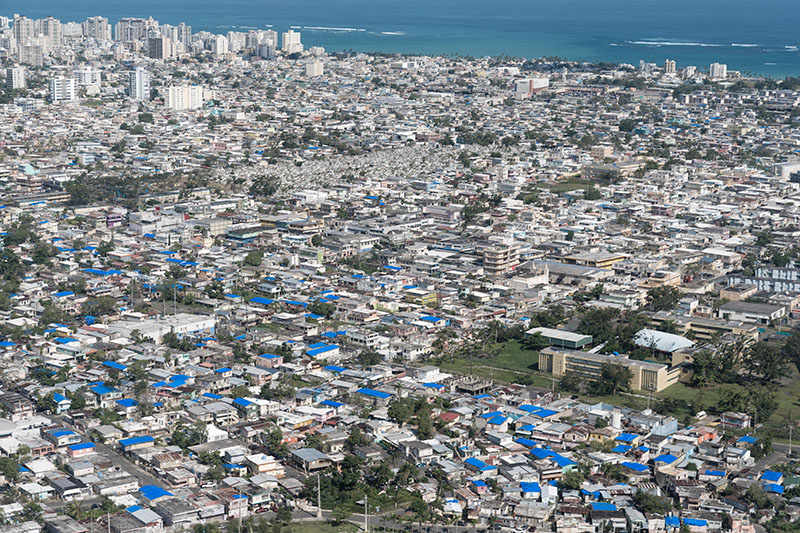
Muchos residentes aún tienen daños importantes en sus hogares, y algunos todavía comparten vivienda con otra familia. En ambos territorios, muchas casas aún tienen techos de lona azul en espera de reparaciones más permanentes. Todos los residentes entrevistados que sufrieron daños en sus hogares todavía estaban en proceso de repararlos. Algunos vivían en sus casas dañadas, mientras que otros habían hecho otros arreglos de vivienda, típicamente viviendo con otros miembros de la familia. Algunos entrevistados dijeron que estos arreglos habían causado un mayor estrés y tensiones en las relaciones familiares. Según FEMA, hasta el 16 de marzo de 2018, más de 3,500 puertorriqueños aún vivían en hoteles en la isla y en 37 estados con vales de vivienda temporales.13  FEMA ha extendido este programa de refugio temporal dos veces; la extensión más reciente finaliza el 14 de mayo de 2018.14 
Los residentes continúan enfrentando inestabilidad financiera, reflejando opciones de trabajo más limitadas y costos continuos asociados con la recuperación. Los entrevistados notaron que muchas personas perdieron o cambiaron de trabajo, o experimentaron reducciones en las horas de trabajo, después de las tormentas, lo que ha aumentado las tensiones financieras en las familias y ha obligado a algunos a agotar sus ahorros. Además, señalaron los mayores costos asociados con la recuperación, incluido el combustible del generador, el reemplazo de los artículos dañados y perdidos, y las reparaciones. Algunos dijeron que el aumento de las presiones financieras los obligó a cambiar o posponer planes para el futuro, como retrasar la educación y las metas profesionales.

La vida diaria y la educación de los niños permanecen interrumpidas. En USVI, con muchas escuelas todavía dañadas, comparten espacio y operan en horarios de cuatro horas. Los entrevistados destacaron que este esquema es difícil para los niños y los padres, particularmente para los padres que tienen que acomodar los horarios de trabajo a la jornada escolar reducida. Muchas familias con niños en edad escolar han dejado USVI debido al horario escolar limitado. Los entrevistados notaron que no está claro cómo las escuelas grandes continuarán operando a horario parcial, y que otras familias pueden irse si esta situación se extiende hasta el próximo año escolar. Los maestros en Puerto Rico también notaron que los estudiantes se han ido de la isla y que muchos no regresarán. El 5 de abril de 2018, el Departamento de Educación de Puerto Rico anunció el cierre de 283 de sus aproximadamente 1,110 escuelas para el año escolar 2018-2019, debido a una reducción de 38.762 estudiantes desde mayo de 2017.15  En algunos casos, el movimiento de niños en edad escolar fuera de las islas está llevando a la separación familiar. Por ejemplo, se envían a los niños a vivir con un pariente en el continente mientras los padres permanecen en las islas. Además, los entrevistados notaron que los niños que se han quedado en las islas están experimentando problemas para desempeñarse en la escuela, con algunos aún desplazados de sus hogares y/o sin electricidad, y otros lidiando con el miedo constante y el estrés emocional de las tormentas.

Los residentes, en particular los profesionales jóvenes y los proveedores de atención médica, continúan migrando. Los entrevistados notaron que la emigración había sido un problema antes de los huracanes y que las tormentas lo agravaron, particularmente entre los profesionales jóvenes y los proveedores de atención médica. Indicaron que, a medida que estas poblaciones se van, la población que se queda son adultos mayores, con menos familia disponible para ayudar a cuidarlos. Aunque los datos sobre la pérdida de población de Puerto Rico y USVI desde las tormentas son limitados, un análisis halló que el número neto de pasajeros aéreos nacionales que partieron de Puerto Rico entre agosto y noviembre de 2017 fue de aproximadamente 160,000 personas por encima de la tendencia.16  En su nuevo plan fiscal, el gobierno de Puerto Rico proyecta una disminución acumulada de 10.9% en la población durante los seis años posteriores a los huracanes.17  Otro estudio proyecta que entre 114,000 y 213,000 residentes de Puerto Rico dejarán la isla anualmente después del huracán María. El estudio estima que Puerto Rico puede perder hasta 470,335 residentes, o el 14% de la población, solo entre 2017-2019.18  Las proyecciones indican que Florida recibirá la mayor parte de este flujo de emigrantes: se esperan aproximadamente de 41,000 a 82,000 personas en el primer año después del huracán María.19 

Las necesidades de salud física y mental han aumentado.

Proveedores, funcionarios de salud y residentes señalaron los aumentos en los problemas de salud física después de las tormentas. Si bien los funcionarios de los territorios y los proveedores observaron que tuvieron éxito en la prevención y contención de los principales brotes de enfermedades luego de las tormentas, los entrevistados describieron aumentos en otras necesidades de atención médica. Dijeron que las condiciones crónicas de algunas personas, como la diabetes, o la hipertensión, habían empeorado, debido a brechas en la atención y a la falta de medicamentos después de los huracanes. También remarcaron que el acceso limitado a alimentos frescos y una mayor dependencia de alimentos altamente procesados han dificultado que muchas personas manejen sus condiciones crónicas. Algunos residentes y proveedores describieron problemas de salud nuevos o empeorados, como úlceras y aumento de peso, debido al mayor estrés. Algunos también señalaron más problemas ortopédicos, como dolor de espalda, hombro y rodilla, por mover objetos pesados como parte de las actividades relacionadas con la recuperación, y la falta de ascensores durante los cortes de energía, en el caso de las personas que viven en edificios altos.

Los desafíos de vivienda y transporte, y la continua inestabilidad de la electricidad han hecho que sea más difícil para las personas acceder a la atención y manejar sus condiciones. Por ejemplo, la inestabilidad de la energía eléctrica ha dificultado mantener la insulina refrigerada y hay un acceso limitado al oxígeno, la diálisis y otros dispositivos. Los proveedores también notaron que, a medida que un número creciente de personas abandona la isla, muchos residentes mayores han perdido el apoyo de los cuidadores, dejándolos con brechas en la atención. En USVI, el personal de la Cruz Roja que ha estado monitoreando y apoyando a los residentes de viviendas públicas ha descubierto que muchas personas aún están desorientadas a causa de las tormentas. Los residentes mayores se han enfrentado a problemas particulares, como pensamientos perturbadores y pesadillas, problemas para dormir y comer, y aislamiento debido a la falta de un sistema de apoyo. Un entrevistado también señaló los desafíos particulares que enfrentan las personas con enfermedades mentales graves que no tienen una vivienda apropiada y no están recibiendo suficiente apoyo.

Las necesidades de salud mental han aumentado drásticamente, y muchas personas todavía están luchando emocionalmente, seis meses después de las tormentas. Los residentes describieron efectos emocionales en curso, incluidos estrés y ansiedad, problemas para dormir y comer, llanto y depresión. Los proveedores, incluidos los centros de salud comunitarios que realizan evaluaciones de rutina para las necesidades de salud mental, también informaron aumento de casos de depresión aguda, ansiedad, ataques de pánico y trastorno de estrés postraumático (TEPT) entre las comunidades que atienden. Algunos entrevistados señalaron las continuas luchas emocionales de los niños, explicando que algunos tienen miedo y lloran cada vez que llueve. Datos preliminares también apuntan a crecientes necesidades de salud mental. Desde noviembre de 2017 a enero de 2018, una línea directa de crisis administrada por el Departamento de Salud de Puerto Rico recibió 3,050 llamadas de personas que dijeron haber intentado suicidarse, un aumento del 246% en comparación con la misma época el año pasado.20  En el mismo período de tres meses, la línea directa recibió 9,645 llamadas de personas que dijeron que habían pensado en el suicidio, un salto del 83% con respecto al mismo período del año anterior.21  A pesar de la creciente necesidad, los entrevistados indicaron que muchos residentes no reciben atención de salud mental, lo que refleja el estigma a largo plazo asociado con buscar estos servicios, y un suministro limitado de proveedores.

El análisis apunta a una tasa de mortalidad derivada de la tormenta potencialmente más alta que los recuentos oficiales. La cifra oficial de muertos por el huracán María en Puerto Rico es de 64,22  y cinco muertes se atribuyeron a los huracanes Irma y María en USVI.23  Sin embargo, un informe de The New York Times de diciembre de 2017 estima que las muertes relacionadas con huracanes en Puerto Rico son más de 1,052, en base a análisis de datos de mortalidad en comparación con años anteriores.24  En general, las muertes adicionales se atribuyeron a sepsis, neumonía y trastornos respiratorios, que podrían haber sido causados ​​indirectamente por los huracanes debido a efectos tales como un retraso en el tratamiento médico, cortes de energía que impidieron usar equipos médicos y condiciones deficientes en los hogares y las instalaciones de atención médica. En enero de 2018, el gobernador de Puerto Rico firmó una orden ejecutiva para establecer un grupo de trabajo encargado de revisar el número de muertes relacionadas con el huracán María.25  También se está realizando trabajo externo, para estudiar el exceso de mortalidad en Puerto Rico relacionado con este huracán.26 

Recuperación del sistema de atención médica

Partes del sistema de atención médica han reanudado las operaciones, pero aún existen brechas en los servicios.

Antes de los huracanes, los residentes en ambos territorios dependían de un sistema de hospitales y clínicas, así como de proveedores privados de atención. Había aproximadamente 70 hospitales que brindaban atención en Puerto Rico,27  junto con 20 centros de salud financiados con fondos federales, que proporcionaban servicios de atención primaria y preventiva en 93 áreas urbanas y rurales.28  En USVI, había dos hospitales, el Schneider Regional Medical Center, en St. Thomas, y el Governor Juan F. Luis Hospital and Medical Center, en St. Croix, además de dos centros de salud con calificación federal (FQHC), incluidos la Corporación St. Thomas East End Medical Center, en St. Thomas, y el Frederiksted Health Center (FHC) en St. Croix. Adicionalmente, el Sistema Médico Regional de Schneider operaba el Myrah Keating Smith Community Health Center, en St. John. El Departamento de Salud de USVI operaba tres centros de salud en las tres islas principales.29  Ambos territorios también tenían una red de proveedores privados, aunque enfrentaban escasez de proveedores, y dificultades para atraer y retenerlos.
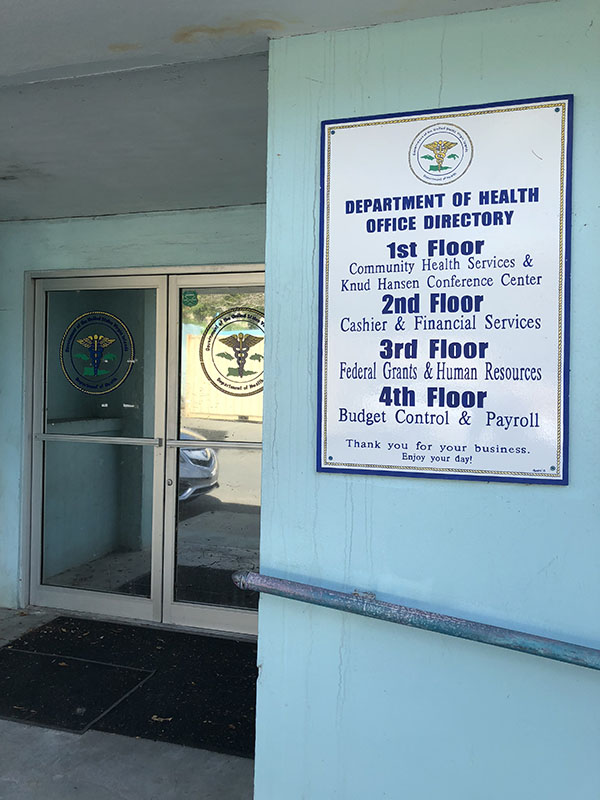
Los hospitales y clínicas en Puerto Rico han reanudado sus operaciones, pero varias clínicas aún no tienen energía eléctrica estable. En Puerto Rico, los hospitales se priorizaron como instalaciones críticas, y los funcionarios locales brindaron apoyo para reanudar las operaciones lo más rápido posible después de los huracanes. Seis meses después de las tormentas, todos los hospitales están ofreciendo servicios. Muchas de las clínicas en Puerto Rico sufrieron daños y pérdida de energía.30  Aunque han reanudado sus operaciones, a mediados de marzo de 2018, aproximadamente uno de cada 10 (11%) de los centros de centros de salud permanentes tenían capacidad eléctrica limitada, o nada de electricidad. Tres de estos centros de salud tienen energía intermitente y dependen de los generadores como fuente de energía de respaldo, mientras que cinco permanecen sin luz y dependen exclusivamente de los generadores. Un centro de salud adicional se convirtió a energía solar para no seguir dependiendo de un generador, y cinco centros de salud están atendiendo en unidades móviles. Directores de clínicas señalaron que trataron de reanudar las operaciones lo más rápido posible después de las tormentas, pero recibieron poco apoyo y enfrentaron desafíos debido a la capacidad limitada del generador y la dificultad para obtener combustible para recargarlos. Los entrevistados enfatizaron que las regiones montañosas y las islas costeras de Puerto Rico continúan teniendo problemas importantes de acceso, a seis meses de las tormentas. Muchos residentes en regiones remotas, en particular las personas mayores, no pueden viajar a los sitios de atención. A través de esfuerzos voluntarios, militares y de otro tipo, algunas personas continúan yendo a estas comunidades para brindar atención, pero a medida que se van eliminando los esfuerzos de alivio, estas dificultades de acceso pueden aumentar. En las islas cercanas a la costa, la disponibilidad de servicios sigue estando severamente limitado, lo que requiere que los pacientes en diálisis viajen a la isla principal para recibir atención.
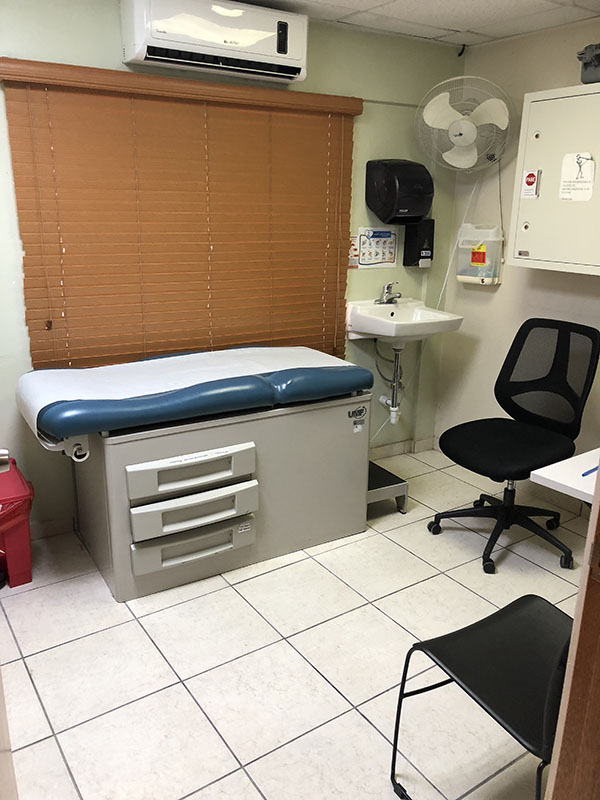
En USVI, los servicios siguen siendo limitados debido a daños estructurales importantes en los hospitales y otras instalaciones, lo que requiere que algunos pacientes continúen siendo trasladados fuera de la isla para recibir atención. En USVI, tanto los hospitales como algunos centros de atención de urgencia, y las instalaciones del departamento de salud, sufrieron daños por las tormentas que limitaron sus operaciones. A seis meses de las tormentas, el Schneider Regional Medical Center, en St. Thomas, que sufrió un daño estructural importante, sigue operando con capacidad limitada para proporcionar atención hospitalaria, servicios de emergencia y atención de diálisis. Las tormentas también destruyeron su centro de tratamiento del cáncer, dejándolo incapaz de proporcionar radioterapias. Desde las tormentas, el hospital ha perdido a más de 170 empleados, incluido el personal de enfermería, y depende de los viajes y las enfermeras temporales para ayudar a llenar estos vacíos creados por estas pérdidas. A partir de mediados de abril de 2018, el hospital estaba esperando una determinación final de FEMA sobre si reparará y reconstruirá las instalaciones existentes o construirá una nueva instalación. Las tormentas también causaron daños significativos al Myrah Keating Smith Community Health Center, en St. John, dejándolo inoperable. Desde entonces se ha acoplado a una clínica del Departamento de Salud en la isla. Los directores de los dos centros comunitarios con calificación federal informaron daños físicos limitados, lo que les permitió reanudar las operaciones rápidamente después de las tormentas. Sin embargo, FHC informó que ha perdido a las enfermeras, al personal dental y a los trabajadores auxiliares, y ha estado usando a los miembros restantes del personal para atender las necesidades de más pacientes, a la vez que continúa lidiando con cortes de energía periódicos. En general, las limitaciones continuas del servicio en USVI requieren traslados continuos fuera de la isla para personas con grandes necesidades y limitan la capacidad de las personas evacuadas para regresar a sus hogares. Antes e inmediatamente después de las tormentas, el Departamento de Salud coordinó la evacuación de casi 800 personas, incluidos muchos pacientes de diálisis. Los funcionarios señalaron que se están llevando a la isla unidades modulares y remolques de diálisis, para ampliar la capacidad de servicio, lo que con suerte reducirá los traslados fuera de la isla y permitirá que más evacuados regresen a sus hogares.

Muchos proveedores privados permanecen cerrados o han abandonado los territorios, lo que ha exacerbado los desafíos de acceso preexistentes, particularmente para la atención especializada y de salud mental. Los entrevistados notaron que, antes de las tormentas, los territorios tenían dificultades para atraer y retener un suministro suficiente de proveedores especializados debido a las bajas tasas de pago. Además, los servicios de salud mental en ambos territorios eran limitados. Las tormentas agravaron estos problemas, ya que muchos proveedores privados permanecen cerrados y un número cada vez mayor ha abandonado la isla, mientras que las necesidades de salud, particularmente las de salud mental, han aumentado. Actualmente, reclutar y retener a los proveedores, y a los profesionales de salud relacionados, es una prioridad para los centros de salud y los funcionarios de salud locales en ambos territorios.

Los hospitales y las clínicas se enfrentan a una mayor presión financiera a medida que crecen las poblaciones de los territorios sin seguro, debido al aumento del desempleo. Los encuestados señalaron que, como las personas pierden trabajos, muchos están perdiendo el seguro de salud. Mientras que algunos pueden calificar para la cobertura de Medicaid, un número se está convirtiendo en no asegurado. El personal de hospitales y clínicas observó que este cambio en la cobertura está incrementando la presión financiera sobre sus operaciones por las pérdidas de los pagos de pacientes con seguro comercial.

El financiamiento de ayuda federal para Medicaid proporciona apoyo esencial, pero persisten desafíos fiscales importantes.

Ambos territorios han tomado medidas para facilitar el acceso a Medicaid. Medicaid y el Programa de Seguro Médico Infantil desempeñaron papeles importantes cubriendo a residentes en ambos territorios antes de las tormentas: casi a la mitad de la población de Puerto Rico (49%) y más de uno de cada cinco individuos (22%) en USVI (Figura 1). Puerto Rico retrasó las renovaciones de Medicaid por 12 meses, y USVI por seis meses, para ayudar a las personas a mantener una cobertura estable en medio de los esfuerzos de recuperación. Los funcionarios y proveedores locales también señalaron que están participando en esfuerzos de divulgación y educación para ayudar a llegar a las personas que pueden ser nuevos elegibles para Medicaid e inscribirlas, ya que están perdiendo empleos e ingresos. En USVI, el uso por parte de los hospitales de determinaciones presuntas de elegibilidad está ayudando a facilitar el acceso a la cobertura, y están planeando expandir el uso de presunta elegibilidad a las clínicas. Los funcionarios de Puerto Rico dijeron que, en general, esperan un pequeño aumento en la inscripción, de alrededor del 1%, lo que reflejaría tanto un incremento en el número de personas que califican para el programa como la desafiliación de las personas que abandonan la isla.
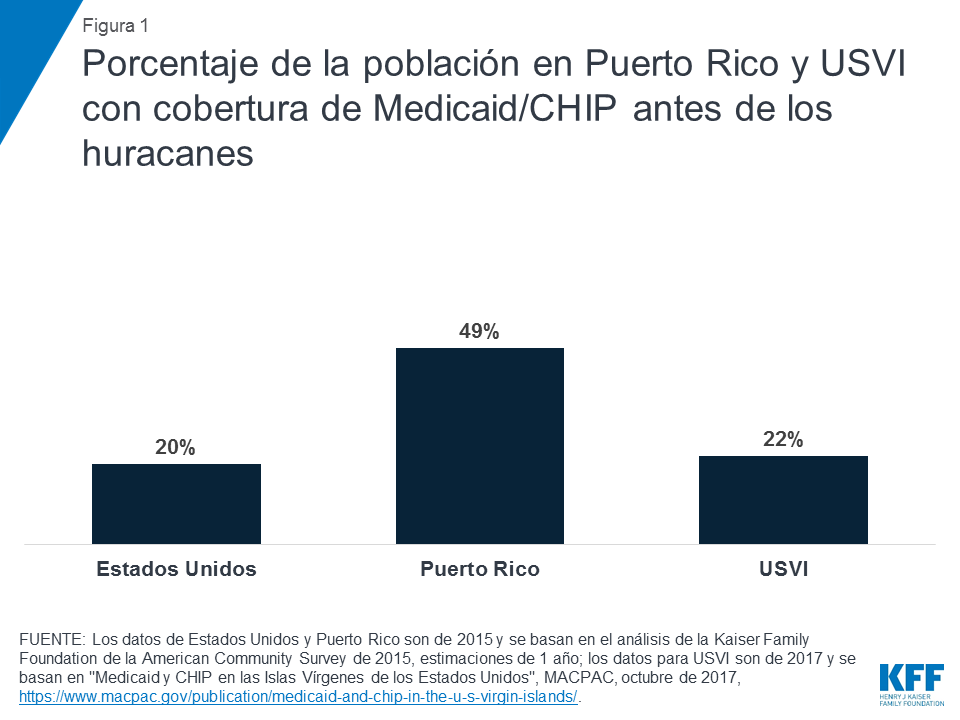
Figura 1: Porcentaje de la población en Puerto Rico y USVI con cobertura de Medicaid/CHIP antes de los huracanes

El proyecto de ley del presupuesto federal de febrero de 2018 proporcionó apoyo federal instrumental para los programas de Medicaid de los territorios, pero no abordó las disparidades subyacentes que enfrentan. A diferencia de los estados, que reciben fondos de contrapartida federales de Medicaid basados ​​en una fórmula vinculada al ingreso per cápita de forma abierta, los territorios reciben una tasa de contrapartida federal fija (55%), que es inferior a la que recibirían de acuerdo con la fórmula de ingreso per cápita. También están sujetos a un tope a los fondos federales. El proyecto de ley de presupuesto aumentó los límites federales para Puerto Rico ($4,8 mil millones) y USVI (aproximadamente $142,5 millones) y proporcionó fondos de Medicaid al 100% de paridad federal desde enero de 2018 hasta septiembre de 2019.31  Los funcionarios y proveedores locales dijeron que estos fondos brindan asistencia inmediata y alivio fiscal muy necesarios, pero expresaron preocupaciones significativas sobre lo que sucederá cuando termine el financiamiento, ya que no se realizaron cambios a largo plazo en la tasa de contrapartida federal ni en los fondos federales. Destacaron que, cuando finalice la financiación federal, se enfrentarán a grandes desafíos fiscales, especialmente porque las economías de los territorios no se habrán recuperado por completo para ese momento. Hicieron hincapié en la importancia de una solución a más largo plazo, para abordar las disparidades en su tasa de contrapartida federal y el tope de los fondos federales, así como otras diferencias en la forma en que se tratan los territorios, incluida su exclusión de los pagos del Disproportionate Share Hospital y las variaciones en los pagos de Medicare.

En medio de los esfuerzos de recuperación, los territorios también participan en los esfuerzos de reforma del sistema.

Para lograr los ahorros requeridos por su Junta de Supervisión Fiscal, Puerto Rico está implementando una importante reforma del sistema. Bajo el plan fiscal que el gobierno puertorriqueño propuso cumplir con la Junta Federal de Control, el territorio apunta a una reducción de $841 millones en gastos de atención médica para el año fiscal 2023.32  El plan fiscal también propone un nuevo modelo de atención médica diseñado para lograr eficiencia administrativa y financiera. Actualmente, una de las cuatro MCOs, junto con un plan adicional que atiende a una población especial, sirve a cada una de las ocho regiones geográficas de la isla.33  A partir del 1 de octubre de 2018, el nuevo modelo requerirá que las MCOs compitan en una sola región territorial para proporcionar servicios a los aproximadamente 1.3 millones de inscritos en toda la isla.34  Otros cambios incluirán una mayor preferencia por los medicamentos genéricos, un monto máximo de pago por miembro por mes y un rediseño de beneficios. Algunas partes interesadas cuestionan si es prudente reducir el gasto en atención médica al tratar de reconstruir la infraestructura y la capacidad, en especial porque actualmente los costos son más bajos que en el continente. Dado el enfoque en los esfuerzos de recuperación y otras demandas del sistema, también existe la preocupación de si los gobiernos locales pueden implementar estas reformas en el cronograma requerido actualmente.

USVI también participan en amplios esfuerzos de reforma del sistema de prestación destinados a reducir la fragmentación de la atención y ampliar el acceso a los servicios. Antes de los huracanes, los proveedores y funcionarios de USVI colaboraban en la mejora del sistema de entrega. Después de las tormentas, expandieron sus esfuerzos al organizar seis grupos de trabajo dirigidos por USVI enfocados en diferentes aspectos del sistema de atención de salud en términos de recuperación de tormentas y mitigación para futuros desastres naturales. Estos grupos de trabajo incluyen temas como salud ambiental, modelos de atención centrados en el paciente y salud comunitaria basada en datos. Los funcionarios de salud en el territorio ya están siguiendo una serie de pasos para lograr un sistema más integrado, como la creación de servicios de navegadores y gestión de casos, aumentar el alcance a los no asegurados o sub asegurados a través de referencias de proveedores y ampliar el acceso a la telemedicina. También colaboran en la recuperación de huracanes al trabajar juntos en temas como salud mental, el refuerzo de los registros de salud electrónicos y un enfoque continuo en lograr una sólida fuerza laboral de atención médica.

Preparándose para la próxima temporada de huracanes

Las personas y las organizaciones están buscando mejorar sus preparaciones y su capacidad de recuperación para futuras tormentas y otros desastres, pero tienen un tiempo limitado para hacerlo antes de la próxima temporada de huracanes. Las personas destacaron pasos específicos que probablemente tomarán para prepararse para futuros huracanes, incluyendo sacar más efectivo, obtener suministros de medicamentos por períodos más largos, establecer planes de comunicación con amigos y familiares e identificar lugares más seguros para refugiarse. Sin embargo, uno de los principales desafíos a los que se enfrentan las personas es que muchas viviendas permanecen dañadas y es poco probable que se las repare antes que comience la próxima temporada de huracanes. Los hospitales y las clínicas también están revisando sus planes de respuesta ante desastres. Señalaron que sus principales prioridades incluyen facilitar el acceso a la energía y las comunicaciones mediante la expansión de la capacidad de los generadores, la exploración de opciones de energía solar, la identificación de formas de garantizar la refrigeración de medicamentos en caso de cortes de energía y la obtención de teléfonos satelitales. Otras acciones que remarcaron son mejorar el abastecimiento de suministros antes del desastre, identificar pacientes con necesidades de salud para asegurar que tengan medicamentos y suministros adecuados, recolectar y documentar información para ayudar con la respuesta al desastre (por ejemplo, coordenadas de ubicación y capacidad de combustible del generador) y planificación para un apoyo rápido del personal. Algunos proveedores notaron que están revisando sus presupuestos para respuestas de emergencia y explorando opciones, tales como obtener unidades móviles para expandir su capacidad de proporcionar servicios en la comunidad luego de un desastre. Se observó que las clínicas desempeñaron un papel clave en la respuesta inmediata, ya que podían llegar a las personas rápidamente, y que sería importante reconocer y mejorar su capacidad de respuesta en el futuro. Los entrevistados notaron que, si bien se pueden tomar algunos pasos rápidamente para mejorar los esfuerzos de recuperación y respuesta, otros llevarán un tiempo que se extiende más allá de la próxima temporada de huracanes.

Conclusión

En septiembre de 2017, los huracanes Irma y María causaron daños históricos a Puerto Rico y USVI, agravando problemas económicos y de salud ya existentes. Seis meses después de las tormentas, se ha seguido avanzando con la recuperación, pero aún queda mucho trabajo por hacer. Las vidas de las personas permanecen quebradas, con muchos hogares dañados, y las personas siguen enfrentando presiones financieras e inseguridad. Mientras que en USVI la electricidad ha sido restaurada ampliamente, los hospitales del territorio continúan lidiando con un daño estructural importante, lo que limita la capacidad de servicio. En Puerto Rico, la energía eléctrica sigue siendo inestable, y las áreas remotas continúan enfrentando importantes desafíos de acceso. En ambos territorios, el aumento de la emigración de proveedores ha aumentado las limitaciones de acceso ya existentes para la atención especializada y de salud mental. Al mismo tiempo, las necesidades de salud física y mental se han incrementado, en especial para la depresión, la ansiedad y las enfermedades crónicas como la diabetes y la hipertensión. Niños, adultos mayores y personas con discapacidades han sido particularmente afectadas, y enfrentan desafíos continuos, incluida la pérdida de apoyo a medida que los miembros de la familia abandonan las islas. El alivio del financiamiento federal temporal para Medicaid aprobado por el Congreso proporcionará apoyo esencial para el sistema de atención de salud de los territorios, pero los fondos de alivio no abordan los problemas fiscales subyacentes o la disparidad en las tasas federales de Medicaid y el tope de los fondos federales de Medicaid que enfrentan los territorios. Las personas y las organizaciones están tomando medidas para prepararse para futuros desastres naturales, pero tienen tiempo y recursos limitados para prepararse para la próxima temporada de huracanes, que está a solo unas semanas de distancia.

Endnotes

  1. The Territory Clause of the U.S. Constitution and subsequent case law authorize Congress to treat territories differently than states under federal laws and programs as long as there is a “rational basis” for the differential treatment. Federal law provides that residents of the territories are generally not required to pay federal income tax, and the territories have special rules regarding Medicaid, Medicare and Supplemental Security Income (SSI). Congressional Task Force on Economic Growth in Puerto Rico, Report to the House and Senate (Washington, DC: Dec. 20, 2016), https://www.finance.senate.gov/imo/media/doc/Bipartisan%20Congressional%20Task%20Force%20on%20Economic%20Growth%20in%20Puerto%20Rico%20Releases%20Final%20Report.pdf. ↩︎
  2. U.S. Federal Emergency Management Agency, “Six Months After Maria: Progress Made, Work Continues” (Washington, DC: Federal Emergency Management Agency, Mar. 16, 2018), https://www.fema.gov/news-release/2018/03/16/six-months-after-maria-progress-made-work-continues, accessed Apr. 18, 2018. ↩︎
  3. Government of Puerto Rico, “StatusPR” (Puerto Rico, 2018), http://status.pr/?lng=en, accessed Apr. 18, 2018. ↩︎
  4. U.S. Federal Emergency Management Agency, “Power Restored to All Eligible Electric Customers in U.S. Virgin Islands” (Washington, DC: Federal Emergency Management Agency, Mar. 9, 2018), https://www.fema.gov/news-release/2018/03/09/power-restored-all-eligible-electric-customers-us-virgin-islands, accessed Apr. 18, 2018. ↩︎
  5. Lucia Molina, Registrations and Occupancy Report in Lodgings Endorsed by the PRTC (San Juan, Puerto Rico: Government of Puerto Rico, Puerto Rico Tourism Company, Mar. 12, 2018), https://www.prtourism.com/dnn/Portals/0/PDF_Statistics/JanREG_OCUP18.pdf?ver=2018-03-12-165327-520; Lucia Molina, Registrations and Occupancy Report in Lodgings Endorsed by the PRTC (San Juan, Puerto Rico: Government of Puerto Rico, Puerto Rico Tourism Company, Aug. 29, 2017), https://www.prtourism.com/dnn/Portals/0/PDF_Statistics/Jan17Registration_Occupancy.pdf?ver=2018-02-09-121921-447. ↩︎
  6. Government of Puerto Rico, “StatusPR” (Puerto Rico, 2018), http://status.pr/?lng=en, accessed Apr. 18, 2018. ↩︎
  7. U.S. Virgin Islands Department of Tourism, “U.S. Virgin Islands Update: March 1, 2018” (U.S. Virgin Islands: Department of Tourism, Mar. 1, 2018), https://drive.google.com/file/d/19j-_x2ogDQmismkELD9LVsjSsFT_WeGx/view, accessed Apr. 18, 2018; see also Beverly Nicholson-Doty, “United States Virgin Islands” (U.S. Virgin Islands: Commissioner of Tourism, Feb. 6, 2018), http://myemail.constantcontact.com/U-S–VIRGIN-ISLANDS-TRAVEL-UPDATE-FROM-COMMISSIONER-OF-TOURISM-BEVERLY-NICHOLSON-DOTY—FEBRUARY-6–2018.html?soid=1101882102592&aid=qGRDSUuX-VQ, accessed Apr. 18, 2018. ↩︎
  8. FEMA Spokesperson, Apr. 16, 2018; see also U.S. Federal Emergency Management Agency, “Puerto Rico Hurricane Maria (DR-4339)” (Washington, DC: Federal Emergency Management Agency, last updated Dec. 7, 2017), https://www.fema.gov/disaster/4339, accessed Apr. 18, 2018. ↩︎
  9. U.S. Federal Emergency Management Agency, “FEMA Provides Alternatives for Verifying Proof of Ownership in Puerto Rico” (Washington, DC: Federal Emergency Management Agency, Mar. 10, 2018), https://www.fema.gov/news-release/2018/03/10/fema-provides-alternatives-verifying-proof-ownership-puerto-rico, accessed Apr. 18, 2018. ↩︎
  10. U.S. Federal Emergency Management Agency, “Hurricane Survivors Have Until June 18 to Register with FEMA” (Washington, DC: Federal Emergency Management Agency, Mar. 15, 2018), https://www.fema.gov/news-release/2018/03/15/hurricane-survivors-have-until-june-18-register-fema-0, accessed Apr. 18, 2018. ↩︎
  11. U.S. Department of Health & Human Services, “Public Health Emergency: HHS Office of the Assistant Secretary for Preparedness and Response” (Washington, DC: Assistant Secretary for Preparedness and Response (ASPR), Apr. 5, 2018), https://www.phe.gov/about/aspr/Pages/default.aspx, accessed Apr. 18, 2018. ↩︎
  12. U.S. Department of Health and Human Services, “About HRSA” (Washington, DC: Health Resources & Services Administration, November 2017), https://www.hrsa.gov/about/index.html, accessed Apr. 18, 2018. ↩︎
  13. U.S. Federal Emergency Management Agency, “Six Months After Maria: Progress Made, Work Continues” (Washington, DC: Federal Emergency Management Agency, Mar. 16, 2018), https://www.fema.gov/news-release/2018/03/16/six-months-after-maria-progress-made-work-continues, accessed Apr. 18, 2018. ↩︎
  14. FEMA spokesperson, Apr. 16, 2018. ↩︎
  15. Government of Puerto Rico, Department of Education, “Departamento de Educación Anuncia las 828 Escuelas Operacionales Para el Curso Escolar 2018-19” (San Juan, Puerto Rico: Government of Puerto Rico, Department of Education, Apr. 5, 2018), https://twitter.com/EDUCACIONPR/status/981998908732792833, accessed Apr. 18, 2018. ↩︎
  16. Jason Bram, Puerto Rico and the U.S. Virgin Islands After Hurricanes Irma and Maria, Economic Press Briefing (New York, NY: Federal Reserve Bank of New York, Feb. 22, 2018), https://www.newyorkfed.org/medialibrary/media/press/PressBriefing-PuertoRico-USVI-February222018.pdf. ↩︎
  17. Government of Puerto Rico. “New Fiscal Plan for Puerto Rico” (San Juan, Puerto Rico: Apr. 5, 2018), http://www.aafaf.pr.gov/assets/newfiscalplanforpuerto-rico-2018-04-05.pdf, accessed Apr. 18, 2018. ↩︎
  18. Edwin Meléndez and Jennifer Hinojosa, Research Brief: Estimates of Post-Hurricane Maria Exodus from Puerto Rico (New York, NY: Center for Puerto Rican Studies, CUNY Hunter College, October 2017), https://centropr.hunter.cuny.edu/sites/default/files/RB2017-01-POST-MARIA%20EXODUS_V3.pdf. ↩︎
  19. Edwin Meléndez and Jennifer Hinojosa. Research Brief: Estimates of Post-Hurricane Maria Exodus from Puerto Rico (New York, NY: Center for Puerto Rican Studies, CUNY Hunter College, October 2017), https://centropr.hunter.cuny.edu/sites/default/files/RB2017-01-POST-MARIA%20EXODUS_V3.pdf. ↩︎
  20. Comisión Para la Prevención del Suicidio. Estadísticas Preliminares de Casos de Suicidio, Puerto Rico, Febrero 2018 (Rio Piedras, Puerto Rico: Puerto Rico Department of Health, February 2018), http://www.salud.gov.pr/Estadisticas-Registros-y-Publicaciones/Estadisticas%20Suicidio/Febrero%202018.pdf. ↩︎
  21. Comisión Para la Prevención del Suicidio. Estadísticas Preliminares de Casos de Suicidio, Puerto Rico, Febrero 2018 (Rio Piedras, Puerto Rico: Puerto Rico Department of Health, February 2018), http://www.salud.gov.pr/Estadisticas-Registros-y-Publicaciones/Estadisticas%20Suicidio/Febrero%202018.pdf. ↩︎
  22. Frances Robles, et al, New York Times. “Official Toll in Puerto Rico: 64. Actual Deaths May be 1,052.” (New York, NY: The New York Times, Dec. 9, 2017), https://www.nytimes.com/interactive/2017/12/08/us/puerto-rico-hurricane-maria-death-toll.html. ↩︎
  23. United States Virgin Islands Department of Justice, Press Release: AG Walker: Five hurricane-related deaths recorded in the Territory (USVI: Department of Justice, Office of the Attorney General, Oct. 2, 2017), http://usvidoj.codemeta.com/documents/AG%20Walker%20said%20five%20hurricane-related%20deaths%20recorded%20in%20the%20Territory.pdf.    ↩︎
  24. Frances Robles, et al, New York Times. “Official Toll in Puerto Rico: 64. Actual Deaths May be 1,052.” (New York, NY: The New York Times, Dec. 9, 2017), https://www.nytimes.com/interactive/2017/12/08/us/puerto-rico-hurricane-maria-death-toll.html. ↩︎
  25. Office of the Governor of Puerto Rico. “Governor Rosselló establishes working group to revise the number of deaths related to Hurricane Maria” (San Juan, Puerto Rico: La Fortaleza, Oficina del Gobernador, Jan. 4, 2018), http://www.fortaleza.pr.gov/content/governor-rossell-establishes-working-group-revise-number-deaths-related-hurricane-maria, accessed Apr. 18, 2018. ↩︎
  26. George Washington University Division of External Relations. “SPH Research Project to Study Hurricane Mortality in Puerto Rico” (Washington, DC: George Washington University, Feb. 22, 2018), https://gwtoday.gwu.edu/sph-research-project-study-hurricane-mortality-puerto-rico, accessed Apr. 18, 2018. ↩︎
  27. Government of Puerto Rico, Department of Health. “Directorio de Hospitales Publicos y Privados” (Rio Piedras, Puerto Rico: Department of Health), http://www.salud.gov.pr/Servicios-al-Ciudadano/Pages/Directorio-de-Hospitales-Publicos-y-Privados.aspx, accessed Apr. 18, 2018. ↩︎
  28. Kaiser Family Foundation, “Health Centers in Puerto Rico: Operational Status after Hurricane Maria” (Washington, DC: Kaiser Family Foundation, Mar. 16, 2018), https://modern.kff.org/medicaid/fact-sheet/health-centers-in-puerto-rico-operational-status-after-hurricane-maria/, accessed Apr. 18, 2018. ↩︎
  29. Government of USVI, Department of Health. “Department Overview” (USVI: Department of Health), http://doh.vi.gov/about/overview.html, accessed Apr. 18, 2018. ↩︎
  30. Kaiser Family Foundation, “Health Centers in Puerto Rico: Operational Status after Hurricane Maria” (Washington, DC: Kaiser Family Foundation, Mar. 16, 2018), https://modern.kff.org/medicaid/fact-sheet/health-centers-in-puerto-rico-operational-status-after-hurricane-maria/, accessed Apr. 18, 2018. ↩︎
  31. 115th Congress of the United States of America. H.R. 1892. “Bipartisan Budget Act of 2018” (Washington, DC: U.S. Congress, Jan. 3, 2018), https://www.congress.gov/115/bills/hr1892/BILLS-115hr1892enr.pdf. ↩︎
  32. Government of Puerto Rico. “New Fiscal Plan for Puerto Rico” (San Juan, Puerto Rico: Apr. 5, 2018), http://www.aafaf.pr.gov/assets/newfiscalplanforpuerto-rico-2018-04-05.pdf, accessed Apr. 18, 2018. ↩︎
  33. Medicaid and CHIP Payment and Access Commission, Medicaid and CHIP in Puerto Rico (Washington, DC: Medicaid and CHIP Payment and Access Commission, February 2018), https://www.macpac.gov/wp-content/uploads/2016/09/Medicaid-and-CHIP-in-Puerto-Rico.pdf. ↩︎
  34. Government of Puerto Rico. “New Fiscal Plan for Puerto Rico” (San Juan, Puerto Rico: Apr. 5, 2018), http://www.aafaf.pr.gov/assets/newfiscalplanforpuerto-rico-2018-04-05.pdf, accessed Apr. 18, 2018. ↩︎
Poll Finding

Kaiser Health Tracking Poll: Preview of the Role of Health Care in the 2018 Midterm Campaigns

Authors: Ashley Kirzinger, Bryan Wu, Cailey Muñana, and Mollyann Brodie
Published: May 10, 2018

Findings

Key Findings

POLL: Ahead of the 2018 midterms, Democratic and Republican voters say candidates’ positions on President Trump outweigh national issues

  • At the beginning of the 2018 primary season, congressional candidates’ positions on President Trump are weighing greater on most voters’ minds than any issue – including health care. When asked what will make the biggest difference in how they vote for Congress, larger shares of both Democratic and Republican voters say a candidate’s support for or opposition to President Trump will make the biggest difference than say the same about specific national issues or local or state issues.
  • Health care is among the top issues that voters want to hear candidates talk about during their congressional campaigns but ranks much lower among Republican voters, including those living in areas where there are competitive House, Senate, and Governor’s races.
  • Democrats have a clear edge when it comes to voter enthusiasm six months out from the 2018 midterm elections. Yet, similar to 2014, no issue – including health care – seems to be a driving force among enthusiastic voters. When asked to say in their own words why they are more enthusiastic about voting this year, the most common response offered by Democratic voters was a “desire for change” (22 percent) while one in five Republican voters said they are more enthusiastic because they want to vote “to support President Trump and the current administration.” About six percent of voters who are more enthusiastic this year explicitly mention concern over a specific issue (few explicitly mention health care) as the main reason for their enthusiasm.
  • Over the next six months, we will be tracking a unique group of voters – health care voters. Health care voters are a liberal-leaning, Democratic group of voters who say a candidate’s position on health care will be the “most important factor” in their 2018 congressional vote choice. These voters want to hear candidates talk about bringing down health care costs and while majorities say they plan to vote for the Democratic congressional candidate in their district, they are not more enthusiastic than other voters about participating in this year’s election.

Top Issues for 2018 Congressional Campaigns

This month marks the big push in the Democratic and Republican primary season and with congressional campaigns gearing up, the latest Kaiser Health Tracking Poll examines the top issues that voters want to hear the candidates talk about on the campaign trail. Overall, the top issues chosen by voters are the economy and jobs (23 percent), health care (22 percent), and gun policy (22 percent) – an issue back in the news following recent school shootings and subsequent protests. Health care also ranks among the top issues that voters who live in areas where there are competitive House, Senate, or Governor races want to hear candidates discuss (20 percent), along with gun policy (23 percent), economy and jobs (20 percent), and immigration (17 percent).
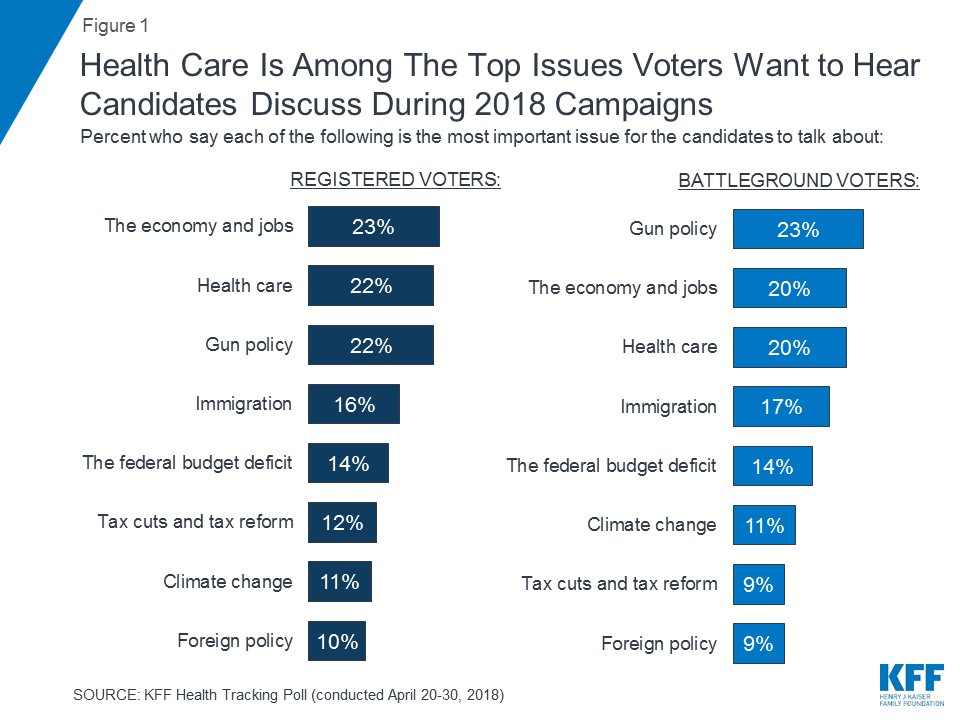
Figure 1: Health Care Is Among The Top Issues Voters Want to Hear Candidates Discuss During 2018 Campaigns

2018 Midterm Election Analysis

As part of Kaiser Family Foundation’s effort to examine the role of health care in the 2018 midterm elections, throughout the year we will be tracking the views of voters – paying special attention to those living in states or congressional districts in which both parties have a viable path to win the election. This group, referred to in our analysis as “voters in battlegrounds” is defined by the 2018 Senate, House, and Governor ratings provided by The Cook Political Report. Congressional and Governor races categorized as “toss-up” were included in this group. A complete list of the states and congressional districts included in the comparison group is available in Appendix A.

Health Care Ranks Higher as Campaign Issue for Democrats

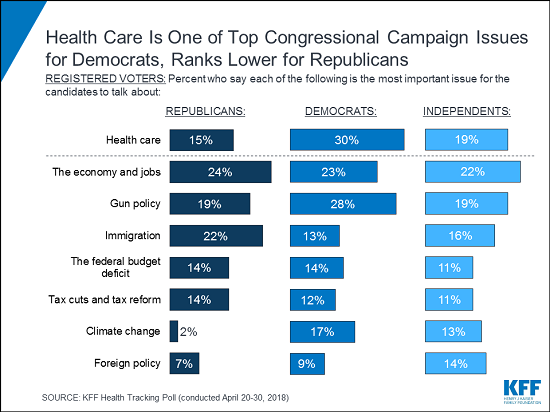
The ranking of these issues varies across party lines with fewer Republican voters (15 percent) saying health care is the “most important issue” for candidates for Congress to talk about. Larger shares of Republican voters say the economy and jobs (24 percent), immigration (22 percent), and gun policy (19 percent) are the most important issue for candidates to discuss. Health care ranks among a series of second tier issues for Republican voters including other issues such as the federal budget deficit (14 percent), and tax cuts and tax reform (14 percent). This may mark a turning point for the prominence of health care in Republican campaigns compared to the past four election cycles – since the passage of the 2010 health care law – health care has been a major talking point for Republican candidates.1 

Health care ranks higher among issues for both Democratic voters and independent voters. Three in ten Democratic voters say health care is the “most important issue” for candidates to talk about, which is similar to the share who say the same about gun policy (28 percent). The top issues for independent voters are the economy and jobs (22 percent), gun policy (19 percent), and health care (19 percent).
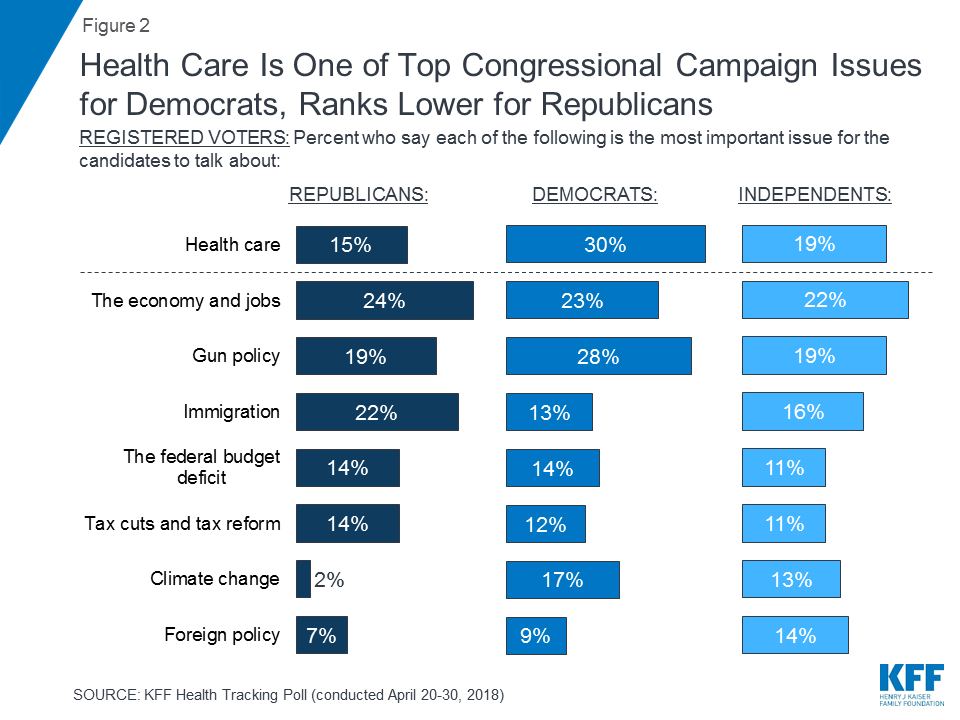
Figure 2: Health Care Is One of Top Congressional Campaign Issues for Democrats, Ranks Lower for Republicans

Health Care v. Other Voting Factors

When forced to choose the most important issue they want to hear the congressional candidates discuss among all issues polled, gun policy (14 percent), the economy and jobs (13 percent) and health care (12 percent) are the top issues for voters overall. However, nearly four in ten voters (36 percent) say none of the issues on this list are the “most important” for the candidates to discuss.
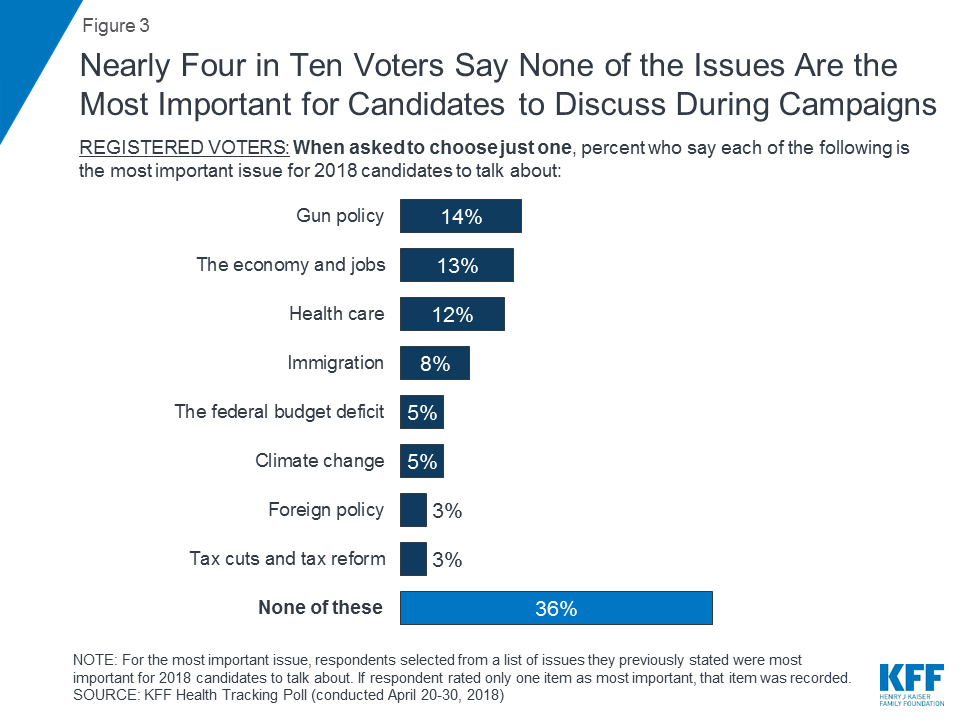
Figure 3: Nearly Four in Ten Voters Say None of the Issues Are the Most Important for Candidates to Discuss During Campaigns

One reason why nearly four in ten (36 percent) say none of the issues provided are the “most important” for congressional candidates to discuss may be because voters seem to care more about the candidates’ character and experience or their support for or opposition to President Trump. When national issues are put up against these other voting factors, majorities of Republican and Democratic voters say “a candidate’s support or opposition to President Trump” or the “candidate’s character and experience” will make the biggest difference in how they vote for Congress.

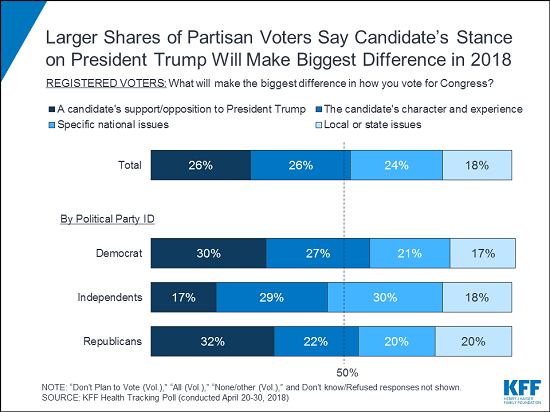
Nearly one-third of Republican voters (32 percent) and three in ten Democratic voters say a candidate’s support for or opposition to President Trump will make the biggest difference in their congressional vote choice. Smaller shares – about one five – say either “specific national issues” or “local or state issues” will make the biggest difference. Independent voters are less likely than partisan voters to say a candidate’s support for or opposition to President Trump will make the biggest difference (17 percent).
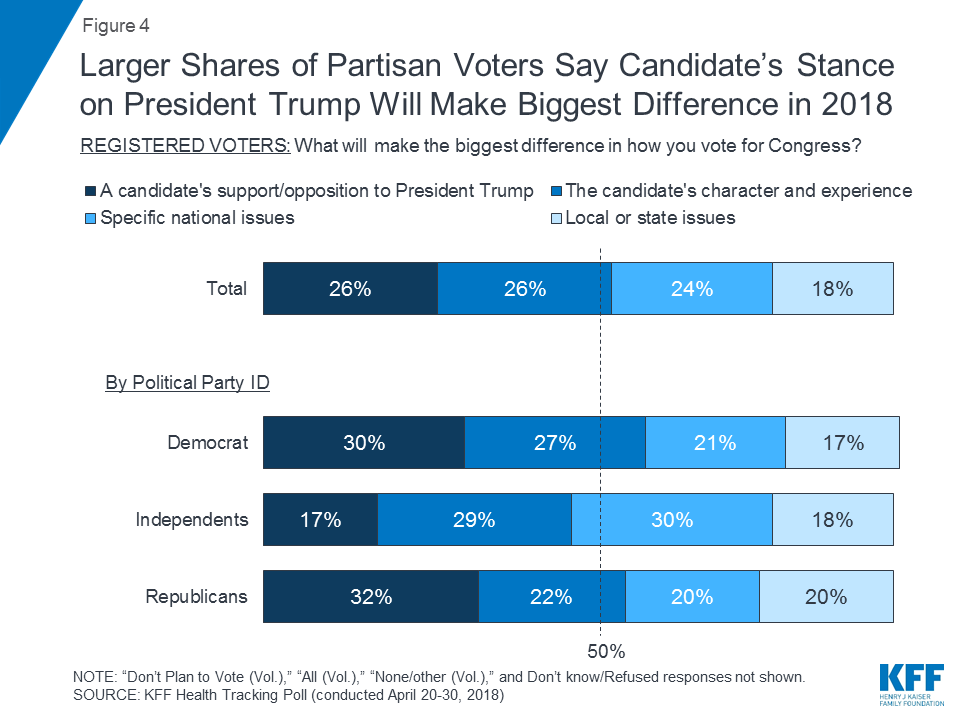
Figure 4: Larger Shares of Partisan Voters Say Candidate’s Stance on President Trump Will Make Biggest Difference in 2018

Even among voters who say health care is the most important issue for 2018 congressional candidates to talk about, three in ten (28 percent) say a candidate’s support for or opposition to President Trump will make the biggest difference in their vote for Congress and another one in five say it will be the candidate’s character and experience.

Battleground Republican Voters in 2018 midterms

Nearly four times as many Republican voters living in battleground areas say a “candidate’s support for or opposition to President Trump” will make the biggest difference in how they vote for Congress (37 percent) than say health care is a top issue for congressional candidates to discuss (10 percent). A large share of this year’s competitive elections are taking place in traditionally strong Republican areas, where voters may be more conservative than Republicans overall.
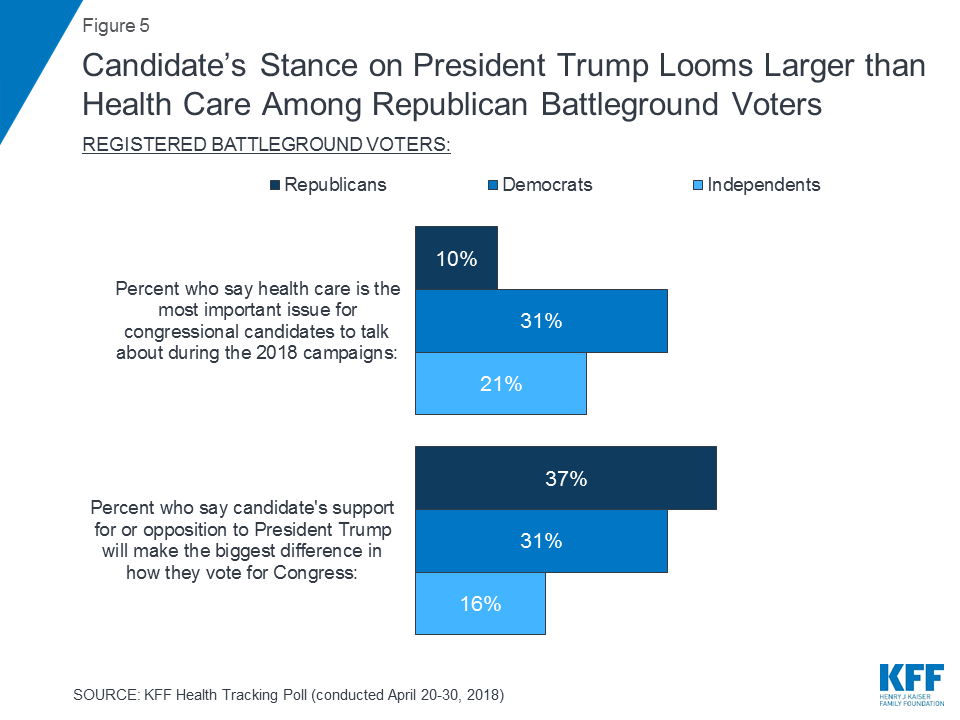
Figure 5: Candidate’s Stance on President Trump Looms Larger than Health Care Among Republican Battleground Voters

Nearly Half of Democratic Voters Say They Are More Enthusiastic About Voting This Year

As other polls have shown, Democrats have a clear edge when it comes to voter enthusiasm six months out from the midterm elections. While a majority of all voters say their enthusiasm about voting this year is “about the same” as in previous congressional elections, 45 percent of Democratic voters say they are “more enthusiastic” this year than in the past, compared to three in ten Republicans and independents (31 percent).
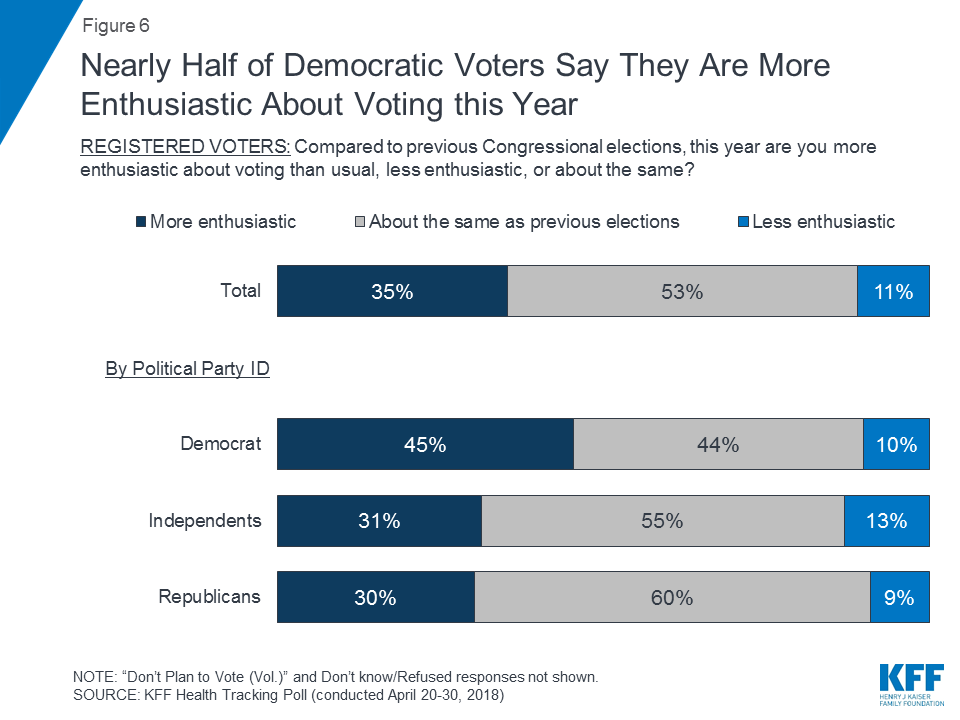
Figure 6: Nearly Half of Democratic Voters Say They Are More Enthusiastic About Voting this Year

The current enthusiasm gap is flipped from KFF’s 2014 midterm polling, in which a slightly larger share of Republicans said they were “more enthusiastic” (27 percent) compared to one in five Democrats and independents (18 percent). Yet, similar to 2014, no issue – including health care – seems to be a driving force among enthusiastic voters – across both Democrats and Republicans.

When asked to say in their own words why they are more enthusiastic about voting this year, the most commonly offered response from Democrats was “a desire for change” (22 percent) while one in five Republicans said they are more enthusiastic because they want to vote “to support President Trump and the current administration.” About six percent of voters who are more enthusiastic this year explicitly mention concern over a specific issue (few explicitly mention health care) as the main reason for their enthusiasm.
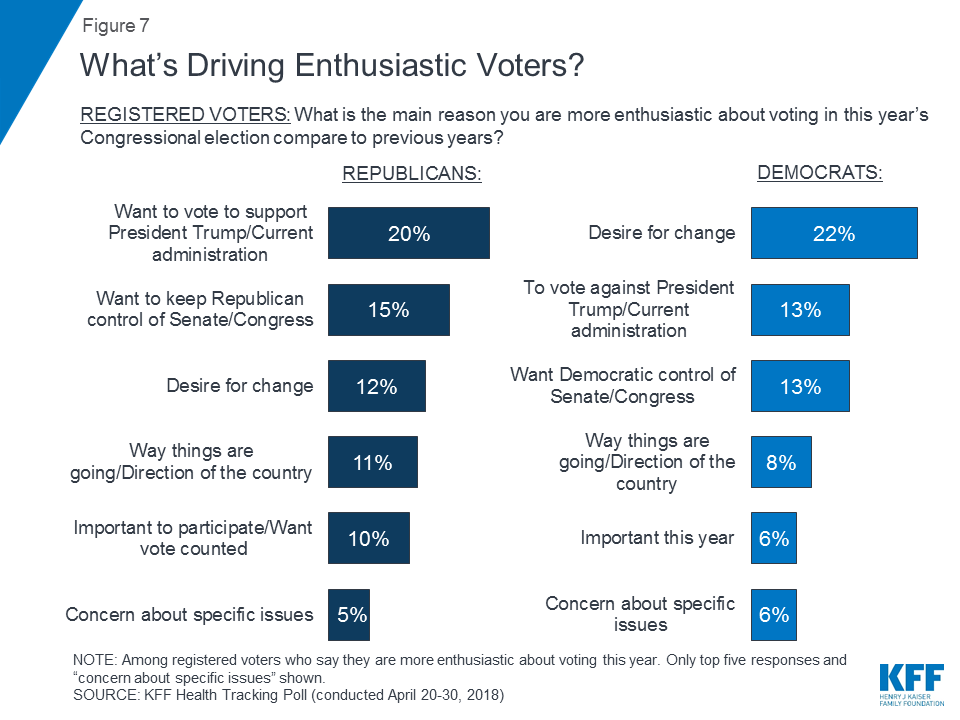
Figure 7: What’s Driving Enthusiastic Voters?

Who Are the Health Care Voters?

Over the next six months, the Kaiser Family Foundation will be tracking a unique group of voters – health care voters. When asked whether a series of issues will be an important factor in their 2018 congressional vote choice, these voters say a candidate’s position on health care will be the “most important factor” in their decision. Overall, one-fourth of voters (23 percent) are “health care voters,” which includes five percent who are single-issue health care voters (meaning they only chose health care as the most important factor). To compare the demographic profile of health care voters to other voters, see our health care voter interactive.
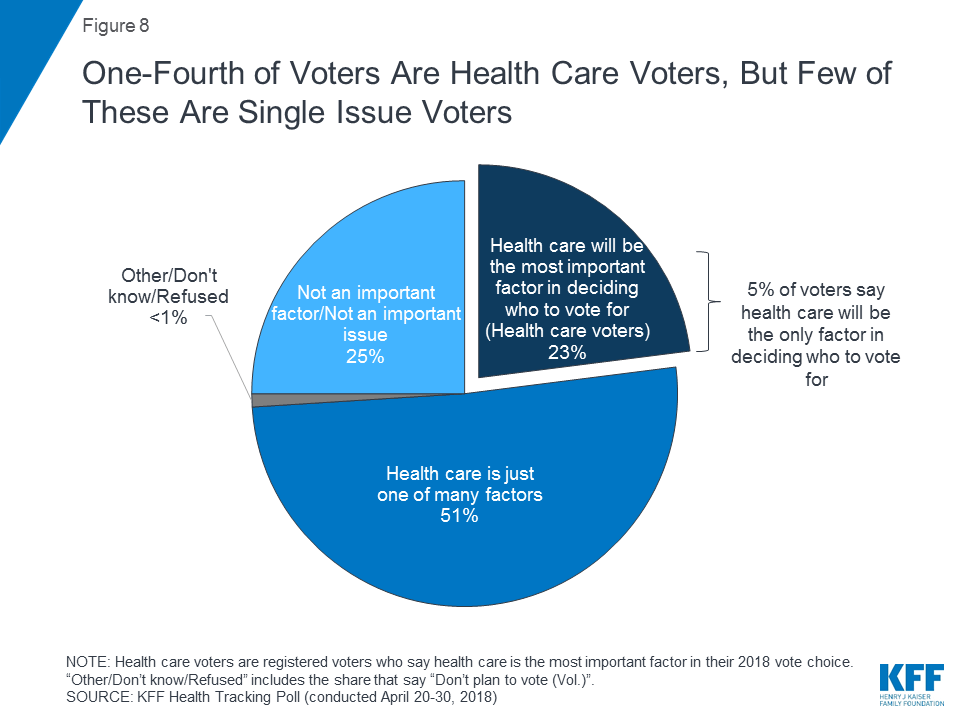
Figure 8: One-Fourth of Voters Are Health Care Voters, But Few of These Are Single Issue Voters

Health Care Voters May Play larger role in Democratic primaries

Six in ten health care voters are Democrats (47 percent) or Democratic-leaning independents (15 percent), while seven percent describe themselves as independents and one-fourth are Republicans (15 percent) or Republican-leaning independents (8 percent).
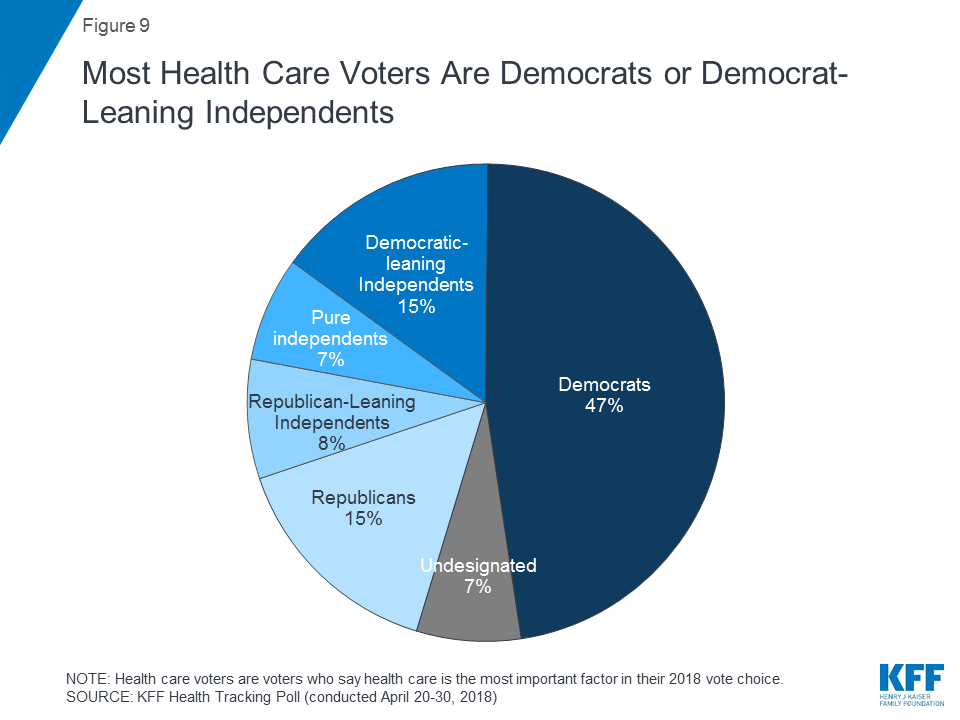
Figure 9: Most Health Care Voters Are Democrats or Democrat-Leaning Independents

A more liberal-leaning, Democratic group of voters, seven in ten disapprove of the way Donald Trump is handling his job as President, and six in ten (59 percent) say that if the November election was held today, they would vote for the Democratic candidate in their district. Yet, this group is not more enthusiastic about voting in the 2018 midterm election with four in ten (38 percent) saying they are “more enthusiastic” compared to 34 percent of voters who are not health care voters.

Table 1: Health Care Voters Lean Democratic on All Measures
 Health Care VotersNot Health Care Voters
Percent who disapprove of the way Donald Trump is handling his job as President:7049
Percent who say this November, they are more likely to support the Democratic Party’s candidate in their district:5942
Percent who are more enthusiastic about voting this year compared to previous congressional elections:3834

What Health Care Issues do Health Care Voters Want to Hear Candidates Talk About?

Poll: Voters’ biggest health care concern is their personal costs – not the #ACA or #singlepayer

When asked to say in their own words what specific health care issues they most want to hear the 2018 candidates discuss, health care costs are the top issue mentioned by both Democratic-leaning health care voters (31 percent) and Republican-leaning health care voters (55 percent). The other health care issues vary in importance by partisanship. About one in five (18 percent) of Democratic health care voters say they want to hear candidates discuss universal coverage and about one in ten (11 percent) mention concerns about quality of coverage or care. About one in ten Republican-leaning health care voters want to hear candidates talk about Medicare/senior concerns (9 percent) and improvements in the way health care is delivered (8 percent). Health care costs are also the top health care issue that all voters want to hear candidates talk about during the 2018 campaign.
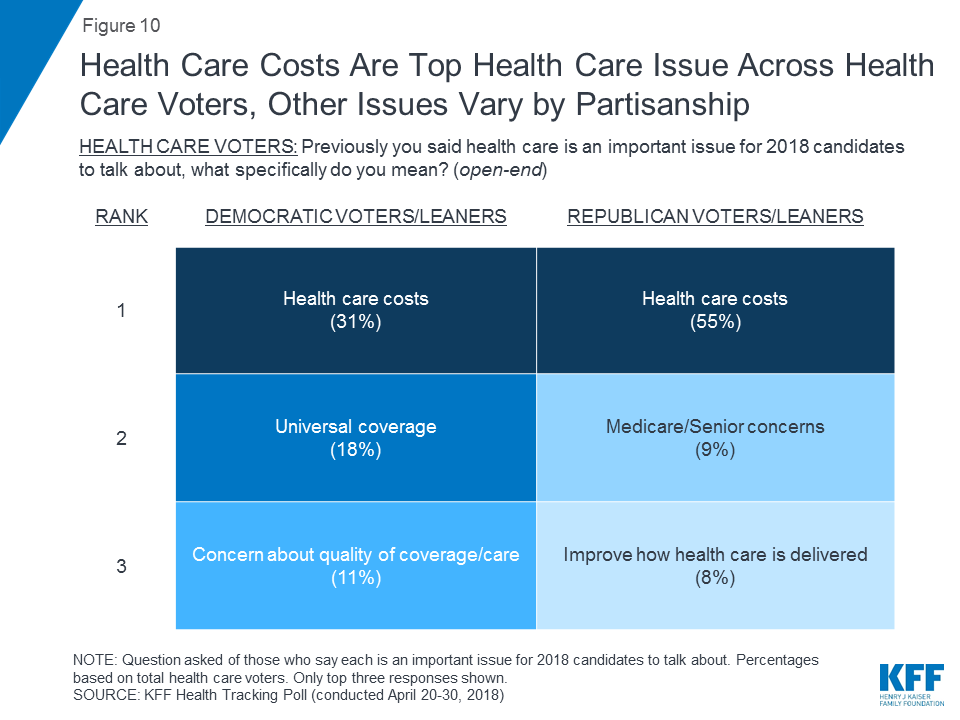
Figure 10: Health Care Costs Are Top Health Care Issue Across Health Care Voters, Other Issues Vary by Partisanship

The Role of Candidates’ Positions on Health Care in Midterm Elections

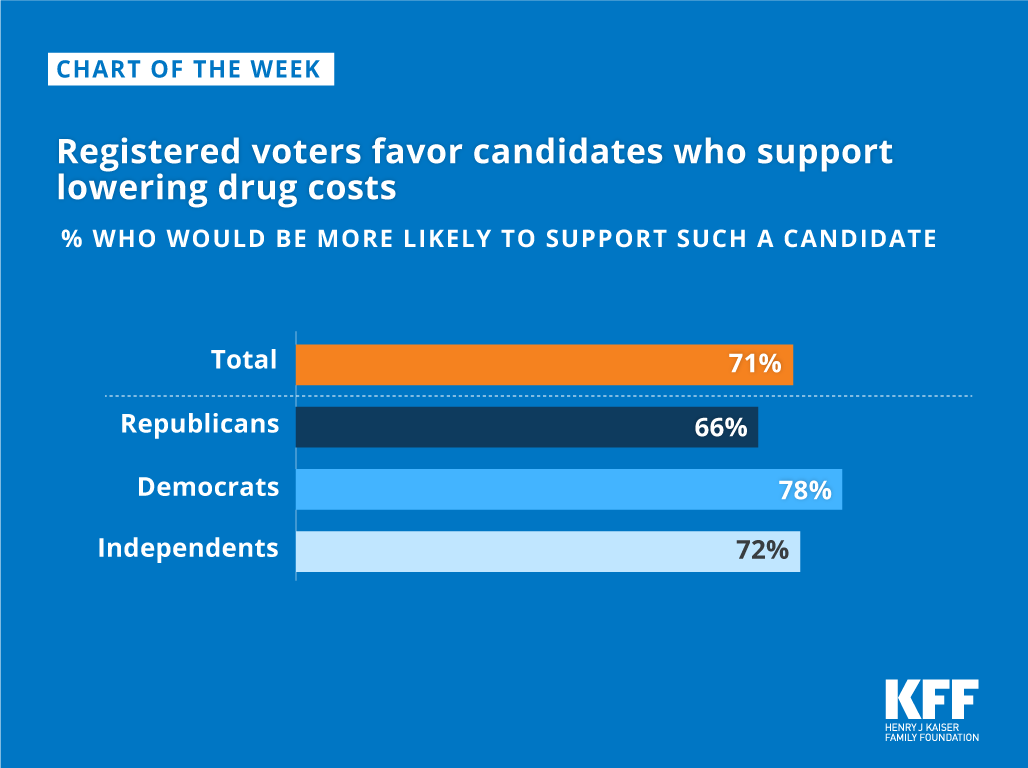
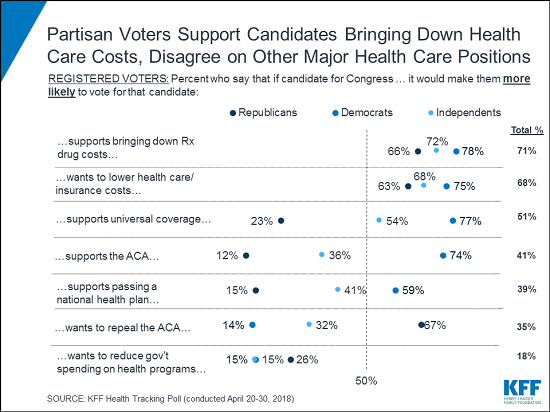
While health care is not the driving issue for most voters, a candidate’s position on specific health care issues may influence voters’ decisions this fall – especially when it comes to health care costs. Two-thirds of Republican voters, nearly eight in ten Democratic voters (78 percent), and 72 percent of independent voters say that if a candidate for Congress supports bringing down prescription drug costs, they would be “more likely” to vote for that candidate. The same is true of a candidate who wants to lower health care or health insurance costs, with six in ten Republican voters (63 percent), three-fourths of Democratic voters, and 68 percent of independent voters saying they would be more likely to vote for that candidate. Few partisans – regardless of party identification – say they would be “more likely” to vote for a candidate who wants to reduce government spending on health programs such as Medicare and Medicaid.
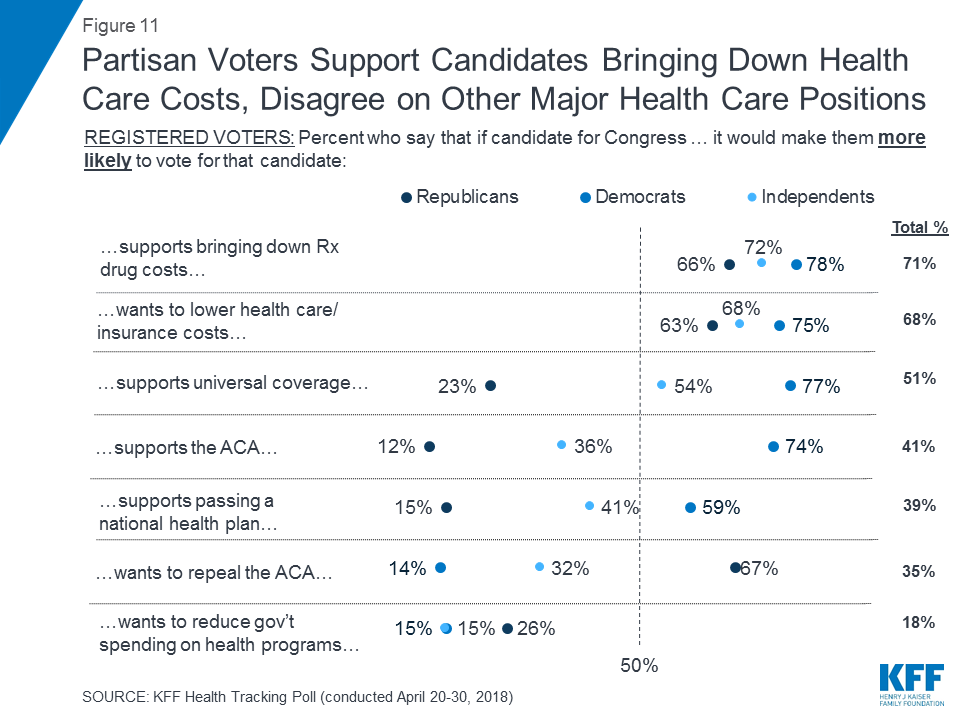
Figure 11: Partisan Voters Support Candidates Bringing Down Health Care Costs, Disagree on Other Major Health Care Positions

That is seemingly, where the partisan agreement ends, with majorities of Democratic voters saying they would be more likely to vote for a candidate who supports universal coverage (77 percent), supports the Affordable Care Act (74 percent), or supports passing a national health plan (59 percent). On the other hand, a majority of Republican voters say they would be more likely to support a candidate who wants to repeal the Affordable Care Act (67 percent).

The Affordable Care Act

Partisanship still drives views of the 2010 Affordable Care Act (ACA). About half (49 percent) of the public and vast majorities of Democrats (79 percent) hold a favorable view of the ACA, while 43 percent of the public and majorities of Republicans (79 percent) hold an unfavorable view of the law. This is similar to last month’s tracking poll and continues the nearly year-long trend of a larger share of the public holding favorable than unfavorable views.
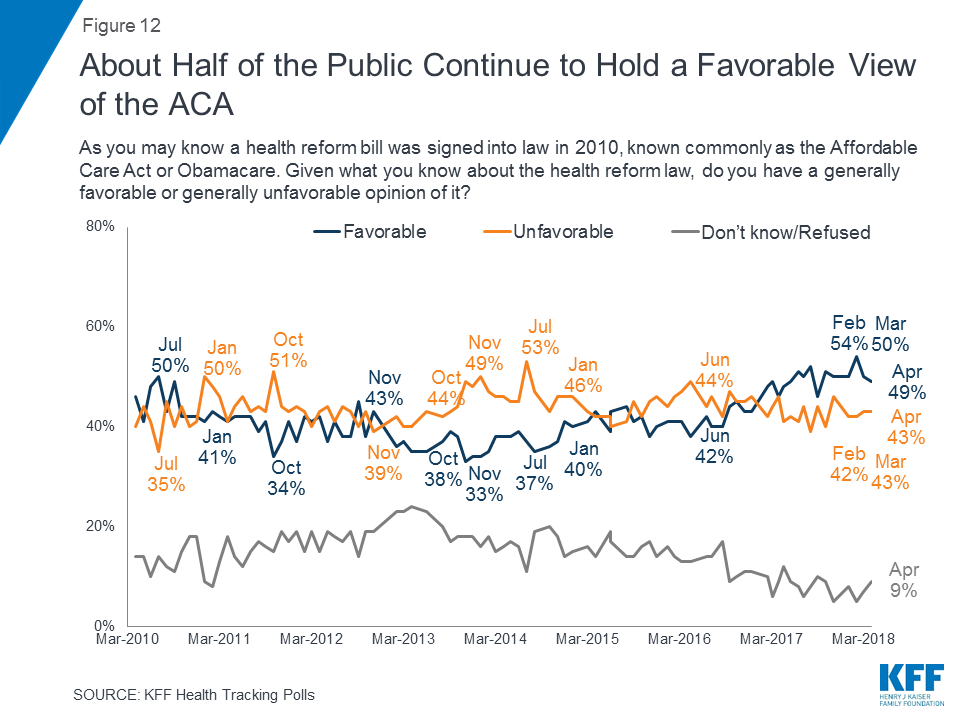
Figure 12: About Half of the Public Continue to Hold a Favorable View of the ACA

Methodology

This Kaiser Health Tracking Poll was designed and analyzed by public opinion researchers at the Kaiser Family Foundation (KFF). The survey was conducted April 20th-30th 2018, among a nationally representative random digit dial telephone sample of 2,000 adults ages 18 and older, living in the United States, including Alaska and Hawaii (note: persons without a telephone could not be included in the random selection process). Computer-assisted telephone interviews conducted by landline (699) and cell phone (1,301, including 864 who had no landline telephone) were carried out in English and Spanish by SSRS of Glen Mills, PA. To efficiently obtain a sample of lower-income and non-White respondents, the sample also included an oversample of prepaid (pay-as-you-go) telephone numbers (25% of the cell phone sample consisted of prepaid numbers) as well as a subsample of respondents who had previously completed Spanish language interviews on the SSRS Omnibus poll (n=14). Both the random digit dial landline and cell phone samples were provided by Marketing Systems Group (MSG). For the landline sample, respondents were selected by asking for the youngest adult male or female currently at home based on a random rotation. If no one of that gender was available, interviewers asked to speak with the youngest adult of the opposite gender. For the cell phone sample, interviews were conducted with the adult who answered the phone. KFF paid for all costs associated with the survey.

The combined landline and cell phone sample was weighted to balance the sample demographics to match estimates for the national population using data from the Census Bureau’s 2016 American Community Survey (ACS) on sex, age, education, race, Hispanic origin, and region along with data from the 2010 Census on population density. The sample was also weighted to match current patterns of telephone use using data from the January-June 2017 National Health Interview Survey. The weight takes into account the fact that respondents with both a landline and cell phone have a higher probability of selection in the combined sample and also adjusts for the household size for the landline sample, and design modifications, namely, the oversampling of prepaid cell phones. All statistical tests of significance account for the effect of weighting.

The margin of sampling error including the design effect for the full sample is plus or minus 3 percentage points. Numbers of respondents and margins of sampling error for key subgroups are shown in the table below. For results based on other subgroups, the margin of sampling error may be higher. Sample sizes and margins of sampling error for other subgroups are available by request. Note that sampling error is only one of many potential sources of error in this or any other public opinion poll. Kaiser Family Foundation public opinion and survey research is a charter member of the Transparency Initiative of the American Association for Public Opinion Research.

GroupN (unweighted)M.O.S.E.
Total2,000±3 percentage points
Registered voters1,655±3 percentage points
Democrats528±5 percentage points
Republicans486±5 percentage points
Independents506±5 percentage points
Voters in competitive elections500±5 percentage points
Health Care voters353±6 percentage points

Endnotes

  1. The Mercury News, Republicans dump favorite election message: Repeal Obamacare, April 14, 2018. https://www.mercurynews.com/2018/04/14/republicans-dump-favorite-election-message-repeal-obamacare/     ↩︎
News Release

Six Months ahead of the Midterm Elections, Democratic and Republican Voters’ Views about President Trump Outweigh their Views on Issues, Including Health Care

Voters’ Biggest Health Care Concern is Their Costs – Not the Affordable Care Act or Single Payer

Published: May 10, 2018

Who are the “Health Care Voters”? Mostly Women, and Mostly Planning to Vote Democratic

As primary season for the 2018 midterm elections heats up, the latest Kaiser Family Foundation poll suggests the elections are shaping up more as a referendum on President Trump than on health care or any other issue.

When asked what will make the biggest difference in how they vote in the Congressional elections, larger shares of Democrats and Republicans cite candidates’ support for or opposition to President Trump (30% of Democrats, 32% of Republicans) and candidates’ character and experience (27% of Democrats, 22% of Republicans) than say national issues (21% of Democrats, 20% of Republicans).
April Tracking Poll_Chart1

At the same time, when asked what issue they want to hear the 2018 candidates discuss on the campaign trail, health care ranks among the top issues for voters, particularly Democrats.

Twice the share of Democrats (30%) as Republicans (15%) name health care as a “most important” issue for the 2018 candidates to talk about. For Democrats, health care is the top issue, slightly ahead of gun policy (28%) and the economy and jobs (23%). Independents also rank health care among their top issues, with about one in five naming the economy and jobs (22%), health care (19%) and gun policy (19%) as a “most important” issue for the candidates to discuss.

For Republicans, health care (15%) ranks fourth behind the economy and jobs (24%), immigration (22%) and gun policy (19%), and similar to immigration (14%) and tax cuts and tax reform (14%). The relatively low ranking suggests health care may plan a less prominent role in Republican campaigns compared to the past four election cycles, when Republicans often focused on their opposition to the 2010 Affordable Care Act.
April Tracking Poll_Chart2

Among Health Care Issues, Voters are Most Focused on Lowering their Costs, Including Drug Prices

Large majorities of Republican (66%), Democratic (78%) and independent voters (72%) say that if a candidate for Congress supports bringing down prescription drug costs, they would be “more likely” to vote for that candidate. Similar large majorities across parties say they would be more likely to vote for a candidate that wants to lower health care and insurance costs.

Other issues – including supporting the ACA, repealing the ACA or supporting a national health plan – split partisans, with Democrats and Republicans on opposite sides.
April Tracking Poll_Chart3

Partisanship similarly continues to drive overall views of the ACA.  The poll finds about half (49%) of the public and a large majority of Democrats (79%) hold a favorable view of the law, while 43 percent of the public and a large majority of Republicans (79%) hold an unfavorable view.

Who are the Health Care Voters?

The new survey also takes a deeper look at those voters who say health care will be a “most important factor” to their vote in the 2018 Congressional elections – nearly a quarter (23%) of all voters. Over the next six months, we will be tracking what is driving this group of health care voters.

Health care voters are more likely to be women, lean liberal, identify as Democrats, and are much more likely to disapprove of President Trump’s job performance than other voters (70% compared to 49%). Health care voters are also more likely to say they support Democrats in Congressional elections (59% compared to 42%) but are not more likely to say they’re more enthusiastic about voting this year (38% compared to 34%).

When asked to say in their own words what specific health care issues they most want to hear the 2018 candidates discuss, health care costs are the top issue mentioned by both Democratic-leaning (31%) and Republican-leaning (55%) health care voters. Other health care issues vary in importance by partisanship, with fewer health care voters mentioning single-payer (5%) or the Affordable Care Act (8%). Health care costs are also the top health care issue mentioned by voters overall.

Designed and analyzed by public opinion researchers at the Kaiser Family Foundation, the poll was conducted from April 20-30, 2018 among a nationally representative random digit dial telephone sample of 2,000 adults. Interviews were conducted in English and Spanish by landline (699) and cell phone (1,301). The margin of sampling error is plus or minus 3 percentage points for the full sample. For results based on subgroups, the margin of sampling error may be higher.

News Release

New Charts Track Growth in U.S. Health Care Prices, Draw Comparisons to Other Countries

Published: May 9, 2018

Two new chart collections from the Kaiser Family Foundation combine original analysis with a synthesis of existing data to examine trends in health care prices and utilization and compare health spending in the United States with that of other wealthy countries.

How have health care prices grown in the U.S. over time? This chart collection explores price increases in private insurance for common services over time and finds significant geographic variation in prices. For example, the average price of a full knee replacement for those in large employer plans increased from $19,595 in 2003 to $34,063 in 2016, growth of 74% compared to a 28% increase in general inflation. The average price of a knee replacement in New York City is more than twice the price of the same procedure in the Louisville, Kentucky area. Prices paid by private insurance for inpatient hospital care are substantially higher than those paid by Medicare and Medicaid, with the gap growing over time.

How do health care prices and use in the U.S. compare to other countries? This chart collection illustrates that higher prices – more so than utilization – explain the United States’ high health spending relative to other high-income countries.

The U.S. has higher prices for most health care services and prescription drugs, according to available internationally comparable data. Meanwhile, utilization of several services, including physician consultations and hospital stays, is lower than in many comparable countries. Use of some services, such as C-sections and knee replacements, is higher in the U.S. than in similar countries.

Despite having fewer office visits and shorter average hospital stays, the U.S. overall spends twice as much per person on healthcare than do comparable countries.

The charts were released as part of a Kaiser Family Foundation/Peterson Center on Healthcare forum on health care prices in Washington. The forum included experts in health care economics, delivery, and policy discussing the state of U.S. health spending, as well as potential strategies for addressing high prices.

Archived video of the event is available on the Peterson-Kaiser Health System Tracker, a partnership between the Peterson Center on Healthcare and KFF that monitors the U.S. health system’s performance on key quality and cost measures.

How have healthcare prices grown in the U.S. over time?

Published: May 9, 2018

This chart collection explores trends in prices for health services over time in the U.S. It finds that prices have increased for a variety of health services more rapidly than general economic inflation, particularly for the privately insured, and there is wide geographic variation in the prices paid for the same services across major metropolitan areas in the U.S.

The analysis is part of the Peterson-Kaiser Health System Tracker, an online information hub dedicated to monitoring and assessing the performance of the U.S. health system.

The USG International Family Planning Landscape: Defining Approaches to Address Uncertainties in Funding and Programming – Discussion Summary

Published: May 4, 2018

Summary

This document represents a summary of discussions from a family planning leadership retreat co-convened by the Center for Global Development and the Kaiser Family Foundation on January 18-19, 2018, in Washington, DC. While it reflects the main ideas of the retreat participants, it is not a consensus document and is not intended to represent the views of any individual or organization. This document was prepared by Felice Apter, Amanda Glassman, and Janeen Madan Keller (Center for Global Development) and Jen Kates, Kellie Moss, and Adam Wexler (Kaiser Family Foundation). Jessie Lu assisted with overall development and production. The authors are grateful for contributions from the Bill & Melinda Gates Foundation in support of this work.

Summary

Background

The international family planning community has made impressive gains in increasing global access to high-quality, voluntary family planning services. As of July 2017, 309 million women and girls in 69 FP2020 countries were using a modern method of contraception, representing an increase of 38.8 million users since 2012.1  However, significant challenges remain with maintaining current support and meeting the growing need projected for family planning services and commodities across low- and middle-income countries (LMICs). A key challenge is the uncertainty surrounding future funding for such efforts from international donors in particular, but also from host country budgets. These concerns are further exacerbated by the political landscape in the United States—the largest single donor to global family planning efforts—including proposals to significantly cut the US international family planning budget as well as other policy changes. Given the current climate, a forward-looking agenda to address the potential implications of increasing unpredictability in future funding as well as policy shifts for family planning programs is more important than ever.

Purpose of Retreat

Brief from @KaiserFamFound & @CGDev highlights key issues for international #familyplanning efforts, including need to measure & mobilize local country resources

Through their respective analytic work tracking funding and policy trends in family planning and linking those changes to larger global health and development paradigms, the Center for Global Development (CGD) and Kaiser Family Foundation (KFF) identified a need to discuss the implications of uncertainty in the global family planning landscape for policy, programs, and people. To this end, CGD and KFF convened a family planning leadership retreat on January 18-19, 2018, that brought together a range of stakeholders from the international family planning space, as well as the broader global health and development community. Participants included US government officials, other donors and international organizations, NGOs, and the private sector.

The meeting was designed to identify practical strategies and approaches going forward. Three interconnected focus areas were identified as high priority:

I. Financing and Policy Changes: Uncertainty of future donor support and financing implications of policy changes;

II. Country Transitions: Acceleration of country transition timelines and realistic assessment of domestic resource mobilization opportunities; and

III. Commodities: Possible decreases in support for commodities and country supply chains.

The retreat included overview presentations in each of these three focus areas followed by related break-out sessions to more specifically identify strategies for further consideration.

Retreat Outcomes

The retreat’s discussions yielded several cross-cutting themes across the three focus areas: 1) improve donor alignment; 2) measure and mobilize domestic resources; 3) fill data gaps; 4) support integration while maintaining a focus on family planning; and 5) recognize that uncertainty also provides opportunity. These are discussed in more depth below. In addition, concrete ideas for potential approaches and strategies in each of the three focus areas are provided in Table 1 and in individual discussion overviews.

  1. IMPROVE DONOR ALIGNMENT: The need for enhanced donor alignment of family planning investments is not new, but it has taken on increased urgency in the current environment.2  In particular, participants identified improved alignment around country selection and prioritization for funding, with a focus on which countries or sub-regions might be most vulnerable to short-term funding reductions, as an urgent need. Coordination around longer-term planning as countries transition from aid eligibility is also needed. Participants also discussed the need to examine and reduce donor inefficiencies at the country and global levels (e.g., addressing parallel supply chains). Short-term strategies can be designed with the goal of serving as a bridge to longer-term strategies for sustainable funding and program self-sustainability.
  2. MEASURE AND MOBILIZE DOMESTIC RESOURCES: Participants identified a critical need to better understand the landscape of domestic resources for family planning, including current spending levels by national governments, fiscal space for additional spending, and political will. Such assessments should be pragmatic and will need to consider the difficulties in tracking family planning-specific expenditures within national budgets and challenges around accounting transparency more generally. It is also important to be cognizant of the fact that countries may be experiencing multiple aid transitions in areas beyond family planning, as well as other overarching development challenges, magnifying budget pressures. Furthermore, considerations of fiscal space for family planning should recognize that national governments have competing priorities both within and outside the health sector. Understanding each country’s fiscal space and political will can help donors program resources most effectively. In addition, building capacity in such areas as contracting, developing insurance schemes, and financial tracking will be an important component of efforts to ensure greater government self-sufficiency.
  3. FILL DATA GAPS: Participants identified several areas where critical data gaps limit the ability of policymakers, implementers, and other stakeholders to plan effectively. These include the lack of data on:
  • Relative effectiveness of key investments
  • Overall projected cost to meet family planning need across both the public and private sectors
  • Improved understanding of family planning service costs
  • Current domestic expenditures for family planning3 
  • Measures of fiscal space

Working to fill these data gaps will be important for informing planning and decision-making going forward.

  1. SUPPORT INTEGRATION WHILE MAINTAINING A FOCUS ON FAMILY PLANNING: The importance of integrating family planning with other global health and development programs, where possible, was highlighted. Indeed, for the past several years, PEPFAR has sought to increase integration of family planning and HIV programs, and currently, USAID is seeking greater integration across global health programs. At the same time, participants discussed the need to ensure that family planning efforts do not get diluted or minimized through integration, particularly given the often-politicized nature of debates about US family planning efforts.
  2. RECOGNIZE THAT UNCERTAINTY ALSO PROVIDES OPPORTUNITY: Although discussions focused largely on the challenges that accompany donor uncertainty, participants identified several important opportunities. There was emphasis on transition as an opportunity to better understand countries’ progress and needs and to strengthen implementation of, and achieve efficiencies in, international family planning assistance. Moreover, increased downward pressure on budgets also presents an opportunity to better harmonize investments across donors and channel available resources to areas of greatest need.
TABLE 1: KEY IDEAS AND PROPOSALS BY FOCUS AREA
I. Financing and Policy Changes
1. Vulnerability Assessment: Support a more systematic assessment of country vulnerabilities to changes in external financing, including identifying factors/ indicators that could be used to help predict vulnerability.
2.  Country Prioritization: Re-examine the methodology used for prioritizing USAID family planning countries to set the stage for enhanced donor coordination.
3.  Stakeholder Involvement: Identify ways in which the larger family planning community can support a USG country prioritization process and vulnerability assessment in the context of funding uncertainty.
4.  Contingency Planning: With the reinstatement and expansion of the Mexico City Policy (MCP), renamed Protecting Life in Global Health Assistance (PLGHA), the USG and/or other stakeholders could develop a process to identify where gaps in family planning access are most likely to occur and, where gaps exist, identify other sources of funding and/or alternate implementers.
5.  Donor Coordination: The main family planning financing actors could more proactively engage in assessing and responding to family planning aid vulnerabilities and prioritizing allocations using existing fora.
6.  Domestic Resource Tracking: Enhance efforts to track domestic resources for family planning, including assessments of fiscal space and political will needed to support increased domestic investment.
7.  Innovative Financing: Utilize innovative financing instruments, where appropriate, to incentivize sustainability.
II. Country Transitions
1.  Transparency: Enhance transparency as a strategy to reduce uncertainty and increase the likelihood of success.
2.  Transition Criteria: Revisit criteria to be used at different points along the transition continuum for family planning programs.
3.  Domestic Resources: Increase domestic spending on family planning, especially in lower-middle-income countries and/or top transition candidates.
4.  Total Market Approach: Take a “total market approach” to transition.
5.  Lessons Learned: To reinforce and build upon lessons from previous experiences, set up a project, initiative, or clearinghouse on transition (or build this into FP2020).
6.  Broader Transition Strategies: Reconsider and strengthen broader approaches and strategies to transition.
III. Commodities
1.  FP-Specific Challenges: While challenges around procurement and distribution of family planning commodities are relevant to other global health areas more broadly, some complexities are unique to family planning.
2.  Resource Allocation Collaboration: Enhance collaboration around strategic resource allocation for family planning commodities, over the short-, medium-, and long-term.
3.  Country-level Planning: Identify opportunities for global actors to further harmonize structures and planning at the country level for family planning commodities—and explore opportunities for synergies with other health commodities.
4.  Assess Existing Landscape: Support assessments to better understand the overall commodities landscape and identify potential gaps and possible efficiencies.
5.  Procurement Coordination: Enhance procurement coordination across public and private sectors to further improve pricing and ensure contraceptive supply security as demand grows.
6.  Global Planning Summit: Explore the possibility of a “global planning summit” on family planning commodities.

Discussion Overviews

Focus Area Discussion Overviews

I. Financing and Policy Changes

Problem Statement and Background

Donor government funding for family planning is on the decline and future funding from the single largest donor—the United States—is uncertain. In addition, a number of recent US policy decisions regarding family planning contribute to this uncertainty.
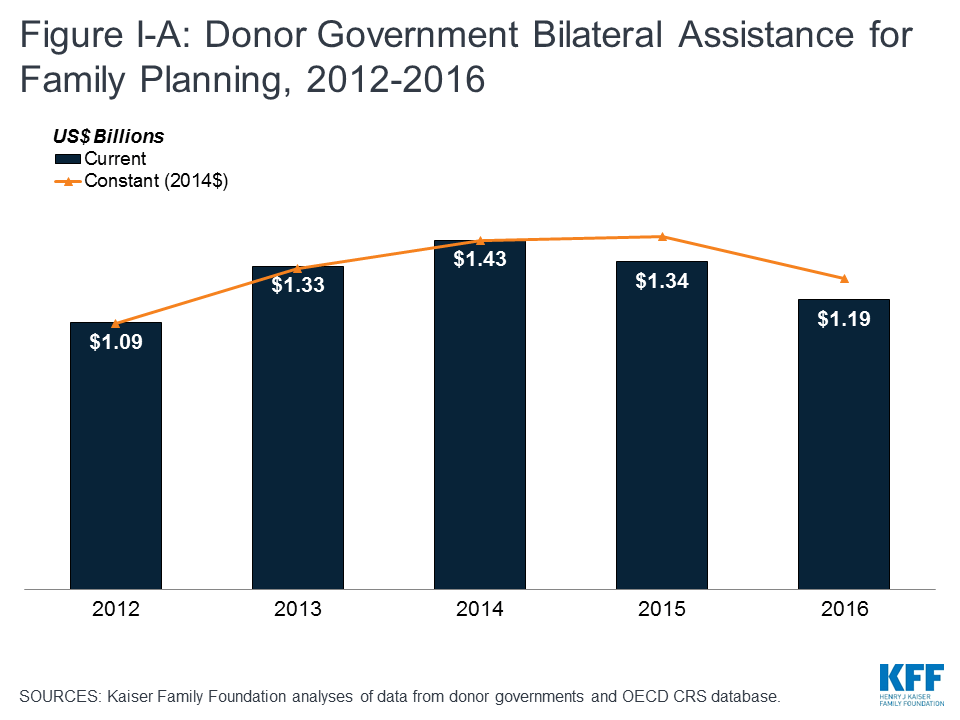
Figure I-A: Donor Government Bilateral Assistance for Family Planning, 2012-2016

Recent analysis finds that donor government funding for family planning is on the decline, even after accounting for currency fluctuations and other factors (see Figure I-A).4  Moreover, future funding is uncertain in large part due to the current fiscal and policy environment in the United States, the single largest government donor to family planning (providing 45 percent of bilateral funding in 2016). The Trump administration has proposed deep budget cuts to global family planning, including zeroing out the global family planning program budget in the President’s FY 2018 budget request. Congress has indicated that it will not support cuts of this magnitude, as evidenced by the FY 2018 Omnibus that included $607.5 million for family planning/reproductive health, matching the FY 2017 enacted level.5  However, the administration’s proposals to significantly reduce global family planning funding continue.6  Furthermore, the larger backdrop of US budgetary challenges is putting downward pressure on discretionary spending across the board. Because the US is the largest government donor to family planning, partner countries are particularly vulnerable to any potential US cuts. This is even more pronounced in the 24 USAID family planning priority countries,7  where the US provides an estimated 76 percent of donor support overall, including more than 90 percent in eight of these countries (see Figure I-B).8 
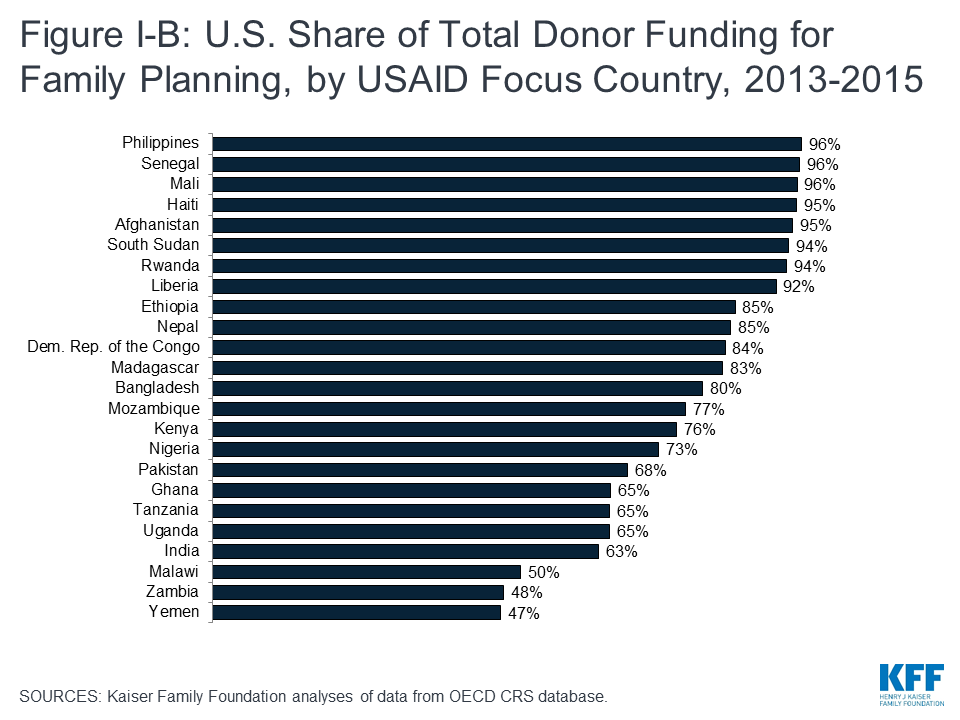
Figure I-B: U.S. Share of Total Donor Funding for Family Planning, by USAID Focus Country, 2013-2015

In addition, a number of recent US policy decisions regarding family planning further contribute to uncertainty. These include the administration’s withholding of funding to the United Nations Population Fund (UNFPA) under the Kemp-Kasten Amendment9  and the reinstatement and expansion of the Mexico City Policy (MCP), renamed Protecting Life in Global Health Assistance (PLGHA)10  by the current administration. On the latter, there remain many unanswered questions about the policy’s impact, but early analyses indicate that the expanded policy could apply to more than $7 billion in global health funding and, by conservative estimates, more than 1,000 foreign NGOs, likely leading to service coverage gaps in some geographic areas and for some populations.11 

Key Ideas and Proposals

Overarching Discussion Goal: Given uncertainty surrounding future family planning funding, it will be important for the main financing actors to engage in a more structured, transparent, and harmonized contingency planning process to help drive a rational prioritization of resources.

Participants identified ways to address and potentially mitigate financial and policy uncertainty, including:

  1. SUPPORT A MORE SYSTEMATIC ASSESSMENT OF COUNTRY VULNERABILITIES TO CHANGES IN EXTERNAL FINANCING, INCLUDING IDENTIFYING FACTORS/INDICATORS THAT COULD BE USED TO HELP PREDICT VULNERABILITY.
  • Participants discussed the need for clear and consistent metrics to assess the vulnerability of countries to changes in financing, including identifying metrics for measuring vulnerability.
    • Among the factors discussed were country income classification; other financial resources available (external and domestic sources); social insurance; and vulnerability of populations (including adolescents, women, and girls in humanitarian contexts).
  • Donors take varying approaches to country prioritization, using different criteria and processes. A review of their respective prioritization methodologies could allow donors, including USAID, and other stakeholders to proactively identify countries with the most need of external assistance and to scale funding flows accordingly.
  • There was discussion on how funding uncertainty affected USAID country mission decisions, which, in turn, could make some countries more vulnerable to changes. Specifically, it was noted that, faced with uncertainty, some missions may choose not to include family planning in their future country strategy and budget requests, which could affect actual services in the field.
  • Lastly, participants felt it was important to not just focus on country and implementer vulnerability; rather, it was also important to understand and document factors supporting resilience. Identification and documentation of lessons learned from countries, implementers, platforms, etc., that have demonstrated resilience to financial and policy changes and uncertainties could provide insight to future decision-making.
  1. RE-EXAMINE THE METHODOLOGY USED FOR PRIORITIZING USAID FAMILY PLANNING COUNTRIES TO SET THE STAGE FOR ENHANCED DONOR COORDINATION.
  • Participants discussed how best to prioritize US family planning priority countries/investments, the challenges to doing so, and opportunities for doing it better.
  • While USAID supports family planning programs in approximately 40 countries, it focuses its effort in 24 high-priority countries and the Ouagadougou Partnership countries. Such prioritization can serve many purposes, including helping to focus limited resources where need is greatest; assisting with contingency planning given funding uncertainty; and allowing for more proactive transition planning as the United States Government (USG) seeks to decrease its investments and in turn increase host country government spending over time. In the case of USAID’s family planning program, these 24 countries also align with US maternal and child health (MCH) investments (23 of the 24 countries are also USAID MCH priority countries).
  • At the same time, the list of priority countries has been static for many years,12  raising questions about whether there are better ways to prioritize countries to address emerging gaps or other challenges (e.g., the use of S-curves depicting the growth trajectory of modern contraceptive prevalence13 ).
  • In addition to prioritizing countries, participants discussed the need to better assess prioritization of service delivery within countries across both public and private sectors. Such efforts could be significantly aided with better data on service effectiveness. Key questions to ask might include: What is the most impactful set of services to support in a particular country? How could greater efficiencies be achieved? Are there interventions that should no longer be invested in? Can interventions be better matched programmatically and geographically to their positions on the modern contraceptive prevalence rate S-curve? Participants also asked what lessons could be learned from PEPFAR, which has undertaken such an exercise across their activities and redirected investments to more effective services.
  • Another issue raised was the need to map the range of donor family planning investments and country prioritization approaches. This not only could help to “right size” investments or redirect investments to where they are needed most, but also help to assess country vulnerabilities to funding shifts. For instance, donors might find instructive analyses of data like that in Figure I-B, which shows US family planning investments as a share of all donor investments in the 24 USAID family planning priority countries. Such analyses could be expanded to include all FP2020 countries.14 
  • Finally, it will be important for any family planning prioritization effort to be connected to USAID’s larger, agency-wide effort to harmonize country prioritization across programs and to identify factors that support country self-sufficiency.15 
  1. IDENTIFY WAYS IN WHICH THE LARGER FAMILY PLANNING COMMUNITY CAN SUPPORT A USG COUNTRY PRIORITIZATION PROCESS AND VULNERABILITY ASSESSMENT IN THE CONTEXT OF FUNDING UNCERTAINTY.
  • Participants identified several key areas where the larger community could support this process, including:
    • Proactively identifying the changes that could occur;
    • Convening leadership across donors to develop a plan to minimize disruption of family planning commodities and services in both public and private sectors;
    • Identifying the capacity of other stakeholders to step in, including prioritizing support to any gaps created by the loss of US technical leadership; and
    • Developing a strategy to measure and track the impact of “shocks” (e.g., funding reductions, abrupt transitions, policy changes) in 1) outcomes, 2) processes, 3) shifts in implementers and providers (including costs associated with these changes), and 4) lessons.
  1. WITH THE REINSTATEMENT AND EXPANSION OF MCP/PLGHA, THE USG AND/OR OTHER STAKEHOLDERS COULD DEVELOP A PROCESS TO IDENTIFY WHERE GAPS IN FAMILY PLANNING ACCESS ARE MOST LIKELY TO OCCUR AND, WHERE GAPS EXIST, IDENTIFY OTHER SOURCES OF FUNDING AND/OR ALTERNATE IMPLEMENTERS.
  • Participants stated that short-term efforts are needed to identify anticipated gaps and alternate sources of funding and implementers.
  • Participants discussed the many kinds of impact assessments that are needed to build on the USG efforts (some of which are underway) including:
    • short-term, more “real-time” assessments to identify needs and gaps; and
    • longer-term research (since the time between congressional appropriation and USAID programming means that effects of decreased funding and policy change may not be felt for several years).
  • The types of impacts to predict and assess include immediate service gaps, adverse health outcomes, effects on sustainability, and the additional costs of having to respond to the policy and/or seek new implementers.
  • As gaps or needs are identified, the community coordination effort should include more recent initiatives and newly engaged donors—SheDecides is one possible mechanism.16 
  1. THE MAIN FAMILY PLANNING FINANCING ACTORS (BILATERAL DONORS, GLOBAL FINANCING FACILITY, UNFPA, WORLD BANK, PRIVATE DONORS, THE PRIVATE SECTOR) COULD MORE PROACTIVELY ENGAGE IN ASSESSING AND RESPONDING TO FAMILY PLANNING AID VULNERABILITIES AND PRIORITIZING ALLOCATIONS USING EXISTING FORA.
  • It was noted that existing venues that bring together the main family planning stakeholders could be utilized more proactively and purposefully to discuss prioritization and planning for such change or “shocks” (e.g., funding reductions, abrupt transitions, policy changes). Specifically, participants identified the FP2020 Initiative as a potential vehicle for such efforts, including its Reference Group and Country Technical Teams.17 
  • These existing mechanisms are well poised to facilitate such discussions, which could be expanded to include other stakeholders (e.g., SheDecides) that may have resources to contribute.
  1. ENHANCE EFFORTS TO TRACK DOMESTIC RESOURCES FOR FAMILY PLANNING, INCLUDING ASSESSMENTS OF FISCAL SPACE AND POLITICAL WILL NEEDED TO SUPPORT INCREASED DOMESTIC INVESTMENT.
  • While there is a global estimate of the share of family planning expenditures provided by domestic governments (29 percent), data on domestic expenditures is significantly limited at this time.18  This was identified by participants as a critical data need. While there is work underway to assess what is currently being spent, it is limited to a subset of countries and will take some time.19 
  • Key points raised included the following:
    • It will be important to work with national governments to assist with resource tracking efforts, including through technical assistance. In some cases, systems may not be in place to easily track expenditures by program area; family planning may not be programmed as a separate line item; and/or some countries are decentralizing health programming and funding.
    • Experience suggests there is fiscal space for governments to increase their investments in family planning, but political will is also needed if such investments are to be secured; assessing political will, therefore, also be critical.20 
  • The US and other donors can work with countries to enhance the incentives to increase resources from their governments and to support/maintain the political will to do so; in some cases, this may also include the need to address increasingly decentralized decision-making.
  • To the extent that the US and other donors decide to transition out of countries, it will be important to provide technical assistance to support successful transitions, even when domestic resources are available.
    • Areas identified include supporting countries and local NGOs in developing ways to strengthen contracting mechanisms, including addressing payment delays from governments to NGOs; regarding the latter, some suggested that the USG or other donors could serve as a guarantor of government payments to support implementers of service delivery.
  1. UTILIZE INNOVATIVE FINANCING INSTRUMENTS, WHERE APPROPRIATE, TO INCENTIVIZE SUSTAINABILITY.
  • Discussions covered several possible approaches (note: while these approaches could relate to family planning programs more broadly, they could also take a more specific focus on commodities, for example).
    • Interest-free loans (e.g., DfID – 50 years, no interest);
    • Bridge funding mechanisms (e.g., UNICEF Vaccine Independence Initiative21 ), revolving funds (e.g., PAHO Revolving Fund22 );
    • Joint trust funds to secure longer-term investments (e.g., International Finance Facility for Immunization23 );
    • Debt relief / debt buy-downs (either for family planning alone and/or the larger health portfolio as long as commodities are included); and
    • Banks or donors serving as guarantors (note: there was some concern about fees charged by for-profit entities).

II. Country Transitions

Problem Statement and Background

Family planning gains may be at risk due to possible abrupt and/or accelerated country transitions by donors, including the US. At the same time, there is an opportunity to carefully plan and execute strategic transitions in close partnership with countries, which could in turn help to alleviate pressure on tight donor budgets.

Many donors, including USAID, are considering policies to reduce aid allocations to countries and strategically transition select countries away from traditional grant-based assistance. Middle-income countries, in particular, are thought to have increasing fiscal space for public spending and could take on all, or most, of what donor assistance is currently funding, if there is sufficient political will. However, assessing the ability of countries to do so and successfully managing such transitions are challenging.

First, country-level estimates of domestic government spending on family planning, which are critical to assess readiness for transitions as well as to ensure that family planning investments continue, are hard to define.24  While there are indications that domestic government spending on family planning is growing in a few middle-income countries—signaling that family planning is a domestic priority in some countries—the amounts are not significant in relation to anticipated needs.25  According to initial estimates from the UNFPA-NIDI Resource Flows Project, for 69 FP2020 countries—comprising low-income countries and some lower-middle-income countries—national government spending accounts for about 30 percent of family planning expenditures, international donors contribute 50 percent, and consumers’ out of pocket spending makes up the remaining 20 percent.26  Moreover, domestic spending priorities are also affected by health sector and budget structural reforms; many countries are decentralizing functions and budget planning to subnational entities and/or developing universal health care (UHC) schemes, which may or may not include family planning.

Second, each donor also takes a varying approach to country transitions, using different criteria and processes. These processes often do not align across donors and affect the outlook for transition success differently in each country. Family planning assistance is often project-focused, programmed off-budget, and channeled through nongovernmental entities. These approaches reflect the primary donors’ broad structural features, and the historic approach has important implications for the design and eventual success of any country transition.

As the USG looks to transition partner countries away from traditional aid it will be important to:

  1. Continue to maximize coordination among donors and other partners at a global level to minimize the possibility of a country experiencing an abrupt change in support and a major financing gap;
  2. Develop a “continuum” approach that recognizes where countries are in terms of their development trajectory and unmet need, and integrates each country’s unique vulnerabilities into assessments; and
  3. Learn from past transitions by USAID, many lessons of which come from USAID family planning programs, and by other donors (e.g., more recently, Gavi).

Key Ideas and Proposals

Overarching Discussion Goal: Focus on transparent and step-by-step transitions, with the goal of sustainable success rather than reacting in haste to (what we hope will be) short-term funding challenges, especially in terms of USG support.

Participants identified a number of ways to work towards this overarching goal, including:

  1. ENHANCE TRANSPARENCY AS A STRATEGY TO REDUCE UNCERTAINTY AND INCREASE THE LIKELIHOOD OF SUCCESS.
  • Participants emphasized building on the Modernizing Foreign Assistance Network (MFAN) recommendations.27 
  • It is critical to envision what transition success looks like across multiple dimensions such as financing, commodities, social norms, health and non-health outcomes. Some examples to consider:
    • Aim to get the closest countries to fully transition from all donor support or transition away from USG support as a first step?
    • Maximize health improvements? (e.g., Health Systems Strengthening Approach)
    • As a related discussion, also ask: are these dimensions and outcomes the same or different compared to current FP2020 goals?
  • There was emphasis on the need for USAID to share, discuss, and publicize the transition strategy with a wide range of stakeholders—implementing agencies, partner countries, other donors, civil society, etc. However, it is important to acknowledge the following:
    • There are still several unknown dimensions of possible transition scenarios. Will transition be specific to family planning programs, health sector-specific, or take on whole of country transitions?
    • Each of the scenarios (family planning-specific and health-sector wide) would differ in approach and in turn impact each other.
  • There was also discussion on the importance of costing and evaluation as part of thinking through a transition plan. Costing is important for potential alternative funders to understand what they are taking on. Evaluation is important for understanding exactly what results might need to be sustained as part of a transition.
  1. REVISIT CRITERIA TO BE USED AT DIFFERENT POINTS ALONG THE TRANSITION CONTINUUM FOR FAMILY PLANNING PROGRAMS.
  • Participants expressed the need to identify possible trigger indicators/thresholds beyond what USAID currently considers (total fertility rate and modern contraceptive prevalence rate) 28  to start a conversation about transition.
  • Quantitative criteria suggested include:
    • On youth bulge and/or security: share of population < 18 years old, or population density
    • On equity: coverage among the poor, geographic equity (urban-rural)
    • On quality: discontinuation rates
    • On health and outcomes for women and girls: births to < 18-year-old girls, child marriage
    • Domestic investments for family planning
    • Un/underemployment rate
  • Qualitative criteria suggested include:
    • Demonstrated commitment or political will to scale or reach the poor as part of the broader enabling environment
    • Social norms/demand for family planning
    • Ability of private sector to rapidly expand coverage in middle-income countries
    • Readiness to implement or scale programs across both public and private sectors
    • Readiness (social and financial) of citizens to take on family planning costs themselves
  • Participants also mentioned building-in a plan for post-transition monitoring, with defined indicators, in the initial strategy.
  • The comparison to MCC-style threshold criteria might also apply here; that is the possibility of setting appropriate indicators with thresholds for when a country is ready to begin discussion about the transition process.
  1. INCREASE DOMESTIC SPENDING ON FAMILY PLANNING, ESPECIALLY IN LOWER-MIDDLE-INCOME COUNTRIES AND/OR TOP TRANSITION CANDIDATES.
  • Among other options, participants stressed that donors should create incentives for increased domestic spending on global health priorities, including family planning, taking an integrated approach.
    • While co-financing has been used as a strategy for incentivizing domestic country spending, it is not yet part of the family planning landscape. It is worth noting, however, that many global health funders like Gavi, the Global Fund, and the Global Financing Facility (GFF) do employ co-financing requirements as one part of a transition strategy.
    • Innovative financing (e.g., Development Impact Bonds, Cash on Delivery Aid) offers one possibility; doing this as part of broader health reforms in-country is another option.
  • Establishing a “hand-off” to the GFF for countries at the top of the S-curve was also mentioned. The proposal would be that USAID funds the GFF to transition family planning, and accountability for family planning becomes on-budget.
  • Participants discussed the need to build an integrated “ask” to governments across global health priorities, which considers the fiscal space that is realistically available. Rather than aspirational, participants felt this approach could be operationalized by, for example, combining with multi-year funding commitments as in PEPFAR’s South Africa Partnership Framework. One hypothesis is that this would result in less competition with other global health priorities and would also open the possibility of synergies with other funding streams.
    • The “ask” should include a strong and well-integrated investment case, going beyond health to include development more broadly, and targeted to budget-holders in national and subnational governments. While this is being done in some contexts, efforts are somewhat ad-hoc and not connected to the budget allocation process.
  1. TAKE A “TOTAL MARKET APPROACH” TO TRANSITION.
  • As USG support is reduced, plan for sustaining and/or increasing provision by private, not-for-profit, and NGO partners, including faith-based providers, that help ensure access to high-quality voluntary family planning programs. Drawing on experiences in Latin America was suggested.29 
  • Relatedly, building capacity for governments to contract with such providers (note: also discussed with PEPFAR in the context of partnership frameworks); this may include building capacity of payers/purchasers as one part of broader health reforms.
  1. TO REINFORCE AND BUILD UPON LESSONS FROM PREVIOUS EXPERIENCES, SET UP A PROJECT, INITIATIVE, OR CLEARINGHOUSE ON TRANSITION (OR BUILD THIS INTO FP2020).
  • USAID has a strong track record of successfully transitioning family planning programs in some 15 countries by planning and preparing for long-term sustainability.
  • Collating, publishing, and discussing lessons learned from past family planning transitions, including USAID transitions more broadly, as well as past PEPFAR partnership frameworks, could serve as a helpful repository. One option would be to dedicate a section of the USAID-funded Knowledge for Health (K4H) to transition.30 
  1. RECONSIDER AND STRENGTHEN BROADER APPROACHES AND STRATEGIES TO TRANSITION.
  • Another issue raised includes working on building capacity to shift cultural and social norms related to the adoption of family planning—this includes working with traditional leaders, faith-based leaders, and others.
  • The idea of staggered transitions with a focus on continued support for programs for young people and vulnerable, harder-to-reach communities was discussed.
  • Identifying transitions that experience backsliding during or after their implementation was raised. Taking an intentional approach to responding to backsliding and having a tool kit that includes a range of potential corrective actions would be helpful.
  • Additional suggestions included bringing in “other partners” outside of family planning and extending beyond health circles; using language that resonates outside internal family planning circles (i.e., tailor terminology for ministries of finance vs. ministries of health vs. US policy audiences vs. other countries, etc.).
  • Prospectively evaluating and developing scenarios, using portfolio review data, creating dashboards of appropriation-obligation calendars, and informing a broad range of partners was mentioned.
  • Use the information collected to hold both donor and partner governments to account, share data and other relevant information with civil society in partner countries and in the US to enhance budget and performance accountability (note: some budget work with civil society organizations is already underway).
  • There was mixed feedback on using the term “graduation.”

III.  Commodities

Problem Statement and Background

The sustainability of contraceptive commodities provision remains at risk due to uncertainty about future donor support, especially from the US. This is further exacerbated by existing challenges including dependence on donors to fund family planning commodities, a lack of alignment across contraceptive supply chains, and the expected rapid growth in demand due to the youth bulge.

Many countries, especially low-income countries, continue to depend on donors to finance a large share of family planning commodities and related support (e.g., forecasting, procurement, supply chain, and logistics). The Reproductive Health Supplies Coalition (RHSC) reports that within the 69 FP2020 countries, users directly purchase 58 percent of commodities.31  Slightly less than half (45 percent) are provided through either donor (30 percent) or domestic government (15 percent) financing. The latter represent subsidies that may or may not be targeted to the poor or most vulnerable. In low-income countries, the proportion of commodities provided by donors is much higher, with domestic government funding accounting for a mere 2 percent (see Figure III-A).32 
Figure III-A: Proportion (%) of contraceptive funding by source in low-income countries

While there have been important advancements in strengthening contraceptive procurement and supply chains, existing mechanisms are not aligned across the health sector and, therefore, not necessarily maximizing efficiencies. In many LMICs, there are still parallel supply chains for family planning commodities—and other global health commodities, more broadly. Moreover, reliance on two major central contraceptive procurers (USAID and UNFPA) introduces both benefits and some risks for the sustainability of family planning commodity supplies. In addition to possible reductions in US funding, UNFPA Supplies, which provides about a quarter of all contraceptive commoditites in FP2020 countries, is facing a significant funding shortfall. These uncertainties create the impetus to address gaps and harmonize approaches across donors and other key actors.

Despite significant progress in increasing the number of women and girls worldwide using modern contraception in line with the FP2020 goal, analyses suggest there are still significant numbers of women and men who want to avoid pregnancy but are not using a modern method. Moreover, the number of women who rely on modern contraception in LMICs is projected to grow. Projections based on varying growth trajectories suggest there could be between 490 and 550 million contraceptive users by 2020 in 135 LMICs—this would result in an estimated 37 to 97 million additional users compared to 2016 levels.33  And, most of this need will be concentrated in some of the lowest-income countries, which also have the fewest resources available.

Uncertainty about future donor support introduces substantial risks to meeting the contraceptive needs of the growing number of women and men entering their reproductive years, especially given donor dependence in high-need lower-income countries. Furthermore, if financing from donors and domestic governments remains flat—or decreases—the cost burden could shift to users who already contribute the largest share to family planning commodity purchases. Recognizing there is no silver bullet, a set of reinforcing and catalytic approaches that take into account USG uncertainties are needed to meet anticipated increases in demand for family planning in the short-, medium-, and longer-term.

Key Ideas and Proposals

Overarching Discussion Goal: Advance toward satisfying the demand for family planning commodities, while also increasing sustainability and planning for uncertainty in future donor support.34 

Participants identified opportunities to decrease vulnerabilities and increase resilience across donors, domestic governments, and the private sector (both not-for-profit and for-profit), including:

  1. WHILE CHALLENGES AROUND PROCUREMENT AND DISTRIBUTION OF FAMILY PLANNING COMMODITIES ARE RELEVANT TO OTHER GLOBAL HEALTH AREAS MORE BROADLY, SOME COMPLEXITIES ARE UNIQUE TO FAMILY PLANNING.
  • Most—though not all—health commodities are provided as one product for a specific purpose, e.g., a vaccine for disease prevention or a specific curative drug. In contrast, participants acknowledged that family planning programs seek to maximize the number of products available (contraceptive method mix) to meet the wide range of needs across diverse populations. Furthermore, short-term methods (e.g., pills, condoms, and injectables) require continuous, uninterrupted product resupply to clients.
  • While the issue of fragmented and parallel supply chains applies to the global health commodity landscape more broadly, participants discussed complexities specific to family planning.
    • For example, current capacity to support global family planning procurement for the public sector is housed within two major organizations—USAID and UNFPA. Both actors, therefore, are central to the planning and designing of strategies to manage possible “shocks.”
    • USAID relies on US FDA-approval (or in some cases, approval by a Stringent Regulatory Authority or WHO prequalification) as the basis for procurement, while UNFPA uses WHO prequalification and country-level approvals for contraceptive procurement.
  • Managing multiple products and multiple manufacturers for the same/comparable products (e.g., implants), which may have different lifespans and specialized procedures for insertion/removal, creates added complexities.
  • One overarching point was that the quality of family planning commodities is important and needs to be integrated into all proposed approaches.
  1. ENHANCE COLLABORATION AROUND STRATEGIC RESOURCE ALLOCATION FOR FAMILY PLANNING COMMODITIES, OVER THE SHORT-, MEDIUM-, AND LONG-TERM.
  • In the short-term, participants stressed the need to enhance efficiencies at the global level by increasing data sharing and synchronizing strategic planning among the leadership of existing global platforms, including the FP2020 Reference Group, the RHSC Executive Committee, the GFF Donor Committee, as well as others outside the family planning space.
    • One suggested idea was to commission short- to medium-term contingency plans to prioritize donor resources available for family planning commodities from existing sources, as well as newly available funding streams, such as SheDecides.
      • It will be important to coordinate outreach and fundraising efforts to cover immediate and anticipated mid-term gaps.
      • This approach should also recognize that coordination is most effective when there is direct engagement by decision-making entities (e.g., governments, providers from the private and faith-based sectors, donors, etc.) to link decisions with financial flows.
  • Another proposal was to improve understanding of GFF’s current, and potential future, intersections with family planning commodity provision.
    • While GFF does not currently procure family planning commodities, closer engagement would be valuable to understand the role that GFF might play vis-à-vis family planning commodity procurement, as well as supply chain strengthening and harmonization across the health sector, more broadly.
  • Over the medium-term, participants suggested increasing the transparency of global, country, and local procurement to minimize overpayment, mark-ups, and large price variations, as well as resource misallocation.
  • In the longer-term, resources will be needed to develop new contraceptives, and to introduce new and newly adapted methods with an eye toward growing the method mix.
  1. IDENTIFY OPPORTUNITIES FOR GLOBAL ACTORS TO FURTHER HARMONIZE STRUCTURES AND PLANNING AT THE COUNTRY LEVEL FOR FAMILY PLANNING COMMODITIES—AND EXPLORE OPPORTUNITIES FOR SYNERGIES WITH OTHER HEALTH COMMODITIES.
  • Overall, the importance of focusing on structural factors was mentioned. Among the ideas discussed were ensuring provision of family planning commodities is included as part of broader health reforms in-country; continuing and accelerating supply chain integration where possible; and supporting, in tandem, larger health commodity supply chain efficiency, effectiveness, and sustainability.
  • Short-term ideas included:
    • Expanding upon and harmonizing the Country Investment Plan and GFF’s Investment Case as they relate to family planning commodities;
    • Recognizing the role of decentralized decision-making at the country level, formally documenting its impacts on commodity forecasting, procurement, and supply chain systems; and
    • Defining key indicators that demonstrate when countries have matured both in terms of social norms and private sector capacity, with an eye toward increasing private sector service delivery as a share of contraceptive commodity provision (e.g., Indonesia is one example of a mature middle-income country).
  • Medium-term ideas included:
    • Strengthening private sector procurement in select settings, possibly by expanding implementation of successful models of pooled procurement designed to support the private sector (both not-for-profit and for-profit). Examples include MedSource in Kenya and DoctorStore in India (which includes online shopping), available to individual providers.
    • Prioritizing donor and country financial flows to essential components of family planning commodities and supply chains. This includes supply chain management information systems (MIS), data collection, and analysis, which should be considered an important public good.
    • Ensuring adequate support to the human capacity needed to manage existing/new IT approaches and to analyze data for quality, and accurate analyses to support critical decision-making.
  • Over the longer-term, participants mentioned continuing efforts to simplify and harmonize regulatory approval to improve product access, especially across sub-Saharan Africa, and to facilitate product movement across borders to maximize flexibility of global suppliers to fill supply gaps.
    • Early lessons from PEPFAR and other organizations in addressing price and regulatory hurdles with ARTs should be reviewed and incorporated, as applicable.
  1. SUPPORT ASSESSMENTS TO BETTER UNDERSTAND THE OVERALL COMMODITIES LANDSCAPE AND IDENTIFY POTENTIAL GAPS AND POSSIBLE EFFICIENCIES.
  • Participants acknowledged the value of existing RHSC studies at the global level, but also pointed to outstanding questions around defining the entirety of the market and analyzing investments in terms of Couple Years of Protection (CYP) and changing method mixes, which are increasingly maturing to expand provision of long-acting reversible contraceptives (LARCs).
  • At the national level, market segmentation within countries will often require better data than are currently available; a more holistic understanding of public, private, faith-based, insurance schemes, etc., is needed.
  • Overall, there is a continued gap in understanding who the market is failing and designing effective responses in this space; management information systems are a critical link between service demand and projected need.
  • Continue to build on ongoing analyses of S-curve country status and demographics to predict global method mix demand and inform national and global marketplaces (e.g., Kenya is a leader in this process).
    • Linking demographic and S-curve analyses will be important to provide mid-term estimates of global demand for LARCs.
  • Increase communication and outreach to experts and policymakers to reinforce the technical and financing leadership role the USG plays as well as the expected increase in demand for family planning in the coming years.
  1. ENHANCE PROCUREMENT COORDINATION ACROSS PUBLIC AND PRIVATE SECTORS TO FURTHER IMPROVE PRICING AND ENSURE CONTRACEPTIVE SUPPLY SECURITY AS DEMAND GROWS.
  • In the short-term, it could be beneficial to explore procurement and broader supply chain- related lessons from other global entities and mechanisms including, but not limited to, Gavi and the Global Fund. Some specific suggestions are as follows:
    • Coordinate a learning meeting between Gavi, the Global Fund, and family planning procurers to share lessons learned.
    • Set the stage for decision-making by defining questions and related indicators to determine if and how to design future global market strategies in family planning to support procurement in the public and private sectors.
  • Commission studies and assessments to understand the potential benefits and costs of pooled procurement mechanisms. It would be important to understand if/how such approaches could help strengthen relationships with contraceptive commodities manufacturers, secure better prices, and ensure supply security in the public and private sectors.
    • Draft a set of scenarios for potential pooled procurement approaches to present to FP2020, RHSC, and GFF for consideration.
    • Define a study to model a “Gavi-type” approach to provide global market and long-term symbiotic partnership with manufacturers to ensure continuous supplies of commodities.
  • Considering the private sector is the primary source of commodities in many middle-income countries, it would also be important to study and better understand possibilities for centralized procurement for the “whole of private sector.”
  • Where feasible, participants discussed the possibility of introducing commodity co-financing for highly dependent partner countries in the medium-term. Some outstanding questions to consider:
    • How to do this if not via UNFPA?
    • Possible stand-alone platform alongside USAID procurement that allows co-financing or buy-ins to obtain access to prices?
    • New procurement public-private partnership that USAID could buy into?
  • When appropriate to the environment, participants also suggested considering other financing mechanisms to support local procurement, such as guarantor processes (insurers)?
    • Further, how could this be balanced by local/regional manufacturing capacity as part of economic development and development sustainability?
  • For all approaches, discussions focused on matching the best country candidates for testing novel interventions that decrease the need for external financing.
  1. EXPLORE THE POSSIBILITY OF A “GLOBAL PLANNING SUMMIT” ON FAMILY PLANNING COMMODITIES.
  • As planning for commodities is a medium- to long-term process, there was discussion around the possibility of a global planning summit to help ensure that contraceptive supply grows commensurately with demand. The purpose would be to review the status of global manufacturers and suppliers, and possibly to design medium- to long-term approaches for meeting projected growth in contraceptive demand. In addition to the key public sector procurers, participants suggested coordination with larger entities supporting private sector providers, such as insurers and groups like MedSource in Kenya and DoctorStore in India. By expanding the groups engaged, the global summit could contribute to a global “whole of market” understanding of manufacturing capacity and opportunities to increase efficiencies in procurement and logistics management for family planning commodities.

Endnotes

  1. FP2020, FP2020: The Way Ahead, 2017, Available at: http://progress.familyplanning2020.org/user/data/resources/download/FP2020_ProgressReport_PRINT_Single_LoRes.pdf, see page 6. ↩︎
  2. For more information, see CGD’s Aligning to 2020 Working Group Report (Silverman R, Glassman A, Aligning to 2020: How the FP2020 Core Partners Can Work Better, Together, Center for Global Development, 2016. Available at: https://www.cgdev.org/sites/default/files/Aligning-to-2020.PDF). ↩︎
  3. For an overview of current efforts to track domestic government expenditures for family planning see Track20’s report (Stover J, Chandler R, Expenditures on Family Planning in FP2020 Focus Countries in 2015, Track20, December 5, 2017. Available at: http://www.track20.org/download/pdf/Expenditures_Assessment_12.5.17.pdf). ↩︎
  4. Wexler A, Kates J, Lief E, Donor Government Funding for Family Planning in 2016, Kaiser Family Foundation, December 5, 2017. Available at: https://modern.kff.org/global-health-policy/report/donor-government-funding-for-family-planning-in-2016/. ↩︎
  5. Kaiser Family Foundation, President Signs FY18 Omnibus Bill, March 22, 2018. Available at: https://modern.kff.org/news-summary/congress-releases-fy18-omnibus/. ↩︎
  6. Kaiser Family Foundation, White House Releases FY 2019 Budget Request, February 13, 2018. Available at: https://modern.kff.org/news-summary/white-house-releases-fy19-budget-request/. ↩︎
  7. Family Planning Countries, USAID, last updated February 8, 2018. Available at: https://www.usaid.gov/what-we-do/global-health/family-planning/countries. ↩︎
  8. Kaiser Family Foundation analysis of data from OECD CRS database, accessed January 8, 2018. ↩︎
  9. Kaiser Family Foundation, UNFPA Funding & Kemp-Kasten: An Explainer, May 12, 2017. Available at: https://modern.kff.org/global-health-policy/fact-sheet/unfpa-funding-kemp-kasten-an-explainer/. ↩︎
  10. Kaiser Family Foundation, The Mexico City Policy: An Explainer, June 1, 2017. Available at: https://modern.kff.org/global-health-policy/fact-sheet/mexico-city-policy-explainer/. ↩︎
  11. Moss K, Kates J, How Many Foreign NGOs Are Subject to the Expanded Mexico City Policy? Kaiser Family Foundation, December 4, 2017. Available at: https://modern.kff.org/global-health-policy/issue-brief/how-many-foreign-ngos-are-subject-to-the-expanded-mexico-city-policy/. ↩︎
  12. For more information, refer to USAID’s Family Planning Program Overview (USAID, Family Planning Program Overview, April 2013. Available at: https://www.usaid.gov/sites/default/files/documents/1864/fp_overview.pdf). In 2003, an initial set of 13 priority countries was selected based on USAID’s allocation formula; 11 countries were added to the priority list under the Obama administration’s Global Health Initiative. More details can be found on page 8 of CGD’s Working Group Report (Silverman R, Glassman A, Aligning to 2020: How the FP2020 Core Partners Can Work Better, Together, Center for Global Development, 2016. Available at: https://www.cgdev.org/sites/default/files/Aligning-to-2020.PDF). ↩︎
  13. See Track20’s one-pager on mCPR growth (Track20, The S-Curve: Putting mCPR Growth in Context, October 2017. Available at: http://www.track20.org/download/pdf/S_Curve_One_Pager.pdf). ↩︎
  14. A list of FP2020’s focus countries can be found on the FP2020 website (FP2020, All Countries. Available at: http://www.familyplanning2020.org/entities). ↩︎
  15. Rose S, Collinson E, Kalow J, Working Itself Out of a Job: USAID and Smart Strategic Transitions, Center for Global Development, December 2017. Available at: https://www.cgdev.org/sites/default/files/working-itself-out-job-usaid-and-smart-strategic-transitions.pdf. ↩︎
  16. More information on SheDecides can be found at: https://www.shedecides.com/. ↩︎
  17. For details on the FP2020 Reference Group, see the FP2020 website (FP2020, The FP2020 Reference Group. Available at: http://www.familyplanning2020.org/about-us/reference-group). ↩︎
  18. See page 83, Figure 5 of FP2020’s latest progress report (FP2020, FP2020 The Way Ahead, 2017. Available at: http://progress.familyplanning2020.org/user/data/resources/download/FP2020_ProgressReport_PRINT_Single_LoRes.pdf). ↩︎
  19. For a more detailed description, refer to Track20’s report on family planning expenditures (Stover J, Chandler R, Expenditures on Family Planning in FP2020 Focus Countries in 2015, Track20, December 5, 2017. Available at: http://www.track20.org/download/pdf/Expenditures_Assessment_12.5.17.pdf). ↩︎
  20. Experience in Latin America shows that progress of family planning programs was sustained following USAID graduation and phase-out, driven by institutionalizing family planning in the public, NGO and private sector. Many governments increased procurement budgets or developed line items, and sustained their commitments over the years. See pages 54-55 in MEASURE Evaluation’s report on Family Planning in Latin American and the Caribbean (Bertrand J, Ward V, Santiso-Galvez R, Family Planning in Latin America and the Caribbean: The Achievements of 50 Years, MEASURE Evaluation, 2015. Available at: https://www.measureevaluation.org/resources/publications/tr-15-101). ↩︎
  21. More information can be found in a UNICEF press release (UNICEF, New funding will allow countries to secure sustainable vaccine supplies and reach children more quickly, December 13, 2017. Available at: https://www.unicef.org/media/media_102311.html). ↩︎
  22. More information can be found on PAHO’s Revolving Fund website at: http://www.paho.org/hq/index.php?option=com_content&view=article&id=1864&Itemid=4135. ↩︎
  23. More information on the International Finance Facility for Immunization can be found at: https://www.iffim.org/. ↩︎
  24. More details are in the FP2020 progress report (FP2020, “Indicator 12: Domestic Government Expenditures On Family Planning” in FP2020 The Way Ahead, 2017. Available at: http://progress.familyplanning2020.org/en/measurement-section/domestic-government-expenditures-on-family-planning-core-indicator-12). ↩︎
  25. Commitments from three countries, India, Bangladesh, and Indonesia account for the lion’s share of the $4 billion pledged by lower-middle-income country governments; though it is important to note that some countries have not yet delivered on commitments made at the 2012 Summit. For more information, refer to a CGD blog (Silverman R, Family Planning Summit Raises Much-Needed Funds. Now It’s Time for Donors to Stop Being Polite and Start Getting Real, Center for Global Development Global Health Policy Blog, July 13, 2017. Available at: https://www.cgdev.org/blog/family-planning-summit-raises-much-needed-funds-now-its-time-donors-stop-being-polite) and a Devex article (Edwards S, How significant were the pledges at the London Family Planning Summit?, Devex, July 26, 2017. Available at: https://www.devex.com/news/how-significant-were-the-pledges-at-the-london-family-planning-summit-90688). ↩︎
  26. FP2020, FP2020: The Way Ahead, 2017, Available at: http://progress.familyplanning2020.org/user/data/resources/download/FP2020_ProgressReport_PRINT_Single_LoRes.pdf, see page 83. ↩︎
  27. For a list of these recommendations, refer to MFAN’s two-pager (MFAN, Principles for Strategic Transitions from Development Aid, November 2017. Available at: http://modernizeaid.net/wp-content/uploads/2017/11/MFAN-Principles-for-Strategic-Transitions.pdf). ↩︎
  28. Per USAID’s current strategy to transition family planning programs, as outlined in a 2006 technical note, the trigger indicators used to start the process are total fertility rate less than or equal to 3.4 and modern contraceptive prevalence rate 48 percent or greater. USAID’s Office of Population and Reproductive Health is currently revising its strategy. In addition, USAID is also developing agency-wide transition metrics. ↩︎
  29. Examples of countries in the LAC region that have successfully graduated from USAID Family Planning assistance include Brazil, Chile, Colombia, Mexico, Jamaica, El Salvador, Nicaragua, Honduras, Peru, Paraguay, and the Dominican Republic. Refer also to MEASURE Evaluation’s 2015 report (Bertrand J, Ward V, Santiso-Galvez, Family Planning in Latin America and the Caribbean: The Achievements of 50 Years, MEASURE Evaluation, 2015. Available at: https://www.measureevaluation.org/resources/publications/tr-15-101). ↩︎
  30. More information on K4H is at: https://www.k4health.org/. ↩︎
  31. Reproductive Health Supplies Coalition, Global Contraceptive Commodity Gap Analysis, 2017. Available at:  https://www.rhsupplies.org/uploads/tx_rhscpublications/Global_Contraceptive_Commodity_Gap_Analysis_2016.pdf. ↩︎
  32. Estimate compiled by USAID, based on Avenir Health data and Global Contraceptive Commodity Gap Analysis Reproductive Health Supplies Coalition, 2016. For more information, refer to the CGD blog on family planning funding (Silverman R, Global Family Planning Funding – What Should Funders Be Thinking About Now?, Center for Global Development Global Health Policy Blog, December 20, 2016. Available at: https://www.cgdev.org/blog/global-family-planning-funding-what-should-funders-be-thinking-about-now). ↩︎
  33. Reproductive Health Supplies Coalition, Global Contraceptive Commodity Gap Analysis, 2017. Available at:  https://www.rhsupplies.org/uploads/tx_rhscpublications/Global_Contraceptive_Commodity_Gap_Analysis_2016.pdf, see page 5. ↩︎
  34. In line with FP2020 indicator 4: “Percentage of women whose demand is satisfied with a modern method of contraception.” ↩︎

Health and Access to Care and Coverage for Lesbian, Gay, Bisexual, and Transgender (LGBT) Individuals in the U.S.

Authors: Jennifer Kates, Usha Ranji, Adara Beamesderfer, Alina Salganicoff, and Lindsey Dawson
Published: May 3, 2018

Executive Summary

Lesbian, gay, bisexual, and transgender (LGBT) individuals often face challenges and barriers to accessing needed health services and, as a result, can experience worse health outcomes. These challenges can include stigma, discrimination, violence, and rejection by families and communities, as well as other barriers, such as inequality in the workplace and health insurance sectors, the provision of substandard care, and outright denial of care because of an individual’s sexual orientation or gender identity.1 ,2 ,3  

While LGBT individuals have many of the same health concerns as the general population, they experience certain health challenges at higher rates, and also face several unique health challenges. In particular, research suggests that some subgroups of the LGBT community are more likely to suffer from certain chronic conditions and face higher prevalence and earlier onset of disabilities compared to heterosexuals. Other major health concerns include HIV/AIDS, mental illness, substance use, and sexual and physical violence. In addition to the higher rates of illness and health challenges, some LGBT individuals are more likely to experience challenges obtaining care. Barriers include gaps in coverage for certain groups, cost-related hurdles, and stigma, including poor treatment from health care providers.

Several recent changes within the legal and policy landscape have served to increase access to care and insurance for LGBT individuals and their families. Most notably these include the passage of the Affordable Care Act (ACA) and the Supreme Court’s overturning of a major portion of the Defense of Marriage Act (DOMA) in United States v. Windsor and subsequent ruling in Obergefell v. Hodges legalizing same-sex marriage nationwide. The ACA expands access to health insurance coverage for millions, including LGBT individuals, and contains specific protections related to sexual orientation and gender identity, although recent actions taken by the Trump Administration have sought to scale back some of these gains. The Supreme Court’s 2013 ruling on DOMA resulted in federal recognition of same-sex marriages for the first time and paved the way for recognition in many more states and its 2015 decision in Obergefell ruled that the Fourteenth Amendment requires a state to license same-sex marriages and to recognize such marriages performed out-of-state, thereby further expanding access and coverage across the country.

This issue brief provides an overview of what is known about LGBT health status, coverage, and access in the United States, and reviews the implications of the ACA, the Supreme Court rulings on marriage equality, and other recent policy developments for LGBT individuals and their families going forward.

Issue Brief: The Lgbt Community

While there is no single definition of the “LGBT community” – indeed, it is a diverse and multidimensional group of individuals with unique identities and experiences, and variations by race/ethnicity, income, and other characteristics – LGBT individuals share the common experience of often being stigmatized due to their sexual orientation, gender identity, and/or gender expression.4   In its landmark 2011 report, The Health of Lesbian, Gay, Bisexual, and Transgender People: Building a Foundation for Better Understanding, the Institute of Medicine defines sexual orientation as “an enduring pattern of or disposition to experience sexual or romantic desires for, and relationships with, people of one’s same sex, the other sex, or both sexes.”5  This definition incorporates elements of attraction, behavior, and identity. It is important to note that for some individuals, their sexual identity does not necessarily fall into any specific category but, rather, exists along a spectrum. In addition, not all persons who engage in same-sex behavior or experience same-sex attraction identify as lesbian, gay, or bisexual.

Gender Identity refers to “an individual’s internal sense of being male, female, or something else. Since gender identity is internal, one’s gender identity is not necessarily visible to others.”6  Additionally, gender expression and gender role conformity further describe the extent to which a person does or does not adhere to expected gender norms and roles. Transgender refers to individuals whose sex at birth is different from their identity as male, female, or elsewhere along the gender spectrum. People who identify as transgender may live their lives as the opposite gender, and may seek prescription pharmacologic therapy and/or surgical transformation. Transgender people may identify as heterosexual, lesbian, gay, or bisexual, or somewhere else along the spectrum of sexual identity.

Lastly, while sexual orientation and gender identity are important aspects of an individual’s identity, they interact with many other factors, including sex, race/ethnicity, and class. The intersection of these characteristics helps to shape an individual’s health, access to care, and experience with the health care system.

Population Characteristics

Assessing the health needs and barriers to care of the LGBT population has been challenging due to the historical lack of data collection on sexual orientation and gender identity. While some health surveys have asked about sexual orientation, it has not been routine to collect and analyze data on sexual orientation and gender identity in major health surveys, particularly nationally representative ones, meaning that much of the data available to date have been from smaller, non-representative studies and convenience samples. Where data have been collected, they have mostly focused on same-sex couples using data systems that collect information on relationship status.7  In addition, where data are available for individuals, there is more information about lesbian, gay, and bisexual persons than transgender individuals (sometimes due to design and other times due to sample limitations). There has been growing recognition of the need for research focused on the LGBT community, and the ACA instituted new federal data collection requirements on disparities, which include sexual orientation and gender identity (described below). The National Health Interview Survey (NHIS), a nationally representative survey and the principal source of information on the health of the U.S. population, began including a question on sexual orientation in its 2013 survey and the first round of findings were released in July 2014.

The latest data available on the size and characteristics of the LGBT population are as follows:
  • Data on the size of the LGBT population in the United States range. The most recent data from the NHIS  indicate that 2.8% of adults ages 18 and older in the U.S. identify as lesbian, gay, or bisexual, equating to more than 5.5 million people.8  Recent Gallup poll data have found slightly higher rates of LGBT identification of 4.1%, or about 10 million adults.9  Estimates may vary due to differing methodologies for data collection.  Most of these surveys include only those who self-identify as LGB10  and do not include those who may have engaged in same-sex behavior or have same-sex attraction but do not identify as gay, lesbian, or bisexual. Other studies have looked beyond self-identification, to include behavior and attraction, and obtained higher estimates, including one that found that 10% of adults reported experience with same-sex partners.11  In addition, a recent analysis indicates that standard survey measures appear to significantly underestimate non-heterosexual identity and same-sex sexual experiences.12 
  • Racial and ethnic minorities, young people, and women are more likely than their counterparts to identify as LGBT (Figure 1).13 
Figure 1: Demographic Characteristics of LGBT Americans
  • The Youth Risk Behavior Surveillance System (YRBSS), a nationally representative survey of high school students, asks about sexual identity and sex of sexual contacts. It found that in 2015, 8% of high school students identified as LGB and 6.3% had same sex sexual contact. Demonstrating that sex of sexual contacts is not always an indication of sexual identity, among students who said they had sexual contact only with partners of the same-sex or both sexes, 25% identified as heterosexual.14 
  • Data on those who identify as transgender are limited but a recent study found that an estimated 0.6% of the U.S. population is transgender, equating to approximately 1.4 million people.15 
  • Estimates of self-identified LGBT individuals also vary by state. According to a 2017 Gallup poll, the share of adults who identify as LGBT ranges from a low of 2.0% in South Dakota to a high of 8.6% in the District of Columbia (followed by 5.3% in Vermont).16  This range could reflect local policies and societal attitudes regarding LGBT equality, which may be correlated with an individual’s willingness to self-identify as LGBT or live in a certain locale.
  • Nearly one quarter (23%) of LGBT individuals indicate they are married (including those in opposite-sex and same-sex marriages).17  The share reporting that they are married to a same sex spouse has risen over time, from 7.9% in 2015, in the months prior to the Supreme Court’s Obergefell decision, to 10.2%, two years after the decision.18 
  • According to the 2016 American Community Survey, a smaller share of same-sex couples (17%) is raising children compared to heterosexual couples (39%). A greater share of female couples (23%) are raising children compared to male couples (10%).19 
  • Compared to the general population, LGBT people are disproportionately poor overall, although there is variation between subgroups. A 2013 Pew Research poll of LGBT individuals found that about 4 in 10 (39%) earned $30,000 or less per year, compared to 28% of the U.S. population overall.20  Poverty rates on average are higher among lesbian and bisexual women, young people, and African Americans.21  According to an analysis of the 2006-2010 National Survey of Family Growth, more than one-quarter (28%) of lesbian and bisexual women are poor, compared with 21% of heterosexual women. Just over 1 in 5 gay and bisexual men (23%) are poor, compared to 15% of heterosexual men. However, when comparing couples, lesbian couples have the highest poverty rates, followed by heterosexual couples and male same-sex couples. Further, a 2015 survey of 27,715 transgender people from across the U.S. found that one-third (32%) of respondents had an annual income of less than $10,000 compared to 23% of the US population.22 

Issue Brief: Health Challenges

Health is shaped by a host of social, economic, and structural factors.23  For LGBT individuals, these factors include the experience and impact of discrimination, stigma, and ostracism which affect health outcomes, access, and interaction with the health system care.24 ,25 , 26  Research available to date finds that while LGBT people have many of the same health concerns as the general population, they experience some health challenges at higher rates, and face several unique health challenges.

Chronic Conditions

Studies have found that LGBT people experience worse physical health compared to their heterosexual and non-transgender counterparts.27 , 28 
Figure 2: Health Status Among Adults 18-64, by Sexual Orientation, 2015
  • A recent literature review found that self-identified LGB individuals are more likely than heterosexuals to rate their health as poor, have more chronic conditions, and have higher prevalence and earlier onset of disabilities. Overall, LGB people report more asthma diagnoses, headaches, allergies, osteoarthritis, and gastro-intestinal problems than heterosexual individuals.29 
  •  Additionally, there are differences between subgroups within the LGBT community. Lesbian and bisexual women report poorer overall physical health and higher rates of asthma, urinary tract infections, and Hepatitis B and C than heterosexual women. Lesbian and bisexual women also report heightened risk for and diagnosis of some cancers and higher rates of cardiovascular disease diagnosis. Similarly, gay and bisexual men report more cancer diagnoses and lower survival rates, higher rates of cardiovascular disease and risk factors, as well as higher total numbers of acute and chronic health conditions such as headaches and urinary incontinence than heterosexual men.30 
  •  According to data from the NHIS, fewer bisexual women reported excellent or very good health compared to heterosexual women and lesbians. Similarly, fewer bisexual men reported good/excellent health compared to gay or heterosexual men. (Figure 2)31   In a separate survey, fewer transgender individuals report very good or excellent health than the rates found in NHIS for LGB people.32   Similarly, a study of Massachusetts residents, transgender persons are the least likely among LGBT individuals to self-report their health as Excellent or Very Good (67% vs. 79%) and are twice as likely to report limitations in daily activities due to impairment of health problems (33% vs. 16%).33 
  •  LGB individuals on average have higher rates of some risk factors for chronic illnesses. Obesity rates are higher among lesbian and bisexual women compared to heterosexual women, but are lowest among gay men. However, there were no significant differences by sexual orientation for women or men in rates of meeting physical activity guidelines.

HIV/AIDS and Sexually Transmitted Infections (STIs)

One of the most significant health challenges facing the LGBT community has been the HIV/AIDS epidemic’s impact on gay and bisexual men, and transgender women. After experiencing a dramatic rise in new infections in the 1980s, efforts by the gay community and public health officials helped to bring HIV incidence down; however, in recent years, new infections among gay and bisexual men in the U.S. have been on the rise, the only group for which infections are increasing (Figure 3).
Figure 3: Impact of HIV on Gay and Bisexual Men in the U.S.
  • In 2014, gay and bisexual men and other men who have sex with men (MSM), while representing an estimated 2% of the U.S. population, accounted for six in ten (61%) people living with HIV in the United States, and 70% of new HIV infections.34 ,35 
  •  Between 2008 and 2014, annual HIV infections stabilized among all MSM but this trend was not observed among all racial/ethinic groups. HIV infections declined 18% among white MSM (from 9,000 to 7,400 infections), stabilized among black MSM (about 10,000 infections per year) but increased by 20% among Latino MSM (from 6,100 to 7,300 infections).36 
  •  Despite a stabilizing in rates, young, black MSM accounted for more new diagnoses in 2015 than any other subgroup by race/ethnicity, age and sex.37 
  •  Transgender women, particularly transgender women of color, are also at high risk of HIV. A 2013 study estimated HIV prevalence among transgender women to be 22%.38 
  •  The CDC recommends routine HIV screening in health-care settings for all adults, aged 13-64, and repeat screening, at least annually, for those at high risk (e.g., that sexually active gay and bisexual men may benefit from more frequent testing, such as every 3 to 6 months).39  However, according to a nationally representative survey conducted by the Kaiser Family Foundation, many do not meet this level. While seven in ten gay and bisexual men say they have gotten an HIV test at some point in their lives, just 30 percent say they were tested within the past Three in ten (30%) say they have never been tested for HIV, rising to 44% of those under age 35. The leading reason that men give for not having had a recent test is that they do not consider themselves at risk for HIV.40 
  •  Access to medical care is critical for the health of people with HIV. Among MSM diagnosed with HIV in 2014, 61% received care and 51% achieved viral suppression.41  In addition, according to the Kaiser survey, three in ten (31%) gay and bisexual men either say they don’t have a regular place to go for medical care or they don’t have a regular physician. These men (who tend to be younger, lower-income, and more racially diverse) are also less likely to report discussing HIV with doctors or getting tested for HIV.
  •  To date, there has only been one likely case of female-to-female sexual transmission of HIV in the United States.42  However, HIV is an issue that affects lesbians as well as bisexual women, since individuals who identify as lesbian may still have sexual relationships with men, and lesbians and bisexual women are also at risk of HIV via transmission modes that do not involve sexual contact (such as injection drug use).
  •  STI rates are higher among some LGB groups than heterosexuals, and rates have been increasing for some infections. For example, MSM account for more than eight in ten (82%) new gonorrhea and primary and secondary syphilis cases when the gender of sex partner is known. In addition, antibiotic-resistant gonorrhea
  •  may be higher among MSM.43  MSM also account for 10% of all new hepatitis A infections and 20% of new hepatitis B infections.44  Given the strong interaction between HIV and other STIs, this is a particular concern for MSM.
  •  Human Papillomavirus (HPV) is the most common STI and is a major cause of cervical, anal, and mouth cancers.45  MSM are 17 times more likely to develop anal cancer than men who only have sex with women.46  The HPV vaccine, which protects against certain strains of the virus that are associated with anal cancer, could reduce anal cancer rates among future generations of MSM

Behavioral and Mental Health

Research has found that LGBT individuals are at elevated risk for some mental health and behavioral health conditions, with studies finding that they are two and a half times more likely to experience depression, anxiety, and substance misuse.47 ,48  The history of discrimination and stigma, including lack of acceptance from family members, contributes to higher rates of mental illness.49 ,50  In fact, until the 1970s, homosexuality was considered a mental illness in the Diagnostic and Statistical Manual (DSM) of Mental Disorders and by various professional organizations. The diagnosis “gender dysphoria,” which has replaced the transgender diagnosis in the DSM, is intended to communicate the emotional distress that transgender people may experience as well as promote insurance coverage of services related to gender transition, such as counseling or hormone therapy, that typically have not been covered by insurance plans51  Further, stigma and prejudice against sexual and gender minorities remain pervasive and continue to have negative consequences for the mental health of the LGBT population.52 

  • The recent NHIS provides the first national comparisons of gay, lesbian and bisexual adults to heterosexual adults on alcohol consumption, smoking status, and one measure of mental health status (Table 1).
    • Heavy consummation of alcoholic beverages during at least one day in the past year was reported by more bisexual (47%) and gay or lesbian (36%) adults than heterosexual adults (28%). Rates among men of all sexual orientations were substantially higher than for women.
    • Smoking rates were higher among LGB adults compared to heterosexuals. A separate meta-analysis of several studies found that overall, LGBT people smoke cigarettes at 1.5 to 2.5 times the rate of heterosexual and non-transgender people.53 
    • Nearly one in six bisexual women experienced serious psychological distress in the past 30 days, more than three times the rate of heterosexual women. Approximately 3% of heterosexual men reported experiencing serious psychological distress.
  • Other studies have used state-level data or sample populations to identify mental health trends among LGBT individuals. Nearly one fifth (19%) of bisexual adults in Massachusetts report they had recently seriously considered suicide, compared to 4% of lesbian and gay adults and 3% of heterosexuals.54  There are notable differences between subgroups, with the rate highest among bisexual women (26%), followed by bisexual men (11%), gay men (6%), and approximately 3% among all other subgroups. Another nationwide study found a reported 41% prevalence of suicide attempts among the transgender population.55 
  • Research suggests that MSM have higher use of certain substances. One study has estimated that MSM are more than 12 times as likely to use amphetamines and almost 10 times as likely to use heroin as heterosexual men. However, it’s important to note that research in this field is older and data are not necessarily comparable to the heterosexual population.56 

Sexual Assault and Physical Violence

Sexual assault and physical violence can have lasting consequences for victims, families, and communities.57  LGBT individuals experience higher rates of sexual and physical violence compared to heterosexual and non-transgender individuals.  Violence toward LGBT people has led to public policy responses. For example, federal legislation as well as some state laws allow for the classification of violence based on gender identity or sexual orientation bias as a “hate crime,” which has implications for penalties as well as funding to states and locales for deterrence and surveillance of these crimes.58   Key statistics include the following:
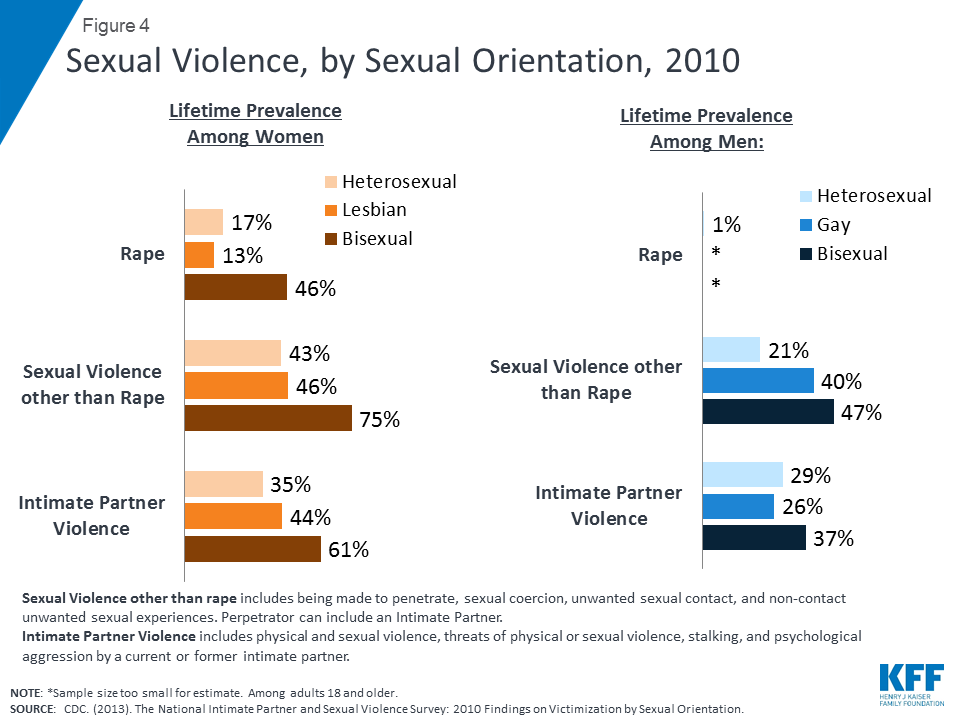
  • A recent poll of LGBT adults found that two thirds had experienced some form of discrimination because of their sexual orientation or gender identity, including subjection to slurs, rejection by a friend or family member, being physically threatened or attacked, receiving poor service at a place of business or treated unfairly by an employer, or made to feel unwelcome at a place of worship; a full 30% said they had been physically threatened or attacked.59 
  • Many women and men have experienced some form of sexual violence, but the rates are significantly higher among some LGBT groups. It is estimated that almost half (46%) of bisexual women have been raped, as have 17% of heterosexual and 13% of lesbian women. More than four in ten heterosexual and lesbian women and the majority (75%) of bisexual women have experienced other forms of sexual violence, such as coercion or harassment. Six in ten (61%) bisexual women have encountered intimate partner violence (IPV), as have 44% of lesbian and 35% of heterosexual women (Figure 4).60 
Figure 4: Sexual Violence, by Sexual Orientation, 2010
  • While sexual violence rates are higher among women overall, bisexual and gay men experience significantly higher rates than heterosexual men. Four in ten gay men and nearly half of bisexual men have encountered sexual violence other than rape. More than one-third (37%) of bisexual men have faced partner violence. For both men and women, the perpetrators were predominantly male.
  • Anti-LGBT bias also puts LGBT people at risk for physical violence. According to the FBI’s crime reporting surveillance, one in five single-bias incident hate crimes was due to sexual orientation bias.61  Studies using convenience samples have shown a significant number of LGBT individuals have been victims of physical and verbal assaults, as well as personal property damage, due to their sexual orientation or gender identity.62  One recent nationally representative study examined self-reported experiences with physical violence due to sexual orientation among gay men, lesbian women, and bisexual individuals, and found almost 8% of individuals have experienced physical violence once and 5.5% have experience physical violence at least twice. Gay men were the most likely to experience physical violence due to their sexual orientation.63  Transgender people, particularly transgender women and transgender people of color, are also at particular risk of physical violence.64  Statistics from the National Coalition of Anti-Violence Programs indicate that half of the victims of anti-LGBT bias-motivated murders in 2012 were transgender women and the majority were also people of color.65 

Adolescent and Young Adult Health

Adolescence and young adulthood are often times when individuals begin to identify as LGBT and in fact high school students identify as LGB at higher rates than do adults in any age group.66 ,67  As mentioned above, the YRBS recently found that 89% of high school students identify as heterosexual, 2% as gay or lesbian, 6.0% bisexual, and 3% reported that they were unsure of their sexual identity.68  While these times can be challenging for many individuals, they are often especially so for LGBT youth. Despite growing societal acceptance and understanding, some young people still suffer discrimination at the hands of their family and friends and in their schools and communities, experiences which can lead to serious challenges, such as housing problems, that affect health. There is growing awareness about bullying and violence affecting LGBT youth, including dating and sexual violence. These include efforts to promote greater attention to fostering inclusive school climates, teaching youth about online safety, establishment of reporting processes in schools and communities when violence or bullying occur, and referring young people for professional mental and behavioral health services when needed. In addition, LGB high school students report engaging in some higher risk taking activities than do their heterosexual peers including with respect to actives such as drug, alcohol use and sexual behavior.69  Key statistics include the following:

  • Like their adult counterparts, students who identify as lesbian, gay, or bisexual, experience higher rates of mental illness and suicidality. LGB students more likely to have felt sad or hopeless compared to their heterosexual peers (60% v. 26%), seriously considered suicide (43% v. 15%), or attempted suicide (29% v. 6%).70 
  • LGB students are also more likely to engage in certain risk taking activities, including having ever tried alcohol (75% v. 63%), marijuana (53% v. 38%), or cocaine (11% v. 4%). LGB students were also less likely to report condom use during last sexual intercourse than heterosexual students (48% v. 58%).71 
  • Like their adult counterparts, youth who identify as a sexual or gender minority experience higher rates of discrimination compared to the general population. Additionally, LGBT youth are more likely to be homeless and live in poverty than non-LGBT youth. Research has found that parental rejection can increase the likelihood that an LGBT youth will suffer from depression, attempt suicide, use illegal drugs, and/or engage in risky sexual behaviors.72 
  • Approximately 40% of homeless youth are LGBT, and the leading reasons for homelessness among this group are due to family rejection.73 
  • Almost two thirds (64%) of LGB students and 4 out of 10 (44%) transgender students report feeling unsafe at school because of their sexual orientation or gender identity.74 
  • LGB students experience higher rates of violence than do heterosexual students including having been threatened or injured with a weapon, been in a physical fight, or injured in a fight. The share of students who have experienced dating violence is two times higher among LGB students than heterosexual students (18% v 8%) and more than three times as many LGB youth report ever physically forced to have sexual intercourse against their will, compared to their heterosexual peers (18% vs. 5%).75 
  • Recent research estimates that 20,000 LGBT youth will receive conversion therapy from a licensed health care provider before the age of 18 and an additional 57,000 youth will receive “treatment” from a religious or spiritual advisor.76  This is contrary to the recommendation from professional medical organizations, including the American Psychological Association, American Medical Association, and America Association of Pediatrics, which oppose the practice citing its impact as harmful and ineffective.77 

Insurance Coverage and Access to Care

Research has shown that LGBT populations have different patterns of health coverage and utilization of services and has begun to document gaps within the delivery system in meeting the needs of the LGBT population.

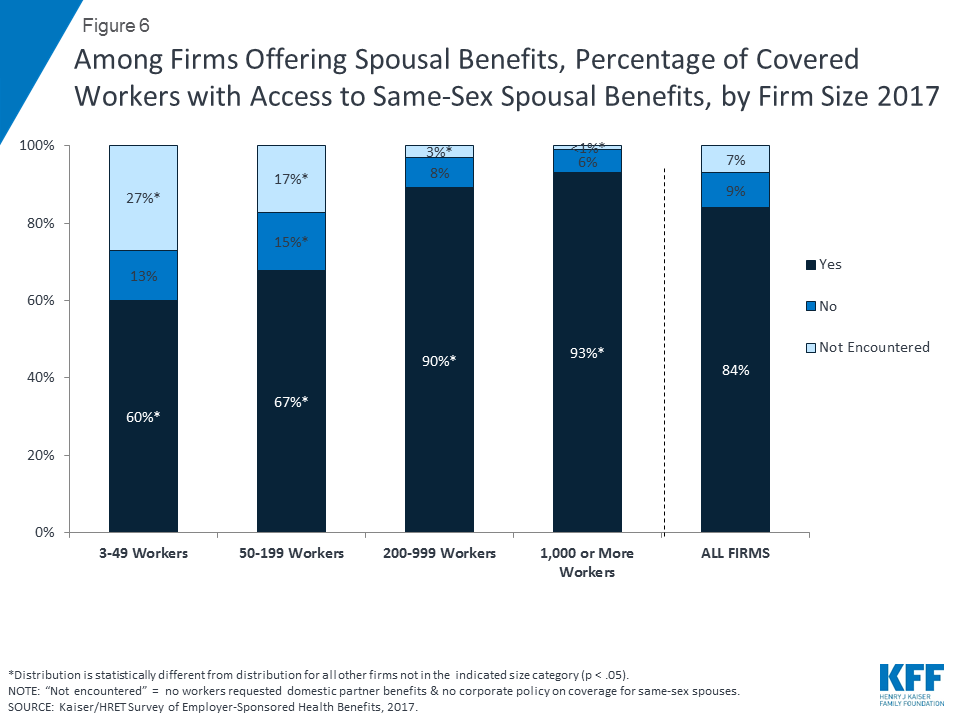
  • While LGB individuals have similar rates of insurance coverage and uninsurance, and saw similar gains in coverage under the ACA (see below), in some cases access to care differs for this population. In particular, research finds that on some measures, bisexual individuals have more limited access to care while lesbian and gay individuals have rates comparable to heterosexual adults (Figure 5). In particular, bisexual adults fared poorer than other groups in terms of having a usual place to go for medical care and going without medical care due to cost.
Figure 5: Access to Care and Utilization of Services, by Sexual Orientation, 2015
  • A separate 2013 survey found that among LGBT individuals estimated to have incomes under 400% of the federal poverty level (FPL), almost 4 in 10 had medical debt and more than 4 in 10 reported postponing medical care due to costs.78 
  • Research studies on same-sex couples find that LGB individuals have higher rates of unmet medical need because of cost and are less likely to have a regular provider. Research has also found that women in same-sex couples are less likely than heterosexual married women to have received timely medical care for both primary and specialty services. Among men in couples, gay men are three times as likely as their heterosexual counterparts to report delays in obtaining needed prescription medicines.79 
  • Marriage is tied to access to health insurance. Prior to the Supreme Court’s Windsor ruling, however, same sex married couples were only able to obtain coverage for their spouse as a domestic partner, if their employer provided such coverage, and these benefits were considered taxable income. Under the Windsor and Obergefell rulings, federal and state employees with same-sex married spouses are guaranteed the benefits afforded to opposite-sex married spouses but other employers may continue to elect to cover only opposite-sex married spouses (in states or localities without additional protections).
  • Indeed, recent nationally representative research shows that in 2017 nearly six in ten (57%) firms that offer health benefits to opposite-sex spouses, offer coverage to same-sex spouses80 , that share is much higher (88%) among large employers (those with 200 or more workers) which is significant as most covered U.S. workers (71%) are employed by these firms.81  Because most covered workers are employed by large firms, which are more likely to offer the benefit overall, 84% of covered workers with access to opposite-sex spousal coverage also have access to same-sex spousal coverage. Almost all workers (93%) at firms with 1,000 or more employees have access to this benefit whereas fewer than two-thirds (64%) of workers at the smallest firms (between 3 and 49 employees) have access (see figure 6). 82  In addition, states have the option of enacting their own equal employment legislation protecting on the basis of sexual orientation. Beyond the requirements for state and federal employers, these Supreme Court rulings are through to have influenced the expansion of employment benefits, including health benefits, to same-sex spouses more broadly. Indeed, one study found that the legalization of same-sex marriage in New York was associated with an increase in employer-sponsored insurance among same-sex couples.83 
Figure 6: Among Firms Offering Spousal Benefits, Percentage of Covered Workers with Access to Same-Sex Spousal Benefits, by Firm Size 2017
  • Some studies have found that lesbian women in couples have lower rates of breast and cervical cancer screenings than married heterosexual women.84  In addition to lower mammography rates, lesbian women on average have higher rates of some risk factors for breast cancer, including greater alcohol use and lower likelihood of childbearing. 85 ,86 
  • The transgender population is much more likely to live in poverty and less likely to have health insurance than the general population. Research reflects the impact of these barriers. In one survey of transgender individuals, nearly half (48%) of respondents postponed or went without care when they were sick because they could not afford it.87  In addition, many health plans include transgender-specific exclusions that deny transgender individuals coverage of services provided to non-transgender individuals, such as surgical treatment related to gender transition, mental health services, and hormone therapy.88 
  • An individual’s relationship with providers is another important component of access to care. Significant shares of LGBT individuals report negative experiences when seeking care, ranging from disrespectful treatment from providers and staff, to providers’ lack of awareness of specific health needs. In a survey of LGB people, more than half of all respondents reported that they have faced cases of providers denying care, using harsh language, or blaming the patient’s sexual orientation or gender identity as the cause for an illness.89  Fear of discrimination may lead some people to conceal their sexual orientation or gender identity from providers or avoid seeking care altogether.
  • For transgender persons, discrimination may be as personal as refusing to use the patient’s chosen name or as structural as providers’ lack of knowledge about how to provide appropriate care to transgender people. For example, most transgender men still have a cervix and should be screened for cervical cancer, which requires a sensitive approach.90  Studies of the transgender community show that up to 39% of transgender people have faced some type of harassment or discrimination when seeking routine health care, and many report being denied care outright or encountering violence in health care settings.91 ,92 
  • Medical education does not routinely encompass LGBT health issues. More than half of medical schools and public health school curricula lack instruction about the health concerns of LGBT people beyond work related to HIV/AIDS.93 ,94  However, the medical community’s awareness of LGBT health needs has grown. Several professional medical societies have formed policies and guidance that advocate on behalf of fair treatment and access for LGBT patients and health providers.95  For example, the American Medical Association (AMA) has issued an explicit nondiscrimination policy as well as numerous other statements that recognize prior discriminatory practices in the medical setting, the importance of better understanding and addressing LGBT health needs, the impact of discrimination on health and well-being, and the need to include sexual orientation in research.
  • The World Professional Association for Transgender Health also maintains a set of standards and principles to guide health care professionals in providing health care to transgender people.96  Additionally, in 2011, the Joint Commission, an independent non-profit national organization that accredits and certifies more than 20,000 health care organizations and programs in the U.S., began to require that hospitals prohibit discrimination based on sexual orientation, gender identity and gender

Issue Brief: Impact Of Changes In The Legal And Policy Landscape On Coverage And Access To Care

In addition to specific health needs, the health of and access to care for LGBT communities is shaped by federal and state policies on insurance, compensation and benefits, and marriage. The passage of the ACA in 2010, the Supreme Court’s ruling overturning DOMA in 2013, and subsequent ruling in Obergefell in 2015 (guaranteeing the right to same-sex marriage nationally), have significantly affected access to care and coverage for LGBT individuals and their families, expanded nondiscrimination protections, increased data collection requirements, and supported family caregiving. States and private organizations have also moved to add nondiscrimination protections and enhance coverage for LGBT individuals. While the Obama Administration supported expansion of many of these protections, the Trump Administration has sought to scale some of them back.

Impact of the ACA

The ACA makes far-reaching changes in health coverage and delivery of care for millions, including LGBT individuals. For LGBT populations, three major areas are of particular saliency: 1) expanded access to coverage and insurance market reforms, 2) “nondiscrimination” protections, and 3) requirements for data collection and research.

Coverage

  • The ACA extends coverage to millions of uninsured persons through the expansion of Medicaid, in states that choose to expand, as well as the creation of new federally subsidized health insurance marketplaces in all states. In states that expanded their Medicaid programs, a new pathway to Medicaid eligibility is available based solely on income and immigration status, and is available to most individuals with incomes below 138% FPL regardless of their family or disability status. Uninsured individuals not eligible for Medicaid, can purchase coverage in insurance marketplaces, with subsidies available to most with incomes between 100% and 400% of FPL to help offset the costs of premiums. Additional subsidies are available to those between 100% and 250% FPL to help with other out-of-pocket costs.
  •  As of January 2014, individuals can no longer be denied most private market insurance due to a pre-existing condition, such as HIV, mental illness, or a transgender medical history. Additionally, new private plans are now required to cover recommended preventive services without cost sharing. This includes screenings for HIV, STIs, depression, and substance use. And, those who gain coverage through the Medicaid expansion or in the marketplace will have coverage for a set of essential health benefits, including prescription drugs and mental health services.
  •  A recent Kaiser Family Foundation study found that since implementation of the ACA, rates of uninsurance decreased significantly among LGB adults (dropping from 19% in 2013 to 10% in 2016), representing an estimated 369,000 fewer uninsured LGB individuals. In addition, Medicaid coverage increased (rising from 7% to 15% during the same period), representing an estimated 511,000 more LGB individuals with Medicaid coverage. These coverage changes were similar to those seen in the heterosexual population.97 

Nondiscrimination Protections

  • As described above, bias and discrimination in the health care system have been an unfortunate reality for many LGBT people.98  In addition to provider level discrimination, prior to the ACA, some policies in the insurance and financing system have disproportionately affected LGBT people, including pre-existing condition clauses permitting plans to deny insurance to people with conditions such as HIV, mental illness, or to transgender individuals, who may require specific health care services.99  Furthermore, some plans interpreted these exclusions broadly and used them to deny transgender people coverage for services that are not related to gender transition.100 
  •  The ACA and subsequent federal regulations implementing the ACA prohibit such discrimination in many aspects of health care. For instance, federal regulations issued by the Department of Health and Human Services (DHHS) governing health insurance marketplaces101  as well as regulations governing any health plan offering essential health benefits102  bar discrimination in insurance provision based on sexual orientation and gender identity.
  •  The law (and implementing regulations) includes additional protections under Section 1557 including the prohibition of discrimination based on sex, defined to include gender identity and sex stereotypes, in any health program receiving federal funds (such as Medicaid, Medicare, and providers who receive federal funds). However, as part of an ongoing lawsuit, a federal court has issued an injunction halting enforcement of this provision’s protections around gender identity (and termination of pregnancy). HHS is currently reconsidering the final implementing rule that clarified these protections and has sent a draft proposed rule to OMB (a final step in the rulemaking process). Notably, while the injunction remains in place, it applies only to HHS’s authority to enforce this part of the regulation. Covered entities must still comply with the law and those that do not could be liable if someone files a discrimination claim in court under Section 1557 (rather than to seek remedy through HHS’ Office of Civil Rights (OCR)).103 
  •  Federal regulations governing health plan marketing practices prohibit health insurance issuers offering non-grandfathered insurance coverage in the group or individual markets (including health care marketplaces) from employing marketing practices or benefit designs that discriminate on the basis of certain specified factors, including sexual orientation and gender identity.104  In 2014, the Centers for Medicare and Medicaid Services issued an FAQ105  clarifying that these regulations include coverage of same-sex married spouses.  Per the FAQ, the regulations require health issuers who offer coverage to opposite-sex spouses to also offer coverage to same-sex married spouses, based on state of celebration, as of January 2015  However, the regulation does not apply to employers.
  •  In June 2016, CMS issues a proposed rule that would have required hospitals participating in the Medicare and Medicaid programs to establish non-discrimination policies that include prohibitions on discrimination on the basis of gender identity and sexual orientation.106  Given that the vast majority of hospitals participate in these programs, this rule could have widespread impact by extending protections on the basis of sexual orientation. This could be especially meaningful as sexual orientation protections remain unspecified under Section 1557 and because gender identity protections under 1557 are threatened by ongoing litigation. However, as of April 2018, the Trump Administration has taken no action to finalize this regulation.
  •  Since taking office, the Trump administration has sought to widen the availability of plans that may be exempt from key protections, including non-discrimination protections related to sexual orientation and gender identity. Of particular note, short-term limited duration (STLD) and association health plans may lack the protections or comprehensive design necessary to meet the needs of LGBT populations (and many others as well).107 
  •  In addition, the Trump Administration has taken steps to provide conscience and religious exemptions for certain groups that could curb access to care and treatment for LGBT people. In 2018 HHS created a new unit at the HHS OCR called the “Conscience and Religious Freedom Division” with the stated purpose of protecting moral and religious convictions and issued a proposed rule aiming to ensure health care providers may refrain from participating in procedures incongruous with their moral or religious beliefs.108  LGBT advocates have said that the creation of this unit could suggest a move towards shielding healthcare workers from performing certain procedures or treating certain patients, such as transgender patients based on personal moral objections.109 

Data Collection

  • The ACA calls for the inclusion of routine data collection and surveillance on health disparities, which HHS and many other groups have recognized includes LGBT populations. Research on LGBT health has increased over time, and HHS has sponsored efforts to collect and report data on LGBT health, as evidenced with the inclusion of LGBT-specific data in publications such as the National Healthcare Disparities Report, the addition of Healthy People 2020 goals to increase routine data collection efforts on LGBT populations, and early efforts of collection and surveillance on sexual orientation and gender identity in national health care surveys.110  In fact, the Obama Administration worked to significantly expand the collection of LGBT data. The number of federal surveys and studies collecting sexual orientation data increased to 12 and 7 of these also collected data on gender identity.111  Since 2013, the NHIS has included a question on sexual orientation. In addition, several agencies within HHS have taken steps toward broader data collection. For example, the CDC has added sexual orientation and gender identity questions to the state-administered Behavioral Risk Factor Surveillance System surveys and the Substance Abuse and Mental Health Services Administration’s National Survey on Drug Use and Health. The Administration on Aging also added a sexual orientation and gender identity questions to the National Survey of Older Americans Act (OAA) Participants. However, it is still not routine for researchers and health data systems to collect and report data by individuals’ sexual orientation and gender identity. Additionally, since taking office, the Trump Administration has sought to roll back data collection on sexual orientation and gender identity in a several surveys including the questions in the OAA survey. It also reversed plans to add such questions to a disability survey out of The Administration for Community Living (ACL). However, in response to pressure from advocacy groups the sexual orientation (but not gender identity) question was added back into the OAA survey. No changes were made to the disability survey.112 
  •  At the provider and patient level, some groups advocate for clinicians to collect patient information on sexual orientation and gender identity to better understand an individual’s health profile and needs. Some providers have expressed discomfort with and inadequate knowledge on soliciting this information. Advocates’ recommendations include being direct with patients about why questions on sexual orientation and gender identity are being asked, ensuring that confidentiality will be maintained, informing patients of the right to opt-out, and asking multiple questions to assess both sexual orientation and gender identity.113  In particular, the IOM recommends collecting such data in electronic medical records (EMRs), which are growing in use.114 
  •  In October 2016, the NIH formally designated sexual and gender minorities (SGMs) as a health disparity population for research purposes. In doing so NIH recognized the health disparities faced by this population and that “the extent and causes of health disparities are not fully understood, and research on how to close these gaps is lacking.”115 

Impact of Supreme Court Rulings

Spousal coverage is an important pathway to insurance and other health benefits and marriage offers legal protections for millions of people, particularly in the context of employer-sponsored health insurance. Until recently, the federal government did not recognize same-sex marriage due to DOMA and several states banned same-sex marriage. This limited the ability of LGBT individuals and families to access a wide range of benefits, including health coverage as a dependent spouse and the ability to make health care decisions for a married partner.  Two rulings by the Supreme Court have fundamentally changed this landscape.

  • United States v. Windsor116 : In June 2013, the Supreme Court’s ruling in United States v. Windsor overturned a portion of DOMA and required the federal government to recognize legal same-sex marriages for the first time. The ruling and subsequent Agency policy interpretations and guidance have resulted in expanded access for many LGB families to a range of benefits, including dependent health coverage and family and medical leave. However, the ruling did not require states to recognize same-sex marriage or end state-level bans.  As such, while the federal government extended benefits to legally married same-sex couples based on “state of celebration”117  where possible,  some benefits remained dependent on the legal status of same sex marriage in “state of domicile.”118  This led to a patchwork of coverage availability across the country until the Obergefell
  •  Obergefell v. Hodges119 : In June 2015, the Supreme Court ruled in Obergefell v. Hodges that the Fourteenth Amendment requires states to license same-sex marriages and to recognize such marriages lawfully licensed and performed out-of-state, resulting in legal recognition of same-sex marriage nationwide. This effectively ends the distinction between state of celebration and state of domicile and further expanded access to health coverage and care for LGBT individuals and families.

Specific changes that affect spousal coverage and benefits due to these rulings are as follows:

  • Tax Implications: As a result of the Windsor ruling, the Internal Revenue Service (IRS) ruled that it recognized all legally married same sex couples, based on state of celebration, who could now file federal taxes as “married” and, where same-sex marriage was legal, state taxes as well. As a result of the Obergefell decision, same-sex couples can now file state taxes jointly in every state. Tax filing affects a number of health-related financial issues such as taxes on health benefits.120   For example, dependent coverage, including spousal coverage, is excluded from an employee’s taxable income. Prior to the Supreme Court’s Windsor ruling, coverage for a same-sex spouse was considered taxable income, which raised taxes for those who received this coverage. The same is true for state taxes in states that did not recognize same-sex marriage prior to the Obergefell  These rulings mean that married same-sex couples no longer face this higher tax burden at the federal and state levels.121 ,122  
  •  Federal Employees & Federal Contractors: The Supreme Court’s Windsor decision also prompted federal agencies to reverse previous limitations on spousal benefits in federal programs. Where the federal government determined it had jurisdiction to do so, such benefits were extended to all legally married same-sex couples based on state of celebration. For example, all federal employees who are legally married to a same-sex partner (regardless of where they live), were given the same eligibility for dependent spousal health coverage in the Federal Employees Health Benefits Program (FEHBP) as well as other dependent benefits, including dental and vision insurance, long-term care insurance, and flexible spending accounts.123  In addition, in 2014, President Obama issued an executive order124  adding sexual orientation and gender identity to the prohibited bases of discrimination in employment by federal contractors and subcontractors. As such, it requires contractors that provide spousal benefits to opposite-sex married couples to also provide them to same-sex married couples.125 
  •  Members of the Military and Veterans: Following the Windsor decision, the Department of Defense recognized same-sex marriages based on state of celebration and extended spousal benefits, such as TRICARE health coverage, to the same-sex spouses of military service members and employees.126   However, several benefits for Veterans continued to be tied to state of domicile, which meant that eligibility for spousal benefits for Veterans was uneven between marriage equality and non-equality states until the ruling in Obergefell.  As a result of that decision, the Department of Veterans Affairs now recognizes all same-sex marriages127  and will extend benefits to all same-sex spouses of Veterans, including CHAMPVA health coverage, survivor compensation, and burial benefits.
  •  State and Municipal Employees: While the Windsor decision resulted in eligibility for spousal coverage for all federal employees and contractor employees, a patchwork of policies remained for state and local public employees based on where they lived.  As a result of the Obergefell ruling’s recognition of same-sex marriages in all states, spousal coverage benefits should be extended to state and municipal employees across the nation to the same degree as their heterosexual counterparts.
  •  Private Employers: Neither the Windsor nor Obergefell decisions are binding on employers.  In addition, as mentioned above, ACA regulations regarding health issuers are also not binding on employers.  Therefore, while employers in marriage equality states were largely expected to offer same-sex spousal coverage after Windsor, and in all states after Obergefell, there remains some question about whether employers can legally limit spousal coverage to opposite-sex spouses.  Still, many experts believe that an employer that offers health benefits to opposite-sex spouses but refuses to offer such benefits to same-sex spouses would likely be in violation of Title VII of the Civil Rights Act, which prohibits discrimination based on sex.  The Equal Employment Opportunity Commission (EEOC)128  and at least one federal court129  have found Title VII to have standing in such cases.  Moreover, a recent EEOC decision found that “sexual orientation is inherently a ‘sex-based consideration” under Title VII.130   The EEOC ruling allows such cases from both private and public sector employees to be brought forward for its review and will also be considered by federal courts in their review of cases, although it is not binding on them.  In addition to potential Title VII violations, employers who provide spousal coverage for opposite sex couples but not same-sex couples may be subject to state non-discrimination laws.  Given the remaining uncertainties regarding employers, this will be an important area to watch going forward.
  •  ERISA Protections: The Department of Labor issued guidance131  on the implications of the Windsor ruling for health plans and plan sponsors governed by the Employee Retirement Income Security Act of 1974 (ERISA), the federal law that sets minimum standards for most voluntarily established pension and health plans. The guidance states that under ERISA, the definition of “marriage”, wherever it appears, will include same-sex marriage based on state of celebration. This makes clear that group health plans can extend certain protections to married same sex couples, most notably COBRA, the law that offers employees and their families a temporary extension of group health coverage following a job loss or other qualifying event.  In addition, because ERISA requires group health plans that offer spousal coverage generally to permit special enrollment opportunities for newly-married spouses, this guidance makes clear that group health plans can extend special enrollment rights to same-sex marriages where spouses are otherwise eligible to participate.  However, neither the guidance nor ERISA specifically addresses whether the employer that sponsors the group health plan is required to recognize a same-sex marriage.
  •  State-Level Insurance Protections: In addition to federal law, the number of states that have nondiscrimination policies in insurance coverage and employment has increased over time, although the majority of states do not have such protections. Twelve states (CA, CO, DE, HI, IL, ME, MN, NV, NY, OR, RI, VT, and WA) plus DC prohibit discrimination based on sexual orientation and gender identity in private health insurance.132  New Jersey provides protection on the basis of sexual orientation but not gender identity in private health insurance.133  Nineteen states (CA, CT, CO, DE, HI, IL, MA, MD, MI, MN, NJ, NV, NY, OR, PA, RI, VT, and WA) and DC prohibit transgender exclusions in health insurance through legislation or regulation.134  Twenty states (CA, CO, CT, DE, HI, IL, IA, ME, MD, MA, MN, NV, NJ, NM, NY, OR, RI, UT, VT, and WA) plus DC prohibit discrimination by private employers on the basis of sexual orientation and gender identity and another two states (NH and WI) prohibit discrimination based only on sexual orientation.135 
  •  Health Insurance Marketplaces: Windsor also affected eligibility for assistance for same-sex couples in all ACA health insurance marketplaces (whether federally-facilitated or state based). Eligibility is based in part on an applicant’s family structure and income.  Federal regulations were issued stating that insurance marketplaces must recognize same-sex marriages and base eligibility for tax credits on a couple’s income according to their tax filing.136   (It is important to note that when a couple’s income is used to determine eligibility for tax credits in the marketplace, it could mean they are more or less likely to qualify, depending on their specific situation).
  •  Medicaid and CHIP: Because Medicaid and the Children’s Health Insurance Program (CHIP) are federal-state partnerships, the federal government determined that Windsor did not allow it to require states to recognize same-sex marriages for the purpose of determining eligibility, although it encouraged them to do so.137  This meant that eligibility could vary based on state laws regarding same-sex marriage.  With the Obergefell ruling, however, all states must now recognize legal same-sex marriages and state Medicaid agencies are expected to do so (as with marketplaces, eligibility may be impacted when income is counted jointly).
  •  Medicare: These decisions have also resulted in expanded access to Medicare for same-sex couples. After Windsor, DHHS issued guidance clarifying that same-sex married beneficiaries in Medicare Advantage plans who each need care in a skilled nursing facility can receive care at same facility, as applicable to married Medicare beneficiaries more generally.138  Also after Windsor, individuals in same-sex marriages became eligible for free Medicare Part A (hospital) premiums in marriage recognition states if their spouse had sufficient work history to qualify for Medicare benefits, even if they themselves did not.139  If they lived in a non-recognition state, however, they had access to reduced premiums only.  Obergefell expanded access to free Part A premiums nationwide.  In addition, a special enrollment period (SEP) for Medicare Part B (and Premium Part A) is available for an individual who gains and then loses insurance coverage related to spousal employment without facing a penalty (this was already based on state of celebration after Windsor).140  As with other means-tested programs, eligibility may be impacted when income is counted jointly.

Family Caregiving Issues

Caring for ill family members is another area of policy that has been evolving in recent years for LGBT people and their families. The Family Medical Leave Act (FMLA) provides workplace protections to employees if they take time off to care for a family member in the event of illness or birth of a child. Under DOMA, LGB individuals were not afforded the law’s protections to care for a spouse because the federal government did not recognize same-sex marriages; however, the Supreme Court’s decision extends the law to all legally married individuals at qualifying employers. While this is an important step, it does not cover all workers. Additionally there are still other barriers that can limit the reach of these new policies.

  • After the Supreme Court’s Windsor ruling, the DOL expanded FMLA to include legally married same-sex spouses residing in states that recognized same-sex marriage.141  In February 2015, the DOL expanded the FMLA to include same-sex couples based on state of celebration, regardless of their state of residence.142 
  •  In addition to workplace protections, visiting loved ones in the hospital or another health care setting has not always been guaranteed for LGBT people. However, federal regulations in effect since 2011 require hospitals participating in Medicare and Medicaid (virtually all hospitals in the U.S.) to adopt written policies and procedures regarding a patient’s rights to visit his or her same-sex partner (whether or not they are legally married) and state explicitly that discrimination based on sexual orientation and gender identity are prohibited.143 
  •  Providers must sometimes communicate information or discuss medical decisions on a patient’s behalf with a patient “representative,” who is often a spouse. If finalized, Federal regulations proposed in 2014 would require that providers and suppliers, such as hospitals, hospices, community mental health centers, and laboratories, that participate in Medicare and Medicaid must recognize same-sex spouses (marriage legalized based on state of celebration) as patient representatives.144 
  •  Concerns have also been raised about discrimination against older LGBT individuals and their families in long-term care facilities. Recent federal regulations now provide residents of long-term care facilities, such as nursing homes, the right to have visitors of their choice, including same-sex spouses and domestic partners.145 
  •  However, in October 2017 the Trump admiration withdrew a proposed rule that would have required long term care facilities receiving federal funds to treat same-sex spouses the same as opposite-sex spouses.146  An HHS spokesperson stated that the Administration did not believe the rule needed to be finalized in light of the 2015 Obergefell ruling (requiring licensing and recognition of same-sex marriage in all states).147  However, Obergefell only address the right to marry, not whether institutions can legally treat married same-sex couples differently than married opposite-sex couples.
  •  In addition, there are still areas where LGBT individuals and families are not protected. For example, paid sick leave is an important benefit that many workers do not have. Because it has been legal in more than half the states to fire employees based on their sexual orientation or gender identity, LGBT employees without paid leave may be more reluctant to take time off when they or their family members are sick.148 

Other Changes

  • Medicaid is the primary payer of long-term care, and qualifying for Medicaid long-term services can result in exhaustion of financial resources for those who seek services as well as their spouses. The program’s “spousal impoverishment” protections aim to mitigate this by allowing a spouse who remains in the community to retain a certain level of income and assets without affecting eligibility.  In 2011, states were given the option to extend these “spousal impoverishment” protections to married same-sex couples and domestic partners.149   After Windsor, such protections were required for married same-sex couples in marriage equality states. It is expected that with the Obergefell ruling, all states will be required to apply these protections to married same-sex couples.
  •  Coverage of transgender services has also been expanded in federal programs. In 2014, HHS invalidated a prior policy that had allowed Medicare plans to deny coverage for “transsexual surgery,” 150  and OPM has stated that, as of 2016, the Federal Employees Health Benefits Program (FEHBP) may not issue blanket exclusions for gender transition services.151    As a result, Medicare and FEHBP plans must cover gender transition services that are “medically necessary,” although the definition of medical necessity is in part at the discretion of providers and plans. Several employers have also moved to make their plan offerings more comprehensive by removing exclusions for transgender health services. Among major U.S. employers, there has been a five-fold increase in the number of businesses offering at least one health plan that includes coverage of transgender services such as counseling, hormone therapy, and surgical procedures.152 

***

A number of health challenges disproportionately affect LGBT communities, particularly the HIV epidemic, stigma and violence, substance use, negative experiences in the health care system, and lack of insurance coverage. In addition to health outcomes, access to care has been a concern and intersects with many broader issues, including relationship recognition, legal identity recognition policies for transgender individuals, training and cultural competency of health professionals, as well as overarching societal and cultural issues, particularly a long history of stigma and discrimination. While many of these barriers persist recent policy and legal changes have served to mitigate some of these challenges, particularly the implementation of the ACA and the impacts of marriage equality. While this convergence of policy and legal breakthroughs holds promise for broader access to health services, coverage, and benefits for LGBT communities, actions taken by the Trump administration may threaten to destabilize some of the insurance market and individual protections gained over the past decade, and it will important to monitor these changes moving forward.

Tables

Table 1: Alcohol Use, Cigarette Use, and Serious Psychological Distress Among Bisexual, Gay or Lesbian, and Heterosexual Adults ages 18-64, 2015
Five (men)/four (women) or more alcoholic drinks in 1 day at least once in past yearBisexualGay or LesbianHeterosexual
All adults47.2%36.2%27.5%
Women44.8%32.2%20.7%
Men52.9%39.6%34.5%
Current cigarette smokerBisexualGay or LesbianHeterosexual
All adults26.1%20.1%16.5%
Women24.7%18.7%14.9%
Men29.5%21.2%18.1%
Experienced serious psychological distress in past 30 daysBisexualGay or LesbianHeterosexual
All adults15.0%4.6%3.7%
Women17.0%4.8%*4.3%
MenN/A4.4*3.0%
NOTE: N/A- data not available due to unreliability. * Relative standard error >30% and less than or equal to 50% and should be used with caution.SOURCE:  Centers for Disease Control and Prevention, National Health Statistics Reports. (2015). Data available; https://www.cdc.gov/nchs/data/nhis/sexual_orientation/asi_2015_stwebsite_tables.pdf
Table 2: Impact of Selected Federal Policy Changes on Coverage and Access to Care for LGBT Communities
PolicyKey Provisions and Impact
The Patient Protection and Affordable Care Act (ACA)153 
  • Expands coverage to many uninsured persons through Medicaid and health insurance marketplaces in all states. Medicaid, in states that expand, will base eligibility solely on income and  residency status (no categorical requirement) and tax credits are available to help subsidize the cost of coverage in marketplaces for low income individuals.
  • While currently, not being enforced by the HHS Office of Civil Rights (OCR), as a result of a legal ruling, Section 1557 prohibits discrimination based on sex, defined to include gender identity and sex stereotypes, in any health program receiving federal funds (such as Medicaid, Medicare, and providers who receive federal funds).  The rule creates specific protections for transgender individuals, including the right to access services/facilities consistent with their gender identity. In addition, transgender individuals cannot be denied services based solely on their gender identity or because their gender does not match their recorded sex. The final rule implementing Section 1557 does not explicitly resolve whether discrimination on the basis of sexual orientation alone is prohibited but does state in the preamble that “sex discrimination related to an individual’s sexual orientation where the evidence establishes that the discrimination is based on gender stereotypes” is prohibited.154  Despite OCR’s capacity to enforce 1557 being stayed, it remains illegal to violate 1557 protections and an entity doing so could be held liable in court. (A draft proposed rule revising 1557 implementing guidance is purportedly working its way through the rulemaking process; this section will be updated when additional information is available.)
  • Federal regulations governing health insurance marketplaces155  and regulations governing plans that offer “essential health benefits” prohibit discrimination based on sexual orientation and gender identity.
  • Federal regulations governing health insurance issuers’ marketing practices requires all health issuers offering non-grandfathered plans in the individual and group markets that offer coverage to opposite-sex spouses to also offer coverage to same-sex spouses, based on state of celebration.156 ,157 
  • Promotes data collection and analysis on sexual orientation and gender identity through federally-sponsored surveys and programs.
  • Individuals will no longer be denied coverage due to a pre-existing condition, such as HIV, mental illness, or a transgender medical history in most plans.
  • Non-grandfathered individual market private and Medicaid expansions plans are required to cover USPSTF recommended preventive services without cost sharing. Includes screenings for HIV, STIs, depression, and substance misuse.
Supreme Court Rulings on Marriage Equality:  United States v. Windsor (2013)

and

Obergefell v. Hodges (2015)

  • Legalization of same-sex marriage nationwide by overturning Section 3 of the Defense of Marriage Act, which had limited marriage to persons of the opposite sex (Windsor)158 , and ruling that the fourteenth amendment  requires states to license same-sex marriages and to recognize such marriages performed out-of-state  (Obergefell)159 . The rulings affects access to health coverage, health benefits, and related policies for married same-sex couples nationwide.
  • Department of Justice Federal Marriage Benefits for Same-Sex Couples160 
    • Announcement by Attorney General, following Obergefell ruling, that federal agencies will work to extend marriage benefits to married same-sex couples in all states (Windsor ruling had extended many but not all federal benefits to married same-sex couples based on state of celebration but some benefits not available in states that did not recognize same-sex marriage).
  • Internal Revenue Service (IRS) Ruling 2013-17161 
    • After Windsor, ruled that same-sex couples legally married will be treated as married for federal tax purposes, regardless of whether the couple lives in a jurisdiction that recognizes same-sex marriage or not (“state of celebration” takes precedent). Allows couples to file federal taxes as “married” and thus treats same-sex spousal health coverage as tax exempt for purposes of determining federal income tax.
    • If same-sex spouse received employer-based dependent insurance, the employee may apply for refund of excess federal income taxes paid on the value of the coverage for past 2-3 years.
  • U.S. Office of Personnel Management, Guidance on the Extension of Benefits to Married Gay and Lesbian Federal Employees, Annuitants, and their Families162 
    • After Windsor, extended federal health (FEHB), vision, dental, long-term care, and flexible spending accounts benefits to legal same-sex spouses of federal employees, based on state of celebration.
  • Executive Order 13672 Prohibiting Discrimination Based on Sexual Orientation and Gender Identity by Federal Contractors and Subcontractors163 
    • Prohibit federal contractors and subcontractors from discriminating on the basis of sexual orientation or gender identity in employment, including in the provision of spousal health benefits.
  • Department of Defense Memorandum Subject: Extending Benefits to the Same-Sex Spouses of Military Members164 
    • Legally married spouses eligible for dependent health coverage of service members and DOD civilian employees.
  • Department of Veterans Affairs –  Recognition of Same-Sex Marriages165 
    • Windsor extended VA benefits (including CHAMPVA health coverage, survivor compensation, and burial benefits) to same-sex spouses of Veterans based on state of domicile. Per Obergefell, benefits to be extended to all same sex spouses of Veterans nationwide.
  • Center for Consumer Information and Insurance Oversight (CCIIO) Guidance on IRS Ruling 2013-17 and Eligibility for Advance Payments of the Premium Tax Credit and Cost-Sharing Reductions
    • All Health Insurance Marketplaces are to recognize legal same-sex marriages when determining eligibility for Premium Assistance and Tax Credits.166 
  • Centers for Medicare and Medicaid Services (CMS) Guidance on Eligibility for Medicaid and CHIP167 
    • After Windsor, states encouraged to recognize same-sex marriages by jointly counting spousal income when determining Medicaid eligibility but not required to do so. Since Obergefell, expected to apply nationwide to all Medicaid programs.
  • Social Security Administration Determination of Marital Status for spousal Medicare benefits
    • Same-sex spouses eligible for free Medicare Part A if spouse has sufficient work history to qualify for Medicare benefits.168  (was based on state of domicile after Windsor and extended nationwide per Obergefell).
    • Special enrollment period for Medicare available to those who gain and then lose insurance coverage related to spousal employment.169 
  • Centers for Medicare and Medicaid Services (CMS)  Impact of United States v. Windsor on Skilled Nursing Facility Benefits for Medicare Advantage Enrollees170 
    • After Windsor, clarifies that same-sex married beneficiaries in Medicare Advantage plans who each need care in a skilled nursing facility can receive care at same facility, as applicable to married beneficiaries more generally.
  • Department of Labor, Wage and Hour Division- The Family and Medical Leave Act171 
    • As a result of the Windsor ruling, the DOL finalized a rule in 2015 that expanded the definition of “spouse” to include all legally married same-sex couples for purposes of  providing workplace protections to employees if they take time off to care for a family member in the event of illness or birth of a child.
Other
  • Presidential Memorandum- Hospital Visitation172 
    • Executive order and subsequent regulations173  in 2010 stating that hospitals receiving funds from Medicaid and Medicare are to respect the rights of patients to designate visitors, including same-sex partners (whether married or not) and others designated by legally valid advance directives.
    • Regulations issued in November 2010 supports enforcement of the right of patients to designate the person of their choice, including a same-sex partner, to make medical decisions on their behalf should they become incapacitated.
  • Centers for Medicare and Medicaid Services Memorandum 13-42-NH: Reminder- Access and Visitation Rights in Long Term Facilities174 
    • LTC facilities must ensure that all individuals, including same-sex partners (whether married or not), seeking to visit a resident be given full and equal visitation privileges, consistent with resident preferences within reasonable restrictions that safeguard residents.
  • Centers for Medicare and Medicaid Services- Medicaid Spousal Impoverishment Protections175 
    • In 2011, states were given the option to extend protections to include married same-sex spouses and domestic partners. This allows a spouse living in the community to maintain a certain level of assets when institutional expenses (usually a nursing home) threaten to deplete all resources and impoverish the community-based spouse. After Windsor, marriage equality states were required to extend such protections to married same-sex partners. Since Obergefell, protections are expected to apply nationwide to all Medicaid beneficiaries.
  • Department of Health and Human Services176  and Office of Personnel Management177  – Coverage for Gender Transition Services
    • Prohibit bans on various gender transition services in Medicare, as of June 2014, and FEHBP plans, as of 2016
  • National Institutes of Health- LGBT Research Coordinating Committee178 
    • This committee was formed to consider recommendations of the Institute of Medicine’s study The Health of Lesbian, Gay, Bisexual, and Transgender People: Building a Foundation for Better Understanding and to suggest strategies for how the NIH can support research.
  • Executive order and proposed rule supporting expansion of alternative health plans
    • The Trump administration has sought to widen the availability of plans that may be exempt from key protections, including non-discrimination protections related to SOGI. Short-term limited duration (STLD) and association health plans in particular have been targeted as vehicles for this expansion.179 
  • Creation of Office of “Conscience and Religious Freedom Division” at HHS’s OCR and issuance of proposed rule
    • Office and proposed rule aim to promote protection of moral and religious convictions of health care providers. Could impact access to care for LGB Individuals.180 

Endnotes

  1. Institute of Medicine (IOM). (2011). The Health of Lesbian, Gay, Bisexual, and Transgender People: Building a Foundation for Better Understanding. ↩︎
  2. Healthy People 2020: Lesbian, Gay, Bisexual, and Transgender Health. ↩︎
  3. Agency for Healthcare Research and Quality. (2012). 2012 National Healthcare Disparities Report. ↩︎
  4. IOM. (2011). The Health of Lesbian, Gay, Bisexual, and Transgender People: Building a Foundation for Better Understanding. ↩︎
  5. Ibid. ↩︎
  6. National Center for Transgender Equality. (2009). Transgender Terminology. ↩︎
  7. Gates, G.  (March 22, 2010).  LGBT Demographics:  Presentation to the Institute of Medicine. ↩︎
  8. Kaiser Family Foundation analysis of NHIS 2016 data available at: Dawson, L., Kates, J., and Damico, A. (2018). The Affordable Care Act and Insurance Coverage Changes by Sexual Orientation. Available at: https://modern.kff.org/disparities-policy/issue-brief/the-affordable-care-act-and-insurance-coverage-changes-by-sexual-orientation/ ↩︎
  9. Gates, G (2017). Gallup. In U.S., More Adults Identifying as LGBT. ↩︎
  10. Where data do not include transgender individuals, LGB (lesbian, gay, bisexual) is used. ↩︎
  11. IOM. (2011). The Health of Lesbian, Gay, Bisexual, and Transgender People: Building a Foundation for Better Understanding. ↩︎
  12. Coffman, KB, Coffman, LC & Marzilli Ericson, KM. (2013). The Size of the LGBT Population and the Magnitude of Anti-Gay Sentiment are Substantially Underestimated, NBER Working Paper No. 19508. ↩︎
  13. Gates, G (2017). Gallup. In U.S., More Adults Identifying as LGBT. ↩︎
  14. Kann, L., et al. 2016. Centers for Disease Control and Prevention. MMWR. Sexual Identity, Sex of Sexual Contacts, and Health-Related Behaviors Among Students in Grades 9–12 — United States and Selected Sites, 2015. 65(9);1-202. ↩︎
  15. Flores, A., et al. The Williams Institute. How Many Adults Identify as Transgender in the United States? June 2016. Available at: http://williamsinstitute.law.ucla.edu/wp-content/uploads/How-Many-Adults-Identify-as-Transgender-in-the-United-States.pdf ↩︎
  16. Gates, G. Gallup. . (February 6, 2017.). Vermont Leads States in LGBT Identification. ↩︎
  17. Ibid. ↩︎
  18. Jones, J. Gallup. (June 22, 2017.) In U.S., 10.2% of LGBT Adults Now Married to Same-Sex Spouse. ↩︎
  19. Kaiser Family Foundation analysis of the 2016 American Community Survey. Data available here: https://www.census.gov/data/tables/time-series/demo/same-sex-couples/ssc-house-characteristics.html ↩︎
  20. Pew Research Center (June 2013). A Survey of LGBT Americans Attitudes, Experiences and Values in Changing Times. ↩︎
  21. Badgett, M.V., Durso, L.E. & Schneebaum, A. (2013). New Patters of Poverty in the Lesbian, Gay, and Bisexual Community.  The Williams Institute. ↩︎
  22.  James, S. E., Herman, J. L., Rankin, S., Keisling, M., Mottet, L., & Anafi, M. (2016). The Report of the 2015 U.S. Transgender Survey. Washington, DC: National Center for Transgender Equality. ↩︎
  23. Agency for Healthcare Research and Quality. (2012). 2012 National Healthcare Disparities Report. ↩︎
  24. IOM. (2011). The Health of Lesbian, Gay, Bisexual, and Transgender People: Building a Foundation for Better Understanding. ↩︎
  25. Healthy People 2020: Lesbian, Gay, Bisexual, and Transgender Health. ↩︎
  26. Agency for Healthcare Research and Quality. (2012). 2012 National Healthcare Disparities Report. ↩︎
  27. Lick, D., Durso, L.E., & Johnson, K.L. (2013). Minority Stress and Physical Health Among Sexual Minorities. Pers on Psychological Sci 8(5): 521-548. ↩︎
  28. Denney, J.T., Gorman, B.K. & Barrera, C.B. (2013). Families, Resources, and Adult Health: Where do Sexual Minorities Fit? Journal of Health and Social Behavior 54(1): 46-63. ↩︎
  29. Lick, D., Durso, L.E., & Johnson, K.L. (2013). Minority Stress and Physical Health Among Sexual Minorities. Pers on Psychological Sci 8(5): 521-548. ↩︎
  30. Ibid. ↩︎
  31. Centers for Disease Control and Prevention, National Health Statistics Reports. (July 2014). Sexual Orientation and Health Among U.S. Adults: National Health Interview Survey, 2013. ↩︎
  32. James, S. E., Herman, J. L., Rankin, S., Keisling, M., Mottet, L., & Anafi, M. (2016). The Report of the 2015 U.S. Transgender Survey. Washington, DC: National Center for Transgender Equality. ↩︎
  33. Massachusetts Department of Public Health. (2009). The Health of Lesbian, Gay, Bisexual, and Transgender (LGBT) Persons in Massachusetts. ↩︎
  34. Centers for Disease Control and Prevention. (2016). Monitoring Selected National HIV Prevention and Care Objectives by Using HIV Surveillance Data United States and 6 Dependent Areas, 2015. Vol. 22. No 2. Available at: https://www.cdc.gov/hiv/pdf/library/reports/surveillance/cdc-hiv-surveillance-supplemental-report-vol-22-2.pdf ↩︎
  35. Centers for Disease Control and Prevention. (2016). Diagnoses of HIV Infection in the United States and Dependent Areas, 2016. Vol. 28. https://www.cdc.gov/hiv/pdf/library/reports/surveillance/cdc-hiv-surveillance-report-2016-vol-28.pdf ↩︎
  36. Centers for Disease Control and Prevention (Feb. 2017). HIV Among Gay and Bisexual Men. https://www.cdc.gov/nchhstp/newsroom/docs/factsheets/cdc-msm-508.pdf ↩︎
  37. Centers for Disease Control and Prevention (Sept. 2017), HIV Among Gay and Bisexual Men. https://www.cdc.gov/hiv/group/msm/index.html ↩︎
  38. Baral SD, et al. (2013). Worldwide burden of HIV in transgender women: a systematic review and meta-analysis. The Lancet Infectious Disease. 13(3): 214–222. ↩︎
  39. Centers for Disease Control and Prevention (2006). MMWR. Revised Recommendations for HIV Testing of Adults, Adolescents, and Pregnant Women in Health-Care Settings. 55(RR14); September 2006. ↩︎
  40. Kaiser Family Foundation, HIV/AIDS In The Lives Of Gay And Bisexual Men In The United States, 2014. ↩︎
  41. Centers for Disease Control and Prevention. (2016). Monitoring Selected National HIV Prevention and Care Objectives by Using HIV Surveillance Data United States and 6 Dependent Areas, 2015. Vol. 22. No 2. Available at: https://www.cdc.gov/hiv/pdf/library/reports/surveillance/cdc-hiv-surveillance-supplemental-report-vol-22-2.pdf ↩︎
  42. Centers for Disease Control and Prevention. (2014).  Likely Female-to-Female Sexual Transmission of HIV- Texas, 2012. ↩︎
  43. Centers for Disease Control and Prevention. (2016). https://www.cdc.gov/nchhstp/newsroom/2016/std-surveillance-report-2015-press-release.html ↩︎
  44. Centers for Disease Control and Prevention. (2012). Viral Hepatitis: Information for Gay and Bisexual Men. https://www.cdc.gov/hepatitis/Populations/PDFs/HepGay-FactSheet.pdf ↩︎
  45. Centers for Disease Control and Prevention (2013). HPV-Associated Cancers Statistics. ↩︎
  46. Centers for Disease Control and Prevention. (2012). HPV and Men- Fact Sheet. ↩︎
  47. Lick, D., Durso, L.E., & Johnson, K.L. (2013). Minority Stress and Physical Health Among Sexual Minorities. Pers on Psychological Sci 8(5): 521-548. ↩︎
  48. Cochran, S.D., Sullivan, J.G. & Mays, V.M. (2003). Prevalence of mental disorders, psychological distress, and mental health services use among Lesbian, Gay, and Bisexual adults in the United States. Journal of Consulting and Clinical Psychology 71(1): 53-61. ↩︎
  49. Institute of Medicine. (2011). The Health of Lesbian, Gay, Bisexual, and Transgender People: Building a Foundation for Better Understanding. ↩︎
  50. Substance Abuse and Mental Health Services Administration. (2012). Top Health Issues for LGBT Populations: Information & Resources Kit. ↩︎
  51. Ford, Z. (December 3, 2012). APA Revises Manual: Being Transgender is no Longer a Mental Disorder. Think Progress. ↩︎
  52. Lick, D., Durso, L.E., & Johnson, K.L. (2013). Minority Stress and Physical Health Among Sexual Minorities. Pers on Psychological Sci 8(5): 521-548. ↩︎
  53. Lee J, Griffin G, Melvin C (2009). Tobacco use among sexual minorities in the USA, 1987 to May 2007: a systematic review. Tob Control. 18:275-282. ↩︎
  54. Cochran, S.D., Sullivan, J.G. & Mays, V.M. (2003). Prevalence of mental disorders, psychological distress, and mental health services use among Lesbian, Gay, and Bisexual adults in the United States. Journal of Consulting and Clinical Psychology 71(1): 53-61. ↩︎
  55. Grant JM, Mottet LA, Tanis J, Harrison J, Herman JL, Keisling M. (2011). Injustice at Every Turn: A Report of the National Transgender Discrimination Survey. Washington, DC: National Center for Transgender Equality and National Gay and Lesbian Task Force. ↩︎
  56. Ostrow, D.G. & Stall, R. (2008) Alcohol, tobacco, and drug use among gay and bisexual men. In Wolitski, R.J., Stall, R., & Valdiserri, R.O., Unequal opportunity: Health disparities affecting gay and bisexual men in the United States. New York: Oxford University Press. ↩︎
  57. Centers for Disease Control and Prevention. (2009). Sexual Violence: Consequences. ↩︎
  58. Human Rights Campaign, (2011).  A Guide to State Level Advocacy Following Enactment of the Matthew Shepard and James Byrd, Jr. Hate Crimes Prevention Act. ↩︎
  59. Pew Research Center (June 2013). A Survey of LGBT Americans Attitudes, Experiences and Values in Changing Times. ↩︎
  60. Centers for Disease Control and Prevention. (2013). The National Intimate Partner and Sexual Violence Survey: 2010 Findings on Victimization by Sexual Orientation. ↩︎
  61. U.S. Department of Justice Federal Bureau of Investigation, (2016).  Hate Crime Statistics 2016. ↩︎
  62. Herek, G.M. (2009). Hate Crimes and Stigma-Related Experiences Among Minority Adults in the United States: Prevalence Estimates from a National Probability Sample. Journal of Interpersonal Violence. ↩︎
  63. Ibid. ↩︎
  64. Lombardi E, et al. (2002). Gender violence: Transgender experiences with violence and discrimination. J Homosex 42(1). ↩︎
  65. National Coalition of Anti-Violence Programs. (2013).  Lesbian, Gay, Bisexual, Transgender, Queer, and HIV-Affected Hate Violence in 2012. ↩︎
  66. Human Rights Campaign. (2012). National Coming Out Day Youth Report. ↩︎
  67. Kann L, Olsen EO, McManus T, et al. Centers for Disease Control and Prevention. Sexual Identity, Sex of Sexual Contacts, and Health-Related Behaviors Among Students in Grades 9–12 — United States and Selected Sites, 2015. MMWR. 2016;65(No. SS-9):1–202. Available at: http://dx.doi.org/10.15585/mmwr.ss6509a1 ↩︎
  68. Kann L, Olsen EO, McManus T, et al. Centers for Disease Control and Prevention. Sexual Identity, Sex of Sexual Contacts, and Health-Related Behaviors Among Students in Grades 9–12 — United States and Selected Sites, 2015. MMWR. 2016;65(No. SS-9):1–202. Available at: http://dx.doi.org/10.15585/mmwr.ss6509a1 ↩︎
  69. Kann L, Olsen EO, McManus T, et al. Centers for Disease Control and Prevention. Sexual Identity, Sex of Sexual Contacts, and Health-Related Behaviors Among Students in Grades 9–12 — United States and Selected Sites, 2015. MMWR. 2016;65(No. SS-9):1–202. Available at: http://dx.doi.org/10.15585/mmwr.ss6509a1 ↩︎
  70. Kann L, Olsen EO, McManus T, et al. Centers for Disease Control and Prevention. Sexual Identity, Sex of Sexual Contacts, and Health-Related Behaviors Among Students in Grades 9–12 — United States and Selected Sites, 2015. MMWR. 2016;65(No. SS-9):1–202. Available at: http://dx.doi.org/10.15585/mmwr.ss6509a1 ↩︎
  71. Kann L, Olsen EO, McManus T, et al. Centers for Disease Control and Prevention. Sexual Identity, Sex of Sexual Contacts, and Health-Related Behaviors Among Students in Grades 9–12 — United States and Selected Sites, 2015. MMWR. 2016;65(No. SS-9):1–202. Available at: http://dx.doi.org/10.15585/mmwr.ss6509a1 ↩︎
  72. Centers for Disease Control and Prevention. (2011). Lesbian, Gay, Bisexual, and Transgender Health: Youth. ↩︎
  73. The Williams Institute. (2012). Serving Our Youth: Findings from a National Survey of Service Providers Working with Lesbian, Gay, Bisexual, and Transgender Youth who are Homeless or At Risk of Becoming Homeless. ↩︎
  74. Gay, Lesbian & Straight Education Network. (2012). 2011 National School Climate Survey. ↩︎
  75. Kann L, Olsen EO, McManus T, et al. Centers for Disease Control and Prevention. Sexual Identity, Sex of Sexual Contacts, and Health-Related Behaviors Among Students in Grades 9–12 — United States and Selected Sites, 2015. MMWR. 2016;65(No. SS-9):1–202. Available at: http://dx.doi.org/10.15585/mmwr.ss6509a1. ↩︎
  76. William Institute. (2018). Conversion Therapy and LGBT Youth. https://williamsinstitute.law.ucla.edu/demographics/conversion-therapy-and-lgbt-youth/ ↩︎
  77. American Medical Association. Health Care Needs of Lesbian, Gay, Bisexual and Transgender Populations H-160.991. Available at: https://policysearch.ama-assn.org/policyfinder/detail/H-160.991%20?uri=%2FAMADoc%2FHOD.xml-0-805.xml; American Psychological Association. 2000. Position Statement on Therapies Focused on Attempts to Change Sexual Orientation (Reparative or Conversion Therapies). Available at: http://www.psychiatry.org/File%20Library/Advocacy%20and%20Newsroom/ Position%20Statements/ps2000_ReparativeTherapy.pdf.; and the American Academy of Pediatrics. PEDIATRICS Vol. 92 No. 4 October 1993. Available at: http://pediatrics.aappublications.org/content/pediatrics/92/4/631.full.pdf. ↩︎
  78. Center for American Progress. (2013). LGBT Communities and the Affordable Care Act: Findings from a National Survey. ↩︎
  79. Clift, J & Kirby J. (2012). Health care access and perceptions of provider care among individuals in Same-Sex Couples: Findings from the Medical Expenditure Panel Survey (MEPS). Journal of Homosexuality 59(6): 839-850. ↩︎
  80. Another 41% say they have not encountered this benefits issue and 16% say they do not offer the benefit. ↩︎
  81. Dawson, L., Kates, J. and Rae, M. (2017). The Kaiser Family Foundation. Access to Employer-Sponsored Health Coverage for Same-Sex Spouses: 2017 Update. . Available at: https://modern.kff.org/disparities-policy/issue-brief/access-to-employer-sponsored-health-coverage-for-same-sex-spouses-2017-update/ ↩︎
  82. Dawson, L., Kates, J. and Rae, M. (2017). The Kaiser Family Foundation. Access to Employer-Sponsored Health Coverage for Same-Sex Spouses: 2017 Update. . Available at: https://modern.kff.org/disparities-policy/issue-brief/access-to-employer-sponsored-health-coverage-for-same-sex-spouses-2017-update/ ↩︎
  83. Gonzales, G. (2015).  Association of the New York State Marriage Equality Act with Changes in Health Insurance Coverage.  JAMA. ↩︎
  84. Buchmueller, T.& Carpenter C. (2010). Disparities in health insurance coverage, access, and outcomes for individuals in same-sex versus different-sex relationships, 2000-2007. American Journal of Public Health 100(3): 489-495. ↩︎
  85. Kerker, B.D., Mostashari, F. & Thorpe, L. (2006). Health care access and utilization among women who have sex with women: Sexual behavior and identity. Journal of Urban Health 83(5): 970-979. ↩︎
  86. Cochran, SD, et al. (2001). Cancer-related risk indicators and preventive screening behaviors among lesbians and bisexual women. American Journal of Public Health 91(4): 591-597. ↩︎
  87. National Center for Transgender Equality and National Gay and Lesbian Task Force. (2011). Injustice at Every Turn:  A Report of the National Transgender Discrimination Survey. ↩︎
  88. Center for American Progress. (2012). FAQ: Health Insurance Needs for Transgender Americans. ↩︎
  89. Lambda Legal, “When Health Care Isn’t Caring:  Lambda Legal’s Survey on Discrimination Against LGBT People and People Living with HIV”. ↩︎
  90. The Fenway Institute. (2008). The Fenway Guide to Lesbian, Gay, Bisexual, and Transgender Health. ↩︎
  91. Lambda Legal, “When Health Care Isn’t Caring:  Lambda Legal’s Survey on Discrimination Against LGBT People and People Living with HIV”. ↩︎
  92. Movement Advancement Project. (2009). Advancing Transgender Equality. ↩︎
  93. Tesar, C. & Rovi, S. (1998). Survey on Curriculum on Homosexuality/ Bisexuality in Departments of Family Medicine. Fam Medicine 30(4): 283-287. ↩︎
  94. Corliss, H.L., Shankle, M.D. & Moyer, M.B. (2007). Research, Curricula, and Resources Related to Lesbian, Gay, Bisexual, and Transgender Health in U.S. Schools of Public Health. American Journal of Public Health 97(6): 1023-1027. ↩︎
  95. GLMA, Health Professionals Advancing LGBT Equality. (2013). Compendium of Health Profession Association LGBT Policy & Position Statements. ↩︎
  96. World Professional Association for Transgender Health (2012). Standards of Care for the Health of Transsexual, Transgender, and Gender-Nonconforming People. ↩︎
  97. L. Dawson, J. Kates, and A. Damico. (2018). Kaiser Family Foundation. The Affordable Care Act and Insurance Coverage Changes by Sexual Orientation. https://modern.kff.org/disparities-policy/issue-brief/the-affordable-care-act-and-insurance-coverage-changes-by-sexual-orientation/  ↩︎
  98. Lambda Legal, “When Health Care Isn’t Caring:  Lambda Legal’s Survey on Discrimination Against LGBT People and People Living with HIV”. ↩︎
  99. Baker, K. & Cray, A. (2012). Ensuring Benefits Parity and Gender Identity Nondiscrimination in Essential Health Benefits.  Center for American Progress. ↩︎
  100. Human Rights Campaign. Health Insurance Discrimination for Transgender People. ↩︎
  101. Department of Health and Human Services. Federal Register 77(59): March 27, 2012. ↩︎
  102. Department of Health and Human Services. Federal Register 78(37): February 25, 2013. ↩︎
  103. K. Keith. Health Affairs Blog. ACA Round-Up: Section 1557 Rule On Horizon; CSR And Medicaid Litigation Updates; Focus On Employer Mandate. February 19, 2018.  https://www.healthaffairs.org/do/10.1377/hblog20180219.671383/full/ ↩︎
  104. Department of Health and Human Services. Federal Register 78(39): February 27, 2013. ↩︎
  105. Centers for Medicaid and Medicare Services (CMS). Frequently Asked Questions on Coverage of Same-Sex Spouses . March 14, 2014. ↩︎
  106. Department of Health and Human Services. Federal Register 81(116): June 16 2016. ↩︎
  107. Pollitz, K. (2018.) Kaiser Family Foundation. Understanding Short-Term Limited Duration Health Insurance. https://modern.kff.org/health-reform/issue-brief/understanding-short-term-limited-duration-health-insurance/ ↩︎
  108. HHS. 83 FR 2802. “Statement of Organization, Functions, and Delegations of Authority,” January 19, 2018. Available at https://www.gpo.gov/fdsys/pkg/FR-2018-01-19/pdf/2018-00820.pdf; HHS. 83 FR 3880. “Protecting Statutory Conscience Rights in Health Care; Delegations of Authority.” January 26, 2018. Available at https://www.gpo.gov/fdsys/pkg/FR-2018-01-26/pdf/2018-01226.pdf. ↩︎
  109. Lambda Legal. January 2018. Trump Administration Plan to Expand Religious Refusal Rights of Health Professionals: Legal Issues and Concerns. Available at: https://www.lambdalegal.org/sites/default/files/2018-01- 18_lambda_legal_analysis_re_hhs_ocr_special_religious_refusal_unit_jcp_issued.pdf ↩︎
  110. Department of Health and Human Services. (2013). HHS LGBT Issues Coordinating Committee 2013 Report. ↩︎
  111. Cahill, S., Geffen, S., and Wang, T. The Fenway Institute. One year in, Trump Administration amasses striking anti-LGBT record  2018. http://fenwayhealth.org/wp-content/uploads/The-Fenway-Institute-Trump-Pence-Administration-One-Year-Report.pdf ↩︎
  112. Cahill, S., Geffen, S., and Wang, T. The Fenway Institute. One year in, Trump Administration amasses striking anti-LGBT record  2018. http://fenwayhealth.org/wp-content/uploads/The-Fenway-Institute-Trump-Pence-Administration-One-Year-Report.pdf ↩︎
  113. The Fenway Institute. (2012). Policy Focus: How to gather data on sexual orientation and gender identity in clinical settings. ↩︎
  114. IOM. (2011). The Health of Lesbian, Gay, Bisexual, and Transgender People: Building a Foundation for Better Understanding. ↩︎
  115. National Institutes of Health. National Institute on Minority Health and Health Disparities. Director’s Message. “Sexual and Gender Minorities Formally Designated as a Health Disparity Population for Research Purposes” October 6, 2016.  Available at: http://www.nimhd.nih.gov/about/directors-corner/message.html. ↩︎
  116.   Supreme Court of the United States, United States v. Windsor, June 26, 2013. ↩︎
  117. Their marriages were recognized as long as legally valid where performed and not dependent on whether the state they lived in recognized their marriage. ↩︎
  118. Where the couple lived when seeking the benefit. ↩︎
  119.   Supreme Court of the United States, Obergefell v. Hodges, June 26, 2015. ↩︎
  120. Internal Revenue Service, Rev.Rul.2013-17. ↩︎
  121. Internal Revenue Service, Application of Windsor Decision and Rev. Rul. 2013-17 to Employment Taxes and Special Administrative Procedures for Employers to Make Adjustments or Claims for Refund or Credit ↩︎
  122. How Supreme Court Gay Marriage Ruling Affects Employee Benefit Plans, Insurance Journal, June 26 ,2015. ↩︎
  123. U.S. Office of Personnel Management, Guidance on the Extension of Benefits to Married Gay and Lesbian Federal Employees, Annuitants, and their Families, June 28, 2013. ↩︎
  124. The White House, Executive  Order 13672, Further Amendments to Executive Order 11478, Equal Employment Opportunity in the Federal Government, and Executive Order 11246, Equal Employment Opportunity, July 21, 2014. ↩︎
  125. Department of Labor, Frequently Asked Questions:  EO 13672 Final Rule, July 21, 2014. ↩︎
  126. Department of Defense, Extending Benefits to the Same-Sex Spouses of Military Members, August  13, 2013. ↩︎
  127. U.S. Department of Veterans Affairs, Statement Following Supreme Court Ruling in Obergefell v. Hodges, June 29, 2015. ↩︎
  128. Equal Employment Opportunity Commission (EEOC), Cote v. Walmart Stores, East, L.P., Notice of Right to Sue, May 29, 2015 ↩︎
  129. Hall et al v. BNSF Railway Company, No. 2:2013cv02160 – Document 37 (W.D. Wash. 2014). ↩︎
  130. EEOC, Opinion in Appeal No. 0120133080, July 15, 2015. ↩︎
  131. Department of Labor, Technical Release No. 2013-04, September 18, 2013. ↩︎
  132. Movement Advancement Project.  Healthcare Laws and Policies. ↩︎
  133. Movement Advancement Project.  Healthcare Laws and Policies. ↩︎
  134. Ibid. ↩︎
  135. Movement Advancement Project.  Employment Non-Discrimination Laws. ↩︎
  136. Department of Health and Human Services, Guidance on Internal Revenue Ruling 2013-17 and Eligibility for Advance Payments of the Premium Tax Credit and Cost-Sharing Reductions , September 27, 2013. ↩︎
  137. Department of Health and Human Services, State Health Officer # 13-006, September 27, 2013. ↩︎
  138. Department of Health and Human Services, Impact of United States v. Windsor on Skilled Nursing Facility Benefits for Medicare Advantage Enrollees, August 29, 2013. ↩︎
  139. Social Security Administration. Program Operations Manual System (POMS): GN 00210.002 Same-Sex Marriage – Determining Marital Status for Title II and Medicare Benefits. TN 10 (06-14).  Social Security Administration. Program Operations Manual System (POMS): GN 00210.706 Same-Sex Marriage – HI Premium Reduction for Aged and Disabled Individuals. TN 8 (05-14). ↩︎
  140. Social Security Administration. Program Operations Manual System (POMS): GN 00210.700 Same-Sex Marriage – Eligibility for Medicare Special Enrollment Period (SEP). TN 6 (04-14). ↩︎
  141. Department of Labor, Wage and Hour Division, Fact Sheet #28F: Qualifying Reasons for Leave under the Family and Medical Leave Act, August 2013. ↩︎
  142. Department of Labor, Wage and Hour Division, Fact Sheet: Final Rule to Amend the Definition of Spouse in the Family and Medical Leave Act Regulations, February 2015. ↩︎
  143. Department of Health and Human Services, Medicare finalizes new rules to require equal visitation rights for all hospital patients, November 17, 2010. ↩︎
  144. CMS. (2014). Medicare and Medicaid Program Revisions to Certain Patient’s Rights of Conditions of Participation and Conditions for Coverage. ↩︎
  145. CMS. (2013). Reminder: Access and Visitation Rights in Long Term Care (LTC) Facilities. ↩︎
  146. Department of Health and Human Services.  Medicare and Medicaid Programs; Revisions to Certain Patient’s Rights Conditions for Participation and Conditions for Coverage; Withdrawal. Federal Register 82(191). ↩︎
  147. Mongan, E. October 4, 2017. “CMS withdraws proposal requiring LTC facilities to afford spousal rights to same-sex couples.” McKnight’s Long- Term Care News & Assisted Living. https://www.mcknights.com/cms-withdraws-proposal-requiring-ltc-facilities-to-afford-spousal-rights-to-same-sex-couples/printarticle/697715/ ↩︎
  148. National Gay and Lesbian Task Force, Nondiscrimination Laws Map, June 21, 2013. ↩︎
  149. CMS. (2011).  State Medicaid Director Letter:  Same Sex Partners and Medicaid Liens, Transfers of Assets, and Estate Recovery. ↩︎
  150. Department of Health and Human Services, Departmental Appeals Board, Appellate Division. NCD 140.3, Transsexual Surgery, Docket No. A-13-87, Decision No. 2576, May 30, 2014. ↩︎
  151. Office of Personnel Management, FEHBP Program Carrier Letter No. 2015-12, June 23, 2015. ↩︎
  152. Human Rights Campaign. (2013).  Corporate Equality Index. ↩︎
  153. Department of Health and Human Services. Federal Register 77(59): March 27, 2012. ↩︎
  154. Department of Health and Human Services. Federal Register 81(96): May 18, 2016. ↩︎
  155. Department of Health and Human Services. Federal Register 77(59): March 27, 2012. ↩︎
  156.   Department of Health and Human Services. Federal Register 78(39): February 27, 2013. ↩︎
  157. CMS. Frequently Asked Questions on Coverage of Same-Sex Spouses. March 14, 2014. ↩︎
  158. Supreme Court of the United States, United States v. Windsor, June 26, 2013. ↩︎
  159. Supreme Court of the United States, Obergefell v. Hodges, June 26, 2015. ↩︎
  160. Department of Justice, Attorney General Lynch Announces Federal Marriage Benefits Available to Same-Sex Couples Nationwide, July 9, 2015. ↩︎
  161. U.S. Department of the Treasury, All Legal Same-Sex Marriages Will be Recognized for Federal Tax Purposes, August 29, 2013. ↩︎
  162. U.S. Office of Personnel Management, Guidance on the Extension of Benefits to Married Gay and Lesbian Federal Employees, Annuitants, and their Families, June 28, 2013. ↩︎
  163. The White House, Executive  Order 13672, Further Amendments to Executive Order 11478, Equal Employment Opportunity in the Federal Government, and Executive Order 11246, Equal Employment Opportunity, July 21, 2014. ↩︎
  164. Secretary of Defense, Extending Benefits to Same-Sex Spouses of Military Members, August 13, 2013. ↩︎
  165. Department of Veterans Affairs, Statement Following Supreme Court Ruling in Obergefell v. Hodges, June 29, 2015. ↩︎
  166. Department of Health and Human Services, Guidance on Internal Revenue Ruling 2013-17 and Eligibility for Advance Payments of the Premium Tax Credit and Cost-Sharing Reductions, September 27, 2013. ↩︎
  167. Department of Health and Human Services, State Health Officer # 13-006, September 27, 2013. ↩︎
  168. Social Security Administration. Program Operations Manual System (POMS): GN 00210.002 Same-Sex Marriage – Determining Marital Status for Title II and Medicare Benefits. TN 10 (06-14).  Social Security Administration. Program Operations Manual System (POMS): GN 00210.706 Same-Sex Marriage – HI Premium Reduction for Aged and Disabled Individuals. TN 8 (05-14). ↩︎
  169. Social Security Administration. Program Operations Manual System (POMS): GN 00210.700 Same-Sex Marriage – Eligibility for Medicare Special Enrollment Period (SEP). TN 6 (04-14). ↩︎
  170. Department of Health and Human Services, Impact of United States v. Windsor on Skilled Nursing Facility Benefits for Medicare Advantage Enrollees, August 29, 2013. ↩︎
  171. Department of Labor, Wage and Hour Division. Federal Register 80(37): February 25, 2015. ↩︎
  172. Office of the Press Secretary, Presidential Memorandum- Hospital Visitation, April 15, 2010. ↩︎
  173. CMS. (2010).  Medicare and Medicaid Programs: Changes to the Hospital and Critical Access Hospital Conditions of Participation to Ensure Visitation Rights for all Patients. ↩︎
  174. CMS. (2013).  Access and Visitation Rights in Long Term Care (LTC) Facilities. ↩︎
  175. CMS. (2011).  State Medicaid Director Letter #11-006:  Same Sex Partners and Medicaid Liens, Transfers of Assets, and Estate Recovery. ↩︎
  176. Department of Health and Human Services, Departmental Appeals Board, Appellate Division. NCD 140.3, Transsexual Surgery, Docket No. A-13-87, Decision No. 2576, May 30, 2014. ↩︎
  177. Office of Personnel Management, FEHBP Program Carrier Letter No. 2015-12, June 23, 2015. ↩︎
  178. National Institutes of Health. (January 4, 2013).  Statement by NIH Director Francis S. Collins, M.D., Ph.D., on opportunities for advancing LGBT health research. ↩︎
  179. The White House. Presidential Executive Order Promoting Healthcare Choice and Competition Across the United States. October 12, 2017.  https://www.whitehouse.gov/presidential-actions/presidential-executive-order-promoting-healthcare-choice-competition-across-united-states/; HHS 83 FR 7437. “Short-Term, Limited-Duration Insurance.” February 21, 2018 https://www.gpo.gov/fdsys/pkg/FR-2018-02-21/pdf/2018-03208.pdf ↩︎
  180. HHS. 83 FR 2802. “Statement of Organization, Functions, and Delegations of Authority,” January 19, 2018. Available at https://www.gpo.gov/fdsys/pkg/FR-2018-01-19/pdf/2018-00820.pdf; HHS. 83 FR 3880. “Protecting Statutory Conscience Rights in Health Care; Delegations of Authority.” January 26, 2018. Available at https://www.gpo.gov/fdsys/pkg/FR-2018-01-26/pdf/2018-01226.pdf.; Lambda Legal. January 2018. Trump Administration Plan to Expand Religious Refusal Rights of Health Professionals: Legal Issues and Concerns. Available at: https://www.lambdalegal.org/sites/default/files/2018-01- 18_lambda_legal_analysis_re_hhs_ocr_special_religious_refusal_unit_jcp_issued.pdf ↩︎

As Americans age, Medicare will pay for a growing share of the nation’s prescription drugs

Published: May 2, 2018

Source

Kaiser Family Foundation analysis of National Health Expenditure (NHE) Historical (1960-2016) and Projected (2017-2026) data from Centers for Medicare and Medicaid Services, Office of the Actuary, National Health Statistics Group (Accessed on May 2, 2018) for the Peterson-Kaiser Health System Tracker.

Yes, the Trump administration promotes consumer choice — for healthy people

Author: Karen Pollitz
Published: May 1, 2018

In this Washington Post op-ed column, Karen Pollitz examines how the Trump Administration’s efforts to promote coverage through short-term health insurance policies, rather than Affordable Care Act coverage, creates trade offs for consumers, including lower premiums for less coverage for people healthy enough to qualify, and higher premiums for people with pre-existing conditions who need more comprehensive coverage.