News Release

Community Health Centers Have Seen an Increase in the Share of Patients with Opioid Addiction

Published: Jul 30, 2018

A majority of community health centers have seen a rising number of patients with opioid addiction over the last three years, according to a new issue brief released by the Kaiser Family Foundation.

Nearly seven in 10 (69%) health centers reported an increase in patients with an addiction to prescription opioids and a similar share (63%) reported an increase in patients with an addiction to nonprescription opioids such as heroin and fentanyl. The findings of the survey of community health centers are consistent with national trends and reflect a growing opioid epidemic whose impacts have been especially devastating in the medically underserved rural and urban areas where many health centers are located.

Community Health Centers, the primary source of health care for many low-income Americans, are addressing the epidemic through a combination of prevention, treatment, overdose reversal and safe prescribing practices. Researchers at KFF and the Geiger Gibson Program in Community Health Policy at the George Washington University conducted the online survey of the nation’s more than 1,300 community health centers from early January to late February, drawing responses from 489 centers in 49 states and Washington D.C.

Key findings include:

  • Nearly half (48%) of health centers provide medications as part of medication-assisted treatment, considered to be the most effective opioid use disorder treatment.
  • Health centers face treatment capacity challenges; 63 percent of centers that provide medication-assisted treatment report that they do not have the capacity to treat all patients with opioid use disorder.
  • Health centers in Medicaid expansion states appear to be more equipped to respond to the epidemic. For instance, they are more likely to provide medication-assisted treatment than those in non-expansion states (54% vs. 38%).

To see more of KFF’s work related to the opioid epidemic visit our special resource page on this topic.

News Release

Most Americans – Across Parties – Say 2018 Candidates’ Position on Pre-Existing Condition Protections Will Matter to Their Vote; Do Not Want Supreme Court to Overturn These ACA Protections

A Majority Believe President Trump and His Administration Are Trying to Make the ACA Fail; This Group Also Believes Making the ACA Fail Is a Bad Thing by Nearly Seven to One Margin

Published: Jul 25, 2018

Half in Non-Expansion States Support Their State Expanding Medicaid; More if Tied to Work Requirements

With less than four months to go until the Congressional midterm general election, a candidate’s position on continuing protections for people with pre-existing health conditions is at the forefront of the many health care issues on voters’ minds, finds the latest Kaiser Family Foundation tracking poll.

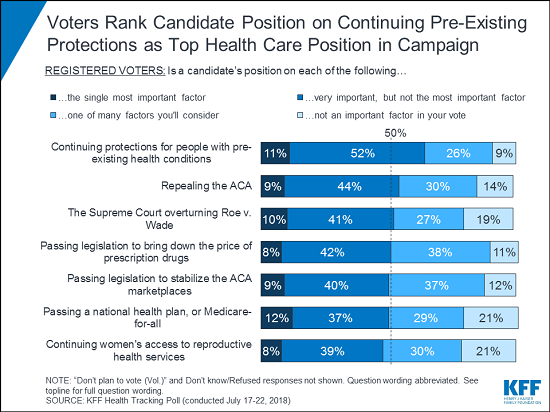
Continuing pre-existing condition protections ranks first among six other candidate positions on health care issues with 63 percent of voters rating it the “most important” or a “very important” factor. Pre-existing condition protections rank highly across party identification, with majorities of Democratic (74%), independent (64%) and half of Republican (49%) voters saying a candidate’s position on this issue is either the “most important factor” in their vote or “very important, but not the most important factor.”


A candidate’s positions on other health care issues also ranked highly, bunched closely together with about half saying they were either “the most important” or “very important” to them in evaluating candidates.

With attention now focused on possible health care issues that could be brought before the Supreme Court, the poll finds nearly two-thirds (64%) oppose the Court overturning the pre-existing condition protections of the health law, and half oppose the Court overturning the ACA entirely.  Additionally, in KFF’s first polling conducted since Justice Kennedy’s retirement announcement, two-thirds (65%) of the public do not want to see the Supreme Court overturn its Roe v. Wade decision, while one-fourth (26%) would like to see it reversed.

The Trump Administration Actions Toward the Affordable Care Act

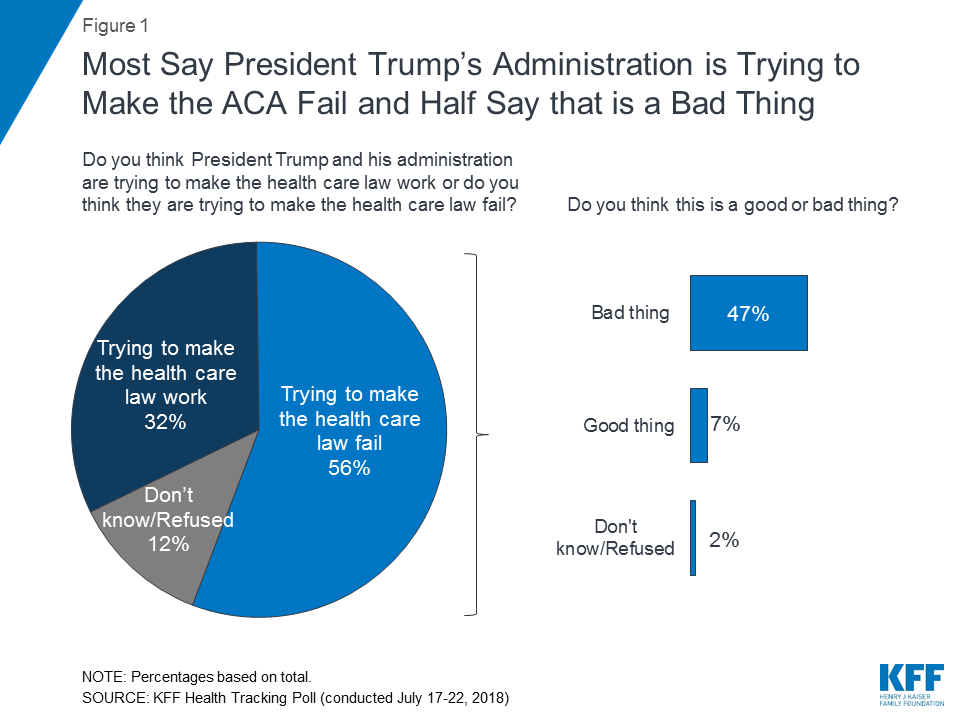
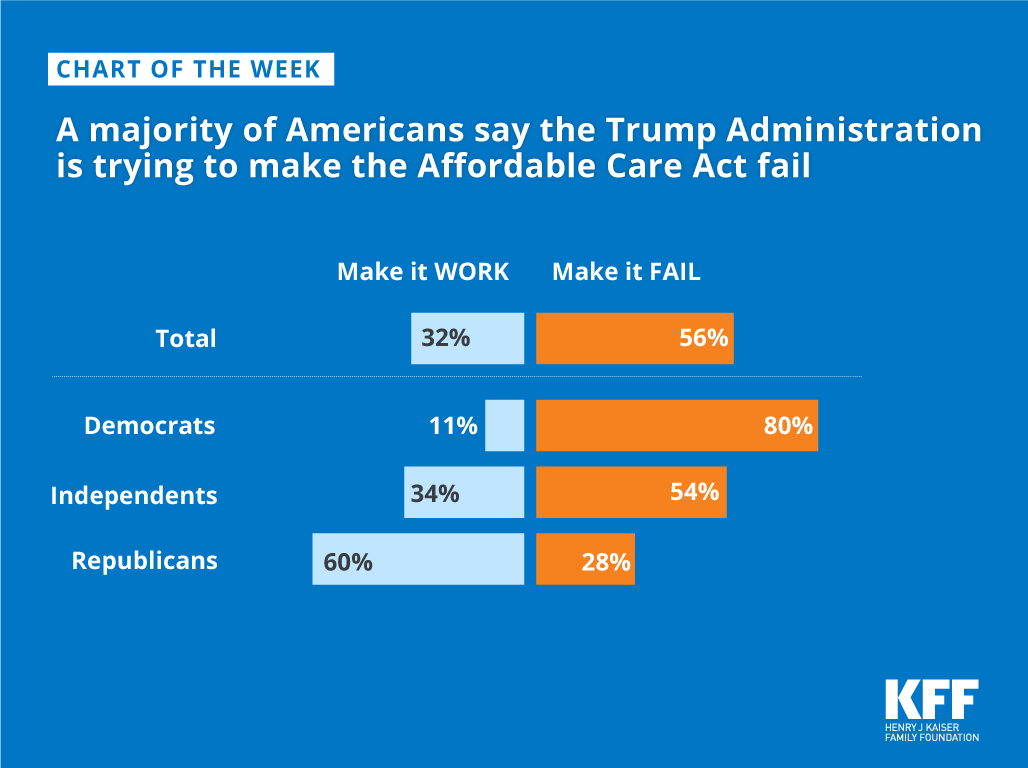
The Trump administration has taken several steps that change the ACA, from reducing funding for advertising and support for Marketplace enrollment navigators, to stopping certain payments to insurers, to introducing health insurance plans that forgo traditional ACA plan benefits, to supporting the elimination of the individual mandate penalty. More than half (56%) of the public thinks that President Trump and his administration are trying to make the ACA fail and more believe this is a bad thing versus a good thing by a nearly seven to one margin (47% vs 7%), including 77 percent  of Democrats who believe this.  A third (32%) of the public thinks the President is trying to make the ACA work.

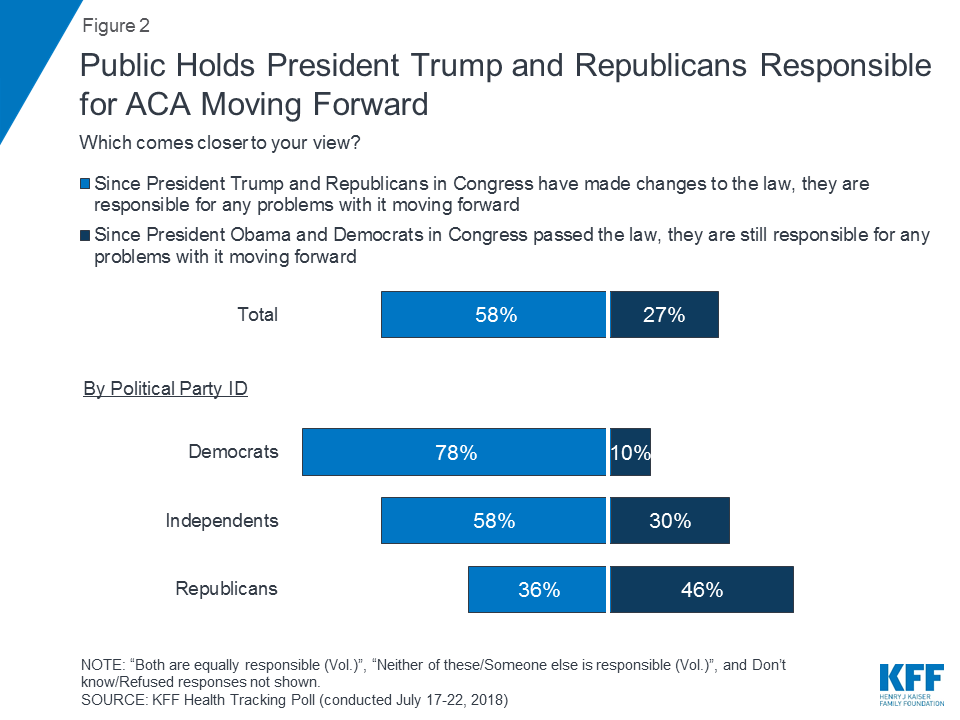
Consistent with previous KFF polling on the topic, a majority of the public (58%) believes that since President Trump and Republicans in Congress control government and have made changes to the ACA, they are responsible for any problems with the law moving forward. About a quarter (27%) say that since President Obama and Democrats in Congress passed the law, they are still responsible for problems with the law going forward.

Half of Those in States That Have Not Expanded Medicaid Favor Expanding It; More Would Support Expansion If a Work Requirement is Included

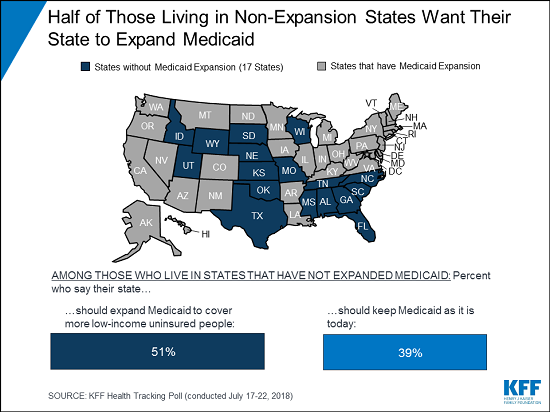
Seventeen states have not expanded their Medicaid programs, an option under the ACA, but three of these states are now considering expansion. Among individuals living in non-expansion states, half (51%) say they would like their state to expand Medicaid to cover more low-income uninsured people. About four in ten (39%) of the non-expansion state residents say they would like to see their state keep Medicaid as it is today.

The Trump administration issued guidance earlier this year allowing states to impose work requirements for individuals enrolled in Medicaid. Eleven states have applied for such waivers and four have been approved to date, with Kentucky’s waiver pending further action since a court has placed its implementation on hold. When Medicaid non-expansion state residents who initially expressed opposition to an expansion (39%) are asked if they would favor such expansion if paired with a work requirement for non-elderly adults states deem able to work, two-thirds of them (68%) would be “more likely” to support an expansion.

Methodology

Designed and analyzed by public opinion researchers at the Kaiser Family Foundation, the poll was conducted from July 17-22, 2018 among a nationally representative random digit dial telephone sample of 1,200 adults. Interviews were conducted in English and Spanish by landline (300) and cell phone (900). The margin of sampling error is plus or minus 3 percentage points for the full sample. For results based on subgroups, the margin of sampling error may be higher.


Poll Finding

Kaiser Health Tracking Poll – July 2018: Changes to the Affordable Care Act; Health Care in the 2018 Midterms and the Supreme Court

Authors: Ashley Kirzinger, Cailey Muñana, and Mollyann Brodie
Published: Jul 25, 2018

Findings

Key Findings:

  • The July Kaiser Health Tracking Poll finds a candidate’s position on continuing protections for people with pre-existing health conditions is the top health care campaign issue for voters, among a list of issues provided. This issue cuts across voter demographics with most Democratic voters (74 percent), independent voters (64 percent), and voters living in battleground areas (61 percent), as well as half of Republican voters (49 percent) saying a candidate’s position on continued protections for pre-existing health conditions is either the single most important factor or a very important factor in their 2018 vote.
  • When it comes to the Supreme Court and possible future court cases, once again, continued protections for people with pre-existing conditions weighs heavy on the minds of the public. Nearly two-thirds (64 percent) do not want to see the Supreme Court overturn these protections compared to half (52 percent) who do not want to see the Supreme Court overturn the Affordable Care Act (ACA) more generally.
  • Almost six in ten (56 percent) Americans say they think President Trump and his administration are trying to make the ACA fail while one-third (32 percent) say they are trying to make the law work. Most of those who say they think the Trump administration is trying to make the law fail think this is a “bad thing” (47 percent of the public). In addition, most (58 percent) say since President Trump and Republicans in Congress have made changes to the ACA, they are responsible for any problems with it moving forward.
  • As of July 20, 2018, 14 states have not expanded their Medicaid programs and three states are considering expansion. Among those living in states that have not yet expanded Medicaid, half (51 percent) support their state expanding their Medicaid program. A majority say they would be more likely to support Medicaid expansion if there is a work requirement included in the expansion. For example, among those who don’t initially support expansion (39 percent of people living in non-expansion states), most (68 percent) say they say they would be “more likely” to support expansion if their state included a work requirement.

President Trump and the Affordable Care Act

President Trump’s administration has taken several recent actions related to the ACA marketplaces including reducing funding for advertising and introducing association health insurance plans that cover fewer benefits than traditional ACA plans. The July Kaiser Health Tracking Poll finds almost six in ten (56 percent) say they think President Trump and his administration are trying to make the health care law fail while one-third (32 percent) say they are trying to make the law work. Most of those who say they think the Trump administration is trying to make the law fail think this is a “bad thing” (47 percent of the public), while few (7 percent of the public) say it is a “good thing.”

Figure 1: Most Say President Trump’s Administration is Trying to Make the ACA Fail and Half Say that is a Bad Thing

Most Democrats (77 percent) and nearly half of independents (45 percent) say they think the Trump administration is trying to make the ACA fail and this is a bad thing. Republicans, on the other hand, think the recent actions are an effort by the Trump administration to make the law work and this is a good thing (56 percent).

Table 1: Is the Trump Administration Trying to Make the ACA Work or Fail?
Percent who say…TotalDemocratsIndependentsRepublicans
…the Trump administration is trying to make the law work:32%11%34%60%
This is a good thing2892856
This is a bad thing3144
…the Trump administration is trying to make the law fail:56805428
This is a good thing71814
This is a bad thing47774510
Note: Don’t know/Refused responses not shown.

Similar to findings from six months ago, the majority of the public (58 percent) say since President Trump and Republicans in Congress have made changes to the ACA, they are responsible for any problems with it moving forward, compared to one-fourth (27 percent) who say that because President Obama and Democrats in Congress passed the law, they are responsible for any problems with it. Partisan differences continue, with majorities of Democrats (78 percent) and independents (58 percent) saying President Trump and Republicans are responsible for any problems with it moving forward. Republicans are more divided, but a larger share say President Obama and Democrats (46 percent) are responsible than say the same about President Trump and Republicans (36 percent).

Figure 2: Public Holds President Trump and Republicans Responsible for ACA Moving Forward

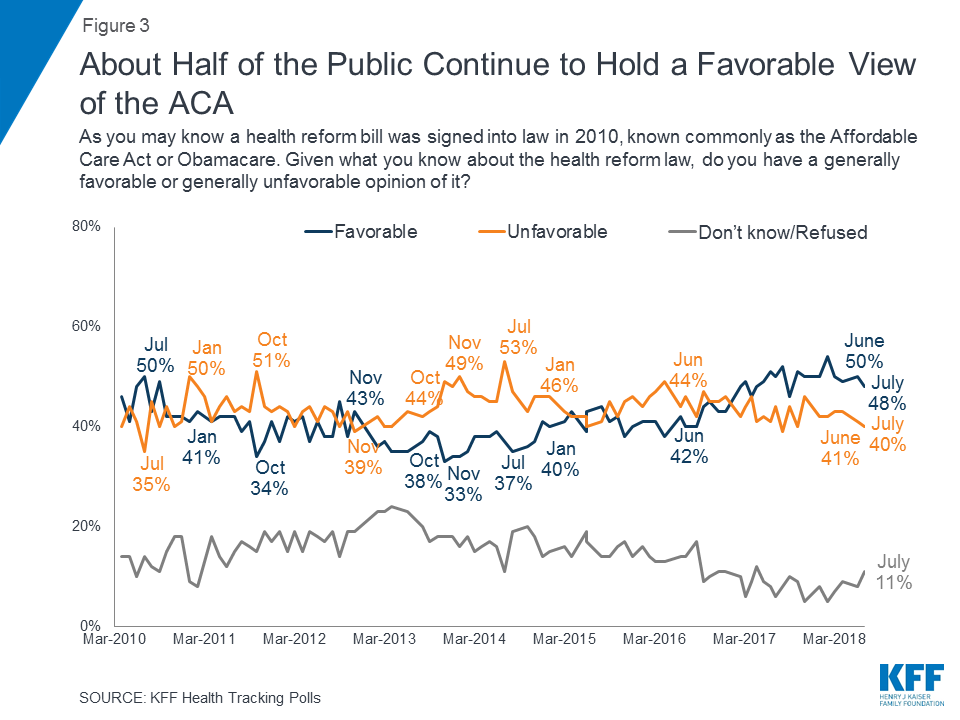
The most recent Kaiser Health Tracking Poll continues to find the public more favorable than unfavorable in their views of the ACA, with 48 percent saying they have a favorable view and 40 percent saying they have an unfavorable view. This continues the trend of a larger share of the public holding favorable views rather than unfavorable ones, first measured during the Republican efforts to repeal the ACA during 2017. A majority of Republicans continue to hold unfavorable views of the 2010 law (77 percent) while most Democrats view the law favorably (75 percent). About half of independents (51 percent) say they hold favorable views toward the ACA, while 40 percent hold unfavorable views.

Figure 3: About Half of the Public Continue to Hold a Favorable View of the ACA

Health Care in the 2018 Campaigns and the U.S. Supreme Court Debate

The July Kaiser Health Tracking Poll examines the role of health care in both the 2018 midterm elections and President Trump’s recent nomination of Judge Kavanaugh to the U.S. Supreme Court.1 

Pre-Existing Conditions Top List of Public’s Health Care Priorities in the 2018 Campaigns

A series of recent national polls released continue to find health care among the top issues for voters in the 2018 campaigns. This month’s Kaiser Health Tracking Poll looks at how important a candidate’s positions on specific health care issues are to voters and finds that protections for pre-existing conditions seem to be weighing heaviest on the minds of the public.

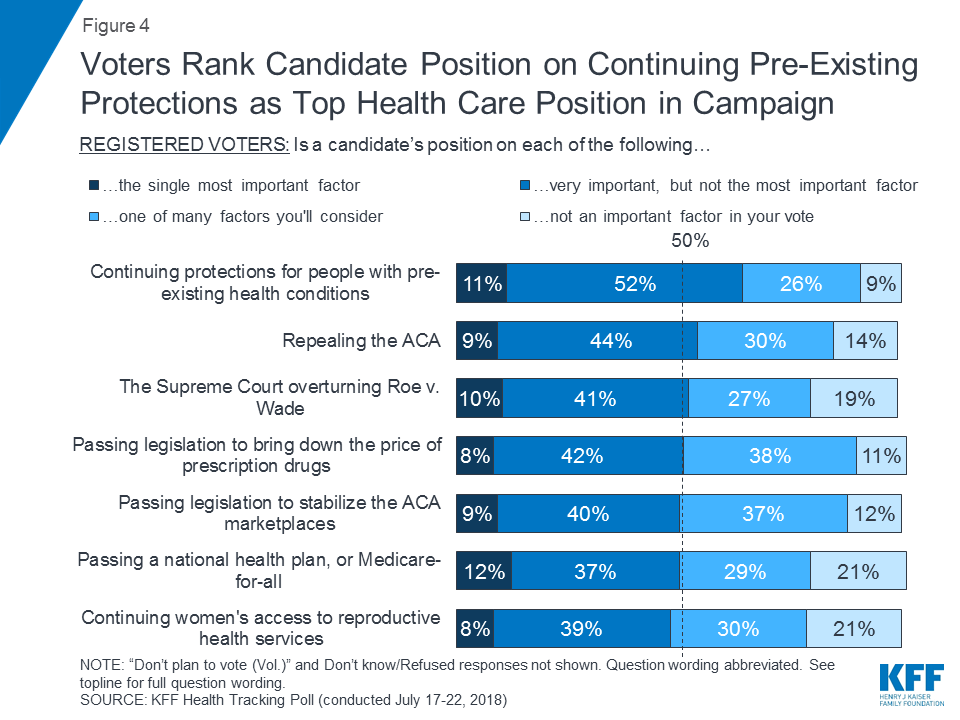
Few voters (about one in ten) say a candidate’s support for a variety of different health care positions will be the “single most important factor” in their 2018 vote choice, but more than six in ten (63 percent) say a candidate’s position on continuing protections for people with pre-existing health conditions is either the “single most important factor” or “very important, but not the most important factor.” Continuing protections for people with pre-existing health conditions tops the list and is followed by a closely bunched list of all of the other health issues provided to voters including repealing the ACA (53 percent) and the Supreme Court overturning the 1973 case Roe v. Wade (51 percent).

Figure 4: Voters Rank Candidate Position on Continuing Pre-Existing Protections as Top Health Care Position in Campaign

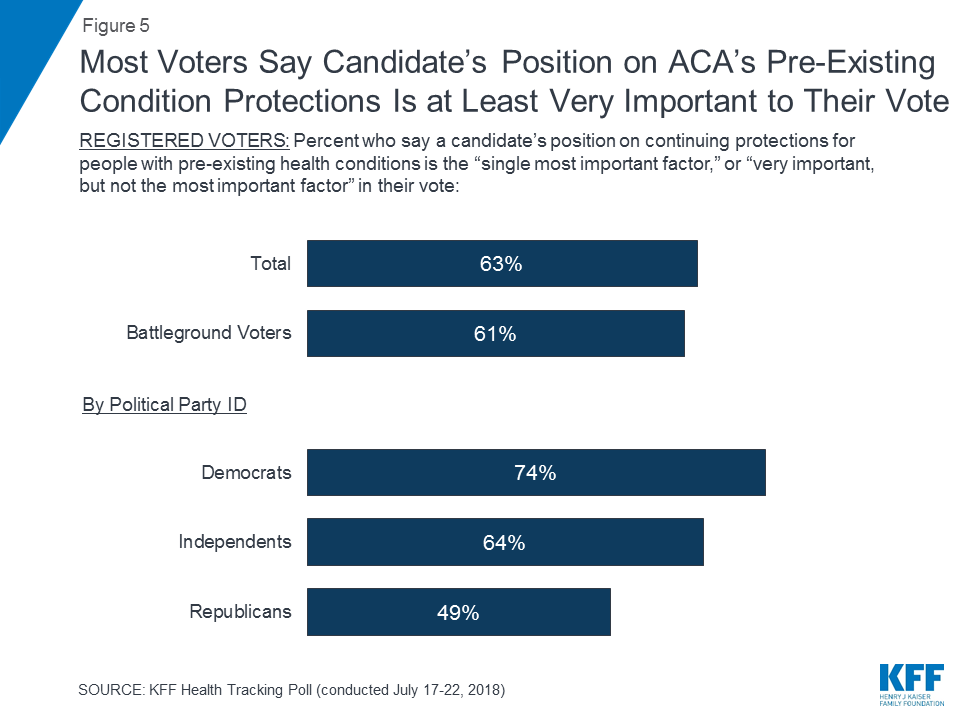
A candidate’s position on continuing protections for people with pre-existing health conditions is the top health care campaign issue among the ones tested in the poll, regardless of party identification. Most Democratic voters (74 percent), independent voters (64 percent) and half of Republican voters (49 percent) say a candidate’s position on continued protections for pre-existing health conditions is either the “single most important factor” or a “very important, but not the most important factor,” in their 2018 vote. A candidate’s position on continuing protections for people with pre-existing conditions is also the top campaign issue for voters living in battleground areas (61 percent).

Figure 5: Most Voters Say Candidate’s Position on ACA’s Pre-Existing Condition Protections Is at Least Very Important to Their Vote

2018 Midterm Election Analysis

As part of Kaiser Family Foundation’s effort to examine the role of health care in the 2018 midterm elections, throughout the year we will be tracking the views of voters – paying special attention to those living in states or congressional districts in which both parties have a viable path to win the election. This group, referred to in our analysis as “voters in battlegrounds” is defined by the 2018 Senate, House, and Governor ratings provided by The Cook Political Report. Congressional and Governor races categorized as “toss-up” were included in this group. A complete list of the states and congressional districts included in the comparison group is available in Appendix A.

Health Care and the U.S. Supreme Court

President Trump’s administration announced earlier this month that it will no longer defend the ACA’s protections for people with pre-existing medical conditions. These provisions prohibit insurance companies from denying coverage based on a person’s medical history (known as guaranteed issue), and prohibit insurance companies from charging those with pre-existing conditions more for coverage (known as community rating). The Trump administration argues that both of these protections are unconstitutional and should be deemed invalid once the individual mandate penalty goes away starting January 1, 2019. Some scholars believe that this case is headed to the U.S. Supreme Court where the court will rule on the constitutionality of both the 2010 law overall and the provisions protecting individuals with pre-existing conditions.

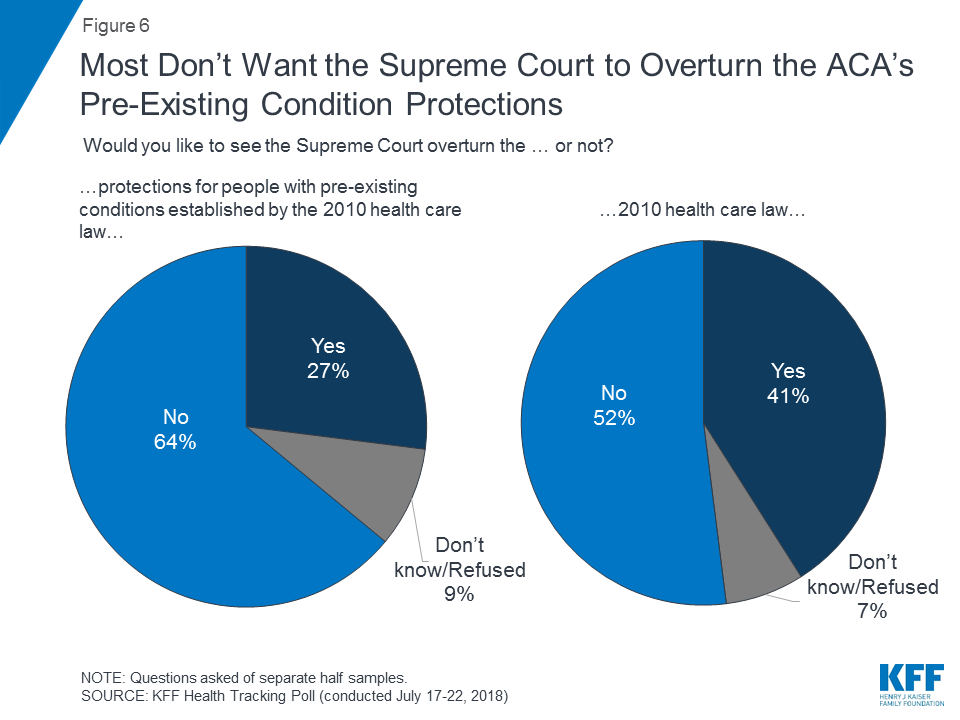
Overall, nearly two-thirds (64 percent) of the public do not want to see the Supreme Court overturn the protections for people with pre-existing health conditions and half (52 percent) do not want to see the Supreme Court overturn the 2010 health care law (ACA) more generally.

Figure 6: Most Don’t Want the Supreme Court to Overturn the ACA’s Pre-Existing Condition Protections

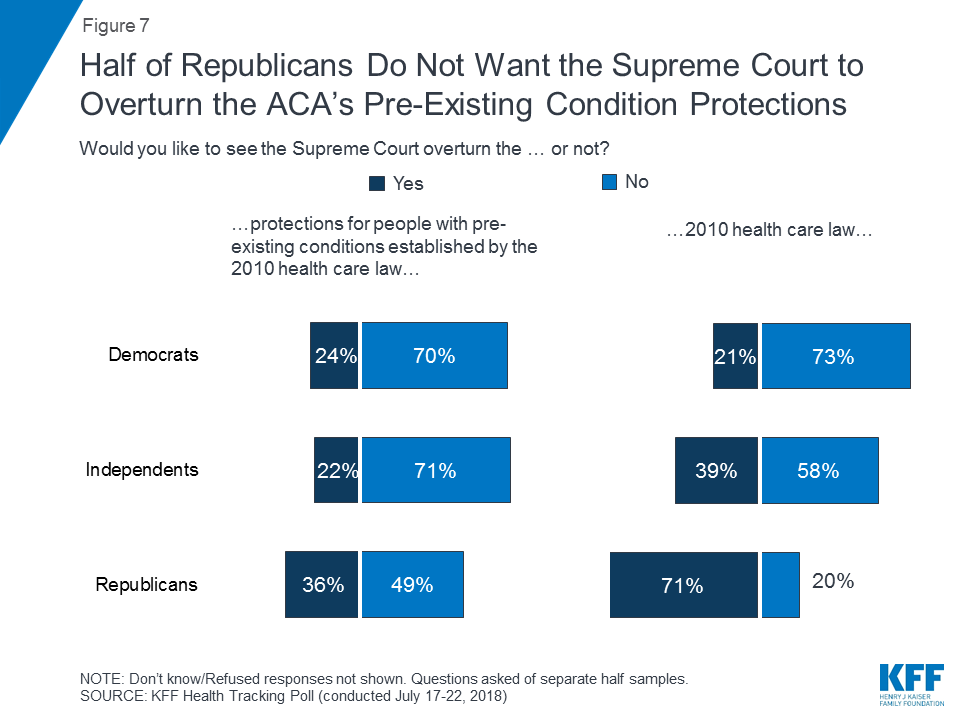
Majorities of Democrats (70 percent), independents (71 percent), and half of Republicans (49 percent) say they do not want the Supreme Court to overturn the protections for people with pre-existing conditions. This is consistent with previous KFF polling, including last month’s tracking poll that found broad public support for these protections.

When the question is framed more generally about the ACA, most Republicans (71 percent) say they want to see the court overturn the 2010 law while majorities of Democrats (73 percent) and independents (58 percent) say they do not want to see the ACA overturned by the Supreme Court.

Figure 7: Half of Republicans Do Not Want the Supreme Court to Overturn the ACA’s Pre-Existing Condition Protections
the U.S. Supreme Court and Roe v. Wade

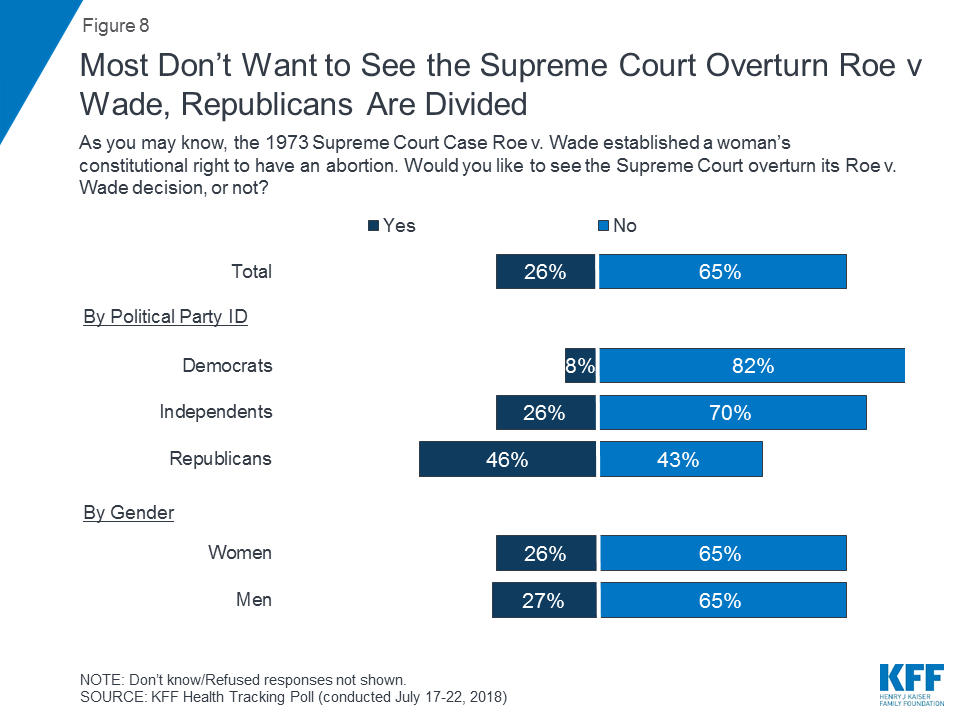
Another possible health issue in front of the U.S. Supreme Court in the coming years is the 1973 Supreme Court case Roe v. Wade which established a woman’s right to an abortion. Two-thirds (65 percent) of the public do not want to see the Supreme Court overturn this case – including majorities of both men and women – while one-fourth (26 percent) say they would like to see the Supreme Court overturn this case. There are partisan differences with majorities of Democrats (82 percent) and independents (70 percent) saying they do not want to see the case overturned, while Republicans are more divided (46 percent v. 43 percent).

Figure 8: Most Don’t Want to See the Supreme Court Overturn Roe v Wade, Republicans Are Divided

Medicaid Expansion and Work Requirements

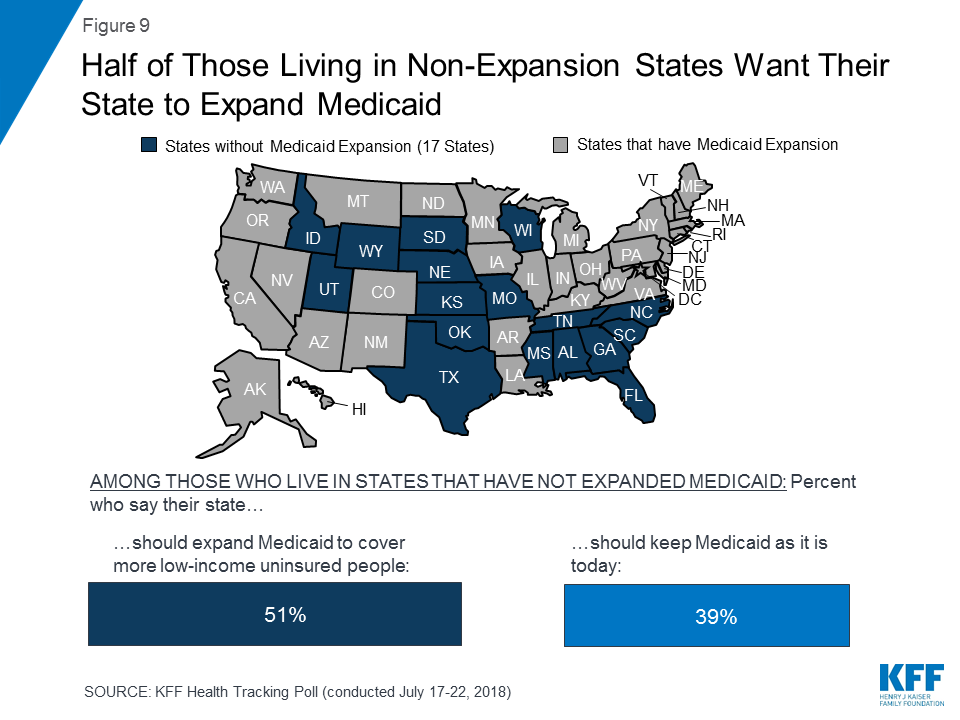
As of July 20, 2018, 14 states have not expanded their Medicaid programs while three states are considering expansion.2  Among individuals living in states that have not expanded their Medicaid program, half (51 percent) say they would like their state to expand Medicaid to cover more low-income uninsured people while four in ten (39 percent) say they would like to see their state keep Medicaid as it is today.

Figure 9: Half of Those Living in Non-Expansion States Want Their State to Expand Medicaid

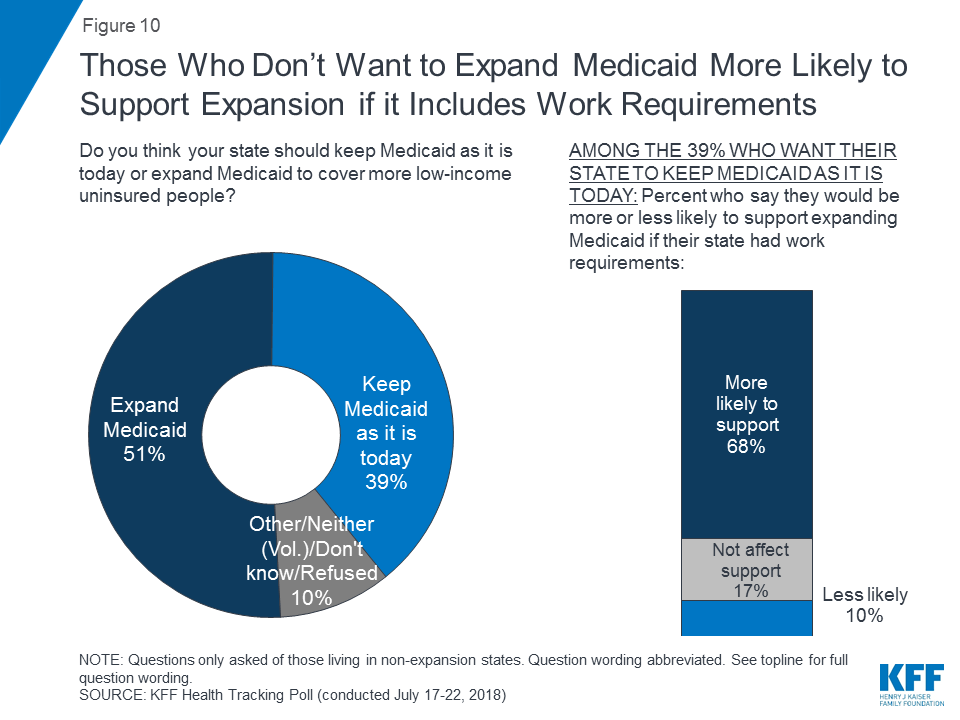
In January 2018, the Centers for Medicare and Medicaid Services (CMS) provided new guidance for Section 1115 waivers, which would allow states to impose work requirements for individuals covered by Medicaid benefits.3  Including a work requirement as part of the Medicaid program does make some individuals more likely to support Medicaid expansion in their state. Among those living in states that have not expanded Medicaid who don’t initially support expansion, two-thirds (68 percent) say they would be “more likely” to support expansion if their state included a work requirement for nonelderly adults who the state says are able to work. Few (10 percent) say including a work requirement would make them “less likely” to support expanding Medicaid.

Figure 10: Those Who Don’t Want to Expand Medicaid More Likely to Support Expansion if it Includes Work Requirements

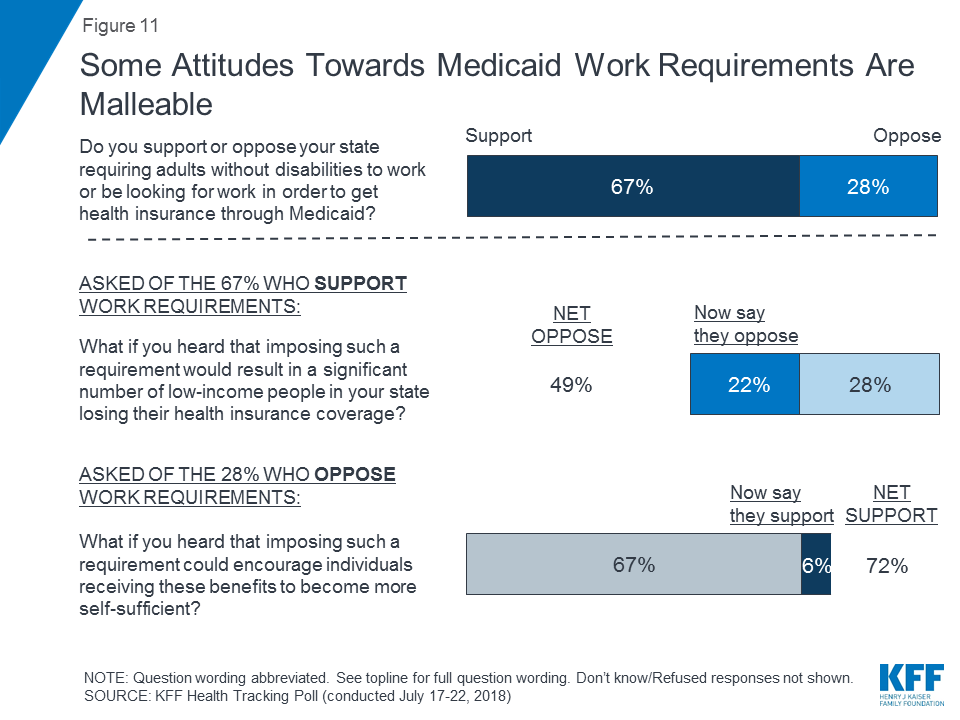
Overall, two-thirds of the public (67 percent) support allowing their state to require adults without disabilities to work or be looking for work in order to get health insurance through Medicaid while three in ten (28 percent) oppose this. This is consistent with previous KFF polling which finds majority support for this proposed change to the Medicaid program. But as with other complex health policy issues, some of the public shifts their attitudes upon hearing counter-messages regarding Medicaid work requirements.

When those who initially support these requirements are told that imposing such requirements would result in a significant number of low-income people in their state losing health insurance coverage, one- third (one-fifth of the public overall) change their mind, bringing the total opposition to about half (49 percent). On the other side of the argument, when those who initially oppose imposing work requirements in their state are told that such a requirement could encourage individuals receiving these benefits to become more self-sufficient, one-fifth (six percent of the public overall) change their minds and now support Medicaid work requirements, pushing total support to 72 percent.

Figure 11: Some Attitudes Towards Medicaid Work Requirements Are Malleable

Despite large Shares Reporting Being connected to Medicaid Program, Public Lacks awareness about Medicaid Population

Overall, seven in ten Americans (71 percent) say they have ever had a connection to the Medicaid program either directly through their own health insurance coverage (34 percent) or their child being covered by the program (seven percent), or indirectly through a friend or family member being covered by the program (30 percent).

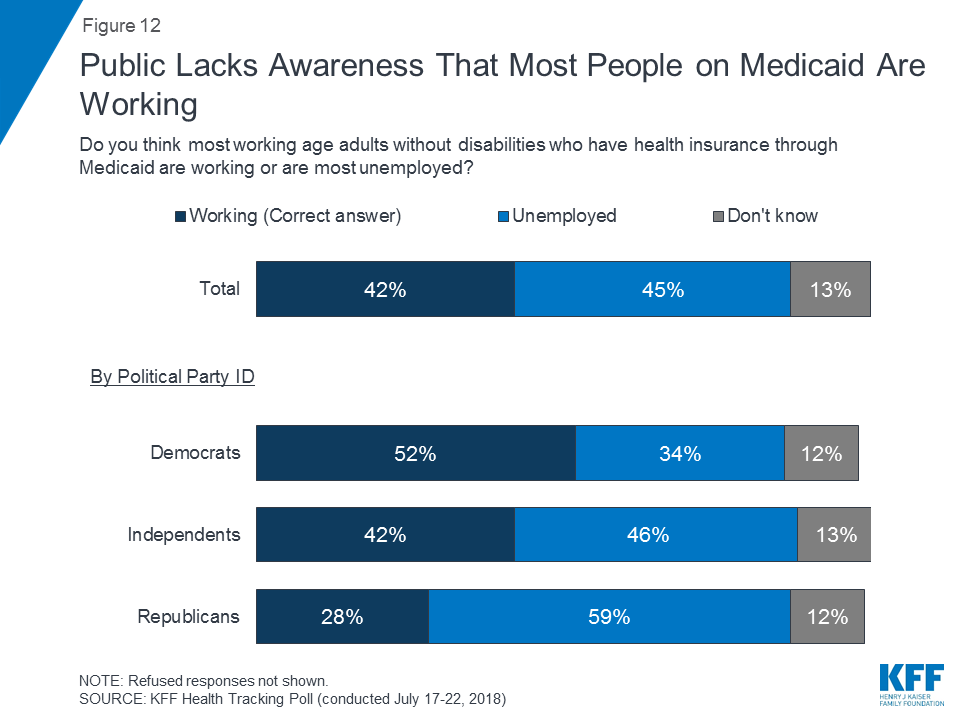
Despite large shares reporting ever being connected to Medicaid, the public is divided in their understanding of whether most working age adults without disabilities who are covered by Medicaid are working (42 percent) or unemployed (45 percent), with 13 percent saying they “don’t know.” Some studies have recently shown that most non-elderly adults without disabilities on Medicaid are currently working.4 

Figure 12: Public Lacks Awareness That Most People on Medicaid Are Working

Methodology

This Kaiser Health Tracking Poll was designed and analyzed by public opinion researchers at the Kaiser Family Foundation (KFF). The survey was conducted July 17th–22th 2018, among a nationally representative random digit dial telephone sample of 1,200 adults ages 18 and older, living in the United States, including Alaska and Hawaii (note: persons without a telephone could not be included in the random selection process). Computer-assisted telephone interviews conducted by landline (300) and cell phone (900, including 606 who had no landline telephone) were carried out in English and Spanish by SSRS of Glen Mills, PA. To efficiently obtain a sample of lower-income and non-White respondents, the sample also included an oversample of prepaid (pay-as-you-go) telephone numbers (25% of the cell phone sample consisted of prepaid numbers) as well as a subsample of respondents who had previously completed Spanish language interviews on the SSRS Omnibus poll (n=7). Both the random digit dial landline and cell phone samples were provided by Marketing Systems Group (MSG). For the landline sample, respondents were selected by asking for the youngest adult male or female currently at home based on a random rotation. If no one of that gender was available, interviewers asked to speak with the youngest adult of the opposite gender. For the cell phone sample, interviews were conducted with the adult who answered the phone. KFF paid for all costs associated with the survey.

The combined landline and cell phone sample was weighted to balance the sample demographics to match estimates for the national population using data from the Census Bureau’s 2016 American Community Survey (ACS) on sex, age, education, race, Hispanic origin, and region along with data from the 2010 Census on population density. The sample was also weighted to match current patterns of telephone use using data from the July-December 2017 National Health Interview Survey. The weight takes into account the fact that respondents with both a landline and cell phone have a higher probability of selection in the combined sample and also adjusts for the household size for the landline sample, and design modifications, namely, the oversampling of prepaid cell phones and likelihood of non-response for the re-contacted sample. All statistical tests of significance account for the effect of weighting.

The margin of sampling error including the design effect for the full sample is plus or minus 3 percentage points. Numbers of respondents and margins of sampling error for key subgroups are shown in the table below. For results based on other subgroups, the margin of sampling error may be higher. Sample sizes and margins of sampling error for other subgroups are available by request. Note that sampling error is only one of many potential sources of error in this or any other public opinion poll. Kaiser Family Foundation public opinion and survey research is a charter member of the Transparency Initiative of the American Association for Public Opinion Research.

GroupN (unweighted)M.O.S.E.
Total1,200±3 percentage points
Party Identification
Democrats369±6 percentage points
Republicans296±7 percentage points
Independents393±6 percentage points
Voter registration
Registered voters927±4 percentage points
Democratic voters304±7 percentage points
Republican voters250±7 percentage points
Independent voters301±7 percentage points
Voters in competitive elections265±7 percentage points

Endnotes

  1. President Trump announced his nominee for the U.S. Supreme Court, Judge Kavanaugh, on July 9, 2018. ↩︎
  2. Status of State Action on the Medicaid Expansion Decisions, July 3, 2018, https://modern.kff.org/health-reform/state-indicator/state-activity-around-expanding-medicaid-under-the-affordable-care-act/?currentTimeframe=0&sortModel=%7B%22colId%22:%22Location%22,%22sort%22:%22asc%22%7D ↩︎
  3. As of July 20, 2018, seven states have applied for waivers to include a work requirement in their Medicaid programs and two states (Indiana and Arkansas) have received approval to implement such requirements. On June 29, 2018, the DC federal district court ruled against Kentucky’s waiver, which included a work requirement. The court ruling explained that because low-income people within the state would be hurt by the waiver, it went against the Medicaid statute and could not be implemented. ↩︎
  4. What do different data sources tell us about Medicaid and work? July 23, 2018, https://modern.kff.org/medicaid/fact-sheet/what-do-different-data-sources-tell-us-about-medicaid-and-work/       ↩︎

Donor Government Funding for HIV in Low- and Middle-Income Countries in 2017

Authors: Jennifer Kates, Adam Wexler, Eric Lief, and The Joint United Nations programme on HIV/AIDS (UNAIDS)
Published: Jul 24, 2018

Key Points

  • DONOR GOVERMENT DISBURSEMENTS FOR HIV INCREASED IN 2017. After two years of declines, donor government disbursements for HIV increased in 2017, rising to US$8.1 billion in current USD (a $1.1 billion or 16% increase over 2016). Both bilateral funding and multilateral contributions to the Global Fund to Fight AIDS, Tuberculosis and Malaria (Global Fund) and UNITAID increased in 2017. However, funding has not returned to its peak level in 2014.1
  • THE INCREASE WAS LARGELY DUE TO THE TIMING OF U.S. FUNDING AND IS NOT EXPECTED TO CONTINUE. Disbursements by the U.S. increased by more than US$1 billion, compared to 2016, but this was primarily an issue of timing, as it shifted funding appropriated in previous years to 2017. This trend is not expected to continue; U.S. appropriations have been flat for several years, and future disbursements will likely return to prior, lower levels. In fact, U.S. appropriations for HIV were again flat in FY 2018.
  • MOST DONORS DECREASED OVERALL FUNDING IN 2017. Eight of 14 donor governments decreased overall disbursements (Australia, Denmark, Germany, Ireland, Japan, the Netherlands, Norway, and Sweden), although increases by the U.S. and 5 others (Canada, France, Italy, the U.K., and European Commission) more than offset these declines. In currency of origin, the pattern was nearly identical.
  • BILATERAL FUNDING FOR HIV BY MOST DONOR GOVERNMENTS HAS BEEN ON THE DECLINE FOR SEVERAL YEARS AND MOST DECREASED IN 2017.Eleven of 14 donor governments decreased bilateral funding in 2017; only 2 donors, in addition to the U.S., increased. Without the U.S. increase, bilateral funding from all other donors declined by US$118 million.
  • MULTILATERAL CONTRIBUTIONS HAVE FLUCTUATED OVER TIME, IN PART REFLECTING PLEDGE PERIODS TO THE GLOBAL FUND; IN 2017, THEY WERE UP. In 2017, contributions by donor governments to the Global Fund and UNITAID (after adjusting for an HIV share), increased by US$287 million, almost all of which was for the Global Fund. Six of 14 donors increased their multilateral contributions, while 4 decreased and 4 remained flat.
  • THE U.S. REMAINS THE LARGEST DONOR TO HIV. In 2017, the U.S. disbursed US$5.9 billion, followed by the U.K. (US$744 million), France (US$268 million), the Netherlands (US$203 million), and Germany (US$162 million). For the first time, the U.S. also ranked first when standardized by the size of its economy, reflecting the increase in its disbursements in 2017. The U.K. was second, followed by Denmark, and the Netherlands.
  • FUTURE FUNDING IS LIKELY TO FALL AGAIN, WITHOUT NEW COMMITMENTS Given the unique circumstances of U.S. disbursements in 2017, which almost entirely drove the 2017 increase, future funding for HIV by donor governments is likely to return to lower levels, unless new commitments are made. However, because some other donors continue to face competing emergency demands for aid, such prospects are uncertain.

  1. The estimate for donor government disbursements presented in this report is not the same as the UNAIDS estimate of total international assistance for HIV in low- and middle-income countries, which includes bilateral disbursements from DAC / non-DAC donors and multilateral disbursements from the Global Fund, other UN agencies, multilateral institutions and foundations. UNAIDS estimates that total international assistance for HIV in 2017 was US$9 billion in constant 2016 USD. ↩︎

What do different data sources tell us about Medicaid and work?

Published: Jul 23, 2018

A central question in the ongoing debate about imposing work requirements in Medicaid is what current work patterns are among Medicaid adults and how many so-called “able bodied” adults are not already working. Answers to these questions rely on various data sources, and characteristics of the underlying data and analytic decisions may lead to different conclusions. This data note examines what different data sources and analytic decisions tell us about Medicaid and work.

Range of Estimates

Widely-cited estimates from the Kaiser Family Foundation indicate that more than six in ten (62%) non-SSI, non-dual eligible, nonelderly adults covered by Medicaid work either full or part-time. These estimates draw from the 2017 Current Population Survey (CPS) and capture, post-ACA, anyone with Medicaid in 2016 who worked during 2016. In contrast, recent estimates from the White House Council of Economic Advisers use the 2014 Survey of Income and Program Participation (SIPP) to indicate that, among non-disabled, non-elderly adults with Medicaid, 47% worked full- or part-time in December 2013, before the ACA expansion population was added.

Work Status After the ACA

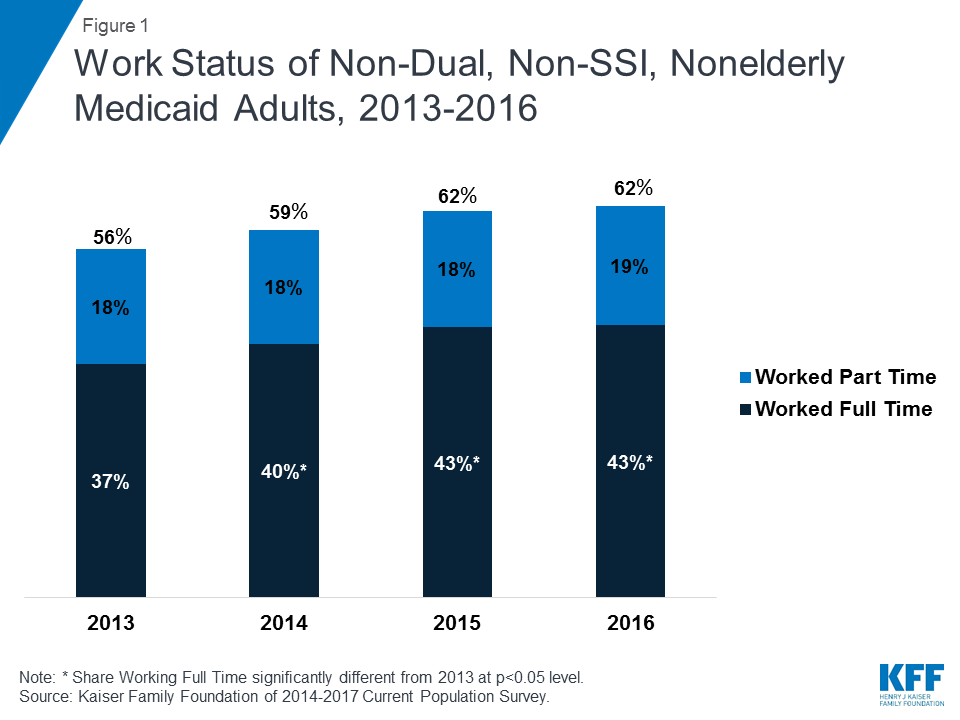
One reason for differences between estimates is the time period included in the analysis. The Affordable Care Act (ACA) extended Medicaid eligibility to many low-income workers as of 2014 by expanding eligibility to adults with income up to 138% of poverty in states that expanded. An individual working full-time (40 hours/week) for the full year (52 weeks) at the federal minimum wage ($7.25 per hour) would earn an annual salary of just over $15,000 a year, or about 125% of poverty, below the maximum targeted by the ACA Medicaid expansion. In addition, improving economic conditions over the past several years have led to a drop in the unemployment rate, from 6.7% in December 2013 to 4.7% in December 2016. As a result of these changes, the share of non-SSI, non-dual, nonelderly adults with Medicaid who work increased significantly after 2013 (Figure 1), rising from 56% before the ACA expansion to 62% in 2016, according to analysis of the CPS. Other analysis of CPS, which enables state-level estimates, found that in 2016, work rates were higher among adults in states that expanded Medicaid compared to those that did not. Data that does not reflect the changing composition of Medicaid adults after the ACA expansion likely understates work rates among Medicaid adults.

Figure 1: Work Status of Non-Dual, Non-SSI, Nonelderly Medicaid Adults, 2013-2016

Work Status in 2013

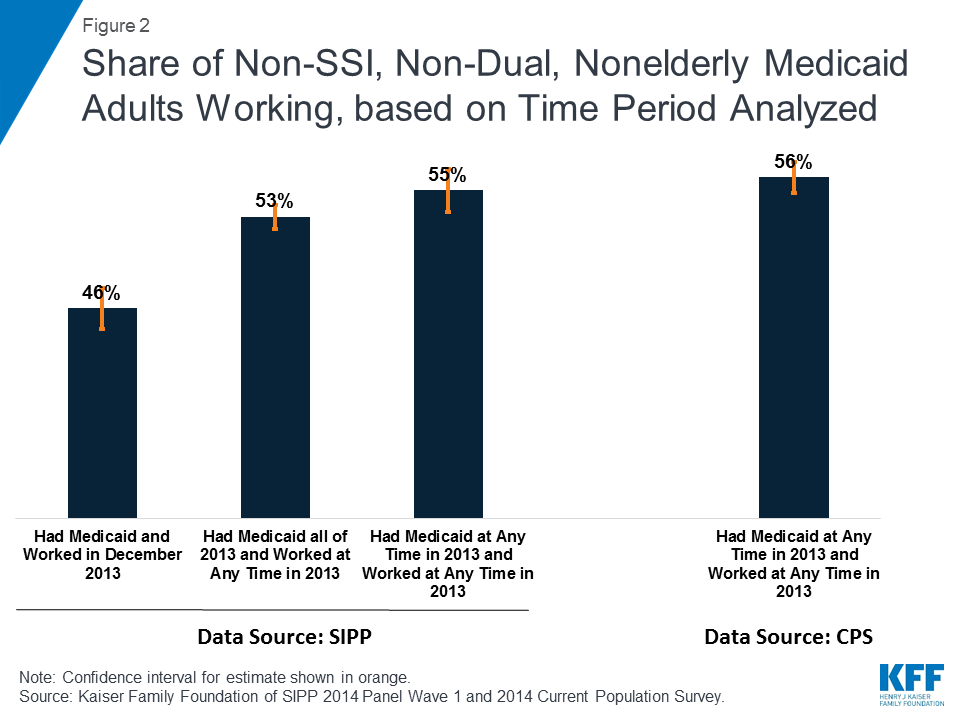
Another reason for the difference between estimates of work rates is the analytic decision of what reference period to use when measuring either Medicaid coverage or work. The CEA analysis of SIPP looks at coverage and work within a single month (December 2013), providing a snapshot of work and coverage. Our analysis of SIPP, using similar parameters,1  similarly finds that less than half (46%) of non-SSI, non-dual, nonelderly adults who had Medicaid in December 2013 worked in that month (Figure 1). Looking at a given month, however, overlooks the fact that many low-income people move in and out of work over the course of a year. When we analyzed SIPP to look at work rates among adults who had Medicaid for the entire year in 2013, a much higher share of Medicaid adults (53%) worked at some point in the year (Figure 2). Other analysis of SIPP also has found that working Medicaid-eligible adults may have inconsistent work hours over the course of a year, even though their total annual hours worked is high. Given the nature of jobs that Medicaid adults typically hold—such as service jobs in the restaurant industry, home health or health care aides, retail sales or cashiers, or janitors or maids—it is not surprising that employment or hours worked may be unstable or inconsistent for this group.

Figure 2: Share of Non-SSI, Non-Dual, Nonelderly Medicaid Adults Working, based on Time Period Analyzed

Further analysis of SIPP to match the reference period for the CPS shows very similar results for work in 2013. The current CPS does not enable analysis of monthly health insurance coverage but instead captures anyone who had Medicaid at any point in the year. Analysis of SIPP using these parameters (that is, any Medicaid coverage during the year) and a similar reference period for work (any work during the year) shows that 55% of non-SSI, non-dual, nonelderly Medicaid adults worked, a difference that is not statistically significantly different from those with Medicaid all year. Our estimates from CPS for 2013 show that 56% of non-SSI, non-dual, nonelderly Medicaid adults worked in 2013, a rate very similar to the corresponding value for SIPP, indicating that the two surveys appear to be similarly measuring coverage and work.

Implications

All data sources have some limitations, whether they are precision of estimates, timeliness of data, or ability to capture state-level data, and analysts weigh these issues when considering which data source to use. In addition, analytic decisions matter in final estimates and in how those estimates should be interpreted. Outdated data or data that captures only a snapshot of a fluid relationship may not provide a full picture of work patterns among the Medicaid population. In addition, looking at work rates in isolation misses important aspects of the relationship between Medicaid and work, including substantial health-related barriers to work among those not working, likely exemptions among those not working, and potential coverage losses even among those complying with work requirements.

  1. Our estimated work rate for December 2013 (46%) differs slightly from the CEA estimate (47%), perhaps due to our exclusion of all dual eligible individuals versus just those receiving SSI, SSDI, or VA disability benefits. ↩︎

Global HIV/AIDS Timeline

Published: Jul 20, 2018

Introduction

On June 5, 1981, the U.S. Centers for Disease Control and Prevention (CDC) issued its first warning about a relatively rare form of pneumonia among a small group of young gay men in Los Angeles, which was later determined to be AIDS-related. While scientists believe that HIV was present years before the first case was brought to public attention, 1981 is generally referred to as the beginning of the HIV/AIDS epidemic. Since that time, tens of millions of people have been infected with HIV worldwide. The Global HIV/AIDS Timeline is designed to serve as an ongoing reference tool for the many political, scientific, cultural, and community developments that have occurred over the history of the epidemic.

Timeline by Year

1981 | 82 | 83 | 84 | 85 | 86 | 87 | 88 | 89 |90|  91 | 92 | 93 | 94 | 95 | 96 | 97 | 98 | 99 |2000| 01 | 02 | 03 | 04 |05 | 06 | 07 | 08 | 09 | 10 | 11 | 12 | 13 | 14 | 15 | 16 | 17 | 18 

1981

  • U.S. Centers for Disease Control and Prevention (CDC) reports first cases of rare pneumonia in young gay men in the June 5 MMWR. These cases were later determined to be AIDS. This marks the official beginning of the HIV/AIDS epidemic. CDC also issues report on highly unusual occurrence of rare skin cancer, Kaposi’s Sarcoma, among young gay men in the July 4 MMWR.
  • First mainstream news coverage of the CDC’s June 5 MMWR by the Associated Press and the LA Times on the same day it is issued. The San Francisco Chronicle reports on it the next day.
  • New York Times publishes its first news story on AIDS on July 3.

1982

  • U.S. CDC establishes term Acquired Immune Deficiency Syndrome (AIDS); refers to four “identified risk factors:” male homosexuality, intravenous drug abuse, Haitian origin, and hemophilia A.
  • Cases of AIDS now present in many states and its cause not yet known.
  • “GRID” or “gay-related immune deficiency” increasingly used by media and health care professionals, mistakenly suggesting inherent link between homosexuality and AIDS.
  • First U.S. Congressional hearings on AIDS held.
  • Gay Men’s Health Crisis, the first community-based AIDS service provider in the U.S., established in New York City.
  • City and County of San Francisco, working closely with San Francisco AIDS Foundation, Shanti Project and others, develops the “San Francisco Model of Care,” which emphasizes home- and community-based services for people with AIDS.
  • First AIDS case reported in Africa.

1983

  • The U.S. Public Health Service issues recommendations for preventing transmission of the infection through sexual contact and blood transfusions.
  • U.S. CDC clarifies its use of term “high risk group” and urges that it not be used to justify discrimination or unwarranted fear of casual transmission.
  • U.S. CDC adds female sexual partners of men with AIDS as fifth risk group.
  • The Orphan Drug Act is signed into U.S. law, providing incentives to drug companies to develop therapies for rare diseases.
  • In the September 9 MMWR, U.S. CDC notes that AIDS has not been spread through casual contact and declares that “AIDS is not known to be transmitted through food, water, air, or environmental surfaces.”
  • Dr. Luc Montagnier of the Pasteur Institute in France isolates lymphadenopathy-associated virus (LAV) — which he believed to be related to AIDS — and publishes findings. That same year, Dr. Robert Gallo of the National Cancer Institute in the U.S. successfully cultivates LAV (which he identified as HTLV-III) in lab and submits paper for publication proposing that a retrovirus causes AIDS.
  • The World Health Organization (WHO) holds first meeting to assess the impact of AIDS globally and begins international surveillance.
  • People living with AIDS (PWAs) take over plenary stage at a U.S. conference and issue statement on the rights of PWAs referred to as The Denver Principles.
  • National Association of People with AIDS (NAPWA) and Federation of AIDS Related Organizations form.
  • AIDS Candlelight Memorial held for the first time.

1984

  • U.S. Department of Health and Human Services (HHS) announces Dr. Robert Gallo of the National Cancer Institute finds that a retrovirus causes AIDS. Dr. Gallo and Dr. Luc Montagnier of the Pasteur Institute hold joint press conference in June announcing discovery that a retrovirus (identified as HTLV-III by Gallo and LAV by Montagnier; see 1983 entry) — later named Human Immunodeficiency Virus (HIV) — causes AIDS.
  • U.S. CDC states that abstention from intravenous drug use and reduction of needle-sharing “should also be effective in preventing transmission of the virus.”
  • San Francisco officials order bathhouses closed; major public controversy ensues and continues in Los Angeles, New York and other cities.
  • AIDS Action Council is formed by small group of AIDS service organizations from across the U.S.

1985

  • President Ronald Reagan mentions AIDS publicly for the first time.
  • First International AIDS Conference held in Atlanta, hosted by U.S. HHS and WHO.
  • At least one HIV/AIDS case reported in each region of the world. First HIV case reported in China.
  • First HIV test licensed by the U.S. Food and Drug Administration (FDA); detects antibodies to HIV. Blood banks begin screening the U.S. blood supply.
  • Pentagon announces it will begin testing all new recruits for HIV and will reject those who are positive.
  • U.S. Public Health Service issues first recommendations for preventing transmission of HIV from mother to child.
  • Rock Hudson announces that he has AIDS and dies later this year.
  • Ryan White, an Indiana teenager with AIDS, is barred from school; goes on to speak out publicly against AIDS stigma and discrimination.
  • First major play about the early days of the AIDS epidemic, “The Normal Heart” by playwright Larry Kramer, opens.
  • American Foundation for AIDS Research (amfAR) founded by Co-Chairs Mathilde Krim and Michael S. Gottlieb, and National Chair Elizabeth Taylor.
  • Project Inform founded to advocate for faster government approval of HIV drugs.
  • National AIDS Network (NAN) in the U.S. forms.

1986

  • National Academy of Sciences issues report critical of U.S. response to “national health crisis;” calls for $2 billion investment.
  • U.S. Surgeon General Koop issues Surgeon General’s Report on AIDS, calling for education and condom use.
  • Institute of Medicine report calls for a national education campaign and creation of National Commission on AIDS in U.S.
  • AZT, the first drug used to treat HIV/AIDS, begins clinical trials.
  • First HIV cases reported in Russia and India.
  • 2nd International AIDS Conference held in Paris, France.
  • International Steering Committee for People with HIV/AIDS (ISC) created; becomes Global Network of People Living with HIV/AIDS (GNP+) in 1992.
  • Ricky Ray, a nine-year-old hemophiliac with HIV,  barred from Florida school; his family’s home burned by arsonists the following year.
  • Robert Wood Johnson Foundation creates “AIDS Health Services Program,” providing funding to hard hit U.S. cities; program is precursor to Ryan White CARE Act.
  • Informal distribution of clean syringes begins in Boston and New Haven.
  • First panel of the AIDS Memorial Quilt created.

1987

  • First antiretroviral (ARV) drug — zidovudine or AZT (a nucleoside analog) — approved by U.S. FDA.
  • U.S. Congress approves $30 million in emergency funding to states for AZT.
  • AIDS Coalition to Unleash Power (ACT UP) established in New York in response to proposed cost of AZT; the price of AZT is subsequently lowered.
  • President Reagan makes first public speech about AIDS; establishes Presidential Commission on HIV (Watkins Commission).
  • U.S. CDC launches first AIDS-related public service announcements, “America Responds to AIDS.”
  • U.S. CDC holds its first National Conference on HIV and communities of color.
  • U.S. FDA adds HIV prevention as a new indication for male condoms.
  • U.S. FDA creates new class of experimental drugs called Treatment Investigational New Drugs (INDs), which accelerates drug approval by two to three years.
  • U.S. FDA sanctions first human testing of candidate vaccine against HIV.
  • U.S. Congress adopts Helms Amendment banning use of federal funds for AIDS education materials that “promote or encourage, directly or indirectly, homosexual activities,” often referred to as the “no promo homo” policy.
  • U.S. adds HIV as a “dangerous contagious disease” to its immigration exclusion list; mandates testing of all applicants.
  • 3rd International AIDS Conference is held in Washington, D.C.
  • AIDS becomes first disease debated on floor of United Nations (UN) General Assembly. Assembly designates WHO to lead effort to address AIDS globally.
  • Global Programme on AIDS launched by WHO.
  • AIDS Support Organisation (TASO) forms in Uganda.
  • National Black Leadership Commission on AIDS, National Minority AIDS Council, and National Task Force on AIDS Prevention form in the U.S.
  • First issue of “AIDS Treatment News” published to provide HIV treatment information to community members.
  • “And the Band Played On: Politics, People and the AIDS Epidemic,” a history of the epidemic’s early years by Randy Shilts, published.
  • AIDS Memorial Quilt displayed on National Mall in Washington, DC, for first time.
  • Entertainer Liberace dies of AIDS.

1988

  • World AIDS Day first declared by WHO on December 1.
  • WHO reports AIDS cases increased 56% worldwide.
  • UNAIDS reports the number of women living with HIV/AIDS in sub-Saharan Africa exceeds that of men.
  • 4th International AIDS Conference is held in Stockholm, Sweden; International AIDS Society (IAS) forms.
  • Watkins Commission on AIDS presents report to President Reagan.
  • U.S. National Institutes of Health (NIH) establishes Office of AIDS Research (OAR) and AIDS Clinical Trials Group (ACTG).
  • U.S. FDA allows importation of unapproved drugs for persons with life-threatening illnesses, including HIV/AIDS.
  • ACT UP demonstrates at U.S. FDA headquarters in protest of slow pace of drug approval process.
  • The U.S. Health Resources and Services Administration (HRSA) awards 21 grants to plan for HIV/AIDS systems of care, laying groundwork for statewide programs later funded through Ryan White CARE Act.
  • U.S. Health Omnibus Programs Extension (HOPE) Act of 1988 authorizes use of federal funds for HIV/AIDS prevention, education, and testing.
  • U.S. Surgeon General Koop and U.S. CDC mail brochure “Understanding AIDS” to all U.S. households; first and only national mailing of its kind.
  • U.S. Justice Department says people with HIV/AIDS cannot be discriminated against.
  • Judge in Florida rules young girl with AIDS can only attend school if in glass enclosure.
  • U.S. CDC launches TV commercial campaign about AIDS awareness aimed at minorities.
  • Elizabeth Glaser, an HIV positive mother of two HIV positive children, and two friends form the Pediatric AIDS Foundation; later renamed the Elizabeth Glaser Pediatric AIDS Foundation.
  • First comprehensive needle exchange program (NEP) established in North America in Tacoma, Washington; New York City creates first government-funded NEP; San Francisco establishes what becomes largest NEP in the U.S.

1989

  • A foreign traveler with AIDS is not allowed into U.S. because he has AIDS.
  • U.S. Congress creates National Commission on AIDS.
  • U.S. CDC issues first guidelines for prevention of Pneumocystis carinii pneumonia (PCP), an AIDS-related opportunistic infection and major cause of morbidity and mortality for people with HIV.
  • Head of NIH’s National Institute of Allergy and Infectious Diseases (NIAID), Dr. Anthony Fauci, endorses parallel track policy, giving those that do not qualify for clinical trials access to experimental treatments.
  • AIDS activists stage several major protests about AIDS drugs during year, including at the Golden Gate Bridge, the New York Stock Exchange, and U.S. headquarters of Burroughs Wellcome.
  • 5th International AIDS Conference (“The Scientific and Social Challenge of AIDS”) held in Montreal, Canada.
  • First “Day Without Art” organized by Visual AIDS to underscore impact of AIDS on the arts.
  • Dancer and choreographer Alvin Ailey dies of AIDS.
  • Photographer Robert Mapplethorpe dies of AIDS.

1990

  • Ryan White dies at 18.
  • Ryan White Comprehensive AIDS Resources Emergency (CARE) Act of 1990 enacted by U.S. Congress. Provides federal funds for community-based care and treatment services; funded at $220.5 million in first year.
  • Americans with Disabilities Act of 1990 (ADA) enacted by U.S. Congress; prohibits discrimination against individuals with disabilities, including people living with HIV/AIDS.
  • U.S. FDA approves use of AZT for pediatric AIDS.
  • 6th International AIDS Conference (“AIDS in the Nineties: From Science to Policy”) held in San Francisco, CA. To protest U.S. immigration policy, domestic and international non-governmental groups boycott conference. The 1992 conference, scheduled to take place in Boston, moved to Amsterdam.
  • Kimberly Bergalis, of Florida, believed to have been infected with HIV by her dentist, causing major public debate.
  • First National Conference on Women and AIDS held in Washington, D.C.
  • “Women, AIDS and Activism,” developed by ACT UP’s Women’s Caucus, published, becoming the first book of its kind.
  • Pop artist Keith Haring dies of AIDS.

1991

  • NBA legend Earvin “Magic” Johnson announces he is HIV-positive and retires from basketball.
  • U.S. CDC recommends restrictions on practice of HIV-positive health care workers; U.S. Congress enacts law requiring states to take similar action.
  • Housing Opportunities for Persons with AIDS (HOPWA) Act of 1991 enacted by U.S. Congress. Provides housing assistance to people living with AIDS through grants to U.S. states and local communities.
  • 7th International AIDS Conference (“Science Challenging AIDS”) held in Florence, Italy.
  • ICASO (International Council of AIDS Service Organizations) forms as global network of non-governmental and community-based organizations.
  • Red ribbon introduced as international symbol of AIDS awareness at Tony Awards by Broadway Cares/Equity Fights AIDS and Visual AIDS.
  • Lead singer of band Queen Freddie Mercury dies of AIDS.

1992

  • AIDS becomes number one cause of death for U.S. men ages 25 to 44.
  • U.S. FDA licenses first rapid HIV test, which provides results in as little as ten minutes.
  • 8th International AIDS Conference (“A World United Against AIDS”) held in Amsterdam, the Netherlands; would have taken place in Boston but was moved due to U.S. immigration ban.
  • International Community of Women Living with HIV/AIDS (ICW) founded.
  • Teenager Ricky Ray, whose home was torched because he and his siblings were HIV-positive, dies of AIDS.
  • Mary Fisher and Bob Hattoy, each HIV-positive, address the Republican and Democratic National Conventions, respectively.
  • Tennis star Arthur Ashe announces he has AIDS.

1993

  • U.S. President Clinton establishes White House Office of National AIDS Policy (ONAP).
  • U.S. CDC initiates HIV prevention community planning process for local distribution of federal prevention funding.
  • U.S. CDC expands case definition of AIDS to reflect fuller spectrum of the disease, including adding conditions specific to women and injection drug users.
  • U.S. FDA approves female condom for sale in U.S.
  • U.S. Congress enacts NIH Revitalization Act, giving the OAR primary oversight of all NIH AIDS research; requires NIH and other research agencies to expand involvement of women and minorities in all research. President Clinton signs HIV immigration exclusion policy into law as part of the same law.
  • Women’s Interagency HIV Study (WIHS) and HIV Epidemiology Study (HERS) begin; both major U.S. federally-funded research studies on women and HIV/AIDS.
  • First annual “AIDSWatch” — hundreds of community members from across U.S. converge in Washington, D.C. to lobby Congress for increased AIDS funding.
  • 9th International AIDS Conference is held in Berlin, Germany.
  • “Angels in America,” Tony Kushner’s play about AIDS, wins Tony Award and Pulitzer Prize for Drama.
  • “Philadelphia,” film starring Tom Hanks as a lawyer with AIDS, opens in theaters, becoming first major Hollywood movie on AIDS.
  • Ballet dancer Rudolf Nureyev dies of AIDS.
  • Tennis star Arthur Ashe dies of AIDS.
  • Leading advocate for women with AIDS in prison Katrina Haslip dies of AIDS.

1994

  • AIDS becomes leading cause of death for all Americans ages 25 to 44; remains so through 1995.
  • U.S. Public Health Service recommends use of AZT by pregnant women to reduce perinatal transmission of HIV; based on “076” study showing up to 70% reduction in transmission.
  • U.S. FDA approves oral HIV test, first non-blood based antibody test for HIV.
  • NIH issues guidelines requiring applicants for NIH grants to address “the appropriate inclusion of women and minorities in clinical research.”
  • 10th International AIDS Conference (“The Global Challenge of AIDS: Together for the Future”) held in Yokohama, Japan.
  • Author of “And the Band Played On” Randy Shilts dies of AIDS.
  • Pedro Zamora, a young gay man living with HIV, appears on the cast of MTV’s popular show, The Real World; dies later in the year at age 22.
  • Co-founder of Pediatric AIDS Foundation Elizabeth Glaser dies of AIDS.

1995

  • First protease inhibitor, saquinavir, approved in record time by the U.S. FDA, ushering in new era of highly active antiretroviral therapy (HAART).
  • U.S. CDC issues first guidelines for prevention of opportunistic infections in persons infected with HIV.
  • U.S. CDC issues report on syringe exchange programs (SEPs). The National Academy of Sciences concludes SEPs are effective component of a comprehensive HIV prevention strategy.
  • U.S. President Clinton establishes Presidential Advisory Council on HIV/AIDS (PACHA).
  • First White House Conference on HIV/AIDS held.
  • First National HIV Testing Day held on June 27; created by the National Association of People with AIDS (NAPWA).
  • Olympic Gold Medal diver Greg Louganis discloses he is living with HIV; announcement leads to public debate regarding disclosure of HIV status.
  • Rap artist Eric Wright (Eazy-E of NWA) dies of AIDS.

1996

  • 11th International AIDS Conference (“One World, One Hope”) held in Vancouver, Canada; highlights effectiveness of HAART, creating a period of optimism.
  • UNAIDS (Joint United Nations Programme on HIV/AIDS) begins operations; established to advocate for global action on epidemic and coordinate HIV/AIDS efforts across UN system.
  • IAVI (International AIDS Vaccine Initiative) forms to speed the search for effective HIV vaccine.
  • Brazil begins national ARV distribution; first developing country to do so.
  • Number of new AIDS cases diagnosed in U.S. declines for first time in history of epidemic.
  • HIV no longer leading cause of death for all Americans ages 25-44; remains leading cause of death for African-Americans in this age group.
  • Time Magazine names AIDS researcher Dr. David Ho as its “Man of the Year.”
  • The Levine Committee, a blue ribbon advisory panel, calls for overhaul of NIH AIDS research, including stronger role for OAR and increased support for vaccine-related and investigator-initiated research.
  • U.S. FDA approves viral load test, a new test that measures the level of HIV in the body.
  • U.S. FDA approves first HIV home testing and collection kit.
  • U.S. FDA approves first HIV urine test.
  • U.S. FDA approves first non-nucleoside reverse transcriptase inhibitor (NNRTI), nevirapine.
  • U.S. Congress reauthorizes Ryan White CARE Act.
  • AIDS awareness ad campaigns target larger public, not only those at high risk.
  • Former heavyweight boxing champion Tommy Morrison announces he is HIV-positive.

1997

  • AIDS-related deaths in U.S. decline by more than 40 percent compared to prior year, largely due to HAART.
  • U.S. President Clinton announces goal of finding an effective vaccine in 10 years and creation of Dale and Betty Bumpers Vaccine Research Center.
  • U.S. FDA approves Combivir, a tablet combining two ARV drugs, making it easier for people living with HIV to take medication.
  • U.S. Congress enacts FDA Modernization Act of 1997, codifying accelerated approval process and allowing dissemination of information about off-label uses of drugs.

1998

  • First large-scale human trials (Phase III) for an HIV vaccine begin.
  • Despite earlier optimism, several reports indicate growing signs of treatment failure and side effects from HAART.
  • U.S. HHS issues first national guidelines for use of antiretroviral therapy in adults.
  • U.S. HHS Secretary Shalala determines needle exchange programs to be effective and do not encourage use of illegal drugs, but Clinton Administration does not lift ban on use of federal funds for such purposes.
  • U.S. Supreme Court, in Bragdon v. Abbott, rules that Americans with Disabilities Act covers those in earlier stages of HIV disease, not just AIDS.
  • Ricky Ray Hemophilia Relief Fund Act of 1998 enacted by U.S. Congress, authorizing payments to hemophiliacs infected through un-screened blood-clotting agents between 1982 and 1987.
  • Minority AIDS Initiative created in U.S., after African-American leaders declare “state of emergency” and Congressional Black Caucus (CBC) calls on U.S. HHS to do the same.
  • 12th International AIDS Conference (“Bridging the Gap”) held in Geneva, Switzerland.
  • Treatment Action Campaign (TAC) forms in South Africa; grassroots movement pushes for access to treatment.
  • Global AIDS and human rights activists Jonathan Mann and Mary Lou Clements-Mann killed in plane crash.

1999

  • First human vaccine trial in a developing country begins in Thailand.
  • U.S. President Clinton announces Leadership and Investment in Fighting an Epidemic (LIFE) Initiative to address the global epidemic; leads to increased funding.
  • U.S. Congressional Hispanic Caucus, with the Congressional Hispanic Caucus Institute, convenes Congressional hearing on impact of HIV/AIDS on Latino community.
  • Founder of National Task Force on AIDS Prevention Reggie Williams dies of AIDS.

2000

  • 13th International AIDS Conference (“Breaking the Silence”) held in Durban, South Africa; first time held in developing nation; heightens awareness of the global pandemic.
  • U.S. National Security Council and UN Security Council each declare HIV/AIDS a security threat.
  • G8 Leaders acknowledge need for additional HIV/AIDS resources during Okinawa Meeting.
  • Millennium Development Goals, announced as part of Millennium Declaration, include reversing the spread of HIV, TB, and malaria as one of 8 key goals.
  • UNAIDS, WHO, and other global health groups announce joint initiative with five major pharmaceutical manufacturers to negotiate reduced prices for AIDS drugs in developing countries.
  • U.S. Congress enacts Global AIDS and Tuberculosis Relief Act of 2000, authorizing up to $600 million for U.S. global efforts.
  • U.S. President Clinton announces Millennium Vaccine Initiative, creating incentives for development and distribution of vaccines against HIV, TB and malaria.
  • U.S. President Clinton issues Executive Order 13155 to assist developing countries in importing and producing generic forms of HIV treatments.
  • U.S. President Clinton creates first ever Presidential Envoy for AIDS Cooperation.
  • U.S. CDC forms Global AIDS Program (GAP).
  • U.S. CDC reports that among men who have sex with men in the U.S., African-American and Latino cases exceed those among whites.
  • U.S. Congress reauthorizes the Ryan White CARE Act for the second time.
  • U.S. HHS approves first state 1115 Medicaid expansion waivers for low-income people with HIV in Maine, Massachusetts and District of Columbia; in 2001, Massachusetts becomes first state to enroll new clients.

2001

  • June 5 marks 20 years since first AIDS case reported.
  • UN General Assembly convenes first ever special session (UNGASS) on HIV/AIDS.
  • UN Secretary-General Kofi Annan calls for a global fund, a “war chest”, to address AIDS, during African Summit on HIV/AIDS in Abuja, Nigeria.
  • Newly appointed U.S. Secretary of State, Colin Powell, reaffirms U.S. statement that HIV/AIDS is a national security threat.
  • World Trade Organization announces “DOHA Agreement” to allow developing countries to buy or manufacture generic medications to meet public health crises, such as HIV/AIDS.
  • Generic drug manufacturers offer to produce discounted, generic forms of HIV/AIDS drugs; several major pharmaceutical manufacturers agree to offer further reduced drugs prices in developing countries.
  • First National Black HIV/AIDS Awareness Day in U.S.
  • First National HIV Vaccine Awareness Day in U.S.

2002

  • HIV is leading cause of death worldwide among those aged 15-59.
  • Global Fund to Fight AIDS, Tuberculosis and Malaria begins operations; approves first round of grants later this year.
  • 14th International AIDS Conference (“Knowledge and Commitment”) held in Barcelona, Spain.
  • UNAIDS reports that women comprise about half of all adults living with HIV/AIDS worldwide.
  • U.S. National Intelligence Council releases report on “next wave” of epidemic, focused on India, China, Russia, Nigeria, and Ethiopia.
  • U.S. FDA approves OraQuick Rapid HIV-1 Antibody Test; first rapid test to use finger prick. OraQuick granted Clinical Laboratory Improvement Amendments (CLIA) waiver in 2003, enabling test to be performed outside of laboratory, allowing more widespread use.

2003

  • President Bush announces President’s Emergency Plan for AIDS Relief (PEPFAR), a five-year, $15 billion initiative to address HIV/AIDS, TB, and malaria in hard hit countries.
  • G8 Evian Summit includes special focus on HIV/AIDS; new commitments to the Global Fund announced.
  • WHO announces “3 by 5” Initiative, intended to bring treatment to 3 million people by 2005.
  • Government of South Africa announces new antiretroviral treatment program.
  • William J. Clinton Presidential Foundation secures price reductions for HIV/AIDS drugs from generic manufacturers to benefit developing nations.
  • First National Latino AIDS Awareness Day in U.S.

2004

  • PEPFAR begins first round of funding.
  • UN Secretary-General Kofi Annan compares war on terror to war on AIDS.
  • UNAIDS launches Global Coalition on Women and AIDS to raise the visibility of epidemic’s impact on women and girls.
  • Group of Eight (G8) nations call for creation of “Global HIV Vaccine Enterprise,” a consortium of government and private sector groups designed to coordinate and accelerate research efforts to find an effective HIV vaccine.
  • 15th International AIDS Conference (“Access for All”) held in Bangkok, Thailand; first time held in Southeast Asia.
  • Global Fund to Fight AIDS, Tuberculosis and Malaria holds first ever “Partnership Forum” in Bangkok, Thailand; 400 delegates participate.
  • U.S. HHS announces expedited review process by U.S. FDA for fixed dose combination and co-packaged products; to be used by the U.S. in purchasing medications under PEPFAR.
  • U.S. FDA approves OraQuick Rapid HIV-1 Antibody Test for use with oral fluid; oral fluid rapid test granted CLIA waiver.

2005

  • United Kingdom hosts G8 Summit at Gleneagles; focus on development in Africa, including HIV/AIDS.
  • World Economic Forum’s Annual Meeting in Davos, Switzerland includes focus on addressing HIV/AIDS in Africa and other hard hit regions.
  • UN General Assembly convenes high-level meeting to review progress on targets set at 2001 UNGASS on HIV/AIDS.
  • WHO, UNAIDS, U.S. Government, and Global Fund to Fight AIDS, Tuberculosis and Malaria announce results of joint efforts to increase availability of antiretroviral drugs in developing countries. An estimated 700,000 people had been reached by the end of 2004.
  • U.S. FDA grants “Tentative Approval to Generic AIDS Drug Regimen for Potential Purchase Under the President’s Emergency Plan for AIDS Relief”, marking first ever approval of an HIV drug regimen manufactured by a non-U.S.-based generic pharmaceutical company, under U.S. FDA’s new expedited review process.
  • First Indian drug manufacturer (Ranbaxy) gains U.S. FDA approval to produce generic antiretroviral for PEPFAR.
  • First National Asian and Pacific Islander HIV/AIDS Awareness Day in U.S.

2006

  • June 5 marks quarter century since first AIDS case reported.
  • United Nations convenes follow-up meeting and issues progress report on the implementation of the Declaration of Commitment on HIV/AIDS.
  • Russia hosts G8 Summit for first time (in St. Petersburg); HIV/AIDS is addressed.
  • First Eastern European and Central Asian AIDS Conference (EECAAC) held in Moscow, Russia.
  • 16th International AIDS Conference (“Time to Deliver”) held in Toronto, Canada.
  • U.S. CDC releases revised HIV testing recommendations for health-care settings, recommending routine HIV screening for all adults, aged 13-64, and yearly screening for those at high risk.
  • U.S. Congress reauthorizes Ryan White CARE Act for third time.
  • First National Women and Girls HIV/AIDS Awareness Day in U.S.
  • First National Native HIV/AIDS Awareness Day in U.S.

2007

  • President Bush calls on Congress to reauthorize PEPFAR at $30 billion over 5 years.
  • WHO and UNAIDS issue new guidance recommending “provider-initiated” HIV testing in health-care settings.
  • WHO and UNAIDS recommend “male circumcision should always be considered as part of a comprehensive HIV prevention package.”

2008

  • U.S. Congress reauthorizes PEPFAR for an additional 5 years at up to $48 billion; the legislation ends the statutory HIV travel and immigration ban.
  • UN General Assembly convenes UNGASS follow-up meeting and issues progress report on implementation of Declaration of Commitment on HIV/AIDS.
  • 17th International AIDS Conference (“Universal Action Now”) held in Mexico City; first time held in Latin America.
  • U.S. CDC releases new HIV incidence estimates for U.S., showing that the U.S. epidemic is worse than previously thought.
  • First National Gay Men’s HIV/AIDS Awareness Day in U.S.

2009

  • U.S. President Obama launches the Global Health Initiative (GHI), an effort to develop a comprehensive U.S. Government approach to addressing global health in low- and middle-income countries, with PEPFAR as a core component.
  • Obama Administration officially lifts HIV travel and immigration ban by removing final regulatory barriers to entry; to take effect in January 2010. Leads to announcement that International AIDS Conference will return to U.S. for first time in more than 20 years, and be held in Washington, D.C., in 2012.
  • U.S. President Obama calls for first-ever National HIV/AIDS Strategy for U.S.
  • U.S. Congress eliminates long-standing statutory ban on use of federal funding for needle exchange in U.S., with caveats.
  • First National Caribbean American HIV/AIDS Awareness Day in U.S.

2010

  • Removal of U.S. HIV travel and immigration ban officially begins.
  • Large international clinical study (iPrEx) shows daily dose of combination antiretroviral pill reduced risk of acquiring HIV among men who have sex with men and transgendered women who have sex with men.
  • South African researchers announce results of clinical trial CAPRISA 004 showing that use of microbicide gel reduced risk of HIV infection among sexually active women.
  • 18th International AIDS Conference (“Rights Here, Right Now”) held in Vienna, Austria; focus is on human rights as a critical part of HIV response.
  • UN convenes a summit to accelerate progress toward the 2015 UN Millennium Development Goals.
  • Obama Administration releases first comprehensive National HIV/AIDS Strategy for U.S.
  • U.S. President Obama signs comprehensive health reform, the Patient Protection and Affordable Care Act (ACA), into law, which provides new health insurance coverage opportunities for millions of individuals in U.S., including people with HIV. Provisions of law to be implemented in coming years.

2011

  • June 5 marks 30 years since first AIDS case reported.
  • Large multinational study of serodiscordant, mostly heterosexual, couples (HPTN 052) shows early treatment of HIV-infected person greatly reduces transmission to negative partner.
  • UN General Assembly convenes meeting to review progress on HIV/AIDS; adopts new Political Declaration on HIV/AIDS.
  • Obama Administration announces goal of AIDS-free generation, highlighted in speeches by Secretary of State Clinton and President Obama.
  • U.S. Congress reinstates decades-long ban on federal funding for needle exchanges only two years after eliminating the same ban.
  • U.S. CDC releases new HIV incidence estimates for U.S.
  • U.S. HHS launches 12 Cities Project, focusing resources on areas with the highest HIV/AIDS burden in the country.
  • AIDS activist and actress Elizabeth Taylor dies.

2012

  • XIX International AIDS Conference held in Washington, D.C., marking first time conference held in U.S. since 1990.
  • U.S. FDA approves OraQuick In-Home Test, first rapid test using oral fluid that can be bought over-the-counter; results of which are obtained at home.
  • U.S. FDA approves the use of Truvada (emtricitabine/tenofovir disoproxil fumarate) for reducing risk of HIV infection in uninfected individuals at high risk, marking the first HIV treatment to be approved for pre-exposure prophylaxis (PrEP).

2013

  • UNAIDS reports that since 2005, deaths related to AIDS have declined by almost 30%.
  • WHO releases new guidelines recommending earlier use of antiretrovirals, calling for treatment to begin when CD4 cell count falls below 500 cells/mm3, a change from the previous standard of 350 cells/mm3; also includes recommendations related to antiretroviral therapy for children under 5 with HIV, pregnant and breastfeeding women with HIV, and HIV-positive persons with uninfected sexual partners.
  • Article published in the New England Journal of Medicine details case of an infant thought to be cured of HIV by starting HAART 30 hours after birth.
  • U.S. Secretary of State John Kerry marks the 10th anniversary of PEPFAR.
  • U.S. Preventative Services Task Force gives routine HIV screening an A grade, indicating “there is high certainty that the net benefit is substantial.”
  • U.S. President Obama issues HIV Care Continuum Initiative executive order “to further strengthen the capacity of the Federal Government to effectively respond to the ongoing domestic HIV epidemic.”
  • U.S. Congress passes, and U.S. President Obama signs, HIV Organ Policy Equity (HOPE) Act, allowing HIV-infected organs to be donated to persons who are already living with HIV.

2014

  • Child thought to have cleared HIV with treatment tests positive for HIV, a disappointing setback in the quest for a cure.
  • 20th International AIDS Conference (“Stepping up the Pace”) held in Melbourne, Australia.
  • Major coverage reforms under the U.S. Affordable Care Act go into affect, impacting health coverage for many people with and at risk for HIV in U.S.
  • U.S. FDA issues statement announcing the agency “will take the necessary steps to recommend a change to the blood donor deferral period for men who have sex with men from indefinite deferral to one year since the last sexual contact.”

2015

  • Findings from Ipergay and PROUD studies show PrEP to be effective in reducing HIV acquisition among gay men.
  • Findings from “Strategic Timing of AntiRetroviral Treatment” (START) study released; show starting antiretroviral treatment early improves health outcomes for people with HIV.
  • WHO validates Cuba’s elimination of mother-to-child transmission of HIV and syphilis.
  • White House announces updated National HIV/AIDS Strategy for U.S.; releases federal agency implementation plan
  • Millennium Development Goals’ HIV/AIDS-related targets of “halting and reversing” HIV/AIDS epidemic met ahead of schedule.
  • International community agrees on new Sustainable Development Goals (SDGs), which include a target to end AIDS epidemic by 2030; U.S. announces new PEPFAR targets for treatment and prevention.
  • WHO announces “treat all” recommendation calling for people to begin HIV treatment as soon as possible following diagnosis.
  • U.S. FDA issues final guidance changing its blood donation deferral policy for men who have sex with men from “indefinite deferral” to 12 months since last sexual contact with another man.
  • U.S. Congress lifts restrictions, under certain circumstances, for states and localities on the use of federal funds for syringe services in response to outbreaks of HIV related to injection drugs.

2016

  • United Nations General Assembly High-level Meeting on Ending AIDS held in New York; Member States adopt new political declaration on ending epidemic.
  • 21st International AIDS Conference (“Access Equity Rights Now”) held Durban, South Africa.
  • First organ transplant from HIV-positive donor to HIV-positive recipient conducted in U.S.
  • HHS releases guidance that permits certain jurisdictions (those experiencing or at risk for an increase in viral hepatitis or HIV infections due to injection drug use) to use federal funds to support syringe-services programs (SSPs); funds may be used for support services but not for the purchase of sterile needles or syringes.
  • Fifth Global Fund Replenishment Conference takes place in Montréal, Canada, mobilizing US$12.9 billion for the next three years.
  • Sweden becomes first country to achieve 90-90-90 targets.

2017

  • 9th IAS Conference on HIV Science held in Paris, France.
  • U.N. and partners announce pricing agreement to accelerate the availability of first affordable, generic, single-pill HIV treatment regimen in low- and middle-income countries.

2018

Back to Top

Key Sources

Aegis, A Brief History of HIV/AIDS, ww1.aegis.org/topics/timeline/default.asp.

AIDS.gov, A Timeline of AIDS, aids.gov/hiv-aids-basics/hiv-aids-101/aids-timeline/.

AIDS Project Los Angeles, APLA History, www.apla.org.

AIDS Memorial Quilt History, www.aidsquilt.org/about/the-aids-memorial-quilt.

AIDS-Arts Timeline, www.artistswithaids.org/artery/AIDS/AIDS_index.html.

American Foundation for AIDS Research (amfAR), www.amfar.org.

Arno, P., and Frieden, K., Against the Odds: The Story of AIDS Drug Development, Politics, and Profits, Harper Collins: New York, 1992.

Avert, HIV & AIDS History, www.avert.org/aids-timeline.htm.

Being Alive Los Angeles, http://beingalivela.org/index.html.

Gay Men’s Health Crisis, HIV/AIDS Timeline.

Global Fund to Fight AIDS, Tuberculosis, and Malaria, www.theglobalfund.org.

International AIDS Society, www.iasociety.org.

Joint United Nations Programme on HIV/AIDS (UNAIDS), www.unaids.org.

Mann, J., and Tarantola, D. (eds.), AIDS in the World II, Oxford University Press, 1996.

National Association of People with AIDS, History of NAPWAwww.napwa.org.

Netter, T. , Mann, J., and Tarantola, D., AIDS in the World, Harvard University Press, 1992.

NYTimes.com Library, AIDS Indextopics.nytimes.com/topics/news/health/diseasesconditionsandhealthtopics/aids/index.html.

Personal communication with: David Barr, Pat Christen, Chris Collins, Fred Dillon, Anne Donnelly, Robert Greenwald, Steven Johnson, Miguelina IleanaLeon, Jeff Levi, Mary Lucey, David Munar, Scott Sanders, Jane Silver, Gustavo Suarez, Richard Sorian, Tom Sheridan, Todd Summers, Tim Westmoreland, Susan Wolfson.

Smith, R. (ed.), Encyclopedia of AIDS: A Social, Political, Cultural, and Scientific Record of the Epidemic, Fitzroy Dearborn Publishers: Chicago and London, 1998.

Treatment Action Campaign (TAC), www.tac.org.za.

United Nations Special Session on HIV/AIDS (UNGASS), www.un.org/ga/aids/conference.html.

University of California, San Francisco, Thirty Years of AIDS: A Timeline of the Epidemic,  http://www.ucsf.edu/news/2011/06/9971/thirty-years-aids-timeline-epidemic.

U.S. Department of Health and Human Services – Centers for Disease Control and Prevention (www.cdc.gov/hiv).

U.S. Food and Drug Administration (www.fda.gov/oashi/aids/hiv.html).

U.S. Health Resources and Service Administration (www.hab.hrsa.gov).

U.S. National Institutes of Health (www.oar.nih.gov, www.niaid.nih.gov/daids).

Also based on KFF, The AIDS Epidemic at 20 Years: Selected Milestones, prepared by Regina Aragón and Jennifer Kates, 2001, www.kff.org/docs/AIDSat20/loader.cfm?url=/commonspot/security/getfile.cfm&PageID=29922.
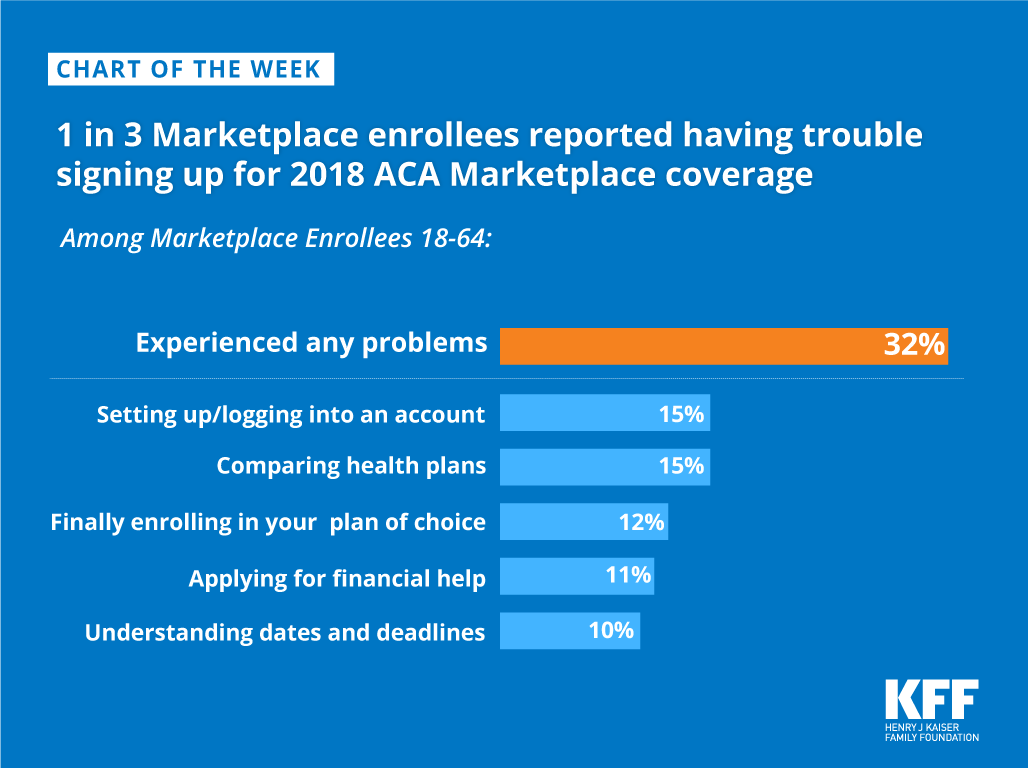
One in three Marketplace enrollees reported having trouble signing up for 2018 ACA Marketplace coverage

Published: Jul 19, 2018

Source

KFF Health Tracking Polls (interviews from February and March 2018)

News Release

Kaiser/UNAIDS Study Finds Donor Government Funding for HIV Rose to US$8.1 Billion in 2017 due to Shift in Timing of U.S. Support

Most Donor Governments Decreased Support

Published: Jul 18, 2018

Donor government disbursements to combat HIV in low- and middle-income countries increased 16 percent from US$7 billion in 2016 to US$8.1 billion in 2017 – though the higher total stems largely from the timing of U.S. funding and is not expected to last, a new report from the Kaiser Family Foundation and the Joint United Nations Programme on HIV/AIDS (UNAIDS) finds.

The increase follows two years of declines in donor support for HIV and results largely from a boost by the United States, the world’s largest donor nation, which increased disbursement from US$4.9 billion in 2016 to US$5.9 billion 2017, including funds appropriated but not spent from previous years. New U.S. appropriations have been flat for several years, suggesting that future disbursements will likely fall back to prior levels.

While eight of 14 donor governments reduced their spending on global HIV efforts in 2017, increases by the U.S. and five other donors more than offset these declines.  Bilateral aid went up, due to the U.S. increase.  Multilateral contributions to the Global Fund to Fight AIDS, Tuberculosis and Malaria also increased.

Donor government funding supports HIV care and treatment, prevention and other services in low- and middle-income countries. The report notes that without new commitments by other donor governments, however, future funding for HIV is likely to return to lower levels.

“UNAIDS is deeply concerned that a lack of sufficient resources will mean more deaths and more new HIV infections that can be prevented,” said Michel Sidibé, UNAIDS Executive Director. “Even a 20% cut in international funding would be catastrophic for the 44 countries who rely on international assistance for at least 75% of their national HIV responses.

“This year’s increase is more an anomaly than a trend as it doesn’t reflect new resources,” said Kaiser Family Foundation Vice President Jen Kates, Director of Global Health and HIV Policy. “Going forward, the urgency to identify alternative funding sources grows if the global community wants to reach its HIV targets.”

After the U.S., the governments making the largest contributions to global HIV efforts include the U.K. (US$743.9.million), France (US$267.7 million), the Netherlands (US$202.6 million), and Germany (US$161.9 million).

The new report, produced as a long-standing partnership between the Kaiser Family Foundation and UNAIDS, provides the latest data available on donor government funding based on data provided by governments. It includes their bilateral assistance to low- and middle-income countries and contributions to the Global Fund as well as UNITAID.  “Donor government funding” refers to disbursements, or payments, made by donors. Donor contributions to multilateral organizations are counted as part of their disbursements.