Immigrant Health

survey of immigrants

KFF-New York Times Survey: Immigrants Report Rising Fear, Negative Economic and Health Impacts, and Changing Political Views During the First Year of President Trump’s Second Term

The 2025 Survey of Immigrants, a partnership between KFF and The New York Times, takes an in-depth look at the experiences of immigrants during the first year of President Trump’s second term, including their worries related to increased immigration enforcement, their health and economic wellbeing, and the political views and preferences of immigrant voters. The survey paints a portrait of families under strain — where fear of detention and economic instability are negatively impacting immigrants’ health and reshaping immigrant families’ daily lives and views of U.S. political parties.

Read the News Release | Explore The New York Times’ Reporting
Subscribe to KFF Emails

Choose which emails are best for you.
Sign up here

Filter

101 - 110 of 175 Results

  • Nearly Half of Those Likely Eligible for DACA are Uninsured

    News Release

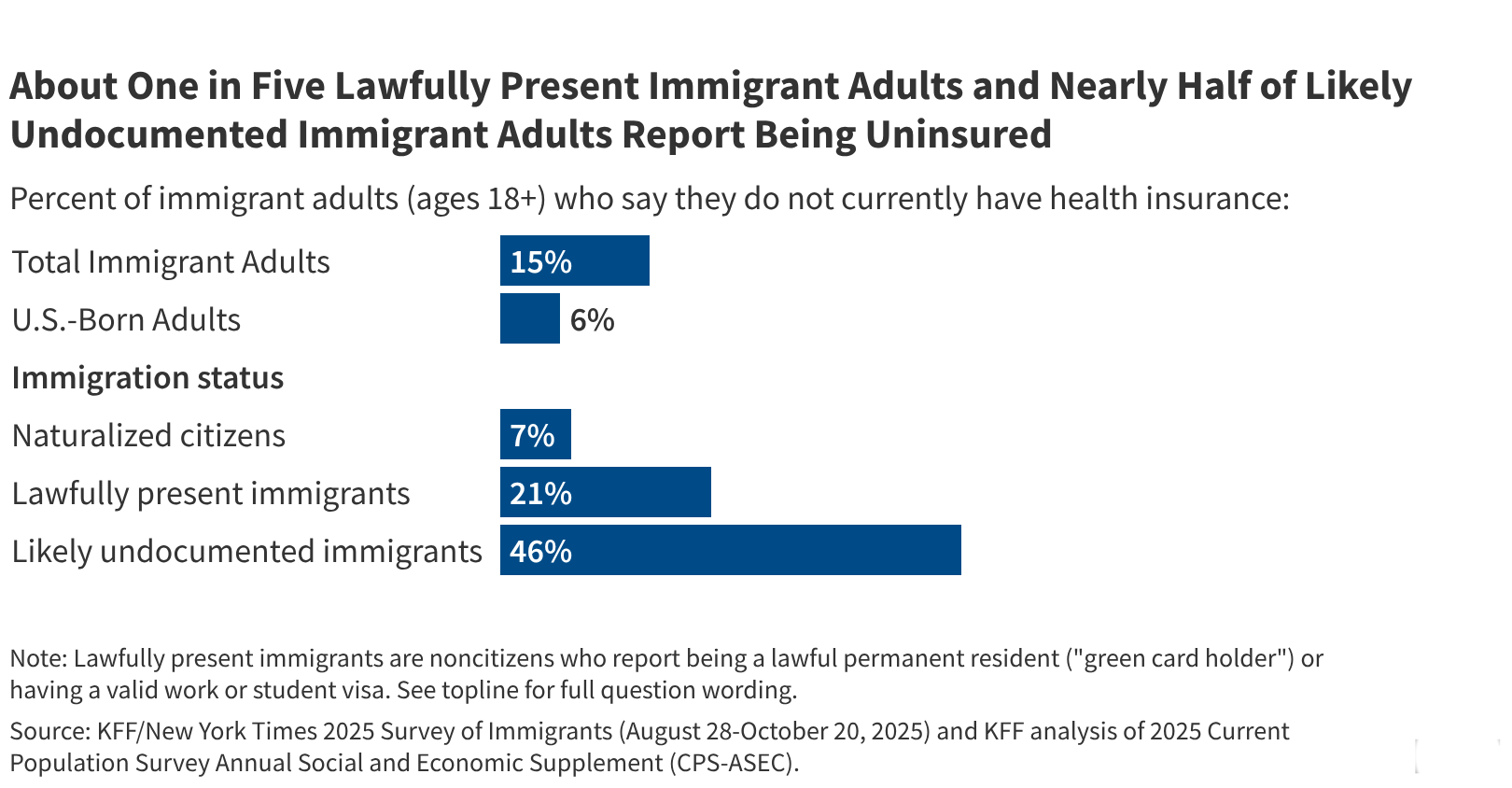
    Yesterday, the Biden Administration announced a plan to expand eligibility for Medicaid and ACA Marketplace health coverage to Deferred Action for Childhood Arrivals (DACA) recipients. A KFF analysis finds 47% of individuals likely eligible for DACA are uninsured compared to 10% of U.S. born individuals in their age group. The analysis estimates that among those likely eligible for DACA: 84% are in a family with at least one full-time worker, 54% of adults work full-time,…

  • 2023 Update on Key Federal Immigration Policies and Implications for Health

    Issue Brief

    This issue brief provides the latest update on some key evolving immigration policies, including Title 42 as it applies to border enforcement, the Deferred Action for Childhood Arrivals (DACA) program, and the public charge rule and discusses the implications of these policies for the health and well-being of immigrants.

  • The U.S.-Mexico Border Region Faced a Range of Health Challenges Long Before the Current Immigration Surge

    News Release

    With intense immigration activity at the U.S.-Mexico border this year and attention focused on the plight of newly arriving migrants, a new KFF analysis finds communities along the border faced an array of socioeconomic challenges and weak health infrastructures well before this year’s surge. Texas – which has the most counties along the border and is the only border state that has not expanded Medicaid under the Affordable Care Act – stands out as facing…

  • Health and Health Care in the U.S.-Mexico Border Region

    Issue Brief

    The four states along the U.S.-Mexico border are home to over 78 million people of whom 8 million live in 44 counties that adjoin the border and border activity is at an all-time high. KFF's county-level analysis of the region shows that people living in border states fare worse along socioeconomic and health access measures as compared to the rest of the U.S. and that people who live in border counties within these states, especially…

  • A 50-State Review of Access to State Medicaid Program Information for People with Limited English Proficiency and/or Disabilities Ahead of the PHE Unwinding

    Issue Brief

    This issue brief reviews accessibility of information for people with LEP and people with disabilities provided through state Medicaid websites and call center automated phone trees as of June 16, 2022. The analysis shows that while states have taken some steps to support access to information and applications for people with LEP and people with disabilities, gaps in accessibility remain.

  • 4 Key Q&As About the Impact of Climate Change on Health Equity

    News Release

    While climate change effects ripple across the world and all populations, it is poised to disproportionately affect people of color, low-income communities, immigrants, and other high-need groups. Many of these groups have historically been exposed to climate hazards due to government policies and discriminatory practices that leave them more vulnerable to adverse climate events like record-breaking heat, wildfires, coastal flooding, and the spread of infectious diseases. A new KFF brief looks at key questions about…

  • Climate Change and Health Equity: Key Questions and Answers

    Issue Brief

    While climate change poses health threats for everyone, people of color, low-income people, and other marginalized or high-need groups face disproportionate risks due to underlying inequities and structural racism and discrimination.

  • Mitigating Childhood Lead Exposure and Disparities: Medicaid and Other Federal Initiatives

    Issue Brief

    Exposure to lead can seriously harm a child’s health, including damage to the brain and nervous system, slowed growth and development, learning and behavior problems, and hearing and speech problems. The effects of lead on the nervous system can cause lower IQ, decreased ability to pay attention, and under performance in school.

  • Health and Health Care Experiences of Hispanic Adults

    Poll Finding

    The COVID-19 pandemic has exposed and exacerbated longstanding underlying disparities in health and health care facing Hispanic people. Using data from the COVID-19 Vaccine Monitor, this report provides insights into the health care experiences of Hispanic adults and examines how they vary by key factors, including insurance and immigration status.