Green Card Processing Backlogs for Refugees and Asylees Could Have Implications for Health Coverage and Care
Introduction
The 2025 reconciliation law eliminated access to federally funded health coverage for refugees and asylees without a green card as well as several other groups of lawfully present immigrants. Refugees and asylees can apply for Lawful Permanent Resident status (LPR status, or a green card) after one year in the country or one year after being granted asylum. Because the 2025 reconciliation law largely limits eligibility for federally funded coverage to lawfully present immigrants with LPR status, how quickly U.S. Citizenship and Immigration Services (USCIS) processes these applications directly affects whether refugees and asylees can keep or gain access to Medicaid, the Children’s Health Insurance Program (CHIP), subsidized Affordable Care Act (ACA) Marketplace, and Medicare coverage.
This data note highlights changes in green card (I-485) application processing for refugees and asylees between fiscal year (FY) 2021 and FY2025, as well as across the first three quarters of FY2025 to FY2026 (since FY2026 data are only available through the third quarter). It discusses the implications of these trends for access to federally funded health coverage following eligibility changes under the 2025 reconciliation law. It is based on KFF analysis of USCIS data.
In this analysis, we find a decrease in USCIS completion of applications for adjustment to LPR status for refugees and asylees between FY2025 and FY2026. While some of the decreases in application completions could be due to fewer humanitarian migrants being admitted into the U.S. in recent years, we find that the number of applications completed by USCIS as a share of all applications fell between FY2025 and FY2026 and the average processing time for applications increased during the same time period. As of June 30, 2026, there were over 275,000 pending green card applications from refugees and asylees awaiting a decision from USCIS, and between FY2025 and FY2026, the average processing time for applications had increased from 7.8 months to 13.3 months for refugees and from 10.7 months to 19.9 months for asylees. As a result, many refugees and asylees who have already applied for a green card will be left without access to federally funded health coverage for potentially long periods of time as they wait for USCIS to process their green card applications.
Changes in Health Coverage for Refugees and Asylees
Since 1980, the U.S. has had a formal system for admitting refugees and asylees—individuals and their families who are unable to return to their country of nationality due to a well-founded fear of persecution for certain protected reasons. The right to seek asylum is rooted in international law, and the system reflects the U.S.’s longstanding inclusion of humanitarian protection as a core principle of immigration law. Refugees and asylees are generally fleeing from unsafe conditions and arrive to the U.S. with few to no resources, with many experiencing traumatic experiences in their countries of origin and/or during their journey to the U.S. The U.S. historically provided refugees and asylees access to assistance with food, housing, and health care upon arrival to the country as well as other time-limited services to support their transition to the U.S. Since taking office, the Trump administration has taken steps to significantly reduce the entry of refugees and asylees into the U.S., including by pausing refugee applications, setting the lowest ceiling for refugee admissions on record, and effectively closing the southern border to most migrants, including asylum seekers.
Under federal law, refugees and asylees (i.e. those who have officially been granted asylum) can apply for adjustment to LPR status once they have been physically present in the U.S. for at least one year. They apply by filling out Form I-485, “Application to Register Permanent Residence or Adjust Status.” Asylum seekers whose asylum applications are still awaiting approval are not considered asylees and are not eligible to apply for LPR status regardless of their length of stay in the country.
The 2025 reconciliation law eliminated refugees’ and asylees’ longstanding access to federally funded health coverage as well as other public assistance programs. Most lawfully present immigrants, including most LPRs, must wait five years after getting a “qualified” immigration status before they can enroll in federally funded coverage such as Medicaid and CHIP. Under longstanding policy, refugees and asylees previously were exempt from this waiting period if they met income and other state eligibility requirements. They could also enroll in subsidized ACA Marketplace coverage and Medicare if otherwise eligible. However, the 2025 reconciliation law eliminates eligibility for Medicaid and CHIP (except in states that use a Medicaid and/or CHIP option to cover lawfully residing children and pregnant people), subsidized Marketplace coverage, and Medicare for refugees and asylees without a green card, as well as certain other groups of lawfully present immigrants. The Medicaid and CHIP restrictions took effect October 1, 2026, with restrictions on subsidized Marketplace and Medicare coverage fully taking effect in January 2027. The Congressional Budget Office estimates that the law’s eligibility restrictions for lawfully present immigrants will lead to about 1.4 million people becoming uninsured by 2034.
Trends in Processing Green Card Applications for Refugees and Asylees
The number of I-485 applications received for adjustment to LPR status for both refugees and asylees increased between FY2021 and FY2025, but applications received for asylees dropped between FY2025 and FY2026. Between FY2021 and FY2025, I-485 applications received for adjustment to LPR status increased by 274% (22,906 to 85,743) for refugees and by 68% (44,837 to 75,292) for asylees. Lower numbers of I-485 applications received from refugees and asylees in FY2021 could reflect COVID-19-related reductions in the entry of migrants into the U.S. Between the first three quarters of FY2025 and FY2026, I-485 applications received for refugees continued to increase but at a lower rate of about 10% (59,754 to 66,013) and decreased by about 32% (58,682 to 40,344) for asylees. This pattern could reflect that the Trump administration lowered the refugee admissions cap from 125,000 in FY2025 to 7,500 for FY2026. Additionally, the Biden and Trump administrations effectively closed the border to individuals seeking asylum starting in 2024.
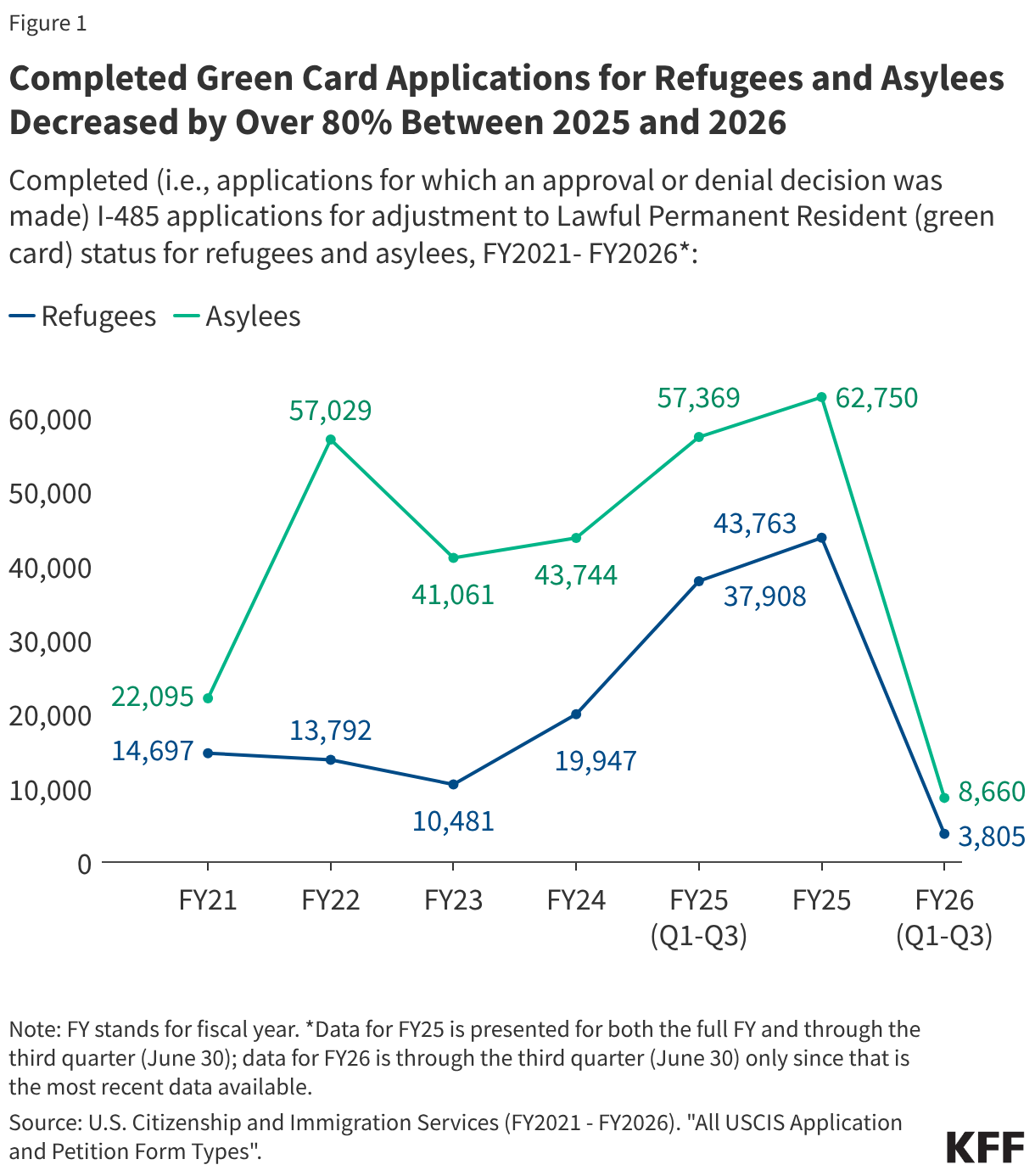
While the number of applications completed by USCIS for both refugees and asylees increased between FY2021 and FY2025, they decreased significantly between FY2025 and FY2026 (Figure 1). Between FY2021 and FY2025, completed I-485 applications, i.e., applications for which an approval or denial decision was made by USCIS, increased by 198% for refugees (14,697 to 43,763) and by 184% for asylees (22,095 to 62,750). However, between the first three quarters of FY2025 and FY2026, I-485 applications completed by USCIS decreased by about 90% (37,908 to 3,805) for refugees and by about 85% (57,369 to 8,660) for asylees.
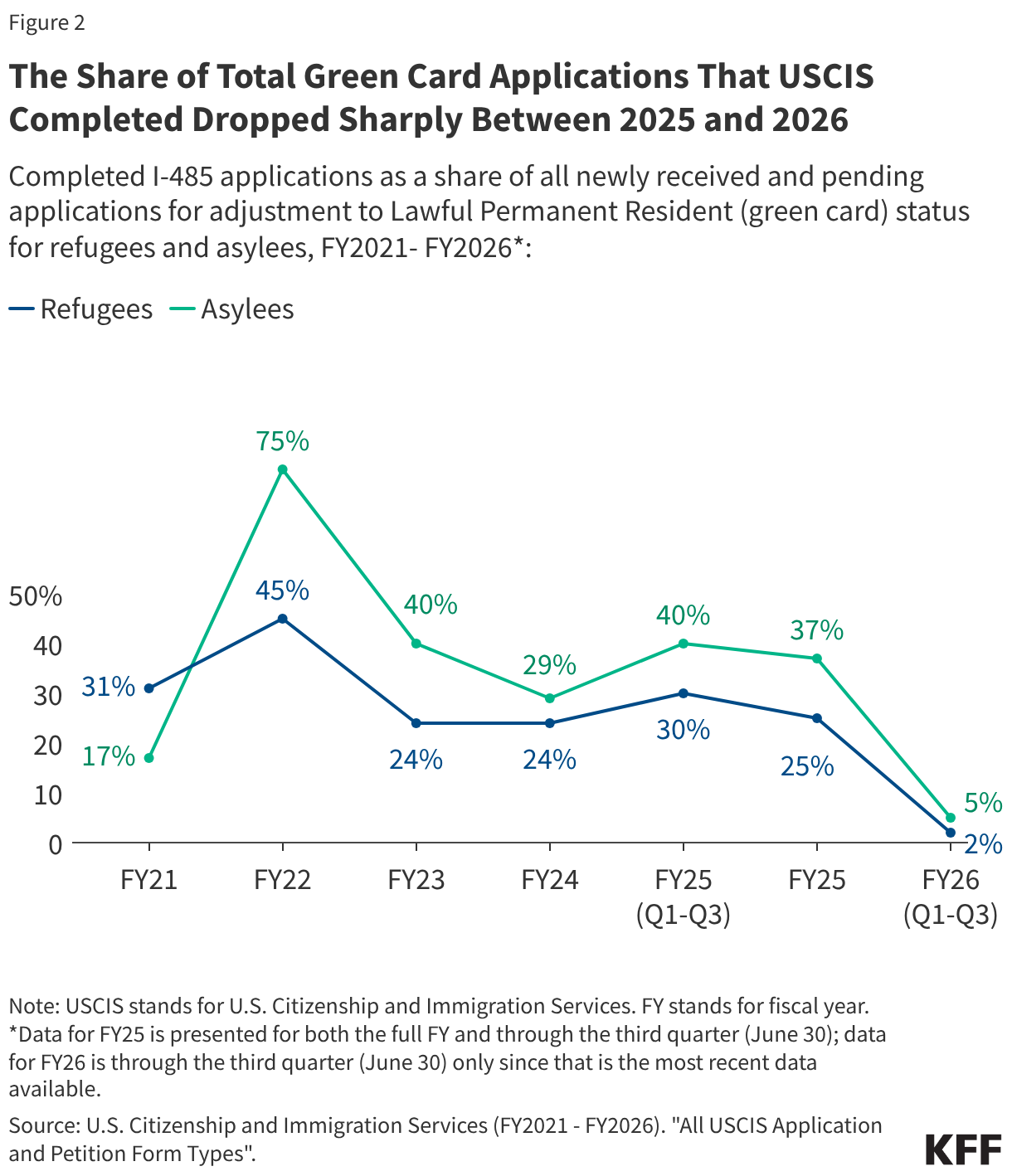
The percentage of completed applications as a share of all applications for refugees and asylees dropped sharply between FY2025 and FY2026 (Figure 2). Between FY2021 and FY2025, the percentage of I-485 applications completed by USCIS as a share of all applications (i.e., newly received and pending applications) decreased from 31% to 25% for refugees and increased from 17% to 37% for asylees. However, between the first three quarters of FY2025 and FY2026, completed I-485 applications as a share of all applications decreased sharply from 30% to just 2% for refugees and from 40% to just 5% for asylees.
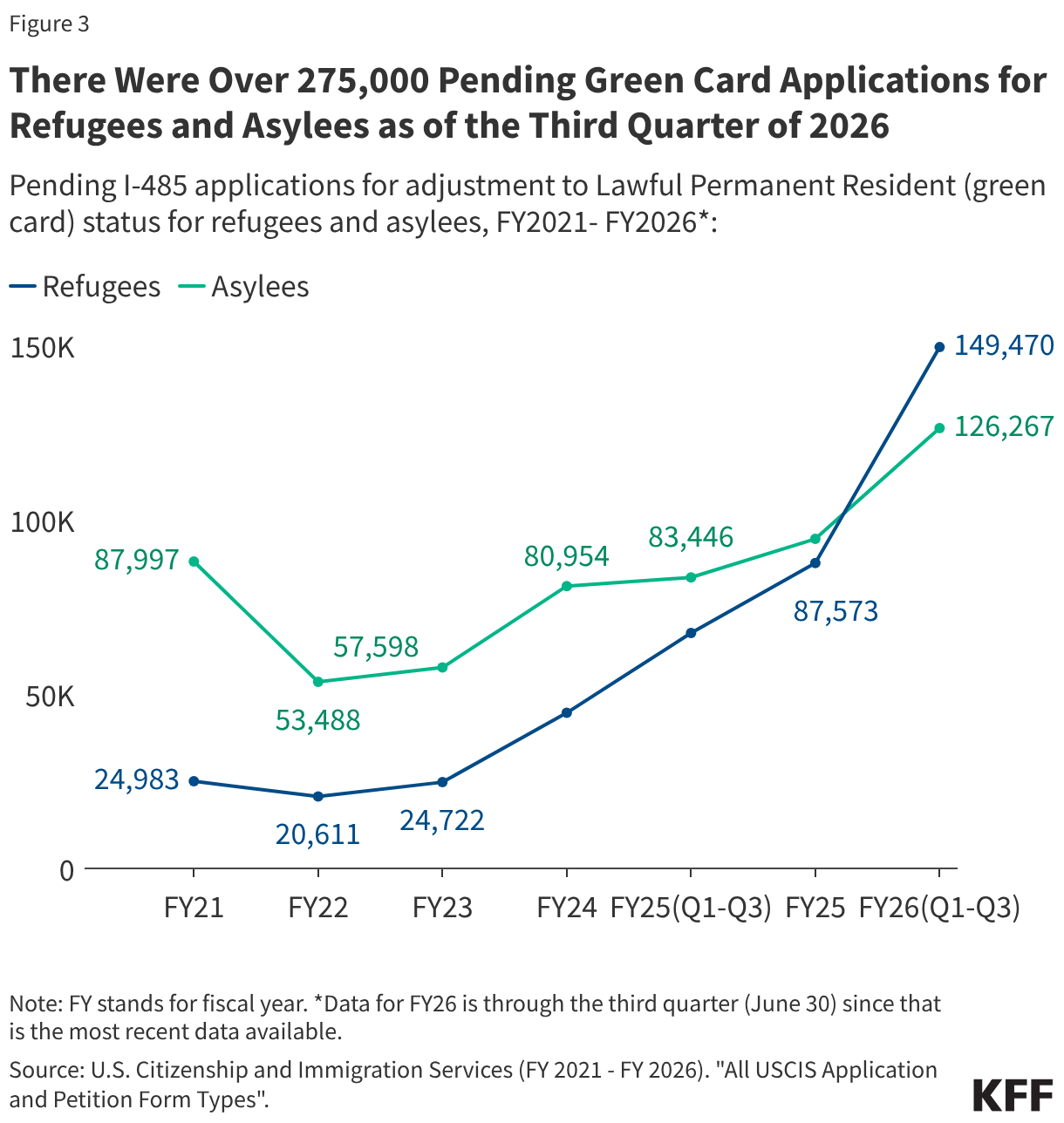
At the same time, the number of pending green card applications for refugees and asylees grew to over 275,000 as of the third quarter of FY2026, and application processing times increased between 2025 and 2026. The number of I-485 applications pending a decision from USCIS increased 251% for refugees, from 24,983 as of the end of FY2021 to 87,573 as of the end of FY2025, and by about 7% for asylees, from 87,997 as of the end of FY2021 to 94,482 as of the end FY2025 (Figure 3). Between the third quarter of FY2025 and the third quarter of FY2026, pending applications from refugees increased by 121% (67,502 to 149,470) and from asylees by 51% (83,446 to 126,267), for a total of 275,737 pending applications as of June 30, 2026. This number is expected to continue to increase by the end of FY2026. Further, reflecting the decrease in completed applications, the average processing time for green card applications increased from 7.8 months to 13.3 months for refugees, and from 10.7 months to 19.9 months for asylees between the first three quarters of FY2025 and FY2026. Within FY2026, the processing time for green card applications from refugees and asylees has increased each quarter, more than doubling from 7.6 months in Q1 to 17.6 months in Q3 for refugees and from 12.1 months in Q1 to 25.6 months in Q3 for asylees.