Poll Finding

NPR/Kaiser/Harvard Survey: Health Care and the Economy in Two Swing States: A Look at Ohio and Florida – Toplines

Published: Jun 30, 2008

These toplines provide an overview of the results from a May 21 and June 4, 2008, survey conducted jointly by NPR and public opinion researchers at the Kaiser Family Foundation and the Harvard School of Public Health that examines examine the pocketbook problems facing people in Ohio and Florida – two presidential swing states – including their struggles with gas prices, getting and keeping a good-paying job and affording health care.

The telephone surveys involved statewide representative samples of 1,358 adults in Florida and 1,201 adults in Ohio and were conducted between May 21 and June 4. The margin of sampling error is plus or minus 3 percentage points for the full sample in each survey. For subgroups, the margin of error may be higher.

These surveys are a part of a series of projects about health-related issues by NPR, the Henry J. Kaiser Family Foundation, and the Harvard School of Public Health. Representatives of the three organizations worked together to develop the survey questionnaire and to analyze the results, with NPR maintaining editorial control over its broadcasts on the surveys.

Toplines (.pdf)

2008 Presidential Candidate Health Care Proposals, Side-by-Side Summary

Published: Jun 29, 2008

2008 Presidential Candidate Health Care Proposals: Side-by-Side Summary

Voters have identified health care as the leading domestic issue for the government to address and for the presidential candidates to discuss in the 2008 campaign. In particular, voters would like to hear the candidates’ positions on reducing the cost of health care and health insurance and expanding coverage to the 47 million uninsured Americans.

This side-by-side comparison of the candidates’ positions on health care was prepared by the Kaiser Family Foundation with the assistance of Health Policy Alternatives, Inc. and is based on information appearing on the candidates’ websites as supplemented by information from candidate speeches, the campaign debates and news reports. The sources of information are identified for each candidate’s summary (with links to the Internet). The comparison highlights information on the candidates’ positions related to access to health care coverage, cost containment, improving the quality of care and financing. Information will be updated regularly as the campaign unfolds.

View PDF of Both Final Candidates (PDF) View Proposals from Former and Additional ’08 Candidates (PDF)

View the new Health Care Issues Side-by-Side to compare the candidates’ proposals and positions on 15 topics, including Medicaid and SCHIP, Medicare, prescription drugs, racial and ethnic disparities, women’s health, and HIV/AIDS and global health.

Pulling It Together: Moving Away From Employer Based Coverage: Don’t Forget Public Opinion

Published: Jun 25, 2008

One of the underlying big issues in the unfolding health reform debate is whether most Americans should continue to get insurance through work where they get it today, or purchase it themselves in the individual private health insurance marketplace. Senator McCain promotes moving to individual insurance and having individuals rather than employers make coverage decisions, as has President Bush.  But this is not only a conservative idea.  Many on the liberal side — such as Senator Ron Wyden and SEIU President Andy Stern — also would like to see the country move away from the employment-based health insurance system. They see the current tax preference for employment-based health insurance as regressive because subsidies are related to marginal income tax rates and therefore go disproportionately to higher income workers (in fact, a majority of the benefits from the tax exclusion are estimated to go to families with incomes greater than 400% of the poverty level). All are tempted by the $200 plus billion in federal revenues eliminating the tax preference would produce, which could, among other things, be used to pay for covering the uninsured.

Democrats and liberals would take steps to create a more structured market for individual insurance — allowing people to buy into a purchasing pool like the Federal Employees Health Benefits Program or a public plan like Medicare, as well as requiring insurers to accept all comers regardless of pre-existing health conditions. Senator Obama’s health reform plan contains many of these features, but leaves the tax preference for employer-sponsored coverage intact. Conservatives take the opposite approach, relaxing insurance regulations and promoting more unfettered competition, while promoting measures such as high risk pools as a fallback for people with health conditions that would exclude them from non-group insurance.

As discussion of moving away from the employment-based system continues, not very much attention has been paid to a giant question: How will the public (and voters) feel about such a big change? Health reformers have learned the hard way in the past that whatever the appeal of policy proposals on their merits, they ultimately have to be acceptable to the public or they will not fly.

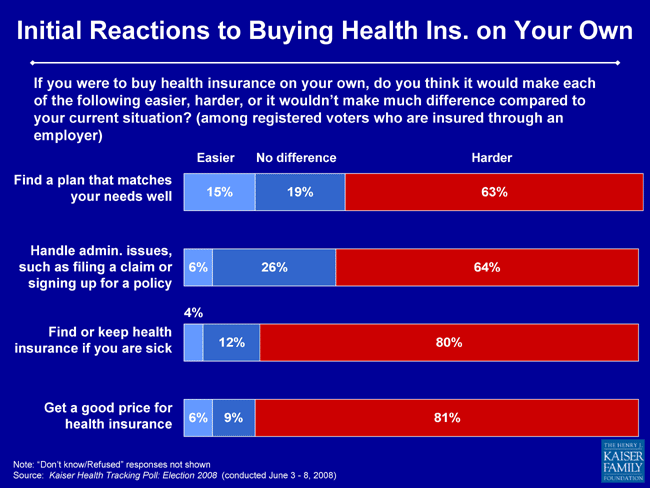
With this in mind, we asked people with employment-based insurance a series of questions on our most recent tracking poll about whether they thought purchasing insurance on their own would make things better or worse for them. You can see the results below. In every case, between 63 and 81 percent said it would make things worse. There were no meaningful differences by party affiliation.

PIT-june08_Slide1_corrected

The point is not that moving away from employment-based health insurance is a good idea or a bad one –- polls tell us where the public is at a point in time, not always what is the right thing to do — but that in health reform the burden is always on those who are proposing that people change their current arrangements to persuade the public of why change makes sense and to offer them positive inducements to try something new. For example, in one proposal to switch from employment-based health insurance, the Wyden-Bennett bill, employers are required to substitute higher wages for the tax exemption for employer-paid health insurance, which would disappear.  Economists generally believe that eliminating the tax preference for health benefits will result in higher wages over time even without a requirement, as fewer employers contribute towards health coverage and shift compensation towards wages.  But in an economy driven by multiple factors, the extent to which this would actually happen — and how quickly — is unknowable.

Advocates of the proposal made by Senator McCain argue that consumers get real advantages from his plan, too.  Despite losing the tax preference for their health benefits, they would get in return:  a substantial tax credit to help pay for health care, which would be refundable for lower income people; greater health plan choices; and the advantages, as advocates see it, of tax-preferred Health Savings Accounts, including owning their own insurance policies, which would become portable no matter where they worked.

All of the purported advantages of these different approaches to employment-based health insurance will be the subject of a lot of examination and ongoing debate, and new proposals will be made by others. What the poll finding highlights, however, is some initial nervousness people have about purchasing health insurance on their own.  And this unease — which opponents will undoubtedly exploit — is a challenge for proposals from the right and the left that would abruptly switch from employment-based insurance.  It is an old law of health reform that despite frustrations with the health care system and a general desire among the public for reform, the burden is always on reformers who would change how people get their health care and health insurance today. That’s why the easy answer — though not necessarily the right one — is to assure people that they can keep what they have today.

Poll Finding

Toplines: Kaiser Health Tracking Poll: Election 2008 – June 2008

Published: Jun 24, 2008

This document contains the detailed toplines from the June Kaiser Health Tracking Poll: Election 2008 poll. The poll involved a nationally representative random sample of 1,206 adults (including 1,066 who say they were registered to vote), who were interviewed by telephone between June 3 and 8, 2008. The margin of sampling error for the total sample is plus or minus 3 percentage points; for registered voters, it is plus or minus 4 percentage points. For results based on subgroups, the sampling error is higher.

icon_reports_studies.gif

 Toplines (.pdf)

Poll Finding

Key Findings: Kaiser Health Tracking Poll: Election 2008 – June 2008

Published: Jun 24, 2008

This document contains the key findings from the June Kaiser Health Tracking Poll: Election 2008 poll. The poll involved a nationally representative random sample of 1,206 adults (including 1,066 who say they were registered to vote), who were interviewed by telephone between June 3 and 8, 2008. The margin of sampling error for the total sample is plus or minus 3 percentage points; for registered voters, it is plus or minus 4 percentage points. For results based on subgroups, the sampling error is higher.

icon_reports_studies.gif

 Key Findings (.pdf)

Poll Finding

Kaiser Health Tracking Poll: Election 2008 – June 2008

Published: Jun 23, 2008

The latest Kaiser Health Tracking Poll: Election 2008 poll finds that the recent economic downturn continues to create serious financial problems for most Americans. When asked about the impact of recent economic changes, nearly six in 10 adults (59 percent) report having a “serious problem” with one of seven major financial issues, including one in four who cite paying for health care as a serious problem.

Not surprisingly, with gas prices topping $4 per gallon nationally, people are most likely to cite paying for gas as a serious problem (43 percent), followed by getting a well-paying job or a raise (27 percent) and paying for health care costs (25 percent). Other problems rank lower: paying for food (19 percent), dealing with credit card or other personal debt (16 percent), losing money in the stock market (15 percent) and paying their rent or mortgage (14 percent).

In thinking about health care costs, voters are more troubled by their personal costs than by national health spending. Nearly half say they are most worried about increases in what the average American pays out-of-pocket for health care and for insurance. In comparison, two in 10 say they are most concerned about increases in how much the U.S. as a whole spends on health care. Smaller shares cite increases in spending on public health insurance programs or increases in what employers pay for their workers’ health insurance.

The June poll — the eighth in a series designed and analyzed by the Foundation’s public opinion research team — also probes early public opinion about some potential elements of health reform.

Key Findings

Topline


Abortion in the U.S.: Utilization, Financing and Access

Published: Jun 19, 2008

This fact sheet provides key data on the levels of use of different abortion procedures in the United States and reviews the different federal and state policies that affect availability of and access to services. It also provides information on how abortions are financed in the public and private sectors and reviews the state-level policies and Medicaid and private insurance rules that affect coverage of abortion services, including parental involvement laws, provider protections and clinic regulations.

Fact Sheet (.pdf)

Pulling It Together: Perspectives on State Health Reform

Published: Jun 9, 2008

This Pulling It Together column is the fourth in my new series. All four so far have dealt with different dimensions of health reform. This time I write about one of my favorite topics, the states.

As a former head of an umbrella health and social services agency in a big state responsible for about a third of a state budget and workforce, I have a deep appreciation for state government. It’s a level of government where you make broad policy decisions, run institutions and deliver services, and are held directly accountable in nearly real time for what you do. In health, states are influenced by the same panoply of vested interests as Washington is, but state politics are more practical and less prone to the ideological gridlock that has prevented action on health reform in Washington. What most states don’t have, and it’s a critical missing element, is the money to sustain big new spending programs without help from the federal government.

A GLIMPSE INSIDE STATE GOVERNMENT  Because health care costs rise faster than virtually anything else in a state budget Medicaid spending rises faster too, even if no changes are made to the program. Enrollment also goes up in a weak economy. This simply reflects Medicaid playing its vital counter cyclical role as a safety valve when the economy falls off, but it also means more spending. Here is how it works at the state level. In a weak revenue year when the economy is bad, budget increases for Medicaid just to maintain the current program can easily consume more than a third of the new money available in a state budget.  A lot of state government is an annual contest for these new resources, and this can instantly make you the least popular person in the governor’s cabinet or with the state legislature. A single program and a single state department can only win just so much of the new money on the table each year, because other priorities are important, and other departments have influential constituencies too, often more influential. This means that there will not be enough money to address other critical health and social services priorities, from reducing waiting lists for community services for the mentally ill and developmentally disabled, to adequately funding state institutions, to paying child protective services workers a living wage, to funding state Head Start programs, to paying for services for homeless families, to providing child care so women on welfare can work, and much more. If you run a state umbrella agency as I did, the truly agonizing decisions are these tradeoff decisions because in state government decisions about Medicaid and SCHIP spending, especially in “bad years”, occur in the context of a host of other underfunded and unmet needs. For governors, who also need to worry about funding secondary and higher education, and corrections, and the environment and the state police and much more, the tradeoff decisions are even broader and more difficult. States are captives of their budget cycles which are driven by economic forces they do not control. As a result, as our annual fifty state surveys have shown over many years, states expand programs in good times and they cut them in bad times, and even when preserving coverage is a priority, many end up having to exact savings from programs like Medicaid and SCHIP.  When SCHIP was enacted with substantial new federal dollars for coverage of children, all states stepped up to the plate, but today with the economic downturn many are struggling to maintain children’s coverage and have sidelined efforts to expand adult coverage.  This is the essential reason why we can’t reform health care state by state: too many states don’t have the resources, and those that do at one point may not be able to sustain programs that require new spending when their fortunes shift. This is also one of the reasons why health reform failed here in California. The effort arrived at its key legislative moment exactly when the governor declared a state budget crisis. It is not possible to win political support for a big new spending program in state government when at the same time you are cutting so many other programs key constituencies care about.

A small number of pacesetting states can, however, serve as laboratories for national health reform, just as they did so decisively in welfare reform. Here the Massachusetts health reform program is especially significant. It is a real life example of a cross-ideological, combination approach to health reform that won support from all sides and passed with an overwhelming majority in the state legislature.  By building on public programs and the employment based system and also relying heavily on the private health insurance marketplace, the Massachusetts plan gave all sides something they could like. It allows those who like their coverage to keep it and tries to make affordable options available to those without coverage by extending public coverage and subsidies to assist those with low and modest incomes.  Massachusetts has shown that effective outreach and financial assistance can enable many of the uninsured to gain coverage.

A centrist compromise similar in spirit, though not in detail, will almost certainly be necessary if there is to be a deal on health reform in the Congress in 2009. The Massachusetts program does not satisfy the purists on the left or right; it does not achieve universal coverage; and it has faced and will continue to face many challenges, not least whether the private health plans it offers will prove affordable in the long run and whether the cost of the program will be sustainable for the state.  But to date it has covered about 340,000 previously uninsured citizens of my former home state, cutting the rate of uninsured in half, and the State and the coalition supporting the program has shown a willingness to make whatever adjustments are necessary in implementation to keep it moving forward.  Massachusetts’s (and California’s failed plan) also underscore a critical point about financing state health reform; about half of the new funding originally proposed for both plans came from federal Medicaid funds underscoring that even motivated and relatively wealthy states cannot pay for significant coverage expansions without substantial federal financial participation and raising a cautionary note for other states where the ability to utilize federal financing is more limited.

While the weak economy has halted the momentum for comprehensive state health reform efforts, states have not cut back as much as in past downturns, in part because they have previously exhausted their most obvious cutback strategies that focus on provider payments and one-time savings. There are also many incremental efforts underway in the states that can provide important lessons for other states and for national policy across a broad range of issue areas, from payment reform, to quality improvement, to disease management, to long term-care, to cost containment, to coverage expansion.  But with a debate looming in the presidential campaign about building on the employment based system and public programs versus moving to individually purchased insurance, special efforts should be made to learn everything we can from the states about the successes and failures they have had in their efforts to make private policies affordable for the uninsured and to make the nongroup market work more effectively for all comers. It is instructive to remember that two-thirds of the nation’s uninsured come from families earning less than $40,000 for a family of 4 in 2006; as a result the vast majority of the newly insured people in Massachusetts (175,000) have qualified for subsidized coverage and two percent of state residents (~130,000) with incomes above the subsidy cutoff were exempted from the mandate to purchase insurance because no affordable options were available for people in their income range. This underscores the difficulty of making health insurance affordable for working people without some form of subsidy. As reform discussions continue to focus on providing broader access to the individual health insurance market, the state experience with high risk pools and insurance market reform will offer additional insight into the challenge of putting together the pieces of health reform.

Should comprehensive health reform legislation fail in the Congress in 2009 as history suggests it could, a fallback might be to consider a program to facilitate state reform efforts.  One obvious strategy for states would be to build on the existing SCHIP and Medicaid framework for coverage of the low-income uninsured.  To spur broader state action, Congress could develop new authorities to broaden the scope of Medicaid-based waiver projects and eliminate the requirement that demonstration projects be revenue neutral to the federal government, which was initially imposed in the Carter Administration when I worked in HCFA (now CMS). If the federal government wants to usher in a new era of large scale state health reform efforts it would need to think differently about waivers, enact a broader demonstration authority that goes beyond programs in the Social Security Act to address tax code changes and federal ERISA requirements which pose serious obstacles to many state reform efforts and provide a real incentive for states to participate in the form of enhanced federal financial participation and a long-term commitment. In return the federal government could require states to put up new money of their own and meet other health reform objectives.

As I can attest having once secured a critical federal waiver for a welfare reform program at 2 a.m. in the White House after a marathon bargaining session, it would also be important to depoliticize the process by specifying the key rules for the new program in statute (our program, which would have been operating in violation of federal rules, was scheduled to go live at 9 a.m. that morning!).  Indeed, the program should probably not work through the existing Social Security Act Section 1115 waiver authority at all, but rather take the form of a newly legislated federal effort to encourage state innovation in health reform if critical national objectives are met by participating states. In terms of covering the uninsured, controlling costs, and establishing a reliable financing base for health reform, a state initiated, state by state strategy would never accomplish as much as national legislation could. History suggests that only a relatively small number of states could be expected to participate or to mount large scale efforts. However, it could be a good stepping stone to guide future health reform activities if national legislation does not prove achievable.

Having seen the back and forth between state and federal government both as a state and a federal official and studied it at Kaiser, both my experience and our studies suggest that the biggest obstacle to greater efforts at the state level has never really been disagreement between Washington and the states about the philosophy of federalism and state flexibility, rather it has been the ongoing tussle over the level of federal financial participation in state efforts. At the federal level the biggest obstacle to action on health reform may well be the ideological and policy differences between left and right; at the state level it is money.

(I want to thank my friend, colleague and trustee Donna Shalala for getting me thinking again about state innovation, though Secretary Shalala is not responsible for any of the particulars above.)
Previous Fellows and Their Work

Published: Jun 6, 2008

The Kaiser Media Fellowships in Health: Previous Fellows and Their Work

Below is a complete list of fellowship classes from 2000 – 2009, the fellows’ jobs at the time of their selection to participate, and, where possible, links to work they produced over the course of their fellowship.

2000, 2001, 2002, 2003, 2004, 2005 [on hiatus],2006, 2007, 2008, 2009

2009 Kaiser Media Fellows

Lawrence K. Altman, M.D., “The Doctor’s World” columnist and former senior medical correspondent, The New York Times, NYReporting on the health of Presidential and political candidates

Paula Andalo, managing editor, El Tiempo Latino, Washington DCThe role community clinics play in providing care for Hispanic immigrants“El Cuidado M

Uninsured Young Adults: A Profile and Overview of Coverage Options

Published: Jun 2, 2008

Young adults, age 19-29, have the highest uninsured rate of any age group. Since 29% of the uninsured are young adults, efforts to decrease the overall number of uninsured must address this population. This brief examines health coverage for young adults, as well as their health status, access to care, and the financial burdens they encounter when paying for care. It also provides an overview of public and private approaches to expand health coverage for young adults.

Issue Brief (.pdf)