KFF designs, conducts and analyzes original public opinion and survey research on Americans’ attitudes, knowledge, and experiences with the health care system to help amplify the public’s voice in major national debates.
This report from the Kaiser Family Foundation’s Commission on Medicaid and the Uninsured (KCMU) illustrates the financial struggles of many families in the United States and shows the central role of health care costs and coverage in a household’s economic stability.
The report, , is based on interviews with 27 families from six cities across the U.S.. It finds pervasive uncertainty over job security and households teetering on the financial brink, stretching to pay for basics such as food and housing and ill-equipped to cope with unexpected costs for things such as a medical emergency or a necessary home repair.
Health care costs were of particular concern, with many families, including some with health insurance, forgoing doctor visits, skipping prescription medications and postponing needed care. Despite barely being able to meet the cost of basic needs, many families did not qualify for public programs like Medicaid and the Children’s Health Insurance Program.
This document contains the key findings from the February 2009 Kaiser Health Tracking Poll. The survey was conducted February 3 through February 12, 2009, among a nationally representative random sample of 1,204 adults ages 18 and older. Telephone interviews conducted by landline (903) and cell phone (301, including 123 who had no landline telephone) were carried out in English and Spanish. The margin of sampling error for the total sample is plus or minus 3 percentage points. For results based on subgroups, the margin of sampling error is higher.
This document contains findings presented in charts from the February 2009 Kaiser Health Tracking Poll. The survey was conducted February 3 through February 12, 2009, among a nationally representative random sample of 1,204 adults ages 18 and older. Telephone interviews conducted by landline (903) and cell phone (301, including 123 who had no landline telephone) were carried out in English and Spanish. The margin of sampling error for the total sample is plus or minus 3 percentage points. For results based on subgroups, the margin of sampling error is higher.
This Kaiser Family Foundation documentary, “Snapshots from the Kitchen Table: Family Budgets and Health Care,” profiles several American families who are struggling to make ends meet. It depicts the narrow financial ledge on which millions of low- and middle- income working households stand even in normal economic times, and illustrates the central role that health care costs and coverage play in a household’s economic stability. Some of the families profiled have health insurance, others do not.
Please note, the videos are no longer available. If you have an urgent need for them, you may contact us (choose “problem with video” on the form) and we will try to locate them. Include the URL for this page in your message to us.
In the spring of 2008, 60-year-old Ron Gaston was a shipping and receiving clerk in Wichita, Kansas, who earned about $30,000 a year and received his health insurance through his employer. He and his ailing wife were barely making ends meet, in part, because of medical bills. After our interview, Gaston had surgery for what doctors feared was kidney cancer, but the tumor was benign. Still, he incurred $15,000 in medical bills and then in late 2008 he was laid off from a job he had most of his adult life.
View Interview
In the spring of 2008, 31-year-old Andrea deRoulet worked as a waitress at a restaurant in Wichita, Kansas, and was raising three children on her own. Her children are covered by Medicaid but she has no health insurance coverage because her employer does not offer it and she cannot afford to buy private insurance.
View Interview
In the spring of 2008, 27-year-old Japera Smith-Stewart, married and a mother to three young children, worked as a temp in San Francisco. During her pregnancies, Smith was covered by Medicaid but when she got a job, she was shifted into the state’s Share of Cost program, which has high out-of-pocket expenses. Japera skipped taking her blood pressure medication to make her prescription last longer and she sometimes hesitated before taking her children in for their medical needs because of the cost. After our interview, Smith began working full-time for San Mateo County and has health insurance for the whole family.
This issue brief examines coverage of the nearly 9 million “dual eligible” beneficiaries, the low-income elderly and persons with disabilities who are enrolled in both Medicare and Medicaid. It explores the national and state impacts of shifting the financing of selected services for dual eligibles from Medicaid to Medicare, including having the federal government pick up the full cost of Medicare premiums, cost-sharing and gaps in Medicare-covered services and long-term care services for this population.
Missouri’s 2005 Medicaid Cuts: How Did They Affect Enrollees and Providers?
This study, prepared for the Kaiser Family Foundation’s Commission on Medicaid and the Uninsured, examines the result of sweeping cutbacks that Missouri instituted in its Medicaid program in 2005 in response to state budget shortfalls. Researchers at the Urban Institute found that the number of uninsured people in the state increased, hospitals faced greater demand for uncompensated care and community health centers confronted revenue shortfalls that forced staffing cuts and higher charges for patients.
The study was published in Health Affairs and can be viewed at the journal’s Web site.
These issue briefs examine coverage of the nearly 9 million “dual eligibles,” the low-income elderly and persons with disabilities who are enrolled in both Medicare and Medicaid.
The reports explore the national and state impacts of shifting the financing of selected services for dual eligibles from Medicaid to Medicare, and provide state-level Medicaid spending and enrollment data related to this population. The policy options studied could collectively provide tens of billions of dollars in annual fiscal relief to states.
Most dual eligibles have substantial health needs, including some who are in nursing homes. Although they comprise only 18 percent of people on Medicaid, dual eligibles account for nearly half of the program’s spending on medical services and more than a quarter of all Medicare expenditures.
This policy brief reviews the literature and examines the impact of Medicaid and SCHIP on coverage, access to care and health for the nation’s low-income children.
In what would be a domestic policy trifecta, we may be headed for interconnected big debates about economic recovery, entitlement programs and health reform. A core issue in the entitlement and health reform debates is the problem of rising health care costs. President Obama, now apparently fully briefed on the economic, budget and health reform realities he faces, is talking conspicuously about hard choices that may lie ahead. In a short period of time the focus has shifted from the emphasis in the primaries and general election on covering the uninsured and making insurance more affordable to a new focus on hard choices, spending and costs.
As this discussion looms it may be useful to keep in mind the very different — and sometimes conflicting — definitions and agendas at play when we talk about health care costs.
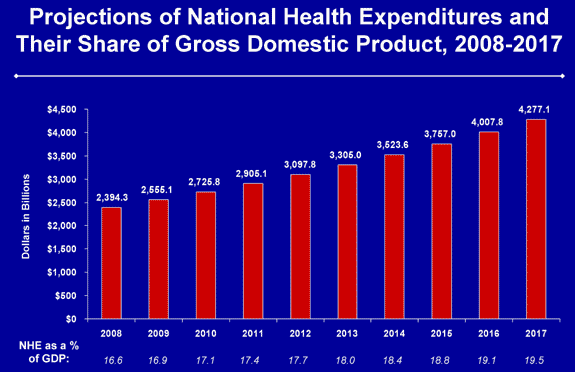
For many, especially economists, reducing health care costs means reducing the share of the nation’s economy we spend on health, which is 16.6 percent now and is headed for almost 20 percent in 2017 (Figure 1). Growth in health spending has exceeded growth in the economy by about two and a half percentage points for decades, and the worry is that it will squeeze out our ability to spend on all kinds of other priorities at all levels of the economy and government if we do not reduce the rate of increase in health spending.
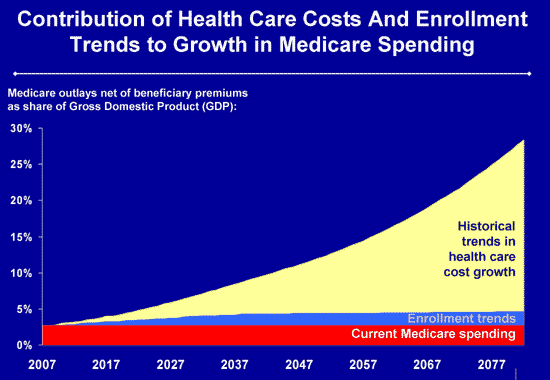
Others — for example, deficit hawks that include many Republicans and the Blue Dog Democrats in Congress — are focused more on the impact of health costs on federal spending, the budget deficit, and government’s ability to meet its obligations. Spending on entitlement programs is the core of their concern. It almost certainly has been pointed out to President Obama that if current projections hold true, Medicare will not be able to pay all its hospital bills soon after the end of his second term. As the CBO chart below makes clear, the underlying issue behind Medicare’s projected insolvency is the broader problem of health care costs and not the aging of the baby boomer generation. Public spending for Medicaid and the tax exemption for employer-provided health insurance similarly rise with the underlying cost of health care. This bolsters the argument for linking the debate about health reform and health care cost containment with a discussion of entitlements (Figure 2).
Figure 2
SOURCE: Congressional Budget Office, The Long-Term Outlook for Health Care Spending, November 2007.
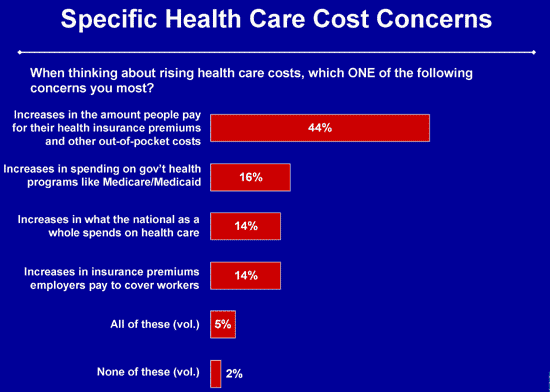
The biggest group of all, the American people, is worried about an entirely different problem and has yet again a different agenda: their own health care costs and the rising amounts they have been paying out-of-pocket for premiums, deductibles and co-pays, while at the same time being hit by multiple other economic shocks in the recession. For the worker share of the premium alone, the average amount paid by families increased from $1,543 in 1999 to $3,354 in 2008. It is this concern that has propelled health care back to the front of the national agenda and redefined it as a bread and butter economic issue of real salience for working and middle class Americans. Figure 3, from one of our recent tracking polls, makes this crystal clear. It explains why what people mostly want from health reform is for government to come to their rescue — either through subsidies or regulation or both — so that they can spend less for their health care and health insurance. People don’t really distinguish between subsidies that help to cover the cost of their insurance or cost containment efforts that mitigate the premiums themselves; they just want to pay less.
Figure 3
Source: Kaiser Health Tracking Poll: Election 2008 (conducted Oct 8-13, 2008)Note: “Don’t know/Refused” responses not shown.
A “grand bargain” discussion about health reform and entitlements, if it develops, could create a unique opportunity to pursue all three health cost objectives together. In particular, initiatives developed as part of health reform to contain health care costs hold the promise of helping with the long-term growth of government health entitlements, though the savings may take many years to materialize. But there is also a risk that the effort will fracture over differences in goals or succeed on some objectives more than others. For example, a deal that would rein in entitlement spending over the long term, in part through promised reforms of the health delivery system, but do little to provide immediate help to the public with their health care bills, is not likely to be very popular with voters who have put health care back on the agenda precisely because of their problems paying for health care today. Of course, the steps often discussed to control entitlement spending itself, such as pushing back the age of eligibility for Medicare, income relating Medicare premiums, or reducing provider payments, have never been an easy sell with the public or the Congress, and would likely be even more difficult in the context of a severe economic recession, and deficit hawks might only buy the bargain if clear triggers for implementing them were written into the legislation.
A grand bargain discussion itself would require looking out over longer time horizons than the Congress normally does in considering the costs and potential savings from legislation; in effect trading a willingness to spend now for savings down the road that will put public programs and the federal budget on a more sustainable long term course. A discussion like this, an attempt at linking so many big issues and interests usually dealt with in Washington issue by issue, committee by committee, press story by press story, and vested interest by vested interest, would be unprecedented. It would represent an attempt not just at achieving a policy outcome, but at leapfrogging the usual policymaking process.
The problem of health care costs will be central to both the health care reform and entitlement discussions, whether they are separate or joined in a new way. It will be important to keep clearly in focus in these debates that controlling health care costs can mean very different things to a health economist or a deficit hawk or to the public; to keep the public’s agenda in mind at all times or risk jeopardizing voter support; and to make an effort to address the different agendas in health care cost containment comprehensively rather than in the usual piecemeal fashion.
Revisiting ‘Skin in the Game’ Among Medicare Beneficiaries: An Updated Analysis of the Increasing Financial Burden of Health Care Spending From 1997 to 2005
This data update by Kaiser Family Foundation researchers finds the financial burden of out-of-pocket health care spending by Medicare beneficiaries increasing between 1997 and 2005. During this nine-year period, median out-of-pocket spending as a share of income for people on Medicare climbed to 16.1 percent in 2005, up from 15.6 percent in 2004 and 11.9 percent in 1997. For some beneficiaries, the spending burden was even greater, with 25 percent of people on Medicare spending nearly one-third or more of their income on health care. The analysis does not capture the effects of the Medicare Part D drug benefit, which began in 2006, because the data are not yet available.
The analysis of out-of-pocket health care spending as a share of Medicare beneficiaries’ income updates a paper previously published in Health Affairs and coauthored by Tricia Neuman and Juliette Cubanski of Kaiser, with Katherine Desmond and Thomas Rice of the University of California-Los Angeles.