Pulling it Together from Drew Altman: Multiple Agendas for Controlling Health Care Costs

Published: Jan 26, 2009

In what would be a domestic policy trifecta, we may be headed for interconnected big debates about economic recovery, entitlement programs and health reform. A core issue in the entitlement and health reform debates is the problem of rising health care costs. President Obama, now apparently fully briefed on the economic, budget and health reform realities he faces, is talking conspicuously about hard choices that may lie ahead. In a short period of time the focus has shifted from the emphasis in the primaries and general election on covering the uninsured and making insurance more affordable to a new focus on hard choices, spending and costs.

As this discussion looms it may be useful to keep in mind the very different — and sometimes conflicting — definitions and agendas at play when we talk about health care costs.

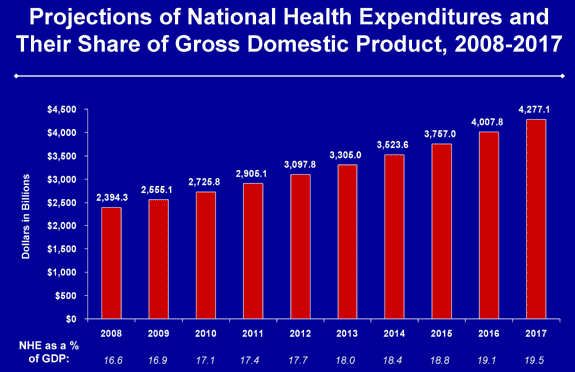
For many, especially economists, reducing health care costs means reducing the share of the nation’s economy we spend on health, which is 16.6 percent now and is headed for almost 20 percent in 2017 (Figure 1).  Growth in health spending has exceeded growth in the economy by about two and a half percentage points for decades, and the worry is that it will squeeze out our ability to spend on all kinds of other priorities at all levels of the economy and government if we do not reduce the rate of increase in health spending.

Figure 1
012809_fig2.gif

Source: Centers for Medicare and Medicaid Services, Office of the Actuary, National Health Statistics Group, at http://www.cms.hhs.gov/NationalHealthExpendData/03_NationalHealthAccountsProjected.asp#TopOfPage (see Projected; NHE Historical and projections, 1965-2017, file nhe65-17.zip).

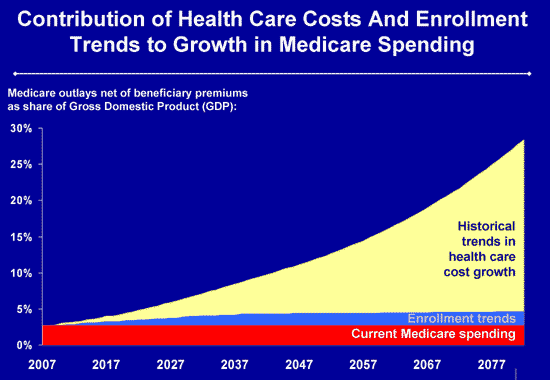
Others — for example, deficit hawks that include many Republicans and the Blue Dog Democrats in Congress — are focused more on the impact of health costs on federal spending, the budget deficit, and government’s ability to meet its obligations.  Spending on entitlement programs is the core of their concern.  It almost certainly has been pointed out to President Obama that if current projections hold true, Medicare will not be able to pay all its hospital bills soon after the end of his second term. As the CBO chart below makes clear, the underlying issue behind Medicare’s projected insolvency is the broader problem of health care costs and not the aging of the baby boomer generation.  Public spending for Medicaid and the tax exemption for employer-provided health insurance similarly rise with the underlying cost of health care. This bolsters the argument for linking the debate about health reform and health care cost containment with a discussion of entitlements (Figure 2).

Figure 2
012809_fig1.gif

SOURCE: Congressional Budget Office, The Long-Term Outlook for Health Care Spending, November 2007.

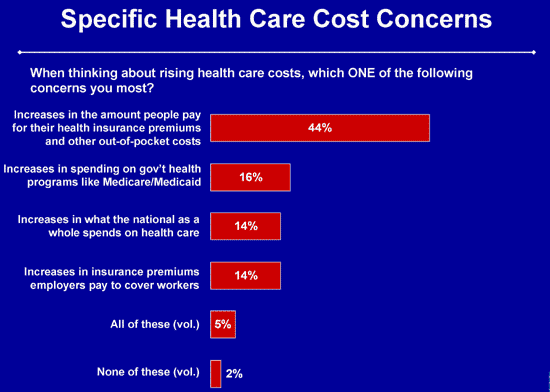
The biggest group of all, the American people, is worried about an entirely different problem and has yet again a different agenda: their own health care costs and the rising amounts they have been paying out-of-pocket for premiums, deductibles and co-pays, while at the same time being hit by multiple other economic shocks in the recession. For the worker share of the premium alone, the average amount paid by families increased from $1,543 in 1999 to $3,354 in 2008.  It is this concern that has propelled health care back to the front of the national agenda and redefined it as a bread and butter economic issue of real salience for working and middle class Americans.  Figure 3, from one of our recent tracking polls, makes this crystal clear. It explains why what people mostly want from health reform is for government to come to their rescue — either through subsidies or regulation or both — so that they can spend less for their health care and health insurance.  People don’t really distinguish between subsidies that help to cover the cost of their insurance or cost containment efforts that mitigate the premiums themselves; they just want to pay less.

Figure 3
012809_fig3.gif

Source: Kaiser Health Tracking Poll: Election 2008 (conducted Oct  8-13, 2008)Note: “Don’t know/Refused” responses not shown.

A “grand bargain” discussion about health reform and entitlements, if it develops, could create a unique opportunity to pursue all three health cost objectives together.  In particular, initiatives developed as part of health reform to contain health care costs hold the promise of helping with the long-term growth of government health entitlements, though the savings may take many years to materialize.  But there is also a risk that the effort will fracture over differences in goals or succeed on some objectives more than others. For example, a deal that would rein in entitlement spending over the long term, in part through promised reforms of the health delivery system, but do little to provide immediate help to the public with their health care bills, is not likely to be very popular with voters who have put health care back on the agenda precisely because of their problems paying for health care today.  Of course, the steps often discussed to control entitlement spending itself, such as pushing back the age of eligibility for Medicare, income relating Medicare premiums, or reducing provider payments, have never been an easy sell with the public or the Congress, and would likely be even more difficult in the context of a severe economic recession, and deficit hawks might only buy the bargain if clear triggers for implementing them were written into the legislation.

A grand bargain discussion itself would require looking out over longer time horizons than the Congress normally does in considering the costs and potential savings from legislation; in effect trading a willingness to spend now for savings down the road that will put public programs and the federal budget on a more sustainable long term course. A discussion like this, an attempt at linking so many big issues and interests usually dealt with in Washington issue by issue, committee by committee, press story by press story, and vested interest by vested interest, would be unprecedented. It would represent an attempt not just at achieving a policy outcome, but at leapfrogging the usual policymaking process.

The problem of health care costs will be central to both the health care reform and entitlement discussions, whether they are separate or joined in a new way. It will be important to keep clearly in focus in these debates that controlling health care costs can mean very different things to a health economist or a deficit hawk or to the public; to keep the public’s agenda in mind at all times or risk jeopardizing voter support; and to make an effort to address the different agendas in health care cost containment comprehensively rather than in the usual piecemeal fashion.

Revisiting ‘Skin in the Game’ Among Medicare Beneficiaries: An Updated Analysis of the Increasing Financial Burden of Health Care Spending From 1997 to 2005

Authors: Tricia Neuman, Juliette Cubanski, and Anthony Damico
Published: Jan 20, 2009

This data update by Kaiser Family Foundation researchers finds the financial burden of out-of-pocket health care spending by Medicare beneficiaries increasing between 1997 and 2005. During this nine-year period, median out-of-pocket spending as a share of income for people on Medicare climbed to 16.1 percent in 2005, up from 15.6 percent in 2004 and 11.9 percent in 1997. For some beneficiaries, the spending burden was even greater, with 25 percent of people on Medicare spending nearly one-third or more of their income on health care. The analysis does not capture the effects of the Medicare Part D drug benefit, which began in 2006, because the data are not yet available.

The analysis of out-of-pocket health care spending as a share of Medicare beneficiaries’ income updates a paper previously published in Health Affairs and coauthored by Tricia Neuman and Juliette Cubanski of Kaiser, with Katherine Desmond and Thomas Rice of the University of California-Los Angeles.

Public Education Partnerships FOX: Resources and Materials

Published: Jan 12, 2009
fox_pause_med.gif

When you give yourself a minute to think, you give yourself a chance to make a better decision.”

clear.gif

Resources & Materials

PAUSE Online

www.fox.com/pause is a dedicated site through fox.com that provides information and resources on the range of issues addressed within the PAUSE campaign. Content is organized under three main sections: Mind, Body, and Relationships. The site offers original content and features links to prominent national organizations including:

BODY

TobaccoAmerican Legacy Foundation

Alcohol and DrugsNational Youth Anti-Drug Media Campaign

PregnancyNational Campaign to Prevent Teen Pregnancy

Obesity and NutritionAlliance for a Healthier Generation A partnership between the William J. Clinton Foundation and American Heart Association

MIND

DepressionKidsHealth.org/teenshealthCreated by the The Nemours Foundation’s Center for Children’s Health Media

Eating Disorders (anorexia/bulimia)National Eating Disorders Association

CuttingS.A.F.E. Alternatives

Public Education Partnerships FOX: PSAs

Published: Jan 12, 2009
fox_pause_med.gif

When you give yourself a minute to think, you give yourself a chance to make a better decision.”

clear.gif

Public Service Ads

The Kaiser Family Foundation and Fox jointly produce PSAs addressing a wide range of issues including teen pregnancy and sexually transmitted diseases; alcohol and substance use; and online safety, among other topics. These television spots aim to encourage young people (ages 15 and older) to make smart choices and maintain healthy life-styles.

The PSAs are tagged with the campaign’s website, www.fox.com/pause where viewers can get more information about the issues addressed in the PSAs.

2009

Cute or Comfy (:30)Cute or Comfy (:20)Call or Text (:30)Call or Text (:20)

2008

Decisions (:30) 56K256K

2007 Patterns (:15) 56K256K Patterns (:30) 56K256K

2006 Paddles (:15) 56K256K Paddles (:30) 56K256K

Rising Unemployment, Medicaid and the Uninsured

Published: Jan 9, 2009

This policy brief and accompanying snapshot examines the relationship between increases in the unemployment rate and changes in the number of people covered by employer-sponsored health insurance, Medicaid, the State Children’s Health Insurance Program and non-group insurance policies, as well as the financial implications for government budgets.

The report also estimates the potential state costs for Medicaid, SCHIP and the uninsured under such a scenario, and the potential impact of proportional statewide budget cuts on Medicaid and SCHIP funding assuming that states maintain eligibility levels for public programs. If states reduce eligibility levels or established enrollment barriers, then Medicaid and SCHIP enrollment and spending will be depressed and the number of uninsured would be higher than the estimates in this report. In addition, states may not be able to provide additional funding to hospitals and other providers to care for the uninsured.

The one-page snapshot projects the effect of rising unemployment on the financing of state Medicaid and SCHIP programs into fiscal year 2011.

icon_fact_sheet

 Policy Brief (.pdf)

icon_fact_sheet

 Snapshot: Multi-Year Look at State Financing Effects (.pdf)

Next Steps in Covering Uninsured Children: Findings from the Kaiser Survey of Children’s Health Coverage

Published: Jan 1, 2009

This issue brief provides key findings from the Kaiser Survey of Children’s Health Coverage, including that many low- and middle-income working families with an uninsured child do not have access to employer-sponsored health insurance. The telephone survey of parents that was conducted in 2007 to learn more about children’s access to coverage and care and the health care cost-related pressures facing their families.

Issue Brief (.pdf)

Enrolling Uninsured Low-Income Children in Medicaid & SCHIP

Published: Jan 1, 2009

This fact sheet outlines issues in outreach and enrollment for Medicaid and SCHIP. It provides a profile of eligible but uninsured children, discusses the greatest barriers to enrollment, and offers strategies to improve enrollment.

Fact Sheet (.pdf)

Health Insurance Coverage of America’s Children

Published: Jan 1, 2009

This chartbook provides fundamental facts about children’s health insurance coverage.

Chartbook (.pdf)

Previous Versions:

February 2007 (.pdf)

Covering Uninsured Children: Reaching and Enrolling Citizen Children With Non-Citizen Parents

Published: Jan 1, 2009

This issue brief examines health insurance coverage for low-income citizen children whose parents are not citizens and some of the specific barriers to enrolling these children in Medicaid and the State Children’s Health Insurance Program. It is based on findings from the Kaiser Survey of Children’s Health Coverage, a telephone survey of parents conducted in 2007 to learn more about children’s access to coverage and care and the health care cost-related pressures facing their families.

Issue Brief (.pdf)

Addressing the HIV/AIDS Epidemic at Home and Abroad: Short-Term Policy Options Under Consideration by the New Administration and Congress

Published: Jan 1, 2009

This past summer, the United States government’s global HIV/AIDS program was reauthorized and the U.S. Centers for Disease Control and Prevention (CDC) released new data indicating that the epidemic at home was worse than previously thought. These events called significant attention to HIV/AIDS and together present the new Administration and Congress with an opportunity to address the epidemic at home and abroad.

Several short-term HIV-specific policy options have already been proposed for consideration, or are under consideration, by the new Administration and Congress. This brief provides an overview of some of these options, as put forward by non-governmental organizations and by President Obama. It is not, however, meant to be inclusive of all proposed options nor does it address any broader, non HIV-specific policy changes that are also underway – namely, national health care reform and foreign aid reform – although such efforts will undoubtedly have significant implications for the government’s response to HIV.

Issue Brief (.pdf)