KFF designs, conducts and analyzes original public opinion and survey research on Americans’ attitudes, knowledge, and experiences with the health care system to help amplify the public’s voice in major national debates.
Incorporating data from the 2009 Medicare Trustees’ Report, this chartpack examine the fiscal challenges facing the Medicare program as well as the public’s views on confronting them.
This report is based on a survey of Americans on the U.S. role in global health and was designed and analyzed by public opinion researchers at the Kaiser Family Foundation. It was conducted January 26 through March 8, 2009 (before the international outbreak of the H1N1 influenza A virus), among a nationally representative random sample of 2,554 adults ages 18 and older. Telephone interviews conducted by landline (N=1,951) and cell phone (N=603, including 214 who had no landline telephone) were carried out in English and Spanish. The survey includes oversamples of African American and Latino respondents as well as respondents ages 18 – 29. Results for all groups have been weighted to reflect their actual distribution in the nation. The margin of sampling error for the overall survey is plus or minus 3 percentage points. Most questions reported here were asked of a random half-sample of respondents and have a margin of sampling error of plus or minus 4 percentage points. For results based on subgroups, the margin of sampling error may be higher. Portions of this survey (questions about the domestic HIV epidemic) have been previously released.
This brief, the third in a series, examines changes to citizenship documentation requirements under the Children’s Health Insurance Program Reauthorization Act of 2009. The law extends the requirement to document citizenship that applied in Medicaid to CHIP as well. At the same time, it modifies current requirements to reduce the paperwork burden on families and states and helps ensure that eligible children and others are enrolled and receive needed health care without delay.
On March 30, 2009, the Centers for Medicare & Medicaid Services issued the 2010 “call letter,” which functions as a request for proposals to private health insurers and organizations that want to sponsor Medicare Advantage Plans or Medicare Prescription Drug Plans.
This issue brief reviews the call letter — the first issued by the Obama Administration — and examines the implications for beneficiaries of some of the proposed changes, including its emphasis on accountability of health plan sponsors, promoting informed choices for beneficiaries, and providing protections for beneficiaries.
The brief was prepared for the Foundation by the Center for Medicare Advocacy.
Survey about U.S. Role in Global Health Reports That Americans Want Take Care of Problems at Home First in a Recession, But Say Don’t Cut Funding For Global Health and Development
Two-thirds of the public supports maintaining (39%) or increasing (26%) U.S. government funding to improve health in developing countries, while fewer than a quarter (23%) say the government is spending too much on global health, according to this survey of the American people’s attitudes towards U.S. global health and development assistance. Levels of support are similar for spending to fight HIV/AIDS in developing countries, although the public’s sense of urgency about the HIV/AIDS epidemic around the world has declined. However, perhaps not surprisingly given the current recession, the vast majority (71%) of Americans say that given today’s serious economic problems the U.S. can’t afford to spend more on global health right now.
The survey of Americans on the U.S. role in global health was designed and analyzed by public opinion researchers at the Kaiser Family Foundation. It was conducted January 26 through March 8, 2009 (before the international outbreak of the H1N1 influenza A virus), among a nationally representative random sample of 2,554 adults ages 18 and older. Telephone interviews conducted by landline (N=1,951) and cell phone (N=603, including 214 who had no landline telephone) were carried out in English and Spanish. The survey includes oversamples of African American and Latino respondents as well as respondents ages 18– 29. Results for all groups have been weighted to reflect their actual distribution in the nation. The margin of sampling error for the overall survey is plus or minus 3 percentage points. Most questions reported here were asked of a random half-sample of respondents and have a margin of sampling error of plus or minus 4 percentage points. For results based on subgroups, the margin of sampling error may be higher.
This report contains the toplines from the 2009 Survey of Americans on HIV/AIDS. The survey was designed and analyzed by public opinion researchers at the Kaiser Family Foundation and was conducted January 26 through March 8, 2009, among a nationally representative random sample of 2,554 adults ages 18 and older. Telephone interviews conducted by landline (N=1,951) and cell phone (N=603, including 214 who had no landline telephone) were carried out in English and Spanish. The survey includes oversamples of African American and Latino respondents as well as respondents ages 18– 29. Results for all groups have been weighted to reflect their actual distribution in the nation. The margin of sampling error for the overall survey is plus or minus 3 percentage points, for whites it is plus or minus 4 percentage points, for African Americans it is plus or minus 5 percentage points, and for Latinos it is plus or minus 6 percentage points.
Several years ago Joanne Silberner from NPR offered some advice I liked. Joanne said that the secret to effective communication was to “have a killer anecdote and a killer number.”
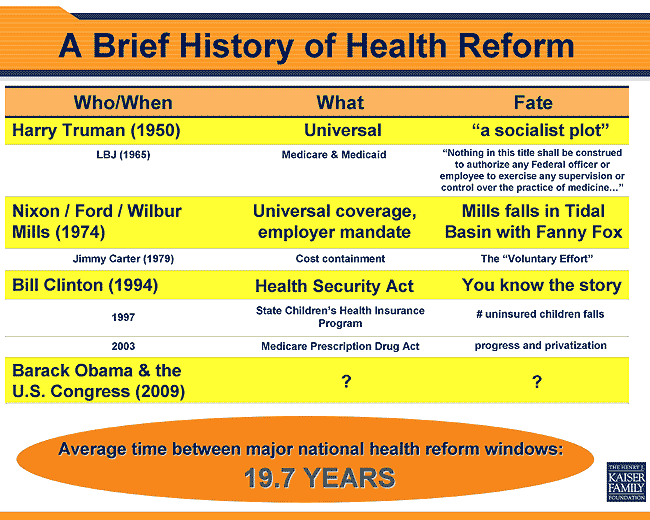
Here is a killer number: 19.7. That’s the average number of years between major attempts at health reform since Harry Truman made health reform a top priority and his plan was branded a socialist plot and soundly defeated in 1950. The chart below chronicles the four major moments of opportunity for health reform from Truman to the present day, as well as some other major legislative successes (Medicare and Medicaid) and failures (Jimmy Carter’s attempt at cost containment) since World War Two.
There are those who believe that the current moment of opportunity for health reform legislation will fade as others have before it. They believe that reaching consensus on how to reform health care and on how to pay for expanding and subsidizing coverage will prove too high a hill to climb. Others believe that the planets are aligned for health reform now as never before; that public concern about paying health care bills in a deep recession and presidential and congressional leadership on health reform have created a truly unique opportunity if Congress and the President are able to move quickly to take advantage of it. There is no way to say for sure who has the better crystal ball here, but history does suggest one thing: with an average elapsed time of 19.7 years between major windows of opportunity for health reform it could be awhile if the current effort fizzles before the planets align again as they have today. Whatever the outcome this time, and whatever approach to health reform you favor, the problems health reform aims to address are real and worsening, and the prospect of another long wait certainly suggests that there is wisdom in making a maximum effort now.
Soy… (I am…) is a ground breaking campaign to address the stigma surrounding HIV/AIDS in the Latino community. A diverse group of Latinos, ranging in age from two teenage sisters living in Los Angeles to a grandmother in Puerto Rico and her daughter who has been living with HIV for more than 10 years, share their personal stories about how HIV has affected their lives. They talk candidly about subjects not commonly discussed in many households in hopes of inspiring more conversations about HIV/AIDS.
Produced by Univision and the Kaiser Family Foundation, the Soy… campaign is part of !Enterate…del VIH y SIDA! (Get the Facts…about HIV and AIDS!), an ongoing public information partnership.
Campaign Components
The multi-faceted partnership includes television and radio public service ads, news and public affairs programming, a dedicated website, and other free resources, including a toll-free Spanish-language hotline that provides local referrals. The campaign also offers an informational guide in Spanish or in English that is available for download.
Soy… aims to create a more personal connection to HIV/AIDS in the Latino community and to inspire action — be that getting tested, talking to your partner or child, or getting involved in the community.
The Need
One in six people living with HIV in the U.S. today is Latino, yet AIDS is still not commonly discussed in many households. This silence allows stigma, misperceptions and fear to fuel an epidemic that is claiming the lives of Latinos at four times the rate of the general population.
This survey by NPR and researchers at the Kaiser Family Foundation and the Harvard School of Public Health highlights the public’s attitudes and experiences with the American health care delivery system. The new survey sheds light on Americans’ experiences with issues more typically discussed by health policy experts – including electronic medical records, coordination of care and comparative effectiveness – all of which have become serious components of reform plans and some of which have been signed into law this year. It also covers public opinion on possible policy changes.
The telephone survey of a nationally representative sample of 1,238 adults was conducted between March 12 and March 22.
The survey is the latest in a series of projects about health-related issues by NPR, the Henry J. Kaiser Family Foundation, and the Harvard School of Public Health. Representatives of the three organizations worked together to develop the survey questionnaire and to analyze the results, with NPR maintaining editorial control over its broadcasts on the surveys.