KFF/Harvard Survey on Public’s Health Care Agenda for the 112th Congress Finds An Uptick in Public Opposition to Health Reform As GOP Ramped Up Repeal Campaign

Published: Jan 25, 2011

Though the public remains divided on health reform overall, according to a new survey jointly conducted by the Kaiser Family Foundation and Harvard School of Public Health, opposition to the new law ticked upward in January from 41 percent to 50 percent as Republicans ramped up efforts to repeal it.

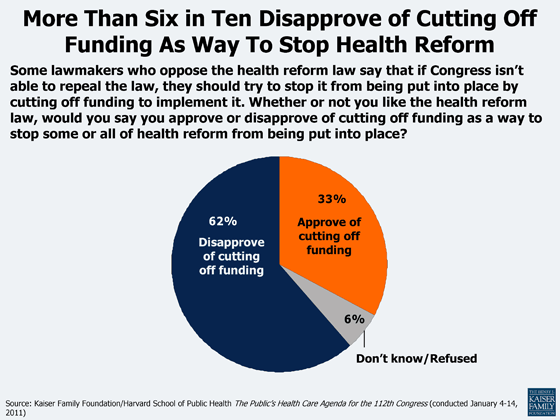
The survey also showed that there is no groundswell of public support for overturning the law, with 47 percent wanting to either expand the law or keep it as is and 43 percent wanting to repeal the law and replace it with a Republican alternative or repeal the law and not replace it at all. Additionally, a majority of Americans (62 percent) oppose the idea of lawmakers using the appropriations process to defund or slow down implementation of the law.

While over half of Americans say they prefer spending cuts over new taxes as the main way to reduce the deficit (57 percent vs. 14 percent), there is little public consensus about where to achieve meaningful savings and a majority opposes any spending reductions in two of the nation’s largest entitlement programs, Medicare and Social Security. Nearly half of Americans oppose any cuts in another major entitlement program, Medicaid.

More Than Six in Ten Disapprove of Cutting Off Funding as a Way to Stop Health Reform

Helping Consumers Manage Long-Term Services and Supports in the Community: State Medicaid Program Activities

Published: Jan 20, 2011

The Medicaid program is a source for many innovative practices in making long-term services and supports (LTSS) available to consumers. Jointly financed by the states and the federal government, Medicaid pays for 40 percent of LTSS spending the United States.

Case management services have been integral to Medicaid community-based LTSS programs since their inception, but as the programs have grown and evolved, particularly as options for care have increased and consumers have taken a more active role in directing services, the functions performed by case managers have changed. Drawing on the professional literature and interviews with state officials, this brief describes current case management efforts in states and activities and policies that can enhance states’ efforts to help consumers manage the services and supports they need.

Issue Brief (.pdf)

News Release

With Federal Support, States Hold Steady in Medicaid and CHIP Coverage Policies for Low-Income Children and Families Despite Recession

Published: Jan 11, 2011

New 50-State Survey Finds Some States Make Targeted Expansions to Strengthen Coverage and Achieve Efficiencies as They Prepare for Health Reform

WASHINGTON — Despite tight budgets, nearly all states maintained or made targeted expansions or improvements in their Medicaid and Children’s Health Insurance Programs (CHIP) eligibility and enrollment rules in 2010, preserving the programs’ ability to provide coverage to millions of low-income Americans who otherwise lack affordable options, according to a new survey released today by the Kaiser Family Foundation’s Commission on Medicaid and the Uninsured (KCMU).

The 10th annual KCMU 50-state survey of Medicaid and CHIP eligibility rules, enrollment and renewal procedures and cost sharing practices, this year conducted with the Georgetown University Center for Children and Families, found that coverage policies held steady or in some cases expanded, particularly for low-income children. However, eligibility for their parents and other low-income adults continued to lag behind. The stability of such programs during a recession that has produced sharp increases in unemployment and declines in state tax revenues arises in large part from the temporary federal fiscal relief for Medicaid provided by the American Recovery and Reinvestment Act of 2009 (ARRA).

That enhanced federal assistance, which will end in July, was tied to requirements for states to maintain Medicaid coverage policies. To help provide a base for the future Medicaid expansion, the health reform law also requires states to maintain public coverage for adults until broader health reform goes into effect in 2014 and until 2019 for children. However, in the coming year states continue to face significant budget pressures as demand for the programs remains high and state revenues continue to be depressed amidst the slow economic recovery.

“Millions of American families have turned to Medicaid and CHIP as incomes have declined after losing jobs and the health insurance that often goes with them,” said Diane Rowland, Executive Vice President of the Foundation and Executive Director of the KCMU. “Keeping these programs stable and strong has helped protect children and avoid an even larger increase in the nation’s 50 million uninsured, and will be key to ensuring the success of health reform implementation over the next few years.”

Coverage Policies Held Steady or Expanded in 2010, Especially For Children

The survey found that 49 states, including D.C., held steady or made targeted improvements in their Medicaid and CHIP eligibility rules and enrollment procedures. A total of 13 states expanded eligibility, largely for children, and 14 states made improvements in enrollment and renewal procedures to reduce burdens on families and streamline administrative processes.

Without the enhanced federal funding and maintenance-of-effort requirements in the ARRA and health reform laws, it is likely that more states would have made cutbacks in coverage to cope with budget pressures. Two states — Arizona and New Jersey — did make reductions that were not subject to the requirements in the laws.

Coverage for Low-Income Adults Continues to Lag Behind

The survey finds that as of January 1, 2011, 25 states, including D.C., cover children in families with incomes at least up to 250 percent of the federal poverty level ($45,775 for a family of three in 2010), continuing a decade of progress in covering children. However, coverage for their parents lags behind. The median Medicaid eligibility threshold for parents nationally remains at 64 percent of the federal poverty level, and 16 states limit eligibility for parents to those in families that earn below 50 percent of the federal poverty level ($9,155 for a family of three in 2010).

Until health reform passed, states could not cover adults without dependent children in Medicaid programs without a waiver. The new law ends the historic exclusion of these adults through a Medicaid eligibility expansion to a national floor of 133 percent of the federal poverty level ($24,352 for a family of three and $14,404 for an individual in 2010). Although the law won’t take full effect until 2014, last year Connecticut and D.C. took advantage of the new option to begin covering these adults by moving into Medicaid low-income adults whom they had previously covered only with state and local dollars. Also, California received approval for a waiver to continue and expand county initiatives that cover low-income adults. A few other states, including Minnesota, also have pending plans to take advantage of the new option to provide Medicaid coverage to adults. Even with these efforts, as of January 1, only seven states (Arizona, Connecticut, Delaware, D.C., Hawaii, New York and Vermont) provided Medicaid or Medicaid-equivalent benefits to adults without dependent children.

In the absence of further expansions over the next couple of years, most uninsured, low-income adults will remain unable to qualify for Medicaid until health reform goes into effect in 2014.

States are Incorporating Technology into Their Programs, but Have More Work Ahead

The survey finds that states continue to adopt technology to modernize their programs. Many of these improvements have helped to reduce barriers to enrollment and renewal for families, while also streamlining administrative processes and achieving administrative efficiencies. For example, about half of the states (29) took advantage of a new option to rely on an electronic data match with the Social Security Administration to more efficiently and accurately verify citizenship status of applicants for Medicaid and CHIP. The survey also found states making progress in using electronic data matches to verify other aspects of eligibility.

Yet states still have a significant amount of work to do, the survey finds. The new health reform law calls upon states to implement an integrated, web-based, technology-driven enrollment process for Medicaid, CHIP, and coverage in the new health insurance Exchanges. While all states make their Medicaid application available online, only slightly more than half (29) allow for the application to be electronically submitted with an electronic signature and most of these still require families to submit paper documentation via mail or fax. In light of a rule proposed by the Administration at the end of 2010 to provide states with a 90% federal matching rate to prepare their Medicaid eligibility systems for health reform, new grant funding, and the likelihood of additional guidance and funding opportunities in the months ahead, more activity in this area is expected in the coming year.

Today’s report, Holding Steady, Looking Ahead: Annual Findings of a 50-State Survey of Eligibility Rules, Enrollment and Renewal Procedures, and Cost-Sharing Practices in Medicaid and CHIP, 2010-2011, and related materials from today’s public briefing on the survey findings, are available online. In addition, an archived webcast of a public briefing will be available on the website after 4 p.m. ET today.The Kaiser Family Foundation is a non-profit private operating foundation, based in Menlo Park, California, dedicated to producing and communicating the best possible information and analysis on health issues.

The Kaiser Commission on Medicaid and the Uninsured provides information and analysis on health care coverage and access for the low-income population, with a special focus on Medicaid’s role and coverage of the uninsured. Begun in 1991 and based in the Kaiser Family Foundation’s Washington, D.C. office, the Commission is the largest operating program of the Foundation. The Commission’s work is conducted by Foundation staff under the guidance of a bipartisan group of national leaders and experts in health care and public policy.
Pulling It Together: Repeal

Published: Jan 6, 2011

The House will soon vote to repeal the health reform law, the Senate won’t, and the President would veto it if they did.  So what does a House vote for repeal mean?

It is, of course, a campaign promise kept to the political right.  It is also a signal from the Republican leadership that they plan to continue to use opposition to the health reform law as a rallying point for their political base.  Our polling shows that Republicans have opposed the law since well before its passage, and its critics have made it a symbol of deeper discontent with Washington and the federal government that resonates strongly with Republican voters.

It is possible that repeal in the House will also embolden governors who have staked out a position against the law to drag their feet; although most states whose governors are opposing the law are still moving forward to implement it.  Ultimately, governors with a strong ideological opposition to the law will have to weigh that opposition against the substantial new federal funding the law will bring to their states in the form of dollars for subsidies for the uninsured, expanded Medicaid coverage, and grant dollars for a variety of new programs.  Usually money trumps ideology at the state level, where politics are generally more pragmatic than they are in Washington; but the recent elections brought substantial changes to many state legislatures, and the patterns I saw when I was in state government may or may not be a good predictor of behavior this time.  If states don’t implement the law, elements of it — such as the exchanges and subsidies — will be implemented by the federal government instead.  Faced with this choice, some Republican governors may seek to implement more conservative-leaning versions of the law, which they can brand as their own.

Some observers believe repeal in the House will actually flip the advantage to the Democrats by underscoring the popular benefits the public will lose if the law were to be repealed.  A repeal debate could enable the Democrats to shift the focus from “Obamacare” as a symbol of the things people don’t like about the federal government and how Washington works to what the law actually does and what people will lose if it disappears; advantage Democrats, or so the argument goes.

Often overlooked in this focus on Washington tactics are these two points:

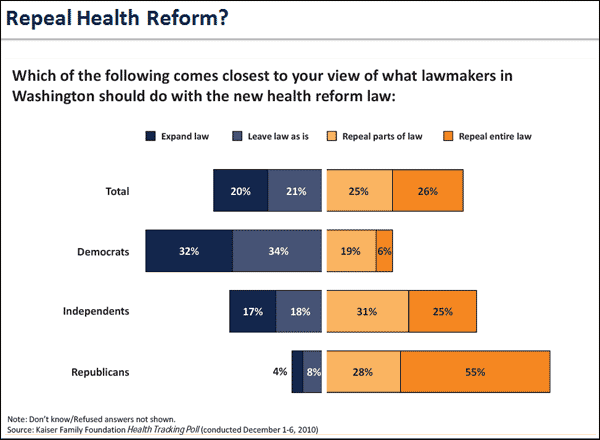
First, while the public clearly continues to be split on the law, there is no groundswell of support for outright repeal.  In our December poll, 26% of the public favored full repeal, 25% favored repealing some parts of the law and keeping other parts, 21% favored keeping the law as it is, and 20% favored expanding the law.  Another way of looking at it: almost as many people (20%) favor expanding it as favor repealing it entirely (26%).  Not surprisingly, 55% of Republicans want to repeal it entirely and 32% of Democrats want to expand it.

PIT-0111_2.gif

Second, a likely result of a repeal vote in the House will be even greater public confusion.  In our December tracking poll, we found that 43% of the public said they were still “confused” about the law (confusion was the public’s dominant feeling —  30% said they were “angry” and 33% said they were “enthusiastic”).  How many people will think the law has actually been repealed (when it has not) if a repeal measure passes the House?  We will test this in an upcoming tracking poll, but there is a real burden on the news media to explain clearly what has and has not happened (and that implementation of the law is continuing).Potentially more important than the House repeal vote are the efforts expected to target and defund parts of the law or to slow implementation.  How successful these efforts will be remains to be determined.  Targeted defunding is itself a complex topic involving disentangling the different kinds of funding authority in the law (for example, mandatory appropriations, entitlements, and tax changes written into the statute vs. discretionary funding requiring future congressional action) and an equally complex web of potential legislative strategies.  In general, however, defunding through the budget process cannot eliminate the law’s main benefits, such as the insurance reforms, Medicaid expansion, and tax credits to help people afford insurance coverage.  But, it can reduce the number of staff in federal agencies available to work on implementation.  Frequent oversight hearings are also expected in the House and could create a continuing climate of confrontation around the law.

What the repeal vote in the House demonstrates is how changing political circumstances can alter the policy landscape, sometimes rapidly.  And it does not require high level political analysis to figure out the next big external event that will affect implementation of the law — the 2012 presidential election.  If the president is re-elected, implementation is likely to move forward pretty much as the statute contemplates; and if he is not, bigger changes in direction are possible.

In the short term, with the main benefits of the legislation not yet implemented, opponents of the law have an opportunity to press their case.  However, once its main provisions are in place in 2014, repeal will be viewed as taking away tangible benefits tens of millions of people have and value. There is an old maxim about our political system that benefits, once conferred, cannot be taken away. Unless that fundamental law of American politics has itself been repealed, after 2014, discussion is likely to shift to improving and expanding the benefits and protections the law provides, not repealing them.

The Public, Health Care Reform, and Views on Repeal

Published: Jan 4, 2011

With the U.S. House of Representatives scheduled to vote on repeal of the health reform law next week, the latest Kaiser Family Foundation data note revisits some recent public opinion findings on the topic. Kaiser’s December Health Tracking Poll found the public divided on the question of repeal: one in four (26 percent) wanted to repeal the law in its entirety; 25 percent wanted to repeal parts of the law and keep other parts; one in five (21 percent) wanted to leave the law as it is; and one in five (20 percent) wanted to expand the law beyond its current footprint. As has been true since the start of the health care debate in 2009, these views were extremely partisan in nature. Most Democrats favored either leaving the law as is or even expanding it while a majority of Republicans backed a complete repeal, and Independents took their place in the middle. Even though roughly half the public favors repealing at least parts of the health reform law, when asked in November whether each of six specific provisions should be repealed, majorities wanted to keep five of them.

Waiting for Economic Recovery, Poised for Health Care Reform: A Mid-Year Update for FY 2011 – Looking Forward to FY 2012

Published: Jan 1, 2011

This report, based on structured discussions in November and December 2010 with leading Medicaid directors, augments the findings from the most recent comprehensive 50-state Medicaid budget survey to provide a mid-year 2011 update on state Medicaid issues.

As they prepare their fiscal 2012 budgets, many states, some under new gubernatorial and legislative leadership, continue to cope with lingering effects of the worst recession in decades and are facing budget shortfalls, with revenues remaining below pre-recession levels half-way through FY 2011. Medicaid enrollment is rising at a slower but still high rate compared to that in 2010. At the same time, enhanced federal Medicaid matching funds from the American Recovery and Reinvestment Act (ARRA) are set to expire on June 30, 2011, and states are moving forward with implementation of the new health reform law, which calls for a significant expansion of Medicaid.

Report (.pdf)

Medicaid’s New “Health Home” Option

Published: Jan 1, 2011

This brief provides key information about the new option for state Medicaid programs to provide “health home” services for enrollees with chronic conditions. The option, established under the new health reform law, took effect on Jan. 1, 2011. Health homes are designed to facilitate access to and coordination of the full array of primary and acute physical health services, behavioral health care and long-term community-based services and supports.

Brief (.pdf)

Holding Steady, Looking Ahead: Annual Findings Of A 50-State Survey Of Eligibility Rules, Enrollment and Renewal Procedures, And Cost Sharing Practices in Medicaid and CHIP, 2010-2011

Published: Jan 1, 2011

The annual 50-state survey of Medicaid and CHIP eligibility rules, enrollment and renewal procedures and cost sharing practices, conducted by the Kaiser Commission on Medicaid and the Uninsured with the Georgetown University Center for Children and Families, found that, in 2010, coverage in Medicaid and the Children’s Health Insurance Program remained strong with some improvements, particularly for low-income children. However, eligibility for their parents and other low-income adults continued to lag behind. The survey also found that states are adopting technology to modernize their programs, but still have a significant amount of work ahead as they begin to prepare for health reform.

The report was released at a Jan. 11, 2011 public briefing at the Foundation’s Washington, D.C., office.

Executive Summary (.pdf)

Full Report (.pdf)

Optimizing Medicaid Enrollment: Spotlight on Technology – Oklahoma’s Automatic Newborn Enrollment System

Published: Jan 1, 2011

This brief examines Oklahoma’s web-based system for automatically enrolling in its Medicaid program, SoonerCare, and provides an overview of the state’s more recent implementation of an online SoonerCare application for children and families, pregnant women, and other adults.

It is the fourth brief in a Spotlight on Technology series profiling several states’ innovative applications of technology to Medicaid enrollment efforts. The series illustrates a range of approaches that states can adopt to improve their systems now and to prepare for the expansion of Medicaid under health reform.

Spotlight (.pdf)