KFF designs, conducts and analyzes original public opinion and survey research on Americans’ attitudes, knowledge, and experiences with the health care system to help amplify the public’s voice in major national debates.
With the passage of health reform, the Money Follows the Person (MFP) demonstration grant program was extended five years through 2016 giving states further options to transition Medicaid beneficiaries living in institutions back to the community.
Enacted into law in 2006 as part of the Deficit Reduction Act (DRA), the MFP demonstration provides states with enhanced federal matching funds for twelve months for each Medicaid beneficiary transitioned from an institutional setting to a community-based setting. Twenty-nine states and DC are currently participating in this demonstration program and more states plan to apply for MFP grants in the coming year.
In July 2010, the Kaiser Commission on Medicaid and the Uninsured (KCMU) surveyed states about the current status of their MFP program including trends in enrollment, services and per capita spending. The 2010 survey is a follow-up to the 2008 KCMU MFP survey and highlights findings based on responses from twenty-six states.
Aiming to take a snapshot of the state of global health journalism, a report produced for the Kaiser Family Foundation found that shrinking newsroom budgets and the closing of many foreign bureaus are curtailing global health coverage within traditional news media outlets. Advocacy and nongovernmental organizations are increasingly bypassing news outlets and producing their own content, leading to questions about how global health news will evolve. In addition, with outside sources now funding some global health journalism coverage, the long-term sustainability of such funding is brought into question.
Commissioned by the Foundation, journalists Nellie Bristol and John Donnelly interviewed 51 stakeholders in global health journalism, including reporters, editors and producers from mainstream publications and news outlets, and policy, trade and medical journals; writers from advocacy outlets; and staff at journalism fellowship organizations.
Those interviewed suggested that disaster-related health crises and infectious disease outbreaks were the main focus of global health reporting. In many cases, journalists said that they were having a difficult time finding compelling angles for long-time global health stories such as HIV/AIDS or policy stories emerging from Washington, D.C.
As Congress and the Administration increasingly focus on the nation’s budget deficit, many policy experts and several bipartisan deficit reduction panels have proposed significant changes to Medicare to reduce federal spending and address rising health care costs.
This primer provides an overview of Medicare spending trends, how the program is financed, and factors contributing to the growth in Medicare spending. Medicare now covers 47 million seniors and younger people with disabilities, with total expenditures of $524 billion in fiscal year 2010, representing 15 percent of federal outlays.
It also describes the expected effects of provisions in the 2010 health reform law on future Medicare spending. The primer reviews the financial obligations and out-of-pocket spending for people covered by Medicare, outlines several ways to assess Medicare’s long-term fiscal outlook, and discusses future financing challenges facing the program.
In 2012, Medicare Advantage plans will be awarded additional payments based on their quality ratings as a result of the 2010 health reform law. The Centers for Medicare and Medicaid Services has proposed a demonstration that would modify the quality-based payments for plans, providing additional payments for 2012 to 2014.
This policy brief by the Kaiser Family Foundation examines the quality ratings of private Medicare Advantage plans by plan characteristics, and beneficiaries’ access to highly rated plans in 2011. The brief shows the potential for Medicare Advantage plans to receive quality-based bonuses under both the 2010 health reform law and the proposed demonstration.
This brief presents short profiles of four Ohio residents who have benefited from the state’s Money Follows the Person demonstration program, known as HOME Choice.
It was released along with several other resources on Medicaid long-term services and supports at a Feb. 7, 2011 briefing at the Foundation’s Washington, D.C., offices.
The Medicaid program is a major payer for long-term services and supports (LTSS) in the United States, accounting for 40 percent of total spending for long-term services and supports. The federal government has played an active role in sponsoring initiatives to promote a shift to community-based care; and evidence from several states suggests that providing care in the community can be less expensive than providing institutional care.
The Affordable Care Act (ACA) provides incentives for states to implement certain policies and practices that have proven effective at promoting access to long-term services and supports in the community. States’ experience has shown that operational details can have a significant impact on whether plans to provide more services and supports in the community succeed.
This brief highlights two important aspects of operations in state Medicaid programs that affect access to long-term services and supports in the community: efforts to provide accurate and timely information to consumers, and procedures to make Medicaid eligibility determinations quickly and efficiently.
This case study of Ohio’s Money Follows the Person demonstration, known as HOME Choice, describes key features of the program and highlights early program experiences.
Ohio was one of 17 states to receive federal funding for the Money Follows the Person (MFP) rebalancing demonstration in January 2007. The state was awarded up to $100 million in enhanced federal matching funds in order to transition roughly 2,200 seniors and people with disabilities from institutions to home and community-based settings and to help Ohio balance its long-term services and support system.
The brief is part of a series that will examine different Money Follows the Person programs across the states. The brief was released along with several other resources on Medicaid long-term services and supports at a Feb. 7, 2011 briefing at the Foundation’s Washington, D.C., offices.
A new report from the Kaiser Family Foundation examines funding and demographic data for countries receiving support under the U.S. Global Health Initiative (GHI), the Obama Administration’s six-year effort aimed at improving the health and lives of people in the developing world.
The new analysis evaluates data from fiscal year 2010 for six programs in the GHI: HIV/AIDS; tuberculosis; malaria; maternal, newborn, and child health; family planning and reproductive health; and nutrition. These six program areas, along with health systems strengthening and neglected tropical diseases, were identified as the key target areas under the GHI when the effort was first announced in 2009.
The report also includes a special spotlight on the eight “GHI Plus” countries, countries selected by the Administration to serve as “learning laboratories.” Seven of these countries — Bangladesh, Ethiopia, Guatemala, Kenya, Malawi, Mali, and Rwanda — receive support in at least five of the six GHI program areas, while the eighth (Nepal) receives support in four areas. Together, the eight countries accounted for one quarter of the total amount of GHI country and regional funding in fiscal year 2010.
OAKLAND, Calif. — Tonight at Oracle Arena, Oakland Mayor Jean Quan, actor/activist Danny Glover, and the Golden State Warriors will encourage fans and all Bay Area residents to be “Greater Than AIDS” as part of a national partnership with NBA Cares. Greater Than AIDS is new national movement to respond to AIDS in America developed by the Menlo Park-based Kaiser Family Foundation together with the Black AIDS Institute.
As part of a locally-focused partnership with The California Healthcare Foundation, Greater Than AIDS has teamed up with the Golden State Warriors for “WARRIORS > AIDS” night to mobilize NBA fans and Bay Area communities in response to AIDS in the United States and reduce the stigma associated with the disease. In addition to in-arena messaging and co-branded giveaways at tonight’s Warriors game against the New Orleans Hornets, Mayor Quan and Danny Glover will address the crowd during half-time to introduce a NBA /Greater Than AIDS public service message. The Warriors>AIDS game is developed as part of an ongoing partnership between Greater Than AIDS and the NBA/WNBA.
Staff and volunteers from two leading Bay Area organizations — Get Screened Oakland and San Francsico AIDS Foundation — will be on-hand at Oracle Arena to distribute custom informational materials and connect fans with local services. All materials distributed to fans at the game feature these local resources.
More than 1.1 million Americans are living with HIV/AIDS today — more than at any time in the 30 year history of the epidemic. According to the U.S. Centers for Disease Control and Prevention (CDC), one in 5 of those who are positive does not know it. Early diagnosis and treatment are known to improve the lives of those living with the disease. Stigma also remains a major barrier to stemming the spread of HIV. The Bay Area remains disportionately impacted, with higher than national prevalence rates in Oakland and San Francisco
Tonight’s WARRIORS > AIDS night tips off at 7:30 PM at Oracle Arena in Oakland as the Warriors host the New Orleans Hornets. Tickets are available at http://www.warriors.com.
About Greater Than AIDSGreater Than AIDS is an unprecedented collaboration among a broad coalition of public and private sector partners united in response to the HIV/AIDS crisis in the United States, in particular among Black Americans and other disproportionately affected groups. Through a national media campaign and targeted community outreach, Greater Than AIDS aims to increase knowledge and understanding about HIV/AIDS and confront the stigma surrounding the disease. http://www.greaterthan.org
The Kaiser Family Foundation — a leader in health policy and communications — provides strategic direction and day-to-day management, as well as oversees the production of the media campaign. The Black AIDS Institute — a think tank exclusively focused on AIDS in Black America — provides leadership and expert guidance and directs community engagement. Greater Than AIDS is developed in support of Act Against AIDS, an effort by the U.S. Centers for Disease Control and Prevention (CDC) to refocus attention on the domestic epidemic. Additional, financial and substantive support is provided by the Elton John AIDS Foundation, Ford Foundation and MAC AIDS Fund, among others.
About Greater Than AIDS / NBA Cares PartnershipGreater Than AIDS and the National Basketball Assocation have teamed up to mobilize NBA fans and local communities in response to AIDS in the United States and reduce the stigma associated with the disease. The partnership includes television and public service ads (PSAs) featuring NBA / WNBA players, including Pau Gasol (Los Angeles Lakers), Al Horford (Atlanta Hawks), Russell Westbrook (Oklahoma City Thunder) and Candice Wiggins (Minnesota Lynx), whose father, former professional baseball player Alan Wiggins, died of AIDS in 1991. as well as targeted activations, community events, and special “Greater Than AIDS” in-arena nights to bring attention to HIV/AIDS in priority markets. Learn more: http://www.greaterthan.org/nba
As Many Americans Would Like To Keep or Expand Health Reform Law As Would Like To Repeal Or Replace It, And Most Oppose Defunding Implementation
Public Concerned About The Deficit But A Majority Opposes Cutting Medicare And Social Security And Nearly Half Are Against Cutting Medicaid
WASHINGTON – Though the public remains divided on health reform overall, opposition to the new law ticked upward in January as Republicans ramped up efforts to repeal it, according to a new survey conducted by researchers from the Kaiser Family Foundation and the Harvard School of Public Health.
The survey also showed that there is no groundswell of public support for overturning the law, that many individual components of the legislation remain popular across the political spectrum and that a majority of Americans oppose the idea of lawmakers using the appropriations process to defund or slow down implementation of the law.
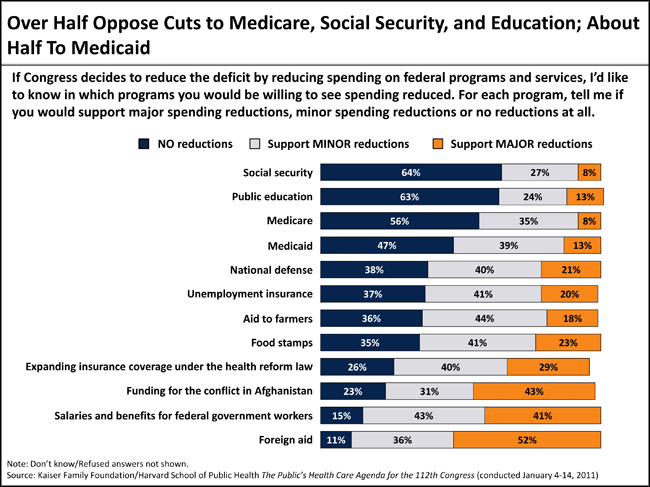
The survey, fielded in the weeks prior to the House repeal vote, was conducted at a time of substantial change in the political landscape in Washington, as Republicans take control of the House and politicians of both major parties attempt to respond to public concerns over the rising federal budget deficit. While most Americans in the survey say they prefer spending cuts over new taxes as the main way to reduce the deficit, there is little public consensus about where to achieve meaningful savings and a majority opposes any spending reductions in two of the nation’s largest entitlement programs, Medicare and Social Security. Nearly half of Americans oppose any cuts in another major entitlement program, Medicaid. Large majorities oppose major reductions in all three programs.
“Budget experts say that the budget deficit cannot be tackled without taking on Social Security, Medicare and Medicaid spending, or by raising taxes,” said Kaiser President and CEO Drew Altman. “But the American people do not believe this at all. There is a huge gap in basic beliefs and understandings of the problem and what it takes to solve it.”
Mixed Views on Repeal, While A Majority Opposes Cutting Off Funding
The share of Americans with unfavorable views of the health reform law rose to 50 percent this month, up from 41 percent in December, while the share holding favorable views remained largely unchanged at 41 percent. Increasing opposition among independents drove much of the change. Fifty-seven percent of independents had an unfavorable view of the law in January, up sharply from 41 percent in December, suggesting that GOP messages about the need to repeal the law resonated with independents during this time period.
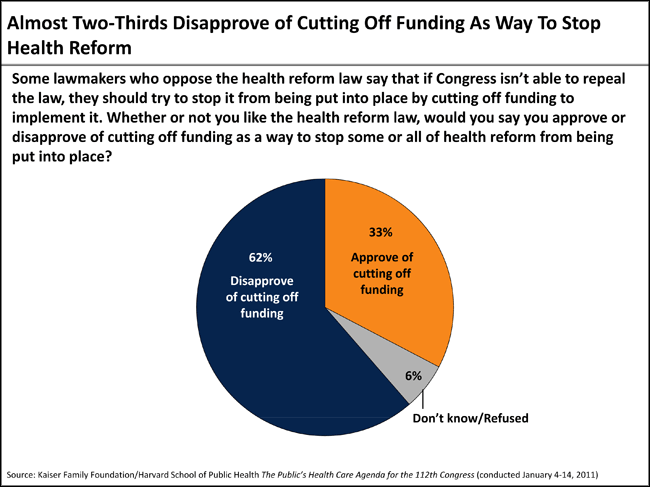
The public also is divided on what should happen next. About as many people want to expand the law or keep it as it is (28% and 19%, respectively) as want to repeal and replace the law or simply just repeal it (23% and 20%). Now that the repeal vote in the House is over, Republicans are expected to turn to efforts to defund and slow down implementation of the law through the appropriations process and other means. Yet the survey finds that most Americans (62%) disapprove of such a strategy. Most Republicans (57%) favor defunding health reform in the absence of repeal, but most independents are opposed (62%) along with a large majority Democrats (84%). Even among those who don’t like the law and want to see it repealed, about four in ten say they disapprove of cutting off funding.
“The public is frustrated with politics as usual, and may be saying that defunding a law is not how government should work,” said Mollyann Brodie, senior vice president and director of the Foundation’s Public Opinion and Survey Research group.
The public’s concerns about the law are varied, and tend to vary by party affiliation. More than half of Americans, including 81 percent of Republicans and 57 percent of independents, believe it will entail too much government involvement in the health care system. Yet most Democrats, 58 percent, think it will lead to about the right amount of government involvement. Also, despite the Congressional Budget Office’s findings to the contrary, 60 percent of Americans think the law will boost the deficit over the next decade — a view common even among supporters of the law.Component Parts of Health Reform Remain PopularDespite such concerns, many of the law’s component parts remain popular. Substantial majorities of Americans say they favor many of its provisions such as gradually closing the coverage gap known as the Medicare doughnut hole (85%), providing subsidies for low- and moderate-income Americans to buy health insurance (79%), establishing a voluntary insurance program known as the CLASS Act to help pay for long-term care services (76%) and expanding the Medicaid program (67%).
Some provisions are less popular, including requirements that all but the smallest employers offer health insurance to their workers or pay a penalty (51% oppose this) and, most controversially, that nearly all Americans obtain health coverage or face a fine (76% oppose).
The survey shows, however, that public opinion about this last provision is somewhat malleable. Told that without the requirement, insurance companies would still be allowed to deny coverage to people who are sick, unfavorable views fall from 76 percent to 47 percent. On the other side, opposition rises to 85 percent when Americans are told that the requirement could mean that some people would have to buy health insurance they find too expensive or don’t want.
Most Want To Reduce The Deficit But Not With Big Cuts in Medicare, Social Security or Medicaid
About two in three Americans say they are “very concerned” about the federal budget deficit, including more than seven in ten Republicans and independents and fewer than half of Democrats. There is a similar partisan divide over when Congress should tackle the problem, with most independents (61%) and Republicans (70%) saying lawmakers should act quickly to reduce the deficit and most Democrats (61%) preferring to wait until the economy gets better.
Most Americans — including majorities of Republicans and independents (76% and 59%) and a plurality of Democrats (39%) — prefer spending cuts over tax increases as the main way to reduce the deficit. But finding spending cuts the public will accept will be difficult for lawmakers. Of the 12 areas of spending cited in the poll, the only one in which a majority of Americans say they are willing to support “major reductions” is the relatively small amount devoted to foreign aid. In addition, about four in ten would back major reductions in funding for the war in Afghanistan and in salaries and benefits for federal workers.
In contrast, a majority of Americans said they would support no spending reductions in Social Security (64%) and Medicare (56%), two entitlement programs that together account for about a third of all federal spending. Nor do they want to see any reduction in spending for public education (63%). Nearly half say the same thing about Medicaid (47%). Very small percentages of Americans support the “major reductions” that some believe are necessary in programs such as Social Security (8%), Medicare (8%) and Medicaid (13%), the survey found. This is true even among Republicans, just 18 percent of whom support major reductions to Medicaid and 10 percent of whom support major reductions to Medicare and Social Security.
“The upcoming battle lines are clear,” said Robert Blendon, professor of health policy and political analysis at the Harvard School of Public Health. “One side will argue we need across the board cuts in domestic spending to quickly reduce the deficit, the other that popular health care programs should not be cut even if the deficit is not reduced. Which side will win is not clear.”
Even among Republicans, who are more likely than Democrats and independents to back spending cuts, majorities say they would not support any reductions in Social Security (59%) and public education (53%). Moreover, 52 percent of Republicans want no reductions in funding for national defense, another major area of federal spending and one in which independents and Democrats would support some cuts. When it comes to funding for expanding insurance coverage under the health reform law, 44 percent of Republicans say they would support major reductions while almost as many Democrats (38%) want to see no reductions.
The public’s reluctance to touch Medicare, Social Security and, when it comes to big cuts, also Medicaid may stem from the benefits, direct and otherwise, that people believe they confer on their families. More than three-quarters of Americans rated Medicare as either “very important” (55%) or “somewhat important” (22%) to their families, while nearly six in ten said the same thing about Medicaid (39% “very important,” 20% “somewhat important”). Sixty-eight percent of Americans say the country’s budgetary problems can be addressed without trimming Medicare spending at all.
Methodology
This Kaiser Family Foundation/Harvard School of Public Health survey,The Public’s Health Care Agenda for the 112th Congress, was designed and analyzed by public opinion researchers at the Kaiser Family Foundation led by Mollyann Brodie, Ph.D., including Claudia Deane, Liz Hamel, Sarah Cho, Bianca DiJulio, and Theresa Boston and by Professor Robert Blendon, Sc.D. and John Benson at the Harvard School of Public Health. The survey was conducted January 4 through January 14, 2011, among a nationally representative random sample of 1,502 adults ages 18 and older. Telephone interviews conducted by landline (1,000) and cell phone (502, including 203 who had no landline telephone) were carried out in English and Spanish by Social Science Research Solutions. The margin of sampling error is plus or minus 3 percentage points. For results based on other subgroups, the margin of sampling error may be higher.
The full question wording, results, charts and a brief on the poll can be viewed online. A webcast of today’s Washington briefing where the survey was released will be available online later today.
The Kaiser Family Foundation is a non-profit private operating foundation, based in Menlo Park, California, dedicated to producing and communicating the best possible information, research and analysis on health issues.
Harvard School of Public Health is dedicated to advancing the public’s health through learning, discovery and communication. More than 400 faculty members are engaged in teaching and training the 1,000-plus student body in a broad spectrum of disciplines crucial to the health and well being of individuals and populations around the world. Programs and projects range from the molecular biology of AIDS vaccines to the epidemiology of cancer; from risk analysis to violence prevention; from maternal and children’s health to quality of care measurement; from health care management to international health and human rights. For more information on the school, visit http://www.hsph.harvard.edu.