KFF designs, conducts and analyzes original public opinion and survey research on Americans’ attitudes, knowledge, and experiences with the health care system to help amplify the public’s voice in major national debates.
This brief provides key information about the new option for state Medicaid programs to provide “health home” services for enrollees with chronic conditions. The option, established under the new health reform law, took effect on Jan. 1, 2011. Health homes are designed to facilitate access to and coordination of the full array of primary and acute physical health services, behavioral health care and long-term community-based services and supports.
Holding Steady, Looking Ahead: Annual Findings Of A 50-State Survey Of Eligibility Rules, Enrollment and Renewal Procedures, And Cost Sharing Practices in Medicaid and CHIP, 2010-2011
The annual 50-state survey of Medicaid and CHIP eligibility rules, enrollment and renewal procedures and cost sharing practices, conducted by the Kaiser Commission on Medicaid and the Uninsured with the Georgetown University Center for Children and Families, found that, in 2010, coverage in Medicaid and the Children’s Health Insurance Program remained strong with some improvements, particularly for low-income children. However, eligibility for their parents and other low-income adults continued to lag behind. The survey also found that states are adopting technology to modernize their programs, but still have a significant amount of work ahead as they begin to prepare for health reform.
This brief examines Oklahoma’s web-based system for automatically enrolling in its Medicaid program, SoonerCare, and provides an overview of the state’s more recent implementation of an online SoonerCare application for children and families, pregnant women, and other adults.
It is the fourth brief in a Spotlight on Technology series profiling several states’ innovative applications of technology to Medicaid enrollment efforts. The series illustrates a range of approaches that states can adopt to improve their systems now and to prepare for the expansion of Medicaid under health reform.
The major coverage provisions in the Affordable Care Act (ACA) go into effect in January 2014 with an expansion of Medicaid eligibility to nearly all individuals under 138% of poverty and new subsidies for individuals with incomes between 138% and 400% of poverty to purchase coverage in newly established Health Insurance Exchanges. The ACA envisions a streamlined and simplified application process with seamless transitions between coverage in the Exchange and Medicaid. Using a web portal, consumers will be able to submit one application for coverage, whether they qualify for coverage in the Exchange or in Medicaid.
This brief examines new funding opportunities available under the health reform law to help states design and implement the information technology infrastructure necessary to streamline and simplify the application process so that there are seamless transitions between coverage in Medicaid and in the new Health Insurance Exchanges.
As 2010 draws to a close, the latest tracking poll shows the public still divided in their views of the health reform law, a sentiment largely unchanged since the law’s enactment in March. Forty-two percent of Americans say they have a generally favorable view of the law, while 41 percent have a generally unfavorable view of it.
Seniors, generally more critical of the law than younger people, seem to be softening in their opposition as the national discussion shifts to the federal budget and deficit. The share of those aged 65 and up holding unfavorable views of health reform dropped to 40 percent in December, the lowest since the passage of the law.
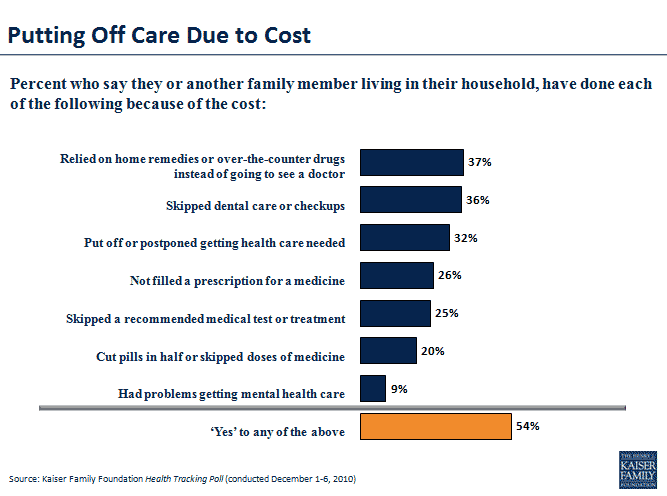
As the weak economy continues, the survey finds that a significant number of people are struggling to stay afloat financially. One in four say their household has had trouble paying medical bills over the past year, and 54 percent say they have delayed needed medical care because of cost.
Newspapers, radio news, or other online news sources continue to be the most common channels through which Americans receive information about health reform, with two-thirds of Americans saying they learn about the law that way. Almost as many say they have gotten information about the law through friends and family (64%) and via cable TV news channels and websites (61%). Fifty-eight percent say they get such information through national broadcast network news channels and websites.
The December poll is the latest in a series designed and analyzed by the Foundation’s public opinion research team.
Like you, the holidays always make me think about those who are less fortunate. Last year around this time, I wrote a“Holiday Reminder” column about the health reform debate and people’s economic difficulties. The drive to pass the health reform law was struggling, and it would struggle even more in the following weeks after the senatorial special election in Massachusetts. I wondered whether we had lost track of what propelled health care to the top of the domestic agenda in the first place — people’s concerns about paying for health care in the middle of a deep recession.
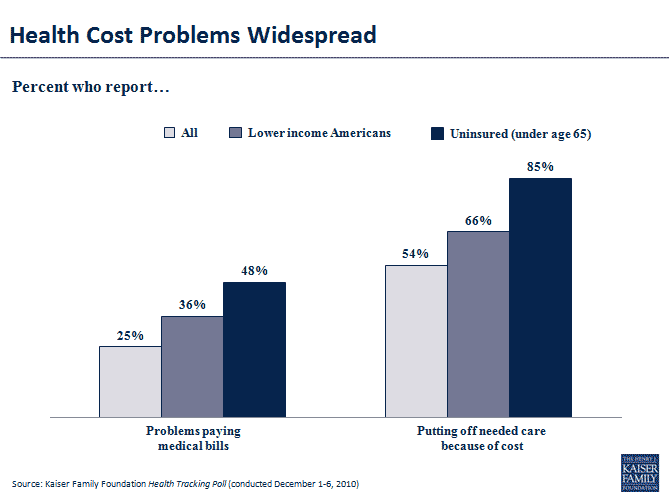
Well, a year later, as we move through another holiday season, much has changed, yet much also remains the same. Congress passed the Patient Protection and Affordable Care Act — spurred in part by reports of big increases in individual health insurance premiums — yet the country continues to debate the merits of the law. We are technically out of the recession, though that means little to the millions of Americans who are out of work or who continue to struggle with their health care bills. Our new tracking poll shows that twenty-five percent of the public, thirty-six percent of low-income people, and forty-eight percent of the uninsured report problems paying their health care bills over the past year. Fifty-four percent of the American people — and a whopping eighty-five percent of the uninsured — report putting off medical care they believe they need because of cost during the same period, including skipping recommended treatments and not filling prescriptions.
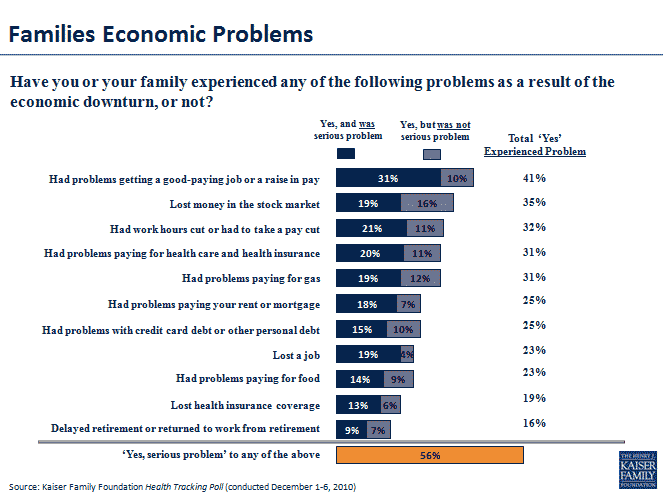
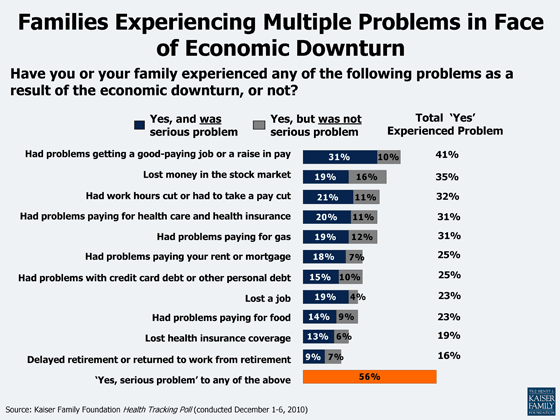
More than half of the American people report a “serious” economic problem, such as difficulty getting a decent job, losing money in the markets, taking a cut in pay, or problems paying for health care, gas, rent or the mortgage. More than half! Difficulty paying for health care ranks fourth on the list of “serious problems experienced as a result of the downturn”, behind job-related issues and losing money in the markets. You can see the data in these three charts:
Click on charts to enlarge.
The public’s concerns about paying their health care bills were the reason we had the health reform debate in the first place. And, as I wrote a year ago, this is also where the health reform message went off track. When average Americans could not easily connect the legislation to their everyday problems of paying bills and making ends meet, they became more susceptible to messages from opponents ready to define the legislation in ways that were scary to the public. However, I am not entirely sure that different messaging would have made a big difference. Views on health reform largely track partisan and ideological differences in the country, and proponents and opponents were always going to play to people’s emotions — whether about the insurance industry (proponents) or about government (opponents). But, helping people understand how the reform law affects their everyday lives might have made a difference at the margin during the debate. And it could continue to, since the law and its implementation obviously remain hotly contested. I’m not sure people understand the degree to which expansions in Medicaid and tax credits will help lower income and working people pay for health insurance. Of course, these changes aren’t scheduled to take effect until 2014.
In the meantime, new rules go into effect next year that require insurers to spend a minimum percentage of their premium revenue on medical care rather than administration and profits, or pay rebates to consumers. And many states are taking more aggressive action to try to hold down premium increases. Their authority and capacity varies from state-to-state, and their efforts are generally limited to the non-group and small employer markets, but several states have had success holding back premium increases (at least temporarily). When states reject proposed rate increases, either insurers or providers have to divide up a smaller pie. The ensuing struggle between the two plays out differently depending upon the relative market power each has in a particular state or region. It would, of course, be better to directly address the fundamental causes of rising health care costs than to limit premium increases, which is the cost control equivalent of plugging a broken steam pipe: the pressure continues to build. But our ability to do that is limited — in some cases by politics and in other cases by how little we as experts know about which delivery and payment reforms will bear fruit — and current efforts will take many years to pay off. In the meantime these efforts by the states err on the side of putting people first, and could meaningfully help some people and small businesses by trying to place reasonable limits on the premium increases they pay.
Whatever your view of the health reform law or of these new state regulatory efforts, our December survey shows that large numbers of people continue to struggle with health care costs and that lower income and uninsured people struggle most of all. In Washington and in health policy circles, debates about how to control health costs are often intensely ideological. The numbers reported in our polls show why people look at health care costs very differently from the combatants in these debates. They are struggling and just want some relief. I doubt they would care much whether the strategy was a liberal, conservative or middle of the road one if they believed it would help them pay their bills.
As 2010 draws to a close, the latest tracking poll from the Kaiser Family Foundation shows the public still divided in their views of the health reform law, a sentiment largely unchanged since the law’s enactment in March. Forty-two percent of Americans say they have a generally favorable view of the law, while 41 percent have a generally unfavorable view of it. As the weak economy continues, the survey finds that a significant number of people are struggling to stay afloat financially. One in four say their household has had trouble paying medical bills over the past year, and 54 percent say they have delayed needed medical care because of cost. Such problems are more prevalent among lower income and uninsured Americans, 36 percent and 48 percent of whom, respectively, report having trouble paying medical bills. Among the uninsured, 85 percent say they have put off needed care because of cost. Beyond health care, many people report having problems getting a good-paying job or a pay raise (41%); losing money in the stock market (35%); suffering cutbacks in pay or work hours (32%); having trouble paying their rent or mortgage (25%); losing a job (23%); and having problems paying for food (23%).
This brief examines efforts by the Chicago Public School system to use multiple strategies including data matching with the school lunch program, marketing and local organizing to target children for outreach and enrollment in public health insurance and other benefits.
It is the third brief in a Spotlight on Technology series profiling several states’ innovative applications of technology to Medicaid enrollment efforts. The series illustrates a range of approaches that states can adopt to improve their systems now and to prepare for the expansion of Medicaid under health reform.
The November 2010 tracking poll was conducted in the days following the mid-term election that resulted in major gains for Republicans, including a shift in control of the House of Representatives. The survey attempts to gauge what role health reform played in voters’ decisions, and to measure the current public mood about the health reform law.
The poll finds that voters say health care reform was a factor that influenced their vote, but not a dominant one. The economy/jobs was the factor mentioned by voters most often (29%), followed by party preference (25%) and views of the candidates themselves (21%). Health care ranked fourth at 17 percent. Those 17 percent of voters who named health care as one of their top voting factors were more likely than non-health care voters to back a Republican candidate for Congress (59% vs. 44%), and to say they have a “very unfavorable” view of the law (56% vs. 33%).
Looking ahead, Americans remain divided about what lawmakers should do, with 21 percent of the public favoring expansion of the health reform law, 19 percent wanting to leave it as is, a quarter wanting to repeal parts of the law, and 24 percent wanting the entire law repealed. Among mid-term voters, a majority (56%) would like to see the law repealed entirely or in part. Voters split sharply along partisan lines. Two-thirds of those who voted for Democratic candidates want the law expanded or left as is, while eight in 10 of those who voted Republican support full or partial repeal.
Several key provisions of health reform remain popular, even among those who support repeal of all or parts of the law. Majorities of supporters of repeal would like to keep tax credits for small businesses offering coverage; the prohibition on insurance companies denying coverage based on medical history or health condition; the gradual closing of the Medicare prescription drug “doughnut hole”; and financial subsidies to help low and moderate income Americans purchase coverage. By contrast, two-thirds of the general public support repealing the individual mandate, another key provision in the law.
The November poll is the latest in a series designed and analyzed by the Foundation’s public opinion research team.