KFF March Health Tracking Poll: One Year Later, Views on Health Reform Remain Divided

Published: Mar 18, 2011

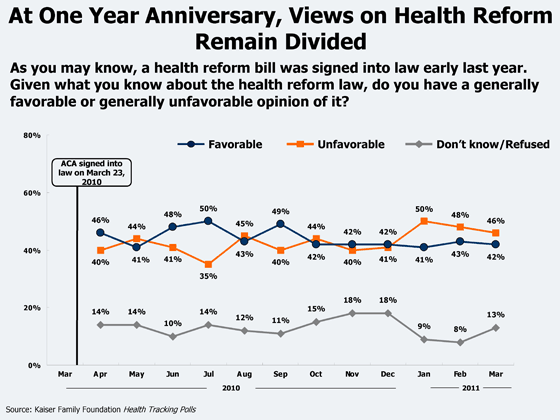
Health reform is a year old and the latest Kaiser Health Tracking Poll finds a basic division that has changed little during the last 12 months. This month, 42 percent of Americans hold favorable views of the law while 46 percent view it unfavorably. In April 2010, the month after passage, 46 percent had favorable views and 40 percent unfavorable ones, but both figures have ticked up and down over the last year. Opinion of the law continues to break sharply along partisan lines, with 71 percent of Democrats backing the law and 82 percent of Republicans opposing it.

About half (51%) of Americans who like the law cite expanded access to insurance and health care as the reason. Those who do not like it give a greater variety reasons: 20 percent are concerned about costs; 19 percent have concerns about government’s role; and 18 percent mention opposition to the individual mandate.

At One Year Anniversary, Views on Health Reform Remain Undivided
News Release

The San Antonio Spurs Join With Mayor Castro, Local Health Department and AIDS Organizations to Mobilize Fans to be “Greater Than AIDS”

Published: Mar 8, 2011

SAN ANTONIO — Tomorrow at the AT&T Center, the San Antonio Spurs join with Mayor Julian Castro, the San Antonio Metropolitan Health District, the Bexar County Department of Community Resources, and HIV210.org to get out information about HIV/AIDS and reduce stigma surrounding the disease. The special SAN ANTONIO>AIDS game night is organized as part of a national partnership between NBA Cares and Greater Than AIDS, a national movement to respond to AIDS in America.

In addition to in-arena messaging throughout the March 9th Spurs game against the Detroit Pistons, Mayor Castro will address the crowd during halftime to introduce a NBA/Greater Than AIDS public service message featuring NBA All Stars Pau Gasol, Al Horford and Russell Westbrook and WNBA player Candice Wiggins, whose father died of AIDS. The Spurs are also working with Greater Than AIDS and local San Antonio organizations to organize a private Player Appearance with Spurs legend George “The Iceman” Gervin.

“I’m so pleased that the NBA and the Spurs have made such a strong commitment in the fight against AIDS. Their leadership will make a real difference in helping our community prevent the spread of this growing epidemic,” said San Antonio Mayor Julian Castro.

Staff and volunteers from leading San Antonio organizations — San Antonio Metropolitan Health District, Bexar County Department of Community Resources, and HIV210.org — will also be on-hand at the AT&T Center to distribute custom informational materials that connect fans with local services. All materials distributed to fans at the game feature these local resources.

“The San Antonio is Greater than AIDS Game is an initiative that will help bring much needed attention to the effects that this devastating disease has had on so many people and their families,” said Charles Pruski, interim deputy director of the San Antonio Metropolitan Health District.

More than 1.1 million Americans are living with HIV/AIDS today — more than at any time in the 30-year history of the epidemic. According to the U.S. Centers for Disease Control and Prevention (CDC), one in five of those who are positive does not know it. Early diagnosis and treatment are known to improve the lives of those living with the disease. Stigma also remains a major barrier to stemming the spread of HIV. The San Antonio area remains disproportionately impacted, with higher than national prevalence rates in San Antonio.

For more information about the Greater Than AIDS/NBA partnership, go to: http://www.greaterthan.org/nba.

About Greater Than AIDSGreater Than AIDS is an unprecedented collaboration among a broad coalition of public and private sector partners united in response to the HIV/AIDS crisis in the United States, in particular among Black Americans and other disproportionately affected groups. Through a national media campaign and targeted community outreach, Greater Than AIDS aims to increase knowledge and understanding about HIV/AIDS and confront the stigma surrounding the disease. http://www.greaterthan.org

The Kaiser Family Foundation — a leader in health policy and communications — provides strategic direction and day-to-day management, as well as oversees the production of the media campaign. The Kaiser Family Foundation is not associated with Kaiser Permanente or Kaiser Industries. The Black AIDS Institute — a think tank exclusively focused on AIDS in Black America — provides leadership and expert guidance and directs community engagement. Greater Than AIDS is developed in support of Act Against AIDS, an effort by the U.S. Centers for Disease Control and Prevention (CDC) to refocus attention on the domestic epidemic. Additional, financial and substantive support is provided by the Elton John AIDS Foundation, Ford Foundation and MAC AIDS Fund, among others.

About Greater Than AIDS / NBA Cares PartnershipGreater Than AIDS and the National Basketball Association have teamed up to mobilize NBA fans and local communities in response to AIDS in the United States and reduce the stigma associated with the disease. The partnership includes television and radio public service ads (PSAs) featuring NBA/WNBA players, including Pau Gasol (Los Angeles Lakers), Al Horford (Atlanta Hawks), Russell Westbrook (Oklahoma City Thunder) and Candice Wiggins (Minnesota Lynx), whose father, former professional baseball player Alan Wiggins, died of AIDS in 1991. The partnership also includes targeted activations, community events, and special “Greater Than AIDS” in-arena nights to bring attention to HIV/AIDS in priority markets. Learn more: http://www.greaterthan.org/nba

News Release

Here Media Empowers Gay Community to be “Greater Than AIDS”

Published: Mar 1, 2011

World’s Largest Gay Media Company Partners on Cross-Cutting HIV/AIDS Campaign, Launches New Informational Resources

Here Media, the world’s largest gay media company, has joined with Greater Than AIDS — a new national movement to respond to AIDS in America — to inform and engage the LGBT community about HIV/AIDS. The multimedia partnership includes public service announcements (PSAs) and expanded HIV/AIDS news and editorial across Here Media’s iconic brands — including Gay.com, OUT, The Advocate, HIV Plus, and MPOWRPlus.com. A dedicated new web portal, http://www.gay.com/greaterthan, provides targeted information and resources for gay and bisexual men.

Gay and bisexual men account for about half of all Americans living with HIV/AIDS today and are the only risk group among which new infections are on the rise. According to a recent study by the U.S. Centers for Disease Control and Prevention (CDC), one in five (19%) men who have sex with men (MSM) in major U.S. cities today are HIV-positive — and as many as half of those who are infected don’t know it.

The Here Media-Greater Than AIDS partnership includes:

  • Targeted PSAs in Here Media print publications, with the debut PSAs appeared in OUT and HIV Plus in February;
  • Online banner ads across Here Media’s multiple websites, including Gay.com (the world’s leading gay social networking site); Out.com; Advocate.com; and HIVPlusMag.com;
  • Expanded news and editorial content on HIV/AIDS and related issues among gay and bisexual men in Here Media publications and online platforms;
  • New Web portal (http://www.gay.com/greaterthan) that provides comprehensive HIV-related information for gay and bisexual men. The site also includes an HIV testing center locator and links to local LGBT and HIV/AIDS service organizations;
  • Special events and community outreach will leverage the popular appeal of Here Media’s brands, including OUT and The Advocate, to provide information about HIV/AIDS.

“Homophobia and other social stigmas, low self-esteem, and high rates of substance use contribute to rising rates of HIV infections among our community,” said Joe Valentino, Vice President and Associate Publisher, Here Media. “We are proud to partner with Greater Than AIDS to educate and empower our audience. This partnership refocuses our community’s attention on the important need to reduce the spread of HIV.”

“As one of the communities hardest hit by the disease, gay and bisexual men have been at the center of the AIDS crisis since the early days of the epidemic,” said Stephen Massey, Associate Director of Entertainment Media Partnerships at the non-profit Kaiser Family Foundation, a founding partner of Greater Than AIDS. “In joining with Greater Than AIDS, Here Media is providing a powerful platform to reach the gay community with action-oriented and empowering messages and helping to mobilize a new generation in response to HIV/AIDS.”

June 2011 will mark 30 years since the first case of AIDS was diagnosed. More than 1.1 million people in the United States are living with HIV today, and at least half a million more have died of AIDS complications. Men who have sex with men (MSM) have been at the center of the epidemic since its earliest days and today account for more than half of new infections in this country. According to a recent study by the U.S. Centers for Disease Control and Prevention (CDC), one in five (19%) gay and bisexual men in some the largest U.S. cities are living with HIV — and half of those who are positive don’t know it. MSM are the only risk group among which new infections are on the rise.

About Here Media

Here Media Inc. produces and distributes niche content across all platforms worldwide. Here Media’s iconic brands distribute gay media and world cinema programming with universal, humanistic appeal. Its distribution platforms include television, VOD, broadband, online, print, and mobile. It earns subscription, advertising, and licensing revenue from its award-winning content.

Here Media owns and operates a variety of media assets, including: here! TV, a premium television network featuring programming that appeals to a gay and lesbian audience airing in 96 of the top 100 U.S. markets, including every top 10 market; Iconic brands including Out, The Advocate, and HIV Plus as well as Alyson Books; The Advocate/Out group of online sites, including Gay.com, Advocate.com, Out.com, and SheWired.com.

Paul Colichman is Chief Executive Officer of Here Media and Stephen P. Jarchow is Chairman. Together, they have produced and/or distributed over 200 motion pictures, including Academy Award

A Profile of Health Insurance Exchange Enrollees

Published: Mar 1, 2011

The Patient Protection and Affordable Care Act calls for the creation of Health Insurance Exchanges in all states by January 1, 2014. The exchanges are a critical element of the health reform law, aimed at helping individuals and families shop for and purchase health insurance on their own with additional assistance for lower-income individuals and families. The Congressional Budget Office has estimated that approximately 24 million people will purchase coverage through the state health exchanges by 2019.

This March 2011 report describes those 24 million Americans expected to purchase private health insurance through the new Health Insurance Exchanges. Among the key findings from the report is that those purchasing coverage are likely to be relatively older, less educated, and more racially diverse and report to have poorer health, but have fewer diagnosed conditions than those who currently have private insurance.

Report (.pdf)

Mobile Technology: Smart Tools to Increase Participation in Health Coverage

Published: Mar 1, 2011

As mobile technology advances and cell phone use continues to increase across demographic groups, there is significant potential to tap these technologies to facilitate enrollment in and retention of health coverage, in both the immediate term and as health reform is implemented.

A brief produced in conjunction with The Children’s Partnership examines how various tools and strategies, including text messages and smart phone apps, can be used to advance coverage goals. The report focuses especially on the capacity of mobile technology to reach and expand health coverage among traditionally underserved communities, who have less broadband access to the Internet at home. It discusses the potential of mobile devices to function as outreach tools and as new means of applying for and renewing coverage, as well as submitting forms, receiving reminders, and paying premiums. The brief also highlights key challenges to maximizing the potential of mobile technology in this sphere and policy steps that could help to address them.

Issue Brief (.pdf)

Medicaid Matters: Understanding Medicaid’s Role in Our Health Care System

Published: Mar 1, 2011

This fact sheet provides key information about the Medicaid program and its role in our health care system and state economies. The nation’s public health insurance program for low-income people is counter-cyclical, expanding during the recent recession to assist millions of individuals and families affected by the loss of jobs and job-based health insurance. While the program has worked as intended, economic conditions have contributed to growing pressure on state budgets and Medicaid funding.

This brief provides key information about the Medicaid program and its role in the U.S. health care system and state economies.

Fact Sheet (.pdf)

Determining Income for Adults Applying for Medicaid and Exchange Coverage Subsidies: How Income Measured With a Prior Tax Return Compares to Current Income at Enrollment

Published: Mar 1, 2011

A major goal of the Patient Protection and Affordable Care Act (ACA) is to significantly expand coverage and reduce the number of uninsured. Beginning in 2014, the ACA will establish a new continuum of coverage that will provide assistance to individuals with incomes up to 400% of poverty through a broad expansion in Medicaid and by making premium tax credits available to eligible individuals to purchase coverage through new Health Insurance Exchanges. The law standardizes the definition of income used to determine eligibility for Medicaid and the premium tax credits to Modified Adjusted Gross Income. Yet, there remain important distinctions related to the timing of the income used to assess eligibility. This analysis suggests that the timing of the income used to determine eligibility has important implications and that establishing simple procedures to collect current income will be important for assuring individuals receive the appropriate coverage and levels of assistance when they apply for Medicaid and Exchange coverage.

Issue Brief (.pdf)

SlidesGraphicMini25.gif

Supplemental Slides Updated as of January 2012

Improving Access to Adult Primary Care in Medicaid: Exploring the Potential Role of Nurse Practitioners and Physician Assistants

Published: Mar 1, 2011

The inadequate supply of primary care providers is among the major challenges facing the U.S. health care system. Sixty-five million people live in areas designated by the federal government as having a shortage of primary care providers. Under the Patient Protection and Affordable Care Act (ACA), the pressures on access are certain to grow as millions of newly insured people enter the health care system. By 2020, the U.S. will face an estimated shortage of 91,000 physicians, split about evenly between primary care physicians and specialists. The impact of this shortage is likely to be more acute among Medicaid beneficiaries due to geographic misalignment between low-income communities and physician practice locations and low physician participation in Medicaid.

Anticipating increased demands for primary care as more people gain coverage, ACA put in place strategies to help build primary care capacity. One of them is greater reliance on primary care health professionals other than physicians. This brief provides basic information about two major types of primary care providers – nurse practitioners and physician assistants – and considers their potential to increase the supply of primary care as Medicaid expands to cover more uninsured adults.

Issue Brief (.pdf)

KCMU Fact Sheets

Published: Feb 28, 2011

These fact sheets from the Kaiser Commission on Medicaid and the Uninsured provide basic information about Medicaid, children’s coverage and the uninsured

Medicaid: Basics

Medicaid Matters: Understanding Medicaid’s Role in Our Health Care System

5 Key Questions and Answers About Medicaid

The Medicaid Program At a Glance

Visualizing Health Policy Infographic–Medicaid: Its Role Today and Under the Affordable Care Act

Medicaid Beneficiaries and Access to Care

Medicaid and Long-Term Services and Supports

Dual Eligibles: Medicaid’s Role for Low-Income Medicare Beneficiaries

The Role of Medicaid for Adults With Chronic Illnesses

Medicaid’s Role for Hispanic Americans

Medicaid’s Role for Black Americans

Faces of Medicaid: Profiles

Why Does Medicaid Spending Vary Across States: A Chart Book of Factors Driving State Spending

Children

Health Coverage of Children: The Role of Medicaid and CHIP

State Adoption of Coverage and Enrollment Options in the Children’s Health Insurance Reauthorization Act of 2009

Children’s Health Insurance Program Reauthorization Act of 2009

Medicaid: Eligibility, Spending and Financing

Five Key Questions About Medicaid And Its Role in State/Federal Budgets and Health Reform

Medicaid Spending Growth and the Great Recession, 2007-2009

Where Are States Today? Medicaid and CHIP Eligibility Levels for Children and Non-Disabled Adults

State Fiscal Conditions and Medicaid

Decoding Medicaid Care Delivery and Financing Models: A Glossary of Widely Used Terms

The Uninsured and the Safety Net

Five Basic Facts on the Uninsured

The Uninsured and the Difference Health Insurance Makes

Characteristics of Uninsured Low-Income Adults

Community Health Centers

Kaiser Media Fellowships Program/Columbia Journalism School: Global Health Dinner

Published: Feb 28, 2011

This note summarizes a forum held by the Foundation on February 9, 2011 examining the state of global health journalism. The discussion included a group of senior editors and reporters, as well as other stakeholders in the world of media.

The discussion centered on the challenges and opportunities faced by global health journalists outlined in a recent report produced for the Foundation by journalists Nellie Bristol and John Donnelly. The questions raised during the discussion included the sustainability and ethics of funding and how emerging global health issues could be covered in fresh ways.

Note (.pdf)