Innovative Financing Mechanisms for Global Health: Overview & Considerations for U.S. Government Participation

Published: Sep 30, 2011

When leaders from the world’s 20 major economies gather for the upcoming G-20 Summit in France, one of their priorities will be finding new ways to maintain and expand the impact of global development programs in the wake of an international financial crisis and mounting efforts to control public spending and debt. The previous decade saw significant increases in support for global health, but there is growing pressure on traditional funding channels. As a result, greater attention is now being paid to what are called “innovative financing mechanisms” – a broad category of proposed approaches to supplement traditional funding for global health.

This report examines some of the most prominent new financing mechanisms for global health across a range of categories, with particular attention to the current level of U.S. government involvement. While these financing mechanisms are not meant to be a substitute for traditional sources of health assistance, they do have the potential to generate additional revenues or extend the impact of existing resources. The report explores the status of U.S. government participation in these financing mechanisms and identifies the potential opportunities and challenges for further engagement by the U.S. as part of its global health effort.

Report (.pdf)

Medicare Part D Data Spotlight: A First Look at Part D Plan Offerings in 2012

Authors: Jack Hoadley, Juliette Cubanski, Elizabeth Hargrave, Laura Summer, and Jennifer Huang
Published: Sep 30, 2011

This data spotlight examines the stand-alone Part D drug plan options available to Medicare beneficiaries in 2012. Medicare beneficiaries will, on average, be able to choose from 31 stand-alone Medicare Part D prescription drug plans to choose from, a new Kaiser analysis finds. Average premiums would increase by 4 percent from 2011 to 2012 if beneficiaries remain with their current plans during the open enrollment period, which begins October 15 and December 31. That represents the lowest projected increase since the program began in 2006.

The analysis is the first in a series of planned reports examining the private plan choices available to Medicare beneficiaries. The analysis was conducted jointly by Jack Hoadley and Laura Summer of Georgetown University, Juliette Cubanski and Jennifer Huang of the Kaiser Family Foundation, and Elizabeth Hargrave of NORC at the University of Chicago.

A related fact sheet summarizes the plan options available by state.

Data Spotlight (.pdf)

Analysis of Medicare Prescription Drug Plans in 2011 and Key Trends Since 2006

Authors: Jack Hoadley, Laura Summer, Elizabeth Hargrave, Juliette Cubanski, and Tricia Neuman
Published: Sep 29, 2011

This report presents findings from an analysis of the Medicare Part D marketplace in 2011 and changes in drug coverage and costs since 2006. It presents key findings related to Medicare drug plan premiums, the subsidy for low-income beneficiaries, the coverage gap, benefit design and cost sharing, formularies, and utilization management, based on data from CMS for all plans participating in Part D.

The analysis was conducted jointly by Jack Hoadley and Laura Summer of Georgetown University, Juliette Cubanski and Tricia Neuman of the Kaiser Family Foundation, and Elizabeth Hargrave of NORC at the University of Chicago.

Issue Brief (.pdf)

News Release

Average Annual Premiums for Family Health Benefits Top $15,000 in 2011, Up 9 Percent, Substantially More than the Growth in Worker’s Wages, Benchmark Employer Survey Finds

Published: Sep 27, 2011

NEWS RELEASESeptember 27, 2011

Average Annual Premiums for Family Health Benefits Top $15,000 in 2011, Up 9 Percent, Substantially More than the Growth in Worker’s Wages, Benchmark Employer Survey FindsAbout 2.3 Million Young Adults Added to Parents’ Plan As a Result of Health Reform

At Small Firms, One in Four Covered Workers Face Annual Deductible of $2,000 or More

MENLO PARK, Calif. — After several years of relatively modest premium increases, annual premiums for employer-sponsored family health coverage increased to $15,073 this year, up 9 percent from last year, according to the Kaiser Family Foundation/Health Research & Educational Trust 2011 Employer Health Benefits Survey released today. On average, workers pay $4,129 and employers pay $10,944 toward those annual premiums.

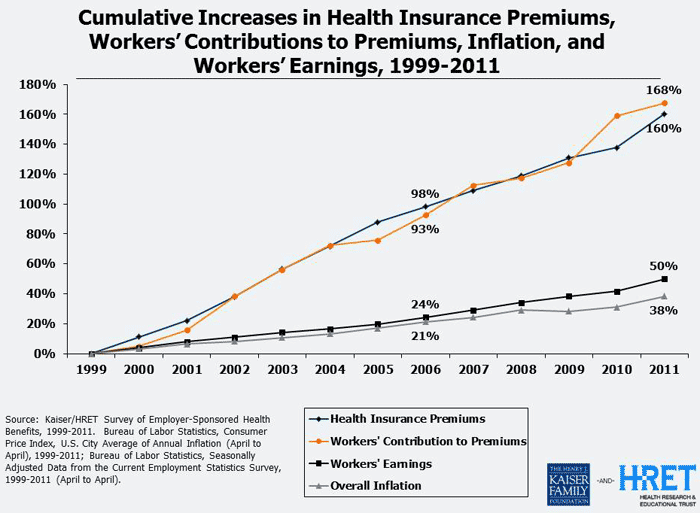
Premiums increased significantly faster than workers’ wages (2.1 percent) and general inflation (3.2 percent). Since 2001, family premiums have increased 113 percent, compared with 34 percent for workers’ wages and 27 percent for inflation.

“This year’s nine percent increase in premiums is especially painful for workers and employers struggling through a weak recovery,” Kaiser President and CEO Drew Altman, Ph.D. said.

According to Maulik Joshi, Dr.P.H., president of HRET and senior vice president for research at the American Hospital Association, “survey findings related to the impact of early provisions in health reform provide valuable insight for employers, providers, consumers, and policymakers as they prepare for additional provisions to take effect by 2014.”

The 13th annual Kaiser/HRET survey of small and large employers provides a detailed picture of trends in private health insurance costs and coverage. This year’s survey also looked at employers’ experiences with several already implemented provisions of the 2010 health reform law affecting employer coverage.

In particular, the survey estimates that employers added 2.3 million young adults to their parents’ family health insurance policies as a result of the health reform provision that allows young adults up to age 26 without employer coverage on their own to be covered as dependents on their parents’ plan. Young adults historically are more likely to be uninsured than any other age group.

“The law is helping millions of young adults to obtain health coverage. In the past, many of these young adults would have lost coverage when they left home or graduated college,” said study lead author Gary Claxton, a Kaiser vice president and co-executive director of the Kaiser Initiative on Health Reform and Private Insurance.

The study also finds 31 percent of covered workers are in high-deductible health plans, facing deductibles for single coverage of at least $1,000, including 12 percent facing deductibles of at least $2,000. Covered workers in smaller firms (3-199 workers) are more likely to face such high deductibles, with half of workers in smaller firms facing deductibles of at least $1,000, including 28 percent facing deductibles of $2,000 or more.

These numbers in part reflect the rise of consumer-driven plans, which are high-deductible plans that include a tax-preferred savings options such as a Health Savings Account or Health Reimbursement Arrangement. Over the past two years, more firms have started to offer these plans, and the share of covered workers enrolled in this type of plan has doubled, from 8 percent in 2009 to 17 percent in 2011. Plans that can be used with a Health Savings Account have lower premiums than other plan types, but must have annual deductibles of at least $1,200 for an individual and $2,400 for a family this year.

Other Findings Related to Health Reform

The survey finds that 56 percent of covered workers are in “grandfathered” plans as defined under health reform. Grandfathered plans are exempted from some health reform requirements, including covering preventive benefits with no cost sharing and having an external appeals process. To obtain this status, employers cannot make significant changes to their plans that reduce benefits or increase employee cost.

One in four covered workers (23 percent) are in plans that changed their cost-sharing requirements for preventive services as a result of a requirement of the health reform law that non-grandfathered plans provide certain preventive benefits without cost sharing. In addition, 31 percent of covered workers are in plans that changed the list of preventive services due to health reform.

Other findings from the study include:

  • Worker-only coverage. Premiums for worker-only health coverage increased 8 percent in 2011 to reach $5,429 annually. Workers on average pay $921 toward this coverage.
  • Offer rate. The share of firms offering health insurance to their workers is 60 percent this year, comparable to the levels in 2009 and earlier years. Last year’s survey found an unexplained sharp increase in the share of the smallest firms (3-9 workers) offering coverage, boosting the overall offer rate; this year’s results suggest that the one-year bump did not reflect a change in the long-term trend.
  • Cost-sharing for office visits and drugs. Covered workers facing copayments for in-network physician office visits on average pay $22 for primary care and $32 for specialty care. For covered workers with three- and four-tier drug plans, average copayments are $10 for generic drugs, $29 for preferred brand-name drugs, $49 for non-preferred brand-name drugs, and $91 for specialty drugs.
  • Retiree health benefits. Among large firms (200 or more workers), about one in four (26 percent) offer retiree health benefits in 2011, unchanged from last year and down significantly from 32 percent in 2007.

Full survey results are available online at http://ehbs.kff.org.

Now in its 13th year, the survey is a joint project of the Kaiser Family Foundation and the Health Research & Educational Trust. The survey was conducted between January and May of 2011 and included 3,184 randomly selected, non-federal public and private firms with three or more employees (2,088 of which responded to the full survey and 1,096 of which responded to a single question about offering coverage). A research team at Kaiser and HRET conducted and analyzed the survey, led by Kaiser’s Gary Claxton and including researchers at the NORC at the University of Chicago (working on the project under contract to HRET). For more information on the survey methodology, please visit the Survey Design and Methods Section at http://ehbs.kff.org.

The Kaiser Family Foundation, a leader in health policy analysis, health journalism and communication, is dedicated to filling the need for trusted, independent information on the major health issues facing our nation and its people. The Foundation is a non-profit private operating foundation, based in Menlo Park, California.

Founded in 1944, the Health Research & Educational Trust (HRET) is a private, not-for-profit organization involved in research, education, and demonstration programs addressing health management and policy issues. An affiliate of the American Hospital Association (AHA), HRET collaborates with health care, government, academic, business, and community organizations across the United States to conduct research and disseminate findings that shape the future of health care. For more information about HRET, visit http://www.hret.org.
Pulling It Together: Rising Health Costs Are Not Just a Federal Budget Problem

Published: Sep 23, 2011

Premiums for employer-provided health insurance, where 150 million Americans get their coverage, jumped 9% in 2011 while workers’ wages grew just 2%, according to our annual employer survey.  The average family policy now costs more than $15,000 per year, more than the cost of a Chevy Aveo or a Ford Fiesta.  Since we began doing this survey thirteen years ago, worker contributions to premiums have increased 168%, wages 50%, and inflation 38%.

PIT0927_1.gif

Critics of the national health reform law passed in 2010 like to blame everything but the weather on “Obamacare,” but regardless of how you feel about the Affordable Care Act, its effect on premiums this year is modest.  Most of the law’s provisions don’t go into effect until 2014.  The two biggest changes this year allow young adults up to age 26 to stay on their parents’ insurance policies and require some insurance plans to cover preventive services at no cost to patients.  These are popular provisions that provide real benefits, and combined they account for about one to two percentage points of this year’s premium increase.

The “Supercommittee” created by the recent debt reduction legislation will be looking for more ways to save money in government health programs, but the focus in Washington is almost entirely on cutting government spending, not curbing rising health costs overall.  Employers will be left to their own devices to try to keep health care costs down.  They have never been very successful at this, nor have private health insurance companies.  While the conventional wisdom is that private insurance does a better job of controlling costs, the opposite is true.  The Centers for Medicare and Medicaid Services (CMS) says that Medicare spending per enrollee grew at a much lower rate than private insurance between 1999 and 2009 (4.9% vs. 7.2% for comparable benefits).  Some say Medicare outperforms private insurance by using its purchasing power to drive a harder bargain, others, mainly providers, say it simply underpays.

In the short term, employers have few new tools to control premium increases.  Employees will continue to see more high-deductible health plans, with and without tax-preferred savings accounts, and deductibles will get even larger.  These plans have lower premiums because the big upfront deductible that people must pay before their insurance kicks in causes them to use fewer health services. The trend here is very clear, especially in firms with fewer than 200 employees where the percentage of workers in a plan with a deductible of $1,000 or more for single coverage has grown from 16% in 2006 to 50% today.  Conservatives rail about Obamacare, but they may be winning more than they are losing; it is their vision of insurance with more “skin in the game” that is gradually taking over the marketplace because employers have no other way to control costs.

Health care groups are maneuvering with defense lobbyists and health provider groups are jockeying with beneficiary advocates about who will take the brunt of the hit from the Supercommittee.  But one thing that should be clear is that reducing federal health spending is not the same thing as controlling health care costs; just ask the 150 million Americans and their employers who will be paying $15,000 when they buy a family policy this year.

September Kaiser Health Tracking Poll: Pre-Existing Conditions

Published: Sep 23, 2011

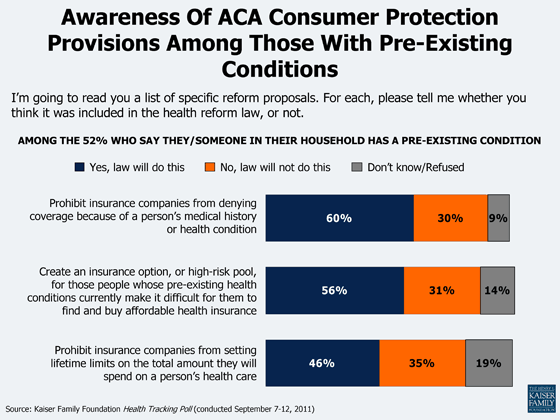
With several elements of the ACA targeted toward individuals with pre-existing conditions, this month’s Kaiser Health Tracking Poll takes a closer look at this group. Fifty-two percent of Americans say that they or someone else in their household has what would be considered a “pre-existing condition,” and among this group, one in five (21 percent) say they or their family member has had difficulty getting health insurance because of this condition. Yet many of these people are unaware that the health reform law offers new protections for them. For example, about four in ten are unaware that the law prohibits insurance companies from denying coverage because of a current or previous medical condition, and over half either think the law does not prohibit insurance companies from setting lifetime caps on benefits (35 percent) or do not know whether it does or not (19 percent).

Most Americans overall (52 percent) believe people with pre-existing conditions will be better off under the ACA; however, those who live in a household where someone has a pre-existing condition are somewhat less likely to think this group will benefit (44 percent say they’ll be better off) compared to those who say no one in their household has such a condition (60 percent).

Overall, Americans’ opinions of the health reform law remain divided this month, much as they have since the law was passed. In September, 41 percent say they have a favorable view of the law, while 43 percent have an unfavorable view. For more, check out the poll summary, chartpack, and full question wording and results.

Awareness of ACA Consumer Protection Provisions Among Those with Pre-existing Conditions

A Profile of Medicaid Managed Care Programs in 2010: Findings from a 50-State Survey

Published: Sep 13, 2011

Most Medicaid beneficiaries nationally are enrolled in some form of managed care, and, with current budget pressure and health reform on the horizon, states are expected to increase their reliance on managed care to deliver services in their Medicaid programs.

This 50-state survey, conducted by the Kaiser Commission on Medicaid and the Uninsured and Health Management Associates, provides a comprehensive look at state Medicaid managed care programs, documenting their diversity, examining how states monitor access and quality, and exploring emerging efforts to improve care, including managed long-term care and initiatives targeted toward dual eligibles.

Among the key findings:

  • Two-thirds of Medicaid beneficiaries nationally are enrolled in comprehensive managed care programs, including risk-based managed care organizations (MCO) and primary care case management programs (PCCM). This does not include enrollees in less comprehensive managed care arrangements, known as prepaid health plans (PHP).
  • Almost two-thirds of those enrolled in Medicaid MCOs are in plans that serve Medicaid enrollees primarily or exclusively. Beneficiaries in MCOs are evenly split between for-profit and non-profit plans.
  • States increasingly are turning to managed care for Medicaid beneficiaries with more complex needs. A majority report that, for at least one Medicaid managed care program and/or geographic area, they now require enrollment in managed care for populations such as disabled children receiving Supplemental Security Income (SSI), children with special health care needs, and seniors and people with disabilities. In addition, half of states report some enrollment of dual eligibles in managed care.
  • Key health reform implications for Medicaid managed care are yet to come into focus in many states. Only about half of states with MCOs report that their plans have or could develop enough capacity to absorb the increased Medicaid enrollment under health reform. Uncertainty is wider concerning state intentions to require Medicaid MCOs to participate in the Exchanges or Exchange plans to participate in Medicaid.

The survey was released Sept. 13, 2011, at a public briefing at the Kaiser Family Foundation’s Washington, D.C., office.

Executive Summary (.pdf)

Full Report (.pdf)

EVENT-RELATED MATERIALS

icon_video_audio.gif

 Full Video

podcasticon.gif

 Podcast

Agenda (.pdf)

Speaker Bios (.pdf)

Presentation Slides (.pdf)

Transcript (.pdf)

Medicare Advantage 2011 Data Spotlight: Medicare Advantage Enrollment Market Update

Published: Sep 9, 2011

This data spotlight examines enrollment trends in Medicare Advantage plans in 2011 and finds that, despite concerns about the effects of the 2010 health reform payment reductions on private Medicare Advantage plans, enrollment continued to rise this year. Additionally, Medicare Advantage enrollees are paying lower premiums, on average, than they did in 2010. Preferred Provider Organizations gained more enrollees than any other plan type, while enrollment in Private Fee-for-Service plans continued to decline.

A companion issue brief examines firm perspectives on the Medicare Advantage marketplace.

The analysis was conducted by a team researchers at Mathematica Policy Research, Inc. and the Kaiser Family Foundation.

Data Spotlight (.pdf)

Firm Perspectives on the Medicare Advantage Market

Published: Sep 9, 2011

Based on interviews with senior executives at 14 large firms, the issue brief finds that insurers anticipate continuing to offer Medicare Advantage plans in 2012, in part because of a Medicare demonstration project that will award bonus payments to plans based on their quality standards.

A companion issue brief examines trends in Medicare Advantage enrollment in 2011.

The analysis was conducted by researchers at Mathematica Policy Research, Inc. and the Kaiser Family Foundation.

Issue Brief (.pdf)

Special Needs Plans: Availability and Enrollment

Published: Sep 9, 2011

Special Needs Plans are a form of Medicare Advantage plan authorized to provide a managed care option for beneficiaries with significant or relatively specialized care needs, including Medicare beneficiaries who are dually eligible for Medicare and Medicaid, beneficiaries living in nursing homes or other institutions, and beneficiaries with severe chronic or disabling conditions.

This data spotlight examines availability and enrollment trends for Special Needs Plans, which account for a small share of enrollment today but are seen by some policymakers as a way to address coordination of care and cost issues for beneficiaries enrolled in both the Medicare and Medicaid programs.

The analysis was conducted by researchers at Mathematica Policy Research, Inc. and the Kaiser Family Foundation.

Data Spotlight (.pdf)