Health Insurance Transparency under the Affordable Care Act

Authors: Karen Pollitz and Larry Levitt
Published: Mar 8, 2012

In February, a final rule was issued implementing the Affordable Care Act (ACA) requirement that all health plans provide a uniform summary of coverage for all enrollees and applicants. The idea of providing easy-to-understand summaries of coverage is, in fact, the most popular provision in the ACA, according to a recent Kaiser tracking poll.

That finding suggests powerful consumer frustration over the complexity of health insurance and the difficulty people face evaluating health insurance choices and understanding how coverage works. Indeed, when asked, people say they would prefer to go to the gym or work on their taxes than read through their health insurance policies. Other Kaiser surveys find that too often, consumers don’t fully understand how coverage actually works until they get sick and try to use it, and then are surprised to learn their plan doesn’t pay as much, or at all, for care they thought would be covered. Economists document significant search costs to small businesses – $35 billion annually – arising from the limited ability of employers “to compare the price and quality of the bewildering variety of complex health insurance policies.” Such information barriers hinder market competition and increase the cost of health insurance. Objective measures of a health plan’s cost and value are not routinely available today nor easy for consumers and business owners to find.

With so much attention devoted to the ACA’s controversial requirement that individuals be insured and debates at the state level of whether to set up health insurance exchanges, the variety of provisions that would promote health insurance transparency have perhaps been somewhat lost in the shuffle. Implementation of some of these provisions is underway, while others await action.

Uniform Summary of Coverage (Section 2715, Public Health Service Act) – Starting this fall as they are offered or renewed, health plans and health insurance policies will have to provide enrollees and applicants with a uniform summary of benefits and coverage (SBC). All individual health insurance policies and group health plans must provide this summary. It will give consumers consistent information about what health plans cover and what limits, exclusions, and cost-sharing apply. It must be written in plain language and contain no fine print. At the outset, the final rule requires two illustrations of typical patient out-of-pocket costs for common medical events (routine maternity care and management of diabetes). Other care scenarios illustrating how coverage works for a broader set of benefits (such as expensive outpatient medical therapies, surgery, and mental health care) will be required at some time in the future.

This summary begins to provide consumers with information they can use to understand the coverage they have today and to evaluate health plan choices in new insurance markets that will begin in 2014. The SBC helps consumers understand how their health plan works on paper. Additional transparency provisions in the ACA are intended to show how health plans work in practice, and to make such information easily accessible to the public.

Transparency in Coverage Disclosures (Section 2715A Public Health Service Act, Section 1311(e) of ACA) – Non-grandfathered health plans, whether offered through exchanges or outside, must also disclose other information that would help consumers understand how reliably the plan reimburses claims for covered services, whether the provider network is adequate to assure access to covered services, and other practical information. The law requires plans to disclose information, and for exchanges and the federal Department of Health and Human Services (HHS) to then make publicly-available accurate and timely disclosure of the following information:

  •  Claims payment policies and practices
  •  Periodic financial disclosures
  •  Data on enrollment
  •  Data on disenrollment
  •  Data on the number of claims that are denied
  •  Data on rating practices
  •  Information on cost-sharing and payments with respect to out-of-network coverage
  •  Information on enrollee and participant rights under this title
  •  Other information as determined appropriate by the Secretary

Information required shall be provided in plain language that the intended audience, including individuals with limited English proficiency, can readily understand and use.

This requirement was scheduled to take effect for non-grandfathered health plans outside of exchanges six months after the date of enactment of the ACA, and for exchange plans starting in 2014. No draft rules or guidance on these requirements have been published to date; HHS has suggested a phased-in approach to implementation may be adopted.

Depending on the details of what HHS ultimately proposes, information disclosed pursuant to Section 2715A could give consumers insight into plan features and practices that affect how easily a patient might actually access care covered under a plan. For example, claims payment and denial practices are a key concern for consumers, many of whom report problems claiming covered benefits today. Disclosures might also include information on the nature of external appeals programs that plans use. Under final appeals rules and guidance published last summer, many plans will have the option of contracting directly with review entities to consider cases when consumers appeal a claim denial, while other plans will submit external review cases to an entity that is chosen independently by a regulator. Consumers might consider such information as they evaluate their health plan choices.

Information disclosed under Section 2715A could also help consumers understand aspects of plan coverage that may not be fully described under the SBC. An emerging trend in health plan design involves the use of tiered provider networks. Patients who seek care from network providers could end up paying more or less out-of-pocket depending on how their health plan ranks a particular hospital or doctor. Patients who seek care out of network could owe even more if they are subject to balance billing (which results when providers are not limited to charging the amount the health plan determines reasonable). This can happen inadvertently when patients are hospitalized or undergo surgery in an in-network facility, and are cared for by providers (such as anesthesiologists) who work in that facility but do not participate in the health plan network. Instructions to insurers and health plans for filling out the SBC note that accurately capturing how a tiered network plan operates may be difficult to summarize in the SBC, so plans and insurers are required to use their “best efforts” to describe rules “as reasonably as possible.” If plans were to report to regulators how frequently consumers claim care from the most preferred provider tier, less preferred tiers, and out-of-network tiers (and what out-of-pocket cost liabilities result), consumers would have additional tools to evaluate the accessibility of health plan provider networks and tiers.

Quality reporting for private health insurance (Section 2717, Public Health Service Act) – The ACA also requires the Secretary of HHS to develop reporting requirements for group and individual health plans with respect to covered benefits and provider reimbursement structures that improve health outcomes, prevent hospital readmissions, improve patient safety and reduce medical errors, and implement wellness and health promotion activities. This provision takes effect two years after the date of enactment, though federal guidance indicates that a phased-in approach to implementation of these requirements may be adopted.

As the health reform law restricts competition based on risk selection, insurers may increasingly have an incentive to compete based on the quality of care enrollees receive. Patients will benefit from information that helps them understand and recognize quality of care, and to compare alternative approaches insurers may adopt.

Quality reporting requirements will apply to non-grandfathered individual and group health plans and policies, offered both inside and outside of exchanges.

Healthcare.gov (Section 1103, Affordable Care Act) – Under the ACA, the Secretary of HHS must establish a website to help individuals, families, and small businesses in every state identify affordable health insurance coverage options. This website, www.Healthcare.gov, was first launched in July 2010. It provides information about major medical health insurance policies offered by private insurers in the individual and small group markets. It also provides coverage, cost and eligibility information about the new Pre-Existing Condition Insurance Program (PCIP) and state high-risk pools, Medicaid, and the Children’s Health Insurance Program (CHIP).

Using the so-called Plan Finder, consumers can see a list of all individual health insurance policies sold in their community. (Some insurers do not yet submit data to healthcare.gov.) Consumers can narrow their search and sort plan information based on enrollment, name of carrier, premium, cost sharing levels, and other coverage features.

The site displays standard rate premium information (that is, prices insurers would offer people in perfect health) for each plan option based on an individual’s age, gender, smoking status, family size, and location. In addition, it provides information about how often applicants for medically underwritten policies are turned down or offered surcharged premiums based on health status. The Plan Finder also displays summary information about covered benefits and cost sharing for each policy. Later this year, benefits and cost sharing information is expected to follow the format of the SBC required for all private health plans.

In the future, the Plan Finder will offer consumers other types of performance information about plans and insurers, based on data collected under Section 2715A authority, including the percent of individual policies that are rescinded; the percent of claims that are denied under each policy, and the number and disposition of appeals of denied claims. Elsewhere on the site, consumers can search information about individual and small group market insurers relating to rate review actions and medical loss ratios.

For small employers, the Plan Finder provides similar information about small group policies offered in each community. Small employers can see generally descriptive standard rate information, reflecting an aggregate of all cost sharing options offered under a plan and the demographics of all small businesses that might purchase a plan. The site does not provide Information about how often insurers surcharge premiums based on a group’s health status.

For low-income individuals, the Plan Finder also provides information about Medicaid and CHIP.Issues involving money and ideology have largely dominated the debate about the ACA during and following its passage, and that’s not necessarily surprising. But as a result, so far at least, less attention has been paid to other ACA changes that would promote greater transparency in health insurance. These provisions may well be less controversial (though surely their implementation has and will engender debate about regulatory burdens) and more popular overall to the extent that they help consumers and small businesses understand how coverage works, reduce their search costs in buying insurance, and foster competition among insurers.

News Release

Women And Girls Are Greater Than AIDS

Published: Mar 6, 2012

NEWS RELEASEMarch 6, 2012

Black Women from TV, Film and Music Speak Out in a Powerful New Message on National Women & Girls HIV/AIDS Awareness Day (March 10th):“Make Every Moment, A Deciding Moment”

In support of National Women & Girls HIV/AIDS Awareness Day (March 10), Greater Than AIDS is partnering with the Community Education Group and the Department of Health and Human Services Office on Women’s Health to bring attention to the impact of the epidemic on women and girls in the U.S. — especially Black women, who have been disproportionately affected — with new public service messages, social media content and free community resources.

National Women & Girls HIV/AIDS Awareness Day spokesperson, Vanessa Williams (MELROSE PLACE/FOX, SOUL FOOD/SHOWTIME), along with Essence Atkins (ARE WE THERE YET/TBS, HALF AND HALF/UPN, SMART GUY/THE WB), Yvette Nicole Brown (COMMUNITY/NBC), Nadine Ellis (LET’S STAY TOGETHER/BET), Tamala Jones (CASTLE/ABC), MC Lyte (President of the L.A. Chapter of the Grammys Recording Academy), Naturi Naughton (NOTORIUS, FAME, 3LW, PLAYBOY CLUB/NBC), Shaun Robinson (ACCESS HOLLYWOOD) and Tamara Taylor (BONES/FOX) are among the celebrities who are speaking out about women and HIV/AIDS in this new message from Greater Than AIDS: “Women and Girls are Greater Than AIDS: Make Every Moment a Deciding Moment.” Television and radio (:30 second) public service ads (PSAs) are also being distributed.

“I am honored and humbled to join my sisters in the Hollywood community in adding our voices to the fight against HIV/AIDS. We have all been touched by this awful disease. We are painfully aware that for women in general, and particularly black women, every moment is a deciding moment,” said Vanessa Williams, who is also a board member of the Black AIDS Institute, a co-founding partner of Greater Than AIDS.

FREE informational materials, including posters, postcards, stickers and more, are available from the Greater Than AIDS online store to community organizations to use in National Women & Girls HIV/AIDS Awareness Day activities.

“Community Education Group is pleased to have partnered with Greater than AIDS to expand the reach and scope of National Women and Girls HIV/AIDS Awareness Day 2012,” said Toni Young, Executive Director of Community Education Group.

“Women have been affected by HIV/AIDS since the beginning of the epidemic, an impact that has grown over time,: said Tina Hoff, Senior Vice President and Director, Health Communication & Media Partnerships, Kaiser Family Foundation, a co-founding partner of Greater Than AIDS. “By speaking out, these women are helping to address the stigma that allows HIV to spread.”

Of the more than 1.1 million Americans living with HIV/AIDS today, more than a quarter (29 percent) are women. Black women are disproportionately affected, accounting for more than half (57%) of new infections occurring among women in the U.S.

“Given recent scientific developments that allow us to think about the end of the AIDS epidemic, it’s important that women are engaged and supported in this fight,” said Phill Wilson, Founder and CEO of the Black AIDS Institute, a co-founding partner of Greater Than AIDS.

The new messages are part of series featuring leading Black celebrities developed for Greater Than AIDS by the Kaiser Family Foundation and the Black AIDS Institute. Linda Jones of The Mass Appeal produced, and Vanessa Williams with Quincy LeNear and Deondray Gossett (THE DL CHRONICLES, THE VOICE) directed.

For more information about National Women & Girls HIV/AIDS Awareness Day, please visit http://www.nwghaad.org and http://www.greaterthan.org/nwghaad.

About Greater Than AIDS

Greater Than AIDS is an unprecedented collaboration among a broad coalition of public and private sector partners united in response to the HIV/AIDS crisis in the United States, in particular among Black Americans and other disproportionately affected groups. Through a national media campaign and targeted community outreach, Greater Than AIDS aims to increase knowledge and understanding about HIV/AIDS and confront the stigma surrounding the disease.

The Kaiser Family Foundation — a leader in health policy and communications — provides strategic direction and day-to-day management, as well as oversees the production of the media campaign. The Black AIDS Institute — a think tank exclusively focused on AIDS in Black America — provides leadership and expert guidance and directs community engagement. Greater Than AIDS is developed in support of Act Against AIDS, an effort by the U.S. Centers for Disease Control and Prevention (CDC) to refocus attention on the domestic epidemic. Additional, financial and substantive support is provided by the Elton John AIDS Foundation, Ford Foundation and MAC AIDS Fund, among others.

http://www.greaterthan.org

###

Key Issues in Understanding the Economic and Health Security of Current and Future Generations of Seniors

Published: Mar 3, 2012

As part of broad deficit-reduction plans, policymakers are considering reforms to the nation’s three major entitlement programs – Medicare, Medicaid and Social Security – that could significantly affect the economic security of seniors in their retirement years. This brief examines the role of these programs in ensuring seniors’ financial security as well as the challenges facing current and future generations when it comes to economic and health security.

Drawing from current research and data, the brief examines the interrelated nature of economic and health security, including the challenges seniors face as medical costs consume a significant portion of their budgets and with most seniors relying on Social Security for the bulk of their income. It also examines the retirement outlook for future generations of seniors in light of rising health care costs and projections of minimal income growth among most seniors. The brief includes a special focus on seniors with low-to-moderate incomes, who are more likely to be women, black, and Hispanic.

The brief is a product of the Kaiser Project on Medicare’s Future, which focuses on producing timely analysis of leading reforms affecting people on Medicare.

Issue Brief (.pdf)

Poll Finding

Data Note: A Snapshot of Public Opinion on the Individual Mandate

Published: Mar 1, 2012

For the two years since the law’s passage, and during the debate leading up to it, the individual mandate has been one of the most controversial aspects of the law. As the lawyers, policy makers, ACA opponents and supporters focus intently on the Supreme Court hearings, this Data Note looks at what the general public thinks of the mandate, explores the reasons why favorability ratings have been so low, and suggests that while opinion on the mandate has been fairly consistent over time, it also remains malleable, and basic factual information and messages can sway Americans’ opinion. The Kaiser Health Tracking Poll has examined these issues over time, asking the public about their views of the law overall and digging deeper into its component parts, and this Data Note draws from several Kaiser surveys to highlight attitudes toward the individual mandate. While the precise share of the public with a favorable or unfavorable view of the individual mandate varies slightly between polls, each survey finds that overall sentiment is about two to one in opposition to the mandate. Data Note (.pdf)

Poll Finding

Kaiser Health Tracking Poll — February 2012

Published: Mar 1, 2012

In the midst of continuing debate on the future of the Medicare program, the February Kaiser Family Foundation Tracking Poll finds most Americans and most seniors favor the status quo, though arguments about the program’s solvency have the potential to sway opinion toward new proposals. The survey also gauges public opinion about the ongoing contraceptive coverage debate, views of the Affordable Care Act, and trust in the presidential candidates on health care issues.

The February poll is the latest in a series designed and analyzed by the Foundation’s public opinion research team.

Findings (.pdf)

Chartpack (.pdf)

Toplines (.pdf)

Governors’ Budgets for FY 2013 — What is Proposed for Medicaid?

Published: Mar 1, 2012

This report provides Medicaid highlights from governors’ proposed state budgets for FY 2013, which starts July 1, 2012 for most states. While some states are beginning to see signs of economic recovery, many remain cautiously optimistic as they continue to experience the recession’s lingering effects. State revenues have not rebounded to pre-recession levels, unemployment rates are still high, and some states continue to face budget shortfalls. There continues to be high demand for Medicaid and other safety net programs, and higher spending and enrollment from the increased demand for services continues to stretch limited state resources.

Thus far, much of the legislative budget discussion has focused on the scope of proposed cuts. Governors have proposed a wide range of Medicaid cost containment measures, including significant cuts in eligibility and benefits for some groups, increased use of care management, and greater use of technology to streamline enrollment processes and find efficiencies. At the same time, many states are preparing for the Affordable Care Act coverage expansions and implementation of state Exchanges and are taking advantage of opportunities for federal financial support to make changes. In a few states some lawmakers have discussed restoring funding to Medicaid for Medicaid services that have endured severe cuts in previous years because of large budget shortfalls. State Budgets will be analyzed in greater detail in the Kaiser Commission on Medicaid and the Uninsured’s annual 50-state Medicaid budget survey, to be released in the fall of 2012.

Issue Paper (.pdf)

Medicaid and Community Health Centers: The Relationship Between Coverage for Adults and Primary Care Capacity in Medically Underserved Communities

Published: Mar 1, 2012

Community health centers play an important role in providing care to uninsured and low-income individuals living in medically underserved communities. They rely on many different revenue sources and, over time, Medicaid has become a central source of funding for most health centers. To better understand how Medicaid influences health center practice, this paper compares the strength of health centers in states that have expanded Medicaid coverage for adults to health centers states with more limited Medicaid coverage for adults. In sum, broader Medicaid eligibility for adults appears to be associated with an enhanced ability of health centers to invest in capacity-building activities to meet the needs of patients and communities. Differences between the two groups of health centers help shed light on the implications of broader Medicaid coverage for low-income populations on the overall strength of health care safety net.

Report (.pdf)

RELATED: Community Health Centers: The Challenge of Growing to Meet the Need for Primary Care in Medically Underserved Communities

The New Review and Approval Process Rule for Section 1115 Medicaid and CHIP Demonstration Waivers

Published: Mar 1, 2012

For many years, Section 1115 waivers have been used in the Medicaid program to provide states an avenue to test and implement coverage approaches that do not meet federal program rules, but there have been longstanding concerns about the lack of public input and transparency in the waiver approval process. As a result, the Affordable Care Act required the Department of Health and Human Services to issue regulations designed to ensure that the public has meaningful opportunities to provide input into the Section 1115 waiver process. On February 22, 2012, the Centers for Medicare and Medicaid Services issued final regulations addressing these provisions. This brief provides an overview of the rule.

Fact Sheet (.pdf)

Poll Finding

Data Note: Americans’ Views on the Personal Impact of the ACA and the Supreme Court’s Decision

Published: Mar 1, 2012

This Data Note draws from the March 2012 Kaiser Health Tracking Poll and examines people’s impressions of how the law and the Court case will affect them, focusing primarily on those groups that are in the position to receive the greatest benefits. For the most part, those that stand to benefit most are not more likely than others to expect to be better off under the law, or to feel that the Supreme Court’s decision will have a major impact on their own families.

Data Note (.pdf)

KFF February Health Tracking Poll: Nearly Half Confused About Status of the Health Reform Law

Published: Mar 1, 2012

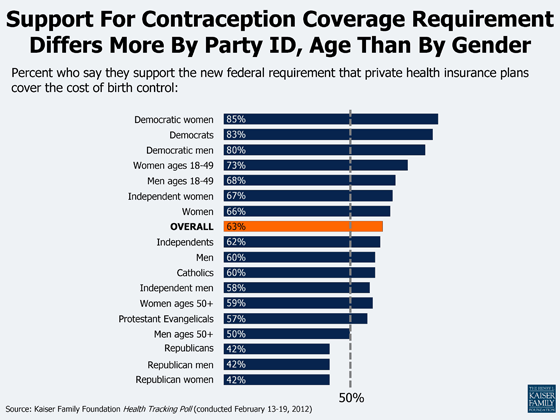
The latest Kaiser Health Tracking poll finds that amid a public debate about contraceptive coverage in insurance plans, 63 percent of Americans support a new federal requirement that plans include no-cost birth control, while a third oppose it. Catholics split along similar lines, but there’s a big partisan divide, including among women: 85 percent of women who are Democrats support the requirement, compared with 42 percent of women who are Republicans. The public is also divided over the root issue in the debate over whether religiously affiliated employers should have to to cover contraceptives in their plans, with a quarter saying it is religious freedom, a quarter saying women’s rights, another quarter thinking it is a mix of both, and the rest not having heard anything on the subject.

As the health reform law approaches its two year birthday, Americans remain divided on the Affordable Care Act, with 42 percent holding favorable views of the law and 43 percent unfavorable. This reflects a five percentage point increase in support for the law since January, driven mostly by an improvement in views among political independents. The proportion of Americans that think their family will be worse off under health reform dropped to 25 percent from 33 percent in January, though there was virtually no change in the share who expect their family to benefit.

Moving onto the presidential elections, at this point in the 2012 campaign, President Barack Obama is trusted by a larger share of the public than any of his Republican challengers in dealing with the future of both Medicare and the Affordable Care Act.

For more on these topics, as well as a closer look at public opinion on the future of the Medicare program, check out the latest poll findings, chartpack, and topline.

Policy-insights-2292012_trackingpoll540