News Release

Kaiser Poll Finds Bipartisan Support For Spending On Global Health

Published: May 21, 2012

Public Believes Much Aid Is Lost To Corruption

MENLO PARK, Calif. – Two-thirds of Americans say that the U.S. is spending too little or about the right amount on global health with one in five saying spending is too high, according to a new Kaiser Family Foundation survey on the public’s views of global health issues.

Americans overall are divided on whether or not more spending by the U.S. and other major donors would lead to meaningful progress in improving health in developing countries — 49% believe it would, while 47% believe it wouldn’t make much difference. Analysis of the survey shows that those who believe more spending will lead to progress are far more likely to support increased aid than those who think it would not make a difference (42 percent, compared with 18 percent).

One likely reason for the public’s mixed views on the potential impact of more spending is the perception about how much aid reaches the people who need it. On average, Americans say that less than a quarter (23 cents) of each U.S. tax dollar spent to improve health in developing countries is getting to where it needs to be on the ground, and that 47 cents of each dollar is lost through corruption.

“One of the strongest predictors of support was the belief that aid would make a difference. This means that documenting the impact of assistance and then communicating that to opinion leaders and the public is absolutely critical for advocates of foreign aid and global health,” Foundation President and CEO Drew Altman wrote in a column published today discussing the implications of the survey results.

When asked about spending “to improve health for people in developing countries,” two-thirds of the public says the U.S. is now spending too little (32%) or about the right amount (34%), while one in five (21%) say we are spending too much. Support for current spending is shared across party lines, with a majority of Democrats (74%), independents (66%) and Republicans (59%) responding that the U.S. spends too little or about the right amount on global health.

Further, six in ten Americans (62%) say that if the U.S. government decided to reduce spending on global health, there would be an increase in the number of illnesses and deaths in developing countries. About a quarter (26%) of the public believes that other wealthier countries would step in to fill the gap if the U.S. were to decrease spending.

The survey finds evidence that the visibility of global health issues has declined in recent years. Currently, 45 percent of Americans report hearing “a lot” (14%) or “some” (31%) in the past year about U.S. efforts to improve health for people in developing countries. This is down from 57 percent who reported hearing “a lot” or “some” in 2010. And roughly half of Americans (52%) now say the news media spends too little time covering global health issues, up from 41 percent in 2010.

The survey also explores views on foreign aid in general, and finds that while the public continues to overestimate the amount the U.S. spends on foreign aid, providing accurate information can shift opinion. On average, Americans estimate that 27 percent of the federal budget is spent on foreign aid, when in reality is accounts for just one percent. After hearing that foreign aid represents about one percent of the federal budget, the share of people saying the U.S. spends too much on foreign aid drops in half (from 54% to 24%) and the share saying the U.S. spends too little doubles (from 17% to 36%).

“As we see in other areas of public policy, public opinion on U.S. global health involvement is characterized by a lack of awareness and misunderstandings,” said Mollyann Brodie, a Foundation senior vice president and director of Public Opinion and Survey Research. “This survey highlights some areas where greater awareness may counter misperceptions and redirect public views.”

The 2012 Survey of Americans on the U.S. Role in Global Health is the fourth in a series that aims to examine the American public’s views, knowledge and opinions of U.S. efforts to improve health for people in developing countries. Full survey results, question wording and methodology are available online at here. Drew Altman’s column examining the findings is also available online here.

Methodology

The survey was designed and analyzed by public opinion researchers at the Kaiser Family Foundation led by Mollyann Brodie, Ph.D., including Liz Hamel, Bianca DiJulio, Sarah Cho, and Theresa Boston, with input and guidance from Jennifer Kates, Ph.D., and Alicia Carbaugh. The survey was conducted February 2-12, 2012, among a nationally representative random digit dial telephone sample of 1,205 adults ages 18 and older living in the United States, including Alaska and Hawaii (note: persons without a telephone could not be included in the random selection process). Computer-assisted telephone interviews conducted by landline (700) and cell phone (505, including 239 who had no landline telephone) were carried out in English and Spanish by Braun Research, Inc. under the direction of Princeton Survey Research Associates International. The margin of sampling error for the full sample is plus or minus 3 percentage points. For results based on subgroups, the margin of sampling error may be higher. Note that sampling error is only one of many potential sources of error in this or any other public opinion poll.

The Kaiser Family Foundation, a leader in health policy analysis, health journalism and communication, is dedicated to filling the need for trusted, independent information on the major health issues facing our nation and its people. The Foundation is a non-profit private operating foundation, based in Menlo Park, California..

2011 Kaiser Media Fellowships in Health

Published: May 11, 2012

The Kaiser Media Internships in Health: 2011 Kaiser Media Interns

The Henry J. Kaiser Family Foundation sponsors 16 annual summer internships for journalists interested in specializing in health and health policy reporting. The aim is to provide journalists just starting their reporting careers with an in-depth introduction to and practical experience on the specialist health beat – with a particular focus on diverse and immigrant communities. Interns are typically just graduating from undergraduate or graduate school, and are selected by the participating news organizations. This is an intensive 12-week program that combines briefings and site visits with practical reporting experience

The program begins in early June with a week-long briefing in Washington, D.C., where the interns meet with a wide range of health policy experts, health providers, and senior health reporters and editors. Briefings are focused on national trends and health-related statistics as well as local demographic, cultural, economic and epidemiological factors that affect health issues in the cities where the interns are working during the summer. Story ideas and reporting challenges specific to the health beat are discussed in some detail. Interns are then based at their news organizations for 10 weeks where they report on health, health policy, and medical issues. The program ends in late August with a 3-day meeting and site visits in Boston, including a detailed critique of each intern’s print, video, or audio clips by a group of senior health journalists.

The 16 news organizations that participated in the 2011 program were The Boston Globe, The Charlotte Observer, KQED Public Radio/San Francisco, KTVU/2-TV/San Francisco/Oakland, The Milwaukee Journal-Sentinel, NPR, The Oregonian, The Orlando Sentinel, The Philadelphia Inquirer, The Plain Dealer/Cleveland, Reuters, The Sacramento Bee, The San Jose Mercury News, The Seattle Times, The Times-Picayune, and The Washington Post. While reporting for these news organizations, the interns produced a considerable number of stories. The clips included here just represent a selection of the work produced during the 2011 program.

2011 Media Interns and Their Host Organizations (click on the interns’ names to see examples of their work)

Neena SatijaThe Boston Globe Deia de BritoThe Charlotte ObserverAlexander Liu KQED Public Radio, San Francisco Rose TibayanKTVU/2-TV, San Francisco-OaklandGrace PatuwoThe Milwaukee Journal SentinelLinda Thrasybule NPR, Washington DC Andrew DoughmanThe Orlando Sentinel Tatiana SanchezThe Oregonian Juliana SchatzThe Philadelphia Inquirer Teresa Chin The Plain Dealer, Cleveland Andrew Seaman Reuters, Washington DC Lynn LaThe Sacramento Bee Jane LeeThe San Jose Mercury News Roberto Daza The Seattle Times Ashley HopkinsonThe Times-Picayune, New Orleans Christian TorresThe Washington Post

clear.gif

Prescription Drug Procurement and the Federal Budget

Author: Richard Frank
Published: May 8, 2012

This brief commissioned by the Foundation considers areas where Medicare faces limited opportunity for market-based competition and price negotiation to drive down drug spending. These areas include drug purchasing for low-income people enrolled in Part D plans who face minimal cost-sharing requirements, and purchasing certain unique drugs, such as biologicals, that have no therapeutic alternatives or competitors.

Authored by Richard G. Frank of Harvard University, the brief discusses policy options that could lower Medicare spending on prescription drugs in these circumstances.

Issue Brief (.pdf)

Medicare Part D Spending Trends: Understanding Key Drivers and the Role of Competition

Author: Jack Hoadley
Published: May 8, 2012

This brief commissioned by the Foundation examines factors that contributed to Medicare’s lower-than-expected spending on prescription drugs under the Medicare Part D drug benefit that started in 2006.

Since its launch, Medicare has spent about 30 percent less on Part D benefits than the Congressional Budget Office originally projected. Some cite the program’s design, with private plans competing for enrollment, as the driving factor in lower spending; others point to factors in the overall market for prescription drugs as more influential.

Author Jack Hoadley of Georgetown University examines the evidence on both sides of this debate. In addition to a discussion of the role of plan competition, the brief cites a number of other factors that contributed to lower spending, including the growth in generic alternatives for popular-but-expensive brand-name drugs and a reduction in new brand-name drugs entering the market – trends that dampened prescription drug spending outside of Medicare as well.

Issue Brief (.pdf)

JAMA Forum: The Future of Private Insurance

Author:
Published: May 4, 2012

“The Future of Private Insurance,” Larry Levitt’s May 2012 post for the JAMA Forum, is now online.

Poll Finding

Kaiser Health Tracking Poll — May 2012

Published: May 2, 2012

The May Health Tracking Poll focuses on the public’s perceptions and reactions to women’s reproductive health reemerging as a heated issue in policy debates and news and its potential impact on the upcoming presidential election.

Three in ten women (31 percent) overall believe that there is currently a “wide-scale effort to limit women’s reproductive health choices and services, such as abortion, family planning, and contraception” in the U.S. A larger share (45 percent) say there are some groups that would like to limit women’s reproductive health choices and services but it is not a wide-scale effort, while others volunteer that no such effort exists (7 percent) or decline to offer an opinion (17 percent).

For many women, women’s reproductive health issues resonate on a personal level, with 42 percent reporting that they took some action in the past six months in reaction to something they’ve seen, heard or read. This includes attempting to influence a friend or family member’s opinion (23 percent), donating money to a non-profit working on reproductive health issues (15 percent), and contacting an elected official (14 percent).

For now, female voters (like male voters) continue to focus on the economy above all else as an election issue, with several other issues (including health care generally) rising above women’s reproductive health. Six in ten women voters name the economy and/or jobs as the issue they’d most like to hear about from candidates, compared to just 5 percent who name women’s health or other women’s issues (including abortion).

In asking about the Affordable Care Act (ACA), the share of the public with a favorable view of ACA dropped 5 percentage points this month, with unfavorable views now outnumbering favorable ones by a small margin (44 percent versus 37 percent). The idea of defunding the law, as discussed by some members of Congress, is as unpopular now as it was a year ago, with roughly six in ten (58 percent) saying they disapprove of cutting off funding as a way to stop some or all of the law from being put into place, and about a third (32 percent) saying they approve of this strategy.

The May poll is the latest in a series designed and analyzed by the Foundation’s public opinion research team.

Findings (.pdf)

Chartpack (.pdf)

Toplines (.pdf)

Public Opinion on Gender Rating

Published: May 2, 2012

With the Republican presidential primaries wrapping up, a barrage of new television commercials, radio ads, and fundraising emails has marked the start of the general election campaign. The Affordable Care Act (ACA) continues to be a mainstay election topic for candidates from both major parties. While Republicans focus on advocating repeal of the 2010 health care law, President Barack Obama and the Democratic Party have concentrated on the benefits of the law. And one lesser known provision of the ACA has received top billing in several of their campaign materials: the elimination of gender rating for health insurance premiums.

Gender rating refers to the practice of charging women higher health insurance premiums than men. With the exception of states that already prohibit or limit gender rating, women are frequently charged higher premiums because they require health care services that men do not need, like regular gynecological visits and maternity care. The ACA will eliminate this insurance practice by 2014. This blog post looks into Americans’ views of this provision, finding that the majority of Americans like the idea of getting rid of gender rating, but at the same time most aren’t aware that the health reform law already has plans to do so.

Awareness Of Gender Rating Prohibition Is Low

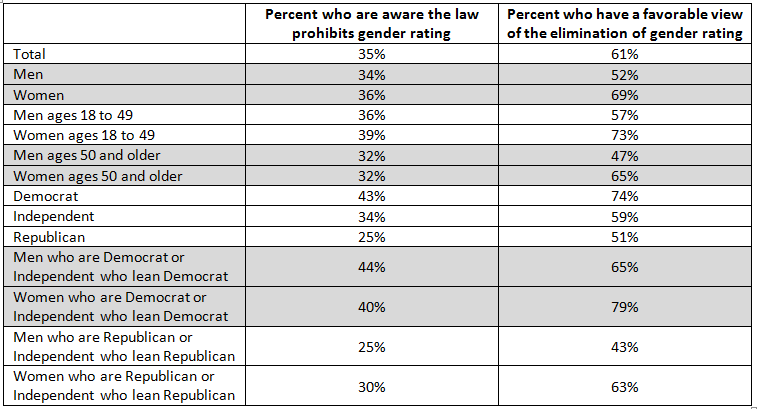
In Kaiser’s April Health Tracking Poll, roughly a third (35 percent) of Americans were aware that the health reform law prohibits insurance companies from charging women higher premiums than men, down from about half (48 percent) in June 2010, just three months after the ACA was signed into law. Although the provision directly impacts women, particularly those under the age of 50, women as a whole were no more likely than men to be familiar with it. Democrats were more likely than Republicans to be aware of this provision (43 percent versus 25 percent), but still fewer than half were familiar with its inclusion in the law.

Policy-insights-gender_rating

But, Favorability Of Provision Is High

While relatively few Americans are aware that the ACA includes the gender rating provision, many Americans like the idea of leveling the playing field for health insurance premiums. Overall, six in ten (61 percent) have a favorable view of this provision, a number that rises to seven in ten (69 percent) among women as a group, and about three-quarters among women under age 50 (73 percent of whom back it).When it comes to the opposite sex, men as a whole are less supportive of the measure, with roughly half (52 percent) supporting it; though that number rises to 57 percent among younger men compared to 47 percent among their older counterparts.

As is true for public opinion on the law as a whole, there is a partisan gap on this provision, albeit a much smaller one. While the measure is overwhelmingly popular among Democrats (74 percent) and looked favorably upon by a solid majority of independents (59 percent), Republicans are a little less enthusiastic. But still, half (51 percent) of Republicans, the law’s most fervent opponents, like that the law gets rid of gender rating. There is also a gender gap on the issue within the Republican party: nearly two-thirds (63 percent) of women who align themselves with the Republican party or lean Republican favor the gender rating prohibition, compared to fewer than half of Republican or Republican-leaning men (43 percent).

Five Key Questions About Medicaid And Its Role in State/Federal Budgets and Health Reform

Published: May 1, 2012

This fact sheet highlights key issues about Medicaid, including the structure, financing and purpose of the program, its role for low-income beneficiaries, its share of the federal budget and state budgets, and the significant implications of the coverage expansion under the Affordable Care Act.

Fact Sheet (.pdf)

Related chartpack: Five Key Questions And Answers About Medicaid

Emerging Medicaid Accountable Care Organizations: The Role of Managed Care

Published: May 1, 2012

This brief examines efforts by a number of states to set up Accountable Care Organizations (ACOs) within their Medicaid programs. An ACO is a provider-run organization in which participating providers are collectively responsible for the care of an enrolled population, and may share in any savings associated with improvements in the quality and efficiency of care. The structure of Medicaid ACO initiatives is influenced by individual states’ experience with managed care, other existing care delivery arrangements within Medicaid, and the challenges of serving low-income and chronically ill populations. Cost-containment also is a motivating factor, and states must balance short-term cost-containment pressures against the investments in partnerships and delivery system redesign necessary for the success of Medicaid ACOs over the longer term.

Policy Brief (.pdf)