News Release

New Data Spotlight Tracks Rising Enrollment in Medicare Advantage Plan

Published: May 1, 2014

A new brief from the Kaiser Family Foundation documents the continuing climb in Medicare Advantage plan enrollment, even at a time when payments to such plans are being reduced under the Affordable Care Act. Despite spending reductions enacted in the ACA to reduce historical overpayments to Medicare Advantage plans, from March 2013 to March 2014 enrollment in Medicare Advantage plans grew by 9 percent, or 1.4 million people, to reach a total of 15.7 million Medicare beneficiaries. The Medicare Advantage 2014 Spotlight: Enrollment Market Update highlights that 30 percent of the Medicare population is now enrolled in such plans, up from 24 percent in 2010, and analyzes trends in Medicare Advantage enrollment, premiums, out of pocket limits, prescription drug coverage and related topics. Other key findings include:

  • Medicare Advantage enrollment continues to vary geographically. Eighteen states had more than 30 percent of Medicare beneficiaries in Medicare Advantage plans, while six states (AK, DE, MD, NH, VT and WY) had fewer than 10 percent of Medicare beneficiaries in Medicare Advantage plans;
  • Since 2013, most of the enrollment growth in Medicare Advantage plans has been in the individual market, but enrollment for retirees in the group (employment-based) market increased relatively rapidly in 2014 and accounts for almost one-third of total Medicare Advantage enrollment growth in the past year;
  • Premiums in Medicare Advantage plans averaged $35 per month in 2014, reflecting little change since 2012 and remaining below average premium levels in 2011 ($39) and 2010 ($44);
  • Out-of-pocket spending limits have been on the rise in recent years, with the share of Medicare Advantage enrollees in plans with limits above $5,000 almost doubling from 24 percent in 2011 to 44 percent in 2014.  Medicare Advantage plans, unlike traditional Medicare, are required to limit out-of-pocket costs for services covered under Parts A and B ($3,400 is recommended; $6,700 is the maximum).

The full analysis is available online, as are the Foundation’s updated Medicare Advantage fact sheet and our latest spotlight on Medicare Advantage plan availability and premiums.

Also available is the Foundation’s newly updated interactive Medicare Health and Prescription Drug Plan Tracker, where users can monitor trends in enrollment, market penetration and other topics for Medicare Advantage plans since 1999 and stand-alone Medicare drug plans since 2006 by state, county and other sub-state geographies.

# # #

KFF: for trusted information on the health issues facing the nation and its people. The Kaiser Family Foundation is a nonprofit organization based in Menlo Park, California.

News Release

Alicia Keys At The 2014 ESSENCE Festival To Headline A Special Essence Empowerment Experience Panel With Greater Than AIDS

Published: May 1, 2014

“Through Love of Self, Family and Community, Empowering Black Women to End AIDS”

Friday, July 4th at the Ernest N. Morial Convention Center, New Orleans

MENLO PARK, CA, May 1, 2014 – Fifteen time Grammy Award-winning artist and HIV advocate Alicia Keys will join with Greater Than AIDS and ESSENCE to headline a special ESSENCE Empowerment Experience panel on Friday, July 4th (specific time to be announced) in New Orleans on “Through Love of Self, Family and Community, Empowering Black Women to End AIDS.” 

The hour-long program will open with a one-on-one with Ms. Keys about her passion for ending AIDS to be followed by an engaging and inspiring conversation with women whose lives have been touched by HIV and how they responded.  Among those joining Ms. Keys on the stage in conversation:  Kym, a young professional who found out she was positive when her new husband became sick and died as a result of HIV/AIDS, and Teresa, a mother whose unconditional love of her HIV positive son has helped him to maintain his treatment and thrive in the face of this disease.  At the close of the program the panel will respond to questions from the audience.

The ESSENCE Empowerment Experience is part of the hugely popular ESSENCE Festival, one of the largest and most powerful gatherings in the nation. Prominent cultural icons, celebrities and community leaders convene for thought provoking conversations on health, education, politics, love and relationships, to offer solutions for the audience’s day-to-day lives. The Empowerment Experience is free to Festival attendees and the New Orleans community.

Of the more than 1.1 million people living with HIV in the United States today, one in four is a woman.  Women of color have been especially hard hit, accounting for the majority of new infections occurring among women in this country.  If current trends continue, it is estimated that one in 32 Black women will contract HIV in her lifetime.

The program is presented as part the Empowered campaign, launched in 2013 by Greater Than AIDS and featuring Ms. Keys  to reach women about HIV/AIDS and the role we all play in helping to end the epidemic. Through targeted media messages, community outreach and special promotions, the campaign promotes specific ways women are empowered in the face of HIV/AIDS, including:

  •   EMPOWERED to know the facts about HIV/AIDS, including the impact of HIV on women
  •   EMPOWERED to speak openly about HIV/AIDS with family, friends and others in our lives
  •   EMPOWERED to protect ourselves and our loved ones
  •   EMPOWERED to ask to be tested and to know doing so is an act of pride, not shame
  •   EMPOWERED to live full and healthy lives and help prevent spread of disease if positive by staying on treatment

The program is organized by ESSENCE together with Greater Than AIDS co-founders, the Kaiser Family Foundation and Black AIDS Institute, and Alicia Keys Worldwide.  Gilead Sciences, Inc. contributed financial resources to support the program.

Over the three days of the ESSENCE Festival, July 4-6, in the Convention Center, Greater Than AIDS together with the Louisiana Office of Public Health and the Black AIDS Institute will provide free daily on-site HIV testing as well as a photo / video booth and other activations to bring attention to the impact of HIV.  (Greater Than AIDS Booth #1800 in Hall D.)

For more information about Greater Than AIDS and the Empowered campaign, including for more details about Alicia Keys’ appearance at the 2014 ESSENCE Empowerment Experience, visit:  www.greaterthan.org/empowered.


Screen Shot 2014-04-28 at 4.10.43 PM

About the ESSENCE Festival and ESSENCE Empowerment Experience

The ESSENCE Festival has become one of the most powerful African-American gatherings as it represents not only our brightest stars but provides inspiration, purpose and enlightenment through its empowerment programming. The ESSENCE Empowerment Experience features engaging content that brings “the pages of ESSENCE to the stage” with our most prominent cultural icons, celebrities and community leaders who provide various modes of thought and solutions for our audience within our daily, themed discussion.  The free Experience has become the daytime destination of the ESSENCE Festival that has made history by having Bill Cosby, Iyanla Vanzant, Tyler Perry, Steve Harvey, Bishop TD Jakes, Soledad O’Brien, Jada Pinkett Smith, Hill Harper, Valerie Jarret, former Secretary of State Hillary Rodham Clinton, Marc Morial, and many others share the stage.

Last year, with a record-breaking audience of more than 545,000 Festival-goers, attendance at thedaily Empowerment series reached maximum capacity  for thought-provoking conversations on love and relationships, health, education, politics and our all-star inspirational Sunday Gospel tribute.  Our media partner MSNBC engaged many of our Empowerment speakers in interviews as they broadcast live from the ESSENCE Festival convention center floor throughout the weekend.

About Greater Than AIDS

Greater Than AIDS is a leading national public information response focused on the U.S. domestic epidemic. Launched in 2009 by the Kaiser Family Foundation and Black AIDS Institute, Greater Than AIDS is supported by a broad coalition of public and private sector partners.  Through targeted media messages and community outreach, Greater Than AIDS and its partners work to increase knowledge, reduce stigma and promote actions to stem the spread of the disease.  While national in scope, Greater Than AIDS focuses on communities most affected.  www.greaterthanaids.org

About Alicia Keys

Alicia Keys is a 15 time Grammy Award® winning singer/songwriter/producer, actress, New York Times best-selling author, entrepreneur and humanitarian. Since releasing her debut album, songs in A minor, Keys has built an unparalleled repertoire of hits with over 30 million albums sold worldwide. As a philanthropist, Keys co-founded Keep a Child Alive (KCA) which provides AIDS treatment, support, nutrition and love to children and families affected by HIV/AIDS in Africa and India.

Measuring Changes in Insurance Coverage Under the Affordable Care Act

Authors: Gary Claxton, Larry Levitt, Mollyann Brodie, Rachel Garfield, and Anthony Damico
Published: Apr 30, 2014

The first open enrollment period under the Affordable Care Act (ACA) has come to an end, and many are looking for ways to assess the law and its implementation thus far. Of particular interest is how many people who were previously uninsured took up new coverage options, but questions about whether people with insurance changed their type of coverage also are receiving attention. Changes in employer-based insurance are particularly important because so many people get their coverage in this way.

The ACA provides significant new coverage options for people, particularly for those with lower incomes or problems with their health. The scope of the reforms, and the intense political controversy surrounding their approach and implementation, has fueled an intense demand for data about their effectiveness. Unfortunately, the information needed to adequately understand enrollment changes across private and public coverage sources will not be available for many months.

Most of what we know about who has health insurance and what type of coverage they have comes from large federal surveys, which provide estimates of the number of people enrolled in different types of coverage, including those with no coverage, along with information about their household demographics and incomes. These surveys can be used to track changes in coverage for different types of people over time. The main advantages of these surveys are their large size and their sophisticated sampling and interviewing techniques, which allow detailed analysis of coverage and coverage changes for people in different demographic and income groups. Further, many federal surveys enable analysis at the state level for at least some states, which is important because ACA implementation (e.g., the availability of expanded Medicaid coverage or the existence of a state-operated Marketplace) will vary greatly across states. Their main disadvantage is that they do not provide rapid turnaround. The data needed to evaluate the coverage changes between 2013 and 2014 will not become available until 2015.

In the interim, people will need to look to other sources of information. One is administrative data, such as the number of people who have enrolled through new health insurance marketplaces or the number of people who have enrolled in Medicaid. A problem with this type of information is that we do not know the enrollees’ coverage status prior to enrollment: did they have insurance before and, if so, what type? It also is difficult to distinguish new enrollment from coverage changes that would have occurred in the absence of the law, since people’s job status and income change throughout the year. Also, there is currently no administrative data that covers the individual market outside of the marketplaces or any data that captures the entire employer market, so there is no information to help us understand how things are changing in the market that covers the majority of nonelderly people. And most importantly, because people without insurance are not enrolled in anything, they cannot be counted in administrative data. Administrative data can provide clues about where to look for changes, but we do not have administrative systems that provide information about changes across types of coverage or changes in the number of people without insurance.

The second interim source of information about health coverage is surveys by private entities, which ask about health insurance by type of coverage and track changes over time (or at least between a few points in time). This means that they provide some opportunity to look at changes across type of coverage as well as changes in the number of people who have any coverage. The main advantage of these surveys is their rapid turn around: indeed, several private surveys already have released findings and show that the number of people without health insurance has fallen between late 2013 and early 2014. Differences in approach and sampling mean that these surveys have different strengths and weaknesses and that their results may not be consistent or comparable.

Below we discuss the details and timing of some of the private and federal surveys that will be used to look at how coverage has changed due to the ACA. Different surveys offer different information and insight into coverage under the ACA, and we discuss the contribution and challenges in each type of effort (see Textbox 1).

Textbox 1: When Interpreting Survey Results, Pay Close Attention to the Time Frame

When looking at survey results about health insurance coverage, one important factor is for what time period the survey is trying to determine coverage (or lack of coverage).

One approach that surveys take is to ask about coverage at the time of the interview. For these surveys, it is then necessary to look at the period over which interviews were conducted. If the interviews were all collected within a short time period (e.g., a week or a month), then the survey is providing an estimate of coverage for that period. Some of the private surveys described in this data note compare coverage between different months or quarters. Other surveys, such as the National Health Interview Survey (NHIS), are conducted throughout the year. In this case, the survey is providing an estimate of the average number of people who had a particular type of coverage (or were not covered) at any point during the year.

Another approach taken in surveys is to ask about coverage for a particular period in the past. For example, the Survey of Income and Program Participation (SIPP) asks respondents about their coverage for the current month and for specific prior months, and survey results report coverage for each month. This approach allows us to see how coverage changes for people over the course of a long period, although there may be issues with the ability of respondents to recall past events. In previous years, the Current Population Survey Annual Social and Economic Supplement (CPS ASEC) asked respondents if they had various types of coverage during the preceding calendar year. Despite asking about the previous year, the Census Bureau concluded that respondents were more likely reporting coverage at the time of the interview than coverage in the previous year, which means that the results were not responsive to the question being asked and that the findings were ambiguous as to the period over which coverage was being measured.1  As part of its redesign, the CPS ASEC is moving to an approach that asks respondents about their current coverage and about their coverage for each month back to January of the preceding year.2 

These different approaches provide different insights into coverage and coverage dynamics. For example, we are used to thinking about how many people are uninsured at any point in time, which is about 50 million people in 2011 according the SIPP. But looking over the course of the year, about 71 million people reported being uninsured for at least one month during the year, while only 29 million reported being uninsured for the entire year. Similar variability can be seen for people with nongroup insurance.3 

In addition, the timing and extension of the 2014 open enrollment period (which ended on March 31, 2014 but was extended for some applicants) produces some challenges for surveys asking about health coverage during the first quarter of 2014. For some people, the enrollment process was extended over several weeks or months because they needed to provide more information or had difficulty completing their applications. For all new enrollees, coverage took effect at some period after they enrolled. It is not known how people who were in the process of enrollment but whose coverage was not yet effective responded to survey questions about their insurance status. Thus, questions fielded between January and March or April of 2014 may produce ambiguous results about people’s coverage status at the time of the interview.

Private Surveys

Surveys conducted by private organizations have provided the first look at coverage changes under the ACA. Private surveys have been used to analyze a number of aspects of the early implementation, including public knowledge and attitudes, changes in the share of people with insurance, and the prior insurance status of early Marketplace enrollees. Many of these surveys are fielded at regular intervals with the goal of understanding how things change over time. In some cases, such as the Gallup-Healthways Well-Being Index (“Gallup”), these are broad public opinion surveys that contain a few questions related to health insurance. In other cases, such as Urban Institute’s Health Reform Monitoring Survey (“HRMS”), the Rand Health Reform Opinion Survey (“RAND”) and our Kaiser California Uninsured Panel Survey, surveys were developed specifically to track ACA implementation. Others, like our Kaiser Health Tracking Poll, focus mainly on opinions, knowledge and early experiences rather than on measuring changes in the share of people with health insurance or non-group coverage.

The main advantage of these private, population-based surveys is their rapidly available results. As opposed to the large federal surveys that will release initial indications many months following the close of open enrollment, we already have some estimates of coverage changes from private surveys, with updates likely in the near future. Several of these surveys had established baseline coverage estimates prior to the beginning of the 2014 open enrollment, making comparisons before and after implementation possible with mostly consistent questions and approaches.

There are, however, several potential limitations to many of the private surveys that need to be kept in mind when interpreting their results.4  One is that the populations that we most want to know about account for a very small share of the overall population and therefore a small share of the sample in any population-based survey. These populations include, for example: the uninsured in states that expand Medicaid compared to states that do not, those with nongroup coverage before ACA implementation who switch to coverage through the Marketplace, and those uninsured who are now newly eligible for Medicaid or for subsidies in exchanges. Most private surveys have relatively small samples for these specific populations, which means that the estimates for these groups are imprecise (that is, estimates have large confidence intervals) and subject to meaningful volatility. Limited precision makes it hard to detect and compare statistically significant changes, particularly for subgroups (e.g., by race, former insurance status, or location).

A second challenge is that asking the questions to determine individuals’ prior and current insurance status in a way the respondents can answer accurately is very complicated and time consuming in a survey. Compared to the large federal surveys, which generally devote a number of questions to identifying type of coverage, private surveys often make due with simpler approaches. People are often confused about the type of coverage they have and may answer wrongly or inconsistently when just asked to pick from a list of coverage sources. Several of the more prominent private surveys also have changed their coverage questions recently, which make interpreting changes over time more difficult.

As a result of these limitations, these private surveys are more likely to shed light on broader questions, such as changes in the overall number of people who have health insurance, than on narrower issues, such as changes by race, income, state, or type of coverage. And even though some of the private surveys manage to obtain a fairly large number of respondents, they still may have a relatively large uncertainty around their estimates, which means that they may be more reliable for pointing to trends in the direction of change rather than providing precise measures of the actual coverage rates overall or by type of coverage.

The recent releases of estimates of coverage changes from several private surveys illustrate some of these issues. Results from Gallup, HRMS, and RAND all find that the number of people without health insurance fell during the initial months of 2014 as new coverage options under the ACA took effect.5  (Our own monthly tracking poll has shown a similar reduction in the number of adults uninsured at the beginning of 2014, though the survey was not designed to detect such changes, which are generally within the poll’s margin of error in any given month.)

The three surveys agree that the number of uninsured people has gone down, despite using very different sampling approaches: Gallup accumulates response from their daily tracking poll, which uses telephone interviews of a random sample of adults each day6 ; HRMS is based on interviews from successive samples of an internet panel, which was randomly selected7 ; and RAND is based on repeated interviewing of the same group of adults in an internet panel, a portion of which were randomly selected and a portion of which are from a convenience sample.8 

The agreement among the surveys on the direction of change reinforces the overall result, although a closer look at their actual coverage estimates shows that some differences make interpreting the specific results somewhat difficult (see Table 1).

To take one example, both HRMS and Gallup showed a comparable (roughly 2 percentage point) reduction in the percentage of nonelderly adults without health insurance over the first several months of 2014, but their estimates of percentage of nonelderly adults who were or are uninsured are quite different.9  Focusing on the fourth quarter of 2013, Gallup reported that 17.1 percent of adults, including the elderly, were uninsured in the fourth quarter of 2013, which translates into about 20.5 percent of nonelderly adults.10  In contrast, HRMS’ fourth quarter 2013 estimate of uninsured adults is 17.5 percent of nonelderly adults.11  So while both show that the share of uninsured adults fell, they are starting from fairly different places in their estimates of the share of nonelderly adults without health insurance. (We should note that the Gallup estimate is for 2014 is an average over a period, but that the point estimate continued to fall throughout the period, so that the estimate of percent of adults without health insurance in the second half of March was 14.5 percent).12 

Another example is the difference between RAND and Gallup relating to changes in employer-based coverage. Again, both surveys found that more people had health insurance in the early part of 2014 compared to the fall of 2013. RAND, however, found a significant increase in the number of nonelderly adults covered by employer-based coverage while Gallup found little change.13  The differences between the two surveys may result from differences in approach, sampling, questions or just random variation. This issue will be worth watching as more survey findings are released.

Table 1: Early Results from Surveys of Coverage Under the ACA Conducted by Private Entities
September 2013March 2014Change In Share of Uninsured, Adults Age 18-64Gains In Coverage
SurveyInterview DatesPercent UninsuredInterview DatesPercent Uninsured
Gallup-Healthways Well-Being IndexJuly 1 – Sept 30, 201318.0% adults age 18 and olderJan 2- Mar 31, 201415.6% adults age 18 and older-2.5 percentage pointsN/A
Urban Institute’s Health Reform Monitoring Survey (HRMS)Sept 1- Sept 30, 201317.9% adults age 18-64Mar 1 – Mar 31, 201415.2% adults age 18-64-2.7 percentage pointsGain in coverage for about 5.4M
RAND Health Reform Opinion SurveySept 1- Sept 30, 201320.5% adults age 18-64Mar 1 – Mar 31, 201415.8% adults age 18-64-4.7 percentage pointsGain in coverage for about 9.3M

Federal Surveys

Most of what we know about who has health insurance and the type of coverage they have comes from large, federal population surveys, such as the National Health Interview Survey (NHIS), the Annual Social and Economic Supplement (ASEC) of the Current Population Survey, and the Survey of Income and Program Participation (SIPP). These surveys collect demographic, economic, health coverage and other information from large samples of the population, which can be used to provide fairly complete pictures of how people are distributed into different types of coverage and how this distribution changes over time. Their main advantages are their large size, sophisticated sampling, and interviewing techniques (often in person). While health insurance coverage estimates differ somewhat across the different federal surveys, in part because they each have different questions and approaches, their results are generally consistent. When available, the information from these surveys will provide the most complete and reliable descriptions of how health insurance has changed as the ACA has been implemented.

The main disadvantage of the federal surveys is that they will not have results reflecting coverage after ACA implementation for many months. An additional challenge is that several of the main surveys are using new questions or approaches to understanding health insurance coverage in order to accommodate the new coverage options under the ACA. These changes will in general improve the ability to compare insurance coverage before and after full implementation of the ACA, but methodological changes may in some cases make it challenging to discern trends across the period leading up to full ACA implementation, from 2012 to 2013.

Following are descriptions of the major federal surveys that will provide information about how coverage has changed under the ACA.

Table 2: Availability of Post-ACA Health Insurance Coverage Data from Major Federal Surveys
SurveySupports State-Level Analysis?Post-ACA Data Availability
  Date Released:Type of Data Available:Reflects Coverage for Period:
National Health Interview SurveyOnly through restricted data center and limited to 40 largest statesSeptember 2014Preliminary Q1 DataAt date of interview (Jan-March 2014)*
December 2014Preliminary Q2 DataAt date of interview (Jan-June 2014)*
March 2015Preliminary Q3 DataAt date of interview (Jan-Sept. 2014)*
June 2015Main 2014 Public Use File**At date of interview (Jan-Dec. 2014)*
Behavioral Risk Factor Surveillance SystemYesJuly 2015Main 2014 Public Use FileAt date of survey (Jan-Dec. 2014)
Annual Social and Economic SupplementYes, but for some analyses (such as insurance coverage rates) two years of data must be pooledSpring-Summer 2015New coverage questions from 2014 CPS ASECMonthly for all of 2013 up to date of interview (Feb-April 2014)
September 20152015 CPS ASECMonthly for all of 2014 up to date of interview(Feb.-April 2015)
Survey of Income and Program ParticipationLimited to 20 largest statesSpring 20162014 Panel Wave 2Monthly for all of 2013 and all of 2014
American Community SurveyYesDecember 2015Main 2014 Public Use FileAt date of survey (Jan-Dec. 2014)
* Includes some information about prior coverage.** Imputed income file may not be available for several months.

National Health Interview Survey

The first-available federal survey that will have health insurance information covering at least some of the ACA’s 2014 open enrollment period is the National Health Interview Survey (NHIS). The NHIS is a national household survey of civilians living outside of institutions conducted by the National Center for Health Statistics, with contractual assistance from the US Census Bureau.14  The survey collects information throughout the year on a range of health topics (including health insurance status at the time of the interview) and on the income, employment, and other personal characteristics of respondents.

While full NHIS survey results for 2014 are not expected until June 2015 (see Table 2), preliminary data and reports are made available earlier through an early release program. In recent years, early release information for interviews conducted for the first quarter (January through March) of a year have been released in September of that year, with information for the first two quarters (January through June) released in December and information from the first three quarters (January through September) released the following March. The early release data has included estimates of the percent of people in different age groups who were uninsured at the time of the interview, the percent of each group uninsured for at least part of the year prior to the interview, and the percent of each group who have been uninsured for more than a year at the time of the interview. Estimates of the percent of each age group with public or private coverage also are typically made available, along with a limited set of demographic variables that can be used to look at coverage statistics for some subpopulations. Household income information deserves caution: approximately one-quarter of respondents’ family incomes are affected by an income imputation procedure that will not be implemented until a few months after the full file release in 2015. Additionally, poverty classification is limited to six categories: Under 100% of the federal poverty level (FPL), 100 to 138% FPL, greater than 138% up to 250% FPL, greater than 250% up to 400% FPL, above 400% FPL, and unknown.15 

The first quarter early release data may provide some insight into the impact of the ACA open enrollment period, but the information will understate the full effect because most of the interviews were conducted in January, February, and early March, before the surge in enrollment at the end of March (see Textbox 1). The second quarter release will be more valuable because roughly half of the interviews will have occurred after the formal close of the open enrollment periods in the federal and state Marketplaces. Although enrollment opportunities in Medicaid (and even in Marketplaces in some circumstances) continue beyond March, interviews conducted in the second quarter are more likely to reflect the substantial enrollment activity that occurred at the end of March (with some ambiguity for people whose coverage had not yet become effective at the time of their interviews). Estimates from the early release data should be comparable to estimates from prior years, allowing for analysis of the change in the percentage of people uninsured as of the end of open enrollment. This will be the first available federal survey allowing for assessment of overall growth in the non-group market and also changes in employer coverage.  Although the preliminary quarterly files cannot be used to distinguish Medicare and military coverage from other government insurance sources, if restricted to the non-elderly, changes in public coverage should largely reflect changes in Medicaid and CHIP.

If the release schedule follows that of the past, the full data release for the 2014 NHIS should occur mid-summer in 2015, but full income information may not be available for several more months. The survey will provide estimates of coverage for both major public programs and private sources at the time of their interview. New questions ask whether coverage was obtained through healthcare.gov or a state exchange and whether the premium for that coverage is based on family income. People without health insurance are asked how long it has been since they last had coverage and why they lost their previous coverage. The main 2014 NHIS release will provide the first reasonably complete look at the first-year coverage effects of the ACA, although all of the first-quarter interviews will have been completed prior to the end of the open enrollment period. Since “month of interview” is included in the public release, earlier interviews can be examined separately or discarded, depending on the analysis aim. This survey is large enough to support analysis of subgroups, although analyses involving income will need to wait until the full income information is released later in 2015. The survey’s sample size is sufficient to support analysis of some of the larger states, but accessing these variables requires application to a Research Data Center. While insurance coverage is estimated at the point of the interview in the NHIS, a series of insurance transition questions will allow an assessment of whether people who report coverage through healthcare.gov or a state exchange were previously uninsured. Insurance coverage question wording remained consistent enough that annual trends across the 2013-2014 period, and to previous years, should be valid.

Behavioral Risk Factor Surveillance System

The Behavioral Risk Factor Surveillance System (BRFSS) is a nationwide telephone survey conducted by state health departments with assistance from the Centers for Disease Control and Prevention (CDC) to monitor health behavior and identify emerging health problems.16  Data are collected monthly in all states and some territories; over 400,000 interviews were conducted in 2012. While the survey focuses on health behavior, it also collects limited information on whether or not respondents have health insurance at the time of the interview. The survey does not collect information on the type of insurance that respondents have, so it is not a source of data for changes across types of coverage.17 

While BRFSS has not historically been viewed as an authoritative source of information about coverage, its recent national estimates of people without coverage have tracked reasonably well to Census data. In 2011 and 2012, the BRFSS found that 21.3 and 20.4 of 18-64 year olds lacked insurance coverage compared to rates of 21.2 and 21.0 from the CPS ASEC over the same period.18  Data from BRFSS for 2014 are expected to be released in mid-2015 and should be a source of information about whether the number of people without coverage declined. BRFSS is designed to support state estimates, and with its large sample size, will be the first available information about changes in the number of adults with coverage at the state level.

Annual Social and Economic Supplement

Another large survey that is often a source of health coverage estimates is Annual Social and Economic Supplement (ASEC) to the Current Population Survey (often referred to as the “CPS”), which provides socioeconomic and demographic information, including health coverage status, for the non-institutionalized U.S. population. The CPS ASEC interviews over 85,000 households each year during the months of February, March or April, with findings and data released in September of the same year. The CPS ASEC is the most widely-used source for counts of the uninsured because it is timely, supports both national and state-level estimates, and provides detailed information on insurance coverage, income, employment, and other personal characteristics. The health coverage questions on the CPS ASEC have historically asked respondents whether they had coverage in the previous year, the source of that coverage (e.g., through an employer, a public program, or purchased directly), and whether individuals are covered in their own name or as a dependent on someone else’s policy. Although widely used, the Census Bureau acknowledges that health coverage is underreported in the survey. Technically, the CPS ASEC asks about coverage in the previous calendar year from the date of the interview, and the number of uninsured reported through the CPS ASEC represents those who were uninsured for all of the previous year. However, researchers believe that many people may instead report their coverage status at the time of the interview rather than for the previous year.19 

Changes to the 2014 CPS ASEC survey (which will reflect data for 2013) should greatly reduce this confusion and provide much better information about health coverage. However, this improvement will both cause a one-time delay of the release of the full survey results and create a break in the trend of health insurance questions from the 2013 CPS ASEC (which reflects data for calendar year 2012). Previously, respondents were asked, for each major type of health insurance, whether or not they were covered at any time during the previous year by that type of coverage. Respondents who said no for each coverage type were subsequently asked to verify that they were not covered by any type of insurance. Starting with the 2014 survey, the survey asks respondents about their coverage at the time of the interview (February, March or April of 2014) and then asks additional questions about coverage in each month from the date of the interview back to January of 2013. This approach should provide clearer information about the type of coverage people have at each point in time and new information about how people’s coverage changes over the course of a year. In addition, the survey asks specifically about enrollment through Marketplaces and whether the premium for the coverage is subsidized based on family income. Other new questions ask respondents who are working but do not report having employment-based coverage whether their employer offers health insurance, whether they are eligible, and why they did not enroll.

Because of these and other changes to the survey20 , the 2014 CPS ASEC results will be released in three stages. The Fall 2014 release will report on coverage in 2013 and provide information similar to prior releases, looking at whether or not respondents had a type of coverage in 2013 or had no coverage. Information from the new questions, including coverage at the time of the interview and information about coverage in each month in 2013, will be released sometime in 2015, after the Census Bureau has time to analyze the results but before the complete 2015 CPS ASEC release in September of 2015. When available, the information from these new questions will allow analysis of how coverage during the first few months of 2014 compared to coverage by month in 2013, including providing estimates of those newly insured and those changing the type of coverage that they have. The survey is large enough to support some analyses at the state-level and by other subgroups like income category.

There will be some reasons for caution, however. Because many of the interviews will have been conducted before the formal open enrollment period ended on March 31, the survey will not capture the full effect of open enrollment. Further, it is unclear how people who were in the process of signing up for coverage at the time of the interview will answer the coverage question. For example, will people who have picked a plan but where coverage is effective the following month say that they were covered by the plan or say that they were uninsured at the time of the interview? Also, given the new question format, reported enrollment patterns may differ from those that we have previously seen from this survey. It is also unclear how consistent respondents will be in reporting coverage at the time of the interview versus recalling how they were covered in each month of the previous year.

The 2015 CPS ASEC should be released in the Fall of 2015 and will have coverage information at the point of the interview (February, March and April) in 2015 and for each month of 2013 and 2014. This release will provide a current insurance estimate following the close of the 2015 open enrollment period (November 15, 2014 through February 15, 2015) as well as monthly coverage estimates for the entire 2014 calendar year. If the Census Bureau does not make additional changes to the questionnaire, the health insurance categories should trend cleanly across the 2014 and 2015 CPS ASEC data sets, providing information on how people were covered before and after implementation of the ACA.

One aspect that will be missing from the CPS ASEC (and which will be supplied by SIPP, discussed below), will be the ability to fully tie coverage in 2014 to coverage status in the previous year for a given individual. While the 2015 CPS ASEC will have information about coverage changes throughout 2014, information on respondents’ coverage status in 2013 will not be available. Thus, for many who gained coverage in 2014, we will be unable to ascertain whether they are newly-insured or whether they switched their coverage type. While the 2014 CPS ASEC will allow us to connect coverage in 2013 to the first few months of 2014, many people in the survey will have been interviewed prior to the close of open enrollment (March 31, 2014); thus, it will be difficult to measure the immediate effect of the availability of coverage in January 2014.

In general, the change in the health insurance questions in the CPS ASEC will allow for fuller and more precise estimates of the effect of the ACA. At the same time, because of the timing of the changes to the CPS ASEC, there will be no way to compare coverage at the time of interviews in 2014 to any previous year and no way to look at trends leading up to the first year of new coverage options under the ACA.

Survey of Income and Program Participation

The Survey of Income and Program Participation (SIPP) is another federal survey often used for coverage estimates. SIPP is a panel survey that follows a sample of households over a period of years. For previous panels, respondents were interviewed three times each year for several years (the panels vary in duration). SIPP collects detailed health coverage, income, employment and demographic information, including health coverage, on a monthly basis, which can be used to analyze changes in circumstances for people and families with different types of coverage. The SIPP 2008 Panel started with more than 40,000 eligible households and ended in 2013.

The approach for the SIPP 2014 Panel has been revised so that households are contacted just once annually to collect information about the previous year and the current year up to the time of the interview. Specifically, respondents are being contacted between February and May of 2014 to collect monthly information, including health coverage, for the interview month and for the previous months all the way back to January of 2013. The initial release (the first wave) of the 2014 SIPP Panel will have monthly information for entire 2013 calendar year and will be released in the Spring of 2015. This release is not expected to include any information about coverage in 2014. Interviews for the SIPP 2014 Panel’s second wave should begin early in 2015 and collect monthly information from the same panel of households for each month during the 2014 calendar year. Data for this second wave should be released by the Spring of 2016, and with this release, it will be possible to analyze monthly coverage information for panel households from January of 2013 through December of 2014, which is the year prior to the first open enrollment period and the first year under the new coverage provisions. These data should provide a comprehensive picture of how coverage changed during the first full year of implementation. SIPP is large enough to support analysis of about half of all states and many other subgroups. The Census Bureau expects to release the third wave of this panel by early 2017 – about one year after the second wave – allowing for detailed exploration of coverage dynamics over the period of January of 2013 through December 2015.

Although there is high demand to know the immediate coverage impacts of the ACA, it is likely that the ultimate coverage changes will play out over a longer period of time as people become more familiar with new options for coverage and as employers revise their plans to accommodate new responsibilities and coverage alternatives. Over time, SIPP will likely be the best source of information to analyze those dynamics nationally, though its limited ability to permit analysis at the state level may restrict its usefulness given how much of the ACA is implemented as the state level.

American Community Survey

Another federal survey that has information on health insurance is the American Community Survey (ACS). This survey originated as a replacement for the long-form of the US Decennial Census and is distributed to one percent of the entire United States population every year. It’s very large sample size allows for coverage estimates for very small geographic areas. However, because it has fewer health insurance questions and collects less information than other survey on family income and structure, it has limited usefulness for national estimates of health insurance coverage. Comparing the 2012 ACS to the 2012 CPS, the two surveys find the nationwide uninsured rate to be about half a percentage point apart (14.8 and 15.4, respectively).

Though it has been in existence since as far back as 1996, the modern ACS only began asking a series of health insurance questions in 2008. While the Census Bureau expects to test new questions collecting ACA Marketplace-related information in the future, there is not currently any timeframe for making changes to the instrument; the health insurance questions currently in the field for the 2014 survey have the exact same structure as they’ve had since 2008. The Census Bureau generally releases the single-year file about two years after the completion of data collection, so the single-year 2013 ACS should be released in December of 2014 and the single-year 2014 ACS should be released in December of 2015.

Conclusion

The ACA includes provisions to address cost, quality, and access of health insurance coverage, and the expansion of health coverage to more Americans is a core goal of the law. Thus, a key measure of success of the ACA is whether the number of uninsured Americans drops. While that outcome seems like a relatively straightforward metric, it will in fact be surprisingly difficult to evaluate.

Early results from polls and surveys by private organizations – Gallup, the Urban Institute, and RAND – show clearly that the number of people uninsured nationally is falling as the ACA goes fully into effect. However, these polls are limited in their ability to precisely estimate the magnitude of the change and discern shifts among different types of coverage. They generally lack the sample size of large, federal surveys and therefore have substantial margins of error and generally do not support state-level analysis. And they are not able to collect as much detailed information on health insurance coverage of demographic groups as the significantly more resource-intensive surveys that often use in-person interviews.

Federal surveys also have their limitations, and in many cases these data sources will not be available for quite some time. For example, the CPS ASEC survey – the most widely-cited source for tabulations of the uninsured – is in the field February, March, and April and has historically asked respondents if they were uninsured for all of the entire previous year. However, researchers have long believed that many people respond to the CPS ASEC based on their insurance status at a point in time instead. The 2014 survey was changed to make the questions more precise, asking about insurance in the previous year as well as at the time of the interview. This will allow for a much better assessment of the effects of the ACA – permitting a comparison of the number of uninsured in 2013 vs. 2014 – but the initial release of this data will not be available until Spring of 2015. And because many of the interviews were completed while open enrollment was still in process, the 2014 survey will not reflect the surge of enrollment in late March.

Other federal survey data that can be used to evaluate the effects of the ACA will be available earlier. First quarter early release results from the NHIS should be available by September of 2014, though it too will not fully reflect the open enrollment period. NHIS results from the first half of 2014 (expected in December) will allow for a fuller assessment of coverage obtained during open enrollment, but even that will not account for Medicaid signups that can occur throughout the year.

A more complete picture of coverage under the ACA will start to emerge in June 2015, when NHIS insurance coverage data for all of 2013 and 2014 will be available. In September 2015 CPS ASEC coverage data for 2013, 2014, and early 2015 will be released (including information by state). By the end of 2015, ACS data will be released, allowing for coverage comparisons with larger sample sizes at the state level. And, by Spring of 2016, SIPP data for 2013 and 2014 will become available, which will permit tracking of coverage changes for the same individuals over time.

A complete understanding of the first year of full ACA implementation will require triangulating across many data sources. Private polls will provide the earliest look at overall coverage changes, but data from larger and more comprehensive federal surveys – which in many cases will not be available until well into 2015 — will be needed to precisely estimate the change in the number of uninsured, shifts across different types of coverage, the demographics of those who have signed up and those who remain uninsured, and trends by state. Even then, it will be difficult to sort out which changes in insurance coverage are due to the ACA and which would have occurred regardless amidst an improving economy. Just as the coverage changes under the ACA will take several years to fully roll out, it will also take time to capture the full effect of the law. In the meantime, efforts to quantify the impact of coverage expansions on individuals will be key to gauging the law’s success.


  1. Pascale, Joanne. “Findings from a Pretest of a New Approach to Measuring Health Insurance in the Current Population Survey.” Statistical Research Division, U.S. Census Bureau, Nov. 16, 2009. http://www.census.gov/srd/papers/pdf/rsm2009-07.pdf#page=10. ↩︎
  2. Brault, Matthew; Medalia Carla; O’Hara, Brett; Rodean, Jonathan; and Steinweg, Amy. “Changing the CPS Health Insurance Questions And The Implications On The Uninsured Rate: Redesign and Production Estimates.” U.S. Census Bureau, Feb. 3, 2014. http://www.census.gov/hhes/www/hlthins/publications/sehsd_wp_2014-16.pdf. ↩︎
  3. Claxton, Gary; Levitt, Larry; Damico, Anthony; and Rae, Matthew. “Data Note: How Many People Have Nongroup Health Insurance?” Kaiser Family Foundation, Jan. 3, 2014. http://modern.kff.org/private-insurance/issue-brief/how-many-people-have-nongroup-health-insurance/. ↩︎
  4. “Data Note: Attempting to Measure Early Impact of the ACA through National Public Opinion Polls- A Note of Caution and What to Watch For”. Kaiser Family Foundation, Nov. 22, 2013. https://modern.kff.org/health-reform/poll-finding/data-note-measuring-aca-early-impact-through-national-polls/. ↩︎
  5. Levy, Jenna. “In U.S., Uninsured Rate Lowest Since 2008.” Gallup, Inc, Apr. 7, 2014. http://www.gallup.com/poll/168248/uninsured-rate-lowest-2008.aspx. Witters, Dan. “Uninsured Rate Drops More in States Embracing Health Law.” Gallup, Inc, Apr. 16, 2014. http://www.gallup.com/poll/168539/uninsured-rates-drop-states-embracing-health-law.aspx.   Carman, Katherine and Eibner, Christine. “Survey Estimates Net Gain of 9.3 Million American Adults with Health Insurance.” The Rand Blog, Rand Corporation, Apr. 8, 2014. http://www.rand.org/blog/2014/04/survey-estimates-net-gain-of-9-3-million-american-adults.html.   Long, Sharon; Kenney, Genevieve; Zuckerman, Stephen; et al. “QuickTake: Number of Uninsured Adults Falls by 5.4 Million since 2013.” Health Reform Monitoring Survey, Urban Institute. http://hrms.urban.org/quicktakes/changeInUninsurance.html.   ↩︎
  6. Levy, Jenna. “In U.S., Uninsured Rate Lowest Since 2008.” Gallup, Inc, Apr. 7, 2014. http://www.gallup.com/poll/168248/uninsured-rate-lowest-2008.aspx. ↩︎
  7. For more information on HRMS and the methodology behind it, see: http://hrms.urban.org/faq.html. ↩︎
  8. For more information on the RAND ALP Panel, see: https://mmicdata.rand.org/alp/index.php?page=panel. ↩︎
  9. Gallup reported reductions in the percentage of adults without insurance between 4th quarter of 2013 and 1st quarter of 2014 of 1.8 percentage points (18-24, 25-34 age groups) and 1.9 percentage points (35-64 age group). See: http://www.gallup.com/poll/168248/uninsured-rate-lowest-2008.aspx. The HRMS showed a reduction in the percent of adults without health insurance between the 4th quarter of 2013 and 1st quarter of 2014 of 2.3 percentage points. See: http://hrms.urban.org/quicktakes/changeInUninsurance.html. ↩︎
  10. Gallup finds that 17.1 percent of all adults, including the elderly, lacked health insurance in the 4th quarter of 2013. If there were about 240 million adults, including the elderly in 2013, the number of uninsured adults would be just over 41 million (17.1% * 240 million). Two percent of the elderly were uninsured (2% * 45 million), or 900,000, leaving about 40.1 million uninsured nonelderly adults, or about 20.6 percent of nonelderly adults. ↩︎
  11. Long, Sharon; Kenney, Genevieve; Zuckerman, Stephen; et al. “QuickTake: Number of Uninsured Adults Falls by 5.4 Million since 2013.” Health Reform Monitoring Survey, Urban Institute. http://hrms.urban.org/quicktakes/changeInUninsurance.html. ↩︎
  12. Levy, Jenna. “In U.S., Uninsured Rate Lowest Since 2008.” Gallup, Inc, Apr. 7, 2014. http://www.gallup.com/poll/168248/uninsured-rate-lowest-2008.aspx. ↩︎
  13. Rand found an increase in the percent of adults with employer-based insurance of 8.2 percentage points between September, 2013 and March, 2014. See page 3, http://www.rand.org/content/dam/rand/pubs/research_reports/RR600/RR656/RAND_RR656.pdf.   Gallup found that the percent of adults with insurance who received their insurance through a current or former employer fell by about 2 percentage points between the 4th quarter of 2013 and the end of February, 2014. However, because the percentage of people with insurance increased over that period, the change is fairly small. See: http://www.gallup.com/poll/167798/uninsured-rate-continues-fall.aspx.   ↩︎
  14. For more information on NHIS data collection procedures, see: http://www.cdc.gov/nchs/nhis/about_nhis.htm#procedures. ↩︎
  15. For more information, see: http://www.cdc.gov/nchs/data/nhis/earlyrelease/microdata201403.pdf#page=8 ↩︎
  16. See http://www.cdc.gov/chronicdisease/resources/publications/AAG/brfss.htm. ↩︎
  17. In fact, the main health insurance question – Do you have any kind of health care coverage, including health insurance, prepaid plans such as HMOs, or government plans such as Medicare, or Indian Health Service? – does not even distinguish public from private insurance. ↩︎
  18. DeNavas-Walt, Carmen; Proctor, Bernadette and Smith, Jessica. “Income, Poverty, and Health Insurance Coverage in the United States: 2012.” Current Population Reports, Sept. 2013. http://www.census.gov/prod/2013pubs/p60-245.pdf. See Table 7. ↩︎
  19. DeNavas-Walt, Carmen; Proctor, Bernadette and Smith, Jessica. “Income, Poverty, and Health Insurance Coverage in the United States: 2012.” Current Population Reports, Sept. 2013. http://www.census.gov/prod/2013pubs/p60-245.pdf. ↩︎
  20. The September 2014 release of the CPS will comprise a 5/8ths file using an income collection methodology consistent with prior definitions. At a later date, the remaining 3/8ths file (using a new methodology, expected to be comparable and trendable) will be released. More detail about this change can be found at: http://www.copafs.org/UserFiles/file/fcsm/H3_Semega_2013FCSM.pdf. ↩︎
News Release

An Early Look at the Affordable Care Act and Women

Published: Apr 30, 2014

On Thursday, May 15 at 9:30 a.m. ET, the Kaiser Family Foundation will host a public briefing to release a new report based on the Foundation’s most recent comprehensive survey on women’s health.  This report provides new findings that will be critical to understanding women’s early experiences with the coverage changes that are part of the Affordable Care Act, including the latest information on:

  •  Private and public insurance coverage rates for women
  •  Use of preventive services for women covered as a result of the ACA
  •  Coverage and use of contraceptives and other reproductive health services for women
  •  The impact of out of pocket costs, medical bills, and other barriers on women’s access to care

The key findings from the new survey will be presented by Usha Ranji, the Foundation’s Associate Director for Women’s Health Policy, which will be followed by a panel discussion on the ACA and challenges in improving women’s health and access to care that will be moderated by Alina Salganicoff, Ph.D, Kaiser Family Foundation Vice President and Director of Women’s Health Policy.

Discussants include:

Amy Allina, Deputy Director, National Women’s Health Network and Co-Founder, Raising Women’s VoicesVanessa Cullins, MD, MPH, MBA, Vice President, External Medical Affairs, Planned Parenthood Federation of AmericaFrancisco Garcia, MD, MPHDirector and Chief Medical Officer, Pima County Health Department, Arizona.Cara James, Ph.D, Director, Office of Minority Health, Centers for Medicare and Medicaid Services

When:

Thursday, May 15, 20149:30 a.m. -11:00 a.m. ET

 (Registration and breakfast begins at 9 a.m. ET)

Where:

Barbara Jordan Conference CenterKaiser Family Foundation Offices1330 G Street, NWWashington, D.C.(one block west of Metro Center)

View the archived webcast of this briefing

KFF: for trusted information on the health issues facing the nation and its people. The Kaiser Family Foundation is a nonprofit organization based in Menlo Park, California.

News Release

Enrollment Surge Did Not Change Public’s Views on the Affordable Care Act

Published: Apr 29, 2014

Most Common Reason for Remaining Uninsured is Not Being Able to Find an Affordable Plan; Just 7 Percent Would Rather Pay a Fine than Pay for Coverage

As the Supreme Court Considers Challenge, a Majority Supports the Law’s Requirements for Contraceptive Coverage, Including for Employers with Religious Objections

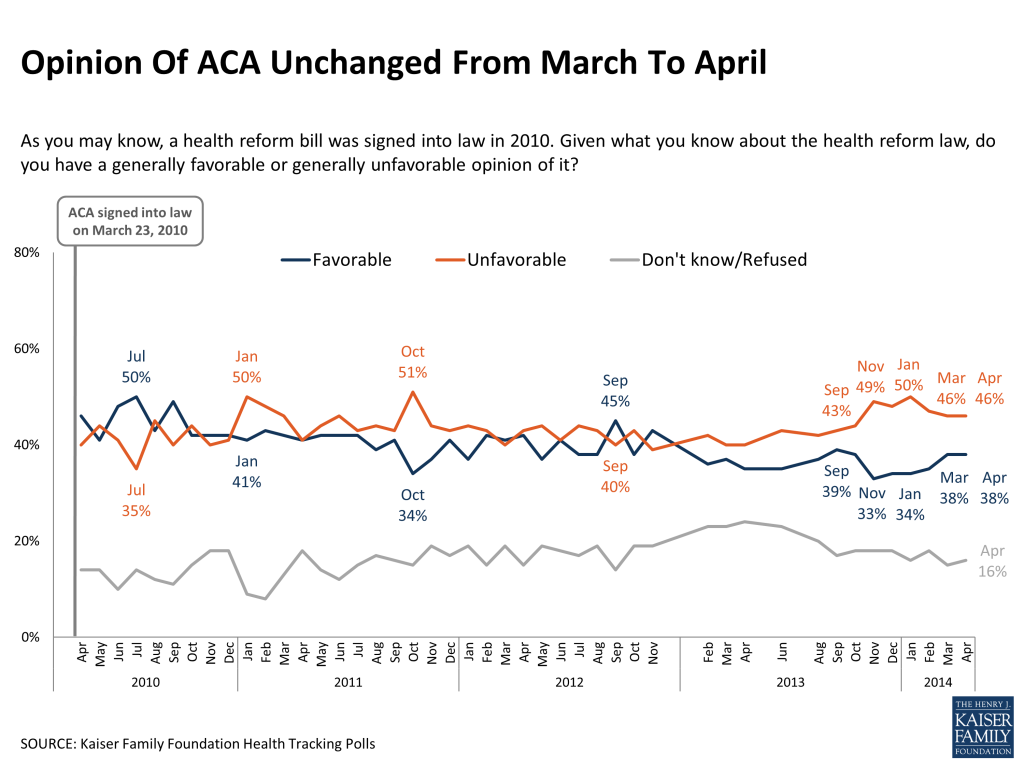
Despite the news that 8 million people have signed up for health insurance through the ACA’s new marketplace, the April Kaiser Health Tracking Poll finds no change over the past month in the public’s view of the law, with 46 percent of the public saying they have an unfavorable view and 38 percent a favorable view.

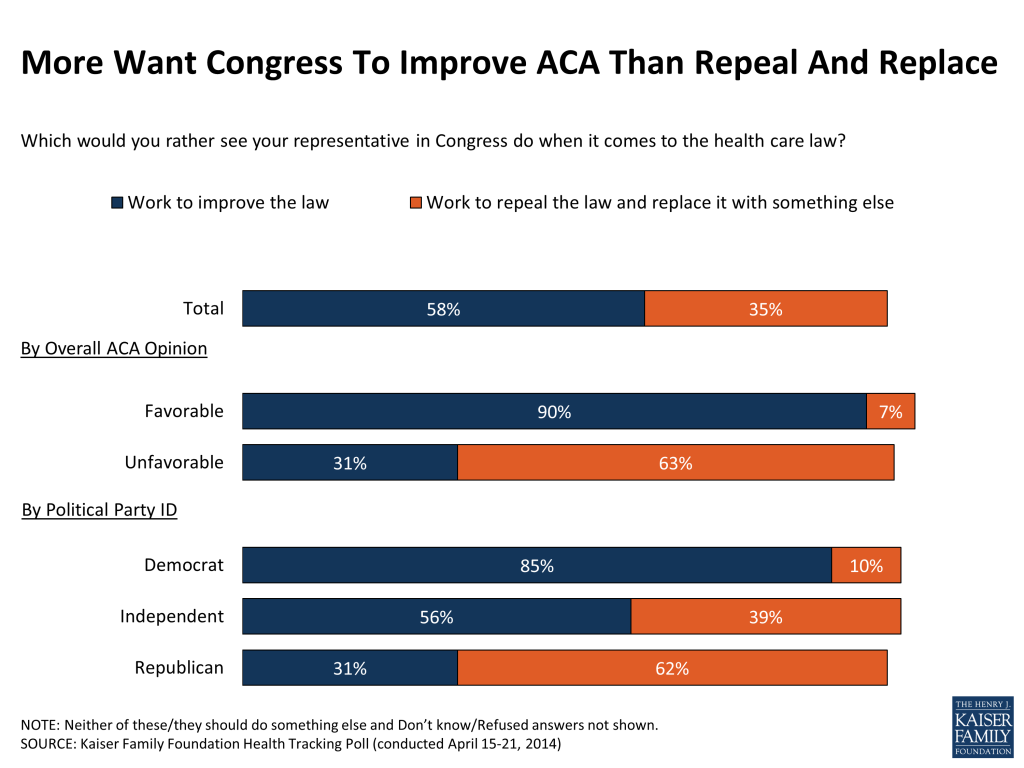
At the same time, nearly six in ten (58%) say they want their representative in Congress to work to improve the law, compared to just over a third (35%) who want them to work on repealing it and replacing it with something else.  While there are clear partisan divisions on this question, about three in ten Republicans agree with the majority, preferring that Congress work to improve the law.

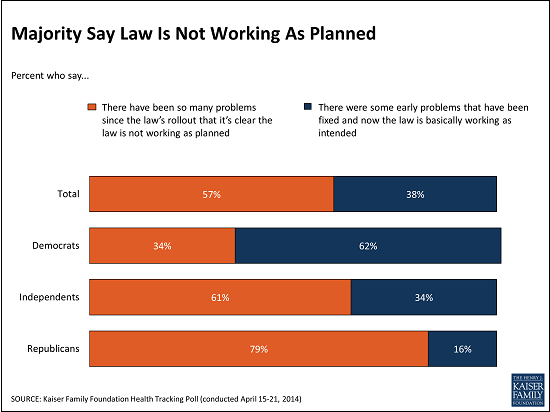
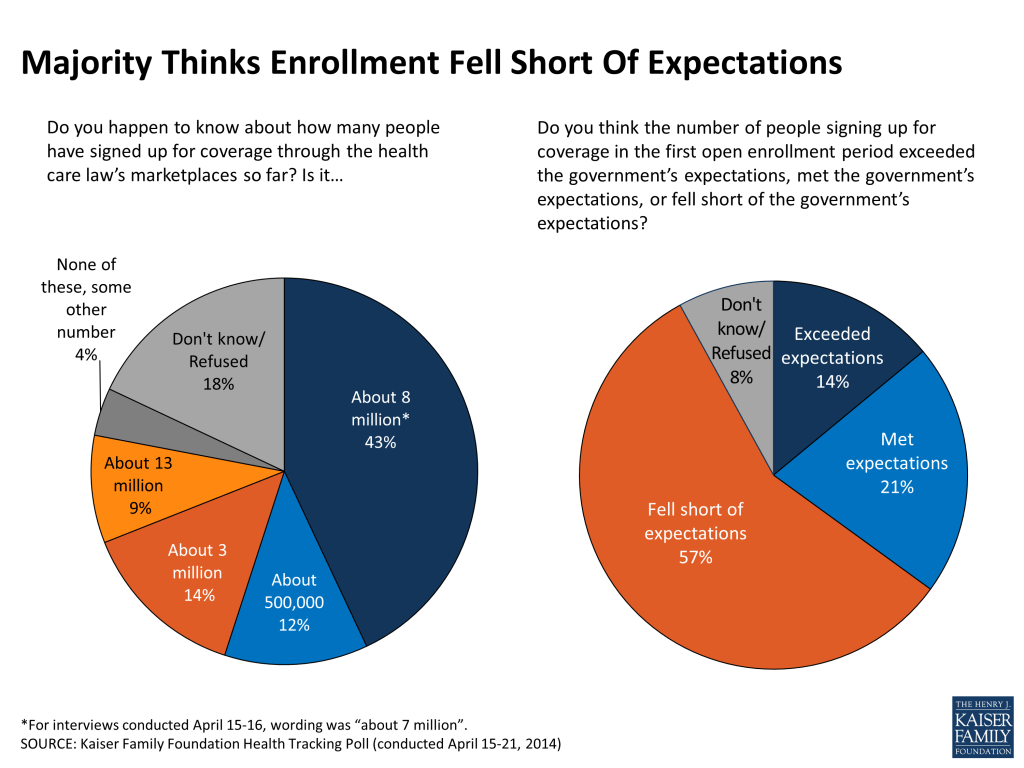
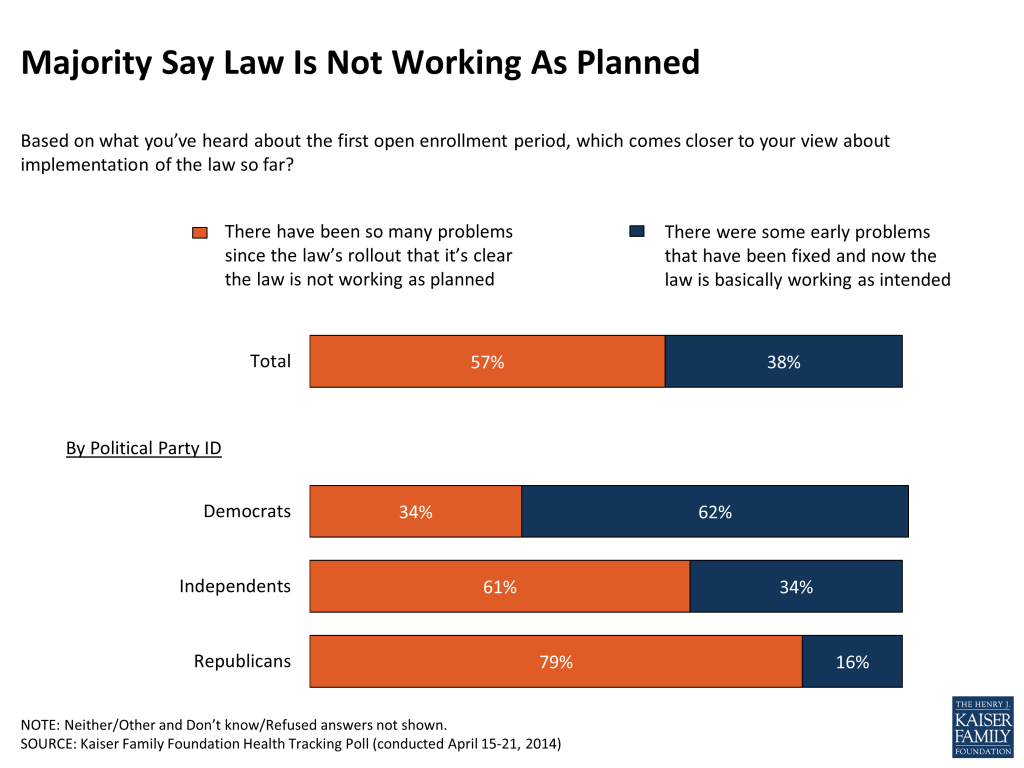
In spite of the late surge that pushed marketplace enrollment above the Congressional Budget Office’s initial projections, nearly six in ten people (57%)  say that the number of people signing up for coverage fell short of the government’s expectations.  The same share (57%) also says “there have been so many problems since the law’s rollout that it’s clear the law is not working as planned.”  As expected, Republicans are far more likely to say the law is still not working than Democrats, with independents in the middle.  Among Democrats, though, about a third believes the law is still not working.


Slide1-1

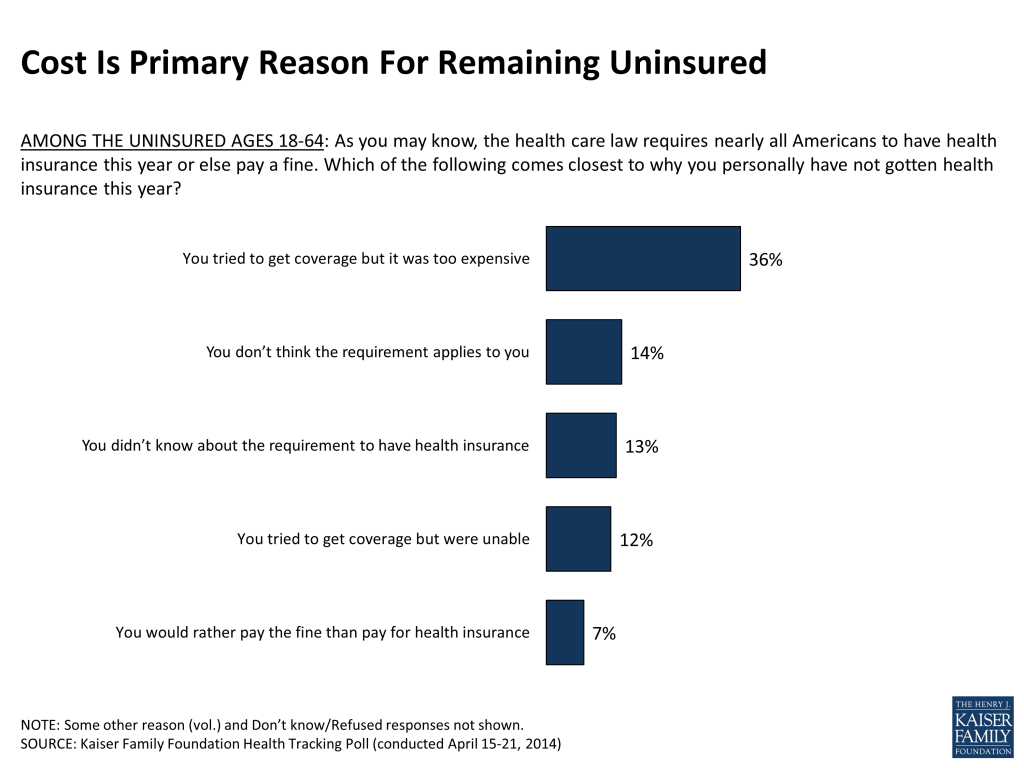
The poll also asked people who remain uninsured to choose the main reason they haven’t gotten coverage this year after being told or reminded of the law’s requirement for individuals to get coverage or pay a fine.  More than a third (36%) say they tried to get coverage but it was too expensive. Smaller shares say they don’t think the requirement applies to them personally (14%), they didn’t know about the law’s requirement to get coverage (13%), and they tried to get coverage but were unable (12%). Few (7%) say they would rather pay the fine than buy insurance.

With the Supreme Court weighing challenges to the ACA’s requirement that private health plans cover prescription birth control without cost-sharing, the latest Kaiser Health Tracking Poll finds that, in general, the public supports the requirement by a nearly 2-to-1 margin (61% support, 32% oppose). Women, younger adults, Democrats and independents are the groups most likely to support the requirement, while seniors are split and a majority of Republicans are opposed.

Asked more specifically about for-profit companies whose owners have religious objections to birth control, a majority (55%) feels these companies should still be required to cover birth control.  This includes nearly three quarters of Democrats, a majority of independents and a third of Republicans.

This month’s Kaiser Health Policy News Index finds that just over half the public (53%) says they closely followed news coverage of the ACA enrollment numbers, and more than four in ten (44%) report closely following the Supreme Court contraceptive coverage case.

The survey was designed and analyzed by public opinion researchers at the Kaiser Family Foundation and was conducted from April 15-21 among a nationally representative random digit dial telephone sample of 1,504 adults ages 18 and older. Telephone interviews conducted by landline (750) and cell phone (754) were carried out in English and Spanish. The margin of sampling error for the full sample is plus or minus 3 percentage points. For results based on subgroups, the margin of sampling error may be higher.

News Release

New Issue Brief Examines the U.S. Government and Global LGBT Health

Published: Apr 29, 2014

A new Kaiser Family Foundation brief explores the U.S. government’s efforts to address the health and human rights of lesbian, gay, bisexual and transgender (LGBT) individuals around the world. LGBT individuals continue to face stigma, discrimination, and violence, both within and outside of the health sector, and in many countries — including those in which the U.S. provides global health assistance — these barriers include discriminatory laws and policies. Recent actions by several countries to further criminalize LGBT individuals have raised the stakes in the conversation and introduced a greater sense of urgency, yet many questions and challenges remain about the best way forward.

The U.S. Government and Global LGBT Health: Opportunities and Challenges in the Current Era summarizes two roundtable discussions convened by the Foundation, which identified opportunities, challenges, and potential next steps for the U.S. government to consider on LGBT health.  It also provides an overview of global LGBT health issues, and reviews U.S. government efforts to address global LGBT health to date.

Filling the need for trusted information on national health issues, the Kaiser Family Foundation is a nonprofit organization based in Menlo Park, California.

Poll Finding

Kaiser Health Tracking Poll: April 2014

Authors: Liz Hamel, Jamie Firth, and Mollyann Brodie
Published: Apr 29, 2014

Kaiser Health Tracking Poll: April 2014

The enrollment surge at the end of March in the health insurance exchanges, created by the Affordable Care Act (ACA), was widely covered in the news, as was the announcement that at least 8 million people have used the new marketplaces to sign up for coverage.  The news got a fair amount of attention from the public, with over half saying they followed the enrollment numbers “very” or “fairly closely.” But the latest Kaiser Health Tracking Poll finds that this news did little to change the public’s impressions of the law, with overall opinion remaining exactly where it was last month (46 percent unfavorable, 38 percent favorable). While over four in ten correctly identify the number of people who have signed up for insurance1 , enrollment levels do not register as a success for most Americans. Nearly six in ten (including half of those who correctly identified the 8 million figure) believe enrollment fell short of the government’s expectations, and the same share believe the rollout problems indicate that the law is not working as planned. Still, more want the government to give the law a chance than want to scrap it and start over; nearly six in ten would prefer their representative in Congress work to improve the law, while just over a third want them to repeal and replace it. When asked why they haven’t gotten coverage yet this year, over a third of the uninsured say they tried to get coverage but it was too expensive, while smaller shares say they didn’t know about the ACA’s requirement to have insurance or didn’t think it applied to them. Just 7 percent of the uninsured say they would rather pay the fine than pay for coverage. This month’s tracking poll also finds public support for the ACA’s requirement that private health insurance plans cover the full cost of birth control, including a majority who believe that for-profit companies should be subject to this requirement even if their owners object to birth control on religious grounds.

Overall opinion remains unchanged from March

Despite the announcement that at least 8 million people have signed up for health insurance through the ACA’s new marketplace, overall favorability of the law remains exactly where it was in last month’s tracking poll, with 46 percent of the public saying they have an unfavorable view and 38 percent a favorable view. This is a slight improvement over polls taken from November through January, but still represents a more negative tilt to opinion than was measured in Kaiser tracking surveys before the troubled launch of the exchanges last October.

Figure 1

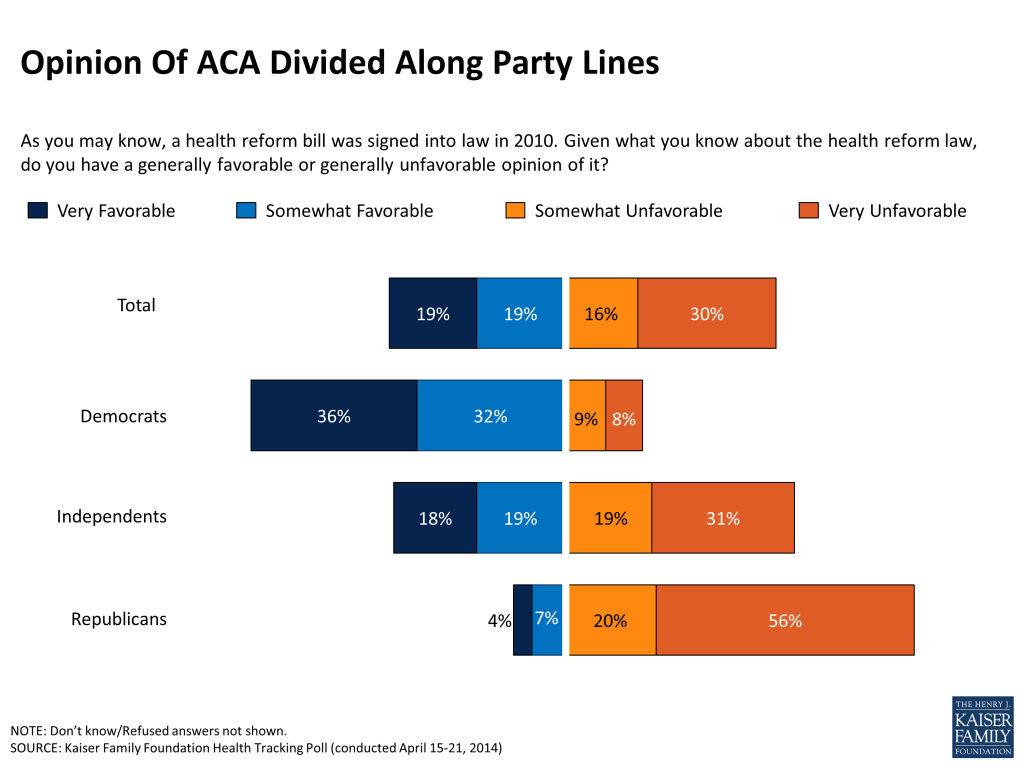
As it has been since the start, opinion remains highly polarized by political party, with three-quarters of Republicans having an unfavorable view of the law and two-thirds of Democrats viewing it favorably.

Figure 2

“8 million” registered with many, but majority don’t view first enrollment period as a success

Just over four in ten Americans (43 percent) were correctly able to identify that “about eight million” people2  have signed up for coverage through the ACA’s new marketplaces as of April. Still, the majority of the public does not seem to register this as a success. Nearly six in ten believe that the number of people signing up for coverage fell short of the government’s expectations. Even among those who correctly identified the fact that 8 million people have signed up so far, roughly half believe enrollment fell short of expectations.

Figure 3

While almost four in ten believe the early problems with the law have been fixed, almost six in ten say “there have been so many problems since the law’s rollout that it’s clear the law is not working as planned.” There are expected partisan divisions on this question, but even among Democrats, who generally view the law favorably, about a third believe the law is still not working.

Figure 4

More want Congress to improve the law than repeal and replace

Despite this, the public is inclined to give the law a chance to work rather than throwing it out and starting over. Nearly six in ten (58 percent) say they want their representative in Congress to work to improve the law, while just over a third (35 percent) want them to work on repealing it and replacing it with something else. Like opinion on the law overall, this question is deeply divided by political party. Still, about three in ten Republicans and the same share of those with an unfavorable view of the law say they would prefer Congress work on improving it rather than repealing and replacing it.

Figure 5

Most common reason for remaining uninsured is not being able to afford coverage

When asked to say in their own words why they don’t currently have health insurance, the most common reason mentioned by the uninsured is that it is too expensive (39 percent), followed by employment-related reasons such as being unemployed or working for an employer that doesn’t offer coverage (22 percent). Roughly one in ten say they just haven’t gotten around to getting coverage or missed the deadline to apply (11 percent), and a similar share feel they don’t want or need coverage (9 percent).

FIGURE 6: In Their Own Words
AMONG THE UNINSURED AGES 18-64: What is the main reason you do not currently have health insurance?
CategoryPercent MentioningQuotes
Too expensive/can’t afford it

39%

“What’s out there now is just unaffordable.”  “Because I think food on the table is more important.”

“Being a single mom every penny I have goes into my household and I have nothing extra.”

Job-related reasons

22

“Because I was laid off from my job in December.” “I only work 2 and half hours a day for 5 days a week and I can’t afford it.”

“Insurance that employer offers not worth the cost.”

Missed the deadline/haven’t gotten around to it/too busy

11

“I didn’t sign up in time.” “I haven’t had time to check all that out.”
Don’t want/need it

9

“Because I don’t want it. I feel it’s my own option whether I want to buy it.” “Because of my age, I don’t need it at the moment.”

 When reminded of the law’s requirement for individuals to get coverage or pay a fine and asked to choose the main reason they haven’t gotten coverage this year, cost again turns up as the biggest barrier for the uninsured; over a third (36 percent) say they tried to get coverage but it was too expensive. Fourteen percent of the uninsured say they don’t think the law’s requirement to have insurance applies to them personally, and another 13 percent say they didn’t know about the requirement. Twelve percent say they tried to get coverage but were unable. Just 7 percent say they would rather pay the fine than pay for health insurance.

Figure 7

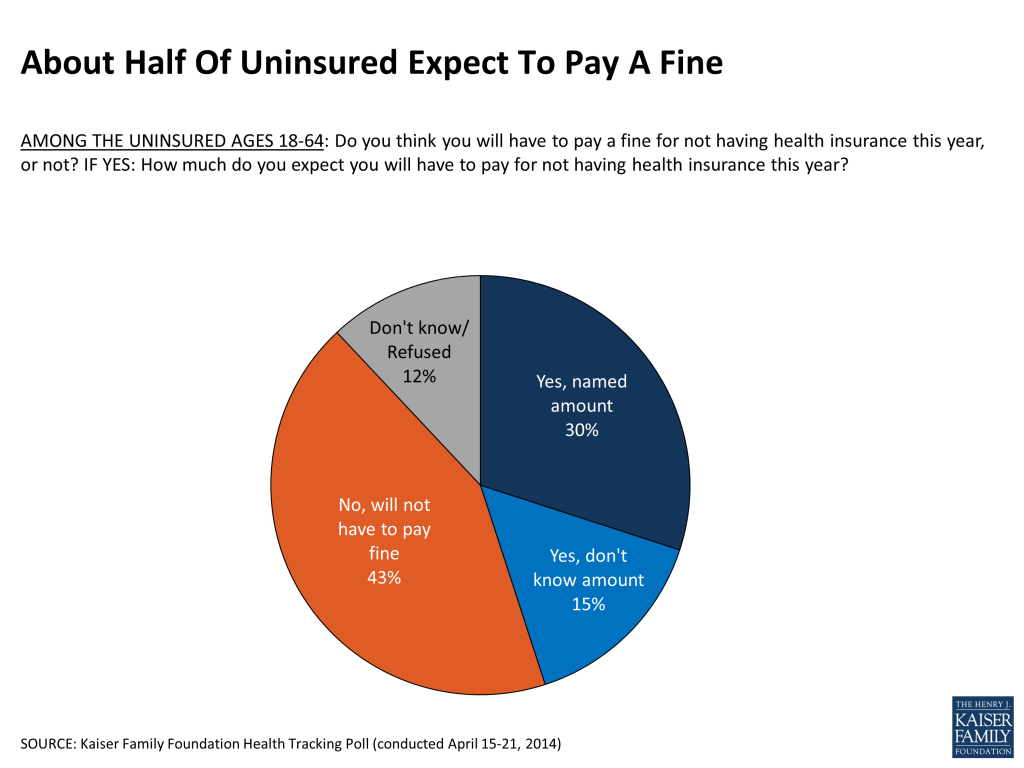
Almost half the uninsured (45 percent) think they will have to pay a fine for not having health insurance this year, though a sizeable share of the uninsured (15 percent) say they don’t know what the amount will be.

Figure 8

Among the public overall, almost half (46 percent) say they don’t know what the fine is for people who don’t get health insurance this year, while 23 percent give responses close to the actual fine, including 14 percent who named dollar amounts between $90 and $100, 5 percent who said it is one percent of a person’s household income, and 4 percent who gave the precise answer that the fine is either $95 or one percent of income, whichever is greater.

Majority support contraceptive coverage requirement, including for-profit companies whose owners have religious objections

In light of the recent Supreme Court hearings in two cases challenging the ACA’s requirement that private health plans cover prescription birth control without cost-sharing, the latest Kaiser Health Tracking Poll finds that, in general, the public supports the requirement by a nearly 2-to-1 margin (61 percent support, 32 percent oppose). Women, younger adults, Democrats and independents are the groups most likely to support the requirement, while seniors are split on the question and a majority of Republicans are opposed.

Figure 9: Majority Supports ACA’s Contraceptive Coverage Requirement
By GenderBy Political Party IDBy Age
In general, do you support or oppose the health care law’s requirement that private health insurance plans cover the full cost of birth control?TotalMenWomenDemIndRep18-2930-4950-6465+
Support61%56%65%81%62%37%71%64%60%45%
Oppose32362814305725303243
Don’t know/refused78758746812

Asked more specifically about whether for-profit companies whose owners have religious objections to birth control should be subject to the requirement, a majority (55 percent) of the public feel these companies should be required to cover birth control even if it violates their owners’ personal religious beliefs, while four in ten feel such companies should not be subject to the requirement even if it means their workers will have to pay out-of-pocket for birth control.

Figure 10: Majority Believe For-Profit Companies Should Be Required To Cover Birth Control, Despite Owners’ Religious Objections
By GenderBy Political Party IDBy Age
Which comes closer to your view about how this law should apply to for-profit companies whose owners object to birth control on religious grounds?TotalMenWomenDemIndRep18-2930-4950-6465+
For-profit companies SHOULD be required to cover birth control in their workers’ health plans, even if it violates their owners’ personal religious beliefs55%50%61%74%55%34%64%58%55%41%
For-profit companies should NOT be required to cover birth control in their workers’ health plans, even if it means their female employees will have to pay the cost of birth control themselves40463522426235374053
Neither/other (Vol.)2222211321
Don’t know/Refused3332141236

Over four in ten Americans (44 percent) reported following news coverage of the Supreme Court hearings regarding contraceptive coverage “very” or “fairly” closely, somewhat higher than the share that reported paying close attention to the recent Supreme Court decision overturning certain limits on campaign donations (37 percent). The Supreme Court contraception case was closely followed by similar shares of men and women, and similar shares of Democrats, Republicans, and independents.

More details on the public’s attention to health policy news in April can be found in the Kaiser Health Policy News Index.

This Kaiser Health Tracking Poll was designed and analyzed by public opinion researchers at the Kaiser Family Foundation (KFF) led by Mollyann Brodie, Ph.D., including Liz Hamel, Bianca DiJulio, and Jamie Firth. The survey was conducted April 15-21, 2014, among a nationally representative random digit dial telephone sample of 1,504 adults ages 18 and older, living in the United States, including Alaska and Hawaii (note: persons without a telephone could not be included in the random selection process). Computer-assisted telephone interviews conducted by landline (750) and cell phone (754, including 440 who had no landline telephone) were carried out in English and Spanish by Princeton Data Source under the direction of Princeton Survey Research Associates International (PSRAI). Both the random digit dial landline and cell phone samples were provided by Survey Sampling International, LLC. For the landline sample, respondents were selected by asking for the youngest adult male or female currently at home based on a random rotation. If no one of that gender was available, interviewers asked to speak with the youngest adult of the opposite gender. For the cell phone sample, interviews were conducted with the person who answered the phone. KFF paid for all costs associated with the survey.

The combined landline and cell phone sample was weighted to balance the sample demographics to match estimates for the national population using data from the Census Bureau’s 2012 American Community Survey (ACS) on sex, age, education, race, Hispanic origin, nativity (for Hispanics only), and region along with data from the 2010 Census on population density. The sample was also weighted to match current patterns of telephone use using data from the January-June 2013 National Health Interview Survey. The weight takes into account the fact that respondents with both a landline and cell phone have a higher probability of selection in the combined sample and also adjusts for the household size for the landline sample. All statistical tests of significance account for the effect of weighting.

The margin of sampling error including the design effect for the full sample is plus or minus 3 percentage points. Numbers of respondents and margin of sampling error for key subgroups are shown in the table below. For results based on other subgroups, the margin of sampling error may be higher. Sample sizes and margin of sampling errors for other subgroups are available by request. Note that sampling error is only one of many potential sources of error in this or any other public opinion poll.


GroupN (unweighted)M.O.S.E.
Total1,504±3 percentage points
Uninsured, ages 18-64154±8 percentage points
Party Identification
   Democrats449±5 percentage points
   Republicans400±6 percentage points
   Independents479±5 percentage points
Opinion of ACA
   Favorable Opinion of the ACA583±5 percentage points
   Unfavorable Opinion of the ACA716±4 percentage points
Gender
   Male707±4 percentage points
   Female797±4 percentage points
Age
   18-29210±7 percentage points
   30-49381±5 percentage points
   50-64479±5 percentage points
   65 +432±5 percentage points

Endnotes

  1. The survey was in the field April 15-21. The Obama Administration announced on April 1 that at least 7 million people had signed up for coverage through the ACA’s marketplace, and announced on April 17 that the figure was at least 8 million. For interviews conducted April 15-16, the question about enrollment numbers included “about 7 million” as a possible response option; that option was changed to “about 8 million” for interviews conducted April 17-21. Our analysis indicates there were no substantive differences in opinion for interviews conducted before and after the April 17 announcement. ↩︎
  2. See previous footnote. ↩︎
Poll Finding

Kaiser Health Policy News Index: April 2014

Authors: Liz Hamel, Jamie Firth, and Mollyann Brodie
Published: Apr 29, 2014

The Kaiser Health Policy News Index is designed to help journalists and policymakers understand which health policy-related news stories Americans are paying attention to, and what the public understands about health policy issues covered in the news. This month’s Index finds that the public followed the missing Malaysia Airlines flight, the shooting at the Fort Hood army post, and the conflict between Ukraine and Russia, more closely than any health policy news stories. Among health policy news, the most closely-followed story was coverage of how many people have enrolled in health insurance options under the Affordable Care Act (ACA), which just over half the public reports following “very” or “fairly” closely.

Figure 1

News of a surge in enrollment through the ACA’s health insurance marketplaces at the end of March caught the public’s attention this month; it was the most closely followed health policy news story, with over half (53 percent) saying they followed it “very” or “fairly closely.” The April 2014 Kaiser Health Tracking Poll found that many Americans retained the information they got from the news, as over four in ten (43 percent) were correctly able to identify that “about eight million” people1  had signed up for coverage through the ACA’s new marketplaces as of April. Over half of those who reported closely following the news about ACA enrollment were able to correctly identify the number of sign ups, while smaller shares of those who reported “not too closely” or “not at all closely” following the story (36 percent and 22 percent) were able to answer correctly.

Figure 2: Those Following ACA Enrollment News More Likely To Correctly Identify Number Of Sign Ups
By reported attention to ACA enrollment news story…
Do you happen to know about how many people have signed up for coverage through the law’s marketplaces so far?TOTALVery CloselyFairly CloselyNot Too CloselyNot At All Closely
About 500,00012%8%11%11%17%
About 3 million1411141812
About 8 million*4357533622
About 13 million9810117
None of these, some other number46334
Don’t know/Refused18982139
*For interviews conducted April 15-16, wording was “about 7 million”.

Public attention to ACA enrollment lagged behind three non-health stories this month: the missing Malaysia Airlines flight (76 percent), a deadly shooting at Fort Hood Army post in Texas (66 percent), and the ongoing conflict between Ukraine and Russia (65 percent). About half of the public – similar to the share who say they closely followed the ACA enrollment numbers – reports closely following discussions of the federal budget (51 percent), reports about safety defects in cars made by General Motors (50 percent), and the extension of the deadline to sign up for health insurance  under the ACA (49 percent).

At the end of March, the Supreme Court heard arguments in two cases challenging the ACA’s requirement that for-profit companies cover birth control in their workers’ health plans. Over four in ten Americans (44 percent) say they followed news of the case “very” or “fairly closely”. This is slightly higher than the share that reported paying close attention to another Supreme Court news story: the decision overturning certain limits on campaign donations (37 percent). The Supreme Court contraception case was closely followed by similar shares of men and women, and similar shares of Democrats, Republicans, and independents.

Two other health policy stories this month were followed by smaller shares of the public: the resignation of Health and Human Services Secretary Kathleen Sebelius (35 percent) and the release of Medicare data detailing what individual physicians were paid in 2012 (25 percent).

NOTE: These questions were asked as part of the April 2014 Kaiser Health Tracking Poll. For more results from that survey, including methods, see: Kaiser Health Tracking Poll: April 2014.

  1. The survey was in the field April 15-21. The Obama Administration announced on April 1 that at least 7 million people had signed up for coverage through the ACA’s marketplace, and announced on April 17 that the figure was at least 8 million. For interviews conducted April 15-16, the question about enrollment numbers included “about 7 million” as a possible response option; that option was changed to “about 8 million” for interviews conducted April 17-21. Our analysis indicates there were no substantive differences in opinion for interviews conducted before and after the April 17 announcement. ↩︎

Tennessee’s Money Follows the Person Demonstration: Supporting Rebalancing in a Managed Long-Term Services and Supports Model

Authors: Molly O'Malley Watts, Erica L. Reaves, and MaryBeth Musumeci
Published: Apr 25, 2014

This case study examines Tennessee’s Medicaid Money Follows the Person (MFP) demonstration, through which over 600 beneficiaries have transitioned from institutions to the community from October 2011 through June 2013. Tennessee’s MFP program is integrated into the state’s mandatory capitated Medicaid managed long-term services and supports program for seniors and people with physical disabilities. Tennessee provides financial incentives to Medicaid managed care organizations (MCOs) that meet specific benchmarks, such as increasing the amount and percentage of Medicaid spending for HCBS relative to institutional spending. The case study details recent program developments as well as the roles and activities of MFP and MCO staff and other key partners in facilitating institution-to-community transitions for Medicaid beneficiaries.

Introduction

The Money Follows the Person (MFP) demonstration is a Medicaid initiative designed to reduce reliance on institutional services and expand community-based long-term services and supports options. MFP, first authorized in the Deficit Reduction Act of 2005, was extended until 2016 under the Affordable Care Act. To be eligible for MFP, Medicaid beneficiaries must reside in an institution (e.g., nursing facility, intermediate care facility for individuals with intellectual disabilities) for at least 90 days prior to transitioning to a community residence (e.g., house, apartment, small group home). Under MFP, a participant receives home and community-based services for which the state receives enhanced federal matching funds during a beneficiary’s participation year. Currently, 42 states, including DC, have operational MFP programs, two states have received funding and are not yet operational, and one state’s demonstration is inactive.

In 2011, Tennessee was awarded a federal Money Follows the Person (MFP) grant, joining the now 45 states with MFP demonstrations.  MFP provides one-time and ongoing home and community-based and transition services that help Medicaid beneficiaries move from institutions to the community, with enhanced federal funding during each beneficiary’s first year home.  Funding for Tennessee’s MFP program totals $119 million and runs through September 2016.

Prior to receiving an MFP grant, Tennessee was reforming its Medicaid long-term services and supports (LTSS) system to rebalance enrollment and expenditures away from institutional care in favor of home and community-based services (HCBS).  For seniors and adults with physical disabilities, these efforts have been implemented within the context of Tennessee’s pre-existing capitated Medicaid managed care delivery system, TennCare.  TennCare was established in 1994 under Section 1115 demonstration authority and provides Medicaid medical and behavioral health services through two managed care organizations (MCOs) in each of the state’s three regions.  Enrollment in TennCare is mandatory and includes the state’s entire Medicaid-eligible population (1.2 million people).

In March 2010, the TennCare demonstration was amended to include CHOICES, a mandatory managed long-term services and supports (MLTSS) program for seniors and adults with physical disabilities administered through the MCOs.  Before the implementation of CHOICES, Tennessee’s LTSS system was fragmented with limited options for beneficiaries and heavily geared toward institutional services for both enrollment and expenditures.  The state’s primary objectives in establishing the CHOICES program included:

  • Decreasing fragmentation and improving care quality and coordination;
  • Expanding access to HCBS so that more beneficiaries can receive care in their preferred setting; and
  • Rebalancing LTSS spending by providing cost-effective HCBS and serving more beneficiaries using existing Medicaid LTSS funds.

As part of its rebalancing efforts, Tennessee focused primarily on delaying or preventing the need for institutional placements, while also facilitating beneficiaries’ transitions from nursing facilities (NFs) to community-based settings.  In its first year of operation, CHOICES transitioned over 500 beneficiaries from institutions to the community.

In 2011, one year after the implementation of CHOICES, Tennessee received its federal MFP grant to support the transition of Medicaid beneficiaries living in institutions to the community.  Tennessee’s MFP program was integrated into the state’s existing LTSS programs, including CHOICES.  Working in conjunction with CHOICES, over 600 of the seniors and adults with physical disabilities who transitioned enrolled in Tennessee’s MFP program.  Those 600 individuals represent a subset of a much larger number of people who transitioned through the CHOICES program.  The MFP program utilizes a financial incentive structure that allows MCOs to earn additional payments when a beneficiary first enrolls in MFP and when she completes the MFP participation year, as well as supplemental payments when other MFP program benchmarks are met.

This case study of Tennessee’s MFP program describes key features and highlights recent experiences focused on the state’s rebalancing efforts for seniors and adults with physical disabilities in a capitated Medicaid MLTSS delivery system.  (Although Tennessee also serves people with intellectual disabilities (ID) through its MFP program, that population does not participate in the MLTSS program and instead receives HCBS on a fee-for-service basis through a Section 1915(c) waiver.)  The case study is based on interviews of Tennessee Division of LTSS, Bureau of TennCare staff, supplemented with background information obtained from the state website and Kaiser Family Foundation’s Commission on Medicaid and the Uninsured MFP surveys conducted between 2011 and 2013.1   Data presented in this case study report are reflective of the program through June 2013; more recent data are available through the Bureau of TennCare.

Text Box 1: Highlights of Tennessee’s MFP Program

  • Tennessee integrated its MFP program into its pre-existing mandatory capitated managed LTSS program (CHOICES) for seniors and people with physical disabilities.
  • Over 600 beneficiaries transitioned from institutions to the community through Tennessee’s MFP program from October 2011 through June 2013, with an additional 77 transitions in progress as of June 2013.
  • The state provides financial incentives to MCOs that meet specific benchmarks, e.g., increasing the amount and percentage of Medicaid spending for HCBS relative to institutional spending.
  • MCO care coordinators provide outreach and transition planning and the MFP housing specialist assists beneficiaries with locating affordable community-based housing. The Memphis Center for Independent Living trains peer volunteers who assist MFP beneficiaries with their transitions.
  • MCOs must maintain an electronic visit verification system, provide provider back-up assistance, and staff a 24-7 call center to prevent a lapse in services.
  • MFP participants, and other CHOICES beneficiaries, can self-direct their services by recruiting, hiring, and supervising direct service workers.
  • The MFP Housing Steering Committee works to expand access to community-based housing; a share of MFP rebalancing funds, along with funds from the state housing finance agency, will be used for a pilot project to provide bridge rental subsidies for MFP participants.

Issue Brief

MFP in Tennessee’s Capitated MLTSS Program

Through CHOICES, Tennessee provides its Medicaid MCOs with a fully blended capitation payment to cover all of the physical, behavioral health, and LTSS (including both NFs and HCBS for NF level of care (LOC) eligible individuals) needed by beneficiaries.  CHOICES beneficiaries are assigned to one of three groups:

  • CHOICES Group 1 includes individuals who meet a NF LOC and receive institutional care;
  • CHOICES Group 2 includes seniors (age 65 and older) and adults (age 21 and older) with physical disabilities who meet a NF LOC and receive HCBS; and
  • CHOICES Group 3 includes seniors and adults with physical disabilities who qualify for TennCare as Supplemental Security Income recipients, who do not meet a NF LOC, but who, in the absence of HCBS, are at risk of NF placement.2 

While there is an enrollment target (which functions as a cap) for CHOICES beneficiaries who receive Medicaid HCBS, Tennessee has been able (except for a brief period while awaiting approval from the Centers for Medicare and Medicaid Services to increase the target) to keep pace with the need, eliminate a waiting list for HCBS, and significantly expand the number of beneficiaries receiving HCBS as well as the percentage of beneficiaries receiving LTSS in home and community-based settings versus institutional settings.  Further, pursuant to the terms and conditions of the state’s Section 1115 demonstration waiver implementing CHOICES, beneficiaries transitioning from a NF receive HCBS even if the CHOICES HCBS enrollment target has been reached, as do certain CHOICES beneficiaries who would be at risk of NF placement absent the provision of HCBS.

To enroll in MFP, beneficiaries must reside in a NF for at least 90 days prior to transitioning to a community-based setting.  Upon transition, Tennessee seniors and adults with physical disabilities who continue to require a NF LOC are simultaneously enrolled in MFP and CHOICES Group 2 to receive HCBS.  (Beneficiaries who transition from a NF into the CHOICES at-risk Group 3 receive HCBS but are ineligible for MFP as they no longer require a NF LOC.)

MCO Financial Incentives for Nursing Facility to Community Transitions

Capitated Payments

Tennessee’s CHOICES MCOs receive the same blended monthly capitated payment for all beneficiaries who meet a NF LOC (CHOICES Groups 1 and 2), regardless of whether those beneficiaries reside in NFs or receive HCBS.  This rate is based on the historical mix of NF and HCBS used by the population enrolled and also takes into account some projected change in the service mix over time (as MCOs focus on serving more beneficiaries in the community when appropriate).  Since, in most situations, the cost of institutional care is significantly higher than that of supporting a beneficiary in a community setting, MCOs have a strong financial incentive to minimize the time that Medicaid beneficiaries spend in NFs and to help those who can do so return to the community and remain there for as long as possible, even if they continue to meet an institutional LOC. Capitation payments for beneficiaries considered at risk of NF placement without the provision of HCBS (CHOICES Group 3) reflect the relatively lower cost associated with serving individuals who do not need an institutional LOC.

MFP Bonus Payments

To further prioritize institution-to-community transitions for MFP-eligible beneficiaries, Tennessee also provides specific financial incentives to MCOs for meeting certain MFP benchmarks (Text Box 2), which are detailed in the MCO contracts and listed below in Text Box 3.3   As a result, state officials believe that MCOs are more focused on reaching transition goals and note that MCOs have developed “transition teams” that concentrate on increasing MFP enrollment.  These teams work along with state MFP staff to ensure that NF residents who desire to transition to the community can do so and in as timely a manner as possible.

Text Box 2: State MFP Benchmarks

  • Benchmark 1: Assist the projected number of eligible beneficiaries in successfully transitioning from institutions to qualified community residences.
  • Benchmark 2: Increase the amount and percentage of Medicaid spending for qualified HCBS relative to institutional spending.
  • Benchmark 3: Increase the number and percentage of seniors and adults with disabilities receiving Medicaid LTSS in home and community-based (versus institutional) settings.
  • Benchmark 4: Increase the number of licensed Community Based Residential Alternatives (CBRA)  contracted with Medicaid MCOs to provide HCBS.
  • Benchmark 5: Increase the number of beneficiaries receiving Medicaid HCBS who self-direct their services.

Text Box 3: MFP Incentive Payments to CHOICES MCOs

  • $1,000 for each beneficiary transitioned from a NF to the community and enrolled in MFP, up to the annual benchmark target
  • $2,000 for each beneficiary transitioned from a NF to the community and enrolled in MFP, in excess of the annual benchmark target
  • $5,000 per beneficiary upon successful completion of 365 days of community living with HCBS without readmission to a NF (excluding Medicare-reimbursed short-term stays)
  • $10,000 one-time payment upon completion of one state benchmark (out of numbers 2-5 above) for each calendar year of the demonstration
  • $25,000 one-time payment upon completion of two state benchmarks (out of numbers 2-5 above) for each calendar year of the demonstration
  • $50,000 one-time payment upon completion of three state benchmarks (out of numbers 2-5 above) for each calendar year of the demonstration
  • $100,000 one-time payment upon completion of four state benchmarks (out of numbers 2-5 above) for each calendar year of the demonstration.

MFP Outreach and Enrollment

CHOICES MCO care coordinators are responsible for regularly assessing NF residents’ interest in and potential for transitioning to the community.  The MCO care coordinators are nurses and social workers, many of whom have experience working in hospitals, managed care systems and Section 1915(c) HCBS waivers.  Once a CHOICES NF resident is identified as a potential candidate for community transition (based on his/her desire to receive HCBS and ability to transition), the MCO care coordinator assesses whether the member is a candidate for transition to the community, and if so, whether the member is also an MFP-eligible individual. The MFP eligibility criteria include: (1) residing in an institutional setting for at least 90 days, (2) transitioning into an MFP qualified residence, and (3) signing an attestation stating a willingness to participate in MFP.  If the transitioning member does not meet all three of the above criteria, they would not qualify to enroll in MFP but would still transition into Group 2 with CHOICES services without simultaneous enrollment in MFP.  Outreach efforts are focused on helping beneficiaries understand Tennessee’s MFP demonstration and why the program is valuable for LTSS system change within the state.  Referrals to Tennessee’s MFP program come from a variety of sources, including beneficiaries themselves, family members, the Minimum Data Set 3.0 Section Q process,4  and NF staff.

MFP Care Coordination and Services

Transition and Care Planning

Once a beneficiary is identified for MFP, she works with a CHOICES MCO care coordinator to develop a transition plan that includes needs and risk assessments, a care plan, and a home safety check.  MCOs must develop a risk agreement as part of the person-centered care planning process for all CHOICES HCBS beneficiaries, including MFP participants.  This includes identifying the potential risks of receiving LTSS in a home and community-based (rather than institutional) setting; determining the potential consequences of the risks; developing and implementing strategies to mitigate the risks; and documenting and supporting the beneficiary’s informed decision to accept a reasonable degree of risk in living more independently in the community. Beneficiaries can receive HCBS so long as their needs can be safely met in a community setting at a cost that does not exceed institutional care.

The care plan takes into account a beneficiary’s physical and behavioral health needs, unpaid natural supports (e.g., a family caregiver), and other personal health care-related circumstances and details the type and amount of HCBS to be provided to ensure that the beneficiary’s needs are met in the community.  During the transition planning period, CHOICES/MFP beneficiaries who need assistance in securing housing work with MCO care coordinators and the MFP housing specialist to complete housing searches or make connections with community-based housing providers.  Prior to a beneficiary’s transition to the community, the MCO care coordinator assists the member as needed to ensure that essential household items (such as kitchen appliances, linens, etc.) are in place or purchased, necessary home modifications are completed, and utilities are set up.  MCOs are permitted to offer a transition allowance of up to $2,000 in order to help a member who needs assistance in securing these items.

Prior to the member’s transition, the CHOICES MCO care coordinator will conduct an on-site evaluation of the physical residence and meet with the member’s family or other caregiver (as applicable).  After the member transitions, CHOICES MCO care coordinators must visit the member face-to-face within 24 hours after transition if the member will live alone or call within 24 hours and visit face-to-face within seven days if the member will be living with family or in a Community-Based Residential Alternative (CBRA).  After the initial 90 days of community living, the MCO care coordinator is required to have at least monthly contacts and quarterly face-to-face visits with each beneficiary.  During these contacts, the MCO care coordinator assesses the beneficiary’s care quality, quality of life, and living environment.  These regular assessments continue after the 365-day MFP participation period ends, through the CHOICES program.

Services

The HCBS benefit package is the same regardless of whether CHOICES beneficiaries also participate in MFP.  In designing the MFP services package, Tennessee wanted to avoid any care disruptions for CHOICES/MFP beneficiaries at the end of their 365-day MFP participation period; after MFP, beneficiaries remain enrolled in CHOICES and continue to have access to the same array of HCBS as they did while they were MFP participants.  The following is a selected list of HCBS available in the CHOICES program:

  • Adult day care services
  • Assistive technology
  • Attendant care services
  • Community-Based Residential Alternatives
  • Home-delivered meals
  • In-home respite care
  • Inpatient respite care
  • Minor home modifications
  • Personal care services
  • Personal emergency response systems

Beneficiary Self-Direction of Services

Nearly all MFP programs nationwide promote beneficiaries’ self-direction of services.  Tennessee offers self- direction (called “consumer direction” in Tennessee) for CHOICES beneficiaries, including those enrolled in MFP.  The self-direct program follows an employer authority model, allowing CHOICES beneficiaries to direct and manage certain aspects of the provision of services, including, primarily, the opportunity to recruit, hire, and supervise direct service workers.  Prior to CHOICES, there were no options for seniors and adults with physical disabilities to self-direct their services in Tennessee.  Now, about 8.5 percent of the CHOICES HCBS population is enrolled in the self-direction model.  Self-direction program participation is lower among CHOICES members enrolled in MFP (3.2%) than in the CHOICES program as a whole, but Tennessee has seen an increase in MFP beneficiaries choosing to self-direct services since 2012.  The state hopes to continue to increase the utilization of self-direction among CHOICES/MFP participants as well as traditional CHOICES HCBS participants; there is an MFP benchmark in place in to track progress in this area.

Service Delivery and Back-Up Plans

Under CHOICES, delivery of HCBS is monitored at the beneficiary-level on an ongoing basis through the use of an electronic visit verification system, which MCOs are required to maintain.  This system requires direct care workers to log in at the beginning of each visit, and if a worker does not arrive as scheduled, an alert is generated to the provider agency as well as the MCO, with both entities obligated to take immediate action to resolve the potential gap in care.

Another key feature of Tennessee’s CHOICES program includes access to a 24-hour back-up assistance to prevent a lapse in the provision of essential medical and supportive services or other circumstances that could negatively affect a beneficiary’s health or welfare.  There is an oversight process in place to ensure that the back-up strategy is working as intended.  In addition to specifying the services and supports that he/she will receive, the beneficiary’s care plan includes a daily care schedule.  The care coordinator develops the care plan in conjunction with each member, and then the MCOs create authorizations based on the approved schedule in the care plan.  Each CHOICES beneficiary’s care plan also includes a back-up plan that describes specifically how the beneficiary’s service and support needs will be met if a direct care worker does not arrive as scheduled to ensure the beneficiary’s continued health and safety.  The back-up plan includes the names and telephone numbers of persons and/or agencies to contact as well as the services and supports provided by each.  The MCO care coordinator is responsible for ensuring that all individuals included in the back-up plan are willing and able to fulfill their assigned roles and responsibilities.  For beneficiaries who self-direct their services, the Fiscal Employer Agency (FEA) is responsible for helping the member develop the initial back-up plan.  The MCO care coordinator is responsible for assessing the adequacy of the beneficiary’s back-up plan, and for helping the member update the plan as needed on an ongoing basis.  If the back-up plan is deemed inadequate, the MCO care coordinator is responsible for following up with the beneficiary and the FEA until all concerns have been addressed.

MCOs are also required to provide access to a call center, 24 hours a day, 7 days a week, to assist beneficiaries in accessing needed medical, behavioral health, and LTSS.  The MCO call center is staffed with nurses who triage urgent care and emergency calls and facilitate the transfer of calls to the care coordinators.  In addition, MCOs are required to designate a staff member to work with the state Medicaid program’s managed care call center staff for immediate resolution of service issues.  The state Medicaid managed care call center also operates 24 hours a day, 7 days a week to help beneficiaries navigate service delivery issues and/or the appeals process.

MFP Staffing and Key Partnerships

Three full-time MFP staff members – a project manager, a data specialist, and a housing specialist – manage Tennessee’s MFP program in conjunction with other state LTSS Division leadership.  Each staff member provides technical assistance to the CHOICES MCOs, and the state communicates with MCO care coordination team leaders on a weekly basis at minimum.  Tennessee’s MFP project director oversees strategic development and regulatory compliance efforts.  The data specialist manages the MFP database that is used primarily to track a potential MFP candidate’s movement through the enrollment process.  Data collection is accomplished via an online LTSS eligibility/enrollment workflow management system, and MFP enrollment and expenditure data is fully integrated into the State’s Medicaid Management Information System.  The housing specialist is charged with improving communication and coordination between MCOs and affordable housing resources across the state.  For example, the housing specialist holds monthly phone calls with MCO staff to discuss complex transition cases and provide guidance on available options that best meet MFP participants’ needs.  Key partnerships with Tennessee’s MFP program include:

Area Agencies on Aging and Disability (AAADs):  Tennessee’s Medicaid program contracts with the state’s nine AAADs, which function as regional Single Points of Entry (SPOE) into the state Medicaid LTSS system and facilitate eligibility and enrollment.  In addition to providing information about the CHOICES program, AAADs explain enrollment processes, including financial and categorical eligibility criteria, conduct individual functional assessments, and facilitate submission of Medicaid applications to both the state Medicaid LTSS Division for LOC determinations and the state Department of Human Services for financial eligibility determinations.5   In addition to their role as regional SPOEs, AAADs conduct the MFP Quality of Life (QoL) surveys (described below).  AAADs were chosen to administer the QoL surveys because of their long-standing experience in working with Medicaid beneficiaries who receive HCBS.

Memphis Center for Independent Living (MCIL):  In an effort to enhance MFP beneficiaries’ transition experience, Tennessee contracts with MCIL for statewide peer-to-peer training of individuals who will transition from NFs to HCBS.  These peer volunteers, who are people with disabilities who have either transitioned from an institutional setting or live independently in the community, provide information about the Medicaid program, the Americans with Disabilities Act, and subsidized housing.  In addition, peers help MFP candidates develop skills such as self-advocacy, personal budgeting, and, for individuals participating in self-direction, direct support staff management.

Tennessee Housing Development Agency (THDA):  TennCare collaborated with Tennessee’s housing finance agency, the Tennessee Housing Development Agency (THDA), to create a pilot project that will provide a “bridge” rental subsidy from the time that the beneficiary leaves an institution until a permanent rental subsidy can be secured.  Pilot program participants will have access to CHOICES care coordinators as they explore more permanent subsidized housing options, and the pilot will be funded through both the THDA Housing Trust Fund and the state’s MFP rebalancing funds.

MFP Housing Steering Committee:  The MFP Housing Steering Committee works to expand access to community-based housing for individuals with LTSS needs.  This housing committee is comprised of representatives from TennCare CHOICES MCOs, AAADs, low-income housing finance groups, low-income housing builders, public housing authorities, and beneficiary advocates.  Committee members meet in-person on a quarterly basis, and the MFP housing specialist contacts committee members individually or as a group by phone or e-mail for guidance and resources as needed.  For example, the MFP housing specialist has utilized the expertise of individual members when issues arose with individual CHOICES beneficiaries, such as assistance with identification of housing resources in specific geographic areas.  Additionally, MFP staff have worked with the steering committee to address barriers and program details related to starting the THDA supportive housing pilot discussed above and sought input in structuring the first TennCare Housing Conference in October 2013.  This conference brought together low-income housing providers and TennCare CHOICES MCOs, with the goals of joint education and troubleshooting barriers associated with obtaining affordable accessible housing for beneficiaries transitioning from institutional settings.

LTC Ombudsman Program:  Tennessee’s LTC Ombudsman Program is operated by the state Commission on Aging and Disability. District LTC Ombudsmen and a statewide network of volunteer Ombudsmen assist residents of NFs or CBRAs with questions and concerns about services and play a critical role in facilitating large scale transitions, including transitions to community-based settings following the closure of an institution.  Ombudsmen, in addition to assisting LTSS beneficiaries in understanding and exercising their rights and responsibilities, also advocate on behalf of LTSS beneficiaries residing in institutions or CBRAs.

Quality and Evaluation

Surveys and Performance Measures

As required by the MFP grant, Tennessee administers the QoL surveyto consenting beneficiaries at three specific timeframes: approximately 10 days prior to discharge from the institution, 11 months post-discharge and 24 months post-discharge.  The QoL survey measures MFP participant’s perceptions and feelings across several domains, including life satisfaction, quality of care, and community life.  Current contact information for each beneficiary is tracked through the state Medicaid program’s IT system, which has been customized to capture beneficiary-specific demographic information.  MCOs have access to this system and must update beneficiary demographic information within two business days of notification of change.

The quality strategy for CHOICES is part of the integrated quality management strategyfor the entire TennCare program, and includes:

  • Uniform measures of system performance;
  • Detailed reporting requirements;
  • Ongoing audit and monitoring processes;
  • Measures to immediately detect and resolve problems, including gaps in care (e.g., Electronic Visit Verification);
  • Independent review by an External Quality Review Organization and the Tennessee Department of Commerce and Insurance;
  • A key focus on member perceptions of quality, including a modified QoL survey for LTSS members beyond MFP participants; and
  • Advocacy for members across MLTSS system.

Certain LTSS performance measures were carried forward from Section 1915(c) HCBS waiver assurances and sub-assurances, including areas such as LOC (e.g., initial and annual LOC evaluations), care plan (e.g., freedom of choice, timely development and initiation of services, annual review, missed and late visits), qualified providers (e.g., credentialing and re-credentialing), health and welfare (e.g., timely reporting, investigation of critical incidents, member education regarding how to report abuse/neglect), and participant rights (e.g., notice of right to appeal any adverse action).  Now that Tennessee provides HCBS to seniors and adults with physical disabilities through a Section 1115 exclusively, the state continues to monitor these areas and strives to ensure prompt remediation of individual findings and to promote systemic improvements in the MLTSS delivery system.  All MCOs are required to maintain National Committee on Quality Assurance accreditation, and other performance measures will be added as new standardized MLTSS program measures are developed.

Critical Incident Reporting

CHOICES MCOs are responsible for developing and implementing a critical incident reporting and management system for incidents that occur in HCBS settings, including:

  • Unexpected death of a CHOICES beneficiary;
  • Suspected physical or mental abuse of a CHOICES beneficiary;
  • Theft or financial exploitation of a CHOICES beneficiary; and
  • Severe injury sustained by a CHOICES beneficiary.

MCOs must review, track, and analyze critical incident reports to identify and address potential and actual care quality and/or health and safety issues.  Specifically, MCOs must review the number and types of incidents and findings from investigations; identify trends, patterns, and opportunities for improvement; and develop and implement strategies to reduce the occurrence of incidents and improve the quality of HCBS.

MCO-contracted HCBS providers are required to report critical beneficiary incidents, and, along with MCO care coordinators, are contractually obligated to take necessary steps to prevent further harm to beneficiaries and to respond to any emergency needs.  For beneficiaries who elect to self-direct services, the MCO care coordinator is responsible for conducting investigations and working with the beneficiary and the FEA to take necessary steps to respond to critical incidents.

MCOs submit a quarterly CHOICES HCBS Critical Incidents Report to the Tennessee state Medicaid agency, which provides information, by month, about specified measures pertaining to MCOs’ management of critical incidents.  State staff review incident management data and also conduct critical incident audits to ensure timely and appropriate remediation of individual issues.  Additionally, they identify potential opportunities for systemic improvements and work with MCOs to address individual beneficiary or broader systemic concerns.

Institutional to Community Transition Progress in Tennessee

From the implementation of Tennessee’s MFP program on October 1, 2011 through June 30, 2013, 628 beneficiaries transitioned to the community through MFP.  Of those, 598 were seniors and adults with physical disabilities simultaneously enrolled in the CHOICES MLTSS program (the remaining 30 beneficiaries simultaneously enrolled in MFP and a fee-for-service HCBS waiver for people with ID.  As of June 30, 2013, another 77 NF residents were in the process of transitioning to the community via MFP as CHOICES participants (Figure 1).  In comparison, during that same time period, 1,069 beneficiaries transitioned home through CHOICES, without enrolling in MFP.

Figure 1: Distribution of Tennessee MFP Transitions, by Target Population, 2011-2013

Table 1 shows the total number of transitions by population group in Tennessee’s MFP program.  Seniors and adults with physical disabilities are the target groups most likely to transition as MFP participants as the number of persons with ID residing in institutions is significantly less.  While the average age of a Tennessee MFP participant is 65 years old, beneficiaries of all ages – from age 21 to 101 – have transitioned to community-based care under Tennessee’s MFP program.  One MFP participant, a person with ID, had been institutionalized for 60+ years.6 

Table 1. Cumulative Tennessee MFP Transitions by Population, as of June 30, 2013
TotalSeniorsPersons with Physical DisabilitiesPersons with Intellectual Disabilities
Cumulative Transitions Completed 62832427430
Transitions in Progress8442357
Rate of Reinstitutionalization10 730
Average Age of MFP Participants65775351
Average Number of Days to Transition to Community31263283
Housing Option Most Likely to Transition ToHome owned or leased by beneficiary or family memberHome owned or leased by beneficiary or family memberHome owned or leased by beneficiary or family memberSupported Living Home
SOURCE: Bureau of TennCare, Division of LTSS, June 2013.

The entire transition process for Tennessee MFP participants – from initiation in the NF to the date of relocation to the community– took 31 days on average to complete (the national average is 3.5 months7 ) with significant variation by target population.  On average, persons with ID (who are not served through CHOICES MLTSS in Tennessee) were in the pre-transition stage for 83 days, while seniors transitioned in 26 days.  MFP participants with ID most frequently transitioned to CBRA settings, while CHOICES/MFP participants primarily transitioned to a house owned or leased a family member.

On average, it costs the state $1,969 per month to serve a CHOICES/MFP participant in the community (Figure 2).8  MFP participants who are seniors are less expensive to serve in the community than adults with physical disabilities ($1,399 and $2,930 per month, respectively).  Across all CHOICES/MFP target populations, the average monthly HCBS expenditures are higher than those for non-MFP HCBS beneficiary populations and lower than those for Medicaid LTSS beneficiaries served in institutional settings (e.g., $3,710 per month to serve individuals in NFs).

Figure 2: Tennessee MFP Monthly Per Capita Costs, by Target Population, 2013

The average reinstitutionalization rate of MFP participants in Tennessee, including persons with ID, was about 10 percent.  Reinstitutionalization is defined as returning to a NF, hospital, or Intermediate Care Facility for Individuals with Intellectual Disabilities, regardless of length of stay, during the beneficiary’s MFP participation year.  Nationally, states reported an average reinstitutionalization rate of 11 percent across all MFP populations.9 

In 2011 and 2012, Tennessee achieved its MFP transition benchmarks; as of August 2013, MCOs reported being behind on their state-set annual transition goals for 2013.  Some of this lag can be attributed to the fact that on July 1, 2012, Tennessee changed its Medicaid NF LOC criteria to target NF services to beneficiaries with higher acuity care needs, while continuing to make HCBS more broadly available to beneficiaries who do not meet the new more stringent LOC standards (i.e., Group 3 beneficiaries).  As a result, the state has diverted nearly 20 percent of all NF applicants to more cost-effective and integrated community-based care.

In order to improve transition rates and meet its 2013 MFP transition benchmark, Tennessee is pursuing additional strategies to better support the remaining higher acuity NF population during transition and in the community.  Examples of these strategies include the following:

  • Developing a set of “best practices” that includes the most effective MCO staffing models such as transition teams, data-driven methods of MFP candidate identification, and use of natural and community-based supports, other outside resources, and community partners to improve MFP transition successes.  These best practices were disseminated to all MCOs for use in developing their internal processes and enrollment strategies;
  • Statewide peer-to-peer trainingfor beneficiaries transitioning from NFs to community-based settings and who wish to support other candidates in transition (described above);
  • Ongoing technical assistance provided by the state to the  MCOs to help identify the strategies and practices that are proving to be successful in identifying and facilitating MFP transitions; and
  • Ongoing development of community-based services and supports and alternative residential settings.

LOOKING AHEAD

Given the state’s NF LOC eligibility criteria and an emphasis on NF diversion by providing HCBS to beneficiaries identified as at risk of NF placement, Tennessee expects a decline in the number of beneficiaries who transition from NFs to the community via MFP in 2014.  As a result of these initiatives, Medicaid beneficiaries being served in NFs have higher acuity of care needs and the challenges associated with supporting the higher acuity individuals in the community are greater.  To improve transitions, Tennessee is currently looking at a variety of options, including expanding community housing options that cost-effectively serve NF residents who desire to transition to the community.

Tennessee has integrated its MFP program into its existing Medicaid LTSS system, including CHOICES, the capitated MLTSS program for seniors and adults with physical disabilities.  Together, these two Medicaid LTSS rebalancing efforts, MFP and CHOICES, are succeeding in placing more beneficiaries in home and community-based settings.  In just under three years, the percentage of seniors and adults with physical disabilities receiving HCBS in Tennessee grew from 17 percent in 2010 to 40 percent as of August 31, 2013.  This shift in care setting reflects Tennessee’s progress in meeting its community integration obligations under the U.S. Supreme Court’s 1999 Olmstead decision and beneficiaries’ preference for needing and receiving community-based care.  Specifically, MFP has assisted in the paradigm shift within MCOs and the way they approach transitions.  As a result of MFP, MCOs have changed staffing models, hired housing specialists, and developed care coordinator performance goals related to transitioning individuals from an institutional setting into MFP.

The lack of affordable, accessible housing options remains a challenge for MFP participants and for NF residents who desire to transition to the community and so Tennessee’s MFP program has focused on developing community housing options through its partnership with the state housing finance agency.  Further, state officials maintain that the allowance of federal Medicaid matching funds for institutional room and board but not community housing assistance perpetuates the institutional bias in the Medicaid LTSS system and impedes MFP states’ efforts to transition individuals to the community.

The performance of Tennessee’s overall MFP program as well as that of CHOICES MCOs will continue to be monitored over time, with program adjustments as needed to ensure that the state continues to achieve its rebalancing goals.  Looking ahead, the CHOICES program and MFP will continue to work together to support the transitions of seniors and adults with physical disabilities from institutions to the most integrated community setting in which they can be served.

This Kaiser Commission on Medicaid and the Uninsured brief was prepared by Molly O’Malley Watts with Watts Health Policy Consulting and Erica L. Reaves and MaryBeth Musumeci from the Kaiser Family Foundation.  Special thanks to Catherine Lemaire Lozier, Rachel Turner, Michelle Morse Jernigan, and Patti Killingsworth of the Tennessee Division of LTSS, Bureau of TennCare who contributed to the content and review of this case study.

Endnotes

  1. Molly O’Malley Watts, Money Follows the Person: A 2013 Survey of Transitions, Services, and Costs, Kaiser Family Foundation’s Kaiser Commission on Medicaid and the Uninsured, April 2014, available at: https://modern.kff.org/other/report/money-follows-the-person-a-2013-survey-of-transitions-services-and-costs. ↩︎
  2. CMS Waiver Documents, Fact Sheet: TennCare II-WAI, available at: http://www.medicaid.gov/Medicaid-CHIP-Program-Information/By-Topics/Waivers/1115/downloads/tn/tn-tenncare-ii-fs.pdf. ↩︎
  3. CMS, Technical Assistance Training Series, “State Approaches to Medicaid Long-Term Services and Supports: Advanced State Training,” July 11, 2013, available at: http://www.chcs.org/usr_doc/State_Approaches_to_Medicaid_MLTSS_Foundational_webinar_07_11_13.pdf. ↩︎
  4. Section Q of the MDS 3.0 focuses on resident participation in assessment and goal setting, and is designed to identify the resident’s goals and expectations relating to where the individual lives and receives services.  If a resident indicates that he or she desires to transition out of the nursing facility (NF) to a community-based setting, the NF must initiate care planning and may make a referral to a local contact agency, which will respond by providing information to the resident about community–based services and supports.  The revised federal Minimum Data Set (MDS) assessment tool for NF residents, MDS 3.0, went into effect on October 1, 2010. ↩︎
  5. As of January 1, 2014, eligibility determinations are made by the Medicaid Agency- in a new Member Services unit. ↩︎
  6. CMS, Technical Assistance Training Series, “State Approaches to Medicaid Long-Term Services and Supports: Advanced State Training,” July 11, 2013, available at:  http://www.chcs.org/usr_doc/State_Approaches_to_Medicaid_MLTSS_Foundational_webinar_07_11_13.pdf. ↩︎
  7. Molly O’Malley Watts, Money Follows the Person: A 2013 Survey of Transitions, Services, and Costs, Kaiser Family Foundation’s Kaiser Commission on Medicaid and the Uninsured, April 2014, available at: https://modern.kff.org/other/report/money-follows-the-person-a-2013-survey-of-transitions-services-and-costs. ↩︎
  8. This average includes just the CHOICES/MFP participants and therefore excludes the ID population whose average per capita costs are $10,298. ↩︎
  9. Molly O’Malley Watts, Money Follows the Person: A 2013 Survey of Transitions, Services, and Costs, Kaiser Family Foundation’s Kaiser Commission on Medicaid and the Uninsured, April 2014, available at: https://modern.kff.org/other/report/money-follows-the-person-a-2013-survey-of-transitions-services-and-costs.   ↩︎

Maryland’s Money Follows the Person Demonstration: Support Transitions Through Enhanced Services and Technology

Authors: Molly O'Malley Watts, Erica L. Reaves, and MaryBeth Musumeci
Published: Apr 25, 2014

This case study examines Maryland’s Money Follows the Person (MFP) demonstration, through which over 1,900 Medicaid beneficiaries have transitioned from institutions to the community since March 2008. Maryland is using its MFP rebalancing funds to support the implementation of new options to increase access to home and community-based services under the Affordable Care Act, such as Community First Choice and the Balancing Incentive Program. The case study details recent program developments as well as the roles and activities of the MFP staff and key partners in facilitating institution-to-community transitions for Medicaid beneficiaries.

Introduction

The Money Follows the Person (MFP) demonstration is a Medicaid initiative designed to reduce reliance on institutional services and expand community-based long-term services and supports options. MFP, first authorized in the Deficit Reduction Act of 2005, was extended until 2016 under the Affordable Care Act. To be eligible for MFP, Medicaid beneficiaries must reside in aninstitution (e.g., nursing facility, intermediate care facility for individuals with intellectual disabilities) for at least 90 days prior to transitioning to a community residence (e.g., house, apartment, small group home). Under MFP, a participant receives home and community-based services for which the state receives enhanced federal matching funds during a beneficiary’s participation year. Currently, 42 states, including DC, have operational MFP programs, two more states have received funding to begin a program, and one state’s demonstration is inactive.

Since March 2008, Maryland has transitioned over 1,900 Medicaid beneficiaries from institutions to community-based settings through its Money Follows the Person (MFP) demonstration.  MFP provides one-time and ongoing home and community-based and transition services to help Medicaid beneficiaries move from institutions to the community, with enhanced federal funding during each beneficiary’s first year home.  The total MFP grant funding awarded to Maryland from 2007 to date is $86.3 million and runs through September 2016.

Prior to participating in MFP, Maryland had policies in place that promoted serving Medicaid beneficiaries with long-term care needs in the most integrated setting.  For example, the state legislature passed the “Money Follows the Individual” (MFI) Act1  in 2003, and Maryland offered several Section 1915(c) home and community-based services (HCBS) waivers targeted to seniors and people with disabilities by 2005.  Under Maryland’s MFI initiative, people who qualify for Medicaid institutional long-term services and supports (LTSS) can apply to receive those services in the community as waiver participants regardless of any budgetary caps on HCBS waiver enrollment.  Initially MFI was targeted to nursing facility (NF) residents, and now MFI also applies to people living in State Residential Centers (Maryland’s term for Intermediate Care Facilities for Individuals with Intellectual and Developmental Disabilities (ICFs/ID) and chronic care hospitals).

Today, Maryland’s MFP program continues to lead the state’s LTSS rebalancing efforts through outreach to institutional residents, pre- and post-transition peer support services, housing location assistance, additional HCBS waiver benefits, and a web-based system to track beneficiaries throughout the transition process.  The enhanced federal funding provided by MFP also helps support broader LTSS system change and sustainability initiatives in Maryland.  For example, many of the lessons learned from the first five years of MFP in Maryland are being applied as the state implements new options to rebalance Medicaid LTSS authorized under the Affordable Care Act (ACA), such as the Balancing Incentive Program (BIP), which requires structural reforms and is aimed at increasing the proportion of LTSS dollars spent on HCBS, and the Community First Choice (CFC) state plan option to provide attendant services and supports.  This case study describes key features of Maryland’s MFP demonstration and highlights recent program experiences.  The case study is based on interviews with staff in the Maryland Department of Health and Mental Hygiene (DHMH), Office of Health Services, Long Term Supports and Services Administration, which administers the MFP program.  The interviews were supplemented with background information from state websites and Kaiser Family Foundation’s Commission on Medicaid and the Uninsured MFP surveys conducted between 2008 and 2013.2 

Text Box 1: Highlights of Maryland’s MFP Program

  • Over 1,900 Medicaid beneficiaries have transitioned from institutions to the community through Maryland’s MFP Program since March 2008.
  • HCBS waiver applications increased as a result of enhanced statewide MFP outreach efforts which include peer mentoring and options counseling for nursing facility residents.
  • Maryland state law allows institutionalized Medicaid beneficiaries to receive HCBS through a waiver regardless of enrollment caps or waiting lists.
  • Several HCBS (transitional case management services, environmental assessments, nutritionist/dietician services, and home delivered meals) began in Maryland as MFP demonstration services and subsequently were added to the waiver benefits package for all beneficiaries.
  • In addition to helping beneficiaries locate housing, MFP housing specialists work to expand affordable housing options by partnering with the state housing agency and others to implement a project-based rental assistance program for non-elderly MFP beneficiaries with disabilities.
  • Maryland is using its MFP rebalancing funds to support  implementation of new ACA’s options to increase access to Medicaid HCBS, including  the Balancing Incentive Program and Community First Choice.

Issue Brief

MFP Program Features in Maryland

Outreach and Enrollment

Maryland utilizes several statewide outreach efforts for its MFP program, including peer outreach and support, peer mentoring, options counseling, and marketing materials, described below.  State officials noted that the number of HCBS waiver applicants has increased tremendously as a result of the outreach, options counseling, and application assistance services available through MFP.

Peer Outreach and Mentoring:  Maryland uses peers (individuals with a disability or with non-professional life experience with Medicaid LTSS) to provide outreach to NF residents and others, such as facility social workers, nursing staff, family, administrators, and resident councils.  Peers have an ongoing presence in NFs and are encouraged to share their personal experiences with community living and mentor residents throughout the decision-making and transition process.  Once a resident indicates he or she is interested in learning more about community-based options, peers make referrals for options counseling and follow up via the LTSS web-based tracking system (described below).  At the request of a resident, the peer will maintain the relationship throughout the HCBS waiver application process.  The state agency for people with disabilities and its peer support contractors are responsible for recruiting and training peers, monitoring peers’ activities, and collecting and reporting data.

Options Counseling:  In addition to the peer outreach and support program, Maryland offers options counseling services to NF residents through its MFP demonstration.  The Area Agencies on Aging (AAAs) and Centers for Independent Living (CILs) receive referrals from residents and their families, guardians, and advocates, peer outreach workers, facility staff, ombudsman, and the Minimum Data Set (MDS) 3.0 Section Q assessments3  and then provide in-depth education on the services and supports available in the community.  For Medicaid beneficiaries who desire additional help, options counseling can include HCBS waiver or CFC application assistance. Once a resident applies for HCBS waiver or CFC services, a supports planner4  (a case manager from an AAA or non-profit HCBS provider) coordinates the medical and financial eligibility determination process, starts the person-centered planning process, and if needed, connects with the housing specialist within their agency or the MFP housing specialist.

Marketing Materials:  In Maryland, MFP outreach methods have included marketing materials developed by the state, letters to facility administrators, educational articles in industry publications such as the Health Facilities Association of Maryland and LifeSpan Network newsletters, and trainings for HCBS providers. Marketing has been targeted to AAAs, CILs, local health departments, social service departments, advocacy groups, NF trade associations, county/senior expos, local/state/national conferences, senior provider networks, and housing organizations.  Outreach materials illustrate the experiences of individuals with physical disabilities with transitioning from an institutional setting and living successfully in the community.  Other state-generated materials provide information on services and supports available through HCBS waivers, basic financial and functional eligibility criteria, and guidance on how to request additional information and application assistance.5   MFP staff frequently provide presentations to local and statewide groups about MFP-specific initiatives, as well as broader rebalancing reform efforts.

Key MFP Services and Supports

Home and Community-Based State Plan and Waiver Services:  Once enrolled in MFP, beneficiaries can access HCBS through the Medicaid state plan benefits package and/or one of Maryland’s Section 1915(c) waivers for seniors and people with physical disabilities, people with brain injuries, and people with intellectual/developmental disabilities.  As noted above, although HCBS waiver enrollment slots are limited, Maryland’s MFI state law allows Medicaid beneficiaries residing in an institution to apply to receive HCBS through a waiver, regardless of waiver enrollment caps or waiting lists.  Once enrolled in a HCBS waiver, beneficiaries may access any of the services in the waiver’s benefits package as well as the services available through the state plan benefits package, as medically necessary.  Common HCBS that Maryland’s MFP participants may receive include personal assistance, supports planning, assistive technology, environmental accessibility modifications, medical day care, personal emergency response systems, and transition services.

MFP Demonstration and Supplemental Services:  In addition, MFP demonstration and supplemental services are available during beneficiaries’ 365-day participation period.  MFP demonstration services are HCBS that are not available to non-MFP participants; demonstration services receive enhanced federal matching funds.  Maryland’s MFP participants receive post-transition peer mentoring as a demonstration service.

Maryland’s MFP supplemental services are one-time services that are not otherwise allowable, may not be long-term in nature, and are designed to help support the participant’s initial transition; supplemental services are reimbursed at the state’s regular federal matching rate.  Maryland offers flexible funds (up to $700 per enrollee) as an MFP supplemental service, which can be used to cover an initial supply of groceries, security deposits, rental application fees, and/or other needed goods and services that could not otherwise be funded by Medicaid.

Stakeholders and state officials identified flexible funds and transitional case management as two critical services that contribute to the success of the Maryland’s demonstration.  Prior to funding transitional case management as a waiver service, MFP paid for the service as a demonstration service to applicants who did not otherwise have access to this service.

New Home and Community-Based Waiver Services That Originated in MFP:  Maryland’s MFP program was the catalyst for adding services to two of the state’s existing Section 1915(c) waivers.  For example, transitional case management services (which include housing assistance) previously was covered as a demonstration service only for MFP participants transitioning to the HCBS waiver for seniors, and in 2012, was added to the waiver benefits package.  In addition, as a result of recommendations made by the stakeholder advisory group, environmental assessments, nutritionist/dietitian services, and home delivered meals were added to the HCBS waiver benefits package for people with physical disabilities and transition services were added to the waiver for seniors in 2009.  The added services are now available to all participants in the HCBS waiver for seniors and people with physical disabilities, regardless of MFP enrollment status.

Beneficiary Self-Direction of HCBS:  Nearly all MFP demonstrations nationwide promote beneficiary self-direction of services and supports as an alternative to the provider management service delivery model.  Self-direction promotes personal choice and allows the beneficiary to control a service budget and/or the selection, training, and dismissal of providers.  Nationally, about 19 percent of MFP participants are enrolled in a self-directed model.6   Currently, there are limited options for beneficiary self-direction of HCBS in Maryland; only MFP participants who receive services through one of the state’s HCBS waivers have the ability to self-direct their services, but none currently exercise this option.  The state plans to expand access to self-direction for beneficiaries receiving attendant care services and supports through the CFC state plan option in 2014 and will offer voluntary self-direction training to these beneficiaries. More opportunities for self-direction now exist under the new Home and Community-based Options (CO) Waiver (which combined the Living at Home Waiver (LAH) and the Waiver for Older Adults (WOA)), e.g., setting rates for personal assistant services, taking a more active role in hiring and firing workers, acting as one’s own supports planner/case manager.

Housing Assistance

Because finding accessible affordable housing is often the biggest challenge to transitioning to the community, Maryland provides housing assistance to MFP participants through a number of strategies:

Housing Location Assistance as a Home and Community-Based Waiver Service:  One of the major components of transitional case management is the provision of housing assistance.  Supports planners/case managers provide information about types of housing options, the availability of housing, and the housing subsidy systems, and will also provide intensive support to complete applications, acquire needed documentation, and secure housing.  Housing assistance may also include opportunities for MFP participants to visit different housing options using their supplemental service funds.  Housing assistance will be available to residents of state residential centers who indicate a preference for independent community housing instead of an Alternative Living Unit and will be provided by their Service Coordinators.  Through MFP, DHMH maintains four housing specialists who accept referrals from transitional case managers and provide enhanced housing assistance when the case manager is unable to secure community housing.  These specialists are also tasked with establishing and maintaining relationships with local public housing authorities (PHAs) to advocate for additional resources and providing training to MFP partners.

Expansion of Subsidized Community Housing:  MFP’s housing specialists participate in statewide housing policy development.  For example, in February 2011, MFP staff worked with partners to help secure 112 federal category 2 Housing Choice vouchers from the U.S. Department of Housing and Urban Development (HUD) for non-elderly individuals with disabilities transitioning from institutions.  Since then, all of these vouchers have been awarded to beneficiaries.

Additionally, in February 2013, Maryland received $10.9 million in grant funding from HUD for a Section 811 Project-based Rental Assistance program (PRA).  The Maryland Partnership for Affordable Housing (MPAH), a grant project obtained through a Centers for Medicare and Medicaid Services (CMS)-sponsored Real Choice System Change grant, enabled MPAH to successfully create an inter-agency agreement between the state housing, Medicaid, and disability agencies and together apply for the Section 811 PRA grant.  Maryland’s Section 811 PRA demonstration will support 150 units for the non-elderly persons with disabilities.  To underscore their commitment to the goals of Maryland’s Section 811 demonstration, local PHAs committed an additional 102 vouchers or rental units for MFP participants with disabilities age 62 or younger.  Maryland’s MFP housing director works with state and local partners to develop and implement the PRA program, while MPAH develops the infrastructure required by the PRA demonstration, including coordination of services and supports between agencies and an efficient and timely unit referral system.

Maryland’s MFP grant also funds the following activities to support the Section 811 PRA demonstration:

  1. Person-Centered Planning Training – MFP funded this training, with an emphasis on housing, for case managers, service providers, and other professionals.
  2. Housing Subsidies – One million dollars in MFP funds are being held in trust by the state housing agency to fund housing subsidies for demonstration participants for a period of up to six months if the PRA demonstration is not renewed and housing funding is no longer available from HUD.
  3. Support to Help Beneficiaries Maintain Community Housing  The MFP housing director and housing specialists will be responsible for training and supporting case managers who will help PRA beneficiaries navigate landlord/tenant issues and maintain stable community housing.
  4. Streamlining Eligibility Determinations The state Medicaid agency is contracting with a non-profit to administer the PRA demonstration’s web-based eligibility and unit identification system.

Staff Dedicated to Housing for People with Disabilities:  Maryland’s MFP program currently funds two positions through an agreement with the state agency for people with disabilities, a housing specialist and an interagency housing liaison.  This housing specialist administers the MPAH program described above, provides technical assistance to waiver supports planners/case managers and landlords participating in the PRA Section 811 demonstration, maintains housing waiting lists, and manages waiting list preferences and the selection process.  The housing specialist also is the state disability agency’s liaison to other state agencies, advocacy groups, stakeholders, and the public for housing outreach initiatives related to MFP.

In addition, the state disability agency housing specialist administers the Weinberg Affordable Housing program.  Since 2011, the state housing, Medicaid and disability agencies have had a joint venture with the Weinberg Foundation to work together to finance affordable, quality, independent, and integrated housing opportunities for people with disabilities and very low incomes.  To qualify for these units, participants must be between the ages of 18-61 at the time of occupancy, receiving Supplemental Security Income or Social Security Disability Insurance with income between 15-30 percent of the area’s median income, and willing to live in the identified project location.

The interagency housing liaison coordinates special MFP projects related to housing between the state Medicaid and disability agencies, such as the MFP bridge subsidy7  and transit-oriented development and sustainable community planning initiatives to create affordable accessible housing for people with disabilities transitioning out of NFs.  The liaison also is responsible for developing and maintaining key relationships with affordable housing stakeholders including PHAs, developers, and local municipalities.

State Staffing and Key Partnerships

Maryland’s MFP program has 13 full-time staff members within the state’s Medicaid agency: a project director (who also currently oversees the state’s BIP implementation); an associate project director; a housing director; three housing specialists; a data specialist; a policy analyst/behavioral health specialist (who also works on implementing the state’s CFC state plan option and acts as the MFP liaison with state and local mental health agencies); three staff members who focus on transitioning individuals with developmental disabilities and work closely with the state’s agency for people with developmental disabilities; a finance specialist; and an Aging and Disability Resource Center (ADRC) specialist.  All of these positions are fully funded by federal MFP administrative dollars. Key partnerships with Maryland’s MFP program include:

ADRCs Like other states nationally, Maryland has received ADRC funding from the federal Administration for Community Living and CMS to develop a program to streamline access to information about LTSS, especially HCBS options.  Maryland’s program, called Maryland Access Point (MAP), began in 2004,8  and is led by the state department of aging; twenty local MAP sites make up the statewide “no wrong door/single entry point” information and referral system.9   MAP staff assist individuals with navigating the state’s LTSS system and application processes and make referrals to service providers.Collaborations between the state Medicaid agency and the MAP program have expanded significantly as a result of MFP.  The MAP program receives MFP funding to assist with MFP functions and to support staffing, marketing, and training to expand the MAP program.  MFP and state Medicaid agency staff participate on steering committees for all MAP initiatives, such as the Person Centered Hospital Discharge Program and the Community Options Counseling Program.

AAAsAAAs are the lead agency for the MAP sites (with the exception of the Worcester County Health Department) and have a key role in developing partnerships with other local agencies such as CILs, local social services departments, county health departments, and public housing authorities, and help with options counseling and application assistance for NF residents pursuing community LTSS options.  Outside of the MAP sites, AAAs also provide supports planning for the CO Waiver.

CILsCILs are a state-mandated MAP partner and provide peer outreach and ongoing supports to NF residents.  CILs also provide peer mentoring to NF residents through, for example, community integration activities, during the final stages of the transition process and post-transition.  CILs also partner with the AAAs in providing options counseling.

State Housing Financing Agency and Local Public Housing AuthoritiesMFP staff are working to strengthen relationships with the state housing financing agency and the local PHAs, as described above.  State officials report that continued education and advocacy are the key steps towards an increased supply of safe, affordable, and accessible housing for people with LTSS needs in Maryland.

Long-Term Care Ombudsman– The state Long-Term Care Ombudsman programs are available as a resource for NF residents and their relatives and advocates.  Ombudsmen investigate complaints, provide mediation, and assist with residents’ issues concerning rights, payments, guardianship, and NF placement.  Ombudsmen are also knowledgeable about transition services and about Medicaid HCBS and they refer people to MFP that express a desire to return to the community.

MFP Stakeholder Workgroup – This workgroup meets bi-monthly with attendance ranging from 34 to 50 beneficiaries, agency staff, providers, and advocates from the aging and disability communities. This group provides input on demonstration activities and priorities for rebalancing investment.

State Departments of Aging and Disabilities – These state agencies administer the options counseling and peer support programs for MFP beneficiaries, respectively, and provide additional quality oversight and monitoring.

Maryland Disability Law Center – This is Maryland’s protection and advocacy agency for people with disabilities. They provide input on how MFP activities impact NF residents and make recommendations to improve the process.

State University SystemsThe state Medicaid agency funds the University of Baltimore’s Schaefer Center to administer the Quality of Life (QoL) Survey to MFP participants and The Hilltop Institute at the University of Maryland, Baltimore County to provide ongoing IT support, data management, and analysis to assist with CMS reporting requirements and provide analysis to assist state staff in the policy making process.  Hilltop also developed Maryland’s initial web-based MFP tracking system (described below).

Quality and Evaluation

QoL Survey:  As noted above, Maryland administers the CMS QoL survey to MFP participants.  The survey is given to participants during three specific timeframes: prior to discharge from the institution, twelve months post discharge date, and twenty-four months post discharge date.

Web-Based Tracking System:  As noted above, Maryland uses a web-based system to track potential and enrolled MFP participants from initial contact through transition.  The tracking system is accessible by peer outreach contractors, options counselors at the AAAs and CILs, waiver case managers, and the various state agencies involved in MFP.  The system initially was built to track the QoL survey administration and assist state staff in monitoring contractor activities (such as peer outreach and options counseling), the number of application assistance referrals, and the administration of flexible funds (an MFP supplemental service).

The tracking system combines administrative data from the state’s Medicaid Management Information System, MDS 3.0 nursing home assessments, and other data sources to help the MFP program director and staff appropriately identify specific characteristics associated with successful or unsuccessful transitioning and promote person-center transition planning.  In 2013, the state’s multiple web-based Medicaid LTSS tracking systems were integrated into one system.  Maryland’s medical assessment tool and new time-keeping system for attendant care providers also were added.  A reportable events module went live in 2014, and there are future plans to add a client portal and include tracking capabilities for other community-based supports such as CFC.

In addition to tracking associated specifically with MFP, each of the Section 1915(c) waivers in which MFP participants may enroll has a comprehensive quality management system that includes emergency back-up systems and incident reporting and management strategies.

Transition Progress

As of March 2014, 1,931 people have transitioned to the community through Maryland’s MFP program (Figure 1).  Seniors and people with physical disabilities are the target groups most likely to transition as MFP participants.  The average age of an MFP participant is 61 years old.  State officials report that Maryland is on pace with its annual transition goals and expect the MFP enrollment rate to stay the same in the year ahead.  The oldest beneficiary to transition via MFP was 106 and the youngest was 19.

Figure 1:  Distribution of Maryland MFP Transitions, by Target Population, 2008-2013

On average, it cost $4,618 per month to serve an MFP participant in the community in calendar year (CY) 2011 (Figure 2).  The per participant per month cost of serving seniors in Maryland’s HCBS waiver ($3,333) was lower than the cost of serving adults with physical disabilities in in Maryland’s HCBS waiver ($5,904).  Across all MFP populations, the average costs are comparable to other Medicaid HCBS beneficiary expenditures across the state and are lower than the average costs of serving Medicaid beneficiaries in institutional settings ($6,082).  For individuals who enrolled in MFP in CY 2011, average monthly Medicaid expenditures decreased after transition across all waiver programs, except for the Older Adults waiver program (expenditures remained the same) (Figure 3).  Per member per month Medicaid HCBS expenditures were highest among traumatic brain injury (TBI) waiver participants ($16,891).10 

Figure 2:  Maryland MFP Monthly Per Capita Costs, by Target Population, CY 2011
Figure 3:  Pre- and Post-Transition MFP Participant Monthly Costs for All Medicaid Expenditures, by Waiver Program, CY 2011 Transitions

On average, Maryland’s MFP participants took 6 months to transition to the community.  This compares to a national average of 3.5 months.11   Under MFP, there are three types of community-based residences in which MFP participants can choose to reside: a house owned or leased by the beneficiary (or a relative), an apartment leased by the beneficiary, or a group home in which no more than four unrelated individuals reside.12   In Maryland, senior MFP participants most often transition to a house whereas individuals with physical disabilities most often transition to an apartment. Most individuals with intellectual/developmental disabilities and individuals with TBI transitioned to a group home.

About five percent of Maryland’s MFP participants have been reinstitutionalized either in a hospital, NF, or ICF/ID. Nationally, states reported an average reinstitutionalization rate of 11 percent across all MFP populations.13 

MFP and ACA LTSS Options

MFP contributes to ongoing LTSS rebalancing efforts in Maryland as well as supports the research, development, and implementation of the ACA’s new and expanded opportunities to increase access to Medicaid HCBS.  When the state needed to revise its MFP Operational Protocol in 2011, following the ACA’s extension of the MFP demonstration, Maryland engaged an active stakeholder group (comprised of consumers, advocates, consumer protection agencies, Legal Aid, AAAs, CILs, state agencies, case management providers, and NF associations) to solicit ideas about potential changes to MFP.  The group decided MFP should support rebalancing initiatives by reinvesting savings into CFC, BIP, implementation of a universal assessment tool, and MAP sites.  As of March 2014 Maryland had implemented the BIP program, a Section 1915(k) CFC state plan option for attendant care services and supports with enhanced federal funding, and the new state plan option to provide health home services.  Alongside the CFC implementation, the two Section 1915(c) waivers that serve most MFP participants (i.e., LAH and WOA) were combined to create the new CO Waiver as mentioned above.  All services allowable under CFC were removed from the CO Waiver and covered through the state plan option.  These state plan services are available to CO participants that live in a community-based setting, including MFP participants.

MFP and BIP:  The state utilized lessons learned from MFP when applying for BIP, a new ACA option that provides financial incentives to states that implement certain structural reforms to increase access to community-based LTSS.  BIP requires states to create a conflict-free case management system, develop a no wrong door/single entry point system, and utilize a statewide core standardized assessment.  States, such as Maryland, that spent 25 to 50 percent of their fiscal year 2009 Medicaid LTSS dollars on community-based LTSS are eligible to receive a two percent increase in their federal matching rate through September 2015 by participating in BIP.

Maryland’s MFP demonstration helped finance the structural changes required under BIP.  In order to do this, the MFP Operational Protocol was revised in January 2012 to explicitly define programs and activities that help Maryland develop a more balanced system of LTSS in home or community-based settings, such as research and implementation of a core standardized assessment (the interRAI) and staff funding for MAP sites that serve as Maryland’s Single Entry Point/No Wrong Door system.  Maryland was approved for its BIP grant in March 2012.

MFP and CFC:  The ACA established CFC, a new Medicaid state plan option that allows states to provide expanded statewide home and community-based attendant supports and other waiver-like services to individuals who require an institutional level of care.  States taking up this option receive a permanent six percent increase in their federal matching rate for CFC services.  CFC is designed to assist individuals with activities of daily living, instrumental activities of daily living, and health-related tasks and with acquiring, maintaining, and enhancing their own skills to accomplish these tasks.  CFC services include “self-direction” training; backup systems; and at state option, other services and supports linked to an assessed need or goal in the person-centered service plan.

Maryland implemented the CFC option in January 2014.14   The state has utilized CFC to consolidate, under one program, personal assistance services that were previously available as three separate programs: the state plan personal care services benefit, the Section 1915(c) waiver for persons with physical disabilities, and the Section 1915(c) waiver for seniors.  By consolidating personal assistance services under one program, the state is able to standardize rates, providers, and regulations and to provide participants with increased self-direction opportunities. The state reports that initial CFC start-up costs such as staffing, technology, training, and outreach will be financed using MFP and BIP funding, and CFC will be sustained through the six percent enhanced federal match on CFC services.15 

Looking Ahead

The goal of Maryland’s MFP demonstration is to encourage LTSS rebalancing by improving the transition process, increasing outreach, and decreasing barriers.  To accomplish this, Maryland uses federal MFP funding to provide peer mentoring services, options counseling, and application assistance to NF residents, improve information technology, offer housing assistance, provide flexible transition funds, and add services to existing HCBS waivers.  In addition, the state leveraged MFP funding to accelerate LTSS rebalancing efforts through new and expanded ACA LTSS options.  MFP has helped finance the structural changes required in BIP and helped to fund the start-up costs associated with the CFC state plan option.  Additional funding has been approved in Maryland’s MFP Operational Protocol to support specific rebalancing efforts, including housing partnerships with the state agency for people with disabilities, training initiatives, a Bridge Subsidy Rental Assistance program, provider registry, and enhanced peer support for ICF/ID residents who wish to transition to the community.16 

Maryland officials report housing as the number one challenge facing LTSS beneficiaries who want to transition from institutions to the community.  With Maryland’s housing costs among the highest in the nation, finding affordable housing can be difficult for potential MFP participants.  MFP staff continue to be concerned that participants entering a NF have given up their previous housing, making it harder to transition back into the community.  Therefore, assistance with locating housing, provided through the supports planners or MFP housing staff, and ongoing training to develop housing expertise among waiver case managers and MAP partners continue to be a focus of Maryland’s MFP program.  At a systems level, MFP will continue to support collaborations with developers, landlords, property managers, and the state and local housing authorities to advocate for safe, affordable, accessible, and integrated housing for persons with LTSS needs.  Other ongoing efforts include continuing to improve how BIP and MFP work together (through funding structural changes and the expansion of services); strengthening MAP sites through BIP funding; planning for program sustainability; standardizing services and supports, provider requirements, and rates across the various HCBS waiver programs; supporting NF diversion programs; and determining how the January 2014 definition of home and community-based setting affects Maryland’s CFC option and Section 1915(c) waivers.17 

This Kaiser Commission on Medicaid and the Uninsured brief was prepared by Molly O’Malley Watts with Watts Health Policy Consulting and Erica L. Reaves and MaryBeth Musumeci from the Kaiser Family Foundation.  Special thanks to Devon Mayer with the Maryland Department of Health and Mental Hygiene who contributed to the content and review of this case study.

Endnotes

  1. Money Follows the Individual Act is codified in the Annotated Code of Maryland, Health General §15–137; the Maryland Department of Health and Mental Hygiene may not deny an individual access to a home- and community-based services waiver due to a lack of funding for waiver services if: (1) The individual is living in a nursing facility at the time of the application for waiver services;(2) At least 30 consecutive days of the individual’s nursing facility stay are eligible to be paid for by the Program;(3) The individual meets all of the eligibility criteria for participation in the home- and community-based services waiver; and(4) The home- and community-based services provided to the individual would qualify for federal matching funds. ↩︎
  2. Molly O’Malley Watts, Money Follows the Person: A 2013 Survey of Transitions, Services, and Costs, Kaiser Family Foundation’s Kaiser Commission on Medicaid and the Uninsured, April 2014, available at: https://modern.kff.org/other/report/money-follows-the-person-a-2013-survey-of-transitions-services-and-costs. ↩︎
  3. The Minimum Data Set (MDS) 3.0 is an assessment tool that is used with residents in all Medicare-licensed nursing facilities.  Section Q of the MDS relates to the resident’s desire to return to receive services in the community. ↩︎
  4. Effective January 6, 2014, applicants and participants have freedom of choice among available enrolled providers. ↩︎
  5. Department of Health and Mental Hygiene, State of Maryland, Money Follows the Person Operational Protocol, 2011, available at: https://mmcp.dhmh.maryland.gov/docs/MFP-Operational-Protocol-v%201-1.pdf. ↩︎
  6. Molly O’Malley Watts, Money Follows the Person: A 2013 Survey of Transitions, Services, and Costs, Kaiser Family Foundation’s Kaiser Commission on Medicaid and the Uninsured, April 2014, available at: https://modern.kff.org/other/report/money-follows-the-person-a-2013-survey-of-transitions-services-and-costs. ↩︎
  7. The Bridge Subsidy program links individuals in nursing homes and institutions to temporary housing subsidies until permanent support can be located. ↩︎
  8. The Governor’s budget has provided annual funding of $250,000 since 2006. In 2013, Senate Bill 83 codified in state statute the Maryland Access Point (MAP) program and the agencies responsible for administering, supervising, and coordinating the program.  The MAP program has strengthened partnerships between state executive staff and legislators. Executive staff of the state’s Departments of Health and Mental Hygiene (Maryland’s Medicaid Agency), Disabilities, Human Resources, Housing and Community Development, Education, Veterans Affairs, and Aging are active on the State MAP Advisory Board and in the workgroups. ↩︎
  9. To ensure that people can access the same information, the state Medicaid agency is working to create a toll-free hotline that connects directly to the caller’s local MAP; the hotline is expected to be available in 2014.  MAP site staff will complete a brief telephone screen that triages a person into LTSS, focusing on person-centered planning and providing direct referrals to functional and financial assessments when appropriate. ↩︎
  10. The Hilltop Institute, presentation by Ian Stockwell and Rebekah Natanov to the Maryland Department of Health and Mental Hygiene, Medicaid Long-Term Services and Supports in Maryland: Money Follows the Person Metrics, June 4, 2013, available at: https://mmcp.dhmh.maryland.gov/longtermcare/SitePages/Maryland%20Money%20Follows%20the%20Person.aspx, See Hilltop presentation on MFP Metrics, Part 2. ↩︎
  11. Molly O’Malley Watts, Money Follows the Person: A 2013 Survey of Transitions, Services, and Costs, Kaiser Family Foundation’s Kaiser Commission on Medicaid and the Uninsured, April 2014, available at: https://modern.kff.org/other/report/money-follows-the-person-a-2013-survey-of-transitions-services-and-costs. ↩︎
  12. Code of Maryland Regulations 10.07.14.02B(10). As defined in state law, assisted living facilities are qualified residential settings that may serve small groups of unrelated individuals.  Code of Maryland Regulations 10.07.14.02B(10) ↩︎
  13. Molly O’Malley Watts, Money Follows the Person: A 2013 Survey of Transitions, Services, and Costs, Kaiser Family Foundation’s Kaiser Commission on Medicaid and the Uninsured, April 2014, available at: https://modern.kff.org/other/report/money-follows-the-person-a-2013-survey-of-transitions-services-and-costs. ↩︎
  14. Maryland Department of Health and Mental Hygiene, https://mmcp.dhmh.maryland.gov/longtermcare/SiteAssets/SitePages/Community%20First%20Choice/General%20CFC%20Provider%20Memo.pdf ↩︎
  15. Maryland Department of Health and Mental Hygiene, Balancing Incentive Program Application, February 2012, available at: http://www.medicaid.gov/Medicaid-CHIP-Program-Information/By-Topics/Long-Term-Services-and-Supports/Balancing/Downloads/Maryland-Submission.pdf. ↩︎
  16. A summary of these initiatives is available at: https://mmcp.dhmh.maryland.gov/docs/MFP-Operational-Protocol-v%201-1.pdf ↩︎
  17. “Medicaid Program; State Plan Home and Community-Based Services, 5-Year Period for Waivers, Provider Payment Reassignment, and Home and Community-Based Setting Requirements for Community First Choice and Home and Community-Based Services (HCBS) Waivers,” 79 Federal Register 2947 (16 January 2014), pp. 2947-3039, available at: https://www.federalregister.gov/articles/2014/01/16/2014-00487/medicaid-program-state-plan-home-and-community-based-services-5-year-period-for-waivers-provider. ↩︎