KFF designs, conducts and analyzes original public opinion and survey research on Americans’ attitudes, knowledge, and experiences with the health care system to help amplify the public’s voice in major national debates.
So it’s a major concern that, according to a Kaiser Family Foundation survey published Thursday, only a third of gay and bisexual men know that infections are increasing among this group. Only a quarter know that if someone who is HIV-positive is taking HIV antiretroviral treatment, his risk of passing on the virus is significantly reduced. The Centers for Disease Control and Prevention recommends testing every three to six months for sexually active gay and bisexual men; many state health departments do as well. But almost a third of gay and bisexual men have never been tested for HIV, and another third were tested more than a year ago. More than half don’t know about pre-exposure prophylaxis (PrEP)–a pill that HIV-negative men can take to prevent infection that is about 90% effective when taken every day.
Discrimination and stigma are still barriers to spreading the word about testing and new treatments among gay and bisexual men, and there is no one-size-fits-all approach for such a broad, diverse community that encompasses 40-year-old white men in San Francisco and teenage African American high-school students just coming out in, say, Texas. There has also been discussion about how widely PrEP should be used by HIV-negative gay and bisexual men.
The message about PrEP is almost certainly best spread in the context of a comprehensive approach to prevention and treatment. One attempt to do this right is Speak Out, part of the national Greater Than AIDS campaign–that the Kaiser Family Foundation has helped to lead–that focuses on groups at greatest risk of HIV infection. Whatever the approach, there is no question that the problem of HIV among gay and bisexual men remains urgent–and under the radar.
In his latest column for The Wall Street Journal’s Think Tank, Drew Altman examines employer attitudes and the evidence on wellness programs, and what the prospects for wellness programs are long term.
All previous columns by Drew Altman are available online.
President Obama recently announced an increased effort by the United States to respond to the spread of Ebola in West Africa as the scale of the outbreak continues to grow. What has the global response been so far? How has the United States contributed? What will the response be going forward in the coming weeks and months? What key lessons can be learned from this outbreak, and what can be learned by comparing the outbreak to other large-scale disasters?
On Sept. 30 at 3 p.m. ET, the Kaiser Family Foundation will hold an interactive web briefing exclusively for journalists to examine these questions.
Steve Monroe, deputy director of the National Center for Emerging and Zoonotic Infectious Diseases at the U.S. Centers for Disease Controls and Prevention; Sophie Delaunay, executive director of Doctors Without Borders/Médecins Sans Frontières; Jen Kates, Kaiser Family Foundation vice president and director of global health and HIV policy; and Josh Michaud, Foundation associate director of global health policy will provide insights and answer questions. Penny Duckham, executive director of the Foundation’s Media Fellowships Program, will moderate, and the majority of the web briefing will be devoted to a question-and-answer session with journalists.
The launch of the Affordable Care Act has focused attention on the idea of a health insurance exchange, or marketplace. Separate from the ACA, private exchanges have also started to emerge as an option for employers providing coverage to their workers. This report identifies the different types of private exchanges as well as projects the potential size of the private exchange market, which has the potential to reshape the employer-sponsored health insurance landscape, in the coming years.
Through interviews with representatives of more than fifteen private health insurance enrollment platforms as well as several employers and health plans moving in this direction, this report examines important implications in this quickly-growing landscape, including the potential for cost stability to employers and more choice among health plans for consumers.
A new Kaiser Family Foundation report examines private exchanges and how the approach could reshape employer-sponsored health insurance as it gains popularity. These private exchanges have gained currency as new health insurance marketplaces for individuals have begun operating under the Affordable Care Act, though the approaches are quite different.
The report estimates that at least 2.5 million people now get health coverage through private exchanges, and the market is poised to grow. According to the recently-released Kaiser/HRET annual employer survey, 2% of large employers have adopted a private exchange approach, and 13% who have not say they are considering it.
The new resource describes who is building private exchanges, how they work, how employers of varying sizes are using them, and what growing participation could mean for employers and consumers. One key element of a number of private exchange approaches is the use of “defined contributions” for health coverage, providing employees a fixed amount of money for buying insurance on the hubs. That shift would give employers greater control over how much they spend on health benefits, though also could increase the financial burden for consumers if employer contributions don’t keep up with growing health care costs.
Powerful Personal Videos Reveal the Impact of HIV And Urge Others to #SpeakOutHIV
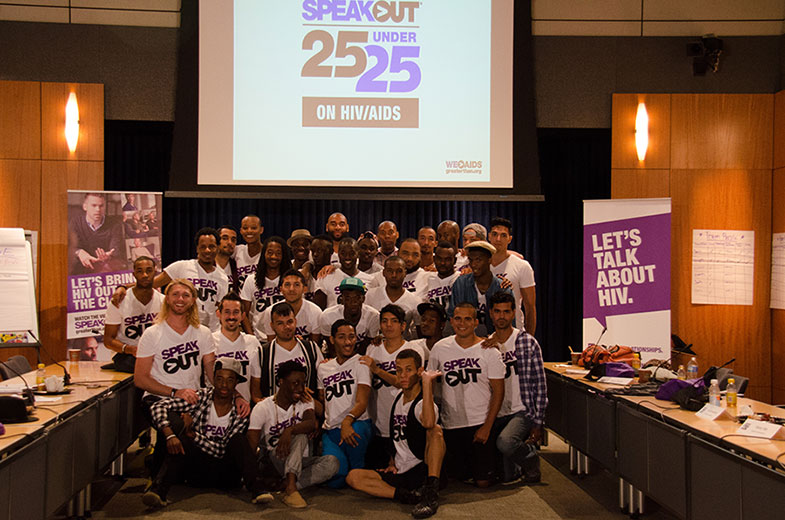
MENLO PARK, CA – Twenty-five young gay men get real about HIV as part of #SpeakOutHIV, a campaign from Greater Than AIDS. The group is encouraging people to break the silence around HIV on social media in the two weeks between National Gay Men’s HIV/AIDS Awareness Day (September 27) and National Coming Out Day (October 11).
Anchored by a series of powerful personal videos recorded by men who are 25 or younger, #SpeakOutHIV challenges people to post their own stories about HIV on YouTube and share through Twitter, Facebook and other social media platforms as part of a collective effort to promote more open discussion about the issue.
The campaign comes at a critical time. New HIV infections are rising among young gay men. The U.S. Centers for Disease Control and Prevention (CDC) reported a 22 percent increase in new infections among gay men ages 13-24 between 2008 and 2010. Overall, young gay men account for one in five new infections in the United States, a share far greater than their representation in the population.
“Despite the continued impact of HIV, gay and bisexual men are not talking about HIV even with those closest to them,” noted Tina Hoff, Senior Vice President and Director of Health Communication and Media Partnerships, Kaiser Family Foundation – a co-founding partner in Greater Than AIDS. “#SpeakOutHIV is about promoting a more open dialogue about HIV in all aspects of life, in relationships, with health care providers and within the community generally.”
The young men featured in #SpeakOutHIV offer unfiltered, intimate accounts about how HIV has affected them and what they want others to know about the disease. They come from regions with high rates of HIV, including the South. The majority are men of color. About one third are HIV positive.
They created their videos with cellphones and other personal devices this month at a Speak Out digital storytelling workshop organized by Greater Than AIDS in Washington, DC. “Once the courageous stories about coming out, HIV-diagnosis, isolation, self-esteem, and the like were shared, I learned from these young men that my story is not so uncommon,” said Jai, an HIV/AIDS educator from Dallas who helped facilitate the workshop and serves as a Greater Than AIDS Speak Out ambassador. “The stories and our shared experience linked us.”
#SpeakOutHIV is part of a broader Speak Out campaign, launched last fall by Greater Than AIDS, to engage the lesbian, gay, bisexual and transgender (LGBT) community in response to the silence and stigma surrounding HIV. The cross-platform campaign, which features HIV-positive and HIV-negative gay men, encourages more open communication about the disease in personal relationships, as well as with healthcare providers and within the community.
AIDS United, Black AIDS Institute and the National Alliance of State and Territorial AIDS Directors helped organize the workshop, along with the Kaiser Family Foundation. Funding was provided by the Ford Foundation and Elton John AIDS Foundation.
For more information about Greater Than AIDS and all the Speak Out elements, including #SpeakOutHIV, visit: www.greaterthan.org/speak-out.
About Greater Than AIDS
Greater Than AIDS is a leading national public information response focused on the U.S. domestic epidemic. Launched in 2009, it is supported by a broad coalition of public and private sector partners, including: major media and other business leaders; federal, state and local health agencies and departments; national leadership groups; AIDS service and other community organizations; and foundations, among others. Through targeted media messages and community outreach, Greater Than AIDS works to increase knowledge, reduce stigma and promote actions to stem the spread of the disease. While national in scope, Greater Than AIDS focuses on communities most affected.
The Kaiser Family Foundation provides strategic direction and day-to-day management, in addition to overseeing the production of the campaigns. The Black AIDS Institute – a think tank exclusively focused on AIDS in Black America – provides leadership and expert guidance and supports community engagement. Additional financial and substantive support is provided by the Elton John AIDS Foundation and Ford Foundation, among others.
Filling the need for trusted information on national health issues, the Kaiser Family Foundation is a nonprofit organization based in Menlo Park, California.
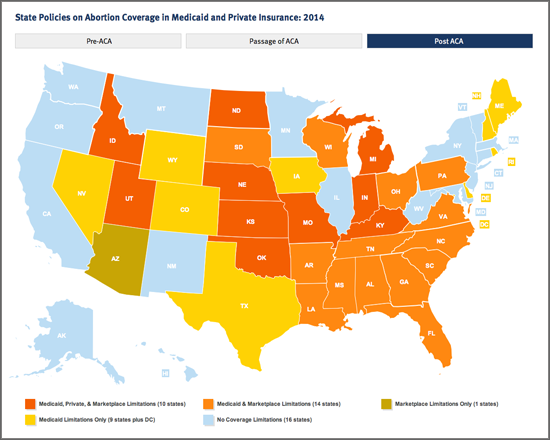
A new interactive map from the Kaiser Family Foundation provides a broad look at states’ laws shaping access to coverage for abortion in Medicaid and private insurance. The map includes the ability to view snapshots showing the extent of such limitations in states across the nation for the years 2000, 2010 and 2014. Taken together, the maps chart the increase in such limitations over that time period.
State and federal attempts to limit private insurance and Medicaid coverage of abortion services began soon after the 1973 Roe v. Wade Supreme Court decision legalizing abortion. However, the passage of the Affordable Care Act in 2010 fueled a new round of legislative efforts to curb insurance coverage of abortion, this time focusing on private plans in the new ACA insurance marketplace. While a handful of states restricted abortion coverage in private insurance prior to the ACA, many more enacted private plan limits and banned abortion coverage from Marketplace plans in the wake of the law’s enactment.
In addition to the new interactive map, a related resource, Coverage for Abortion Services and the ACA, provides a more detailed look at current federal and state policies on Medicaid and insurance coverage of abortion services. For information about state policies impacting abortion, see the State Health Facts section of the Kaiser Family Foundation’s website.
For more information about Women’s Health Policy and the ACA, visit kff.org.
In-person enrollment assisters played an important role in connecting consumers with health coverage during the Affordable Care Act’s first open enrollment period. Based on findings from focus groups with assisters in four cities—Miami, FL; Houston, TX; Raleigh, NC; and Cleveland, OH—this brief identifies key strategies that contributed to their success and priorities and challenges as they look ahead to the next open enrollment period.
Keys to Success
Recruit a committed group of assisters who are able to reach key target populations. The assisters in the study shared a personal commitment to enroll people in health coverage and experience working with the populations they sought to serve. This commitment and experience enabled assisters to build trust with consumers that was critical to breaking down barriers to enrollment.
Foster strong partnerships and collaborations among assisters. Assisters emphasized the importance of partnerships and collaborations across their organizations as a way to share best practices, stay abreast of policy changes, and coordinate outreach and enrollment events. Networking with other assisters was the most consistently helpful strategy for facilitating their work.
Build relationships with local organizations and stakeholders to reach people in their communities. Partnering with key stakeholders in the community helped assisters expand their reach. Assisters noted they could not wait for consumers to come to them; rather they went into the communities where people live and work.
Focus on outreach and consumer education about the law and health insurance. Lack of knowledge among consumers about the health law and new coverage options proved to be a huge hurdle for assisters. Conducting outreach to raise awareness of the law was a necessary step before they could sign people up.
Provide ongoing support to consumers throughout the process, including applying for coverage, selecting a plan, and accessing care. Once they have insurance, helping people understand how to access care has been an unexpected challenge for assisters. They have developed educational materials and tools to assist consumers.
Looking Forward
Even as they face new challenges, assisters are planning for the next open enrollment period. Their priorities for the coming year include strengthening coordination efforts with other assisters, starting outreach earlier with an increased emphasis on the penalty as a way to motivate consumers, and fostering more community ties, especially with physicians. At the same time, overcoming misinformation and lack of awareness about the ACA and ensuring people who are enrolled renew their coverage will present challenges for assisters. The failure of many states to implement the Medicaid expansion will continue to leave many poor adults without an affordable coverage option and place assisters in the difficult position of not being able to help those most in need. Despite these challenges, assisters look forward to building on their experience from the first open enrollment to achieve similar success in year two.
Issue Brief
Introduction
In-person enrollment assisters played an important role in connecting consumers with health coverage during the Affordable Care Act’s first open enrollment period. According to the Kaiser Survey of Health Insurance Marketplace Assister Programs, it is estimated that over 28,000 individual assisters across the country provided assistance to more than 10 million consumers, answering their questions about the health law, helping them apply for coverage through Medicaid and the Marketplaces, and where eligible, helping them select a qualified health plan.1 Through one-on-one appointments and large enrollment events, these assisters guided consumers through the complex application and enrollment process. In the face of many obstacles, assisters developed successful strategies for finding eligible individuals and helping them enroll. Their efforts contributed to the successful enrollment of over eight million consumers into coverage through the Marketplaces and growth in total Medicaid enrollment of an estimated seven million individuals.2,3
This brief highlights the experiences of Navigators, Federally Qualified Health Centers (FQHCs), and Certified Application Counselors (CACs), collectively referred to as assisters in this brief, in conducting outreach and providing enrollment assistance during the first open enrollment period. It complements the findings from our survey of assister programs to provide greater insight into the outreach and enrollment strategies the assisters developed and identifies the keys to successfully overcoming the challenges of the first year that assisters intend to apply during the next open enrollment period. These insights are based on findings from focus groups with assisters conducted in late June and early July in four cities: Miami, Florida; Houston, Texas; Raleigh, North Carolina; and Cleveland, Ohio.
Background
The ACA created a variety of assister programs to provide outreach and direct enrollment assistance to help consumers learn about and enroll in new coverage options through the Health Insurance Marketplaces and expanded Medicaid in the 27 states choosing to adopt the expansion. These programs included Navigators, In-person Assisters (which operate solely in states with a State-based or Consumer Assistance Partnership Marketplace), Certified Application Counselors (CACs), and Federally Qualified Health Centers (FQHCs). While the duties and responsibilities of these programs were similar, the training and other requirements for Navigators and In-person Assisters were generally more extensive than those for CACs and FQHCs. Whether and how these programs were funded also differed across these assister types.
While all assisters faced a myriad of challenges as they sought to find and enroll consumers into coverage, those operating in states with a Federally-facilitated Marketplace (FFM) confronted additional barriers to their work. Fewer resources were available to support assister programs in FFM states. Broad-based marketing and advertising campaigns to raise awareness of the law and the availability of enrollment assistance, common in State-based Marketplaces (SBMs), were virtually non-existent in FFM states. In addition, political opposition to the ACA was often stronger in these states, which contributed to the spread of misinformation and fostered mistrust on the part of consumers. Finally, many states defaulting to an FFM also chose not to expand Medicaid, leaving many poor adults in the coverage gap (not eligible for Medicaid but too poor to qualify for subsidies in the Marketplaces).4
The four focus groups sites were chosen because they were all located in states that opted for the FFM. In addition, three of the four states, FL, NC, and TX, did not expand Medicaid. These state implementation decisions presented assisters with unique challenges; however, assisters in each of the cities achieved significant to modest success in enrolling consumers into coverage (See enrollment data for the focus group states in Figure 1).
Figure 1: Marketplace and Medicaid Enrollment Statistics for Focus Group States
US
Florida
North Carolina
Ohio
Texas
MARKETPLACE COVERAGE
Total Number of Individuals Who Selected a Marketplace Plan
8,019,763
983,775
357,584
154,668
733,757
Marketplace Enrollees as a Share of Potential Marketplace Population
28%
39%(Rank: 4th)
33%(Rank: 9th)
19%(Rank:37th)
23%(Rank:27th)
MEDICAID COVERAGE
Total Change in Medicaid and CHIP Enrollment from Summer 2013 to June 2014
7,258,861
222,919
65,833
292,779
94,101
12%
7%(Rank:28th)
4%(Rank:37th)
13%(Rank:20th)
2%(Rank:39th)
Source: US Department of Health and Human Services, Health Insurance Marketplace: Summary Enrollment Report for the Initial Open Enrollment Period, May 1, 2014 and CMS, Medicaid & CHIP: June 2014 Monthly Applications, Eligibility Determinations, and Enrollment Report, August 2014
Keys to Success
Reflecting back on their experiences during the first open enrollment period, assisters in the focus groups admitted facing many challenges but were also able to recognize their accomplishments. While they served different populations and operated in different environments that presented unique opportunities and challenges, they coalesced around several key strategies that they believe contributed to their successful enrollment efforts.
“The personal connection was what did it in all of those difficult cases for us, people felt comfortable with getting the plan because they liked the CAC they were working with and they felt comfortable…Yeah just trust just to say it again”
– Cleveland Assister
Recruit a committed group of assisters who are able to reach key target populations. The assisters in the study shared a personal commitment to enroll people in health coverage. This commitment allowed them to overcome barriers they faced, think creatively to reach more individuals, and stay positive in a challenging political environment. Despite the many challenges they faced, the assisters described their work as rewarding and believed in the value of the services they were providing. Many were well-known in their communities and had established relationships with members of the community over the course of many years. Across all the focus groups, assisters emphasized the importance of building trust within the community. They agreed that being viewed as a trusted source of information and assistance was critical to their work. It enabled them to overcome the many barriers to enrollment, including a broken website, language barriers, and mistrust of the system on the part of consumers.
Many of the assisters had prior experience enrolling consumers in Medicaid, SNAP, or other programs, which meant they had a foundation to build on as they prepared for the beginning of open enrollment. Many of the assisters in Miami had been working together as Health Navigators since 2006, which they believe contributed to their successful enrollment effort over the past year. Assisters in the other cities also said their prior experience helping consumers enroll in Medicaid and other programs meant that consumers were more willing to come to them for information and assistance applying for Marketplace coverage.
“I think our success rate went up enormously in getting specifically Hispanic families in once we had people who spoke the language doing outreach events. So we had a bilingual Navigator who went on the radio, he went to churches…he did great outreach and people were so hungry for it, but I think they felt like they could trust him more once he was there speaking their language, looked like them and you know had a name that was familiar. So I think that helped a lot.”
– Raleigh Assister
Assisters served many populations with language barriers, complicated immigration status issues, and varying levels of literacy. Reflecting the communities they served, many of the assisters in the focus groups were bilingual. Having bilingual assisters was important to engaging immigrants and other minority populations. An assister in Raleigh reflected that their ability to sign up Hispanic families increased once they recruited bilingual staff. An assister from Miami was the only Creole speaker at her organization and had consumers driving hours to meet with her for assistance. However, many assisters felt there was a need for even more bilingual staff, especially assisters who spoke languages other than Spanish and English. Assisters in Miami, in particular, indicated that a priority for the next open enrollment period was to hire more Spanish and Creole speaking assisters.
“And it was like…we were just bonding in the midst of this chaos; I mean just not knowing what was going on and it was a learning experience for everyone and it didn’t matter. You know, we went in, if there was something you didn’t know, no one was like, “Oh well should know that.” …And so for me, I think working together with such a great group of people helped me get through it.
– Raleigh Assister
Foster strong partnerships and collaborations among assisters. Assisters in every site spoke to the importance of partnerships and collaboration across their organizations. In Miami, one assister said at the beginning of the process, the relationship between organizations felt more territorial as everyone worked to meet their own deliverables. But as the enormity of demand among consumers was made clear, everyone began to collaborate and work together. In Houston, as a large city that is very spread out, assisters worked together to coordinate events, redirect consumers when demand became too intense for a particular site, and share lessons learned. Assisters in Raleigh said knowing they were not alone and could go to anyone with a question without judgment helped immensely. One assister said she felt as if they all bonded in the midst of chaos.
“And then when you look at Harris County and then the other counties it was, the work was too important to run the risk of ten people from ten different organizations showing up for this event; and then no one show[ing] up for this event. So that was the reason that we decided to coordinate our efforts. And so we had one call center and we all went in on maintaining this one call center number. And we tried to have all requests to come in through the collaborative…”
– Houston Assister
Most of the Assisters say their organizations were part of coalitions that shared best practices, policy changes, schedules of events, and “workarounds” for website problems. These consortiums grew out of the need to have conversations with one another and provided a platform for many enrollment assisters to address concerns and challenges or to propose new ideas. In some of the sites, these coalitions were spearheaded by local government or supported by federal agencies, while in other areas, the coalitions developed more organically among the groups themselves. Some of the coalitions had internal listservs, weekly webinars or calls, and monthly meetings. Assisters relied on these coalitions to coordinate mass enrollment events, schedule appointments, and to shift staff, particularly bilingual staff, to different sites as needed.
Assister groups in Raleigh and Houston described the value of having a single call center handle all appointment and event requests. Assisters in North Carolina established a statewide 800 number that consumers could call to find out what help was available to them and to schedule appointments. They also maintained an internal website for managing appointments and events to ensure that events were staffed with the right number and mix of assisters. Navigators in Houston also set up a local call center for coordinating outreach and enrollment events. The call center was staffed by the members of the collaborative and all event requests were logged into the central database. A committee reviewed the requests and managed staffing for the many events.
“I think a lot of the times we, those who had the ability to interconnect with one other, leaned on one another a lot.”
– Miami Assister
Assisters found that networking with other assisters was the most consistently helpful tool in answering their questions. Many assister organizations also developed their own resources for consumer education and outreach, such as a one-pager or folders with information to distribute. They worked to simplify the messages in their own way to help consumers better understand their options.Most of the Assisters in the study said there was a culture of learning and sharing within their organizations and among assister organizations that enabled them to improve in their jobs quickly. The ability to share experiences and learn from one another was especially important because most assisters felt the training they received prior to open enrollment was inadequate. Many said the leaders of their organizations did a good job of keeping them abreast of changes in policy or the process. Most had some kind of weekly email or webinar that comprehensively addressed what their focus should be for that week. In North Carolina, the FQHCs sent around a biweekly newsletter about policy changes and other enrollment issues.
Build relationships with local organizations and stakeholders to reach people in their communities. Beyond collaboration with other enrollment assister organizations, the assisters in our study said they also partnered with key stakeholders at the state and community level, including hospitals, churches, other social service organizations, food banks, small businesses, and local TV and radio stations, among others to spread the word and expand their efforts. Most assisters found working with groups focused on outreach and public education particularly beneficial. Groups, such as Enroll America, Planned Parenthood, and local unions in some areas, helped raise awareness and could direct people to the assisters for help applying for coverage. In Houston, Enroll America was particularly active going to churches and other faith based organizations to spread awareness and advertise enrollment events.
Assisters were often able to leverage existing partnerships they already had on the ground to help spread the word about the availability of free, in-person assistance. In Miami and Cleveland, for example, some participants went to hospitals and clinics weekly and set up a table for enrollment. One hospital in Cleveland also kept a record of every patient who paid out of pocket for care and would connect those patients with enrollment assisters. In Raleigh, a local health department played an active role in the enrollment effort and sent letters to self-pay patients who had received services in the past two years. They garnered interest from about fifteen thousand people through that effort.
“Yeah, trying to be present in folks’ lives so that they would come across us enough to see that we were here, we were here to help, it was consistent, it was safe. And so that was really tough for us to generate those places and events and be in enough different places. I mean we tried everything.”
– Cleveland Assister
Many Assisters in the focus groups agreed they could not wait for consumers to come to them for assistance—they had to go out into the community and make their presence known. Assisters said they would look for ways to insert themselves into people’s everyday lives, such as setting up tables at grocery stores, libraries, churches, soup kitchens, and homeless shelters. Their goal was to be everywhere – town hall meetings, open houses, small businesses, and parks – in an effort to show consumers they were there and available to help.
Assisters also benefitted from support from local non-profits, city elected officials, and federal government representatives. For example, the city of Houston Health Department was active in spearheading outreach events and coordinating enrollment activities across the Houston area. Also, the regional CMS representative in Houston was very visible during this period and attended many outreach functions as well as acted as a resource for assisters. Although local officials in Miami joined the effort late in the process, according to assisters there, their presence at enrollment events helped generate media attention and interest within the community. In Cleveland, participants spoke highly of the United Way 211 number, a resource available to consumers to hear about outreach and enrollment events in their area and to find in-person assistance close to them.
While assisters built partnerships with many stakeholders, for the most part, they did not collaborate with brokers. Although brokers possess expertise in the area of private insurance and understanding health plan options available to consumers, assisters in this study said they were wary of working too closely with brokers, seeing their roles as vastly different. Likewise, they did not often refer consumers to brokers for fear that brokers would try to “sell” consumers on a particular plan rather than the plan that may fit the consumers’ needs the most. Brokers were often present at events, but assisters looked at them as more of an information resource than a partner.
Focus on outreach and consumer education about the law and health insurance. Conducting outreach to raise public awareness about the law and the availability of enrollment assistance was an important first step to getting people enrolled in coverage, but one that many assister organizations, scrambling to get staff in place for the start of open enrollment, initially did not have the resources to invest in. One navigator organization in Raleigh said they initially did not do a lot of outreach so that they could focus on enrolling people into coverage. They realized that was a mistake – that consumers did not know where to go for help or even that help was available and were too confused by the law to understand what coverage options were available – so they shifted gears during the open enrollment period to focus more on outreach. Assisters in Houston made a similar adjustment. During the early part of open enrollment when the website was down, they used the time to reach out to consumers and educate them about the law and what would be needed to sign up.
Some assisters recognized early the importance of community outreach. For example, one organization in Cleveland had begun community education two years before open enrollment with presentations describing the Affordable Care Act. They went back to the same groups of people once the open enrollment period started to help enroll those who were eligible. Assisters housed in health clinics also explained they could not just rely on in-reach with their current patients – that is, only reaching out to clinic patients they knew were uninsured – but needed to go out into the community to conduct outreach and education to spur enrollment.
In Cleveland, assisters worked together to hold several phone-a-thons throughout the open enrollment period. They partnered with local television stations and were able to field phone calls from interested consumers and schedule them for appointments. Early in the process, these navigators said that people were mostly asking questions about what the Affordable Care Act was and what benefits it offered, but by the end of the enrollment period, they were asking specific questions about where they could go to get enrolled. Enrollment assisters agreed the anonymity callers had during the phone-a-thon helped them ask important questions they may have been embarrassed to ask otherwise.
Lack of knowledge among consumers about the health law and new coverage options was a huge hurdle for assisters in this study. Before assisters could sign people up, they had to first educate them on what insurance was. Often this meant two appointments instead of just one – the first one to educate about the law and new options, and the second to start the application. Assisters felt that media advertising could have been employed earlier during the open enrollment period and used more effectively to explain the law to consumers.
“You had the situation where somebody would come in and they heard from a friend, I got a plan that cost me, it’s only going to cost me $60 a month. So they come in, immediately the first thing they say is, I want that plan…And they don’t realize that everything’s based on your household size or income, so everybody’s situation is a little bit different.”
– Miami Assister
Although many of the assisters in this study had experience helping people apply for Medicaid, they were less familiar with private insurance and found questions about health insurance sometimes difficult to answer. They needed to explain deductibles, copays, premiums, and other insurance terms with very little training about these concepts. Many of the assisters reported developing their own educational materials explaining health insurance and how it works to hand out to consumers. Assisters also found explaining the subsidy to consumers challenging. Assisters in Miami, in particular, felt the lack of education around the availability of the subsidies and how they worked presented a significant barrier to consumers applying for coverage. They also noted that even when consumers were aware of the subsidies, there was a great deal of misinformation about how they worked. It was common for consumers to come in expecting to pay what their neighbor paid. Assisters had to explain that the subsidy amount each person receives is based on their individual circumstances, which some found difficult to understand.
“[Consumer education] took our clinic twice as long, because you have to translate it and how do you explain to someone…in a language that doesn’t have the word insurance? How do you explain to a Burmese refugee who’s never had health insurance, you know, what it is and how to use it?”
– Houston Assister
Educating consumers about insurance and their plan choices was even more difficult when there were language or cultural barriers. Assisters complained about the lack of resources available in different languages, particularly for those working with large immigrant populations. But, the challenges were greater than simply not having an application in the right language. For example, one Assister in Houston expressed the difficulty she faced in explaining insurance to people who came from a country that did not offer insurance or who spoke a language that did not have a word for “deductible” or “co-pay.” For these consumers, choosing a plan was made more daunting by their unfamiliarity with the concept of insurance and how to use it.
Provide ongoing support to consumers throughout the process, including applying for coverage, selecting a plan, and accessing care. Assisters noted the importance of providing one-on-one assistance to consumers at every stage of the process, including helping them understand their eligibility for coverage, educating them about the premium and other costs associated with the QHP options, and once enrolled, helping them understand how to use their coverage to access the care they need.
“We got to the point that we would form relationships with these folks, and they would call back. On our business cards we have our cell number and our office number so it’s sort of 24/7 hand-holding. These folks that you know this part didn’t work out or they haven’t heard or they can’t figure this out. So it’s not a onetime shopping [experience] and they really look to you to continue to solve these problems and figure it out.”
– Cleveland Assister
According to assisters, their clients are coming back to them with questions. A large part of the enrollment assisters’ current job is helping consumers figure out what to do now that they are enrolled. They established personal relationships with many of the consumers they worked with and have continued to serve as an ongoing resource. Many consumers are coming back to the person they know with questions about how to make payments, choose a doctor, or get prescriptions. Some consumers have not received their bills or insurance card and want help figuring out what to do. Assisters seem to be helping consumers solve these problems if they can, often calling the insurance companies directly to answer the consumers’ questions for them.
Helping people understand how to access the care they need now that they have insurance has been an unexpected challenge for assisters. Many assisters realized they needed to educate consumers on how to use their insurance. Many of their clients have never been insured before, so did not know how to go about choosing a primary care physician or even that they needed to go to their physician instead of continuing to go to the Emergency Department.
“Tomorrow we’re setting up a table at our clinic just to say… how to use your benefits.”
– Houston Assister
“We’re doing ‘I’m covered, now what.’ And that loops in what to do with your health insurance plans. How to use your health insurance. How to pick a PCP. What urgent care is versus emergency room care…It’s a powerpoint presentation that we’re going back into the same communities that we enrolled in, usually those same sites.”
– Miami Assister
Assisters reported organizing education events to teach people how to use their benefits. In Houston, one assister said her organization is setting up tables at clinics and talking with patients there. An assister in Miami reported developing a PowerPoint presentation describing how to use insurance. They are going back to the communities where they first conducted outreach to give the presentation. In addition to educating those newly covered, they are also using it as a marketing tool to reach those who did not enroll in the first year to let them know they can sign up beginning in November.
Assisters also see helping with renewals as part of the ongoing support they want to provide to consumers. Most were uncertain of how the renewal process would work, but are committed to making sure the clients they helped sign up in the first year, keep their coverage in the second year. They are, however, worried about their capacity to serve everyone, anticipating a surge in the number of consumers because they will be working with both with those applying for the first time, as well as with those renewing their coverage. In general though, having gone through the process before, they feel much better prepared to handle what they expect will be a challenging second open enrollment period.
Ongoing Challenges for Assisters
Despite their successes, assisters across the study sites reported confronting a number of barriers as they tried to sign consumers up for coverage. Primary among these barriers was the lack of a coverage option for many in states that did not expand Medicaid. Many poor consumers in these states did not meet eligibility requirements for Medicaid, but were too poor to qualify for subsidized coverage in the Marketplace and fell into the coverage gap. Other issues related to technological as well as language and cultural barriers. These challenges are likely to persist into the next open enrollment period.
“I think the hardest thing to explain was that Medicaid gap.…Because you know you’re talking to the poorest population and you’re having to explain to them that they don’t qualify because they’re too poor.”
– Raleigh Assister
Many consumers fell into the coverage gap. Assisters in the three study states that did not expand Medicaid said they encountered many families who fell into the coverage gap and did not qualify for Medicaid or the subsidies to help them pay for coverage through the Marketplace. Although they did not keep statistics on the number of individuals who fell into the coverage gap, the assisters in the states that did not expand Medicaid indicated there were many people who fell into the gap. Several assisters said this was the hardest part of their job. Many described it as emotionally taxing to essentially tell these families that they were “too poor to qualify for health insurance.”
The coverage gap affected a group of people who are used to things not working out for them, according to one navigator. The enrollment assisters said it was incredibly frustrating knowing there was nothing they could do to help beyond providing a list of resources for where those people could go for free or low cost care. Most had a sheet of paper to give the consumer explaining what the coverage gap was using federal poverty level terms.
Because we’ve done, did CHIP and Medicaid outreach for so long, we had a name in the community and people would contact us who were uninsured, but unfortunately a lot of them were people who fell into the Medicaid gap and so that was something that was very difficult, because it put us in the position of having to explain that…unfortunately Texas decided not to accept the Medicaid expansion.
– Houston Assister
Marketplace and Medicaid eligibility systems were not coordinated. Another barrier described by assisters was the lack of coordination between the Marketplace and state Medicaid agencies. Although these eligibility systems were supposed to “talk” to each other so that information would be shared electronically, assisters indicated this coordination did not happen. They learned early on that applications submitted through healthcare.gov were often not transferred to the state Medicaid agency for an eligibility determination. This was a particular problem for children in families whose parents were eligible for coverage through the Marketplace, but who were themselves eligible for Medicaid or the Children’s Health Insurance Program (CHIP). To address this problem, assisters began submitting applications directly to the Medicaid agency, or in some cases, submitting separate applications to the Marketplace and to Medicaid. Assisters in Houston indicated that they would sign children up for Medicaid or CHIP first through the state agency then submit an application for the parents through healthcare.gov. While this process was cumbersome and time-consuming, assisters noted it was necessary to ensure consumers obtained coverage.
“We sign people up for emails that they will never use; they will never get the information…I understand that most populations are getting to be more computer literate, but there’s still a huge population that doesn’t use emails and they have to be able to navigate these systems or have access to these systems without the internet.”
– Miami Assister
Many consumers are not comfortable online. Assisters across all the study sites said many of the consumers they worked with were not able to use computers or did not have internet access at home. Although developing an online application process was intended to streamline the enrollment process, the lack of familiarity with and access to computers and the internet prevented many consumers from applying on their own. Related to the lack of computer use, a majority of consumers helped by assisters did not have email addresses. One assister in Houston said nine out of ten people she helped to enroll did not have emails. Consequently, enrollment assisters would often have to help consumers create email accounts as a first step in the application process. Once these accounts were created, assisters ran into the issue of the consumer not remembering their username and password. To combat this, many developed formulas for creating easy to remember usernames and passwords and developed forms for capturing this information that they would give to consumers at the end of their sessions. Still, many assisters expressed concern over whether consumers without internet access would be able get notices about their accounts.
Affordability was a concern for some consumers. Assisters noted that the cost of coverage through the Marketplace was a barrier for some consumers. One of the problems, according to assisters was that a number of people came to them believing that their insurance would be free. These consumers were frustrated when they saw what the premium amounts were and expressed concern over their ability to afford the coverage. In general, assisters agreed people who qualified for Medicaid were the happiest because their coverage was free or very low cost. Assisters in the focus groups also said they had a number of consumers choose the least expensive plans, not fully understanding (despite the assister’s efforts) the high deductible. After using their plans, they say some consumers have come back to them wanting to change plans.
“Language access, lack of resources in [other] languages…cultural competency with the call center…there were just a lot of things that really frustrated a lot of people but I think the identify verification was the hardest part because a huge part of the immigrant community, they don’t have that credit history so I would say a majority of our clients who came in, we had to get their identity verified the old school way through the mail.”
– Cleveland Assister
Immigrants faced verification and language barriers. The assisters in the focus groups agreed that they encountered particular challenges trying to enroll immigrants in coverage. Proving identity for immigrants was the biggest barrier. One navigator in Raleigh said she had no training on how to properly verify IDs or immigrant forms and did not know of any resource that would have helped. However, even when they had the necessary documents, the assisters noted that systems’ problems prevented them from uploading those documents, and as a result, they had to verify immigrant identities through the mail, which was a long arduous process. There were also language barriers throughout the process. Most assisters who accessed interpreter services through the federal call center found the process cumbersome and often ineffective. Informational materials were often not available in other languages, and sometimes when they were, they were not in the dialects that people spoke and understood. The language barriers continued once people were enrolled in coverage as many of the insurance companies communicated with their enrollees in English, even when another language was identified as the enrollee’s primary language. Adding to these challenges was the nervousness many immigrants felt about sharing information about their families and getting help, fearing legal repercussions.
Looking Forward
Even as they continued to assist consumers with questions and issues related to their current enrollment, assisters are already looking ahead to the next open enrollment period. Of note, all the assisters in the study indicated they planned to provide assistance in the coming year whether or not they receive funding. They gained a great deal of experience and learned what worked and what didn’t for reaching consumers and plan to put those lessons into action for the next open enrollment period. When asked about specific strategies for November, one assister in Miami stated, “I think we would do what we did, but better.”
The assisters identified a number of priority areas leading into the next open enrollment. They plan to build on relationships they developed in the first year to formalize and strengthen communication pathways to facilitate sharing of experiences and lessons learned. They also anticipate coordinating more effectively to plan and execute outreach and enrollment events, both large and small. Recognizing the importance of outreach, they plan to initiate outreach and education campaigns earlier. In fact, many assisters have already begun outreach efforts, this year emphasizing the availability of subsidies and the penalty for not signing up as a way to motivate consumers to act. They will work more closely with the media on broad-based education campaigns and will target education efforts on providers, especially physicians, to increase awareness of the availability of enrollment assistance.
While assisters report feeling much better prepared heading into the next open enrollment period, they will continue to face challenges. It is likely that website issues and glitches will persist. And, even if most of the problems are resolved, assisters will still have the challenge of navigating an online system with consumers who have limited experience and comfort using computers. Misinformation and lack of awareness about the ACA will remain a barrier to enrollment for many consumers. Once enrolled, consumers will continue to need education on how to use their insurance and assistance with post-enrollment problems. Renewals of coverage will present yet another burden for assisters as they work to maintain coverage for consumers they enrolled in the first year at the same time they identify and enroll consumers who did not sign up. The failure of many states to implement the Medicaid expansion will continue to leave many poor adults without an affordable coverage option and place assisters in the difficult position of not being able to help those most in need. Finally, funding to support the work of assister programs will continue to be an issue. Less funding has been made available in FFM states for the coming year, and future financial support remains uncertain.
Assisters in this study, along with others across the country, were instrumental in achieving the enrollment success of the first open enrollment period. They demonstrated persistence in overcoming obstacles and proved flexible in adapting to an ever-changing situation. Their knowledge and experience was hard won and invaluable. Building on this experience will be essential for ensuring similar success in the coming year.
This brief was prepared by Jennifer Tolbert from the Kaiser Family Foundation and Michael Perry, Sean Dryden, and Kathleen Perry from PerryUndem Research and Communication. The authors extend their gratitude to the assisters who participated in the focus groups for sharing their time and experiences to inform this project.
Endnotes
Pollitz K, Tolbert J, Ma R, Survey of Health Insurance Marketplace Assister Programs: A First Look at Consumer Assistance under the Affordable Care Act, Kaiser Family Foundation, July 2014. ↩︎
US Department of Health and Human Services, Health Insurance Marketplace: Summary Enrollment Report for the Initial Open Enrollment Period, May 1, 2014. ↩︎
CMS, Medicaid & CHIP: June 2014 Monthly Applications, Eligibility Determinations, and Enrollment Report, August 2014. ↩︎
For more information, see: u00a0Kaiser Family Foundation, The Coverage Gap: Uninsured Poor Adults in States that Do Not Expand Medicaid, Updated March 2014. ↩︎
The Patient Protection and Affordable Care Act (ACA) makes significant changes to health coverage for women by expanding access to coverage and broadening the health benefits that many will receive. In January 2014 the coverage expansions to assist uninsured individuals gain access to coverage took effect. The issue of abortion coverage was at the heart of many debates in the run up to the passage of the law and continues to the present day. This brief reviews current federal and state policies on Medicaid and insurance coverage of abortion services, and presents national and state estimates on the availability of abortion coverage for women who are newly eligible for Medicaid or private coverage as a result of the ACA.
Impact of the Affordable Care Act on Health Coverage for Women
Signed into law on March 23, 2010, the ACA is a federal law that aims to ensure that U.S. citizens and legal residents have health insurance by requiring most individuals to obtain a minimum level of insurance coverage. This is to be achieved through a combination of public and private insurance expansions. The ACA was designed to expand health care coverage to the poorest uninsured by extending Medicaid eligibility to all qualifying individuals with incomes up to 138% of the Federal Poverty Level (FPL).1 The 2012 Supreme Court ruling, however, had the effect of giving states the option to expand their Medicaid programs rather than requiring this expansion, as was the design of the ACA. As of September 2014, 27 states and the District of Columbia have expanded Medicaid eligibility, but 23 states have not,2 leaving millions of poor individuals without a pathway to affordable coverage.3
The ACA also includes reforms that aim to make insurance more affordable and accessible. Individuals with incomes above the federal poverty level will be able to obtain insurance through healthcare Marketplaces, also known as exchanges, which will offer a variety of plans from which they can purchase insurance. To help those with low and moderate incomes with the costs of insurance, the federal government will provide subsidies (in the form of premium tax credits) to eligible individuals and families with incomes between 100% and 400% FPL.4 All plans offered on the Marketplace must provide coverage for 10 Essential Health Benefits (EHB). Abortion services, however, are explicitly excluded from the list of EHBs that all plans are required to offer. Under federal law, no plan is required to cover abortion.
Federal and State Laws Regarding Coverage of Abortion Services
Since 1977, federal law has banned the use of any federal funds for abortion, unless the pregnancy is a result of rape, incest, or if it is determined to endanger the woman’s life. This rule, also known as the Hyde Amendment, is not a permanent law; rather it has been attached annually to Congressional appropriations bills, and has been approved every year by the Congress. The Hyde Amendment initially affected only funding for abortions under Medicaid, but over the years, its reach broadened to limit federal funds for abortion for federal employees and women in the Indian Health Service. Until recently, insurance coverage of abortion for women in the military had been even more restricted so that pregnancies resulting from rape or incest were not covered. In early 2013, an amendment to the National Defense Authorization Act expanded insurance coverage for servicewomen and military dependents to include abortions of pregnancies resulting from rape or incest, as permitted in other federal insurance policies.5 Federal funds cannot be used to pay for abortions in other circumstances, and abortions can only be performed at military medical facilities in cases of life endangerment, rape or incest.
State level policies also have a large impact on how insurance and Medicaid cover abortions, particularly since states are responsible for the operation of Medicaid programs and insurance regulation. The Medicaid program serves millions of low-income women and is a major funder of reproductive health services nationally. Approximately two-thirds of adult women on Medicaid are in their reproductive years.6 As discussed earlier, the federal Hyde Amendment restricts state Medicaid programs from using federal funds to cover abortions beyond the cases of life endangerment, rape, or incest. However, if a state chooses to, it can use its own funds to cover abortions in other circumstances. Currently, 17 states use state-only funds to pay for abortions for women on Medicaid in circumstances different than those federal limitations set in the Hyde Amendment.7 In 32 states and the District of Columbia, Medicaid programs do not pay for any abortions beyond the Hyde exceptions (Appendix 1). South Dakota limits coverage to cases of life endangerment for the woman, in apparent violation of federal law.
The ACA reinforces the current Hyde Amendment restrictions, continuing to limit federal funds to pay for pregnancy terminations that endanger the life of the woman or that are a result of rape or incest (Table 1). State Medicaid programs continue to have the option to cover abortions in other circumstances using only state funds and no federal funds. President Obama issued an executive order as part of health reform that restated the federal limits specifically for Medicaid coverage of abortion.8 The law also explicitly does not preempt other current state policies regarding abortion, such as parental consent or notification, waiting period laws or any of the abortion limits or coverage requirements that states have enacted.
Table 1: Summary of Abortion Provisions in the Patient Protection andAffordable Care Act (P.L. 111-148)
Benefit Design
Abortion coverage is prohibited from being required as part of the federally-established essential benefits package;
States can prohibit coverage for any abortions by all plans in their state Marketplace;
At least one plan within a state Marketplace must not cover abortions beyond those permitted by federal law (to save the life of the woman and in cases of rape and incest);
Private insurance carriers may offer a plan in the state Marketplace that includes coverage of abortions beyond those permitted by federal law as long as they comply with the requirement to segregate federal funds.
Financing
Federal law only permits federal funds to be used to pay for abortions when the pregnancy is a result of rape or incest or is a medical threat to the woman’s life. States can use state-only funds to pay for “medically necessary” abortions beyond federal requirements under Medicaid or to pay for abortion coverage in plans offered in a state Marketplace;
Federal subsidies (for premiums or cost sharing) are prohibited from being used for coverage for abortions beyond those permitted by federal law;
In order to segregate funds, plans that choose to offer coverage for abortions beyond Hyde limitations must estimate the actuarial value of covering abortions by taking into account the cost of the abortion benefit (valued at least $1 per enrollee per month) and cannot take into account any savings that might be gained as a result of the abortions. Any state Marketplace plan that covers abortions and includes enrollees that receive federal subsidies must collect two separate premium payments from all enrollees – one payment for the value of abortion benefit and one payment for the value of all other covered services.
State Role
The ACA has no effect on state laws regarding coverage, funding or procedural requirements on abortions, such as parental notification/consent laws;
States can prohibit plans in a state Marketplace from covering any abortions, even if the pregnancy is a result of rape or incest or a threat to the woman’s life;
State-level health insurance commissioners monitor and oversee payment segregation requirements for the purchase of plans within their respective state Marketplaces.
Discrimination/ Protection
Plans participating in the state Marketplace are prohibited from discriminating against any provider because of unwillingness to provide, pay for, provide coverage of, or refer to abortions.
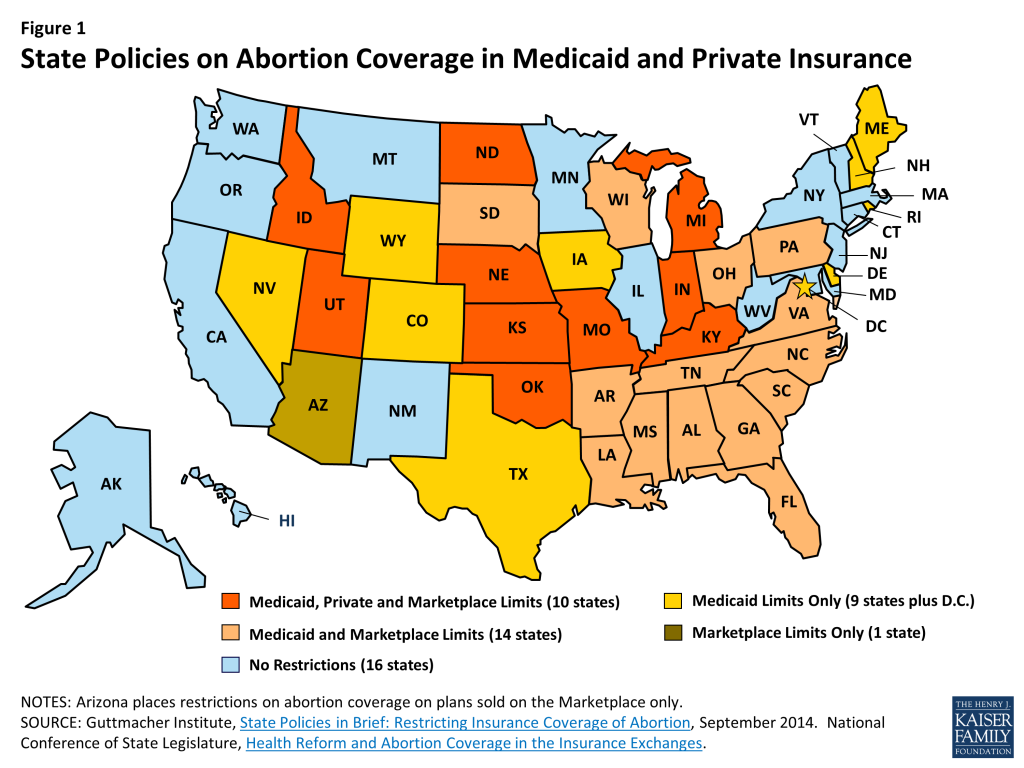
In the private insurance sector, where states have the authority to regulate plans that are issued in the state, 10 states impose restrictions on the circumstances under which insurance will cover abortions in Medicaid, Marketplace plans, and private insurance (Figure 1 and Appendix 1). Some states follow the same restrictions as the federal Hyde Amendment for their private plans, while some are more restrictive. Idaho has exceptions for cases of rape, incest, or to save the woman’s life for plans sold on the Marketplace, but limits abortion coverage to cases of life endangerment to the woman for all other private plans issued in the state. Utah has exceptions to save the life of the mother or avert serious risk of loss of a major bodily function, if the fetus has a defect as documented by a physician that is uniformly diagnosable and lethal, and in cases of rape or incest. However, six states (Kansas, Kentucky, Missouri, Nebraska, North Dakota, and Oklahoma) have an exception only to save the woman’s life for all private plans. Michigan allows abortion coverage in cases of life endangerment to a woman and when the abortion increases the probability of a live birth or preserves the life or health of the child after live birth, such as in cases involving a reduction, or multi-fetal pregnancy.9 Five states had these laws on the books prior to the ACA, and five more states have passed new laws banning private plan coverage post-ACA. While nine of these states allow insurers to sell riders for abortion coverage on the private market, there is little evidence about their availability and no documentation of their cost or impact on access. Utah does not allow riders to be sold for abortion coverage.
Figure 1: State Policies on Abortion Coverage in Medicaid and Private Insurance
Because the ACA explicitly prohibits states from including abortion in any essential benefits package, states or insurers offering plans in a state Marketplace will not be required to offer abortion coverage. The ACA also stipulates that at least one multi-state plan that must limit abortion coverage to those permitted by current federal law. States can also pass laws that bar all plans participating in the state Marketplace from covering abortions, which 25 states have done since the ACA was signed into law in 2010. Most states include narrow exceptions for women whose pregnancies endanger their life or are the result of rape or incest, but two states (Louisiana and Tennessee) do not provide for any exceptions.10 The ACA prohibits plans in the state Marketplaces from discriminating against any provider because of “unwillingness” to provide abortions.
In states that do not bar coverage of abortions on plans available through the Marketplace, insurers may offer a plan that covers abortions beyond the federal limitations, but this coverage must be paid for using private, not federal, dollars. Plans must notify consumers of the abortion coverage as part of the summary of benefits and coverage explanation at the time of enrollment. The ACA outlines a methodology for states to follow to ensure that no federal funds are used towards coverage for abortions beyond the Hyde limitations. Any plan that covers abortions beyond Hyde limitations must estimate the actuarial value of such coverage by taking into account the cost of the abortion benefit (valued at least $1 per enrollee per month). This estimate cannot take into account any savings that might be achieved as a result of the abortions (such as prenatal care or delivery).11
Furthermore, the federal rules stipulate that plans that offer abortion coverage and receive federal subsidies (it is believed that all plans in the state Marketplace will receive at least some federal subsidies) need to collect two premium payments, so that the funds go into separate accounts. One payment would be for the value of the abortion benefit and the other payment would be for the value of all other services. The funds are to be deposited in separate allocation accounts, overseen for compliance by state health insurance commissioners. If a state has multi state plans on the marketplace, then at least one of those plans must limit abortion coverage to the Hyde Amendment restrictions.12 In 2014, of the 150 multi-state plans, two offered coverage of abortion beyond the Hyde restrictions. Both of these plans were offered only in Alaska.13
The Availability of Abortion Coverage to Women Newly Eligible Under the ACA
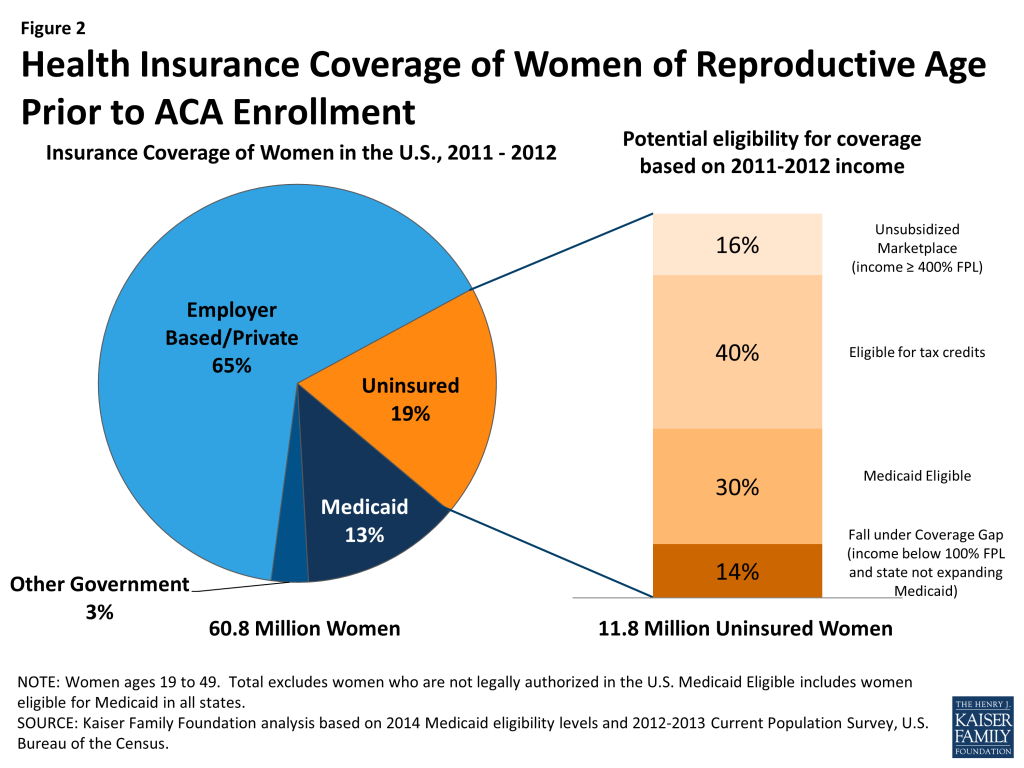
Figure 2: Health Insurance Coverage of Women of Reproductive Age Prior to ACA Enrollment
The ACA intended to increase affordability of health insurance and extend coverage to uninsured individuals through a number of changes to the insurance market, including expansion of Medicaid to include individuals with incomes up to 138% FPL, the creation of the state Marketplaces, and the availability of premium subsidies for low to moderate income individuals and families. However, due to a 2012 Supreme Court decision, Medicaid expansion is now optional for states; currently 23 states have not implemented Medicaid expansion. Women in these states who do not meet traditional Medicaid eligibility requirements and whose incomes are below 100% FPL are not eligible for Medicaid, and do not qualify for subsidies on the Marketplace, effectively creating a coverage gap.14 Using survey data prior to ACA enrollment (from 2011/2012) and applying current state Medicaid and Private insurance policies, one is able to get an estimate of the number of uninsured women who would be eligible for coverage in today’s health insurance market . In 2011/2012, there was an average of 11.8 million uninsured women of reproductive age (ages 19 to 49) legally residing in the United States (Figure 2). Of these uninsured women, an estimated 3.4 million (29%) qualify for Medicaid or have been eligible, but had not previously enrolled in the program (Figure 2). About 4.8 million women (40%) have incomes between 100 – 400% of the Federal Poverty Level (FPL) and qualify for subsidies in the form of tax credits if they obtain coverage through their state Marketplace. About 1.8 million uninsured women with incomes at or above 400% of FPL are eligible to obtain coverage on the state Marketplace or through the individual market, but do not qualify for subsidies because their income is too high. Finally, an estimated 1.7 million uninsured women fall into the so-called “coverage gap” because they live in one of the 23 states that is not expanding Medicaid and their income is below 100% FPL, leaving them ineligible for subsidies to purchase coverage on the health care Marketplace under the law.15, 16
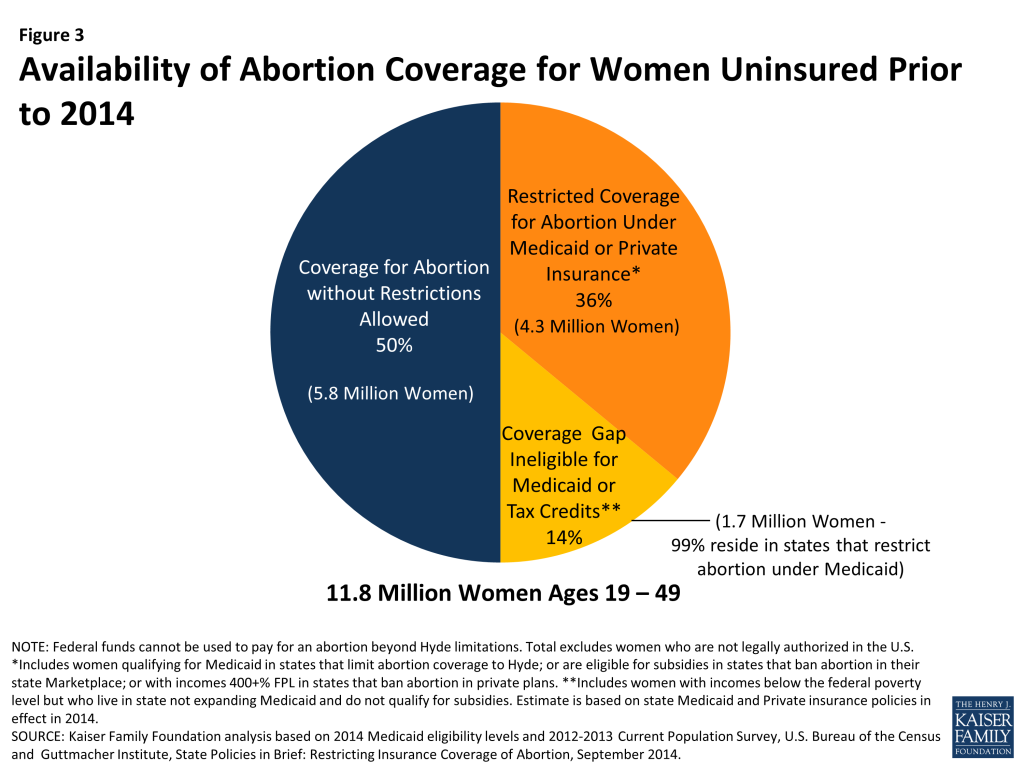
Figure 3: Availability of Abortion Coverage for Women Uninsured Prior to 2014
Because of the Hyde Amendment rules and the state laws that govern coverage of abortion services in private plans, the availability of abortion coverage varies across the states among the women who are newly eligible for Medicaid and private coverage. Of the estimated 11.8 million women who are uninsured and legally present in the United States, half (50%) have been eligible to enroll in a Medicaid plan or private insurance plan that does not limit the scope of coverage for abortion services if they wish (Figure 3). Over one third, 4.3 million women, live in a state where state policy limits the availability of coverage for abortion services in private or Medicaid plans to pregnancies that result from rape or incest or are a medical threat to a woman’s life as in the Hyde Amendment or, in the case of some states, even more limited circumstances, such as only in the case of life endangerment. About 1.7 million women (14%) are in the Medicaid coverage gap and do not have access to affordable coverage, either to Medicaid or subsidies, because their state did not expand Medicaid and their incomes are too low to qualify for tax credits under the law. Out of the 23 states not expanding Medicaid, 21 are states that follow the Hyde Amendment. Two states, Montana and Alaska, use state-only funds to cover abortions beyond the Hyde limits but are not expanding Medicaid eligibility. As a result, nearly all of the women in the coverage gap states (99%) would have restricted availability of abortion coverage under Medicaid even if their state were to broaden eligibility.
Women who seek an abortion but do not have coverage for the service need to shoulder the out-of-pocket costs of the services. The cost of an abortion varies depending on factors such as location, facility, timing, and type of procedure. A clinic-based abortion at 10 weeks’ gestation is estimated to cost between $400 and $550, whereas an abortion at 20-21 weeks’ gestation is estimated to cost $1,100-$1,650 or more.17 Though the vast majority (~90%) of abortions are performed early in pregnancy, the costs could be economically challenging for many low-income women.18 Approximately 5% of abortions are performed at 16 weeks or later in the pregnancy.19 For women with medically-complicated health situations or who need a second-trimester abortion, the costs could be prohibitive. In some cases, women may have to delay their abortion while they have time to raise funds20 , or women may first learn of a fetal anomaly in the second trimester when the costs are considerably higher.21
Conclusion
While millions of women have gained health insurance coverage as a result of the ACA insurance expansions, many are enrolled in insurance plans that restrict the circumstances in which abortion services will be covered. As a result of state actions to limit coverage of abortion in the Marketplace plans and federal law limiting abortion coverage under Medicaid, over one third of women who were newly eligible for coverage are limited to enrollment in a plan that restricts abortion coverage to Hyde restrictions or, in some states, more restrictive circumstances. Half of women of reproductive age who are legally residing in the U.S. qualify for coverage in plans that do not have limitations, and 14% are in the coverage gap and have not been able to qualify for Medicaid or affordable coverage.
These coverage limitations are occurring at a time when many states are taking other actions to curtail access to abortion through multiple fronts. These efforts include state level legislation that focuses on the doctors and clinics that provide abortion services to women. Some state legislatures are enacting laws that expand the regulatory requirements on abortion clinics, place gestational limits on when women can have abortions, include new rules for women to have ultrasounds and multiple visits, and impose new regulations on clinicians such as requiring them to have hospital admitting privileges.22 In addition, legislative activity has focused on prohibiting certain providers and clinics that perform abortions from qualifying for any public financing, including Title X allotments and Medicaid funds, even when those funds are specifically required to be used for other services such as family planning and other preventive services and not abortions.
The impact of the abortion coverage restrictions is disproportionately felt by poor and low-income women who have limited ability to pay for abortion services with out-of pocket funds. The effect of the absence of abortion coverage could be magnified by laws that have been enacted in some states requiring that additional services, such as sonograms, be performed before all abortions or by the multiple visits and waiting periods that are required in some states which will result in increased costs of abortion procedures and higher travel costs. These requirements, along with policies that increase the regulations on clinics and providers, can have the expected result of limiting access to and the availability of abortion services in some states, especially for low-income women.
In the coming years as the ACA is implemented, the laws that are enacted at the federal and state level as well as the choices that are made by insurers, employers, and policy holders will ultimately determine the extent of abortion coverage that will be available to women across the nation.
The authors would like to thank Anthony Damico for assistance with data analysis.
Appendix
Appendix 1: Scope of Abortion Coverage in Medicaid and in Private Plans, By State
State
States with No MedicaidExpansion
States with Medicaid Expansion and Restricting Abortion Coverage to Hyde Rules
State Law Restricting Abortion Coverage to Limited Circumstances in Marketplace Plans
State Law Limiting Abortion on Private InsuranceIssued in the State
Total Number of Uninsured Women ages 19 to 49 (2012-2013)
Percent of Uninsured Women in the Coverage Gap or Eligible for Medicaid or Private Plans that Restrict Abortion Coverage, by State (2012-2013)
NOTES: Women ages 19 to 49; Pennsylvania is implementing Medicaid expansion starting January 2015. Indiana and Utah indicated that they are planning on moving forward with Medicaid expansion post-2014. *All 23 states except Montana and Alaska limit Medicaid coverage of abortion to the Hyde Amendment.**South Dakota violates federal law by only providing abortions in cases of life endangerment for Medicaid beneficiaries.SOURCES: Kaiser Family Foundation State Health Facts; Guttmacher Institute State Policies in Brief, Overview of Abortion Laws ; Analysis of the coverage gap and abortion coverage based on data from Kaiser Family Foundation/Urban Institute estimates of ASEC supplement to March 2012 and March 2013 Current Population Surveys, U.S. Bureau of the Census. Methods available
Endnotes
Legislation extends Medicaid coverage to all individuals with incomes up to 133% of the poverty level (FPL) and includes a provision to disregard first 5% of income, effectively extending Medicaid to all individuals with incomes up to 138% FPL. ↩︎
Kaiser Family Foundation, Status of State Action on the Medicaid Expansion Decision, Updated August 28, 2014. Currently, 23 states have not expanded Medicaid, though many states are looking to expand Medicaid in the future. Indiana has an expansion plan pending, while Utah is in negotiation with CMS on its plan. Tennessee, Wyoming, and Maine are also considering expansion. ↩︎
Wisconsin has not formally expanded Medicaid under the ACA, but extends coverage to adults up to 100% of FPL. Wisconsin does not have a coverage gap. ↩︎
For a discussion of the methods used to derive the estimates of women in the coverage gap and eligible for tax credits see: KFF, The Coverage Gap: Uninsured Poor Adults in States that Do Not Expand Medicaid and KFF, State-by-State Estimates of the Number of People Eligible for Premium Tax Credits Under the Affordable Care Act. The estimates of the availability of abortion coverage were derived using a two-step process. 1) Using state level estimates we classified the number of uninsured women of reproductive age (19 to 49) legally residing in the United States in 2011/2012 into four groups: those who were eligible for Medicaid, tax credits, had incomes below poverty and resided in a state that was not expanding Medicaid (coverage gap), or had incomes that were at or above 400% of the federal poverty level. 2) These calculations were then used to estimate the number of women with differing levels of abortion coverage based on whether or not their state permitted the use of state only funds to pay for abortions beyond the Federal Hyde limitations; enacted laws that banned coverage on the plans available through the state Marketplace beyond limited circumstances; and those enacting similar legislation affecting private plans available in the state. The number of women with limitations in the scope of abortion coverage or who were in the insurance coverage gap was summed and divided by the number of uninsured women who were legally residing the state. The policies used to determine the availability of abortion coverage were based on those collected by the Guttmacher Institute and available in: State Policies in Brief: Overview of Abortion Laws, September 2014. ↩︎
Media Messages and Community Outreach Respond to High and Rising Rates of HIV Among Gay and Bisexual Men in the State
DALLAS, TX – Greater Than AIDS — a leading national public information response to the U.S. domestic HIV/AIDS epidemic – today launched Speak Out Texas, a new campaign developed with local health departments to engage the lesbian, gay, bisexual and transgender (LGBT) community in response to the silence and stigma of HIV. The cross-platform campaign, which features gay men from Texas, encourages more open communication about HIV in relationships, with healthcare providers and within the community.
Speak Out Texas comes at a critical time when new HIV infections are rising among gay men in the state, mirroring national trends. Although gay men are not the only population affected by HIV, they have been from the beginning of the epidemic and continue today to be among those hit hardest. Then, as now, gay men represented the largest share of people affected by HIV/AIDS. In Texas, gay men represent nearly 70 percent of new HIV diagnoses occurring each year in the state.
“Breaking the silence about HIV is a critical part of prevention,” said Tina Hoff, Senior Vice President and Director, Health Communication and Media Partnerships, Kaiser Family Foundation, a founding partner Greater Than AIDS. “Speak Out is about supporting people to talk openly about HIV in all aspects of life.”
The centerpiece of the campaign is a series of videos produced from group and individual conversations with gay men currently residing in Dallas (some HIV positive, some not). In these intimate and candid videos, the men talk about how HIV has affected their lives and inspire others to take action by speaking out. Campaign content is being distributed on the web and through social media as well as through targeted community outreach.
Targeted messages will also be placed through gay-related websites and mobile digital banners, as well as posters in LGBT venues. Health departments and local AIDS services organizations are also engaging communities in Dallas, Austin and other cities with interactive booths and informational materials at Pride festivals and other events.
“Stigma continues to fuel the HIV epidemic and is especially apparent here in Texas,” said Dr. John Carlo, CEO, AIDS Arms, Inc., which is a non-profit agency providing prevention and health care services for those in the Dallas area. “Added to this, an overall waning in public awareness and complacency are combining to further cause alarming rates of new infections, particularly in younger gay men. Speak Out hopefully will start more open conversations about HIV, so that we can come closer to achieving an AIDS free generation.”
Speak Out Texas is directed at the broader LGBT community including those who are living with HIV and those who are not. “I am my brother’s keeper, positive or not,” says Jai Makokha, an HIV/AIDS educator from Dallas who appears in Speak Out Texas. “When those of us who are HIV-negative speak out about the stigma associated with HIV, we can really make a change.”
In addition to Jai, others featured in the campaign are: Angel, newly diagnosed, who speaks about the importance of the support of family and friends, but still struggles with the stigma and isolation; Nat, who speaks openly about his battle with methamphetamine addiction and then subsequent HIV infection; and six others who open up about how HIV has touched their lives: Alex; Daniel; David; Melvin; Mikey; and Ocie.
There are more tools available today to prevent and treat HIV than ever before. Early diagnosis and treatment are critical to improving health, extending life, and helping to prevent the spread of the disease. People with HIV who take their medications regularly can reduce the chance of transmitting the virus by as much as 96 percent.
Among the messages within the campaign are informational resources about PrEP – pre-exposure prophylaxis — a new one pill, once-daily prescription pill to reduce risk of infection, as well as other prevention options. Given the overwhelming effectiveness of PrEP, the U.S. Centers for Disease Control and Prevention (CDC) recently issued new clinical guidelines encouraging its use for those at significant risk for HIV.
The Speak Out Texas campaign was produced by the Kaiser Family Foundation. The Elton John AIDS Foundation, among others, provide financial support for Speak Out.
For more information about Greater Than AIDS and the new Speak Out Texas campaign, visit: www.greaterthan.org/speak-out.
About Greater Than AIDS
Greater Than AIDS is a leading national public information response focused on the U.S. domestic epidemic. Launched in 2009, it is supported by a broad coalition of public and private sector partners, including: major media and other business leaders; Federal, state and local health agencies and departments; national leadership groups; AIDS service and other community organizations; and foundations, among others. Through targeted media messages and community outreach, Greater Than AIDS works to increase knowledge, reduce stigma and promote actions to stem the spread of the disease. While national in scope, Greater Than AIDS focuses on communities most affected.
The Kaiser Family Foundation provides strategic direction and day-to-day management, as well as oversees the production of the campaigns. The Black AIDS Institute – a think tank exclusively focused on AIDS in Black America – provides leadership and expert guidance and supports community engagement. Additional financial and substantive support is provided by the Elton John AIDS Foundation and Ford Foundation, among others.