KFF designs, conducts and analyzes original public opinion and survey research on Americans’ attitudes, knowledge, and experiences with the health care system to help amplify the public’s voice in major national debates.
In a Health Affairs blog post, Laurie Sobel, Caroline Rosenzweig and Alina Salganicoff of the Kaiser Family Foundation discuss the feasibility of abortion riders to private group and individual health plans as a means of providing access to abortion coverage when states ban the coverage as part of an insurance plan. They summarize their 2018 analysis that these amendments are virtually non-existent.
In All But Four States, Seniors on Medicare Can Be Denied a Medigap Policy Due to Pre-existing Conditions, Except During Specified Windows of Opportunity
In all but four states, insurance companies can deny private Medigap insurance policies to seniors after their initial enrollment in Medicare because of a pre-existing medical condition, such as diabetes or heart disease, except under limited, qualifying circumstances, a Kaiser Family Foundation analysis finds.
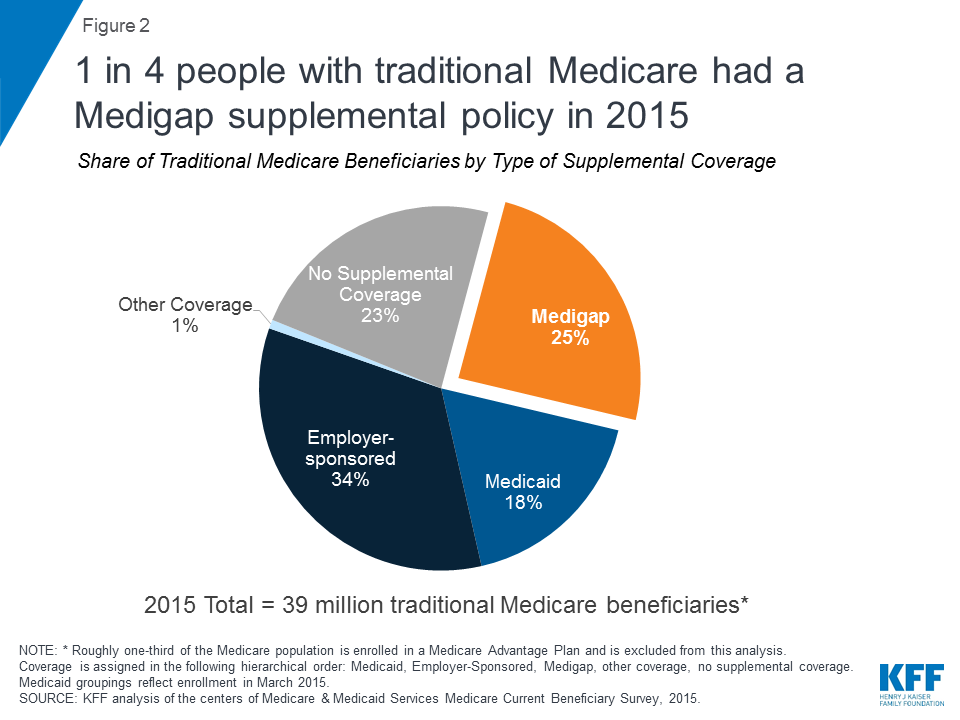
Medigap policies provide supplemental health insurance to help cover the deductibles and coinsurance for Medicare covered services. One in four people in traditional Medicare had a Medigap policy in 2015.
This new analysis of federal law and state regulations shows that only Connecticut, Maine, Massachusetts, and New York require Medigap insurers to sell policies to all Medicare beneficiaries ages 65 and older either continuously during the year or for at least one month per year. In all other states and the District of Columbia, insurers may deny a Medigap policy to seniors, except during their initial open enrollment period when they start on Medicare, or when applicants have other specified qualifying events, such as the loss of retiree health coverage.
Depending on their state, Medicare beneficiaries who miss these windows of opportunity may unwittingly forgo the chance to purchase a Medigap policy later in life if their needs or priorities change, or if they choose to switch to traditional Medicare after several years of being in a Medicare Advantage plan.
The brief provides new national and state-by-state data on Medigap enrollment, and describes federal and state-level consumer protections that can affect seniors’ access to Medigap.
One in four people in traditional Medicare (25 percent) had private, supplemental health insurance in 2015—also known as Medigap—to help cover their Medicare deductibles and cost-sharing requirements, as well as protect themselves against catastrophic expenses for Medicare-covered services. This issue brief provides an overview of Medigap enrollment and analyzes consumer protections under federal law and state regulations that can affect beneficiaries’ access to Medigap. In particular, this brief examines implications for older adults with pre-existing medical conditions who may be unable to purchase a Medigap policy or change their supplemental coverage after their initial open enrollment period.
Key Findings
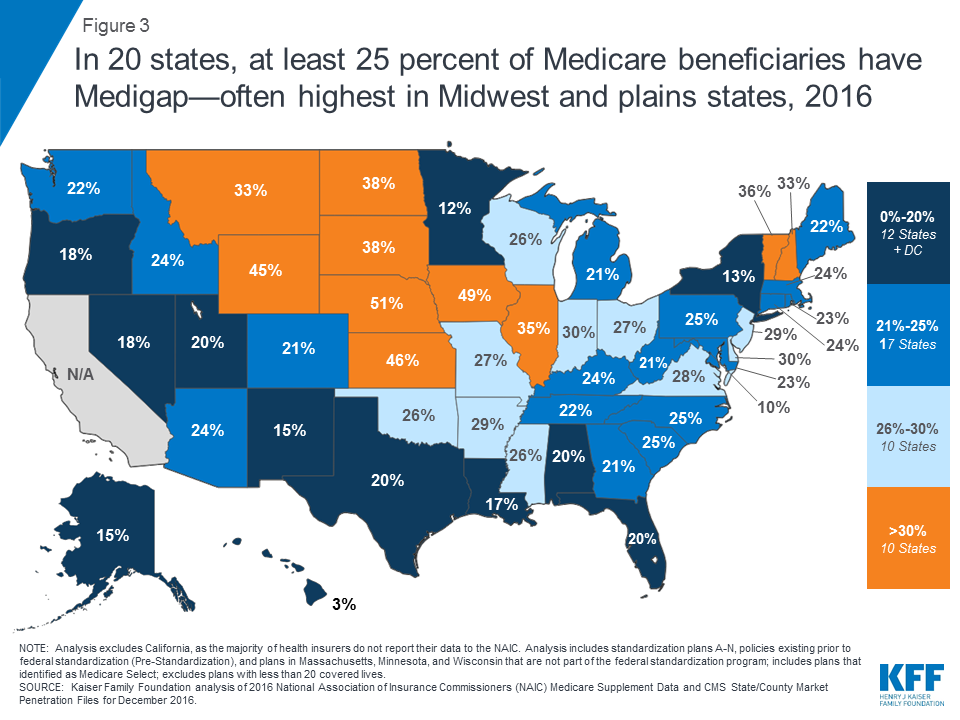
The share of beneficiaries with Medigap varies widely by state—from 3 percent in Hawaii to 51 percent in Kansas.
Federal law provides limited consumer protections for adults ages 65 and older who want to purchase a supplemental Medigap policy—including, a one-time, 6-month open enrollment period that begins when they first enroll in Medicare Part B.
States have the flexibility to institute consumer protections for Medigap that go beyond the minimum federal standards. For example, 28 states require Medigap insurers to issue policies to eligible Medicare beneficiaries whose employer has changed their retiree health coverage benefits.
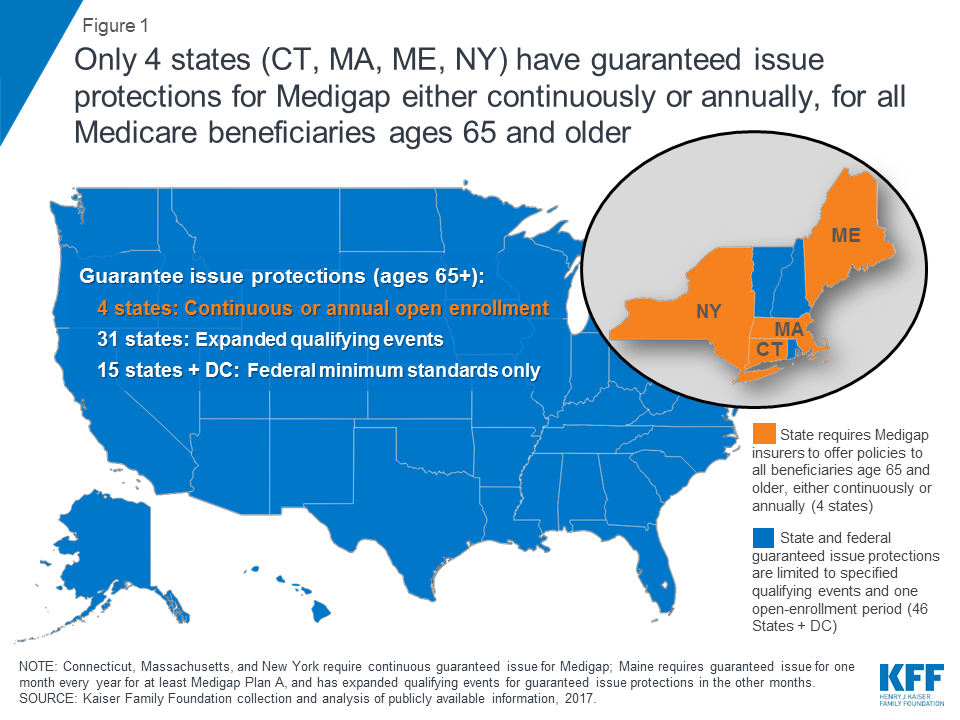
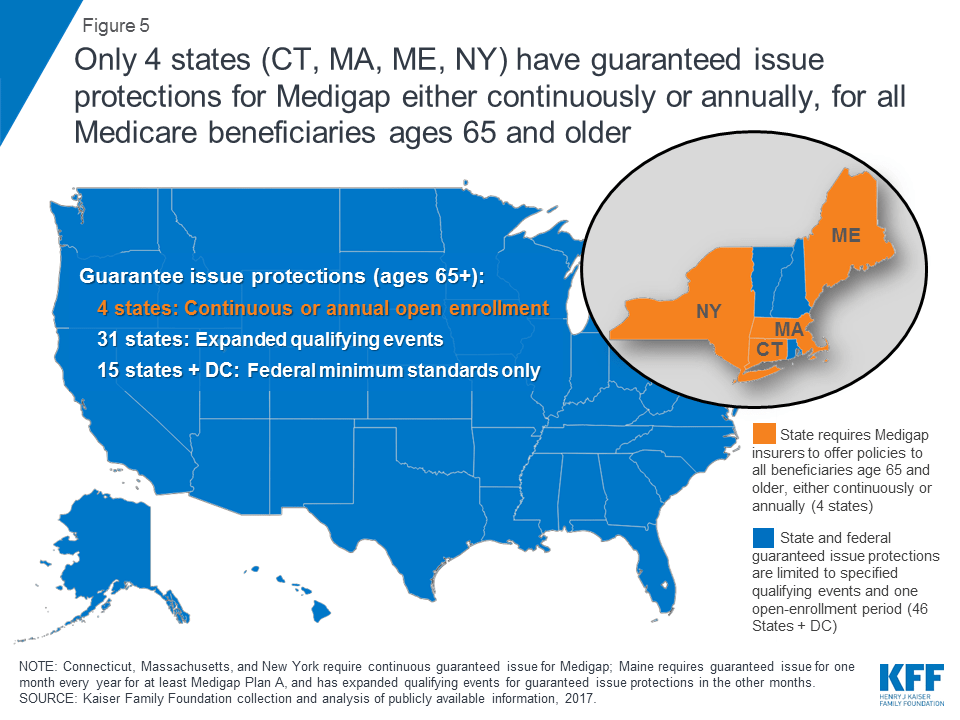
Only four states (CT, MA, ME, NY) require either continuous or annual guaranteed issue protections for Medigap for all beneficiaries in traditional Medicare ages 65 and older, regardless of medical history (Figure 1). Guaranteed issue protections prohibit insurers from denying a Medigap policy to eligible applicants, including people with pre-existing conditions, such as diabetes and heart disease.
In all other states and D.C., people who switch from a Medicare Advantage plan to traditional Medicare may be denied a Medigap policy due to a pre-existing condition, with few exceptions, such as if they move to a new area or are in a Medicare Advantage trial period.
Figure 1: Only 4 states (CT, MA, ME, NY) have guaranteed issue protections for Medigap either continuously or annually, for all Medicare beneficiaries ages 65 and older
Medigap is a key source of supplemental coverage for people in traditional Medicare
Medicare beneficiaries can choose to get their Medicare benefits (Parts A and B) through the traditional Medicare program or a Medicare Advantage plan, such as a Medicare HMO or PPO. Roughly two-thirds of Medicare beneficiaries are in traditional Medicare, and most have some form of supplemental health insurance coverage because Medicare’s benefit design includes substantial cost-sharing requirements, with no limit on out-of-pocket spending. Medicare requires a Part A deductible for hospitalizations ($1,340 in 2018), a separate deductible for most Part B services ($183), 20 percent coinsurance for many Part B (physician and outpatient) services, daily copayments for hospital stays that are longer than 60 days, and daily copays for extended stays in skilled nursing facilities.
To help with these expenses and limit their exposure to catastrophic out-of-pocket costs for Medicare-covered services, a quarter of beneficiaries in traditional Medicare (25 percent) had a private, supplemental insurance policy, known as Medigap in 2015 (Figure 2). Medigap serves as a key source of supplemental coverage for people in traditional Medicare who do not have supplemental employer- or union-sponsored retiree coverage or Medicaid, because their incomes and assets are too high to qualify. Medicare beneficiaries also purchase Medigap policies to make health care costs more predictable by spreading costs over the course of the year through monthly premium payments, and to reduce the paperwork burden associated with medical bills.1
Figure 2: 1 in 4 people with traditional Medicare had a Medigap supplemental policy in 2015
What is Medigap? Medigap is Medicare supplemental insurance, which is a type of private health insurance designed to supplement traditional Medicare. Medigap policies help cover out-of-pocket costs for services covered under Medicare Parts A and B. There are 10 different types of Medigap Plans (labeled A through N), each having a different, standardized set of benefits. Most cover some or all of the Part A deductible. Some are high deductible plans with an out-of-pocket maximum, and a few cover some overseas travel (Table 1). Three states, Massachusetts, Minnesota, and Wisconsin, have a different set of standardized plans, through a federal waiver.
Table 1: Standard Medigap Plan Benefits, 2018
BENEFITS
MEDIGAP POLICY
A
B
C
D
F
G
K
L
M
N
Medicare Part A Coinsurance and All Costs After Hospital Benefits are Exhausted
Yes
Yes
Yes
Yes
Yes
Yes
Yes
Yes
Yes
Yes
Medicare Part B Coinsurance or Copayment for Other than Preventive Service
Yes
Yes
Yes
Yes
Yes
Yes
50%
75%
Yes
Yes*
Blood (First 3 Pints)
Yes
Yes
Yes
Yes
Yes
Yes
50%
75%
Yes
Yes
Hospice Care Coinsurance or Copayment(Added to Plans A, B, C, D, F, and G in June 2010)
Yes
Yes
Yes
Yes
Yes
Yes
50%
75%
Yes
Yes
Skilled Nursing Facility Care Coinsurance
No
No
Yes
Yes
Yes
Yes
50%
75%
Yes
Yes
Medicare Part A Deductible
No
Yes
Yes
Yes
Yes
Yes
50%
75%
50%
Yes
Medicare Part B Deductible
No
No
Yes
No
Yes
No
No
No
No
No
Medicare Part B Excess Charge
No
No
No
No
Yes
Yes
No
No
No
No
Foreign Travel Emergency (Up to Plan Limits)*
No
No
80%
80%
80%
80%
No
No
80%
80%
Out-of-Pocket Limit
N/A
N/A
N/A
N/A
N/A
N/A
$5,240
$2,620
N/A
N/A
NOTE: These plans are effective on or after June 1, 2010. Plans E, H, I, and J are no longer offered to new applicants, as of 2010. Starting in 2020, Plans C and F will no longer be offered to new applicants. “Yes” indicates 100 percent of benefit coverage. * Plan N pays 100% of the Part B coinsurance except up to $20 copayment for office visits and up to $50 for emergency department visits.SOURCE: Centers for Medicare & Medicaid Services, How to compare Medigap policies, 2018.
Medigap policy benefits were standardized through the Omnibus Budget Reconciliation Act of 1990, which also included additional consumer protections discussed later in this issue brief.2 Of the 10 standard Medigap policies available to beneficiaries, Plan F is the most popular, accounting for over half of all policyholders in 2016, because it covers the Part A and B deductibles (as does Plan C), and all cost-sharing for Part A and B covered services.3
The share of all Medicare beneficiaries with Medigap coverage varies widely by state—from 3 percent in Hawaii to 51 percent in Kansas in 2016 (Figure 3, Appendix Table). In 20 states, at least one-quarter of all Medicare beneficiaries have a Medigap policy. States with higher Medigap enrollment tend to be in the Midwest and plains states, where relatively fewer beneficiaries are enrolled in Medicare Advantage plans.4
Figure 3: In 20 states, at least 25 percent of Medicare beneficiaries have Medigap—often highest in Midwest and plains states, 2016
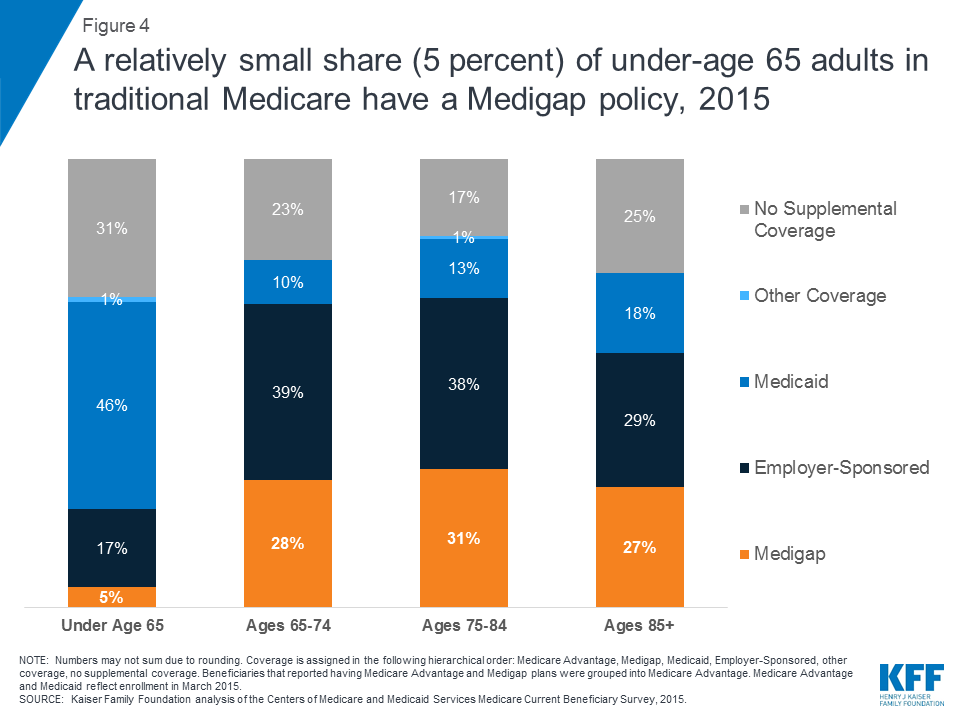
Medigap coverage is substantially more common for Medicare beneficiaries ages 65 and older than it is for younger Medicare beneficiaries, many of whom qualify for Medicare because of a long-term disability. Only 5 percent of traditional Medicare beneficiaries under age 65 had Medigap in 2015—considerably lower than the shares in older age brackets (Figure 4). The low enrollment in Medigap by beneficiaries under age 65 is likely due to the absence of federal guarantee issue requirements for younger Medicare beneficiaries with disabilities (discussed later in this brief) and higher rates of Medicaid coverage for people on Medicare with disabilities who tend to have relatively low incomes.
Figure 4: A relatively small share (5 percent) of under-age 65 adults in traditional Medicare have a Medigap policy, 2015
Federal law provides limited consumer protections for Medigap policies
In general, Medigap insurance is state regulated, but also subject to certain federal minimum requirements and consumer protections. For example, federal law requires Medigap plans to be standardized to make it easier for consumers to compare benefits and premiums across plans. Federal law also requires Medigap insurers to offer “guaranteed issue” policies to Medicare beneficiaries age 65 and older during the first six months of their enrollment in Medicare Part B and during other qualifying events (listed later in this brief). During these defined periods, Medigap insurers cannot deny a Medigap policy to any applicant based on factors such as age, gender, or health status. Further, during these periods, Medigap insurers cannot vary premiums based on an applicant’s pre-existing medical conditions (i.e., medical underwriting). However, under federal law, Medigap insurers may impose a waiting period of up to six months to cover services related to pre-existing conditions, only if the applicant did not have at least six months of prior continuous creditable coverage.5 As described later in this brief, states have the flexibility to institute Medigap consumer protections that go further than the minimum federal standards.
Federal law also imposes other consumer protections for Medigap policies. These include “guaranteed renewability” (with few exceptions), minimum medical loss ratios, limits on agent commissions to discourage “churning” of policies, and rules prohibiting Medigap policies to be sold to applicants with duplicate health coverage.6 (For further details on these requirements and a history of federal involvement in the Medigap market, see Medigap: Spotlight on Enrollment, Premiums, and Recent Trends, April 2013.)
When does federal law require guaranteed issue protections for Medigap?
Federal law provides guaranteed issue protections for Medigap policies during a one-time, six-month Medigap open enrollment period for beneficiaries ages 65 and older when enrolling in Medicare Part B, and for certain qualifying events. These limited circumstances include instances when Medicare beneficiaries involuntarily lose supplemental coverage, such as when their Medicare Advantage plan discontinues coverage in their area, or when their employers cancel their retiree coverage. Beneficiaries who are in a Medicare Advantage plan also have federal guaranteed issue rights when they move to a new area and can no longer access coverage from their Medicare Advantage plan. In these qualifying events, people ages 65 and older in Medicare generally have 63 days to apply for a supplemental Medigap policy under these federal guaranteed issue protections.
Federal law also requires that Medigap polices be sold with guaranteed issue rights during specified “trial” periods for Medicare Advantage plans. One of these trial periods is during the first year older adults enroll in Medicare. During that time, older adults can try a Medicare Advantage plan, but if they disenroll within the first year, they have guaranteed issue rights to purchase a Medigap policy under federal law. Another trial period applies to Medicare beneficiaries who cancel their Medigap policy to enroll in a Medicare Advantage plan. These beneficiaries have time-limited guaranteed issue rights to purchase their same Medigap policy if, within a year of signing up for a Medicare Advantage plan, they decide to disenroll to obtain coverage under traditional Medicare.
States have the flexibility to institute Medigap consumer protections that go further than the minimum federal standards, such as extending guaranteed issue requirements beyond the open enrollment period or adding other qualifying events that would require insurers to issue policies, as discussed later in this brief.
When does federal law not provide guaranteed issue protections for Medigap?
Broadly speaking, after 6 months of enrolling in Medicare Part B, older adults do not have federal guaranteed issue protections when applying for Medigap, except for specified qualifying events described earlier (Table 2). Therefore, older adults in traditional Medicare who miss the open enrollment period may, in most states, be subject to medical underwriting, and potentially denied a Medigap policy due to pre-existing conditions, or charged higher premiums due to their health status.
Table 2: When do people seeking a Medigap policy have guaranteed issue protections under federal law?
Beneficiaries’ coverage status
Guaranteed issue rights
Federally-required
NOT federally-required
In traditional Medicare
In first 6 months of enrolling in Medicare Part B at age 65 or older
After the first 6 months of enrolling in Medicare Part B
In a Medicare Advantage Plan or PACE
When their plan withdraws from their area
When moving to a new area not covered by their plan
When voluntarily disenrolling from a plan within a trial perioda
After one year of enrollment in any plan
Has employer-sponsored supplemental (retiree) coverage
When their employer cancels their supplemental coverage
When their employer changes (but does not drop) retiree coverage benefits
When beneficiaries drops retiree coverage
Medigap
Medigap insurance company goes bankrupt or no longer offers Medigap coverage
When beneficiaries voluntarily drop Medigap coverage
Has Medicaid
Noneb
When Medicaid coverage or eligibility is lost or changedb
Under age 65 in Medicare
Nonec
In all casesc
NOTE: Beneficiaries typically have a 63-day period of guaranteed-issue rights for Medigap when a Medicare Advantage plan withdraws from their area or when an employer group plan (including COBRA) or union cancels coverage. Beneficiaries have guaranteed issue rights if their Medicare Advantage or Medigap insurer commits fraud.aTrial rights apply to beneficiaries who canceled their Medigap policy to join a Medicare Advantage plan and to beneficiaries who enrolled in Medicare Advantage during their first year on Medicare and disenrolled within a year.bBeneficiaries may suspend Medigap for up to two years if they become eligible for Medicaid, in which case they have no new medical underwriting or waiting periods for pre-existing conditions when they restart their Medigap.cWhen beneficiaries under age 65 turn 65, they have the same federally-guaranteed issue protections for Medigap as people age 65 and older, regardless of whether or not they had Medigap when they were under age 65.SOURCE: KFF analysis of federal requirements for Medigap insurers.
Medical Underwriting. Insurance companies that sell Medigap policies may refuse to sell a policy to an applicant with medical conditions, except under circumstances described above. The Text Box on this page provides examples of health conditions that may lead to the denial of Medigap policies, derived from underwriting manuals/guides from multiple insurance companies selling Medigap policies. Examples of conditions listed by insurers as reasons for policy denials include diabetes, heart disease, cancer, and being advised by a physician to have surgery, medical tests, treatments, or therapies.
Barriers for Beneficiaries Under Age 65 with Disabilities. Under federal law, Medigap insurers are not required to sell Medigap policies to the over 9 million Medicare beneficiaries who are under age of 65, many of whom qualify for Medicare based on a long-term disability. (However, when these beneficiaries turn age 65, federal law requires that they be eligible for the same six-month open enrollment period for Medigap that is available to new beneficiaries age 65 and older.)
Beneficiaries Choosing to Switch from Medicare Advantage to Traditional Medicare. There are no federal guarantee issue protections for individuals who choose to switch from a Medicare Advantage plan to traditional Medicare and apply for a Medigap policy, except under limited circumstances described in Table 2. In most states, therefore, beneficiaries who want to switch from their Medicare Advantage plan to traditional Medicare may be subject to medical underwriting and denied coverage when they apply for a Medigap policy because they do not have guaranteed issue rights, with some exceptions (e.g., if they have moved or if they are in a limited trial period). In states that allow medical underwriting for Medigap, Medicare Advantage enrollees with pre-existing conditions may find it too financially risky to switch to traditional Medicare if they are unable to purchase a Medigap policy. Without Medigap, they could be exposed to high cost-sharing requirements, mainly because traditional Medicare does not have a limit on out-of-pocket spending (in contrast to Medicare Advantage plans).7
Potential medical conditions for which a Medigap Insurer may deny coveragewithout guaranteed issue protections
Advised by a physician to have surgery, medical test, treatment, or therapy
Implantable cardiac defibrillator
Use of supplemental oxygen
Use of nebulizer
Asthma requiring continuous use of 3+ medications including inhalers
NOTE: Uninsurable health conditions vary by plan. This list is not an extensive list of all possible conditions/reasons for denial.
SOURCE: Kaiser Family Foundation collection and analysis of numerous insurance companies’ 2016-2017 Medicare supplemental underwriting manuals/guides.
Some states require guaranteed issue and other consumer protections for Medigap beyond the federal minimum requirements
States have the flexibility to institute Medigap consumer protections that go further than the minimum federal standards. While many states have used this flexibility to expand guarantee issue rights for Medigap under certain circumstances, 15 states and the District of Columbia have not, relying only the minimum guarantee issue requirements under federal law (Table 3).
Only four states require Medigap insurers to offer policies to Medicare beneficiaries age 65 and older (Figure 5). Three of these states (Connecticut, Massachusetts, and New York) have continuous open enrollment, with guaranteed issue rights throughout the year, and one state (Maine) requires insurers to issue Medigap Plan A (the least generous Medigap plan shown earlier in Table 1) during an annual one-month open enrollment period. Consistent with federal law, Medigap insurers in New York, Connecticut, and Maine may impose up to a six-month “waiting period” to cover services related to pre-existing conditions if the applicant did not have six months of continuous creditable coverage prior to purchasing a policy during the initial Medigap open enrollment period.8 Massachusetts prohibits pre-existing condition waiting periods for its Medicare supplement policies.
Figure 5: Only 4 states (CT, MA, ME, NY) have guaranteed issue protections for Medigap either continuously or annually, for all Medicare beneficiaries ages 65 and older
Some states provide additional guaranteed issue rights for current Medigap policyholders. Two states (CA and OR) allow beneficiaries to switch each year to a different Medigap plan with equal or lesser benefits within 30 days of their birthday, and another state (MO) allows policyholders to switch to an equivalent plan within 30 days before or after the annual anniversary date of their policy. Medigap policyholders in Maine can switch to a policy with equal or less generous benefits at any time during the year (not only during the annual open enrollment period) if there is less than a 90 day gap in coverage. Some Medigap insurers may also provide guaranteed issue rights to their policies that go beyond the state requirements. In Illinois, Blue Cross Blue Shield of Illinois and Health Alliance provide ongoing guaranteed issue rights for all beneficiaries ages 65 or older.
Many other states have expanded on the federal minimum standards in more narrow ways by requiring Medigap insurers to offer policies to eligible applicants during additional qualifying events (Table 3). For example, 28 states require Medigap insurers to issue policies when an applicant has an involuntary change in their employer (retiree) coverage. (This qualifying event is more expansive than federal law, which applies only when retiree coverage is completely eliminated.) Nine states provide guaranteed issue rights for applicants who lose their Medicaid eligibility.9
As noted above, federal law does not require Medigap insurers to issue policies to Medicare beneficiaries under the age of 65, most of whom qualify for Medicare because of a long-term disability. However, 31 states require insurers to provide at least one kind of Medigap policy to beneficiaries younger than age 65 (typically through an initial open enrollment period).10
Table 3: Medigap Guaranteed Issue Requirements for Medicare Beneficiaries Ages 65+, by State, 2017
Federal Minimum Standards Only
Guaranteed Issue Rights (continuous or annual)
Qualifying Events For Guaranteed Issue Rights Beyond Minimum Federal Standards
Upon Retiree Benefit Changes
Upon Loss of Medicaid Eligibility
Other*
Total State Counts
16
4
28
9
14
Alabama
Yes
–
–
–
–
Alaska
No
No
Yes
No
Yes
Arizona
Yes
–
–
–
–
Arkansas
No
No
Yes
No
No
California
No
No
Yes
Yes
Yes
Colorado
No
No
Yes
No
Yes
Connecticut
No
Continuous
n/a
n/a
n/a
Delaware
Yes
–
–
–
–
District of Columbia
Yes
–
–
–
–
Florida
No
No
Yes
No
Yes
Georgia
Yes
–
–
–
–
Hawaii
Yes
–
–
–
–
Idaho
No
No
Yes
No
No
Illinois
No
No
Yes
No
No
Indiana
No
No
Yes
No
No
Iowa
No
No
Yes
No
No
Kansas
No
No
Yes
Yes
Yes
Kentucky
Yes
–
–
–
–
Louisiana
No
No
Yes
No
Yes
Maine1
No
One month/year
Yes
Yes
Yes
Maryland
Yes
–
–
–
–
Massachusetts
No
Continuous
n/a
n/a
n/a
Michigan
Yes
–
–
–
–
Minnesota
No
No
Yes
No
No
Mississippi
Yes
–
–
–
–
Missouri
No
No
Yes
No
No
Montana
No
No
Yes
Yes
Yes
Nebraska
No
No
Yes
No
No
Nevada
No
No
Yes
No
No
New Hampshire
Yes
–
–
–
–
New Jersey
No
No
Yes
No
No
New Mexico
No
No
Yes
No
No
New York
No
Continuous
n/a
n/a
n/a
North Carolina
Yes
–
–
–
–
North Dakota
Yes
–
–
–
–
Ohio
No
No
Yes
No
No
Oklahoma
No
No
Yes
No
Yes
Oregon
No
No
Yes
Yes
Yes
Pennsylvania
No
No
Yes
No
No
Rhode Island
Yes
–
–
–
–
South Carolina
Yes
–
–
–
–
South Dakota
Yes
–
–
–
–
Tennessee
No
No
No
Yes
No
Texas
No
No
Yes
Yes
Yes
Utah
No
No
No
Yes
No
Vermont
No
No
Yes
No
No
Virginia
No
No
Yes
No
No
Washington
No
No
No
No
Yes
West Virginia
No
No
Yes
No
No
Wisconsin
No
No
Yes
Yes
Yes
Wyoming
No
No
No
No
Yes
NOTE: 1In Maine, Medigap insurers must offer guaranteed-issue policies, at least for Plan A during one month of their choosing each year. *Examples of “Other” qualifying events include: beneficiary’s health plan changes its benefits, a participating hospital leaves the network of a beneficiary’s health plan.SOURCE: Kaiser Family Foundation analysis of state insurance regulations, 2017.
Some states provide stronger consumer protections for Medigap premiums than others
States also have the flexibility to establish rules on whether or not Medigap premiums may be affected by factors such as a policyholder’s age, smoking status, gender, and residential area. Federal law allows states to alter premiums based on these factors, even during guaranteed issue open enrollment periods.
There are three different rating systems that can affect how Medigap insurers determine premiums: community rating, issue-age rating, or attained-age rating (defined in the Text box below). States can impose regulations on which of these rating systems are permitted or required for Medigap policies sold in their state. Of the three, community rating provides the strongest consumer protection for Medigap policies because it does not allow premiums to be based on the applicant or policyholder’s age or health status. However, insurers in states that require community rating may charge different premiums based on other factors, such as smoking status and residential area. In states that allow attained age rating, older applicants and policyholders have considerably less protection from higher premiums because premiums may increase at unpredictable rates as policyholders age.
Premium rating systems
Community rating: Insurers must charge all policyholders within a given plan type the same premium without regard to age (among people age 65 and older) or health status. Insurers can raise premiums only if they do so for all policyholders of the given plan type. Insurers may still adjust premiums based on other factors, including smoking status, gender, and residential area.
Issue-age rating: Insurers may vary premiums based on the age of the policyholder at the time of purchase, but cannot increase the policyholder’s premium automatically in later years based on his/her age. Additionally, insurers may charge different premiums based on other factors, including health status, smoking status, and residential area.
Attained-age rating: Insurers may vary premiums based on the age of the policyholder at the time of purchase and increase premiums for policyholders as they age. Additionally, insurers may charge different premiums based on other factors, including health status, smoking status, and residential area.
Currently, eight states (AR, CT, MA, ME, MN, NY, VT, and WA) require premiums to be community rated among policyholders ages 65 and older. This means that Medigap insurers cannot charge higher premiums to people because they are older or sicker, and therefore, must charge an 80-year old policyholder the same as a 70-year old policyholder regardless of health status (Table 4). Insurers may still adjust premiums based on other factors, including smoking status, gender, and residential area. A state’s community rating requirement does not, in itself, guarantee that applicants will be issued a policy in the state. However, as described earlier, four of the states that have community rating (CT, MA, ME, NY), have guarantee issue protections and require insurers to issue Medigap policies to eligible applicants either continuously during the year, or during an annual enrollment period.
Table 4: Medigap Premium Rating Rules
Community Rating Required
Issue Age Rating or Attained Age Rating
Arkansas
Alabama
Kentucky
Oklahoma
Connecticut
Alaska
Louisiana
Oregon
Maine
Arizona
Maryland
Pennsylvania
Massachusetts
California
Michigan
Rhode Island
Minnesota
Colorado
Mississippi
South Carolina
New York
Delaware
Missouri
South Dakota
Vermont
District of Columbia
Montana
Tennessee
Washington
Florida
Nebraska
Texas
Georgia
Nevada
Utah
Hawaii
New Hampshire
Virginia
Idaho
New Jersey
West Virginia
Illinois
New Mexico
Wisconsin
Indiana
North Carolina
Wyoming
Iowa
North Dakota
Kansas
Ohio
NOTE: The 8 states listed in the left-hand column prohibit issue age and attained age rating. States that require issue age rating do not allow attained age rating; but states that allow attained age rating, typically allow issue age ratings. All states permit insurers to use community rating.SOURCE: Kaiser Family Foundation collection and analysis of publicly available information, 2017.
The remaining 38 states and the District of Columbia do not require premiums to be community rated; therefore, Medigap premiums in these states may be subject to issue-age and attained-age rating systems, depending on state regulation. Medigap insurers are permitted to offer community rated policies in these states, but most do not.11 Additionally, Medigap insurers may increase premiums due to inflation, regardless of the premium rating system.12
Discussion
Medigap plays a major role in providing supplemental coverage for people in traditional Medicare, particularly among those who do not have an employer-sponsored retiree plan or do not qualify for cost-sharing assistance under Medicaid. Medigap helps beneficiaries budget for out-of-pocket expenses under traditional Medicare. Medigap also limits the financial exposure that beneficiaries would otherwise face due to the absence of an out-of-pocket limit under traditional Medicare.
Nonetheless, Medigap is not subject to the same federal guaranteed issue protections that apply to Medicare Advantage and Part D plans, with an annual open enrollment period. As a result, in most states, medical underwriting is permitted which means that beneficiaries with pre-existing conditions may be denied a Medigap policy due to their health status, except under limited circumstances.
Federal law requires Medigap guaranteed issue protections for people age 65 and older during the first six months of their Medicare Part B enrollment and during a “trial” Medicare Advantage enrollment period. Medicare beneficiaries who miss these windows of opportunity may unwittingly forgo the chance to purchase a Medigap policy later in life if their needs or priorities change.13 This constraint potentially affects the nearly 9 million beneficiaries in traditional Medicare with no supplemental coverage; it may also affect millions of Medicare Advantage plan enrollees who may incorrectly assume they will be able to purchase supplemental coverage if they choose to switch to traditional Medicare at some point during their many years on Medicare.
Only four states (CT, MA, NY, ME) require Medigap policies to be issued, either continuously or for one month per year for all Medicare beneficiaries age 65 and older. Policymakers could consider a number of other policy options to broaden access to Medigap. One approach could be to require annual Medigap open enrollment periods, as is the case with Medicare Advantage and Part D plans, making Medigap available to all applicants without regard to medical history during this period. Another option would be to make voluntary disenrollment from a Medicare Advantage plan a qualifying event with guaranteed issue rights for Medigap, recognizing the presence of beneficiaries’ previous “creditable” coverage. For Medicare beneficiaries younger than age 65, policymakers could consider adopting federal guaranteed issue protections, building on rules already established by the majority of states.
On the one hand, these expanded guaranteed issue protections would increase beneficiaries’ access to Medigap, especially for people with pre-existing medical conditions. They would also treat Medigap similarly to Medicare Advantage in this regard, and make it easier for older adults to switch between Medicare Advantage and traditional Medicare if their Medicare Advantage plan is not serving their needs in later life. On the other hand, broader guaranteed issue policies could result in some beneficiaries waiting until they have a serious health problem before purchasing Medigap coverage, which would likely increase premiums for all Medigap policyholders. A different approach altogether would be to minimize the need for supplemental coverage in Medicare by adding an out-of-pocket limit to traditional Medicare.14
Ongoing policy discussions affecting Medicare and its benefit design could provide an opportunity to consider various ways to enhance federal consumer protections for supplemental coverage or manage beneficiary exposure to high out-of-pocket costs. As older adults age on to Medicare, they would be well-advised to understand the Medigap rules where they live, and the trade-offs involved when making coverage decisions.
Data Sources and Methods
We analyzed data from the Centers for Medicare and Medicaid Services (CMS) 2015 Medicare Current Beneficiary Survey (MCBS) to examine the characteristics of Medicare beneficiaries, by source of supplemental coverage. The MCBS is a nationally representative longitudinal survey of Medicare beneficiaries, which provides information on beneficiary characteristics, coverage, service utilization, and spending.
We used data from the National Association of Insurance Commissioners (NAIC) Medicare Supplement Insurance files for our analysis of Medigap enrollment by plan type and by state. These data include the number of policyholders as of December 31, 2016 for each state, insurance company, and type of plan sold. The number of covered lives represent a snapshot of enrollment at that time, rather than average enrollment over the course of the year. This analysis used data from 49 states and the District of Columbia excluding California because only a small share of companies reported California data to the NAIC. We also excluded data from all US territories and plans reporting fewer than 20 enrollees. In this analysis, Medigap policies issued prior to Medigap standardization in 1992 are treated as a single additional type of plan, “Pre-Standardized.” In addition, policies sold in the three states exempted from Medigap standardization (MA, MN, and WI) are also grouped together as “Waivered.”
This issue brief was funded in part by The Retirement Research Foundation.
Laura Kanji interned with the Kaiser Family Foundation and contributed significantly to the data collection and analysis of state insurance regulations.
Appendix
Appendix Table: Number and Share of Medicare Beneficiaries with a Medigap Policy, 2016
State
Number of Medigap Beneficiaries
Share of All Beneficiaries in Medigap
Share of all Traditional Medicare Beneficiaries in Medigap
Alaska
12,881
15%
15%
Alabama
197,535
20%
27%
Arkansas
176,662
29%
36%
Arizona
282,623
24%
38%
California
n/a
n/a
n/a
Colorado
175,770
21%
33%
Connecticut
154,390
24%
33%
DC
9,449
10%
12%
Delaware
57,472
30%
34%
Florida
831,573
20%
33%
Georgia
343,639
21%
32%
Hawaii
8,736
3%
6%
Iowa
290,255
49%
59%
Idaho
72,810
24%
36%
Illinois
745,608
35%
45%
Indiana
363,080
30%
41%
Kansas
231,674
46%
54%
Kentucky
212,505
24%
33%
Louisiana
138,624
17%
25%
Massachusetts
304,012
24%
31%
Maryland
226,815
23%
26%
Maine
71,292
22%
30%
Michigan
418,914
21%
33%
Minnesota
115,430
12%
27%
Missouri
312,279
27%
38%
Mississippi
148,569
26%
30%
Montana
70,138
33%
41%
North Carolina
466,027
25%
36%
North Dakota
46,862
38%
48%
Nebraska
166,692
51%
58%
New Hampshire
92,613
33%
37%
New Jersey
452,538
29%
35%
New Mexico
57,471
15%
22%
Nevada
84,016
18%
27%
New York
461,459
13%
21%
Ohio
609,567
27%
44%
Oklahoma
185,745
26%
32%
Oregon
141,662
18%
32%
Pennsylvania
657,714
25%
42%
Rhode Island
47,346
23%
37%
South Carolina
247,745
25%
33%
South Dakota
62,984
38%
49%
Tennessee
287,321
22%
35%
Texas
772,368
20%
30%
Utah
70,941
20%
30%
Virginia
391,440
28%
34%
Vermont
49,001
36%
39%
Washington
272,306
22%
31%
Wisconsin
279,958
26%
42%
West Virginia
90,815
21%
29%
Wyoming
45,150
45%
47%
NOTE: Analysis excludes California, as the majority of health insurers do not report their data to the NAIC. Analysis also excludes plans with less than 20 covered lives.SOURCE: Kaiser Family Foundation analysis of 2016 National Association of Insurance Commissioners (NAIC) Medicare Supplement Data and CMS State/County Market Penetration Files for December 2016.
The share of beneficiaries with Plan C and F is expected to decline in the future due to a change in law that prohibits insurers from issuing new policies that cover the full Part B deductible, as Plans C and F currently cover. Existing C and F policies will be grandfathered and therefore, renewable by current policyholders, but not sold to new purchasers. “Medicare Access and CHIP reauthorization Act of 2015 (MACRA),” HR 2, Public Law No: 114-10, April 2015. Available at: https://www.congress.gov/bill/114th-congress/house-bill/2/text. ↩︎
Pre-existing conditions apply to conditions for which medical advice was given or treatment received within a “look back period” of six months before the effective date of coverage. For further details on federal requirements for Medigap with respect to pre-existing conditions, see https://www.medicare.gov/Pubs/pdf/02110-Medicare-Medigap.guide.pdf. ↩︎
Pre-existing conditions apply to conditions for which medical advice was given or treatment received within a “look back period” of six months before the effective date of coverage. Continuous coverage means that the applicant had no break in coverage greater than 63 days over the prior six-month period prior to purchasing the Medigap policy. In New York, Medigap insurers must reduce the waiting period by the number of days that applicants had continuous creditable coverage. ↩︎
Under federa law, Medicare beneficiaries may suspend Medigap for up to two years if they become eligible for Medicaid, in which case they have no new medical underwriting or waiting periods for pre-existing conditions when they restart their Medigap. ↩︎
Centers for Medicare & Medicaid Services and the National Association of Insurance Commissioners, “2017 Choosing a Medigap Policy: A Guide to Health Insurance for People with Medicare,” 2017. Available at: https://www.medicare.gov/Pubs/pdf/02110-Medicare-Medigap.guide.pdf. ↩︎
Proposals to add an out-of-pocket limit have been discussed by the Medicare Payment Advisory Commission. See, for example, its chapter, “Reforming Medicare’s benefit design,” Report to the Congress: Medicare and the Health Care Delivery System (June 2012). http://medpac.gov/docs/default-source/reports/jun12_ch01.pdf?sfvrsn=0↩︎
Texas is a state with a diverse population and is home to the largest number of uninsured residents among U.S. states. In a new survey, the Kaiser Family Foundation and the Episcopal Health Foundation sought to gauge Texans’ views on health policy priorities, as well as their own experiences in the health care system. This brief, the second based on the survey, examines Texas residents’ experiences with health care affordability and access to care.
Affording health care tops Texans’ financial concerns , per @KaiserFamFound / @Health4Texas survey of Texas residents on health costs and access
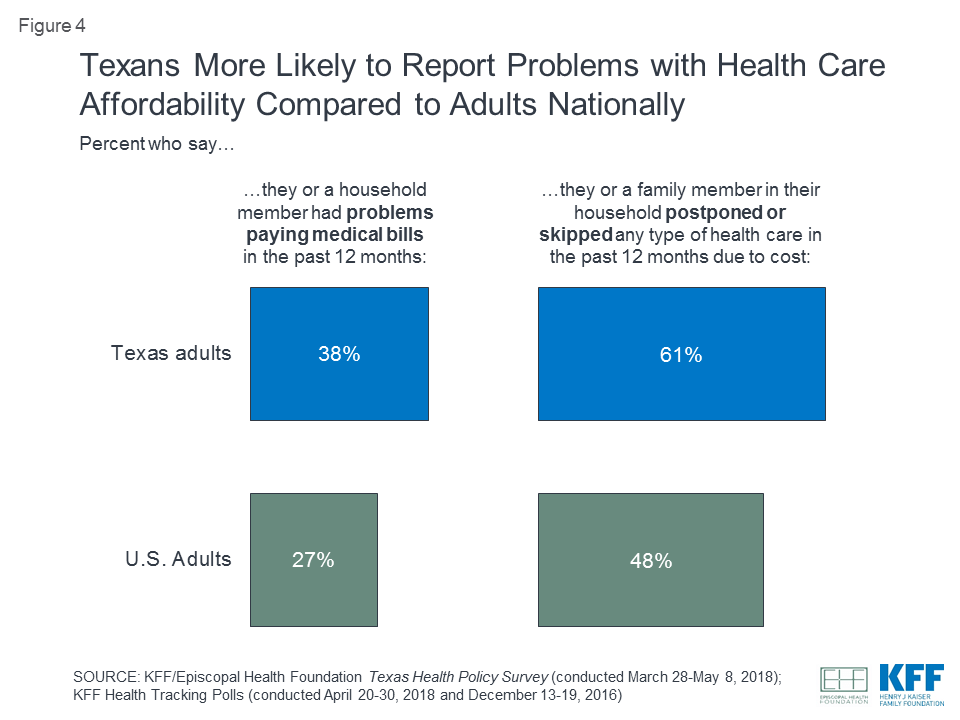
The survey finds that health care affordability is a major concern for many Texans. Over half of Texas residents say it is difficult for their family to afford health care, higher than the shares that say the same about housing, utilities, transportation, or food. About four in ten say they’ve had problems paying medical bills in the past year, and roughly six in ten say someone in their household has postponed or skipped some sort of medical care in the past year because of the cost; both of these shares are higher than the shares measured nationally in Kaiser Family Foundation tracking polls.
Problems with health care affordability are much more commonly reported among Texans with lower incomes, those with health problems, and the uninsured. Cost is a barrier to getting insurance, too; among the uninsured, the most commonly reported reason for not having insurance is not being able to afford the cost. However, insurance does not offer ironclad protection against health care affordability problems. Even among those with insurance, many Texans report problems paying medical bills or skipping or delaying care because of the cost.
While most adults in Texas report having a place to go when they are sick or need advice about their health, about a quarter say they either have no usual place for care or that they rely on a hospital emergency room. The share without a usual place for care beyond the ER is higher among lower-income Texans and Black and Hispanic residents, and rises to about half among the non-elderly uninsured. Even for those with a usual place for care, difficulty traveling to this place is a problem for some Texans, particularly those with lower incomes, those with Medicaid coverage, and individuals who report being in fair or poor health.
Findings
Texans’ Struggles with Health Care Affordability
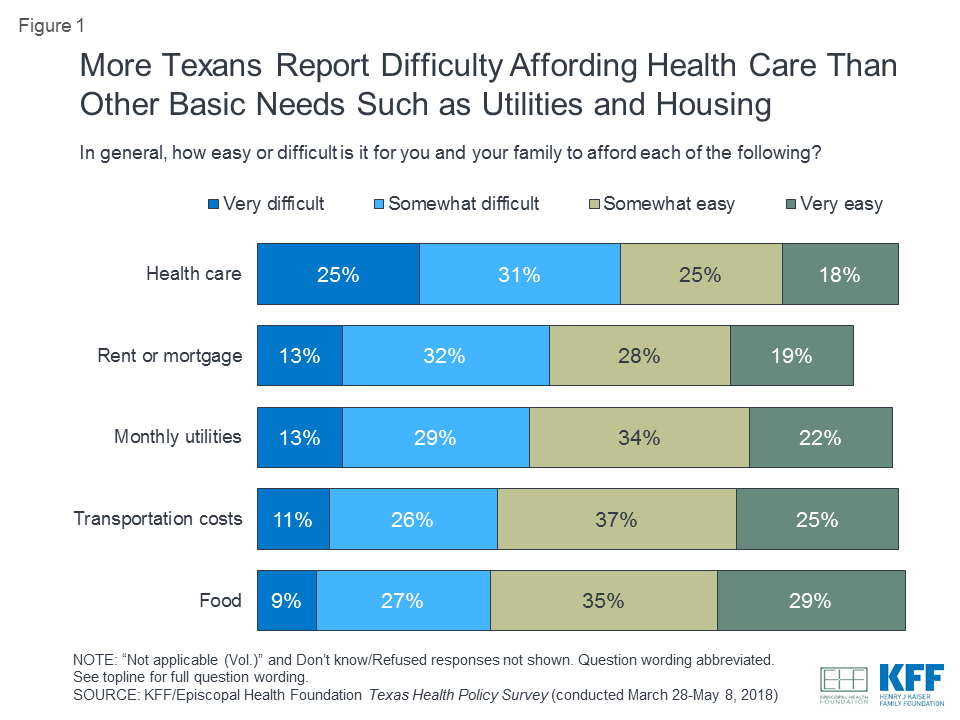
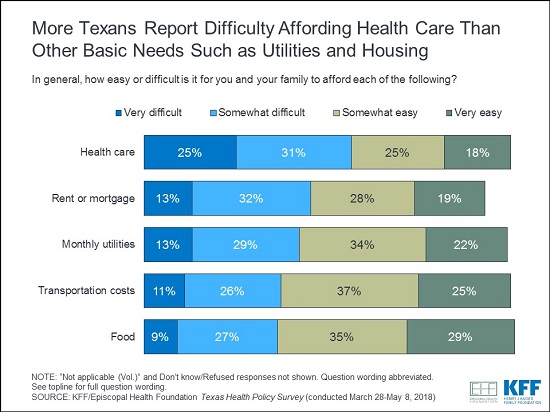
The survey finds that affordability of health care is a concern for many Texans, more so than affordability of other basic needs such as housing and transportation. Over half (55 percent) of Texas residents say it is difficult them and their family to afford health care, including a quarter who say it is “very difficult” (Figure 1). Fewer report finding it difficult to afford the cost of their rent or mortgage (45 percent), monthly utilities (42 percent), gasoline or other transportation costs (37 percent), or food (36 percent).
Figure 1: More Texans Report Difficulty Affording Health Care Than Other Basic Needs Such as Utilities and Housing
Poll: 38% of Texans say they or someone in their household had problems paying medical bills in the past year; most of this group say it had a major impact.
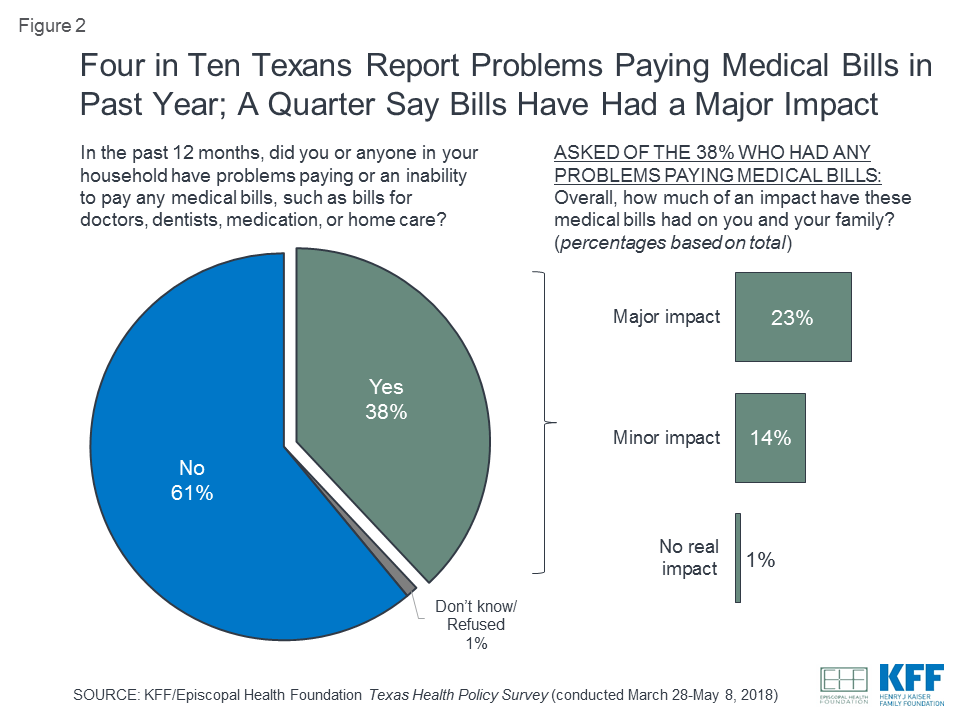
In addition to general difficulty affording care, about four in ten Texas (38 percent) say they or someone in their household had problems paying medical bills in the past 12 months (Figure 2). Among Texans who had problems paying medical bills, most say the bills have had a major impact on their family (23 percent of all Texans) while 14 percent say they have had a minor impact and few say they’ve had no real impact (1 percent).
Figure 2: Four in Ten Texans Report Problems Paying Medical Bills in Past Year; A Quarter Say Bills Have Had a Major Impact
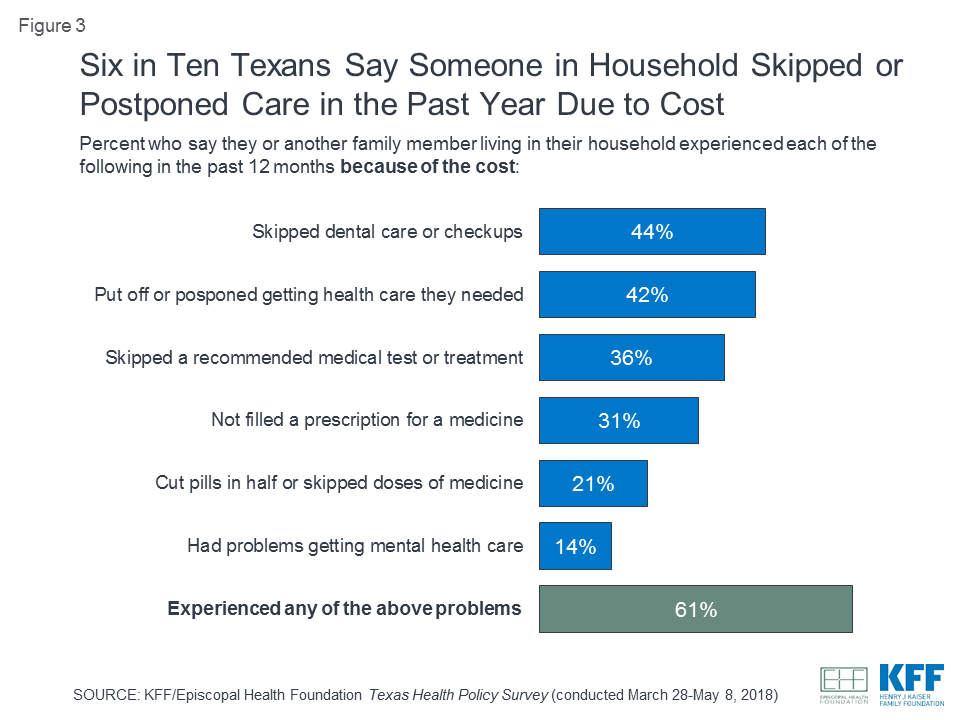
Further highlighting Texans’ challenges with health care expenses, a considerable share say they or a family member living in their household have skipped or put off getting some form of care in the past year because of the cost (Figure 3). The most common of these are skipping dental care or checkups (44 percent) and putting off or postponing needed health care (42 percent). About a third report skipping a recommended medical test or treatment (36 percent) or not filling a prescription for a medicine (31 percent). Fewer Texans say they or a family member cut pills in half or skipped doses of medicine (21 percent), or that they had problems getting mental health care (14 percent) in the past year due to cost. In total, six in ten Texans (61 percent) say they or another family member have done at least one of these in the past year because of the cost.
Figure 3: Six in Ten Texans Say Someone in Household Skipped or Postponed Care in the Past Year Due to Cost
The shares of Texans who report problems with health care affordability are higher than the shares of adults nationally who report the same in recent Kaiser Health Tracking Surveys. For example, 38 percent of Texans say they or someone in their household had problems paying medical bills in the past 12 months, compared with 27 percent of adults nationally who reported the same in a KFF poll in March 2018. And in Texas, 61 percent say they or a family member skipped or postponed some type of health care in the past year because of the cost, higher than the 48 percent of adults nationally who reported the same in a December 2016 KFF survey (Figure 4). These differences between Texas and national averages likely reflect the fact that Texas has a somewhat higher share of people living in poverty and a larger share of people without health insurance compared to national averages.
Figure 4: Texans More Likely to Report Problems with Health Care Affordability Compared to Adults Nationally
Problems with Health Care Affordability by Demographic Group
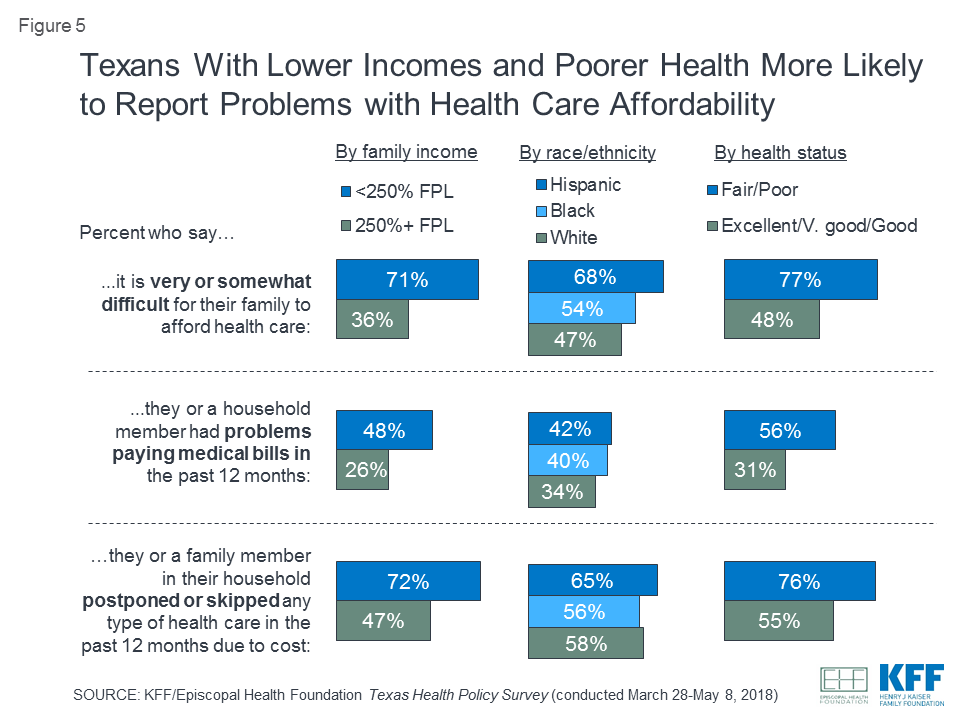
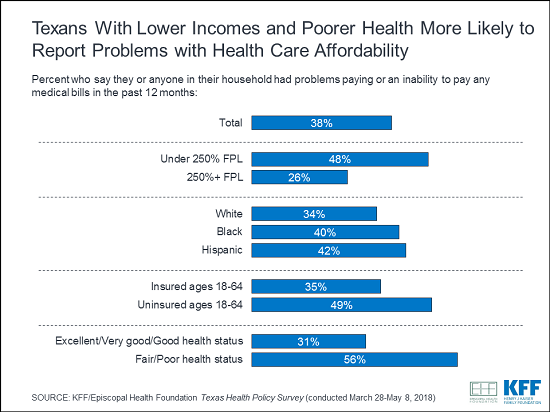
When it comes to problems related to health care costs, certain groups of Texans are more likely than others to report difficulty. In general, those with lower incomes, Hispanic residents, and those in poorer health are more likely to report experiencing these types of problems compared to their higher-income, white, and healthier counterparts (Figure 5).
For example, Texans with self-reported family incomes under 250 percent of the federal poverty level (FPL) are nearly twice as likely as those with higher incomes to say it is difficult for their family to afford health care (71 percent versus 36 percent). They are also much more likely to say they’ve had problems paying medical bills in the past year (48 percent versus 26 percent) and to say someone in their family has put off or postponed some type of medical care in the past year because of the cost (72 percent versus 47 percent).
Similarly, Hispanic residents are more likely to report difficulty affording health care compared to their Black and white counterparts (68 percent, 54 percent, and 47 percent, respectively). Hispanic Texans are also more likely than whites to say they’ve had problems paying medical bills in the past 12 months (42 percent versus 34 percent). However, there is no significant difference by race or ethnicity in the share who report skipping or postponing care because of the cost. Health status makes a difference on all these measures; those who say their own health is only fair or poor are much more likely than those who report being in better health to report difficulty affording health care (77 percent versus 48 percent), problems paying medical bills (56 percent versus 31 percent), and skipping or postponing care due to cost (76 percent versus 55 percent).
Figure 5: Texans With Lower Incomes and Poorer Health More Likely to Report Problems with Health Care Affordability
Problems with Health Care Affordability among the Uninsured
Texas is home to the largest number of uninsured adults and has the highest uninsured rate of any U.S. state; 21 percent of adults between the ages of 19-64 in Texas are uninsured, compared to the national average of 12 percent.1 One contributing factor to the uninsured rate is the fact that Texas has not expanded Medicaid under the Affordable Care Act, and Texas has relatively strict adult Medicaid eligibility criteria compared to other states.2
Previous research, both nationally and in Texas, has found that individuals without health insurance are more vulnerable to high medical bills and more likely to report problems with health care affordability compared to their insured counterparts.3 The current survey finds similar results. Large majorities of uninsured Texans ages 18-64 say that health care is difficult for their family to afford (82 percent) and that someone in their household has skipped or postponed some type of medical care in the past year because of the cost (76 percent). About half of the uninsured (49 percent) say someone in their household had problems paying medical bills in the past 12 months (Figure 6).
However, while problems with health care affordability are a major problem for the uninsured, it is notable that insurance doesn’t offer ironclad protection against such problems. Even among Texans ages 18-64 with health insurance, nearly half (47 percent) say health care is difficult for their family to afford, about six in ten (58 percent) report skipping or postponing care due to cost, and about a third (35 percent) say they’ve had problems paying medical bills in the past year.
Figure 6: Uninsured Texans More Likely to Report Problems Affording Health Care than Those with Insurance
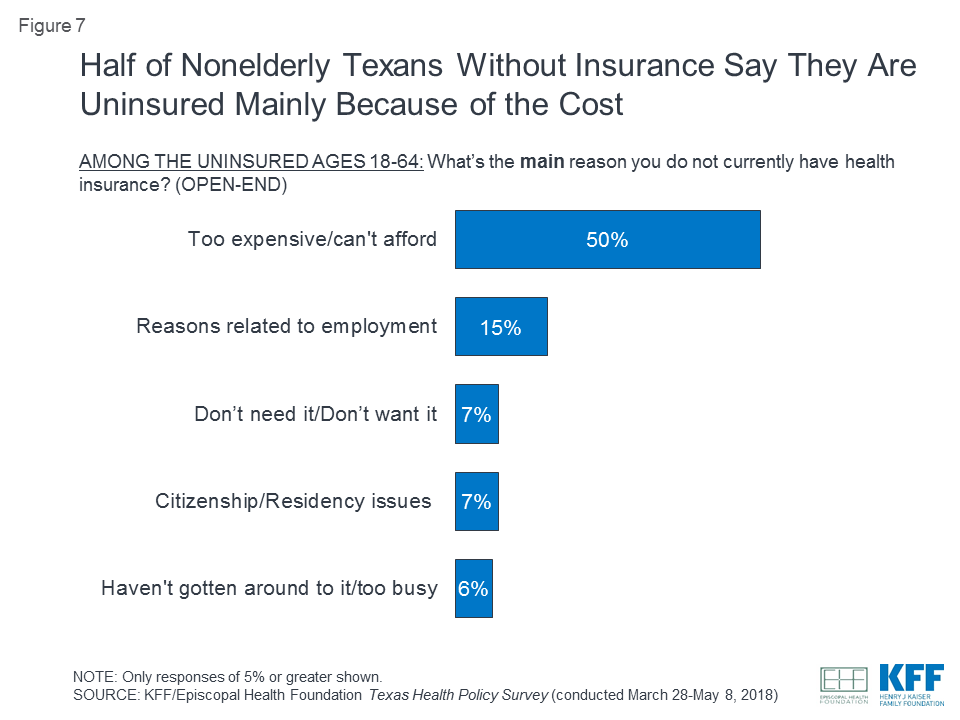
For the uninsured, issues with affordability extend not only to health care services, but also to their ability to obtain health insurance. Among Texans ages 18-64 who are uninsured, the top reason reported for not having insurance is because is too expensive or they cannot afford it (50 percent, Figure 7). Smaller shares cite other explanations such as reasons related to employment (15 percent), citizenship or residency issues (7 percent), or being too busy (6 percent). Just 7 percent of those without coverage say they are uninsured because they don’t want insurance or feel they don’t need it. These findings are consistent with previous research from the Episcopal Health Foundation and Rice University’s Baker Institute among uninsured adults in Texas and national results from previous Kaiser Family Foundation surveys.4
Figure 7: Half of Nonelderly Texans Without Insurance Say They Are Uninsured Mainly Because of the Cost
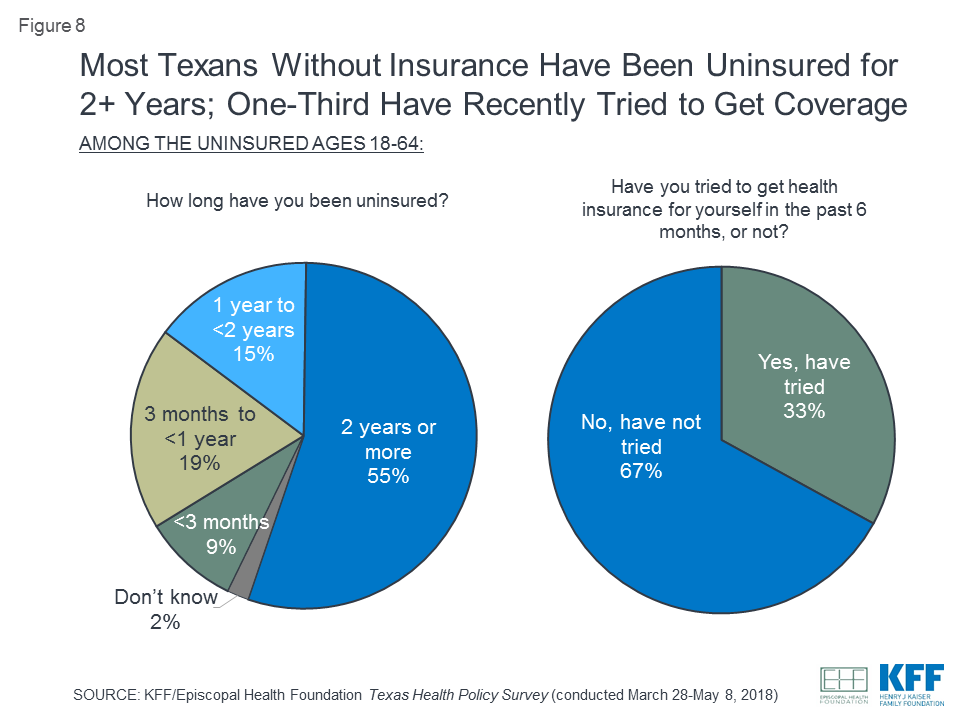
Problems with health care affordability among the uninsured also reflect the fact that for most of the uninsured in Texas, lack of coverage is a long-term problem. Seven in ten non-elderly adults without health insurance say they have gone without coverage for at least a year, including over half (55 percent) who say they have been uninsured for two years or more. Just a third of the uninsured say they have tried to get coverage for themselves in the past 6 months (Figure 8).
Figure 8: Most Texans Without Insurance Have Been Uninsured for 2+ Years; One-Third Have Recently Tried to Get Coverage
Usual Source of Care for Texas Residents
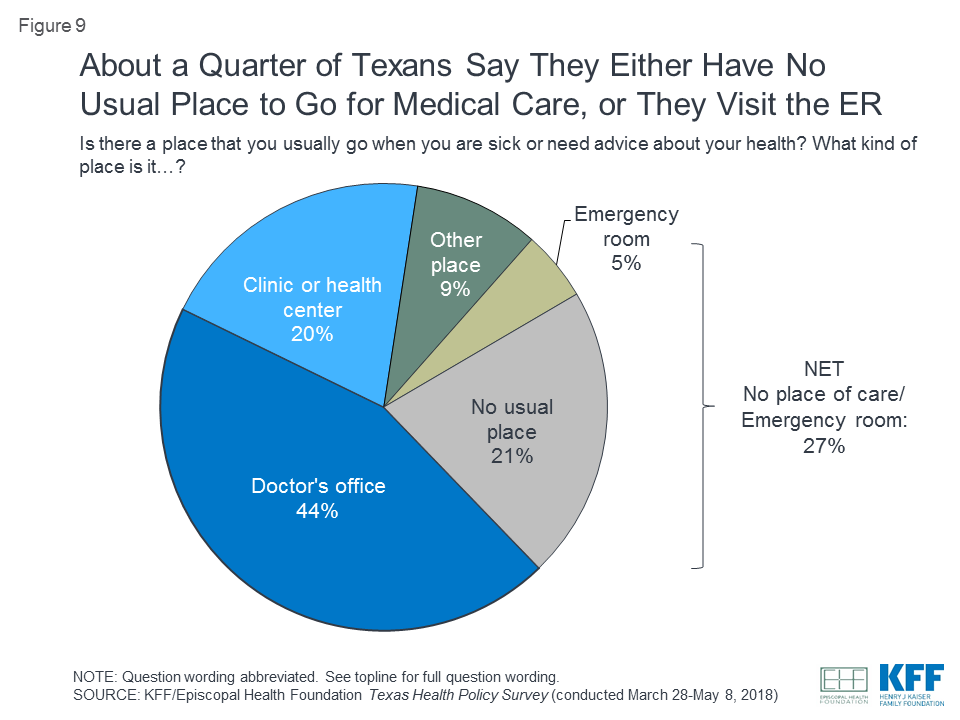
Beyond the cost of health care, access to providers can be a barrier to receiving needed medical care for some individuals. About a quarter of Texans say that there is either no place they usually go when they are sick or need advice about their health (21 percent), or the place they usually go to is a hospital emergency room (5 percent). About four in ten Texans (44 percent) say they usually go to a doctor’s office, while one in five say they visit a clinic or health center, and smaller shares report relying on another place of care such as an urgent care center or hospital outpatient department (Figure 9).
Figure 9: About a Quarter of Texans Say They Either Have No Usual Place to Go for Medical Care, or They Visit the ER
There are differences by race/ethnicity, income, and insurance status in the places where Texans report receiving their medical care. Lower-income adults, those without health insurance, and Black and Hispanic residents are more likely than their higher-income, insured, and white counterparts to say they don’t have a usual source of care or they rely on hospital emergency rooms. Hispanic adults and those with lower incomes are also more likely than other groups to report visiting a clinic or health center for their care (Table 1).
Table 1: Usual Source of Care for Texans
Self-reported Income
Race/Ethnicity
Insurance Status(among age<65)
<250% FPL
250%+ FPL
White
Black
Hisp.
Insured
Uninsured
Percent who have a usual place for medical care, besides emergency room (NET)
72%
86%
84%
82%
67%
84%
56%
Doctor’s office
32
56
55
43
27
50
15
Clinic or health center
23
17
15
19
28
20
24
Urgent care/Outpatient/Other
8
11
10
9
7
9
8
Percent who have no usual place of care or usual place of care is emergency room (NET)
36
16
19
29
38
20
53
Emergency room
8
1
4
10
5
4
10
No place for care
28
14
15
18
33
16
44
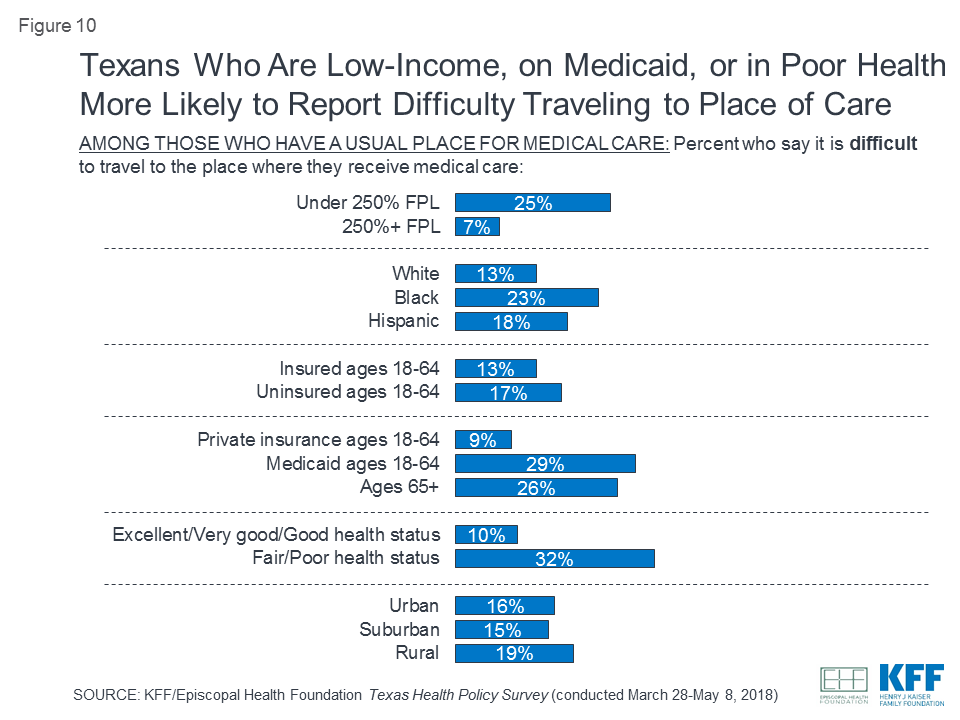
Even among Texans who have a place they usually go to when sick or in need of advice, difficulty traveling to this place can be a barrier for some. Overall, the large majority of Texans with a usual place for medical care say it is either “very easy” (61 percent) or “somewhat easy” (23 percent) to travel there, but 16 percent say it is “somewhat” (13 percent) or “very difficult” (3 percent). More vulnerable individuals, such as Texans with lower incomes, Medicaid enrollees, seniors, and those in fair or poor health are particularly likely to report difficulty traveling to the place they usually receive care. For example, among those with a usual place to go for medical care, Texans with self-reported incomes under 250 percent of the federal poverty level are three times as likely as higher-income residents to say it is difficult to travel to that place (25 percent versus 7 percent). And among Texans ages 18-64 with Medicaid coverage and those who report being in fair or poor health, roughly three in ten say it is difficult to travel to their place of care (Figure 10).
Figure 10: Texans Who Are Low-Income, on Medicaid, or in Poor Health More Likely to Report Difficulty Traveling to Place of Care
Methodology
The Kaiser Family Foundation/Episcopal Health Foundation Texas Health Policy Survey was conducted by telephone March 28 – May 8, 2018 among a random representative sample of 1,367 adults age 18 and older living in the state of Texas (note: persons without a telephone could not be included in the random selection process). Interviews were administered in English and Spanish, combining random samples of both landline (439) and cellular telephones (928, including 688 who had no landline telephone). Sampling, data collection, weighting and tabulation were managed by SSRS in close collaboration with Kaiser Family Foundation and Episcopal Health Foundation researchers. Episcopal Health Foundation paid for the costs of the survey fieldwork, and Kaiser Family Foundation contributed the time of its research staff. Both partners worked together to design the survey and analyze the results.
The sampling and screening procedures included an oversample component designed to increase the number of respondents ages 18-64 with Medicaid or non-group health insurance coverage. This included 180 respondents who were reached by calling back respondents in Texas who had previously completed an interview on either the SSRS Omnibus poll or the Kaiser Health Tracking Polls and indicated they fit one of the oversample criteria (based on age and type of health insurance coverage). It also included an oversample of counties with higher shares of Medicaid recipients.
The dual frame cellular and landline phone sample was generated by Marketing Systems Group (MSG) using random digit dial (RDD) procedures. All respondents were screened to verify that they resided in Texas. For the landline sample, respondents were selected by asking for the youngest adult male or female currently at home based on a random rotation. If no one of that gender was available, interviewers asked to speak with the youngest adult of the opposite gender. For the cell phone sample, interviews were conducted with the qualifying adult who answered the phone.
A multi-stage weighting design was applied to ensure an accurate representation of the Texas adult population. The first stage of weighting involved corrections for sample design, including accounting for oversampling of high-Medicaid counties, as well as non-response for the callback sample. In the second weighting stage, demographic adjustments were applied to account for systematic non-response along known population parameters. Population parameters included gender, age, race, Hispanicity (broken down by nativity), educational attainment, phone status (cell phone only or reachable by landline), state region, and residence in a low-income county. This stage excluded the Medicaid and non-group oversample components. Based on this second stage of weighting, estimates were derived for types of health insurance coverage (Medicaid, non-group, employer-sponsored, all else) in the Texas population. The last stage of weighting included all respondents and included health insurance coverage based on the previous stage’s outcomes. Weighting parameters were based on estimates from the U.S. Census Bureau’s March 2017 Current Population Survey (CPS), with the exception of population density of the respondent’s county of residence which was based on the 2010 Census, and telephone use (cell phone-only, landline-only, dual-user) which was based on data from the January-June 2016 National Health Interview Survey.
The margin of sampling error including the design effect for the full sample is plus or minus 3 percentage points. For results based on subgroups, the margin of sampling error may be higher. Sample sizes and margins of sampling error for subgroups are available by request. Note that sampling error is only one of many potential sources of error in this or any other public opinion poll. Kaiser Family Foundation public opinion and survey research is a charter member of the Transparency Initiative of the American Association for Public Opinion Research.
Affording health care ranks at the top of Texans’ financial concerns, with more than half (55%) saying it is difficult for them and their families to afford health care, including a quarter (25%) who say it is “very difficult,” finds a new Kaiser Family Foundation/Episcopal Health Foundation poll of Texas residents.
Fewer report difficulties affording other basic necessities, including rent or mortgage, monthly utilities, transportation costs, or food.
In addition, nearly four in 10 (38%) Texans say they or someone in their household had problems paying medical bills in the past year. Most of this group (and 23% of all Texans) say medical bills had a major impact on their family.
Many Texans are also skipping or postponing care due to its costs, the poll finds. Six in 10 (61%) say they or another family member has taken at least one of six such actions due to costs: skipped dental care (44%), postponed needed medical care (42%), skipped a recommended test or treatment (36%), not filled a prescription (31%), cut pills in half or skipped doses (21%), or had problems getting mental health care (14%).
“Texans said that their state government should be doing more to help many people get access to health care and these numbers show why they feel that way,” said Elena Marks, EHF’s president and CEO. A previous KFF/EHF health poll in June found that roughly two thirds of Texans say the state is not doing enough to help low-income adults get health care.
“Texans are even more likely than Americans overall to face real challenges affording health care,” KFF President and CEO Drew Altman said. “This likely reflects Texas’ uninsured rate, though the survey shows that even many residents with insurance are struggling to pay for needed care.”
Texans report many problems affording health care at a significantly higher rate than adults nationwide. For example, a recent national KFF survey found a quarter (27%) of adults report problems paying medical bills in the past year, significantly smaller than the share among Texans (38%). Texas’ higher rates likely reflect lower average incomes and higher uninsured rates than the nation as a whole.
Among Texans, certain groups are more likely than others to report difficulty in all of these areas. Those with lower incomes, Hispanic residents, and those in poorer health are more likely to report experiencing these types of problems compared to their higher-income, white, and healthier counterparts.
Not surprisingly, uninsured Texans report much higher rates of difficulties affording health care, paying medical bills and postponing or skipping needed care than Texans with insurance. Texas currently has more residents without health insurance than any other state and has the highest uninsured rate in the country (21% among adults ages 19-64, compared to 12% nationally).
Cost is the main obstacle to getting more Texans insured. Half (50%) of non-elderly uninsured Texans say that the main reason they don’t have coverage is because it is too expensive and unaffordable. Far fewer cite other main reasons such as employment issues (15%), not wanting or needing it (7%) or citizenship/residency issues (7%).
The poll also examines Texans’ experiences accessing medical care. One in five (21%) say they don’t have a place where they usually go for care when they are sick or need health advice, and another 5 percent say they usually go to the emergency room. Others usually visit a doctor’s office (44%), a clinic or health center (20%) or another location such an urgent care or hospital outpatient center (9%).
The findings come from the second report in a series based on a KFF/EHF survey of Texans. The first report captured residents’ views of and experiences around state health policy and Medicaid.
Designed and analyzed by researchers at the Kaiser Family Foundation and the Episcopal Health Foundation, the Texas Health Policy Survey was conducted from March 28-May 8, 2018 among a random digit dial telephone sample of 1,367 adults living in Texas. Interviews were conducted in English and Spanish by landline (439) and cell phone (928). The margin of sampling error including the design effect for the full sample is plus or minus 3 percentage points. For results based on subgroups, the margin of sampling error may be higher.
The Episcopal Health Foundation (EHF) believes all Texans deserve to be healthy. EHF is committed to transforming the health of our communities by going beyond just the doctor’s office. By providing millions of dollars in grants, working with congregations and community partners, and providing important research, we’re supporting solutions that address the underlying causes of poor health. EHF was established in 2013 and is based in Houston. With more than $1.2 billion in estimated assets, the Foundation operates as a supporting organization of the Episcopal Diocese of Texas and works across 57 Texas counties. #HealthNotJustHealthcare
With President Trump having declared the opioid epidemic a public health emergency, both the House and Senate are advancing legislation to address the crisis. A new issue brief from the Kaiser Family Foundation summarizes current federal legislative proposals related to Medicaid’s role in the opioid epidemic and identifies issues to watch as final legislation takes shape.
The House has passed several bills culminating in the Substance Use Disorder Prevention that Promotes Opioid Recovery and Treatment (SUPPORT) for Patients and Communities Act. The Senate Finance Committee has approved the Helping to End Addiction and Lessen (HEAL) Substance Use Disorders Act, which is expected to be considered by the full Senate later this year. Appendix tables detail the House SUPPORT Act, the Senate HEAL Act, and other bills pending at the Senate and House committee level as of late June, 2018
Any final legislation could affect state Medicaid programs, SUD treatment providers, health plans, opioideneficiaries and other stakeholders.
To see more of KFF’s work related to the opioid epidemic visit our special resource page on this topic.
A new issue brief from the Kaiser Family Foundation explains the June 29 federal court ruling invalidating the Kentucky HEALTH Medicaid waiver program and its implications for other states. The DC Federal District Court decision in Stewart v. Azar blocked Kentucky from implementing the waiver on July 1, including its work requirement, monthly premiums up to 4% of income, coverage lockouts for failure to timely renew eligibility or timely report a change in circumstances, and other provisions.
The court held that the primary purpose of Medicaid is to provide affordable health coverage. It determined that the approval of the waiver by the federal secretary of Health and Human Services violated the law because he did not consider the plan’s impact on furnishing medical assistance – providing affordable health coverage — to the low-income populations identified by Congress in the Medicaid statute. Specifically, the secretary never discussed how many people would lose coverage, despite the state’s estimate that 95,000 people would lose Medicaid, the court found.
The secretary also failed to cite any evidence that some enrollees would gain private coverage as a result of the waiver or estimate how many might do so. In addition, the court found that the secretary cannot prioritize the impact on “traditional” or “vulnerable” Medicaid populations at the expense of the Medicaid expansion group.
The court vacated the waiver and remanded it to HHS to make a decision that is supported by the administrative record. The ruling comes at a time when the Trump administration is encouraging states to impose work requirements in Medicaid. The decision sets the stage for appeals and future litigation that could affect the other states with approved work requirement waivers as well as how HHS and the states address these issues in the future.
For more information on which states are seeking waivers for work requirements and other provisions, visit our Medicaid waiver tracker.
On June 29, 2018, the DC federal district court issued a decision in Stewart v. Azar, the lawsuit brought by a group of Medicaid enrollees challenging the Health and Human Services (HHS) Secretary’s approval of the Kentucky HEALTH Section 1115 waiver program, which includes a work requirement, premiums, coverage lockouts, and other provisions that the state estimated would lead 95,000 people to lose coverage. Key rulings by the court include that:
The plaintiffs have the ability to bring the lawsuit;
The court has the ability to review the waiver approval;
The Secretary’s waiver approval violates the Administrative Procedure Act;
The Kentucky HEALTH waiver is vacated and remanded to HHS; and
The separate “institution for mental disease” substance use disorder payment waiver continues.
While this decision may not be last word on such waivers, given the potential for an appeal in this case as well as possible similar challenges in other states, the court’s decision is notable for its affirmation of Medicaid’s status as a health insurance program and the program’s equal treatment of all groups covered by the statute.
On June 29, 2018, the DC federal district court issued a much-anticipated decision in Stewart v. Azar, the case brought by 16 Kentucky Medicaid enrollees challenging the Secretary of Health and Human Services’ (HHS) approval of the Kentucky HEALTH Section 1115 waiver program. The waiver included several provisions approved for the first time in Medicaid — a work requirement, monthly premiums up to 4% of income, and coverage lockouts for failure to timely renew eligibility or timely report a change in circumstances — as well as heighted cost-sharing for non-emergency ER use and elimination of retroactive eligibility and non-emergency medical transportation. The court vacated the waiver approval and remanded to HHS to consider how the waiver would help furnish medical assistance consistent with Medicaid program objectives. This issue brief summarizes the court’s decision and considers its implications. An earlier issue brief provides background and answers key questions about the lawsuit.
The Court’s Decision
The Plaintiffs Have the Ability to Bring the Lawsuit
The court determined that the plaintiffs are actually injured by the waiver, and their injury is likely to be redressed by the relief they are seeking. The premiums imposed by the waiver would cause economic injury to at least two of the plaintiffs, whom CMS and Kentucky concede are unlikely to be determined medically frail or otherwise exempt from the payments. The court also found that a ruling that HHS illegally approved the waiver would grant meaningful relief to these plaintiffs. The court noted that the Kentucky Governor’s Executive Order to terminate the state’s Medicaid expansion if a final court judgment invalidates the waiver does not affect plaintiffs’ standing to sue because the Executive Order would not be implemented until after all court appeals are exhausted or waived, the state submits a state plan amendment (SPA) to CMS, CMS approves the SPA, and CMS’s decision on the SPA is potentially subject to judicial review.
The Court Has the Ability to Review the Waiver Approval
The court rejected HHS’s argument that the Secretary’s Section 1115 waiver decisions are not subject to judicial review under the Administrative Procedure Act (APA) because such decisions turn on the Secretary’s judgment about whether a waiver is likely to assist in furthering program objectives. The court noted that Congress placed this limit on the Secretary’s authority in the statute, relying on the courts to act as a check on the executive branch’s exercise of discretion. The Secretary is afforded deference in interpreting Medicaid’s objectives but must exercise his discretion reasonably in light of text of the statute. The court also determined that the entire set of Kentucky HEALTH waiver provisions should be reviewed as a whole rather than considering each individually.
The Secretary’s Waiver Approval Violated the APA
The court determined that the Secretary’s waiver approval was arbitrary and capricious, in violation of the APA, because he entirely failed to consider the waiver’s impact on furnishing medical assistance – i.e., providing affordable health coverage — to the low-income populations identified by Congress in the Medicaid statute. Specifically, the court found that the Secretary never discussed how many people would lose coverage when approving the waiver, despite the state’s estimate of 95,000 people and numerous public comments citing research and concerns that the waiver policies and new administrative requirements would likely lead to coverage losses. The Secretary also failed to cite any evidence that some enrollees would gain private coverage as a result of the waiver or estimate how many might do so.
Additionally, the court concluded that the Secretary did not adequately consider how the waiver would promote coverage. The waiver approval contains only a single “conclusory” statement that eliminating retroactive coverage would encourage beneficiaries to obtain and maintain coverage even when healthy and does not acknowledge public comments that pointed out that this provision would reduce coverage for those not already enrolled in Medicaid. The court rejected the Secretary’s argument that a separate waiver provision authorizing federal Medicaid payments for substance use disorder (SUD) treatment services in “institutions for mental disease” (IMDs) shows that Kentucky HEALTH provides medical assistance, finding that the IMD SUD provision is an independent waiver program, as detailed below.
The Secretary’s assertion that he considered whether the waiver would promote beneficiary health is not a substitute for considering whether the waiver promotes Medicaid’s primary purpose of covering health costs, the objective that Congress identified for the program. In creating Medicaid and expanding it under the Affordable Care Act (ACA), Congress focused not only on promoting health but also on making coverage affordable. The Secretary also cannot prioritize the impact on “traditional” or “vulnerable” Medicaid populations at the expense of the expansion group. Kentucky’s waiver applies to traditional low-income parents as well as expansion adults. Moreover, by amending the Medicaid statute to add the ACA expansion, Congress placed the expansion group “on equal footing” with other populations identified in the statute for whom Medicaid furnishes medical assistance. Consequently, the Secretary cannot prefer certain Medicaid populations over others and instead must consider the waiver’s impact on all affected enrollees, including coverage losses among the expansion group. The court also noted the record lacks substantial evidence that Kentucky’s Medicaid program is in danger of economic collapse without the waiver. Finally, statutory language about promoting independence and self-care is tied to providing rehabilitation and other services, not limiting medical assistance. Even if the Secretary could properly consider the waiver’s impact on self-sufficiency, he failed to balance that objective with any consideration of the impact on coverage.
The Kentucky HEALTH Waiver is Vacated and Remanded
The Secretary’s approval of Kentucky HEALTH without considering Medicaid’s central objective of providing affordable coverage is a fundamental failure that invalidates the waiver. The court remanded the waiver to HHS to correct this error and make a decision that is supported by the administrative record. The court also vacated the waiver, preventing it from being implemented in the meantime, noting that doing so will preserve the status quo and protect the plaintiffs from harm.
The IMD SUD Payment Waiver Continues to be in Effect
The court’s decision does not disturb Kentucky’s IMD SUD payment waiver authority. The IMD SUD payment waiver applies to a different population, with a different start date, and different purposes from the set of Kentucky HEALTH waivers challenged by the plaintiffs. The Secretary has approved stand-alone IMD SUD payment waivers in other states. When approving this provision in Kentucky, the Secretary evaluated whether IMD SUD payment would further program objectives independent of, and granted separate authorities for, the Kentucky HEALTH waivers challenged by the plaintiffs.
Implications
As a result of the court’s ruling, HHS must reconsider its decision on the Kentucky HEALTH waiver, including all relevant facts based on the administrative record. The Secretary must evaluate the waiver’s impact on Medicaid’s primary objective of providing affordable health coverage, including the impact on coverage losses among the expansion group. While the Secretary does not have to address every public comment in writing, concerns raised by the comments must be considered. In an appendix to the decision, the court excerpted a number of public comments raising concerns and citing evidence about the likelihood of coverage losses under the waiver. The court did not hold that the Secretary can never approve a waiver that reduces coverage nor identify the limits of any permissible coverage loss.
Given the court’s decision, Kentucky cannot implement the Kentucky HEALTH waiver on July 1st as planned. In the meantime, ACA expansion coverage continues in Kentucky. The court’s decision does not trigger the Governor’s Executive Order to terminate Medicaid expansion. Instead, the Executive Order by its terms only would apply six months from the date that all judicial appeals have been exhausted or waived or otherwise as soon as legally practicable. Kentucky could implement other measures short of terminating the expansion. A June 20th presentation to the state legislature’s Health and Welfare and Social Services Committee indicated that the state would consider eliminating certain benefits currently provided to the expansion group, including vision, dental, and “possibly” pharmacy,1 in addition to undertaking an “immediate evaluation” of eliminating the expansion, if faced with an adverse court decision.2
Looking Ahead
HHS and Kentucky have 60 days to file with the U.S. Circuit Court of Appeals for the DC Circuit if they choose to appeal the district court’s decision. The defendants also can ask for the district court’s decision to be stayed, or prevented from taking effect, during an appeal. This request would first go to the district court and if denied, could then be made to the appeals court.3 The CMS Administrator indicated that the agency was conferring with the U.S. Department of Justice about how to proceed in light of the court’s decision. Kentucky stated that it would work with CMS to address the issues raised by the decision.
Legally, the court’s decision only impacts Kentucky’s waiver. However, the decision is likely to have practical and political implications for other states considering similar waivers. States without waiver approvals to date might wait to see how the Kentucky case is finally resolved before proceeding. While this decision may not be last word on such waivers, given the potential for an appeal as well as possible similar challenges in other states, the court’s decision is notable for its affirmation of Medicaid’s status as a health insurance program and the program’s equal treatment of all groups covered by the statute.
Endnotes
Federal law requires that expansion enrollees receive a benefit package with the ACA’s 10 essential health benefits, including prescription drugs. 42 U.S.C. §§ 1396a(k)(1); 1396u-7(b)(5); 18022(b)(1)(F); 42 C.F.R. § 440.347(a)(6). ↩︎
In deciding whether to stay the decision, the court would consider the likelihood that HHS and Kentucky will ultimately prevail on the merits, the prospect of irreparable injury if relief is withheld, the possibility of harm to the plaintiffs if relief is granted, and the public interest. U.S. Court of Appeals for the DC Circuit, Circuit Rule 8(a)(1). ↩︎
Large Majority of the Public View Federal Funding of Family Planning Services for Low-Income Women as “Important”
As President Trump prepares to make a new Supreme Court nomination, new polling from the Kaiser Family Foundation finds that two-thirds (67%) of the public do not want the Supreme Court to overturn the 1973 landmark Roe v. Wade decision that established women’s constitutional right to abortion.
Fielded this month prior to Justice Anthony Kennedy’s retirement announcement, the poll finds about three in 10 Americans (29%) say they want the Supreme Court to overturn Roe v. Wade. The case is expected to be a major flashpoint in the Senate debate over Justice Kennedy’s replacement, as Justice Kennedy has been a swing vote on abortion on a court closely divided on the issue.
The poll finds a slim majority (53%) of Republicans would like to see Roe v. Wade overturned, while large majorities of Democrats (81%) and independents (73%) would not. Similar shares of women (68%) and men (65%) want Roe v. Wade to stand, but among women of reproductive age, three-quarters (74%) want Roe v. Wade to stand.
The public overall is split on how easily they think women can access abortion services in their communities today – with major differences in perceptions by party. About a quarter (27%) say it is “too easy” for women to get these services, while one in five (22%) say it is “too difficult” and about a third (35%) say it is “about right.” Half (51%) of Republicans say it is too easy, while nearly four in 10 (37%) Democrats say “too difficult.”
In light of the attention generated by the #MeToo movement and 2018 primary victories by female candidates, the poll looks ahead to November’s midterm elections and examines the public’s and voters’ views on a broad range of issues affecting women, including sexual harassment, paid parental leave and reproductive health.
While not at the top of voters’ concerns heading into the midterms, most voters (56%) do say it is at least “very important” for candidates to discuss issues that primarily affect women.
When this group is asked to say in their own words what issues they mean, about four in 10 (44%, or 25% of all voters) mention issues related to equal pay or fair employment. This is twice as many as those who mention reproductive health issues including abortion or contraception (20%, or 11% of all voters).
In addition, substantial shares of voters say that a candidate’s position on certain policies that mainly affect women will influence their vote.
For example, six in 10 (60%) voters say they would be more likely to vote for a candidate who supports increased workplace protections against sexual harassment and assault, and a majority (53%) say the same about a candidate who supports a law requiring paid parental leave. Democratic voters and women voters are more likely to favor candidates who support each of these positions than are Republican voters and men voters.
Voters are divided along partisan lines on how a candidate’s position on access to abortion services will affect their vote. Overall about four in 10 (42%) voters say they are more likely to vote for a candidate who supports access to abortion services, while three in 10 (29%) say they are more likely to vote for a candidate who wants to restrict access to abortion services. Most (72%) Democratic voters say they are more likely to vote for a candidate who supports abortion access, while most (58%) Republican voters say they are more likely to vote for a candidate who wants to restrict abortion access.
The international #MeToo movement working to raise awareness about sexual harassment and assault is also a touchstone for many voters. Half (49%) say they are more likely to support a candidate who is a strong supporter of the #MeToo movement, while just 7 percent say they are more likely to vote for a candidate who does not address the issues raised by the movement.
Other findings from the poll include:
Eight in 10 (80%) of the public say federal funding for family planning and other reproductive health services to low-income women is “very important” or “somewhat important” to them. This includes most Republicans (59%) and the overwhelming majority (94%) of women 18-44.
Most of the public (57%) say they oppose new Title X regulations proposed by the Trump Administration that would block federal family planning funds from going to organizations like Planned Parenthood, which also provide abortions, even though the money can’t be used for abortion. Nearly four in 10 (38%) say they favor those proposed regulations.
Most (55%) of the public says that women’s access to family planning services in their communities is “about right,” while twice as many say it is “too difficult” than say it is “too easy” (24% and 12%, respectively). Among women of reproductive age who are more likely to have direct experience, about one-third (35%) say it is “too difficult” to access such services, five times the share who say it is “too easy” (7%).
Designed and analyzed by public opinion researchers at the Kaiser Family Foundation, the poll was conducted from June 11-20, 2018 among a nationally representative random digit dial telephone sample of 1,492 adults. Interviews were conducted in English and Spanish by landline (319) and cell phone (1,173). The margin of sampling error is plus or minus 3 percentage points for the full sample. For results based on subgroups, the margin of sampling error may be higher.
In light of the #MeToo Movement, recent 2018 primary election wins by female candidates, and Justice Kennedy’s retirement, there has been increased attention to the role of women’s issues in the political process and the courts, including workplace protections and reproductive health issues. The latest Kaiser Health Tracking Poll examined the public’s attitudes towards these issues with a focus on the views of women of reproductive age (ages 18-44).
Key Findings:
Conducted prior to the announcement of Supreme Court Justice Anthony Kennedy’s retirement, the poll finds two-thirds of the public do not want to see the Supreme Court overturn Roe v. Wade, while three in ten (29 percent) would like to see the decision overturned. A slim majority (53 percent) of Republicans would like to see Roe v. Wade overturned, while large majorities of Democrats (81 percent), independents (73 percent), and women of reproductive age (74 percent) say they would prefer to see Roe v. Wade stay in place.
Voters are divided along party lines on how a candidate’s position on access to abortion services will influence their vote. Overall, four in ten (42 percent) say they are more likely to vote for a candidate who supports access to abortion services while three in ten (29 percent) say they are more likely to vote for a candidate who wants to restrict access to abortion services. One-fourth of voters say a candidate’s position on this issue does not make a difference in who they will vote for in the fall.
The Trump Administration recently has proposed changes to rules about federal Title X family planning funding that helps pay for reproductive health care, contraception, and other preventive care services for low-income women. The new rule would prohibit federal family planning funding from going to organizations that also provide abortion services, even if the funds themselves cannot be used to pay for abortions. Over half the public (57 percent) say they oppose the newly proposed rule, while four in ten (38 percent) support it. While majorities of Democrats (67 percent) and independents (55 percent) oppose the new rule, Republicans are more evenly split (46 percent support, 48 percent oppose).
While few voters (eight percent) say issues affecting women are the “most important issue” for 2018 candidates to discuss, about half (48 percent) say they are “very important but not the most important issue.” When the 56 percent of voters who want to hear candidates talk about women’s issues are asked to say in their own words what issues they specifically want to hear the candidates discuss, four in ten (44 percent) mention issues related to equal pay or fair employment practices. In addition, most voters say they are more likely to vote for a candidate who supports stronger workplace protections against sexual harassment and assault, as well as paid parental leave.
The Public’s Views on Women’s Access to Abortion and Family Planning Services
In light of news about Supreme Court Justice Anthony Kennedy’s impending retirement, many commentators have raised questions about the future of abortion laws in the U.S., and some have questioned whether Roe v. Wade, the 1973 decision establishing women’s constitutional right to abortion, might be overturned if President Trump appoints a more conservative Justice to replace Kennedy. The latest Kaiser Health Tracking Poll, which began collecting data two weeks before Justice Kennedy’s retirement was announced, finds that two-thirds of the public do not want to see the Supreme Court overturn this decision, while three in ten (29 percent) would like to see the decision overturned.
Poll: Two-thirds of Americans Don’t Want the Supreme Court to Overturn Roe v. Wade
While a slim majority (53 percent) of Republicans would like to see Roe v. Wade overturned, large majorities of Democrats (81 percent) and independents (73 percent) do not want the decision overturned. Seven in ten (68 percent) women overall, and three-quarters (74 percent) of women of reproductive age (18-44 years) say they would prefer to see Roe v. Wade stay in place.
Figure 1: Majority of the Public Does Not Want Supreme Court to Overturn Roe v. Wade
Views About CUrrent Access Levels to Abortion Are Largely driven by Partisanship
When it comes to their opinion about women’s current level of access to abortion services in their community, the public is divided, with about a quarter (27 percent) saying it is “too easy” for women to get these services, one in five (22 percent) saying it is “too difficult,” and about a third (35 percent) saying access is “about right.” Democrats (37 percent) are more likely to say it is currently “too difficult” for women to access abortion services in their community, while about half (51 percent) of Republicans say it is “too easy” for women to access these services. Among women between the ages of 18-44 who are the most likely to have direct experience regarding abortion access, three in ten (30 percent) say it is “too difficult,” about a quarter (24 percent) say it is “too easy,” and about a third (36 percent) say access is “about right.”
Figure 2: Views Are Divided on Access to Abortion Services in Their Community
Most Say Access to Family Planning Services in their community is about right
The public is less divided when it comes to their views about access to family planning services and contraception in their community, with most (55 percent), saying that women’s access to these services is “about right.” Still, more say it is “too difficult” for women in their community to get these services than say it is “too easy” (24 percent versus 12 percent). Among women of reproductive age who are more likely to have direct experience – most (56 percent) say women’s access to family planning services in their community is “about right,” but about one-third (35 percent) say it is “too difficult” to access such services, five times the share who say it is “too easy” (seven percent).
Figure 3: Most Say Access to Family Planning Is About Right, but One-Third of Women, 18-44, Say It’s Too Difficult
Majority of the Public Oppose Trump Administration’s Proposed Changes to Title X Funding
The Trump Administration has recently proposed changes to rules about federal Title X family planning funding that helps pay for reproductive health care, contraception, and other preventive care services for low-income women.1 The proposed rule would require providers that offer abortion care in addition to family planning services to have a “physical separation” and “separate personnel” from other family planning activities in addition to the financial separation requirement already in place. In effect, it means that organizations like Planned Parenthood that provide abortions in addition to other health services will no longer be able to receive Title X funds to serve low-income women. The poll finds that 33 percent of women, including 39 percent of women under the age of 45, say they have visited a Planned Parenthood clinic for health services at some point.
Over half the public (57 percent) say they oppose the proposed rule that would prohibit federal funding from going to organizations that provide abortion services, even if the funds themselves cannot be used to pay for abortions, while four in ten (38 percent) support the proposed rule. While majorities of Democrats (67 percent) and independents (55 percent) oppose the proposed rule, Republicans are more evenly split (46 percent support, 48 percent oppose). Views among men and women (including women of reproductive age) are similar, with about four in ten of each group in support and about six in ten opposed.
Figure 4: Most Oppose New Rule Prohibiting Federal Funds From Going to Organizations that Provide Abortions
Majority of the Public Supports COntinued Federal Funding for Reproductive Health Care Services for Low-Income Women
More broadly, the poll finds strong support for federal government funding for reproductive health services for low-income women. Eight in ten adults say it is either “very important” (57 percent) or “somewhat important” (23 percent) to them that the federal government provides funding for services like family planning and birth control for low-income women. Support differs somewhat by party identification, with Democrats (79 percent) more than twice as likely as Republicans (31 percent) to say such funding is “very important.” Still, a majority (59 percent) of Republicans say this funding is at least “somewhat important.” Support also differs by gender, with about half of men (47 percent) and two-thirds of women saying it is “very important” to them that the federal government provides funding for reproductive health services for low-income women, rising to almost three-quarters (73 percent) among women ages 18-44.
Figure 5: Eight in Ten Say It’s Important for Federal Government to Fund Reproductive Health Services for Low-Income Women
The Role of Women’s Issues in the 2018 Campaigns
While few voters say that issues that mainly affect women are the top issue for 2018 candidates to talk about, the latest Kaiser Health Tracking Poll finds large shares of voters saying a candidate’s stance on key women’s issues will make a difference in who they vote for this fall.
Few voters (eight percent) say issues affecting women are the “most important issue” for 2018 candidates to discuss during their campaigns. Larger shares of voters say health care (25 percent), the economy and jobs (23 percent), gun policy (20 percent), immigration (18 percent), and foreign policy (13 percent) are the “most important issue” for candidates to talk about.
Figure 6: About One in Ten Say Issues that Mainly Affect Women Are Most Important for 2018 Candidates to Discuss
A larger share of Democratic voters (15 percent) say issues that mainly affect women are the “most important issue” for 2018 candidates to discuss compared to six percent of independent voters and four percent of Republican voters. Women voters (10 percent), and women voters under the age of 45 (12 percent), are more likely than men voters (six percent) to say that issues affecting women are the “most important issue” for the 2018 candidates to talk about.
Equal Pay and Fair Employment Practices Are Top Women’s Issues for Voters
When the 56 percent of voters who say it is important for candidates to talk about women’s issues are asked to say in their own words what issues they specifically want to hear the candidates discuss, four in ten (44 percent, or 25 percent of all voters) mention issues related to equal pay or fair employment practices. This is twice as many as mention reproductive health issues including abortion or contraception (20 percent, or 11 percent of all voters) or general mentions of equality or equal rights (18 percent, 10 percent). Fewer – about one in ten – mention issues surrounding sexual harassment or sexual assault (12 percent, seven percent) or women’s health issues such as breast cancer or cancer screenings (11 percent, six percent).
Figure 7: Equal Pay and Fair Employment Practices Top List of Women’s Issues Voters Want to Hear About From Candidates
Candidates’ Stances on Key Women’s Issues Could Play Role in 2018 Vote Choice
While issues mainly affecting women do not necessarily top the list of things voters want to hear candidates talk about, many voters say candidates’ stances on certain issues may play a role in how they vote. For example, six in ten voters say they are more likely to vote for a candidate who wants to enact stronger workplace protections, such as harsher penalties for sexual harassment and assault in the workplace, while just seven percent say they are more likely to vote for a candidate who does not want to enact stronger workplace protections.
Similarly, 53 percent of voters say they are more likely to vote for a candidate who supports a law requiring employers to provide paid parental leave while seven percent of voters say they are more likely to vote for a candidate who does not support a law requiring employers to do this. Half of voters (49 percent) also say they are more likely to support a candidate who is a strong supporter of the #MeToo Movement, the international movement working to raise awareness about sexual harassment and assault, while few (seven percent) say they are more likely to vote for a candidate who does not address issues raised by the movement. At least three in ten voters – across all of these issues – say a candidate’s position on these issues will not make a difference in who they vote for in the fall.
Figure 8: Large Shares of Voters Say They Are More Likely to Vote for a Candidate Who Supports Key Women’s Issues
Majorities of Democratic voters, and about half of independent voters and Republican voters, say they are more likely to vote for a candidate who wants to enact stronger workplace protections such as harsher penalties for sexual harassment and assault in the workplace (76 percent, 54 percent, and 48 percent, respectively). Similarly, most Democratic voters (73 percent) and half of independent voters (47 percent) say they are more likely to vote for a candidate who supports a law requiring paid parental leave. About one-third of Republican voters (34 percent) say the same. Majorities of women voters and at least seven in ten women voters under age 45 also say they are more likely to vote for candidates who support both of these workplace protections.
Figure 9: Large Shares Say They Are More Likely to Vote For Candidate Who Supports Certain Workplace Protections
Majorities of Democratic voters (74 percent) and women voters (54 percent), especially those under the age of 45 (62 percent), say they are more likely to vote for a candidate who is an outspoken supporter of the #MeToo movement, while most Republican voters (63 percent) say a candidate’s position on this issue does not make a difference in who they will vote for.
Figure 10: Large Partisan Divide on Whether Voters Are More Likely to Vote For A Candidate Who Supports the MeToo Movement
Voters Are Divided on Party Lines on How a Candidate’s Position on Access to Abortion May Impact Their Vote
Overall, four in ten (42 percent) say they are more likely to vote for a candidate who supports access to abortion services while three in ten (29 percent) say they are more likely to vote for a candidate who wants to restrict access to abortion services. One-fourth of voters (26 percent) say a candidate’s position on this issue does not make a difference in who they vote for in the fall.
Figure 11: More Voters Say They’ll Vote For Candidate Who Supports Access to Abortion Services Than Wants to Restrict Access
Similar to views on other abortion issues, these attitudes largely fall along party lines with large shares of Democratic voters saying they are more likely to vote for a candidate who supports access to abortion services (72 percent), while six in ten (58 percent) of Republican voters say they are more likely to vote for a candidate who wants to restrict access to abortion services. A larger share of independent voters say they are more likely to vote for a candidate who supports access (39 percent) than for a candidate who wants to restrict access (20 percent). Among women voters under the age of 45, more than twice as many say they are more likely to vote for a candidate who supports access (57 percent) than a candidate who wants to restrict access (25 percent) to abortion services.
Figure 12: Role of Candidates’ Stance on Access to Abortion Services in 2018 Vote Largely Driven by Partisanship
While party identification appears to be a bigger driver than gender in voters’ attitudes on these issues, there are some differences between women voters and men voters within parties on how a candidate’s position on women’s issues may influence their vote. For example, while majorities of both women and men Democratic voters say they are more likely to vote for a candidate who supports access to abortion services, the share is somewhat larger among women than men (77 percent compared to 63 percent). Among independent voters, a larger share of women than men say they are more likely to vote for a candidate who wants to enact stronger workplace protections (61 percent compared to 47 percent). In addition, among Republican and independent voters, a larger share of women than men say they are more likely to vote for a candidate who is an outspoken supporter of the #MeToo movement.
Table 1: Role of Women’s Issues for Voters in the 2018 Campaigns
Percent who say they are more likely to vote for a candidate who …
Democratic Voters
Independent Voters
Republican Voters
Women
Men
Women
Men
Women
Men
…supports access to abortion services
77%
63%
45%
34%
11%
16%
…supports a law requiring employers to provide paid parental leave
76
69
51
42
38
30
…wants to enact stronger workplace protections
80
71
61
47
52
45
…is an outspoken supporter of the #MeToo Movement
74
74
55
39
28
16
Methodology
This Kaiser Health Tracking Poll was designed and analyzed by public opinion researchers at the Kaiser Family Foundation (KFF). The survey was conducted June 11th–20th 2018, among a nationally representative random digit dial telephone sample of 1,492 adults ages 18 and older, living in the United States, including Alaska and Hawaii (note: persons without a telephone could not be included in the random selection process). Computer-assisted telephone interviews conducted by landline (319) and cell phone (1,173, including 793 who had no landline telephone) were carried out in English and Spanish by SSRS of Glen Mills, PA. To efficiently obtain a sample of lower-income and non-White respondents, the sample also included an oversample of prepaid (pay-as-you-go) telephone numbers (25% of the cell phone sample consisted of prepaid numbers) as well as a subsample of respondents who had previously completed Spanish language interviews on the SSRS Omnibus poll (n=10). Both the random digit dial landline and cell phone samples were provided by Marketing Systems Group (MSG). For the landline sample, respondents were selected by asking for the youngest adult male or female currently at home based on a random rotation. If no one of that gender was available, interviewers asked to speak with the youngest adult of the opposite gender. For the cell phone sample, interviews were conducted with the adult who answered the phone. KFF paid for all costs associated with the survey.
This month’s poll also includes an analysis of young women under the age of 45 (n=402). To obtain a large enough sample, the sampling frame included an oversample of women using cell phones (n=59) as well as callbacks among women who fit the screening criteria using the SSRS Omnibus poll (n=182).
The combined landline and cell phone sample was weighted to balance the sample demographics to match estimates for the national population using data from the Census Bureau’s 2016 American Community Survey (ACS) on sex, age, education, race, Hispanic origin, and region along with data from the 2010 Census on population density. The sample was also weighted to match current patterns of telephone use using data from the July-December 2017 National Health Interview Survey. The weight takes into account the fact that respondents with both a landline and cell phone have a higher probability of selection in the combined sample and also adjusts for the household size for the landline sample, and design modifications, namely, the oversampling of prepaid cell phones and likelihood of non-response for the re-contacted sample. All statistical tests of significance account for the effect of weighting.
The margin of sampling error including the design effect for the full sample is plus or minus 3 percentage points. Numbers of respondents and margins of sampling error for key subgroups are shown in the table below. For results based on other subgroups, the margin of sampling error may be higher. Sample sizes and margins of sampling error for other subgroups are available by request. Note that sampling error is only one of many potential sources of error in this or any other public opinion poll. Kaiser Family Foundation public opinion and survey research is a charter member of the Transparency Initiative of the American Association for Public Opinion Research.