News Release

The Number of Uninsured People Rose in 2017, Reversing Some of the Coverage Gains Under the Affordable Care Act

Published: Dec 10, 2018

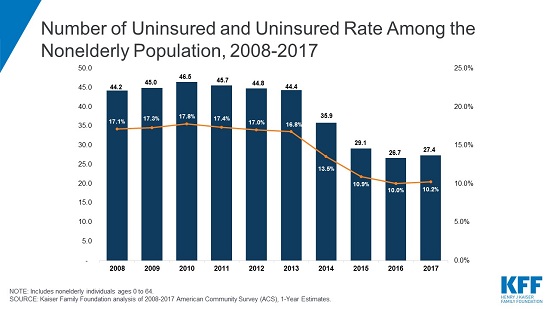
The number of uninsured people rose by nearly 700,000, to 27.4 million people, in 2017, reversing some of the coverage gains achieved under the Affordable Care Act, according to latest analysis of uninsured data by KFF (the Kaiser Family Foundation).

It was the first uptick in the uninsured since implementation of the ACA in 2014, which helped drive down the number of uninsured people in the U.S. from 44 million in 2013 to under 27 million in 2016. That year the uninsured rate dropped to a historic low of 10 percent. It was 10.2 percent in 2017, the most recent year for which federal American Community Survey (ACS) data are available.

The rise in the uninsured was not spread evenly across all states and groups of people. The uninsured rate remained largely unchanged in the 31 states (plus Washington D.C.) that had expanded Medicaid under the ACA by 2017, declining by less than 0.1 percentage points.  In contrast, the uninsured rate in non-expansion states increased overall, rising by 0.6 percentage points. Thirteen of the 18 states with the highest uninsured rates in 2017 were non-expansion states as of that year.

Among other key findings:

  • Nearly three-fourths (74%) of the nonelderly adults who were uninsured in 2017 had been without coverage for more than a year.
  • Over three quarters of the uninsured (77%) in 2017 had at least one full-time worker in their family, and an additional 10% had a part-time worker in their family.
  • People of color are at higher risk of being uninsured than Whites. People of color make up 42% of the nonelderly U.S. population but accounted for over half of the total nonelderly uninsured population in 2017. Hispanics and Blacks had significantly higher uninsured rates (19% and 11%, respectively) than Whites (7%).

Detailed data on state-by-state changes in the uninsured rate since the implementation of the ACA are available in KFF’s recently updated Key Facts About the Uninsured Population. The fact sheet describes how health insurance coverage has changed in recent years, examines the characteristics of the uninsured population, and summarizes the access and financial implications of not having coverage.

About the data

The health coverage data in the fact sheet is now based on analysis of the Census Bureau’s American Community Survey (ACS). In the past, the fact sheet and nearly all KFF products that analyzed health coverage data had used the Census Bureau’s Current Population Survey (CPS). We also recently updated all years of health coverage data in our online State Health Facts database with data based on the ACS. The ACS allows for precise state-level estimates as well as analyses of longer trends over time.

A Generation of Health Care in the United States: Has Value Improved in the Last 25 Years?

Published: Dec 6, 2018

Using data from the Health System Dashboard, a new analysis looks at trends in health spending and outcomes in the United States between 1991 and 2016. While many U.S. health outcomes, like life expectancy and disease burden, have improved, the share of GDP devoted to health increased by 40%, and the U.S. still lags behind other countries in many key measures.

The analysis is part of the Peterson-Kaiser Health System Tracker, an online information hub dedicated to monitoring and assessing the performance of the U.S. health system.

Ask KFF: Karen Pollitz Answers 3 Questions on Trump Administration’s New ACA Waiver Guidelines

Authors: Karen Pollitz and Chelsea Rice
Published: Nov 30, 2018

On Thursday, the Trump administration announced a change to the state innovation waiver under the Affordable Care Act, previously known as Section 1332. Renamed the “State Relief and Empowerment Waiver,” the new guidelines would, among other things, allow states to ask for permission to change how they apply federal subsidies to state insurance marketplaces, including for alternative health plans that do not comply with the ACA coverage requirements.

Karen Pollitz, KFF’s senior fellow on health reform and private insurance, answers three questions from Chelsea Rice, KFF’s digital strategist, on the legal authority for this change and its implications for consumers and state marketplaces in our new “Ask KFF” feature.


1. First of all, does the Centers for Medicare and Medicaid Services (CMS) have the authority to change this element of the Affordable Care Act without going through Congress?

Pollitz: Certainly CMS has the authority to implement the waiver provisions of the ACA, and they have the authority to interpret what the law’s requirements are. I think it remains to be seen whether there will be legal challenges to the Trump administration’s interpretation, since this guidance certainly pushes the boundaries of what kinds of waivers the law allows.


2. How would this affect consumers in the states that apply for these waivers?

Pollitz: This new announcement provides a path for states to restructure the ACA’s subsidies in significant ways, which could have the effect of destabilizing marketplaces and potentially make it harder for people with pre-existing conditions to get affordable coverage.

By law, states are supposed to have flexibility to try new and different things, but in order for an innovation waiver to be approved, coverage has to be at least as affordable and at least as comprehensive for at least as many residents as it would have been before, and it can’t end up costing the federal government more.

The Obama administration made clear that they would evaluate waiver proposals based not only on how they would affect the total population, but also with respect to vulnerable subgroups, including people with low incomes or pre-existing conditions.  Under this new guidance, the most vulnerable residents could be disadvantaged as long as, in the aggregate, at least as many people have coverage.   The Trump administration also re-interpreted what counts as affordable and what counts as comprehensive.  Instead of evaluating the affordability and comprehensiveness of coverage that people actually get under the waiver, HHS will evaluate whether comparably affordable and comprehensive coverage continues to be offered, even if fewer people sign up for it.

What the states ask for will determine the scope of impact on consumers. First of all, the Trump administration said that states can apply for waivers to redistribute federal subsidy dollars. Under the ACA, eligibility for subsidies is the same regardless of age. But states could now make younger people eligible for bigger subsidies and — because it has to be budget neutral – reduce subsidies for older people. CMS also suggested that states could redistribute subsidy dollars based on income — which could allow for subsidies up to 500% of the poverty level or more, but that would require thinning out subsidies for people at lower income levels to stretch the same subsidy pot to be budget neutral.

States could also redistribute the same pool of dollars to subsidize some non ACA-compliant plans, like short term health plans, which are roughly half the cost of ACA-compliant policies. But they offer much less protection and deny coverage to people with pre-existing conditions. The administration is clearly signaling with these additions that even if states redistribute the strength and affordability of the coverage so that some of the most vulnerable people are disadvantaged, they would entertain the waivers that cover the same number of people.


3. CMS says in their announcement that this initiative will “strengthen health insurance markets.” How might the individual insurance market change in the states that choose to apply for this updated innovation waiver?

Pollitz: We’ll have to see what states do. For example, the new guidance makes clear that states can continue to pursue waivers to establish reinsurance programs to stabilize marketplace premiums, as seven states have done already.  In addition, though, states could pursue new actions that could very well de-stabilize the ACA marketplaces.  Waivers under these guidelines might also make it possible for insurers to sell more non-ACA-compliant policies to more people at lower premiums, but those policies would not reliably protect people when they get really sick and need coverage.

Re-approval of Kentucky Medicaid Demonstration Waiver

Authors: MaryBeth Musumeci, Robin Rudowitz, and Elizabeth Hinton
Published: Nov 29, 2018

Issue Brief

What did CMS do with regard to Kentucky’s Demonstration Waiver?  On November 20, 2018, the Centers for Medicare and Medicaid Services (CMS) re-approved a Section 1115 demonstration waiver program called Kentucky HEALTH, as a component of the state’s overall KY HEALTH (“Kentucky Helping to Engage and Achieve Long Term Health”) demonstration.1  The overall demonstration was originally approved on January 12, 2018, and includes 2 major components:  (1) the Kentucky HEALTH program that modifies the state’s existing Medicaid expansion and applies new policies to the current Medicaid expansion population, as well as most other adults covered by Medicaid; and (2) a Substance Use Disorder (SUD) program available to all Medicaid enrollees.2   On June 29, 2018, a DC federal district court ruling set the Kentucky HEALTH program aside before implementation, which was scheduled for July 1, 2018, and sent it back to CMS for further consideration in response to a lawsuit brought by a group of Medicaid enrollees challenging the approval.  CMS subsequently opened a new federal public comment period on the Kentucky HEALTH provisions and received approximately 8,585 “unique, substantive” comments.3 

The key elements of Kentucky’s re-approved Medicaid waiver, which still faces a legal challenge, have not changed. They include work requirements, premiums up to 4% of income, multiple “lock-out” periods and the elimination of retroactive eligibility.

Were there changes in the re-approved waiver?  The recent re-approval of the Kentucky HEALTH program is largely the same as the original approval with a few technical or minor changes.  The re-approval also includes requirements for the state to submit implementation and monitoring protocols to CMS for approval as well as some evaluation hypotheses for the work requirement and other provisions that are likely to have significant implications for beneficiaries’ ability to retain coverage for which they are eligible.  The original waiver approval only required protocols for the SUD program and made submission of any Kentucky HEALTH protocols optional for the state.

What is next?  The new implementation date for Kentucky HEALTH is set for April 1, 2019; however, the plaintiffs in the lawsuit could return to the DC federal district court to challenge CMS’s re-approval.  A final decision from the DC district court could be appealed to the DC Court of Appeals and eventually could ultimately go to the Supreme Court.  At this time, it is not clear if whether or when the waiver re-approval will be challenged in court or if implementation would be postponed while litigation is pending.  The DC federal court ruling did not affect the SUD provisions of the waiver, which are being implemented according to an October, 2018 implementation plan.

What is the history of Medicaid expansion in Kentucky?  Kentucky originally implemented a traditional Medicaid expansion, according to the terms set out in the Affordable Care Act (ACA), in January 2014.  Subsequently, Governor Bevin, who ran on a platform to end the Medicaid expansion and dismantle the State-Based Marketplace, was elected in December, 2015.  Post-election, the Governor instead decided to seek a Section 1115 waiver to change the state’s traditional Medicaid expansion.  On the same day that CMS approved Kentucky’s waiver, Governor Bevin issued an executive order directing the state to terminate the Medicaid expansion if a court decides that one or more of the waiver provisions are illegal and cannot be implemented.  Research points to gains in coverage and reductions in the uninsured, increases in access and health care utilization, and positive fiscal impacts as a result of the Medicaid expansion in Kentucky and other expansion states. Since implementing the ACA, Kentucky’s nonelderly adult uninsured rate fell from 20% in 2013 to 9% in 2016.  Nearly 462,000 adults were enrolled in Medicaid expansion coverage as of FY 2016.

What are the provisions in the waiver?  This fact sheet summarizes key provisions of Kentucky’s approved waiver.  Specific details are included in Table 1.

Key provisions in the Kentucky HEALTH portion of the waiver applicable to most adults, including expansion adults and low-income parents, are: 

  • Work Requirements: Conditioning Medicaid eligibility on meeting and documenting a work requirement of 80 hours per month for most expansion adults and low-income parents and suspending eligibility for those who do not comply until they again meet the work requirement or complete a state-approved health or financial literacy course.  Notably, CMS guidance prohibits states from using federal Medicaid funds for needed employment supports, such as child care, transportation, job training, etc.   Kentucky was the first state to receive waiver approval to condition Medicaid eligibility on meeting a work requirement following guidance released by CMS on January 11, 2018; however, implementation did not move forward as a result of the lawsuit challenging the approval.4 
  • Premiums: Requiring monthly premiums for most expansion adults and low-income parents, up to 4% of household income and at least $1.00, in lieu of copayments; requiring payment of the first premium before coverage is effective for those from 100-138% FPL (coverage is effective after expiration of the 60 day premium payment period for those below 100% FPL who do not pay a premium); removing the 90-day period to change health plans without cause after initial enrollment once the first premium is paid or the 60-day payment period expires.  Premiums of 4% exceed the levels approved in any other waiver to date and those allowed in the Marketplace, both of which are capped at 2% of income.
  • Coverage Lock-Outs: Disenrolling and locking out of coverage for up to six months: (1) those who are over 100% FPL and do not pay premiums within 60 days; (2) most adults who do not provide any documentation needed to timely renew eligibility; and (3) most adults who fail to timely report a change in circumstances affecting eligibility. Those subject to lockouts can re-enroll prior to 6 months if they pay all past due amounts and the current month’s premium (for premium lockouts) and complete a state-approved health or financial literacy course;
  • Exemptions: Varying the groups who are exempt from, or have good cause for not complying with, different waiver requirements.  For example, people who are determined to be medically frail, those eligible for TMA, survivors of domestic violence and former foster care youth are exempt from premiums, unless they wish to access an incentive account (described below), while pregnant women are both exempt from premiums and can have an incentive account without paying premiums.  As another example, being evicted or homeless constitutes good cause for avoiding a 6-month lockout for failing to pay premiums, timely renew eligibility, or report a change in circumstances, but does not qualify as good cause for failing to meet the work requirement.
  • Deductible and Incentive Accounts: Adding a deductible account and an incentive account to purchase additional benefits (moves vision, dental, and over-the-counter drugs from the regular benefit package to the incentive account for expansion adults; also offers limited reimbursement for gym memberships for all enrollees); enrollees must pay premiums to access the incentive account, can accrue funds by completing certain activities and are subject to account deductions as penalties for incurring various rule violations; and
  • Benefit Restrictions: Eliminating retroactive eligibility for most adults, including expansion adults, low-income parents, and people who are medically frail; and waiving non-emergency medical transportation (NEMT) for all services for most expansion adults.

Key provisions in the SUD waiver program available to all Medicaid enrollees include:

  • IMD Payment Exclusion: Waiving the IMD (institution for mental disease) payment exclusion for short-term SUD residential treatment services (with no day limit specified); and
  • NEMT: Waiving NEMT for methadone treatment services (including for people who are medically frail).

What to watch for?  As noted earlier, we will be watching to see if there is additional legal action in Kentucky (i.e. will the plaintiffs in the lawsuit return to the DC federal district court to challenge CMS’s re-approval and then would CMS appeal that decision).  Other milestones moving toward implementation include the submission of the implementation and monitoring protocols that are now required.  If the waiver is implemented in April 2019, understanding the processes and procedures including beneficiary and provider outreach and education, new systems and reporting requirements will be important.  We know from watching implementation of the new work requirements in Arkansas that these are large tasks and can be very difficult to reach enrollees to inform them of program changes.

Years of research and experience implementing Medicaid and CHIP point to coverage gains realized by simplified and streamlined processes and reductions in enrollment and retention of people who remain eligible for coverage when processes are complicated or require additional documentation or verification.  While the total number likely to lose coverage may be under dispute, Kentucky’s waiver proposal anticipated that the demonstration would result in fewer Medicaid enrollees after implementation, as a result of beneficiary non-compliance with waiver policies, such as premiums and the work requirement, and, in later years, due to shifts to commercial coverage.  In Arkansas, the only state to implement a work requirement to date, over 12,000 people have lost coverage due to failure to comply with work or reporting requirements as of November 2018.  Litigation is pending in Arkansas.  A November 8th letter to Secretary Azar from the Medicaid and CHIP Payment and Access Commission (MACPAC) raised concerns about disenrollment and the lack of an approved evaluation plan and asked for a pause in additional disenrollment.  Understanding how many individuals lose coverage, the reasons for the coverage loss and if individuals gain employment with coverage or become uninsured are key questions for waiver evaluations in Arkansas and Kentucky.

Table

                           Table 1:  Kentucky’s Section 1115 Medicaid Expansion Demonstration Waiver
ElementKentucky Waiver
Overview:The overall demonstration, called KY HEALTH, includes 2 major components:
  • (1) A program called Kentucky HEALTH, that modifies the state’s existing Medicaid expansion by:
    • Conditioning Medicaid eligibility on meeting and documenting a work requirement of 80 hours per month for most expansion adults and low-income parents and suspending eligibility for those who do not comply until they again meet the work requirement or complete a state-approved health or financial literacy course;
    • Requiring monthly premiums for most expansion adults and low-income parents, up to 4% of household income but at least $1.00, in lieu of copayments and requiring payment of the 1st premium before coverage is effective for those from 100-138% FPL (coverage is effective after expiration of the 60-day payment period for those at or below 100% FPL who do not pay a premium);
    • Disenrolling and locking out of coverage for up to six months: (1) those who are over 100% FPL and do not pay premiums within 60 days; (2) most adults who do not provide any documentation needed to timely renew eligibility; and (3) most adults who fail to timely report a change in circumstances affecting eligibility. Those subject to lockouts can re-enroll prior to 6 months if they pay all past due amounts and the current month’s premium (for premium lockouts) and complete a state-approved health or financial literacy course;
    • Removing the 90-day period to change health plans without cause after initial enrollment once the first premium is paid or the 60-day payment period expires;
    • Eliminating retroactive eligibility for most adults, including people who are medically frail;
    • Adding a deductible account and an incentive account to purchase additional benefits (enrollees must pay premiums to access the account, can accrue funds by completing certain activities, and are subject to account deductions as penalties for incurring various rule violations); and
    • Waiving non-emergency medical transportation (NEMT) for all services for most expansion adults.
  •  (2) A Substance Use Disorder (SUD) program available to all Medicaid enrollees that changes the SUD benefit package by:
    • Waiving the IMD (institution for mental disease) payment exclusion for short-term SUD services; and
    • Waiving NEMT for methadone treatment services (including for people who are medically frail).
Duration:1/12/18 through 9/30/23.  Implementation of the Kentucky HEALTH components begins no sooner than 4/1/19. The SUD provisions are governed by a 10/5/18 implementation plan.
Coverage Groups:Kentucky HEALTH includes the adult expansion group, low-income parent/caretakers, those receiving Transitional Medical Assistance (TMA), pregnant women, and former foster care youth. Exemptions from specific policies are noted below.
Medical Frailty Determination:People who are determined to be medically frail are exempt from several waiver provisions (noted below). Information about Kentucky HEALTH put out on June 13, 2018 defines Medically Frail: as Medicaid recipients with a: serious and complex medical condition, significant difficulty performing activities of daily living, like eating and getting dressed, disabling mental health diagnosis, chronic substance use disorder, a diagnosis with HIV/AIDS, eligibility for Social Security Disability Insurance (SSDI), or chronic homelessness.

The state will apply the federal definition of medical frailty, including people with disabling mental disorders; chronic SUD; serious and complex medical conditions; physical, intellectual, or developmental disabilities that significantly impact the ability to perform one or more activities of daily living; and those who meet Social Security disability criteria.

The waiver also refers to the process in the state’s alternative benefit plan (ABP).  The ABP for low-income parents and other traditional populations currently specifies that individuals can self-identify as medically frail. However, no further detail about this process is provided in the waiver terms and conditions, which also provide that any operational protocol would be optional for the state to submit to CMS for approval and incorporation into the waiver (as described below). (The ABP for expansion adults is silent about medical frailty.)

Coverage Renewals and Lock-Out:  Most adults (expansion, low-income parents and TMA) who fail to timely complete the annual eligibility renewal process (by not providing any required documentation after a 90-day grace period) will be disenrolled and locked out of coverage for up to six months, unless they verify good cause or cure the lock out as described below.  Pregnant women, former foster care youth, survivors of domestic violence and beneficiaries determined medically frail are exempt from this lock-out. In addition, people with disabilities cannot be disenrolled for failure to submit renewal paperwork if they needed but were not provided with reasonable modifications, under the Americans with Disabilities Act (ADA), Section 504 of the Rehabilitation Act, and Section 1557 of the ACA, necessary to complete the process.

The state shall use pre-populated forms and timely process applications to avoid further coverage delays once the lock-out period ends.  The state also shall achieve successful ex parte renewal for at least 75% of Kentucky HEALTH adults, excluding those whose eligibility is suspended at renewal.

Lock-out for Failure to Timely Report Changes Affecting Eligibility:  Most adults (expansion adults, low-income parents, and TMA) who fail to report a change in circumstances that led to additional month(s) of coverage during which the person was ineligible within 10 days will be disenrolled and locked out of coverage for up to six months. Disenrolled individuals can cure the lock-out and re-enroll prior to six months (as described below) and receive pre-disenrollment safeguards (as described below).  Pregnant women, former foster care youth, survivors of domestic violence and beneficiaries determined medically frail are exempt from this lock-out.
Premiums:Most adults (expansion adults, low-income parents, and those receiving Medicaid premium assistance for ESI) must pay monthly premiums. People who are medically frail, pregnant women, former foster care youth, beneficiaries eligible for TMA, and survivors of domestic violence are exempt from premiums.  Former foster care youth, people who are medically frail and those eligible for TMA can choose to pay premiums to access an incentive account (described below).

Premiums in lieu of copayments shall not exceed 4% of household income, except that all non-exempt beneficiaries must pay a minimum of $1.00/month. The state may vary premium amounts on factors including, but not limited to, household income or length of time enrolled in Kentucky HEALTH, subject to the 4% household limit.  Other bases for varying premiums should be consistent with how premiums vary in the state’s commercial insurance market. Beneficiaries who meet the 5% aggregate household cap on premiums and cost sharing will pay $1.00 monthly premiums for the remainder of the calendar quarter.

The state will determine premium amounts based on income at the eligibility determination and notify the beneficiary and health plan. The state must redetermine monthly premium amounts annually at renewal and any time the state is made aware of a change in household income, with new amounts effective on the 1st of the next month. The state may reduce a premium amount at any time.  The state will annually evaluate the premium rates and amounts, and reserves the right to increase premium amounts up to the 4% of income limit in response to evaluation results. The state will notify CMS of upcoming premium changes through the demonstration annual report (described below) and will notify beneficiaries at least 60 days prior to implementing a premium change.

Third parties (except health plans), such as non-profit organizations and providers, may pay premiums on a beneficiary’s behalf.  Provider or related entities must have criteria for making premium payments that are not based on whether beneficiaries will receive services from the provider.

Health plans will send monthly invoices and collect premiums. Health plans can attempt to collect unpaid amounts, but may not report to credit agencies, place a lien on the enrollee’s home, refer to debt collectors, file a lawsuit, or seek a court order to garnish wages.

The state will not sell any unpaid obligations for collection by a third party.  Unpaid amounts are collectible by the state, but re-enrollment is not conditioned on repayment except when curing a lockout (described below).  Enrollees shall have an opportunity to review and seek correction of payment history. Enrollees will not be charged a higher premium due to nonpayment or underpayment in a prior month, although past due amounts will be separately reflected on subsequent invoices.

Overpayments resulting from a change in circumstances will reduce the next month’s premium. The state shall have a process to refund any premiums paid for a month during which the person was ineligible for Medicaid. The state must suspend monthly invoices to enrollees whose eligibility is suspended for failure to meet the work requirement (described below) and send written notice to prevent overpayments.

Limitation on Changing Health Plans:Beneficiaries may only change health plans for cause once the initial premium is paid or the 60-day payment period expires, until the beneficiary’s next annual enrollment period (waives 90-day change period after initial plan enrollment; applies to all groups except pregnant women and former foster care youth). Individuals can select a health plan when applying or the state will auto-assign them to a plan.
Effective Coverage Date:  Waives 3-month retroactive coverage for most adults (expansion adults and low-income parents), including people who are medically frail. Pregnant women and former foster care youth remain eligible for retroactive coverage. The effective date for those eligible for TMA is governed by the state plan.

Requires most adults (expansion adults and low-income parents ) to pay their first month’s premium prior to the start of coverage unless they have been determined medically frail or presumptively eligible. Coverage begins on the first day of the month in which payment is received. People who are medically frail, former foster care youth, TMA, survivors of domestic violence, or pregnant are not required to pay premiums to start or maintain coverage.

Individuals below 100% FPL who are not medically frail, pregnant, TMA, domestic violence survivors, or former foster care youth and do not pay a premium within 60 days of the invoice have coverage effective on the first of the month in which the 60 day payment period expires.  They also must make point of service copayments at state plan amounts and do not have access to the My Rewards incentive account (described below).

Those above 100% FPL who are not medically frail, pregnant, TMA, domestic violence survivors, or former foster care youth cannot enroll in coverage without a premium payment and must re-apply if the initial payment is not made within 60 days of the invoice.

People exempt from premiums (those known to be medically frail or domestic violence survivors at the time of application, pregnant women, former foster care youth) have coverage effective on the first of the month of application once determined eligible. The coverage effective date for those receiving TMA is governed by the state plan.

Individuals (other than those determined presumptively eligible) can choose to make an initial premium prepayment (at an amount determined by the state, up to the maximum premium amount for those at 138% FPL) as part of the electronic application to expedite coverage.  Once the individual is determined eligible for Medicaid, coverage will begin on the first of the month in which the initial premium pre-payment was made. However, once a premium pre-payment is made, the beneficiary may not change health plans except for cause prior to their next annual open enrollment period (waives 90-day period to change health plans after initial enrollment as described above).  Premium prepayments can be refunded for those determined ineligible or for whom premium payments are not required, at the individual’s request. Overpayments of the initial premium are credited to amounts due for the remainder of the benefit period, with any remaining amount refunded to the beneficiary.

Anyone determined presumptively eligible continues coverage without a break as of the first of the month after the full Medicaid eligibility determination without having to first pay a premium. Instead, these enrollees have copays at state plan amounts and then have 60 days from their first premium invoice to make a payment. (Those over 100% FPL who are not medically frail, pregnant, TMA, domestic violence survivors, or former foster care youth and do not pay a premium within 60 days will be disenrolled and locked out for up to 6 months as described below.)

Consequences for Non-Payment of Premiums, including Disenrollment and Lock-Out or Copays: As described above, premiums are a condition of eligibility for expansion adults, parents and those receiving ESI premium assistance from 101-138% FPL unless medically frail, TMA, or a domestic violence survivor. These groups will be disenrolled from coverage for non-payment of a premium after 60-days from the monthly invoice and not allowed to re-enroll for six months unless they cure the lockout (described below) or verify good cause (described below).  People who are disenrolled for non-payment also will have their incentive account balance reduced (described below). They also are subject to safeguards prior to disenrollment (described below).  People re-enrolling after a lock-out will not be required to pay past due premiums as a condition of eligibility.

People subject to premiums at or below 100% FPL (unless medically frail, domestic violence survivor, or former foster care youth) and those eligible for TMA will not be disenrolled for nonpayment but will be charged copays at state plan amounts, have their incentive account balance reduced (described below), and have their incentive account suspended (unable to accrue or use funds) up to 6 months. These individuals can return to paying premiums instead of copays and reactivate their incentive account before 6 months if they comply with the same requirements as are required to cure a lockout (see below); payment of past-due premiums is not required to reactivate incentive accounts.  Those determined to have good cause for non-payment will be eligible to resume premium payments instead of copays and access their incentive account in the first administratively feasible month.

Deductible Account:Most adults (expansion adults, low-income parents, TMA, and former foster care youth) will have an account to which the state will contribute a $1,000 annual deductible to cover non-preventive healthcare services.  Beneficiaries will receive monthly statements with the cost of utilized services and their account balance.  If the deductible is exhausted before the end of the benefit year, enrollees will have access to covered services without unreasonable delay. If funds remain in the deductible account at the end of the year, enrollees can transfer up to 50% of the prorated balance (for months in which the person was enrolled and eligibility was not suspended) to their My Rewards incentive account (described below). Pregnant women and people receiving Medicaid as premium assistance for ESI will not have a deductible account.
Incentive (My Rewards) Account:All adults required to and making monthly premium payments will have a My Rewards incentive account.  Pregnant women can have a My Rewards account without having to pay premiums.    Former foster care youth, survivors of domestic violence, and beneficiaries determined medically frail have the option to pay premiums to have access to the My Rewards account (to access benefits beyond those covered in the state plan like fitness-related services since these groups have access to state plan benefits including vision and dental).

The incentive account may be used to access additional, prior authorized, benefits not otherwise covered once sufficient funds are accrued.  These benefits include dental, vision, over the counter (OTC) medications, and limited reimbursement for the purchase of a gym membership for non-medically frail expansion adults, and only gym membership for all other adults (who instead continue to receive dental, vision and OTC medication in the state plan benefit package as described below).  Vision, dental, and OTC medications are charged to the incentive account at the Medicaid fee-for-service rate and to the extent these services would have been covered under the state plan. For services that do not have a state plan rate, CMS must determine that the rate is cost effective and efficient.  Expenditures for items and services covered under the incentive account must be determined by the Secretary to meet the federal definition of medical assistance.

Enrollees can start accumulating dollars in their incentive account prior to full Kentucky HEALTH implementation.  Account funds are not subject to an annual limit and can have a negative balance of up to $150, although beneficiaries will not have to make a monetary payment to the state for a negative account balance. Funds accrue, or are subject to deductions, as long as Medicaid eligibility is not suspended or disenrolled.

Enrollees can earn incentive account funds by:

  • transferring 50% of any remaining deductible account funds each year (as described above)
  • completing state-specified healthy behaviors (no further detail provided);
  • completing work activities that exceed the 80 hour per month minimum requirement (described below);
  • not having a non-emergent ER visit during the benefit year; and
  • keeping all scheduled appointments in a year (based on a state evaluation of whether as a general matter enrollees subject to the demonstration are missing appointments).

Enrollees will have incentive account funds deducted for:

  • each non-payment of premiums;
  • non-emergent use of the ER (amount may increase for each subsequent use), unless the enrollee contacts the health plan 24-hour nurse hotline before ER use. The enrollee must receive an appropriate medical screening exam, and the state must ensure that hospitals comply with enrollee education about appropriate alternative settings prior to deducting account funds;
  • each appointment missed without adequate notice of cancellation or good cause (not defined) (based on a state evaluation described above).
Work Requirement and Lock-Out:  Requires monthly documentation of 80 hours of work activities per month as a condition of eligibility for most adults ages 19-64.  Beneficiaries cannot apply excess hours to future months. After Kentucky HEALTH implementation, new enrollees or those transitioning to Kentucky HEALTH will have at least 30 days before being required to meet the work requirement. The work requirement will be implemented on a regional basis.

Per information about Kentucky HEALTH put out on June 13, enrollees can report work hours online at CitizenConnect.ky.gov or by calling / visiting a local Kentucky Career Center. Enrollees are not required to upload supporting documents, but can provide them if available.  The Commonwealth will check PATH Community Engagement hours, and enrollees could be required to provide documents as proof so enrollees can avoid having to find documents later by sharing them at the time of reporting.

The only people exempt from “active” monthly documentation of meeting the work requirement are those who are meeting or exempt from TANF or SNAP work requirements, those enrolled in ESI premium assistance, and those who work at least 120 hours/month.

Former foster care youth, pregnant women, domestic violence survivors, one primary caregiver of a dependent minor child or adult who is disabled per household, people who are medically frail, those with an acute medical condition validated by a medical professional that would prevent them from complying, and full-time students are exempt from the work and reporting requirements.  People with disabilities under the ADA/504/1557 also are exempt from the work requirement if unable to participate due to disability-related reasons (more detail below).

Qualifying work activities include but are not limited to any combination of employment, job search, job training, education (related to employment, high school, college, graduate, ESL, vocational, etc.), volunteer work (community work experience, community service), caring for a non-dependent relative or other person with a disabling chronic condition, or participation in substance use disorder treatment.

The state must make good faith efforts to connect enrollees to existing community supports that are available to assist in meeting the work requirement, including available non-Medicaid assistance with transportation, child care, language access services and other supports, and make good faith efforts to connect people with disabilities with services and supports necessary to enable them to comply. According to CMS guidance, Medicaid funds cannot be spent on employment support services.

Those who fail to meet the required work hours for a month will have one month to cure their noncompliance (as described below). They also can request (at least 10 days before suspension) and verify good cause (as described below) or appeal the suspension before it takes effect. Otherwise, eligibility is suspended on the 1st of the month following the one month opportunity to cure, and the suspension lasts until the first of the month after the person cures the suspension (described below). Those with suspended eligibility at the time of annual renewal will be disenrolled unless they can show they meet the work requirement or are exempt in the renewal month. The state must provide individuals whose eligibility is suspended with information on how to access primary and preventive care at no or low cost.

The state must assess areas that experience high rates of unemployment, areas with limited economies and/or educational opportunities, and areas that lack public transportation to determine whether there should be further exemptions from the work requirement and/or additional mitigation strategies, so that the work requirement will not be impossible or unreasonably burdensome for beneficiaries to meet.

The state shall provide timely written notice about when the work requirement begins, whether an enrollee is exempt and under what conditions the exemption would end, the specific work activities to satisfy and to cure noncompliance, the specific number of hours per month that an enrollee must complete and when and how the enrollee must report participation or requires an exemption or good cause, information about resources that help connect beneficiaries to opportunities for activities that would meet the work requirement, community supports available to assist beneficiaries in meeting the requirement, how hours will be counted and documented, what gives rise to a suspension and how it could affect renewal, how to demonstrate good cause, how to appeal a suspension or good cause denial, and the explanation for good cause decisions.

Notice and Appeal Rights Required for All Lock-Outs/Eligibility Suspension:The state shall provide advance notice and appeal rights prior to any disenrollment/eligibility suspension and lock-out, including the right to apply for Medicaid on a basis other than an expansion adult or low-income parent, the impact on the ability to access Marketplace coverage and premium tax credits, what to do if circumstances change creating eligibility for Medicaid on another basis, and implications for minimum essential coverage. During appeal hearings, individuals must have the opportunity to raise additional issues, including whether they should be subject to the lock-out, and to provide additional documentation during the appeals process.

The state also shall provide written notice of the specific activities that qualify individuals for early re-enrollment during a lock-out period; the groups that are exempt from lock-outs; and the good cause exceptions to lock-outs (listed below).

Outreach and Education:The state shall provide beneficiary education and outreach that supports compliance with renewals, such as through communications or coordination with state-sanctioned assisters, providers, health plans or other stakeholders.

The state also must conduct outreach and education to inform beneficiaries about how premiums should be paid, the potential impact of a change in income; the fact that premiums are determined based on monthly income; the deadline to report a change in circumstances affecting eligibility and the consequences for failing to do so; and how to re-enroll if disenrolled for non-payment.  Health plan invoices also must contain this information.

Good Cause Exemptions to Lock Outs/Eligibility Suspension:Enrollees have good cause and can re-enroll in coverage after an eligibility suspension due to failure to meet the work requirement or without waiting six months or completing the activities otherwise required to cure a lock-out (described below) for failure to timely renew eligibility, failure to timely report a change in circumstances leading to ineligibility, or failing to pay premiums if they can verify that they:
  • were unable to comply during the entire reporting/payment period because they were hospitalized, otherwise incapacitated (work requirement good cause instead requires “serious illness”), or a person with a disability under the ADA/504/1557; or, they are a person with a disability who either did not receive needed reasonable modifications or there were no reasonable modifications that would have enabled the individual to comply. Being out of town during the entire reporting period also is good cause for failure to report a change in circumstances; or
  • had an immediate family member living in the home become institutionalized or die (work requirement good cause instead specifies hospitalization or serious illness of immediate family member or birth or death of family member living with enrollee) during the reporting/payment period; or caretaking or other disability-related responsibilities for an immediate family member with a disability resulted in inability to comply; or
  • obtained or lost private coverage during the reporting period (applies only to lockouts for failing to timely renew or report change in circumstances); or
  • were evicted or homeless during the renewal reporting/payment period (does not apply to work requirement good cause); or
  • were a victim of a declared natural disaster (flood, storm, earthquake or serious fire) that occurred during the reporting/payment period (work requirement good cause specifies severe inclement weather including natural disaster).

This is a list of minimum good cause criteria.

Curing a Lock-Out/Eligibility Suspension to Re-enroll in Coverage:Individuals who have been disenrolled and locked out of coverage for failing to pay premiums, renew eligibility, or report changes (and those under 100% FPL who lose access to their incentive accounts for failing to pay premiums) can cure the lock-out without waiting six months if they both (1) pay the premium for the 1st month of coverage to restart benefits; (2) if locked out (or lost access to incentive account) due to premium nonpayment, also make a one-time payment equaling premiums owed for each month in which they received healthcare coverage in the 60 days prior to the lockout; and (3) attend a state-certified health literacy or financial literacy educational course. However, the opportunity to cure a lockout (or reactivate incentive account) is limited to once per year per consequence type.

Individuals who fail to meet the work requirement can avoid eligibility suspension by, in the month immediately following the month of noncompliance, (1) meeting the work requirement for the current month; and either (2) making up missing hours from the prior month, or (3) completing a state-approved health or financial literacy course (this option is available once/year). Individuals who go on to have eligibility suspended for failing to meet the work requirement can then cure the suspension by completing 80 hours of work activities in a 30-day period or a state-approved health or financial literacy course,

The state shall ensure that the specific activities that qualify individuals to cure a lockout or eligibility suspension are available during a range of times and through a variety of means (e.g., online, in person) and at no cost to the individual.

Safeguards for Lockouts/

Eligibility Suspensions:

Before disenrollment and lock-out for failing to report a change in circumstances or to pay premiums, and before eligibility suspension for failing to comply with the work requirement, the state must determine the beneficiary ineligible for all other Medicaid pathways and review eligibility for other insurance affordability programs.

In addition, the state must offer an opportunity to provide additional clarifying information that an enrollee did report a change or had good cause before disenrollment and lockout for failure to report a change in circumstances affecting eligibility.

Prior to disenrollment and lockout for nonpayment of premiums, the state also must notify the individual that they are able to request a medical frailty review, and the health plan must send at least 2 notices about the delinquent payment, the due date to avoid disenrollment, and the option for a medical frailty screening.

Those who become pregnant or medically frail or eligible for Medicaid under another coverage pathway during the lockout period for nonpayment of premiums can re-enroll on that basis.

While eligibility is suspended for failure to comply with the work requirement, those who subsequently become pregnant, meet an exemption from the work requirement (listed above), or become eligible for Medicaid through another pathway can re-enroll.

Benefits:Expansion adults receive an alternative benefit package (ABP) as defined in a state plan amendment.  Pregnant women, former foster care youth, people who are medically frail, survivors of domestic violence, low-income parents, and those receiving TMA receive the traditional state plan benefit package, which continues to include vision, dental, and over-the-counter (OTC) medications. These services are excluded from the expansion adult ABP and instead available through the My Rewards account (described above).  No waiver of EPSDT for those under 21.

Waives non-emergency medical transportation (NEMT) for most expansion adults. Those who are medically frail, 19 or 20 year olds entitled to EPSDT, former foster care youth, survivors of domestic violence, and pregnant women continue to receive NEMT for all services (see medical frailty exception for methadone NEMT below).

Adds methadone to the state plan benefit package upon demonstration approval, but contingent on waiving NEMT for methadone services provided to all enrollees except children under 21, former foster care youth, and pregnant women (no medically frail exception).

Upon CMS approval of an implementation protocol, the benefit package for all enrollees (both those in Kentucky HEALTH and others), will include SUD residential treatment, crisis stabilization, and withdrawal management services provided in IMDs (short term stays, no day limit specified).

Delivery System: Continues to use existing capitated Medicaid managed care health plans for all populations statewide (except those in ESI premium assistance).
Reasonable Accommodations and Modifications for People with Disabilities: The state must provide reasonable accommodations under the ADA/504/1557 to afford people with disabilities an equal opportunity to participate in the work requirement.

The state also must provide reasonable modifications to the eligibility renewal process, the obligation to report a change in circumstances, and premium payment and work requirement protections and procedures to enable and assist people with disabilities under the ADA/504/1557.  Reasonable modifications for the work program include but are not limited to assistance with demonstrating eligibility for good cause, appealing suspensions, documenting work activities and other documentation requirements, and understanding work requirement notices and program rules, and must include exemptions when non-compliance is due to a disability-related reason, modifications in the number of hours required, and provision of support services necessary for participation. The state must evaluate individuals’ ability to participate in the work requirement and the types of reasonable modifications and supports needed. The state also must assess whether people with disabilities have limited job or other opportunities for reasons related to a disability and address those barriers.

The state also must maintain a system that identifies, validates, and provides reasonable modifications for people with disabilities related to the obligations to report a change in circumstances, to pay premiums, and to comply with the work requirement.

Implementation Processes and Protocols: The waiver requires the state to submit an Implementation Plan for the Kentucky HEALTH provisions to CMS no later than 90 days after approval of the demonstration for CMS approval and incorporation into the waiver terms and conditions. The implementation plan must include definitions and parameters and the state’s strategic approach to implementing and milestones for key policies, including the work requirement, premiums, healthy behavior incentives, lock-outs for failure to timely renew eligibility or report changes affecting eligibility, and elimination of retroactive eligibility and NEMT.  The implementation plan also must discuss application assistance, reporting, and processing; notices; coordinated agency responsibilities; coordination with other insurance affordability programs; appeals; renewals; coordination with other state agencies; beneficiary protections; and outreach.

The  SUD implementation protocol and health information technology plan were approved by CMS on October 5, 2018. .

Performance Metrics and Monitoring:  The state is also required to submit a Monitoring Protocol for the Kentucky HEALTH provisions to CMS no later than 150 days after the approval of the demonstration.  The monitoring protocol will described the qualitative and quantitative elements, data collection methods, and reporting timeframes for the state’s quarterly and annual reports to CMS.  CMS will provide a set of required metrics for key policies, including the work requirement, premiums, healthy behavior incentives, lockouts for failure to timely renew eligibility or report a change in circumstances, and elimination of retroactive eligibility and NEMT. For example, the metrics will cover enrollment, disenrollment, or suspension by specific demographics and reason, participation in qualifying work activities, access to care, and health outcomes.

The state also must submit an SUD monitoring protocol within 150 days of demonstration approval, including reporting on each of the milestone areas in the implementation protocol and for each county, access to MAT, availability of MAT providers, the number of individuals accessing MAT including methadone, and the estimated cost of provided NEMT for accessing methadone.  The SUD monitoring protocol also must include data collection, reporting and analytic methodologies for performance measures identified by the state and CMS, including timeframes and a baseline, target and annual goal for closing the gap.

Reports to CMS, Budget Neutrality, and Administrative Costs:  The state will submit to CMS 3 quarterly reports and 1 annual report each year and post them on the state website within 30 days of CMS approval. The reports must document:
  • any policy or administrative difficulties in demonstration operation, key challenges, their underlying causes and how they are being addressed, key achievements and to what conditions they can be attributed, any issues or complaints identified by beneficiaries, any lawsuits, unusual or unanticipated trends, legislative updates, and any public forums held with a summary of all public comments received.
  • the performance metrics described in the monitoring protocol (see above).
  • the impact of the demonstration in providing coverage to beneficiaries and people who are uninsured, and outcomes of care, quality, costs and access to care (may include beneficiary satisfaction surveys if conducted, and grievances and appeals).
  • the demonstration’s financial performance including budget neutrality – the state will not be allowed to obtain budget neutrality savings from demonstration populations.
  • any results of evaluation hypotheses to date and a summary of the progress of evaluation activities including key milestones and challenges.
  • the actual number of eligible member months for demonstration populations.

The state shall separately track and report administrative cost directly attributable to the demonstration (not included in budget neutrality).

Evaluation:The state must begin to arrange for an independent party to conduct an evaluation upon demonstration approval.  The state will submit a draft evaluation design to CMS for approval within 180 days of demonstration approval, a revised draft within 60 days of receiving CMS’s comments, and will publish the evaluation design within 30 days of CMS approval.  Each hypothesis must specify quantitative and qualitative research methodologies, proposed baseline and comparison groups, proposed process and outcome measures, data sources and collection frequency, cost estimates, and timelines. The design will incorporate multiple stakeholder perspectives including but not limited to surveys of beneficiaries enrolled and no longer enrolled and national survey data.

Hypotheses will include but are not limited to the following:

  • for the work requirement, effects on enrollment and continuity of enrollment, employment levels, income, transition to private insurance, health outcomes, and Medicaid program sustainability.
  • for premiums and healthy behavior incentives, effects on access to care and health outcomes.
  • for elimination of retroactive eligibility, effects on enrollment and eligibility continuity, including for different subgroups such as individuals who are healthy, those with complex medical needs, prospective applicants, and existing beneficiaries in different care settings.
  • for the demonstration as a whole and the key policies listed above, effects on health outcomes, financial impact (such as an assessment of medical debt and uncompensated care costs), and Medicaid program sustainability.

The interim evaluation is due (and should be posted for public comment with) when submitting an application for the waiver renewal or else 1 year prior to demonstration end.  The final interim evaluation shall be posted to the state’s website 60 days after receiving CMS comments on the draft.

The draft summative evaluation is due to CMS within 18 months of the end of the initial waiver approval period, and the final summative evaluation is due within 60 days of CMS’s comments and must be posted to the state’s website within 30 days of CMS approval.

Should CMS undertake a federal evaluation of the demonstration or any component, the state will cooperate fully and timely.

The state also must conduct an independent mid-point assessment of the SUD provisions within 90 days after the third year of the demonstration and collaborate with health plans, providers, beneficiaries, and other key partners to examine progress toward milestones.  The SUD implementation protocol must be modified for milestones at medium to high risk of not being achieved.

The draft SUD evaluation design is due to CMS within 180 days of demonstration approval.  Hypotheses should include initiation and compliance with treatment, utilization of ED and inpatient hospital services, reduction in key outcomes such as overdose deaths, effectiveness of MAT, interaction of MAT impact and access to NEMT and cost effectiveness of the IMD payment and NEMT waivers. Evaluation of the NEMT waiver shall include a beneficiary survey approved by CMS.

Process for Waiver Amendments: CMS reserves the right to amend the waiver terms and conditions to reflect changes “of an operational nature” without requiring the state to submit a waiver amendment, public notice and comment, budget neutrality calculations, a detailed description of the amendment including the impact on beneficiaries, supporting documentation, data supporting evaluation hypotheses, and how the evaluation design will be modified if applicable.

Waiver amendments are subject to guidance published in a 1994 Federal Register public notice, instead of the ACA public notice and comment process.  The 1994 public notice requires the state to do one of the following:  (1) hold at least one public hearing with time for comment on the “most recent working proposal”; (2) use a commission or similar process with an open public meeting in proposal development; (3) submit results from enactment of a proposal by the state legislature that includes an “outline” of the proposal; (4) provide for formal notice and comment of at least 30 days under the state administrative procedures act; (5) post a notice of intent to submit a proposal in newspapers of general circulation and provide a mechanism for receiving a copy of the proposal and at least 30 days to comment; or (6) any other similar process for public input that would allow an interested party to learn about and comment on the proposal contents.

Public Input: Public forum required within six months of implementation and annually thereafter.
SOURCE: CMS Special Terms and Conditions, KY HEALTH 1115 Demonstration, #11-W-00306/4 and 21-W-00067/4, approval period Jan. 12, 2018 through Sept. 30, 2023, amended Nov. 20, 2018 https://www.medicaid.gov/Medicaid-CHIP-Program-Information/By-Topics/Waivers/1115/downloads/ky/ky-health-ca.pdf

Endnotes

  1. CMS’s cover letter refers to “approving Kentucky HEALTH as a component of the KY HEALTH demonstration.”  Letter from Paul Mango, Chief Principal Deputy Administrator and Chief of Staff, CMS Office of the Administrator to Carol H. Steckel, Commissioner, Dep’t for Medicaid Servs., Commonwealth of Kentucky at 1, (Nov. 20, 2018), https://www.medicaid.gov/Medicaid-CHIP-Program-Information/By-Topics/Waivers/1115/downloads/ky/ky-health-ca.pdf.  The waiver terms and conditions indicate that these provisions are included in the KY Health demonstration as an amendment. ↩︎
  2. The KY HEALTH waiver also provides authority for the state to cover former foster care youth who were in foster care in another state and to align Medicaid and CHIP renewals with employer-sponsored insurance (ESI) open enrollment periods for those receiving ESI premium assistance.  CMS Waiver List, KY HEALTH 1115 Demonstration, #11-W-00306/4 and 21-W-00067/4, approval period Jan. 12, 2018 through Sept. 30, 2023, amended Nov. 20, 2018, https://www.medicaid.gov/Medicaid-CHIP-Program-Information/By-Topics/Waivers/1115/downloads/ky/ky-health-ca.pdf. ↩︎
  3. Letter from Paul Mango, Chief Principal Deputy Administrator and Chief of Staff, CMS Office of the Administrator to Carol H. Steckel, Commissioner, Dep’t for Medicaid Servs., Commonwealth of Kentucky at 11, (Nov. 20, 2018), https://www.medicaid.gov/Medicaid-CHIP-Program-Information/By-Topics/Waivers/1115/downloads/ky/ky-health-ca.pdf. ↩︎
  4. In June, 2018, Arkansas became the first state to implement a Medicaid work requirement waiver.  KFF, An Early Look at Implementation of Medicaid Work Requirements in Arkansas (Oct. 2018). ↩︎

Sources of Supplemental Coverage Among Medicare Beneficiaries in 2016

Authors: Juliette Cubanski, Anthony Damico, Tricia Neuman, and Gretchen Jacobson
Published: Nov 28, 2018

Today, 60 million people, including 51 million older adults and 9 million younger adults with disabilities, rely on Medicare for their health insurance coverage. Medicare beneficiaries can choose to get their Medicare benefits (Part A and Part B) through the traditional Medicare program, or they can enroll in a Medicare Advantage plan, such as a Medicare HMO or PPO. In 2018, two-thirds of Medicare beneficiaries are in traditional Medicare, and one-third are enrolled in Medicare Advantage plans.

Many traditional Medicare beneficiaries also rely on other sources of coverage to supplement their Medicare benefits. Supplemental insurance coverage typically covers some or all of Medicare Part A and Part B cost-sharing requirements and, in some instances, covers benefits Medicare does not. This data note explores sources of supplemental coverage among beneficiaries in traditional Medicare, based on data from the 2016 Medicare Current Beneficiary Survey (the most recent year available).

Sources of Supplemental Coverage in 2016

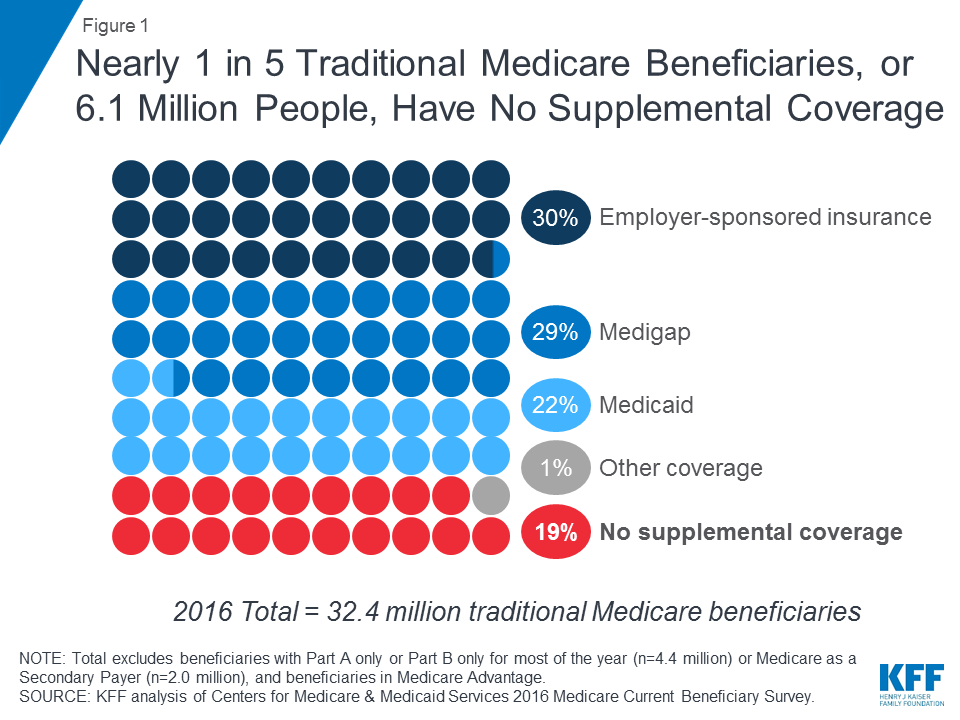
In 2016, eight in 10 beneficiaries in traditional Medicare (81%) had some type of supplemental insurance, including employer-sponsored insurance (30%), Medigap (29%), and Medicaid (22%) (Figure 1). But nearly 1 in 5 beneficiaries in traditional Medicare (19%)—6.1 million beneficiaries overall—had no source of supplemental coverage in 2016, which places them at greater risk of incurring high medical expenses or foregoing medical care due to costs.

Nearly 1 in 5 Traditional Medicare Beneficiaries, or 6.1 Million People, Have No Supplemental Coverage
  • Employer-sponsored insurance provides retiree health coverage to 3 in 10 (30%) traditional Medicare beneficiaries in 2016, or nearly 10 million beneficiaries (not including 3.4 million beneficiaries who were enrolled in Medicare Advantage plans offered exclusively to employers’ or unions’ retirees and 2.0 million who had Medicare as a secondary payer). Compared to all traditional Medicare beneficiaries in 2016, those with employer-sponsored retiree coverage had relatively high incomes and higher education levels, and were disproportionately white (Table 1). Over time, the share of beneficiaries with employer-sponsored retiree coverage is expected to decline, because the share of large firms offering it to their employees has dropped over time.
  • Medigap, also called Medicare Supplement Insurance, provided supplemental coverage to nearly 3 in 10 (29%) beneficiaries in traditional Medicare in 2016, or roughly 9 million beneficiaries, although the share with Medigap varies by state. Medigap policies, sold by private insurance companies, fully or partially cover Part A and Part B cost-sharing requirements, including deductibles, copayments, and coinsurance. Compared to all traditional Medicare beneficiaries in 2016, those with Medigap had higher incomes and education levels, and were more likely to be white—similar to the characteristics of beneficiaries with retiree health benefits. Only a small share of Medigap policyholders (3%) were under age 65 and qualified for Medicare due to a disability; most states do not provide underwriting protections or require insurers to issue Medigap policies to beneficiaries under age 65
  • Medicaid, the federal-state program that provides health and long-term care coverage to low-income people, was a source of supplemental coverage for more than 1 in 5 (22%, or 7.0 million) traditional Medicare beneficiaries with low incomes and modest assets in 2016 (not including 3.5 million beneficiaries who were enrolled in both Medicare Advantage and Medicaid). For these beneficiaries, sometimes called dual eligible beneficiaries because they are eligible for both Medicare and Medicaid, Medicaid typically covers the Medicare Part B premium and may also pay a portion of Medicare deductibles and other cost-sharing requirements. The majority of dually eligible beneficiaries are eligible for full Medicaid benefits, including long-term services and supports. Compared to all traditional Medicare beneficiaries in 2016, a significantly larger share of traditional Medicare beneficiaries with Medicaid had low incomes, reported their health status as fair or poor, were under age 65 and qualified for Medicare due to a disability, and were black (18%) or Hispanic (15%).
  • No supplemental coverage. In 2016, 6.1 million Medicare beneficiaries—nearly 1 in 5 (19%) Medicare beneficiaries in traditional Medicare—had no other source of coverage. Compared to all traditional Medicare beneficiaries in 2016, a larger share of beneficiaries with no supplemental coverage had modest incomes (between $20,000 and $40,000), were age 85 or older, and male. Beneficiaries in traditional Medicare with no supplemental coverage are fully exposed to Medicare’s cost-sharing requirements, unlike people with ESI and Medigap, and lack the protection of an annual limit on out-of-pocket spending, unlike beneficiaries enrolled in Medicare Advantage.

Juliette Cubanski, Tricia Neuman, and Gretchen Jacobson are with the Kaiser Family Foundation. Anthony Damico is an independent consultant.

Methods

This analysis based on data from the Centers for Medicare & Medicaid Services 2016 Medicare Current Beneficiary Survey (MCBS). Sources of supplemental coverage are determined based on the source of coverage held for the most months of Medicare enrollment in 2016. The analysis excludes beneficiaries who were enrolled in Part A only or Part B only for most of their Medicare enrollment in 2016 (n=4.4 million), beneficiaries who had Medicare as a secondary payer (n=2.0 million), and beneficiaries enrolled in Medicare Advantage. The exclusion of Medicare Advantage enrollees is due to data discrepancies between the MCBS and Medicare enrollment files, whereby the weighted total number of Medicare Advantage enrollees as reported in the MCBS is higher than the total number of Medicare Advantage enrollees as reported in the Medicare enrollment files.

Table 1: Characteristics of Traditional Medicare Beneficiaries by Type of Supplemental Coverage, 2016
All TraditionalMedicare Beneficiaries(32.4 million)Medicaid(7.0 million)Employer-sponsored Insurance(9.6 million)Medigap(9.5 million)Other Coverage(0.3 million)No Supplemental Coverage(n=6.1 million)
Gender
Male45%40%*46%42%*48%51%*
Female55%60%*54%58%*52%49%*
Age
Under 6516%46%*5%*3%*27%18%
65-7445%27%*49%*55%*49%45%
75-8426%16%*33%*29%*14%*22%*
85+13%11%*13%13%10%16%*
Race/ethnicity
White79%56%*84%*91%*58%*77%
Black9%18%*8%3%*17%11%
Hispanic6%15%*4%*2%*17%5%
Other 6%10%*4%*4%*9%7%
Education
Less than high school17%37%*8%*9%*18%19%
High school/GED27%33%*23%*27%30%28%
Some college orvocational school31%24%*33%32%38%32%
Bachelor’s or higher26%5%*36%*32%*15%*21%*
Geographic area
Metropolitan74%73%78%72%77%73%
Rural micropolitan17%16%15%18%16%17%
Rural adjacent or nonadjacent9%10%7%10%8%10%
Income
Under $10,00013%38%*4%*6%*14%11%*
$10,000 to <$20,00025%50%*14%*18%*34%26%
$20,000 to <$40,00030%11%*34%*37%*31%36%*
$40,000 or more31%1%*48%*39%*20%28%*
Health status
Excellent16%6%*21%*20%*17%14%
Very good28%14%*34%*34%*25%26%
Good 30%30%30%29%16%*30%
Fair18%32%*12%*13%*31%22%*
Poor7%17%*3%*4%*11%8%
NOTE: *Indicates statistically significant difference from all traditional Medicare beneficiaries at the 95th percentile. Estimates exclude beneficiaries enrolled in Medicare Advantage, beneficiaries in Part A only or Part B only for most of their enrollment in 2016, and beneficiaries with Medicare as a secondary payer. Sources of supplemental coverage are assigned based on the source of coverage held for the most months of enrollment in 2016.SOURCE: KFF analysis of Centers for Medicare & Medicaid Services 2016 Medicare Current Beneficiary Survey.
Poll Finding

KFF Health Tracking Poll – November 2018: Priorities for New Congress and the Future of the ACA and Medicaid Expansion

Authors: Ashley Kirzinger, Bryan Wu, and Mollyann Brodie
Published: Nov 28, 2018

Findings

Key Findings:

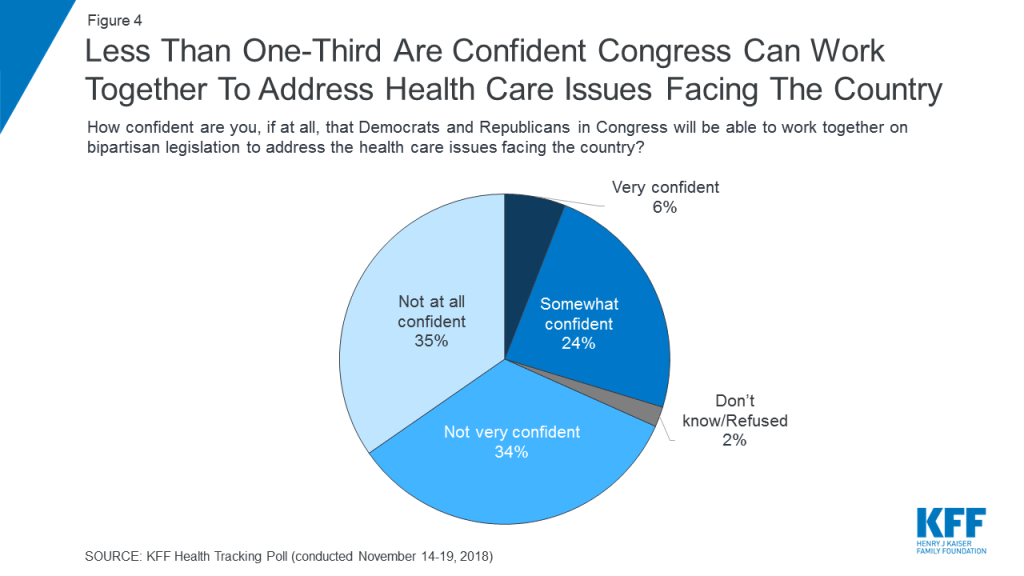
  • The November KFF Health Tracking Poll, conducted the week after the 2018 midterm election, finds a majority of the public wants the new Democratic majority in the U.S. House of Representatives to work with Republicans on legislation to address the major problems facing the country as well as conduct oversight of the Trump administration’s actions on policies such as health care. Yet, few Americans are “very confident” (6 percent) that Republicans and Democrats in Congress will be able to work on bipartisan legislation to address the health care issues facing the country.
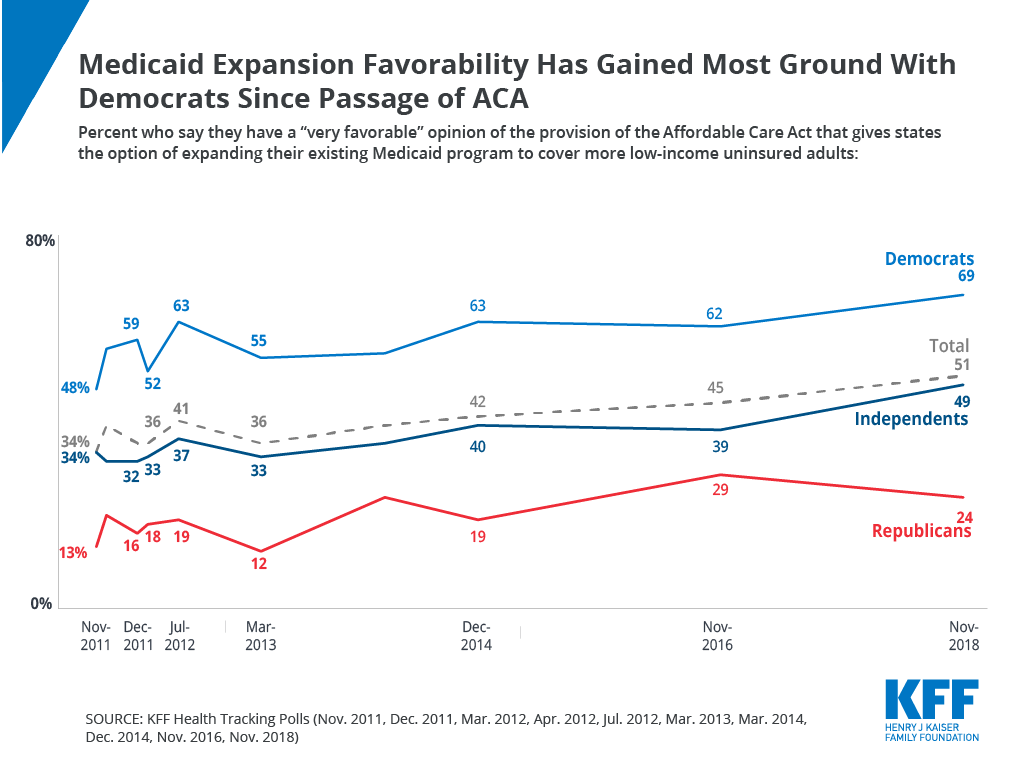
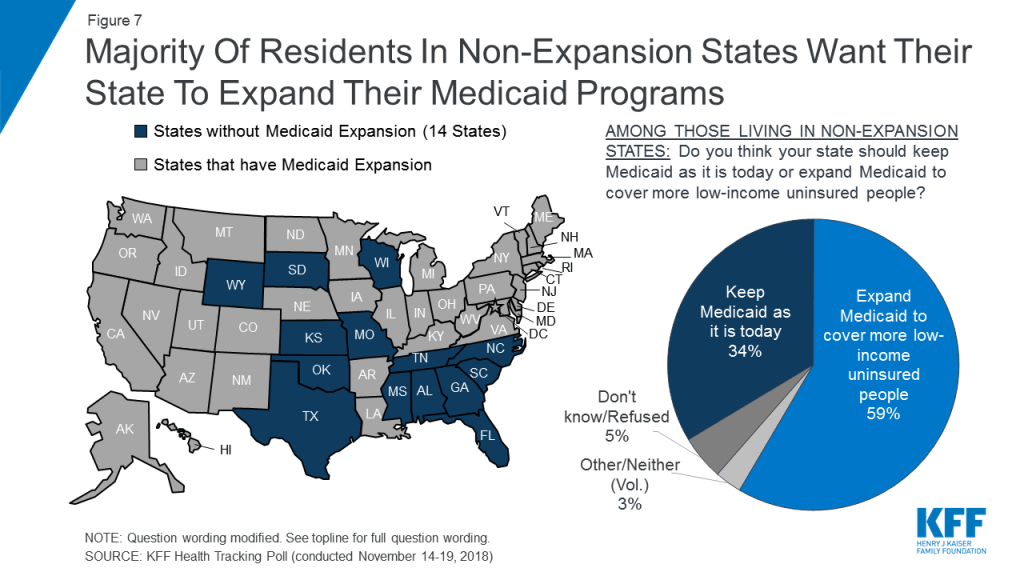
  • The midterm elections brought Medicaid expansion to three additional states, bringing the total number of states that have expanded their Medicaid programs to cover more low-income uninsured adults to 37 (including Washington, D.C.). Those living in states that have not expanded their Medicaid programs continue to hold a favorable view of Medicaid expansion and most would like to see their state expand their Medicaid program. And as a possible indicator of how some other states may expand their Medicaid programs in the future, most of those living in a non-expansion state say that if their state government chooses not to expand, voters themselves should be able to decide if their state expands their Medicaid program.
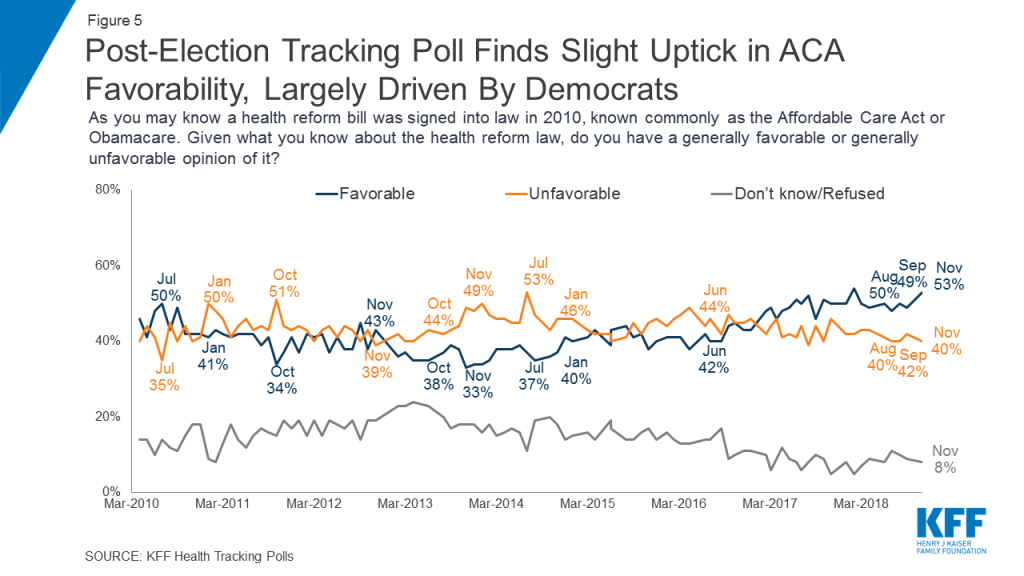
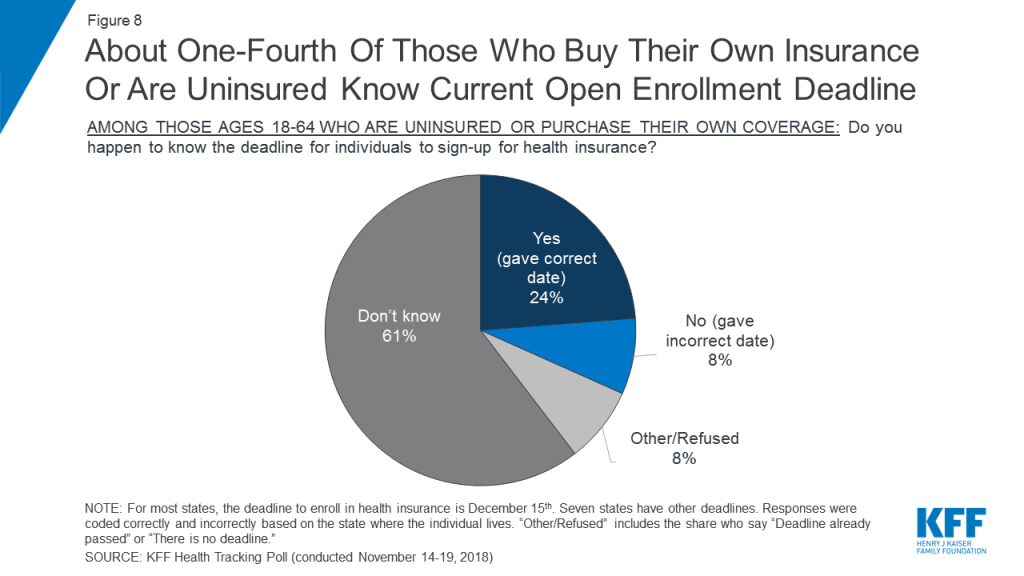
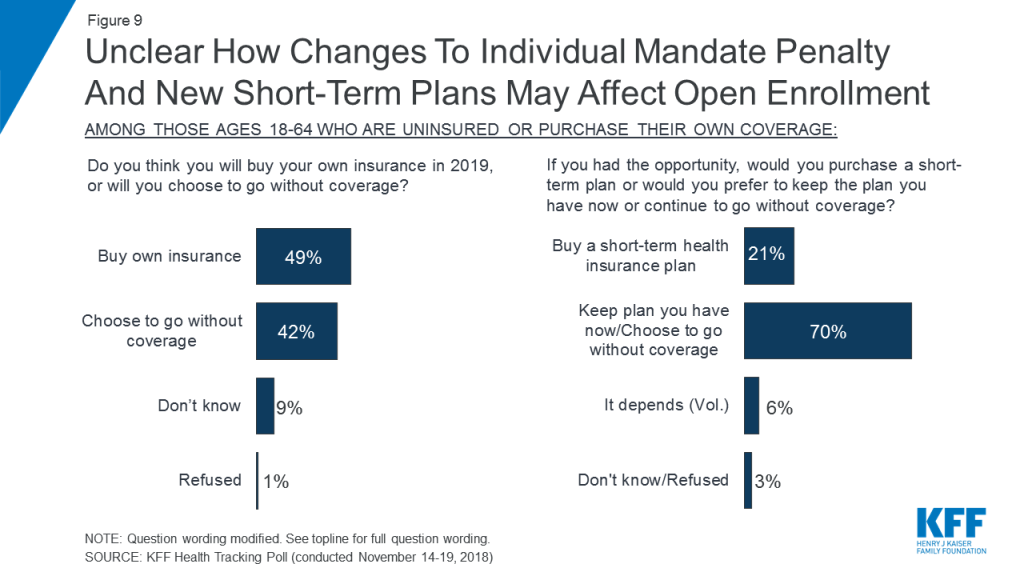
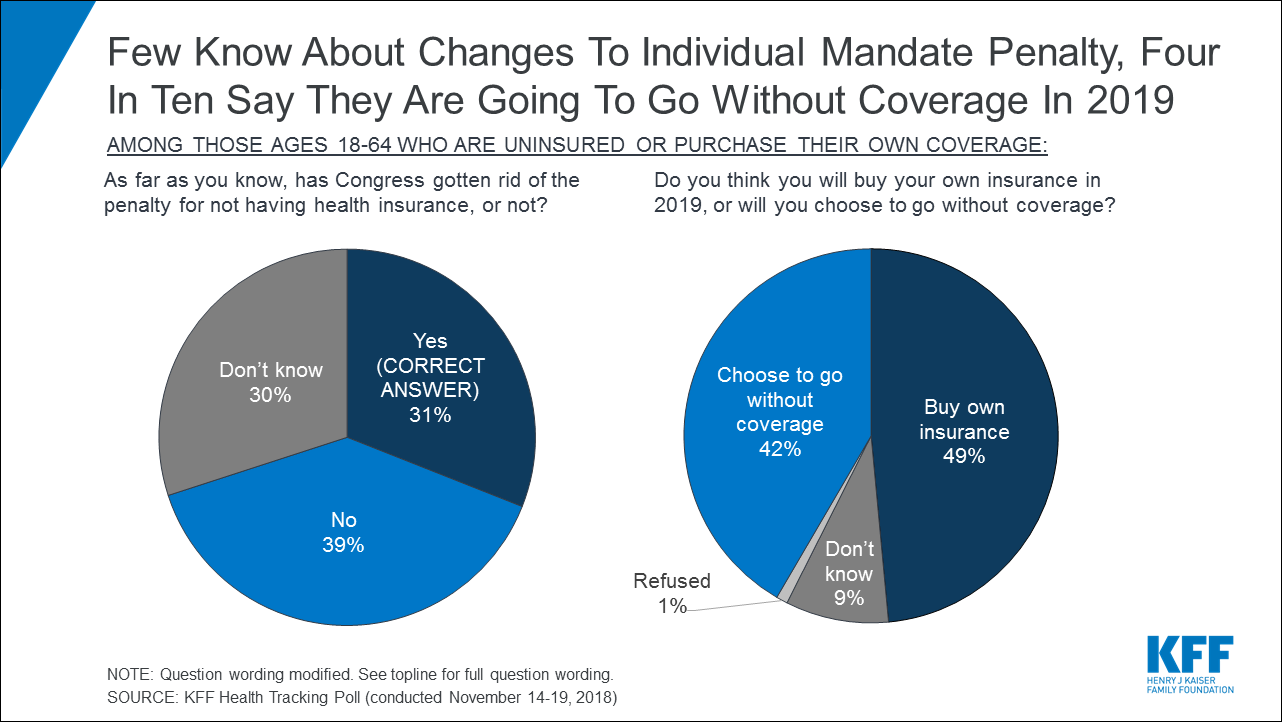
  • The new Democratic majority in the House all but guarantees the Affordable Care Act (ACA) will remain the law of the land for at least the next two years. The most recent tracking poll finds a slight uptick – largely driven by Democrats – in the overall favorability of the law (53 percent) and many of the ACA’s provisions continue to be quite popular with a majority of the public. But the poll also finds the public is largely unaware about the law’s sixth open enrollment period, and four in ten 18-64 year olds who buy their own insurance or are currently uninsured say they will choose to go without coverage in 2019.

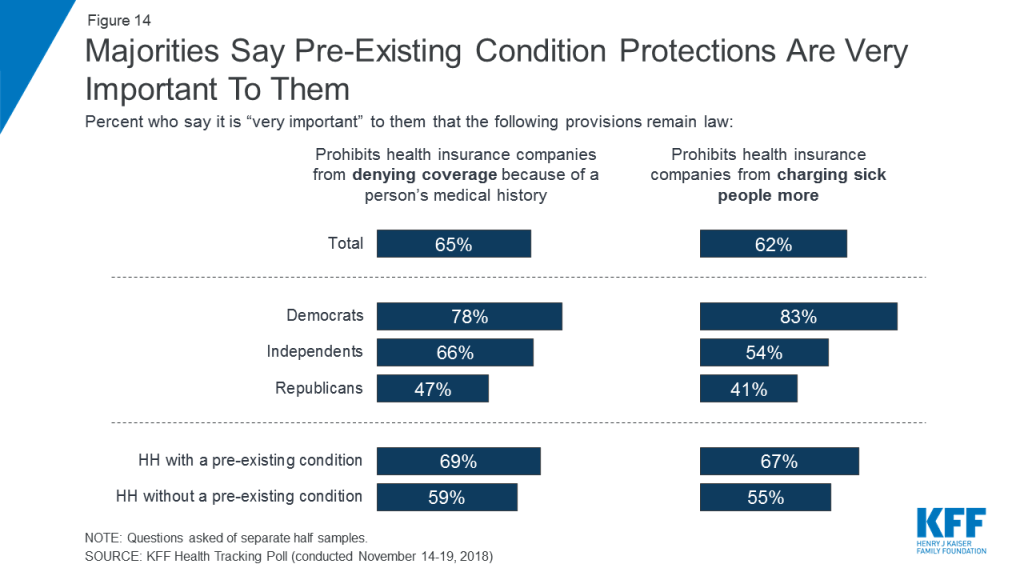
    Most Americans say it is “very important” to keep the ACA provisions barring insurers from denying coverage or charging more (62%) to people with pre-existing conditions, even after hearing that these may have increased costs for some healthy people

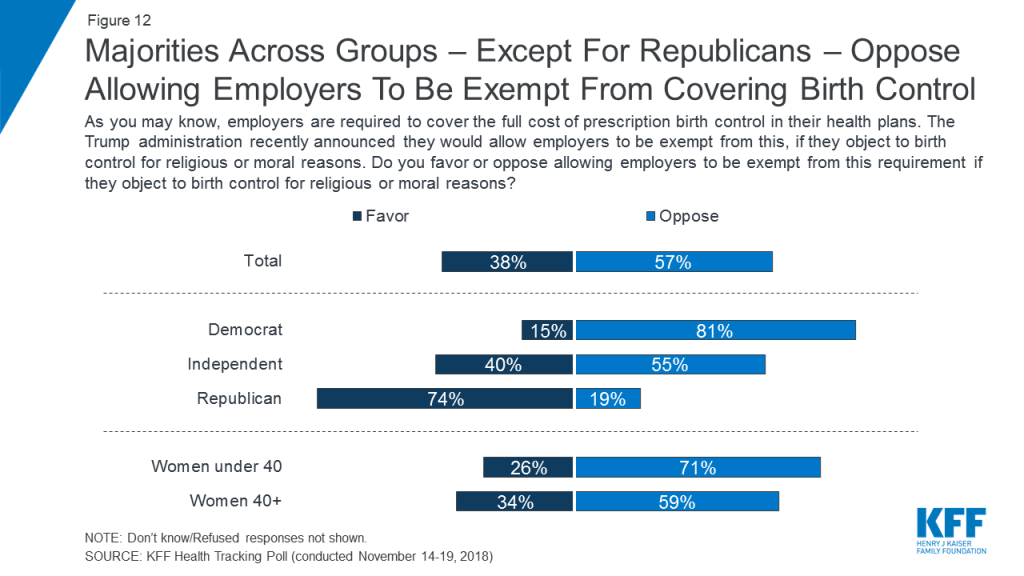
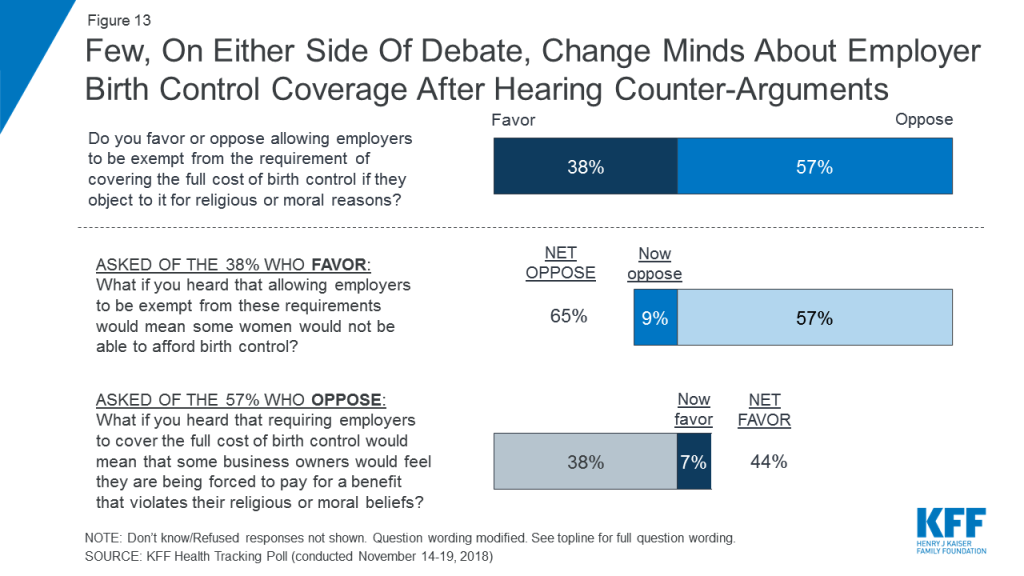
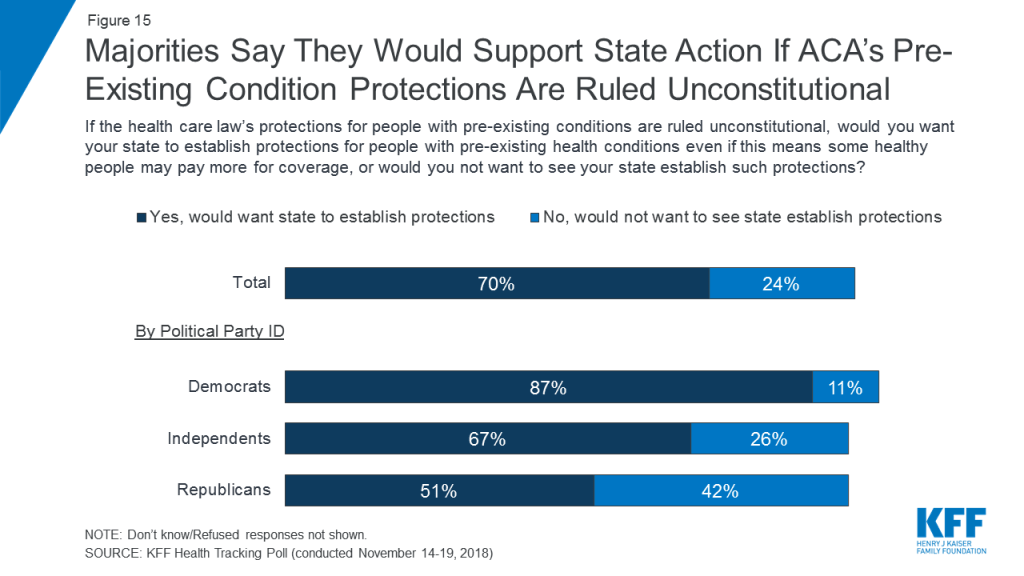
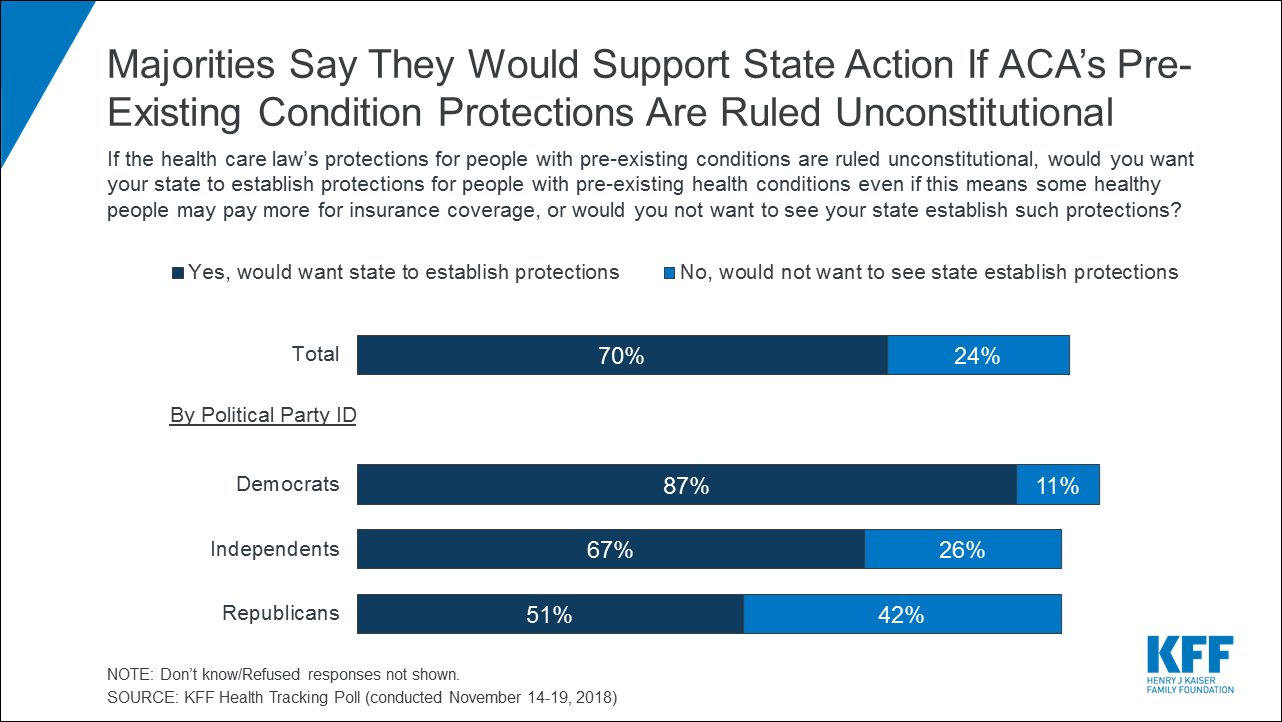
  • A divided Congress does not mean that the coming year will not see any changes to the country’s health care system. There is an impending lawsuit, Texas v. United States, which may end the ACA’s protections for people with pre-existing medical conditions as well as the Trump administration’s recent actions allowing employers to be exempt from covering the full cost of birth control for their employees if they oppose to it due to religious or moral reasons, which could lead to substantial changes to health coverage for many Americans. This month’s tracking poll examines the public’s support for these proposed changes and examines the malleability of these opinions.

The Public’s Priorities for Next Congress

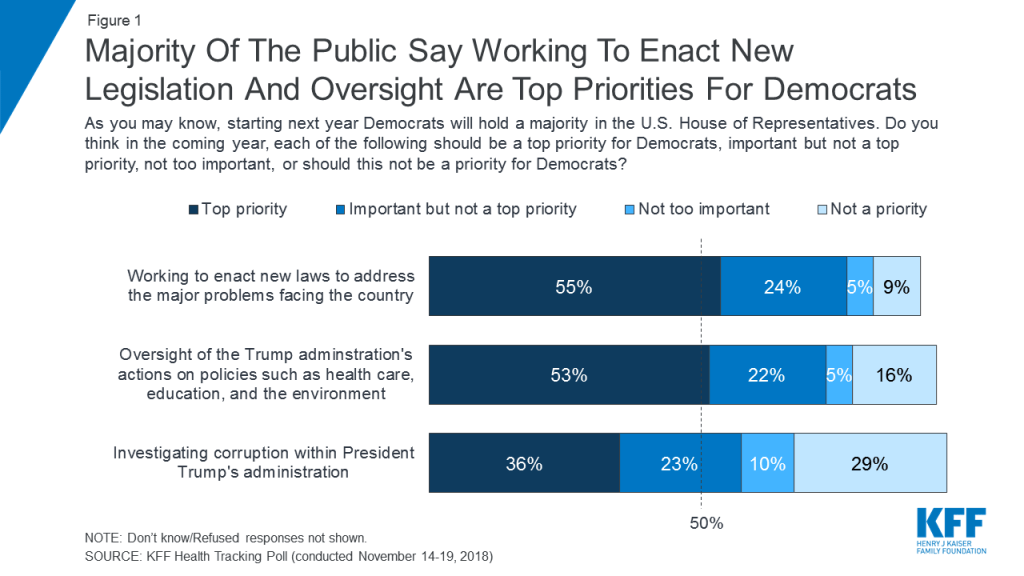
With Democratic gains in the U.S. House of Representatives during the 2018 midterm election, Democrats and Republicans will split control of Congress next year. These results will mean that President Trump will have a divided Congress for the first time in his presidency. About half of the public (53 percent) say oversight of the Trump administration’s actions on policies such as health care, education, and the environment should be a “top priority” for House Democrats in the coming year. This is similar to the share (55 percent) who say that working to enact new laws to address the major problems facing the country should be a “top priority” for House Democrats in the coming year and substantially larger than the share who say investigating corruption within President Trump’s administration should be a “top priority” (36 percent).

Figure 1: Majority of The Public Say Working To Enact New Legislation And Oversight Are Top Priorities For Democrats

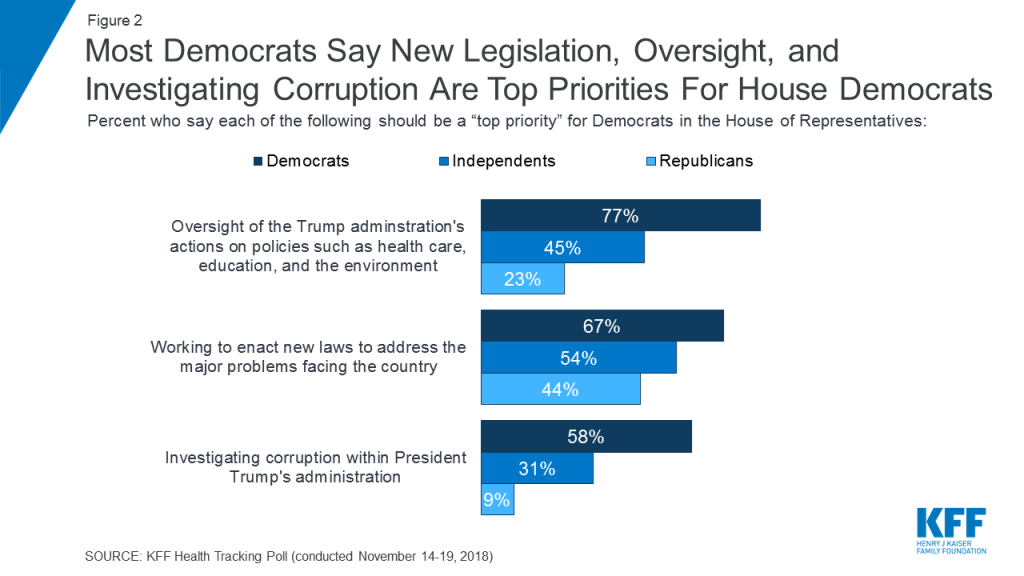
Unsurprisingly, the share of partisans who say each of these should be a “top priority” for Democrats in the U.S. House of Representatives varies drastically; majorities of Democrats saying conducting oversight (77 percent), working to enact legislation (67 percent), and investigating corruption (58 percent) should all be top priorities for the coming year. A majority of independents (54 percent) say working to enact legislation should be a “top priority,” while less than half of Republicans say any of these – including working to enact legislation – should be “a top priority” for House Democrats.

Figure 2: Most Democrats Say New Legislation, Oversight, and Investigating Corruption Are Top Priorities For House Democrats

Immigration and Health Care Top Public’s Priorities

Similar to the issues driving voters in the 2018 midterm elections, the most recent KFF Health Tracking Poll finds immigration and health care as the top issues the public want to see the next Congress act on in 2019 with the issues offered largely driven by party identification. Overall, about one-fifth of voters offer immigration or border security (21 percent) when asked to say in their own words the issue Congress should work on next year. This is similar to the share of the public who offer health care (20 percent) as the top issue they want to see the next Congress work on. Fewer offer gun control/legislation (8 percent), tax reform (4 percent), or education (4 percent) as the issues they want to see Congress act on in 2019.

Four times as many Republicans (41 percent) offer immigration/border security as the issue they would most like the next Congress to act on in 2019 as Democrats (10 percent). On the other hand, health care is the top issue for Democrats. One-fourth of Democrats (27 percent) say health care is the issue they would most like to see the next Congress act on, compared to 11 percent of Republicans who say the same. Independents are divided across the top two issues, with similar shares offering immigration/border security (22 percent) and health care (21 percent) as the issues they want to see Congress work on.

Table 1: Immigration and Health Care Top Public’s Priorities for Next Congress
Thinking about next year, which issue would you most like the next Congress to act on in 2019? (open-end)TotalDemocratsIndependentsRepublicans
Immigration/Border security21%10%22%41%
Health care20272111
Gun control/legislation81348
Tax reform4278
Education472
Note: Only top five responses shown. Question asked of half sample.
Cost and Affordability COntinues to Dominate Health Care Priorities

When asked which health care issue they would most like to see the next Congress act on in 2019, more Americans offer issues around health care affordability and cost (19 percent) than other health care issues including the 2010 Affordable Care Act (ACA) (10 percent) or Medicare (6 percent). Health care affordability and cost are also the most frequently mentioned health care issues by Democrats (14 percent), independents (25 percent), and Republicans (17 percent). The ACA is the second most frequently mentioned health care issue among partisans, with Democrats saying they want to see Congress “protecting or improving the ACA” while Republicans say they want to see the next Congress “repealing the ACA.” Independents are divided on this issue, with similar shares saying they want to see Congress repealing and protecting the 2010 health care law.

Figure 3: Cost And Affordability Top Public’s Health Care Priorities For Next Congress

While there appears to be consensus among the public on what health care issue they want to see Congress work on next year, not quite one-third are confident that Democrats and Republicans in Congress will be able to work together on bipartisan legislation to address the health care issues facing the country. In fact, seven in ten say they are either “not very confident” (34 percent) or “not at all confident” (35 percent) that Congress will be able to work on such bipartisan legislation, while fewer are confident, either “very confident” (six percent) or “somewhat confident” (24 percent), in Congress being able to work together.

Figure 4: Less Than One-Third Are Confident Congress Can Work Together To Address Health Care Issues Facing The Country

Democrats are slightly more confident in the ability of Democrats and Republicans in Congress to be able to work together on bipartisan health care legislation (41 percent) compared to independents (27 percent) and Republicans (19 percent); yet, a majority across party identification say they are either “not very confident” or “not at all confident” (58 percent, 72 percent, and 79 percent, respectively).

The Future of the Affordable Care Act and Medicaid Expansion

The 2018 midterm elections have major implications for both the future of the 2010 health care law known as the Affordable Care Act (ACA) as well as one of its most popular provisions – individual state’s expansion of the Medicaid program for low-income people.

The Affordable Care Act

With Democrats regaining a majority in the U.S. House of Representatives for the first time since 2010, and without continued efforts among Republicans to repeal the ACA, the latest KFF Tracking Poll finds a slight uptick in the public’s view of the law with 53 percent saying they view law favorably compared to four in ten who have an unfavorable view of the law. This slight shift is largely driven by Democrats with about eight in ten saying they have a favorable opinion of the law, including about half (48 percent) who have a “very favorable” view. Similarly, three-fourths of Republicans (76 percent) continue to view the law unfavorably with more than half (54 percent) saying they have a “very unfavorable” opinion of the law.

Figure 5: Post-Election Tracking Poll Finds Slight Uptick in ACA Favorability, Largely Driven By Democrats
Americans Continue to Hold Favorable OPinions of ACA Provisions

Similar to previous KFF Tracking Polls, many of the ACA’s provisions continue to be quite popular, even across party lines. A majority of the public – regardless of party identification – hold favorable views of all of the ACA’s provisions with one exception (fewer than half of Republicans say they have a favorable opinion of the Medicare payroll tax increases on earnings for upper-income Americans).

Table 2: Americans’ Opinions of ACA Provisions
Percent who say they have a FAVORABLE opinion of each of the following provisions of the law:TotalDemocratsIndependentsRepublicans
Allows young adults to stay on their parents’ insurance plans until age 2682%90%82%66%
Creates health insurance exchanges where small businesses and people can shop for insurance and compare prices and benefits82917871
Provides financial help to low- and moderate-income Americans who don’t get insurance through their jobs to help them purchase coverage81928263
Gradually closes the Medicare prescription drug “doughnut hole” so people on Medicare will no longer be required to pay the full cost of their medications81858280
Eliminates out-of-pocket costs for many preventive services79887868
Gives states the option of expanding their existing Medicaid program to cover more low-income, uninsured adults77917755
Requires employers with 50 or more employees to pay a fine if they don’t offer health insurance69886156
Prohibits insurance companies from denying coverage because of a person’s medical history65706658
Increases the Medicare payroll tax on earnings for upper-income Americans65776942
Note. Some items asked of half samples.

In previous KFF Health Tracking Polls, one of the ACA’s provisions – the individual mandate which required nearly all Americans have health insurance or pay a fine – was consistently viewed unfavorably by a majority of the public. As part of the federal tax bill passed in 2017, Congress zeroed out the dollar amount and percentage of income penalties imposed by the individual mandate. Overall, three in ten Americans (31 percent) are aware that Congress has gotten rid of the penalty for not having health insurance, while four in ten (38 percent) incorrectly say Congress has not gotten rid of this penalty and an additional three in ten (31 percent) are unsure. The results are similar among those under 65 years old who either buy their own insurance or are currently uninsured with three in ten (31 percent) aware Congress has gotten rid of the penalty for not having health insurance.

Figure 6: Most Americans Are Not Aware Congress Has Gotten Rid Of The Penalty For Not Having Health Insurance

Medicaid Expansion

Three states (Idaho, Nebraska, and Utah) voted during the 2018 election to expand their Medicaid program to cover more low-income residents, bringing the total number of states that have expanded their Medicaid programs to 37 states including Washington, D.C. Overall, about three-fourths of the public – including 77 percent of those living in non-expansion states – have a favorable view of the ACA’s provision that gives states the option of expanding their existing Medicaid program to cover more low-income, uninsured adults. In addition, a majority (59 percent) of those living in non-expansion states would like to see their state expand Medicaid to cover more low-income uninsured people while one-third (34 percent) say they want to see their state keep Medicaid as it is today. A majority of Democrats and Democratic-leaning independents say they want to see their state expand Medicaid (84 percent) while most Republicans and Republican-leaning independents want to see their state keep Medicaid as it is today (65 percent).

Figure 7: Majority Of Residents In Non-Expansion States Want Their State To Expand Their Medicaid Programs

Among those living in states without Medicaid expansion who want to see their state expand their Medicaid program, nearly nine in ten (51 percent of all residents living in non-expansion states) say that if their governor and state government choose not to expand Medicaid, voters themselves should be able to decide if their state expands Medicaid.

The ACA’s 2019 Open Enrollment Period

The ACA’s sixth open enrollment period for individuals who purchase health plans on their own began on November 2, 2018 and closes in most states on December 15, 2018.1  According to the Centers for Medicare and Medicaid Services, as of November 21, 2018, 1.9 million people have signed up for insurance through the federal marketplace, which is slightly less than in previous years.2 

The most recent KFF Tracking Poll finds a majority of the group most directly affected by open enrollment (those 18-64 years old who either purchase their own insurance or are currently uninsured) are unaware of the current open enrollment deadlines. About one-fourth (24 percent) of this group is aware of the current deadline to buy insurance for 2019 while six in ten (61 percent) say they “do not know” the deadline and 16 percent either offer the wrong date, incorrectly say there is no deadline or that the deadline has passed, or refuse to answer the question.

Figure 8: About One-Fourth Of Those Who Buy Their Own Insurance Or Are Uninsured Know Current Open Enrollment Deadline

Slightly less than half (45 percent) of those 18-64 who either purchase their own insurance or are currently uninsured, say they have heard or seen any ads in the past thirty days from an insurance company attempting to sell health insurance. Fewer – about three in ten (31 percent) say they have heard or seen any information about how to get health insurance under the health care law.

it Is Still Unclear How Two Major changes to ACA Marketplaces Will Affect Open Enrollment

This year’s open enrollment period has two major changes brought about by Republicans and President Trump’s administration: the removal of the penalty for not having health insurance and the introduction of short-term health insurance plans. About half of 18-64 year olds who buy their own insurance or are currently uninsured say they plan to buy their own insurance in 2019, despite the elimination of the fine for people who don’t have health insurance, while four in ten (42 percent) say they will choose to go without coverage in 2019.

Figure 9: Unclear How Changes To Individual Mandate Penalty And New Short-Term Plans May Affect Open Enrollment

One option available to those who buy their own insurance that would not have satisfied the ACA individual mandate in previous years are short-term health insurance plans. These plans cost significantly less than ACA-compliant plans but provide fewer benefits and may not pay for care for some pre-existing medical conditions.3  About one-fifth (21 percent) of those under the age of 65 who buy their own insurance or are currently uninsured say that if they had the opportunity, they would want to purchase a short-term plan. Seven in ten say they would either continue going without coverage or keep the plan they have now.

Public Support Trump Administration’s Actions on Prescription Drug Advertisements, Divided on Actions Aimed at Women’s Health and Pre-Existing Coverage

In recent months, the Trump administration has announced several actions aimed at different aspects of the U.S. health care system. The most recent KFF Tracking Poll finds the public supports the Trump administration’s proposed actions on prescription drug advertisements, even after hearing counter-arguments. The public is more divided on the administration’s actions on women’s health and protections for people with pre-existing conditions.

Prescription Drug Advertisements

Earlier this year, President Trump announced a series of ideas aimed at lowering the price of prescription drugs. One of its key elements is to require drug manufacturers to publish list prices for their prescription drugs in television advertisements. About three-fourths (77 percent) favor the federal government requiring prescription drug advertisements to include a statement about how much the drug costs. In a rare instance of bipartisanship, this policy proposal is supported by a majority of Democrats (80 percent), independents (74 percent) and Republicans (77 percent).

Figure 10: Large Shares, Regardless Of Party, Favor Requiring Prescription Drug Advertisements To Include Pricing Information

After President Trump announced this proposal, there was some debate about how this could be implemented with opponents saying that since people often pay different prices for the same drug based on the type of insurance they have, including a price in a drug advertisement could be confusing to consumers. About one-fifth of those who originally supported this proposal change their minds after hearing this counter-argument, leaving a slight majority of the public (53 percent) continuing to support this proposal. On the other side of the debate, nearly half of those (7 percent of total) who originally opposed this proposal change their minds after hearing that putting the price of a drug in an advertisement would put pressure on drug companies to lower their prices.

Figure 11: Majority Of The Public Continue To Favor Putting Prices In Drug Advertisements Even After Hearing Counter-Arguments

Employer exemption From Covering Birth Control

On November 15, 2018, the Trump Administration issued final regulations expanding the types of employers that may be exempt from the Affordable Care Act’s (ACA) contraceptive coverage requirement to all nonprofit and closely-held for-profit employers with objections to contraceptive coverage based on religious beliefs or moral convictions, including private institutions of higher education that issue student health plans.4  Overall, six in ten (57 percent) of the public, including most women, oppose allowing employers to be exempt from the requirement to cover the full cost of prescription birth control in their plans if they object to it for religious or moral reasons.

Figure 12: Majorities Across Groups – Except For Republicans – Oppose Allowing Employers To Be Exempt From Covering Birth Control

Few individuals, on either side of the debate, change their minds about employers being exempt from covering the cost of prescription birth control for religious or moral reasons after hearing counter-arguments. About one-fourth (9 percent of total) change their minds and now oppose employer exemptions after hearing that this means some women would not be able to afford birth control. On the other side of the argument, one in eight (7 percent of total) now favor this exemption if they heard that some business owners feel like they are being forced to pay for a benefit that violates their religious or moral beliefs.

Figure 13: Few, On Either Side Of Debate, Change Minds About Employer Birth Control Coverage After Hearing Counter-Arguments

Protections for People With Pre-existing Medical conditions

In June 2018, President Trump’s administration announced – as part of a lawsuit known as Texas v. United States, brought by 20 Republican state attorneys general – it will no longer defend the ACA’s protections for people with pre-existing medical conditions. These provisions prohibit insurance companies from denying coverage based on a person’s medical history (known as guaranteed issue), and prohibit insurance companies from charging those with pre-existing conditions more for coverage (known as community rating). The impending suit, Texas v. United States, will decide, among other things, whether both of these protections are unconstitutional and if they will be deemed invalid beginning on January 1, 2019.

The majority of the public say it is “very important” to them that the ACA’s provisions protecting those with pre-existing conditions remain law even after hearing that these protections may have led to increased insurance costs for some healthy people. Sixty-five percent of the public say it is “very important” to them that the provision that prohibits health insurance companies from denying coverage because of a person’s medical history remains law. An additional fifth (22 percent) say it is “somewhat important” this provision remains law. Similarly, about six in ten say it is “very important” that the provision that prohibits health insurance companies from charging sick people more remains law, while an additional one in five (22 percent) say it is “somewhat important.”

Figure 14: Majorities Say Pre-Existing Condition Protections Are Very Important To Them

If the judge ruling on Texas v. United States decides the ACA’s protections for people with pre-existing conditions are unconstitutional, a majority of the public – including 87 percent of Democrats, 67 percent of independents, and about half of Republicans – say they would want their state to establish protections for people with pre-existing health conditions, even if this means some healthy people may pay more for coverage.

Figure 15: Majorities Say They Would Support State Action If ACA’s Pre-Existing Condition Protections Are Ruled Unconstitutional

Methodology

This Kaiser Health Tracking Poll was designed and analyzed by public opinion researchers at the Kaiser Family Foundation (KFF). The survey was conducted November 14th–19th 2018, among a nationally representative random digit dial telephone sample of 1,201 adults ages 18 and older, living in the United States, including Alaska and Hawaii (note: persons without a telephone could not be included in the random selection process). Computer-assisted telephone interviews conducted by landline (291) and cell phone (910, including 587 who had no landline telephone) were carried out in English and Spanish by SSRS of Glen Mills, PA. To efficiently obtain a sample of lower-income and non-White respondents, the sample also included an oversample of prepaid (pay-as-you-go) telephone numbers (20% of the cell phone sample consisted of prepaid numbers) as well as a subsample of respondents who had previously completed Spanish language interviews on the SSRS Omnibus poll (n=13). Both the random digit dial landline and cell phone samples were provided by Marketing Systems Group (MSG). For the landline sample, respondents were selected by asking for the youngest adult male or female currently at home based on a random rotation. If no one of that gender was available, interviewers asked to speak with the youngest adult of the opposite gender. For the cell phone sample, interviews were conducted with the adult who answered the phone. KFF paid for all costs associated with the survey.

The combined landline and cell phone sample was weighted to balance the sample demographics to match estimates for the national population using data from the Census Bureau’s 2017 American Community Survey (ACS) on sex, age, education, race, Hispanic origin, and region along with data from the 2010 Census on population density. The sample was also weighted to match current patterns of telephone use using data from the July-December 2017 National Health Interview Survey. The weight takes into account the fact that respondents with both a landline and cell phone have a higher probability of selection in the combined sample and also adjusts for the household size for the landline sample, and design modifications, namely, the oversampling of prepaid cell phones and likelihood of non-response for the re-contacted sample. All statistical tests of significance account for the effect of weighting.

The margin of sampling error including the design effect for the full sample is plus or minus 3 percentage points. Numbers of respondents and margins of sampling error for key subgroups are shown in the table below. For results based on other subgroups, the margin of sampling error may be higher. Sample sizes and margins of sampling error for other subgroups are available by request. Note that sampling error is only one of many potential sources of error in this or any other public opinion poll. Kaiser Family Foundation public opinion and survey research is a charter member of the Transparency Initiative of the American Association for Public Opinion Research.

GroupN (unweighted)M.O.S.E.
Total1,201±3 percentage points
Adults ages 18-64 who either purchase their own insurance or are currently uninsured168±8 percentage points
Adults living in states that have not expanded Medicaid374±6 percentage points
Party Identification
Democrats439±5 percentage points
Republicans275±7 percentage points
Independents342±6 percentage points
2018 Voters
Registered voters1,026±3 percentage points
Registered voters who participated in 2018 election872±4 percentage points


Endnotes

  1. Seven states have extended their open enrollment period beyond December 15, 2018. ↩︎
  2. Centers for Medicare and Medicaid Services, Weekly Enrollment Snapshot: Week Three, https://www.cms.gov/newsroom/fact-sheets/weekly-enrollment-snapshot-week-3 ↩︎
  3. L. Levitt, R. Fehr, G. Claxton, C. Cox, and K. Pollitz, Why Do Short-Term Health Insurance Plans Have Lower Premiums Than Plans That Comply With the ACA? https://modern.kff.org/health-reform/press-release/short-term-health-insurance-plans-charge-less-than-half-as-much-in-premiums-as-aca-plans-by-excluding-pre-existing-conditions-and-severely-limiting-benefits/ ↩︎
  4. L. Sobel, A. Salganicoff, and C. Rosenzweig. New Regulations Broadening Employer Exemptions to Contraceptive Coverage: Impact on Women. https://modern.kff.org/health-reform/issue-brief/new-regulations-broadening-employer-exemptions-to-contraceptive-coverage-impact-on-women/ ↩︎
News Release

Bipartisan Majorities Support Trump Administration’s Push to Get Drug Prices in Advertisements, Even after Hearing Counter-Arguments

Most Oppose Other Actions that Could Eliminate ACA Pre-Existing Condition Protections and Expand Employer Exemptions to Birth Control Mandate

Published: Nov 28, 2018

Only 1 in 4 Potential Marketplace Customers Know When ACA Open Enrollment Ends; 1 in 5 Say They Would Buy a Short-Term Plan

A large majority of the public backs the Trump Administration’s initiative to require prescription drug advertisements to include information about prices, but fewer support other administrative actions involving pre-existing conditions and contraception coverage, the latest KFF Health Tracking Poll finds.

Requiring drugmakers to include price information in their advertisements is a widely discussed element of the Trump Administration’s plan to address high drug costs. Three-fourths (77%) favor it, and most (53%) continue to favor it, even after being told that the proposal could confuse consumers who may pay different prices for the same drug based on their insurance.

In other areas, the public shows less support for health policies promoted by the Trump administration, including its decision in June not to defend the Affordable Care Act’s protections for people with pre-existing conditions as part of a pending lawsuit filed by conservative state attorneys general.

Most Americans say it is “very important” that the provisions in the ACA that prevent insurance companies from denying coverage (65%) or charging more (62%) to people with pre-existing conditions remain law, even after hearing that these protections may have led to increased insurance costs for some healthy people.

If the courts throw out those protections, a majority (70%) say they would want their state to establish such protections, even if it meant healthy people would pay more. This includes half (51%) of Republicans, as well as majorities of Democrats (87%) and independents (67%).

More recently, the Trump Administration issued final regulations that expand the exemptions for employers that do not want to cover the cost of contraception in their employees’ health plans because of religious or moral reasons. Most (57%) of the public – including most women (63%) – say they oppose such exemptions.

Few Potential Marketplace Customers Know When Open Enrollment Ends

The poll also assesses the public’s awareness about the ongoing Affordable Care Act open enrollment period, during which people who either buy their own health insurance or are uninsured can sign up for a plan through their state’s marketplace.

Open enrollment ends Dec. 15 in states that rely on healthcare.gov, but runs longer in some states that use their own marketplace.

The poll finds most potential marketplace customers – adults under age 65 who are either uninsured or buy their own insurance – do not know when open enrollment ends in their state. About one in four (24%) know the correct date, while most others (61%) say they do not know when open enrollment ends. Smaller shares give a variety of incorrect answers.

The poll also gauges how two policy changes could affect open enrollment this year: Congress eliminated the tax penalty for people who don’t obtain health coverage effective next year, though three in 10 (31%) of those under age 65 who are uninsured or buy their own coverage are aware that the penalty no longer exists. About half (49%) of potential marketplace customers say they plan to buy coverage this year. Nearly as many (42%) say they will go without coverage.

The Trump Administration has taken steps to expand access to short-term health plans, which can cost less than ACA marketplace plans but can discriminate against people with pre-existing conditions, offer fewer benefits, and provide less generous coverage. About one in five (21%) of potential marketplace customers say they would buy a short-term plan if given the opportunity.

Health Care Is Among Public’s Top Priority for Congress

Following midterm elections where health care played a key role, the poll finds Americans now are as likely to cite immigration and border security (21%) as health care (20%) when asked to name the issue that they most want the next Congress to address.

These two issues reflect the different partisan priorities. Immigration/border security is by far the issue most often named by Republicans (41%), while Democrats most often name health care (27%). Independents are about equally likely to cite the two issues (immigration 22%, health 21%).

When asked about priorities within health care they want the next Congress to address, a larger share of Americans offer issues around affordability and costs (19%) than other issues such as the future of the Affordable Care Act (10%), Medicare (9%), and health coverage/insurance for everyone (5%).

Democrats will take control of the House in January, resulting in divided government in Washington for the first time under President Trump. Most Democrats say the top priorities for the Democratic House majority should be oversight of the Trump Administration’s actions on health care, education, and the environment (77%), and working to enact new laws to address the major problems facing the country (67%). A smaller majority (58%) say investigating corruption within the Trump Administration should be a top priority.

In Non-Expansion States, Most Favor Expanding Medicaid to More Low-Income Adults

After successful ballot initiatives in Idaho, Nebraska and Utah to expand those states’ Medicaid programs to low-income adults through the ACA, there are 14 states that have not approved the ACA’s Medicaid expansion.

The poll finds a majority of residents (59%) in those 14 states favor expanding their Medicaid programs to cover more low-income people, while a third (34%) say they want to keep the state’s program as is. A bare majority (51%) across those states also say that they would favor a ballot initiative to expand Medicaid in their states if their governors and state legislatures choose not to expand the program.

Designed and analyzed by public opinion researchers at KFF, the poll was conducted from November 14-18, 2018 among a nationally representative random digit dial telephone sample of 1,201 adults. Interviews were conducted in English and Spanish by landline (291) and cell phone (910). The margin of sampling error is plus or minus 3 percentage points for the full sample. For results based on subgroups, the margin of sampling error may be higher.

News Release

Some Can Get Marketplace Plans With No Premiums,Though With Higher Deductibles and Cost-Sharing

Published: Nov 26, 2018

Many low-income consumers who are eligible for federal financial help under the Affordable Care Act can get a bronze-level plan and pay nothing out-of-pocket in premiums in more than 2,000 counties next year, depending on their annual income, according to a new analysis from KFF (the Kaiser Family Foundation). Such plans come with higher deductibles and out-of-pocket maximums, however.

The analysis finds that the ACA’s premium tax credits would cover the full premium of the lowest-cost bronze marketplace plan in 2,532 counties in 2019 for a 40-year-old with an annual income of $20,000. Going up the income ladder, the figure is 2,014 counties for a 40-year-old making $25,000; 659 counties for a person the same age who makes $30,000; 417 counties for someone making $35,000; and 120 counties for a 40-year-old making $40,000.

The analysis examines how ACA marketplace premiums are changing in 2019. It features interactive maps with county-level data illustrating changes in premiums for the lowest-cost bronze, silver and gold plans in counties across the U.S.

Nationally, the average unsubsidized premium for the lowest-cost bronze plan is decreasing by 0.3 percent in 2019. Unsubsidized premiums for the lowest-cost silver and gold plans are falling by one percent and two percent, on average, respectively. Costs often will be even lower for consumers who receive premium tax credits, although these tax credits will be smaller than in 2018 for many consumers.

The availability of bronze plans for no or low premiums is in large part the result of insurers increasing silver premiums following the termination cost-sharing payments to insurers by the Trump administration in late 2017. Insurers are still required to provide reduced cost-sharing to low-income consumers in silver plans, and those eligible for those reductions should shop around and consider their options carefully as bronze plans come with high deductibles. For example, a single individual making between 100-200% of the poverty level can qualify for a silver plan with an out-of-pocket maximum of no more than $2,600, and the deductible would likely be much lower than that. For a bronze plan, the out-of-pocket maximum and deductible could be upwards to $7,900. Zero- or low-premium plans may not be cheaper overall if the enrollee is sick or has high health spending.

Also available is KFF’s Health Insurance Marketplace Calculator, which allows users to enter their income, age, and family size and get estimates of premiums and available subsidies for insurance purchased on the ACA exchanges.

Filling the need for trusted information on national health issues, the Kaiser Family Foundation is a nonprofit organization based in San Francisco, California.