What the Recent Elections and an Evolving Federal Policy Landscape Could Mean for Medicaid Expansion Efforts in 2027
The outcome of the 2026 mid-term elections will result in major shifts in Congress and in state governments when newly elected officials take office in January 2027. In response to voter concerns about affordability of health care, Democrats ran on promises to roll back changes in Medicaid and the Affordable Care Act (ACA) that are expected to increase costs for people, reduce access to care, shift costs to states, increase fiscal pressure on providers, and increase the number of people who are uninsured. In addition to rolling back recent Medicaid changes, states with newly elected Democratic governors and / or changes in the make-up of state legislatures could reignite discussions to expand coverage by adopting the ACA Medicaid expansion. Among the ten states that have not adopted the expansion, Georgia, Kansas, Texas and Wisconsin are key states to watch for potential new debates about expansion given the outcome of the elections. For these states and other non-expansion states that have debated expansion in prior years, the evolving federal policy landscape could be a factor in renewed expansion debates. For example, federal work requirements could facilitate consideration in Mississippi where expansion efforts previously failed due to an inability to include work requirements, and that could be a factor in debates in other states as well.
How many uninsured people could be newly eligible for Medicaid if states adopt the ACA Medicaid expansion?
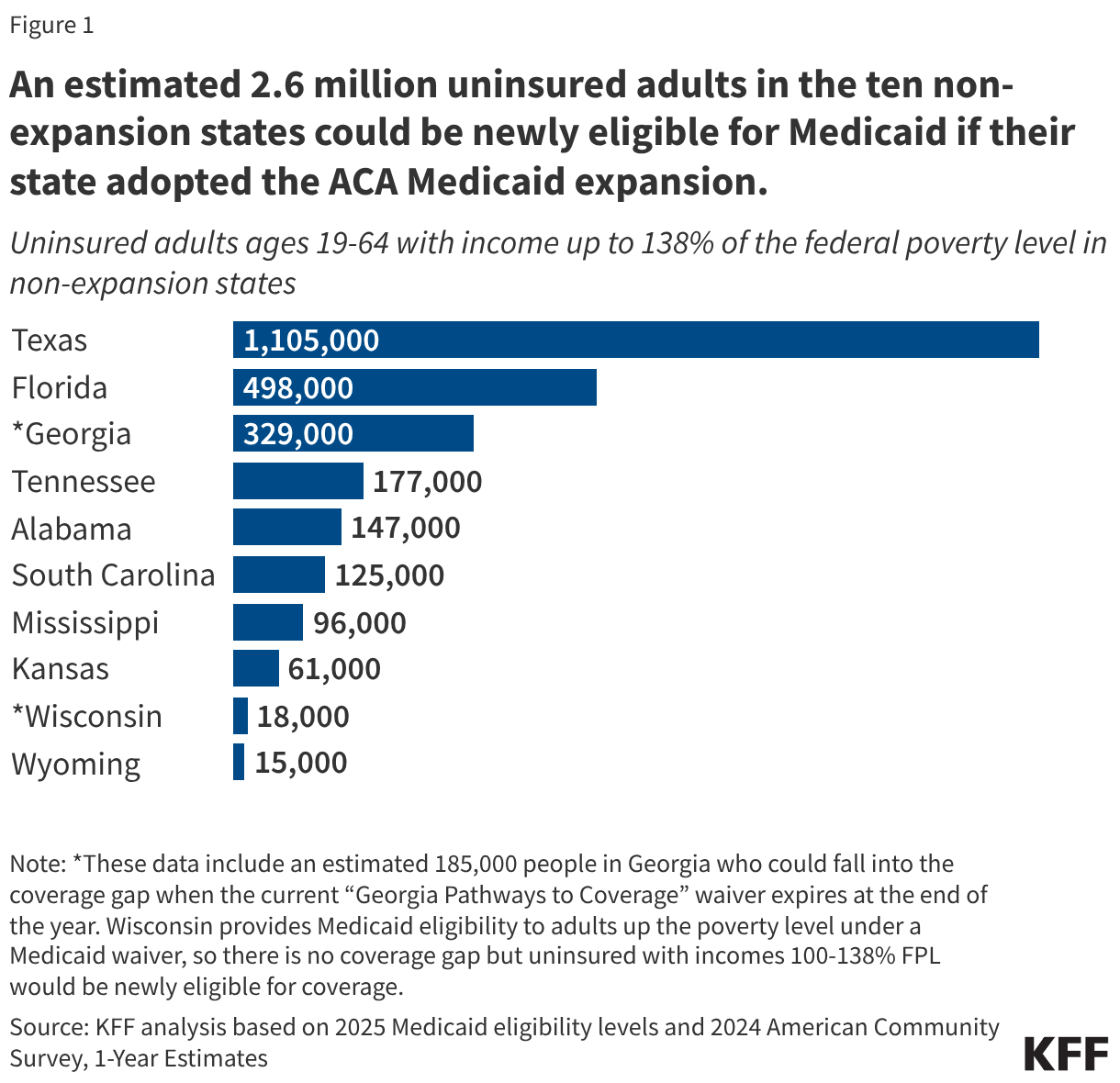
An estimated 2.6 million uninsured adults in the ten non-expansion states could be newly eligible for Medicaid if their state adopts the ACA Medicaid expansion, with nearly half residing in Texas. These uninsured individuals include those with income below 100% of the federal poverty level (FPL) who are in the coverage gap as well as individuals with incomes between 100-138% of the federal poverty level who are eligible for but not enrolled in subsidized Marketplace coverage (Figure 1). This number also includes an estimated 185,000 people in Georgia who could fall into the coverage gap when the current “Georgia Pathways to Coverage” waiver expires at the end of the year. Texas accounts for nearly half of the uninsured people who could be newly eligible for coverage. Policy changes such as the expiration of the temporary enhanced premium tax credits at the end of 2025 as well as new Medicaid eligibility restrictions for certain lawfully present immigrants are not reflected in these numbers and could affect the number of uninsured individuals who could be newly eligible for Medicaid coverage with adoption of the Medicaid expansion. These numbers also do not account for individuals who have coverage in the Marketplace with incomes between 100 and 138% FPL who would transition to Medicaid coverage.
How has the political and policy landscape for Medicaid expansion changed?
Changes in governors and state legislatures following the recent election could reignite expansion discussions. New Democratic governors in Georgia (Keisha Lance Bottoms), Kansas (Cindy Holscher), Texas (Gina Hinojosa), and Wisconsin (David Crowley), ran on promises to address health care costs and specific promises to expand Medicaid in Georgia and Texas. New governors combined with shifts in the make-up of the state legislatures in Georgia (House won by Democrats for split control), Kansas (Republicans retained control of both chambers but with a smaller margin in the House), Texas (House won by Democrats for split control) and Wisconsin (Assembly won by Democrats for single party control) may create new opportunities to pass expansion legislation. Previous efforts to advance proposals to expand Medicaid in these states have not passed through the legislature.
New federal Medicaid work requirements in the 2025 reconciliation law may help reduce opposition to expansion in non-expansion states with more conservative governors and/or legislatures. The 2025 reconciliation law requires 44 states (including DC) to condition Medicaid eligibility for adults in the ACA Medicaid expansion group and certain enrollees in 1115 waiver programs (in three non-expansion states Georgia, Tennessee and Wisconsin) on meeting work requirements starting January 1, 2027. These federal changes could help gain consensus in remaining non-expansion states to move forward with expansion. For example, the inability to adopt work requirements for expansion adults prevented passage of expansion legislation in Mississippi in 2024. Even with work requirements, ideological opposition to adopting Medicaid expansion remains in legislative chambers controlled by Republicans and may be hard to overcome. At the same time, Democrats in Congress have said that pushing to reverse Medicaid cuts, including work requirements, will be a top priority, which may or may not be successful.
What are the financing trade-offs at play in expansion decisions?
States receive a 90% federal match for adults covered through the expansion. This match rate is higher than the match rate for traditional enrollees that ranges from 50% in Wyoming and 59% in Texas to 77% in Mississippi in the non-expansion states. Even with the higher match rate, states are still required to pay 10% of the costs of expansion coverage, and there may be opposition to committing to new spending amid tight state fiscal circumstances.
Georgia and Wisconsin have waivers to expand coverage for certain adults up to the poverty level, but do not receive the higher expansion match rate. If these states adopted the Medicaid expansion, they would need to extend coverage from 100 to 138% of the poverty level (so would cover some uninsured and some people currently covered in ACA plans) but would receive the 90 percent match for people currently covered in their waiver programs. Both states are required to implement the new federal work requirements for their current waiver programs. Georgia’s current waiver program expires at the end of 2026, and the state has a pending waiver proposal seeking a 90% match rate for the demonstration effective January 1, 2027. The Georgia Pathways waiver extended Medicaid coverage to 100% FPL for parents and childless adults conditioned on meeting a work requirement, but with fewer exemptions than were included in the federal requirements. Beginning January 1, 2027, Georgia estimates that complying with federal work rules and exceptions will increase enrollment in the waiver program and the state cannot fund the increase without additional federal dollars. CMS rejected Georgia’s 2019 request for an enhanced federal matching rate for its partial expansion program.
The 2025 reconciliation law includes financing provisions that could be a factor in state decisions about adopting the Medicaid expansion. While the financing provisions affect all states, the law imposed greater financial restrictions on expansion states than on non-expansion states. As part of any consideration to adopt the expansion, states may weigh expanding coverage with an enhanced match against the potential loss of federal Medicaid funding from restrictions on provider taxes and more restrictions on state directed payments they could face as expansion states. If, however, Democrats in Congress are able to reverse some or all of the financing changes included in the reconciliation law, that could limit some financial barriers to states seeking to expand Medicaid. Specifically, the law:
- Eliminates an additional fiscal incentive to adopt the expansion adopted under the Biden Administration. Recent expansion states including Missouri, North Carolina, Oklahoma and South Dakota were able to benefit from a temporary financial incentive that provided a 5 percentage point increase in the state’s regular federal Medicaid match rate for two years. The 2025 reconciliation law eliminated this fiscal incentive.
- Restricts provider taxes and state directed payments (SDPs). The new law makes major changes to Medicaid financing that will affect how states can raise the state share of Medicaid payments through provider taxes and how they can pay providers through state directed payments in managed care. The law limits all states’ future use of provider taxes and reduces revenues from some existing taxes in states that have adopted the ACA Medicaid expansion. The reconciliation law also places stricter limits on state directed payments in expansion states compared to non-expansion states. Several non-expansion states have provider taxes that could be restricted if they adopted expansion including Wisconsin (hospital and ambulance tax) and Texas (hospital tax). Most non-expansion states that use managed care have SDPs above current limits so adopting the Medicaid expansion could result in further SDP limits.
What does research show and what is public opinion about expansion?
Extensive research points to largely positive effects of expansion that may factor into state decisions to reconsider adopting the expansion. A review of research on the effects of the ACA Medicaid expansion finds that expansion led to improvements in access to care, utilization of services, the affordability of care, and financial security among the low-income population. Medicaid expansion is also associated with increased early-stage diagnosis rates for cancer, lower rates of cardiovascular mortality, and increased odds of tobacco cessation. Evidence also indicates that gaining health coverage through the Medicaid expansion saves lives. One recent study found a 2.5% reduction in mortality among low-income adults in Medicaid expansion states and concluded that Medicaid expansion reduced the risk of death by 21% among new enrollees, saving an estimated 27,000 lives from 2010-2022. Studies also point to improvements in economic impacts for providers (particularly rural hospitals) and economic stability for individuals.
Medicaid expansion is popular in non-expansion states. Previous KFF polling has found that two-thirds of people living in non-expansion states think their state should expand Medicaid to cover more low-income people under the ACA. This is nearly twice the share who say they want their state Medicaid program to stay as it is (34%). In addition, seven states have adopted expansion through ballot measures emphasizing that Medicaid is popular when voters weigh in directly.