Untold KFF History Volume 4: Polling Partnerships with News Organizations
In the beginning, when we were getting started in the 1990s, we didn’t have a newsroom, and producing new policy analysis on big national health issues was, and remains, our calling card. But it was our polling that first put us on the map in the ’90s. That’s mostly because there wasn’t a well-developed polling enterprise in health then, and almost none in health policy, and it was unusual for a nonprofit organization to produce its own polling. It was also because we began polling in the middle of the super-heated Clinton health reform debate and then we kept polling.
From the beginning, we emphasized people’s experiences in the health system and with public programs, and we polled about policy, examining the public’s responses to policy ideas in light of tradeoffs and arguments made for and against them, including legislation. This has never made us friends in the advocacy communities on the right or left since most policies can be made to sound good on the surface and poll well but as is almost axiomatic in health policy, policies have tradeoffs that cause support to fall when we present them to the public (except it seems, on the issue of regulating drug prices). We also developed methodologies for surveying the hardest to reach populations, which we’re proud of, using our polling to amplify the voices of groups who are often ignored in policy debates or drowned out by special interests. Over the years, we refined and expanded all these capabilities. In 2026, Dr. Mollyann Brodie, who has led our polling group almost since the beginning, was recognized with the Award for Exceptionally Distinguished Achievement by the American Association for Public Opinion Research, and at the same award ceremony, KFF was recognized with an award we are proud of—a special Inclusive Voices Award for our surveys of Immigrants.
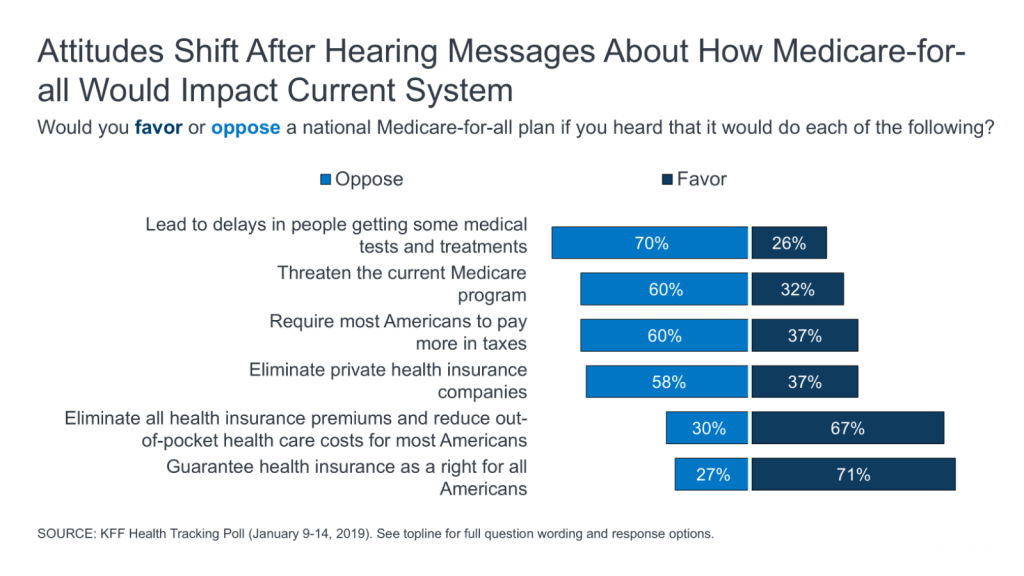
Medicare-for-all is a great example of where our polling on arguments and tradeoffs shows how malleable public opinion can be. Support is as high as 71% when people are told such a plan would guarantee health insurance as a right for all Americans, but it drops as low as 26% when they hear the argument made by critics that it could lead to delays in people getting some medical tests and treatments. That means that in a real-world debate about legislation, it matters whose arguments and which facts get through to voters.
In 1995, we added a twist to our polling, which has endured: we conduct a share of our larger polls as partnerships or joint ventures with major news organizations.
We began with The Washington Post, with whom we have now conducted 37 large polling projects. For some time, these polls were conducted as a three-way partnership with my former colleague at the Robert Wood Johnson Foundation and friend Bob Blendon at Harvard, who recently passed away, until we decided to continue them as a two-way partnership between KFF and the Post. Bob continued on as a great public opinion analyst and educator.
The Washington Post partnerships were not simply polls. They were experiments in combining polling and journalism to amplify the data and tell a bigger story, adding deep reporting, and graphics, and video to the polling data, sometimes with multiple full-page layouts in the newspaper.
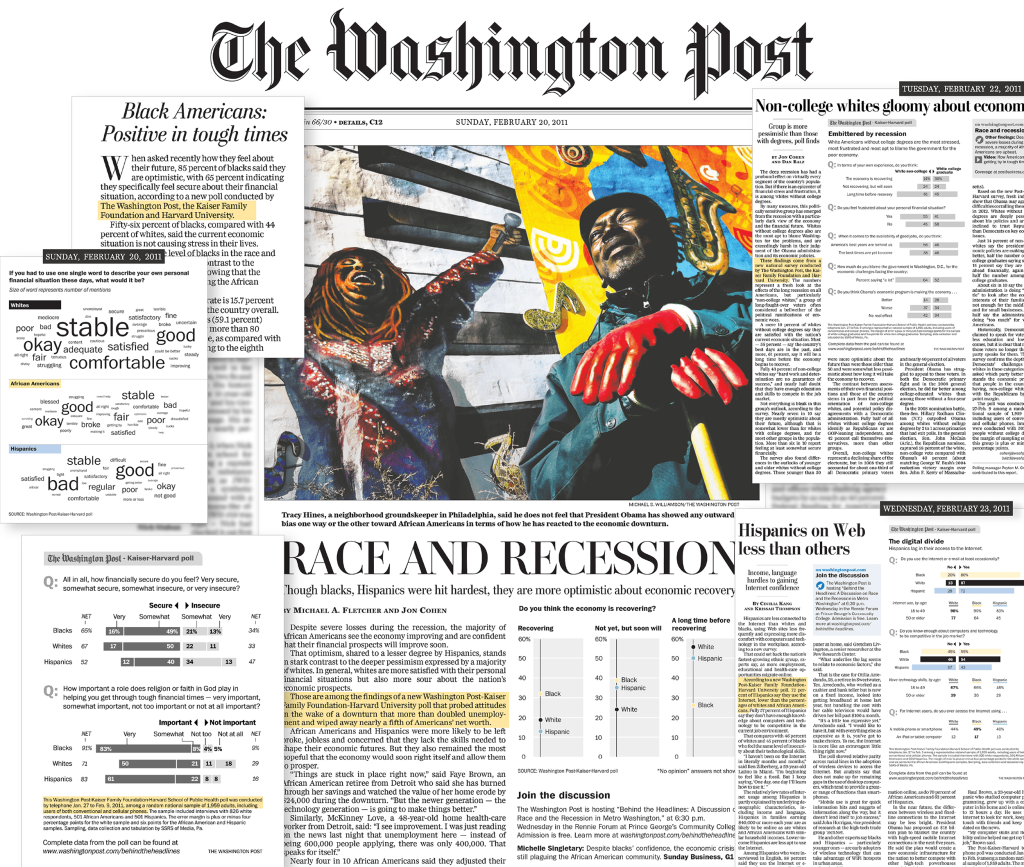
We pick the topics together and design the survey instruments with lots of input from the Post’s reporters and editors and their polling team. The Post publishes its own stories about the poll, and we publish our own reports. Each organization has editorial independence in what it publishes, but there is a true intellectual partnership throughout the process, with teams from both organizations participating in data analysis, fact-checking, and identifying narratives for the stories. Sometimes, we held events to explore the findings in greater depth. Each poll story in the newspaper carried a box explaining how the partnership operated and who did what.
The Washington Post is only one of our polling partners, however. We’ve also conducted polling projects with the Los Angeles Times, CNN, the Associated Press, TheGrio, ESPN, NPR, the Economist, USA Today, San Jose Mercury News, and The New York Times. All of these have involved active collaboration with reporters and editors, but the projects work differently with partners who have their own polling teams that take a more active role in survey design and analysis and those without in-house polling expertise. Sometimes, we also add polling questions to our ongoing polls to enrich stories produced by our own newsroom, KFF Health News, but that’s one part of KFF working with another part of the organization.
In these partnerships, we haven’t limited ourselves to health and health policy. We surveyed the South African people about their new democracy 10 years in (in nine languages, and in person, all over South Africa); Katrina evacuees in the Houston shelters within days of the hurricane hitting; we did big surveys of Black men in America and of Black women; we did surveys comparing the views of the public and economists on the economy and the budget; we did a major survey recently of trans adults; and many, many more.
We conducted perhaps the most comprehensive survey to date of the immigration experience in America with the Los Angeles Times and then an equally ambitious follow-on project more recently with The New York Times. Both were major survey research projects in multiple languages based on pilot tests of best methods and focus groups to determine how best to reach the populations we needed to reach, including undocumented people. When we undertake big projects like these, we mobilize expertise across KFF as needed. For example, staff from our Racial Equity and Health Policy Program contributed mightily to these surveys, just like staff from our Medicaid Policy team contributed to our surveys on Medicaid, and so on.
Another innovative polling partnerships was a poll we conducted last year with ESPN of the living members of the 1988 NFL season, exploring what their lives and their health and mental health are like today. It wasn’t pretty, with many suffering serious health issues and financial hardship, but not surprisingly, the vast majority said they would do it over again if they had the chance. And in 2000, we conducted a poll on race and health with The Undefeated, an ESPN digital content hub exploring issues of sports, race, and culture, which recently expanded and rebranded as Andscape.
A common thread weaving in and out of some of our polling partnerships is Kevin Merida. Kevin was Managing Editor at The Washington Post when we began those partnerships (Len Downie, now Chair of our KFF Health News National Advisory Committee, was Editor-in-Chief). Kevin was at The Undefeated when we conducted that poll, and at ESPN, and was also Executive Editor at the Los Angeles Times, where he helped launch the immigration survey, including with a significant commitment of funds. Kevin also became a member of our KFF board.
Today, news organizations partner frequently with outside organizations on polls, especially with university-based polling groups on political polls such as The New York Times–Sienna poll or The Washington Post’s partnerships with George Mason and University of Maryland on local political polls. We don’t do political horse race polling; our polls with news organizations are in-depth special research and reporting projects focused on issues and people. We don’t have to worry about the likely voter modeling issues besetting election polling as we are not in the election-outcomes-prediction business.
All in all, the polling partnerships have been a mainstay of our overall operations and an effective way to magnify our polling and bring together data and storytelling. They are a part of our history that has “stuck,” and are likely to remain a part of our armamentarium for some time to come.
The polling partnerships are also illustrative of a broader strategy we have used over and over again to expand our reach and magnify impact at KFF. We also have publication partnerships with hundreds of news organizations across the country to distribute our stories produced by our newsroom, KFF Health News. We’ve had big joint ventures with the largest media companies around the world and in the U.S. for our HIV campaigns. Partnerships with state and local governments were a mainstay of our Greater Than HIV program, especially in the American South. They all have taken slightly different forms and had different purposes, but these partnerships, mostly with commercial media organizations, have been an effective way for us to reach the public at-scale and go beyond our core audiences of the national media and policymakers. And for our partners, the polls have offered a way for them to bring their audiences the best possible information there is on health issues. Like any good joint venture, a win-win for both sides.
Read the previous “Untold History of KFF” columns by Drew.