Untold KFF History Volume 3: The Global Media AIDS Initiative
This is the third in my series about the most innovative things we have done over the years at KFF. One big takeaway from these KFF history columns: we keep changing; we don’t always continue what we’ve been doing if the job is done, or it no longer meets a need or an organizational objective. That was the case with one of our most ambitious but relatively short-term efforts—the Global Media AIDS Initiative.
In 2004, in partnership with the United Nations (U.N.) and UNAIDS, we launched the Global Media AIDS Initiative, with regional HIV awareness and prevention media campaigns all over the world.
It was a time when the world was seeking scalable, non-clinical efforts to complement treatment expansion and prevention programs. We saw an opening to add our expertise in media and the experience that we had gained operating large-scale HIV campaigns in South Africa and in partnerships with the largest media companies in the U.S. to the global HIV effort. UNAIDS was interested in co-sponsoring the effort.
U.N. Secretary-General Kofi Annan, UNAIDS head Dr. Peter Piot, Bill Gates and I convened a media “summit” at the U.N. and invited the heads of media corporations and organizations from around the world to attend. I had no idea if they would show up in New York but apparently feeling like they were being treated much like heads of state by being invited to the U.N. by the Secretary General, the interest was overwhelming from global media leaders and executives.
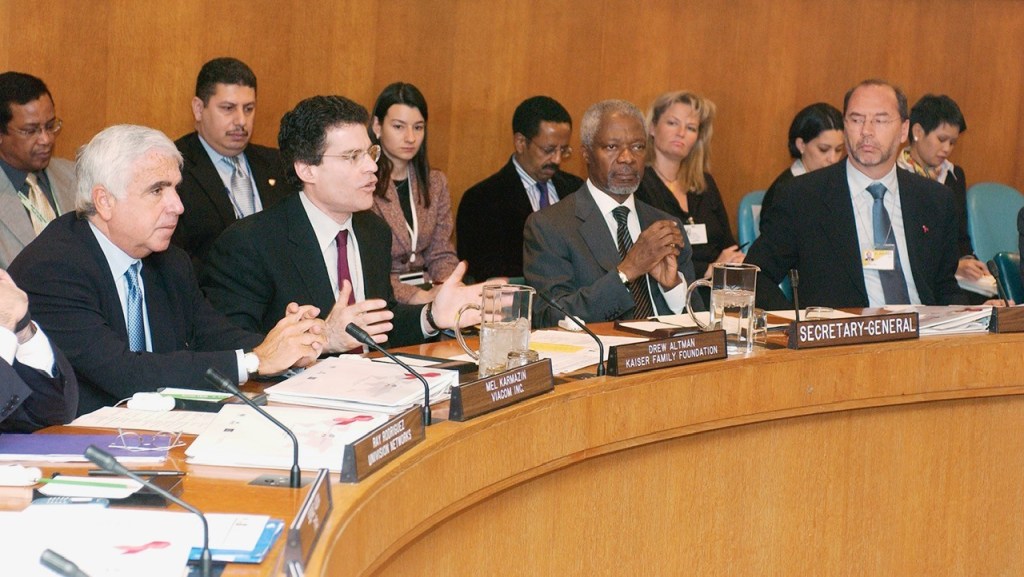
At the summit, no media leader wanted to make a smaller commitment than others made, and like a PTA auction, escalating commitments of media time and content were made. That was the case even for media executives from Russia where HIV, which was mostly an injection drug use epidemic there, had been criminalized and wasn’t discussed. Fortuitously, President Putin was about to host what was then the G8, and wanted to look like a good guy. Putin called the head of Gazprom media out of the meeting to convey the message when he returned that Russia would make big commitments in media time and content to what became known as Stop Spid (Stop AIDS ) in Russia.
We asked the media companies and organizations to make these commitments:
- Designate the fight against HIV/AIDS as an overall corporate priority;
- Commit substantial time and/or space to the issue, including programming/editorial and advertising;
- Provide current news coverage of the epidemic, both globally and locally;
- Support efforts to train reporters and producers to cover the epidemic;
- Support the development and broadcast of HIV/AIDS-related shows, films, and documentaries;
- Encourage the integration of HIV/AIDS-themes in storylines;
- Make content addressing HIV/AIDS available rights-free to other outlets; and,
- Provide comprehensive workforce education efforts about HIV.
Media organizations in several regions committed 5% of their prime-time programming to HIV content. Our job was to scramble around the world and build partnerships with credible organizations that were involved in each region to make all these things happen, launching real campaigns before the media leaders forgot about the summit commitments.
Campaigns were born all over the world. The most significant were: the Caribbean Broadcast Media Partnership on HIV AIDS and its “Live Up” campaign, led from Barbados by my friend Allyson Leacock; the African Broadcast Media Partnership Against HIV/AIDs and “Imagine Africa,” organized by our South Africa program director Michael Sinclair; the Russian Media Partnership to Combat HIV/AIDS and “Stop Spid,” led by KFF staff and an organization called TPAA (the Transatlantic Partnership Against AIDS), whose key vice president we eventually hired; the Latin American AIDS Initiative; and the Asia-Pacific Media AIDS Initiative. We also coordinated our large-scale U.S. based campaigns, which were with companies such as Viacom, Fox, MTV and BET, with the global campaigns. I will write about the domestic efforts separately. The overall effort was directed by our talented Senior Vice President Tina Hoff, who led our domestic media campaigns.
One thing that immediately became clear was that one strategy and one message would not work globally. In the Caribbean, the main issue was stigma, and campaign messaging was aimed at that. Barbados had a uniquely impressive approach. In addition to media messaging, Barbados staged large-scale community festivals where grandparents and parents and kids would come to be tested for HIV together while enjoying food, music and the day together. Everybody got tested together, which reduced if not eliminated any stigma. We often do not apply practices from other countries in health, and I wondered if that could work in communities here.
In Russia, the goal was simply to break the silence on HIV, which previously couldn’t be publicly discussed. Stop Spid helped achieve that. The Russians hated the generally empowering messaging that we favored around the world and requested downbeat, if not dour messaging, instead, which worked well in Russia. Here’s an example:
In Africa, the challenge was to refresh an AIDS message that Africans had been hearing over and over. We chose an upbeat theme that looked beyond HIV to a brighter future—imagining an Africa without HIV. HIV was entrenched in Africa, and messaging also had to be targeted to be effective.
In India, we worked with the Heroes Project, championed by Richard Gere and the government, and built our messaging off of cricket stars and outlandish Bollywood characters. Here’s one example:
Only some of the substantial messaging and creative material developed over the years in our campaigns with U.S. partners proved useful in other countries and cultures, even though the work garnered seven Emmy and two Peabody awards. But it did give us the experience base we needed to bring to the global work, as did our very large loveLife campaign in South Africa. We became adept at developing messaging and creative content. Here’s one example of one of our Emmy-winning U.S. messages that gave us “street cred” in the field:
Of course, not every country proved welcoming. The Dominican Republic was a tough sell, as was Cuba, as we expected it to be. China and CTV were mostly impenetrable although some media from Hong Kong made its way into mainland China.
After about five years, the media companies and organizations had sustained special high-intensity commitments to HIV for about as long as it was reasonable to expect, and we dialed back, and eventually discontinued, our involvement. However, in some regions, notably the Caribbean, efforts were continued by partners for much longer, and in some cases, campaigns evolved under other auspices. Sustained funding for media campaigns on public health issues from UNAIDS and every global funder has always been an issue, and it was in this case, too. Of course, we knew that media by itself was not the answer to HIV, but we also knew it was an indispensable element of an overall global effort and an area where we could make a special contribution. Our objectives had largely been achieved, adding a substantial media component to the global fight against HIV when there was an opportunity to do so.
Read the previous “Untold History of KFF” columns by Drew.