Untold KFF History Volume 2: Kaisernetwork.org
Everyone who knows KFF today thinks of us as the independent source of health policy analysis, polling, and in-depth news coverage. As we head to a leadership transition next year from me to Larry Levitt and Molly Brodie, I plan to write about some of the other things we have done over the years that are part of our history and the soul of the organization, but may not be remembered by our current audiences (or staff). This is the second in the series (Untold KFF History); it’s about kaisernetwork.org.
We announced KFF’s new mission in March 1991, and from the beginning we had a twin focus on policy and media. Our first two major programs were the Kaiser Commission on the Future of Medicaid (later renamed), led by Diane Rowland, and our Media Fellowship Program, which operated for many years under the direction of Penny Duckham. By the mid-90s, we were conducting polls jointly with major news organizations and operating HIV media campaigns with the largest media companies. But our first foray into directly operating a “news” or news-like organization itself was kaisernetwork.org, which began in 2000.
At the time, webcasting was still in its infancy and was a bridge too far for most organizations and congressional committees. I asked the staff if we could develop the capacity not only to webcast our own events but also to broadcast others’ events on a wide scale. When the answer came back “yes,” HealthCast was born. HealthCast was essentially a C-SPAN for health policy over the web—we webcasted the most relevant health policy events from around the country and the world, bringing them to the health care community, and our teams of camera operators and producers spanned out across America and to international AIDS conferences in South Africa, South America, Asia, and Europe. We regularly webcasted the Clinton Global Initiative meetings and other international health events. If I remember correctly, our largest audience was for a lunch and it was 130,000 viewers. But we cheated. The lunch was with Angelina Jolie, who then had a role for the United Nations. Normally, we would have several thousand viewers for a HealthCast, not unlike the audiences we get for virtual events like KFF’s Health Wonk Shop today. Many more people would view the webcasts later, especially when there were time zone differences. HealthCast also enabled journalists to cover events when they could not be there, which was one of our goals.
It was a real success until it wasn’t. Gradually organizations developed their own ability to webcast, including being able to do it from a phone, and like a business without a market—or in our language, “a need to fill”—we were no longer as needed.
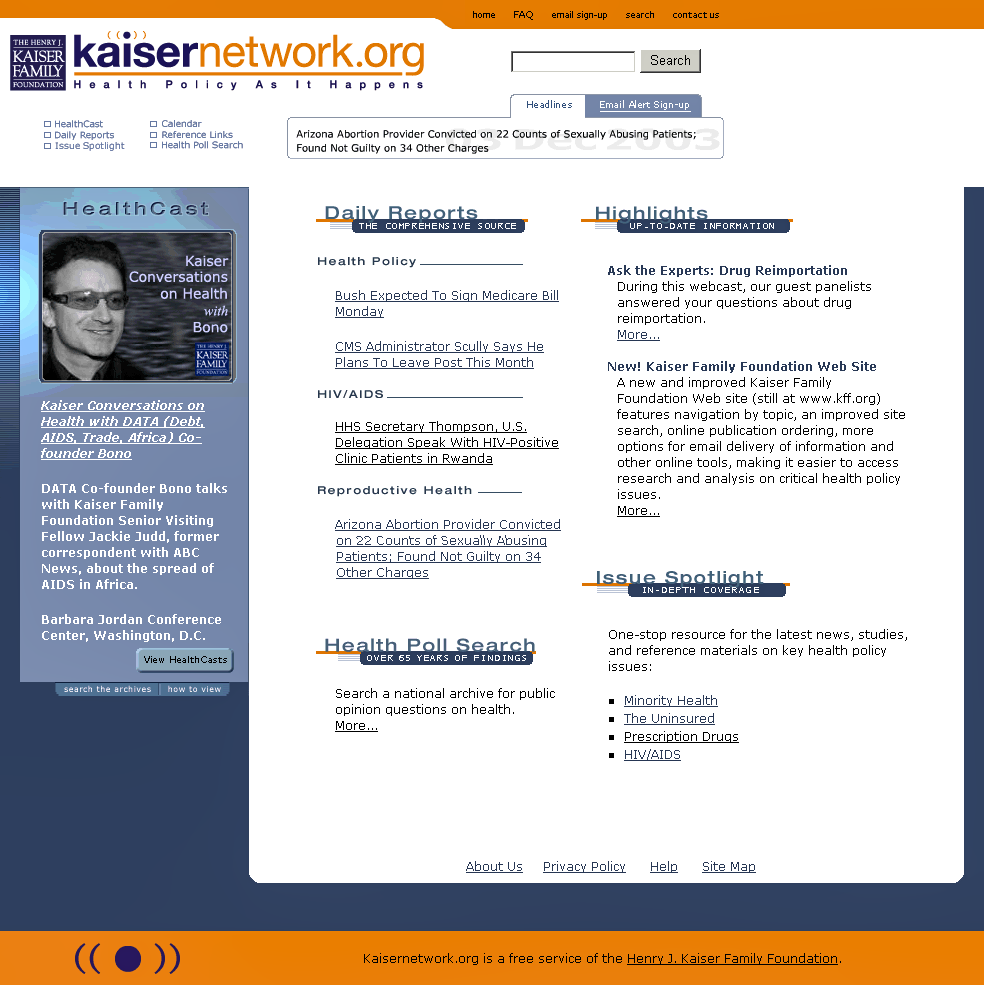
Kaisernetwork had a second feature as well. It’s where we began publishing our daily health policy newsletters, providing a daily summary of what was in the health policy news to the interested health care community, for free. Larry Levitt—yes, that Larry Levitt, the great health policy expert who will be KFF’s CEO next year—oversaw Kaisernetwork in addition to his better-known responsibilities. He edited the newsletters very early every morning from our headquarters in California, assuring maximum policy relevance and attention to policy nuance. We contracted out for the initial screening of the day’s stories and assembly of the newsletters, and Dan Diamond, now a very accomplished and well-known White House reporter at The Washington Post, worked on the project. When I established KFF Health News in June 2009, I moved the newsletters to our news operation, which seemed like the logical place to produce them. The Kaisernetwork site included other components as well, including Poll Search and our Ask The Experts webinars, which were somewhat similar to The Wonk Shop series, although they were all in-person in our Washington, DC broadcast studio rather than on Zoom, as Wonk Shop is today.
Here’s what the Kaisernetwork site looked like:
Larry’s role at kaisernetwork is revealing of a work style at KFF. We always say, “we do our own footnotes.” It doesn’t mean we literally do footnotes, although we do. It means we all do real work. No one is purely a manager or an executive.
Over the years, one source of frustration within KFF has been that sometimes people can’t distinguish our original journalism, produced by our reporters and editors at KFF Health News, from the news stories we aggregate in morning summaries as a service to the health policy community. I would receive calls from prominent people complaining about “our story,” which was not our story at all but a Washington Post or New York Times story or some other news organization’s story that we had aggregated that day in the newsletter. Our own original stories, which are regularly republished through partnerships with hundreds of news organizations, carry our reporters’ bylines and are written by our journalists, who work for KFF in KFF Health News, which is one of our three main operating programs along with policy analysis and polling. Criticism of our own stories is, of course, fair game, but we are not responsible for stories from other news organizations we aggregate as a free service. We want you to see what’s out there whether you, or we, like it or not.
Kaisernetwork also produced some original journalism, not in-house as we do today, but by contracting for it. Mary Agnes Carey, now a Managing Editor for KFF Health News, did a regular “Health on the Hill” podcast when she was at Congressional Quarterly, before podcasts were much of a thing.
Kaisernetwork also produced an HIV daily newsletter, which evolved into our Global Health Policy Daily Report, another newsletter produced for many years by our global health policy team with support from the Gates Foundation.
For the time in which it operated, kaisernetwork was a complete success and HealthCast, in particular, was a classic KFF venture—opportunistic, innovative, meeting a need.
Probably the most important benefit of kaisernetwork was the confidence it gave me to launch something far more ambitious—our own newsroom, a full-fledged news operation inside a non-profit health policy organization, which we did when we launched KFF Health News (then called Kaiser Health News) in June 2009. That began as a small enterprise with two editors and a handful of journalists, and it’s now the largest health policy newsroom in the country, with bureaus and desks across the country. But that’s another story.