Racial Equity and Health Policy

the Essentials
  • How Experiencing Racial Discrimination Impacts Health

    This brief highlights research examining mechanisms underlying health outcomes linked to self-reported experiences of racial discrimination, including biological changes, chronic stress, mental health, substance use, pregnancy-related outcomes, and sleep.
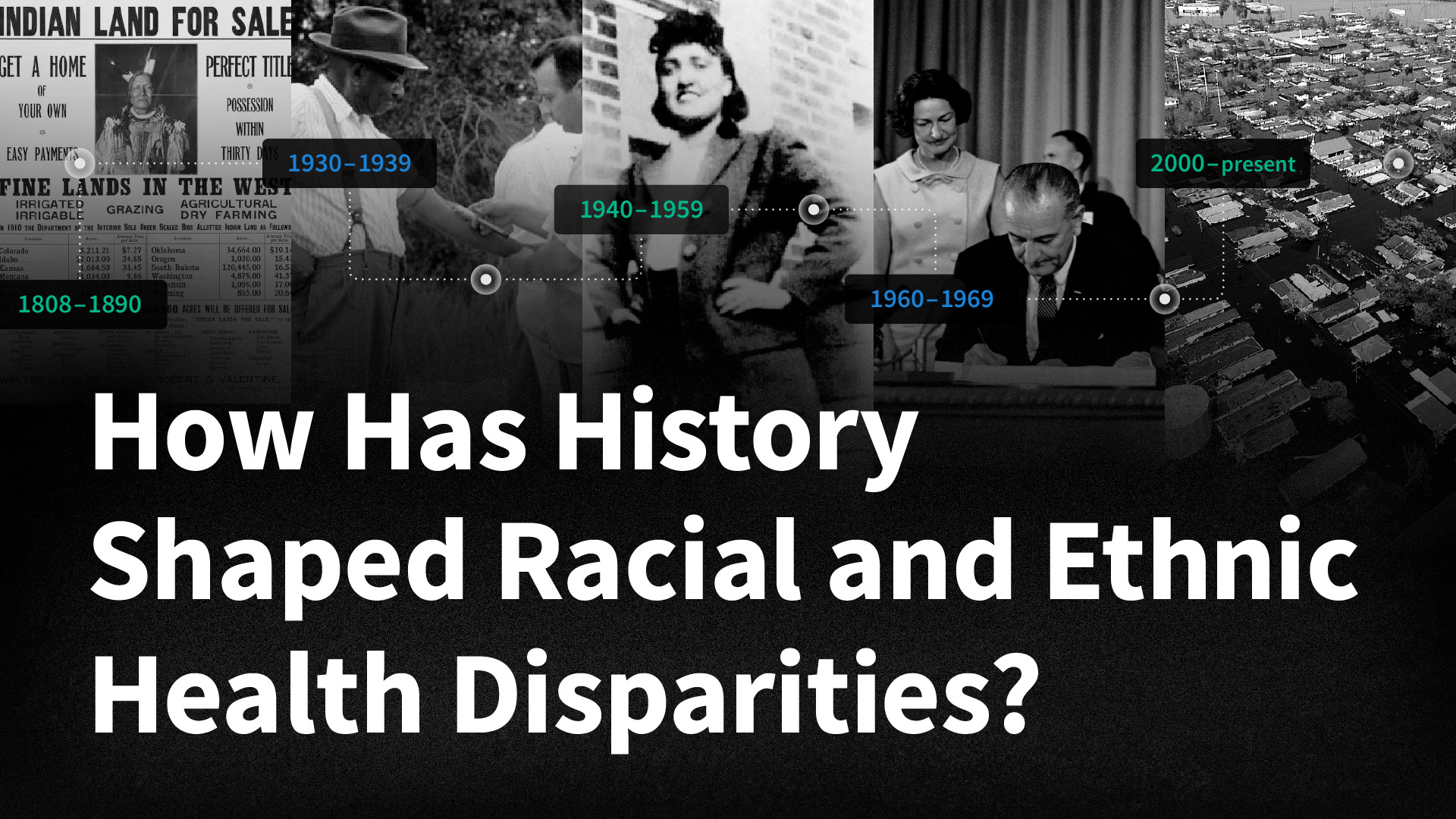
  • Timeline: How History Has Shaped Racial and Ethnic Health Disparities

    This timeline offers a historical view of significant U.S. federal policies and events spanning the early 1800s to today that have influenced present-day health disparities.
  • Health Policy 101: Chapter on Race, Inequality and Health

    Addressing persistent racial and ethnic disparities in health and health care is important for improving the nation’s health and economic prosperity. KFF explains such disparities and the factors that drive them, examines the actions to address them, and outlines future considerations.
  • Key Data on Health and Health Care by Race and Ethnicity

    Racial and ethnic disparities in health and health care remain a persistent challenge in the United States. An updated KFF resource examines how people of color fare compared to White people across 64 measures of health, health care, and social determinants of health.

Survey of Immigrants

KFF-New York Times Survey: Immigrants Report Rising Fear, Negative Economic and Health Impacts, and Changing Political Views During the First Year of President Trump’s Second Term

The 2025 Survey of Immigrants, a partnership between KFF and The New York Times, takes an in-depth look at the experiences of immigrants during the first year of President Trump’s second term, including their worries related to increased immigration enforcement, their health and economic wellbeing, and the political views and preferences of immigrant voters. The survey paints a portrait of families under strain — where fear of detention and economic instability are negatively impacting immigrants’ health and reshaping immigrant families’ daily lives and views of U.S. political parties.

Read the News Release | Explore The New York Times’ Reporting
Stay informed.

Stay informed.

Filter

301 - 310 of 603 Results

  • Resources Examine Racial and Ethnic Disparities Among Men at the State Level

    Other Post

    The Foundation has created a package of resources, including a comprehensive report, fact sheets and other materials, that document the persistence of disparities on 22 indicators between white men and men of color, including rates of diseases such as diabetes, heart disease, AIDS and cancer, and access to health insurance and health screenings. The resources provide a rare look at state-level variations, quantifying where disparities are greatest. Also available are state-level data for men of…

  • Abismo en el financiamiento de Medicaid: Implicaciones para los sistemas de atención de salud de Puerto Rico y las Islas Vírgenes de los EE.UU.

    Issue Brief

    Este resumen ofrece una descripción general del estado de los sistemas de atención médica y los programas de Medicaid en Puerto Rico y las Islas Vírgenes de los EE.UU. (USVI) aproximadamente un año y medio después que los huracanes Irma y María azotaran las islas, en septiembre de 2017. Después de las tormentas, los programas de Medicaid de los territorios han servido como recursos importantes para atender las necesidades de atención médica de los residentes,…

  • One Year after the Storms: Recovery and Health Care in Puerto Rico and the U.S. Virgin Islands

    Issue Brief

    One year after Hurricanes Irma and Maria made landfall, Puerto Rico and the U.S. Virgin Islands (USVI) are still feeling the storms’ effects. Drawing on key stakeholder interviews and public reports, this brief provides an overview of recovery status and preparation efforts for the current hurricane season one year after the storms, with a focus on the territories’ health care systems.

  • When a Family Member is Detained or Deported, Immigrant Families Often Face Financial Hardship, Physical and Emotional Health Consequences and New Fears of Engaging with Public Programs

    News Release

    As the Trump Administration pursues enhanced enforcement of the nation’s immigration laws, a new issue brief from the Kaiser Family Foundation documents how the detention or deportation of an individual can have major effects on families and communities. They include sudden and severe financial hardship and emotional trauma that can trigger long-term effects on mental and physical health, especially for children. At the same time as families are facing these increased needs, their fears of…

  • Medicare’s Role for Latinos – (Spanish version)

    Other Post

    Medicare's Role for Latinos - (Spanish version) Note: This publication is no longer in circulation. However, a few copies may still exist in the Foundation's internal library that could be xeroxed. Please email order@kff.org if you would like to pursue this option

  • Age-Adjusted Death Rates, by Race/Ethnicity, 2006-2008

    Feature

    Age-Adjusted Death Rates, by Race/Ethnicity, 2006-2008 Download Source Centers for Disease Control and Prevention. National Vital Statistics Report. January 2012. http://www.cdc.gov/nchs/data/nvsr/nvsr60/nvsr60_04.pdf    

  • Distribution of U.S. Population by Race/Ethnicity, 2010 and 2050

    Feature

    Distribution of U.S. Population by Race/Ethnicity, 2010 and 2050 Download Source U.S. Census Bureau, 2008, Projected Population by Single Year of Age, Sex, Race, and Hispanic Origin for the United States: July 1, 2000 to July 1, 2050.  http://www.census.gov/population/www/projections/downloadablefiles.html.   

  • Gaps Between Average Income of the Richest and Poorest Households in the United States

    Feature

    Gaps Between Average Income of the Richest and Poorest Households in the United States Download Source Economic Policy Institute/Center on Budget and Policy Priorities analysis of U.S. Census Bureau Data. Income is post-federal. tax and includes the value of the EITC, food stamps, and housing subsidies. Income is adjusted for inflation (to 2009 dollars) and for household size. Pulling Apart, A State-by-State Analysis of Income Trends, November 15, 2012, http://www.cbpp.org/cms/index.cfm?fa=view&id=3860