
Proposed Changes to Demographic Data Collection in the Census Could Impact Efforts to Address Health and Health Care Disparities
Introduction
On September 10, 2026, the Census Bureau published a proposed rule adding two new parts to the regulations that govern the decennial census of population and housing. The proposed changes would prohibit the inclusion of questions on race and ethnicity (in addition to sexual orientation) and would narrow the definition of “usual residence” to exclude millions of noncitizen immigrants, including undocumented immigrants as well as lawfully present immigrants without lawful permanent resident status (i.e., LPR status or a green card) from the census’ apportionment count. This count is the official measurement used to proportionately divide the 435 seats in the U.S. House of Representatives across all 50 states. Further, under the proposed rule, the Census Bureau would consider tax records to determine “usual residence,” which could result in the exclusion of people who don’t file taxes from the census count. As outlined in the U.S. Constitution, the purpose of the decennial census is to count every person living in the U.S., with that information being used to determine “the number of seats each state has in the U.S. House of Representatives” as well as to distribute federal funds.
Since its inception in 1790, the census has always collected data on race and ethnicity and counted all persons living in the U.S., regardless of citizenship or immigration status. While President Trump attempted to exclude undocumented immigrants from the 2020 decennial census during his first term via executive action, legal challenges prevented the policy from being implemented. If finalized and implemented, the changes in the September 2026 proposed rule would mark the first time that race and ethnicity data are not collected in the decennial census and would also be the first time that millions of noncitizen immigrants, including those who are lawfully present but who lack LPR status, are excluded from U.S. population counts.
Public comments on the proposed rule are due by October 13, 2026, after which the Census Bureau is required to review and respond to comments before publishing a final rule. If finalized, the rule is likely to face legal challenges. A change in presidential administration prior to the 2030 decennial census could also impact implementation.
This issue brief provides an overview of the decennial census and discusses potential implications of the changes outlined in the proposed rule. Key takeaways include:
- If finalized, the proposed changes to census data collection would signal the first time since its inception in 1790 that the U.S. decennial census does not collect data on race and/or ethnicity and excludes millions of noncitizen immigrants from apportionment counts.
- The exclusion of millions of noncitizen immigrants from apportionment counts could lead to decreased federal funding and resources for states and localities with higher shares of immigrants. This includes funding for health programs such as Medicaid and the Children’s Health Insurance Program (CHIP).
- Lack of race and ethnicity data could negatively impact research on health and health care disparities as well as data quality and representation since the decennial census is the only source of complete, block-level data on race and ethnicity as well as other key sociodemographic characteristics. Further, the exclusion of many noncitizens will also mean that the census will not accurately reflect who is residing in the U.S.
- The proposed changes could impact the redistricting process and lead to shifts in political representation, including potentially reallocating congressional seats in ways that would reduce political representation for states with large immigrant populations.
The Decennial U.S. Census
The decennial census is constitutionally mandated to obtain a count of every person living in the U.S. to determine political representation and the allocation of federal funds. Beginning in 1790, the U.S. Census Bureau has conducted a census once every decade on April 1 in years ending in zero “to determine the number of people living in the United States.” The data collected by the decennial census are used to proportionately divide the 435 seats in the U.S. House of Representatives across all 50 states as well as to determine the allocation of hundreds of billions of dollars in federal funding annually.
The decennial census is the only source of complete, block-level (smallest geographic unit defined by the Census Bureau) data on race and ethnicity as well as other demographic characteristics. Researchers and organizations rely on census data to understand population distribution by key demographic characteristics, for drawing nationally representative survey samples and weighting surveys, and to do in-depth research in areas like the U.S. workforce, the economy, and housing stock, among others. The race and ethnicity data collected by the census are also used to evaluate the effectiveness of government programs and policies as well as to measure and ensure fairness, equity, and compliance with anti-discrimination laws and policies.
Since its inception in 1790, the U.S. census has collected information on race and ethnicity that has informed policy, the allocation of resources, and research on different groups within the country. How the census has collected and categorized information on race and ethnicity and the racial and ethnic groups for which data have been collected have evolved significantly over time, reflecting social and political shifts and the growing diversity of the U.S. population (Figure 1). In 1977, the Office of Management and Budget (OMB) established federal standards for collecting and reporting race and ethnicity data. The OMB standards guide not only the census but also other federal surveys, ensuring consistency across government data collection efforts. In March 2024, the OMB revised the racial and ethnic data collection and reporting standards to add Middle Eastern or North African as a category, clarify instructions for individuals to select multiple racial and ethnic categories, and require collection of more detailed data. The OMB indicated that these revisions were intended to result in more accurate and useful race and ethnicity data across the federal government. However, the Trump administration has extended the deadline for implementation of these changes twice and canceled plans to use the new standards in the 2027 American Community Survey.
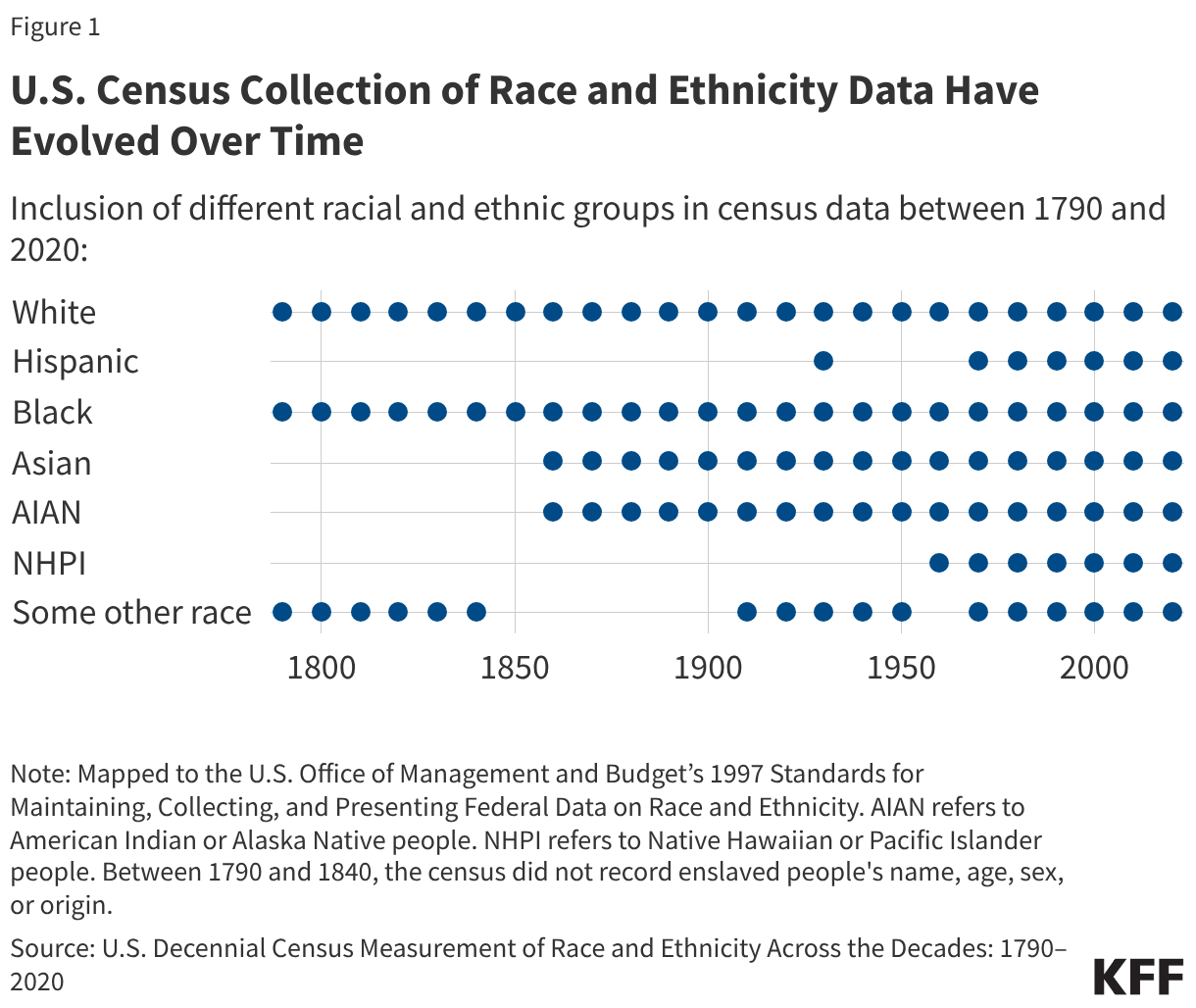
Since its inception in 1790, the decennial census has included all people residing in the U.S. regardless of citizenship or immigration status, consistent with the Constitution's directive to enumerate "persons" rather than citizens. Article I, Section 2 of the U.S. Constitution requires an "actual Enumeration" of the population every ten years for purposes of proportionately dividing, or apportioning, seats in the U.S. House of Representatives, and Section 2 of the Fourteenth Amendment, which eliminated the Three-Fifths Compromise, specifies that representatives be apportioned "according to their respective numbers, counting the whole number of persons in each State…". Consistent with this description, the Census Bureau's longstanding practice has been to count every single “person,” regardless of citizenship or immigration status, who usually lives and sleeps in the U.S. in the decennial census. It has never excluded noncitizens from the apportionment base. During his first term, President Trump sought to exclude undocumented immigrants from the 2020 apportionment count through executive action, but legal challenges prevented the policy from taking effect.
Implications of Proposed Changes
The exclusion of millions of noncitizen immigrants from apportionment counts could lead to decreased federal funding and resources for states and localities with higher shares of immigrants. The proposed rule's exclusion of immigrants without LPR status from the U.S. resident population (in addition to the apportionment base) by redefining the term “usual residence” will impact the allocation of federal funds and resources across areas. The change will lead to areas with higher shares of noncitizen immigrants receiving less funding since the census will show them having fewer residents and the income and demographic profile of state residents may change without those noncitizens being counted. Prior research has found that, beyond total population counts, each state’s poverty rate and share of people living in rural areas are key factors that drive allocation of federal funds since they often are directed to low-income households and rural areas. According to analysis by the Project on Government Oversight, over 370 public programs relied on census data to allocate at least some portion of over $2.2 trillion in federal funds to states, counties, local communities, organizations, and households in fiscal year 2023. The largest share of this funding is for health programs, including Medicaid and CHIP. For example, the federal government’s share of most Medicaid and CHIP expenditures (or Federal Medical Assistance Percentage (FMAP)) is based on a state’s per capita income derived from decennial census data. Excluding many noncitizens--who are disproportionately likely to have lower incomes--from the resident count could result in a reduction in the FMAP for states with large immigrant populations, such as Florida and Texas. Other states that also have large immigrant populations, like California, would likely be affected less since their FMAP is already at the lowest level of 50%. The change could also affect the location of federally funded resources. For example, the Health Center Program uses census-derived data to determine medically underserved areas, which helps determine the location of Federally Qualified Health Centers (FQHCs). Decennial census data also indirectly shape where hospitals are located. For example, 36 states, including D.C., have certificate of need (CON) laws that help determine whether a new hospital or additional beds may be built using "bed need" methodologies that are benchmarked to census data.
Lack of race and ethnicity data and the exclusion of many noncitizen immigrants could negatively impact research on health and health care disparities as well as data quality and representation. Elimination of racial and ethnic data collection from the decennial census will have important implications for the measurement of disparities since the decennial census is the only source of complete, block-level data on race and ethnicity as well as other key sociodemographic characteristics. The exclusion of many noncitizens will also mean that the census will not accurately reflect who is residing in the U.S. Changes to the data beginning with the 2030 decennial census will eliminate a key source of data researchers use to understand population demographics and to ensure surveys are nationally representative and also limit the ability to examine trends over time, since the data will not be comparable to earlier versions. In the proposed rule, the Census Bureau indicates that they are not proposing restrictions on asking demographic questions on the American Community Survey or other surveys that are not used for enumeration of the population. While the administration is not currently proposing changes to such surveys, if similar changes are made to these surveys in the future, that would further limit the ability to understand the demographics of the U.S. population and the ability to measure and address health and health care disparities.
The proposed changes to stop collecting data on race and ethnicity are also likely to affect the redistricting process and lead to shifts in political representation. Decennial race and ethnicity data obtained from the census underpin the redistricting process and consequently, the voting power of communities of color. Under public law 94-171, enacted in 1975, the Census Bureau is required to provide states with block-level demographic data from the decennial census to redraw congressional and state legislative districts based on updated population counts. Section 2 of the Voting Rights Act (VRA) of 1965 prohibits voting practices that discriminate on the basis of race, among other factors. Block-level data on race and ethnicity cross-tabulated by voting age have long been used to establish the threshold required to bring a vote dilution claim under the law. In April 2026, the Supreme Court's decision in Louisiana v. Callais narrowed Section 2, holding that plaintiffs must show a strong inference that a state intentionally drew districts to afford minority voters less opportunity because of race as well as offer alternative maps meeting the state's legitimate goals. Eliminating block-level racial and ethnic data would compound these heightened evidentiary requirements by removing the underlying data to identify vote dilution, draw districts that provide communities of color an opportunity to elect candidates of their choice, and litigate VRA claims in the future.
The exclusion of millions of noncitizen immigrants from the decennial census could lead to the reallocation of congressional seats in ways that would reduce political representation for states with large immigrant populations. According to Pew Research Center, as of 2023, there were roughly 14 million undocumented immigrants and over 2 million lawfully present immigrants without LPR status in the U.S. Although these numbers have likely fallen since 2023, omitting these people from the count could impact representation for states with large numbers of immigrants. For example, a Pew Research Center analysis of President Trump’s earlier proposal to exclude undocumented immigrants from the 2020 decennial census found that, at that time, California, Florida, and Texas would each lose one congressional seat due to the change in population counts, while three other states would gain seats (Alabama, Minnesota, and Ohio).