Racial Equity and Health Policy

the Essentials
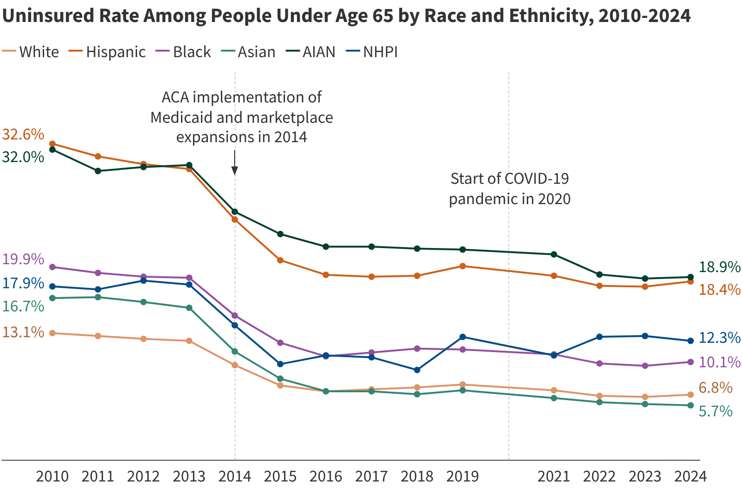
  • Health Coverage by Race and Ethnicity, 2010-2024

    There have been longstanding racial and ethnic disparities in health coverage that contribute to disparities in health. This brief examines trends in health coverage by race and ethnicity from 2010 through 2024 and discusses the implications for such disparities.
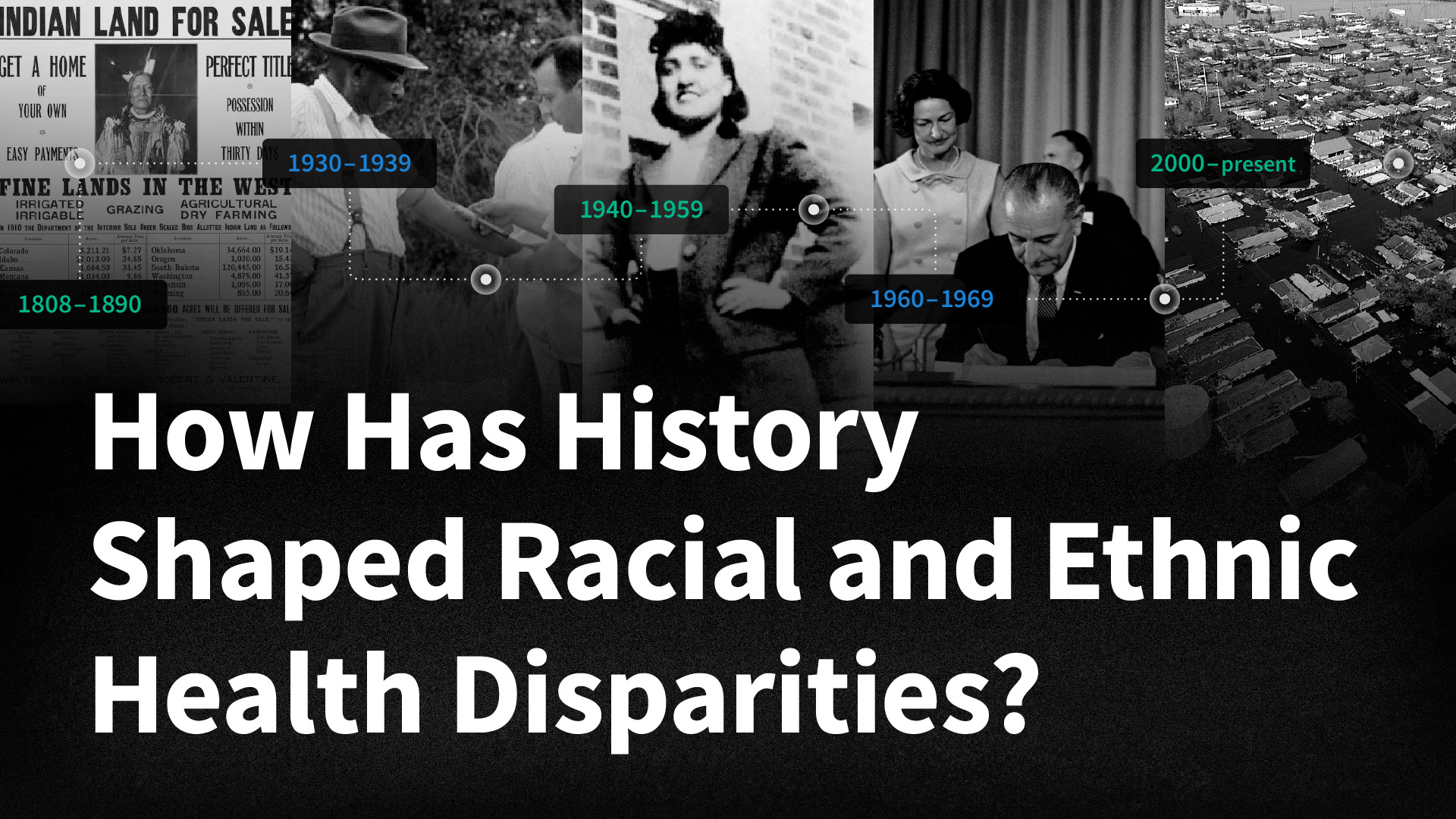
  • Timeline: How History Has Shaped Racial and Ethnic Health Disparities

    This timeline offers a historical view of significant U.S. federal policies and events spanning the early 1800s to today that have influenced present-day health disparities.
  • Health Policy 101: Chapter on Race, Inequality and Health

    Addressing persistent racial and ethnic disparities in health and health care is important for improving the nation’s health and economic prosperity. KFF explains such disparities and the factors that drive them, examines the actions to address them, and outlines future considerations.
  • Key Data on Health and Health Care by Race and Ethnicity

    Racial and ethnic disparities in health and health care remain a persistent challenge in the United States. An updated KFF resource examines how people of color fare compared to White people across 64 measures of health, health care, and social determinants of health.

Survey of Immigrants

KFF-New York Times Survey: Immigrants Report Rising Fear, Negative Economic and Health Impacts, and Changing Political Views During the First Year of President Trump’s Second Term

The 2025 Survey of Immigrants, a partnership between KFF and The New York Times, takes an in-depth look at the experiences of immigrants during the first year of President Trump’s second term, including their worries related to increased immigration enforcement, their health and economic wellbeing, and the political views and preferences of immigrant voters. The survey paints a portrait of families under strain — where fear of detention and economic instability are negatively impacting immigrants’ health and reshaping immigrant families’ daily lives and views of U.S. political parties.

Read the News Release | Explore The New York Times’ Reporting
Subscribe to KFF Emails

Choose which emails are best for you.
Sign up here

Filter

111 - 120 of 602 Results

  • Immigrants’ Access to Health Care

    Issue Brief

    Immigrants account for 20 percent of the uninsured. There are many reasons for immigrants' lack of coverage, but the welfare reform law of 1996 was significant in restricting Medicaid eligibility for certain immigrant populations. The Kaiser Commission on Medicaid and the Uninsured has produced new reports on immigrant health care: a chart pack highlighting statistics and a policy brief discussing the legal status of Medicaid eligibility. An issue paper summarizing the findings of immigrant focus…

  • KFF/The Undefeated Survey on Race and Health

    Report

    The Survey on Race and Health is a joint project between KFF and ESPN’s The Undefeated exploring the public’s views and experiences on health care, racial discrimination, and the coronavirus pandemic. It includes a special focus on the views and experiences of Black Americans, including unconscious bias and structural racism; experiences and trust in the health care system; the social and economic impacts of the pandemic; and views of a potential COVID-19 vaccine.

  • The COVID-19 Pandemic Has Hit People of Color the Hardest, Including Among People With Medicare

    News Release

    The COVID-19 pandemic has underscored the stark racial and ethnic health inequities in the U.S., including among Medicare beneficiaries. Among this group, people of color, including older adults and others on Medicare, account for disproportionate shares of COVID-19 cases, hospitalizations and deaths, according to data presented in a new KFF report about racial and ethnic disparities in health among people with Medicare. Older Black, Hispanic, and American Indian/Alaska Native adults were nearly twice as likely…

  • Under the Affordable Care Act, People of Color Have Seen Greater Gains in Health Coverage But Remain More Likely Than Whites to Be Uninsured

    News Release

    The uninsured rate has fallen among all racial and ethnic groups under the Affordable Care Act with steeper declines among people of color compared to Whites, according to a new analysis by the Kaiser Family Foundation. The findings for Hispanics were especially striking. Between 2013 and 2015, the uninsured rate for Hispanics fell from 26 percent to 17 percent – a sharper decline than for any other group. Nationally, the total number of nonelderly uninsured…

  • COVID-19 Cases and Deaths, Vaccinations, and Treatments by Race/Ethnicity as of Fall 2022

    Issue Brief

    Over the course of the pandemic, racial disparities in cases and deaths have widened and narrowed. However, overall, Black, Hispanic, and American Indian and Alaska Native (AIAN) people have borne the heaviest health impacts of the pandemic. While Black and Hispanic people were less likely than their White counterparts to receive a vaccine during the initial phases of the vaccination rollout, these disparities have narrowed over time and reversed for Hispanic people.

  • Connecting Eligible Immigrant Families to Health Coverage and Care: Key Lessons from Outreach and Enrollment Workers

    Issue Brief

    Beginning in 2014, health coverage options will significantly expand under health reform through an expansion in Medicaid eligibility and by making tax credits available to help individuals purchase coverage through new Health Benefit Exchanges. Given their high uninsured rate and limited access to private and public coverage, one group who could significantly benefit from this coverage expansion is lawfully residing immigrant families. However, it will be important to address barriers eligible immigrant families often face…

  • Kaiser Family Foundation/National Association of Black Journalists 1998 National Survey on Blacks, Media & Health

    Report

    A national survey of 800 African Americans, plus an additional general population sample of 800 Americans, examining perceptions about the media's coverage of health issues that most concern and impact African Americans. This survey was conducted jointly by the Foundation and the National Association of Black Journalists (NABJ) for presentation at the NABJ's annual conference being held in Washington, DC on Friday, July 31st, 1998. TOPLINE Download CHARTPACK Download NEWS RELEASE Download

  • Today’s Topics In Health Disparities: HHS’ Action Plan to Reduce Health Disparities

    Event Date:
    Event

    Today's Topics in Health Disparities webcast examined the new Department of Health and Human Services’ Action Plan to Reduce Racial and Ethnic Health Disparities. The program addressed the contents of the strategy and its timeline for implementation as well as its implications for providers. The panelists also discussed how the new strategy relates to other recently released HHS strategies including the National Strategy for Quality Improvement in Health Care, the National Prevention and Health Promotion…

  • A Look at Federal Health Data Taken Offline

    Policy Watch

    This post looks at federal government databases with key health data that went offline on Jan. 31, 2025, including several related to HIV, some of which had returned by Feb. 2, 2025. It briefly describing the affected databases, which include widely used, large-scale national health surveys, indices, and data dashboards, that inform research, policy making, and media coverage about health care and public health.