Medicaid

new and noteworthy

Medicaid: What to Watch in 2026

Medicaid: What to Watch in 2026

In this brief, KFF explores how state fiscal pressures are likely to converge with the implementation of the 2025 reconciliation law to affect Medicaid coverage, financing, and access to care over the next year, especially leading up to the midterm elections.

Medicaid Watch

Featuring policy research, polling and news about how Medicaid is changing, and the impact of those changes due to the tax and spending cuts law

Medicaid Work Requirements

Tracking Medicaid Work Requirements:
Data and Policies

To implement Medicaid work requirements, states will need to make important policy and operational decisions, implement needed system upgrades or changes, develop new outreach and education strategies, and hire and train staff, all within a relatively short timeframe. The information tracked here can serve as a resource to understand Medicaid work requirements and state options, gauge readiness, and track implementation of the requirements.

understanding medicaid

Medicaid Financing

Medicaid represents $1 out of every $5 spent on health care in the U.S. and is the major source of financing for states to provide health coverage and long-term care. This brief examines key questions about Medicaid financing and how it works.

Medicaid and Provider Taxes

All states except Alaska cover some state Medicaid costs with taxes on health care providers. This brief uses data from KFF’s 2024-2025 survey of Medicaid directors to describe current practices and the federal rules governing them.

5 Facts: Medicaid and Hospitals

Absorbing reductions in Medicaid spending could be challenging for hospitals, particularly for those that are financially vulnerable. This brief provides data on the reach of Medicaid across hospitals, patients, and charity care.

Medicaid Home Care in 2025

This issue brief provides an overview of what Medicaid home care (also known as “home- and community-based services”) is, who is covered, and what services were available in 2025.

5 Facts: Medicaid Program Integrity

This brief explains what is known about improper payments and fraud and abuse in Medicaid and describes ongoing state and federal actions to address program integrity.

2025 Medicaid Home Care survey

Payment Rates Ahead of 2025 Reconciliation Law

This issue brief describes Medicaid payment rates for home care and other workforce supports that are in place in 2025, before the majority of the 2025 reconciliation law provisions start taking effect.

Home Care Support for Family Caregivers in 2025
number of responding states, including DC, that allow payments for family caregivers by type of home care program and type of caregiver.

This issue brief describes the availability of self-directed services and supports for family caregivers in Medicaid home care in 2025, before most provisions in the reconciliation law take effect.

States’ Management of Home Care Spending

This issue brief describes the mechanisms states are currently using to limit Medicaid spending on home care and their plans for adopting new mechanisms in state fiscal year (FY) 2026.

Waiting Lists for Medicaid Home Care, 2016 to 2025
A Look at Waiting Lists for Medicaid Home- and Community-Based Services from 2016 to 2025

This data note provides new information about waiting lists in Medicaid home care before many of the provisions in the 2025 reconciliation law go into effect.

Eligibility and coverage
  • Eligibility, Enrollment, and Renewal Policies

    KFF's survey findings capture state actions that seek to improve the accuracy and efficiency of Medicaid and CHIP enrollment and renewal processes, as of January 2025.
  • Seniors and People with Disabilities

    More than 1 in 3 people with disabilities (15 million) have Medicaid (35%). In comparison, only 19% of people without disabilities have Medicaid.
  • Children with Special Needs

    Amid debates about proposed cuts to federal Medicaid spending, this brief analyzes key characteristics of children with special health care needs and explores how Medicaid provides them with coverage.
  • People With Intellectual and Developmental Disabilities

    Among the estimated 8 million people with intellectual and developmental disabilities (I/DD), over three million have Medicaid coverage.
  • Adults with Chronic Conditions

    Among working age adults enrolled in Medicaid, approximately three quarters have one or more chronic conditions, and nearly one-third have three or more.

Latest News

No Posts to Show

Subscribe to KFF Emails

Choose which emails are best for you.
Sign up here

Filter

2,021 - 2,030 of 2,688 Results

  • Faces of Dually Eligible Beneficiaries: Profiles of People with Medicare and Medicaid Coverage

    Issue Brief

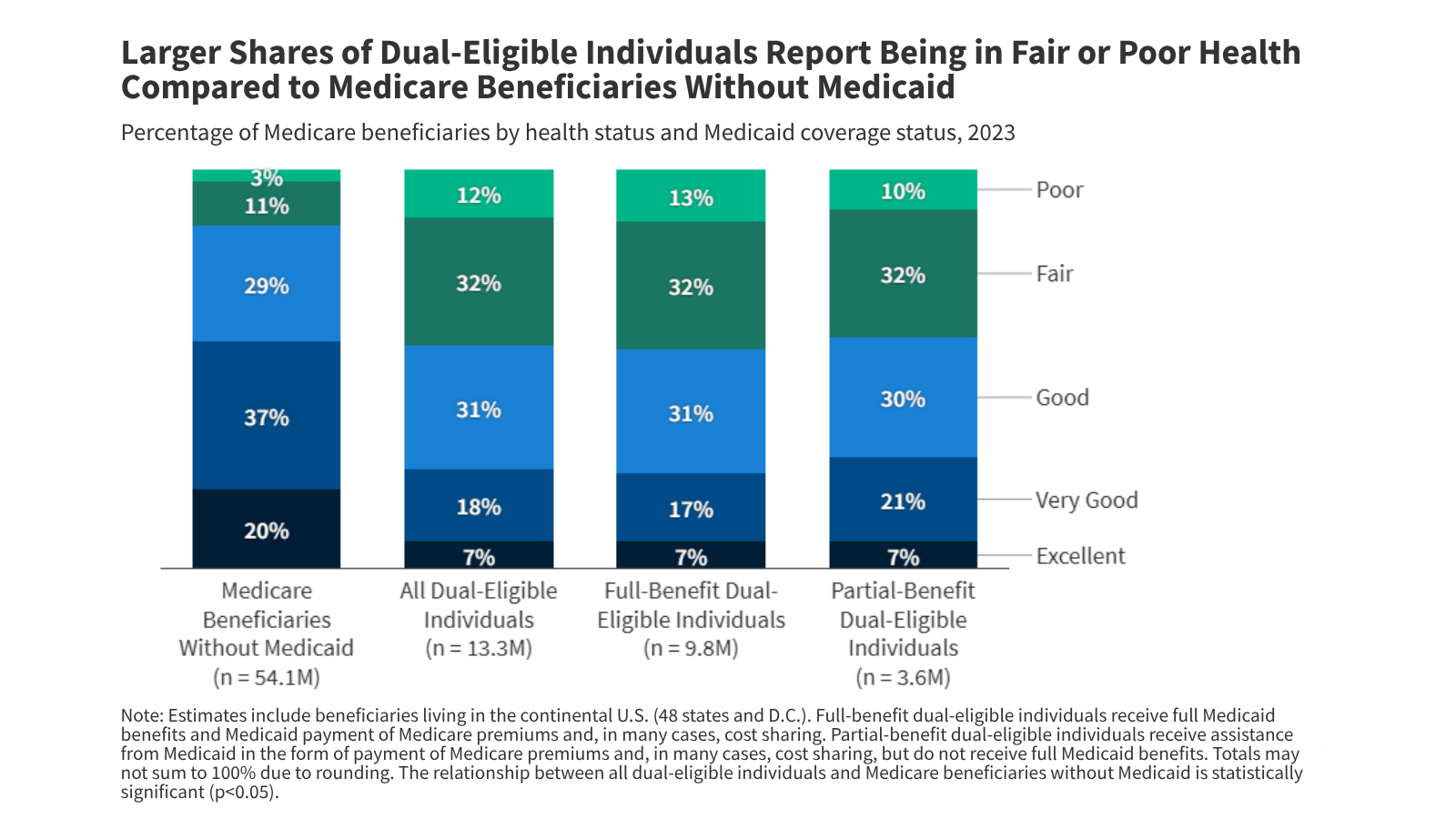
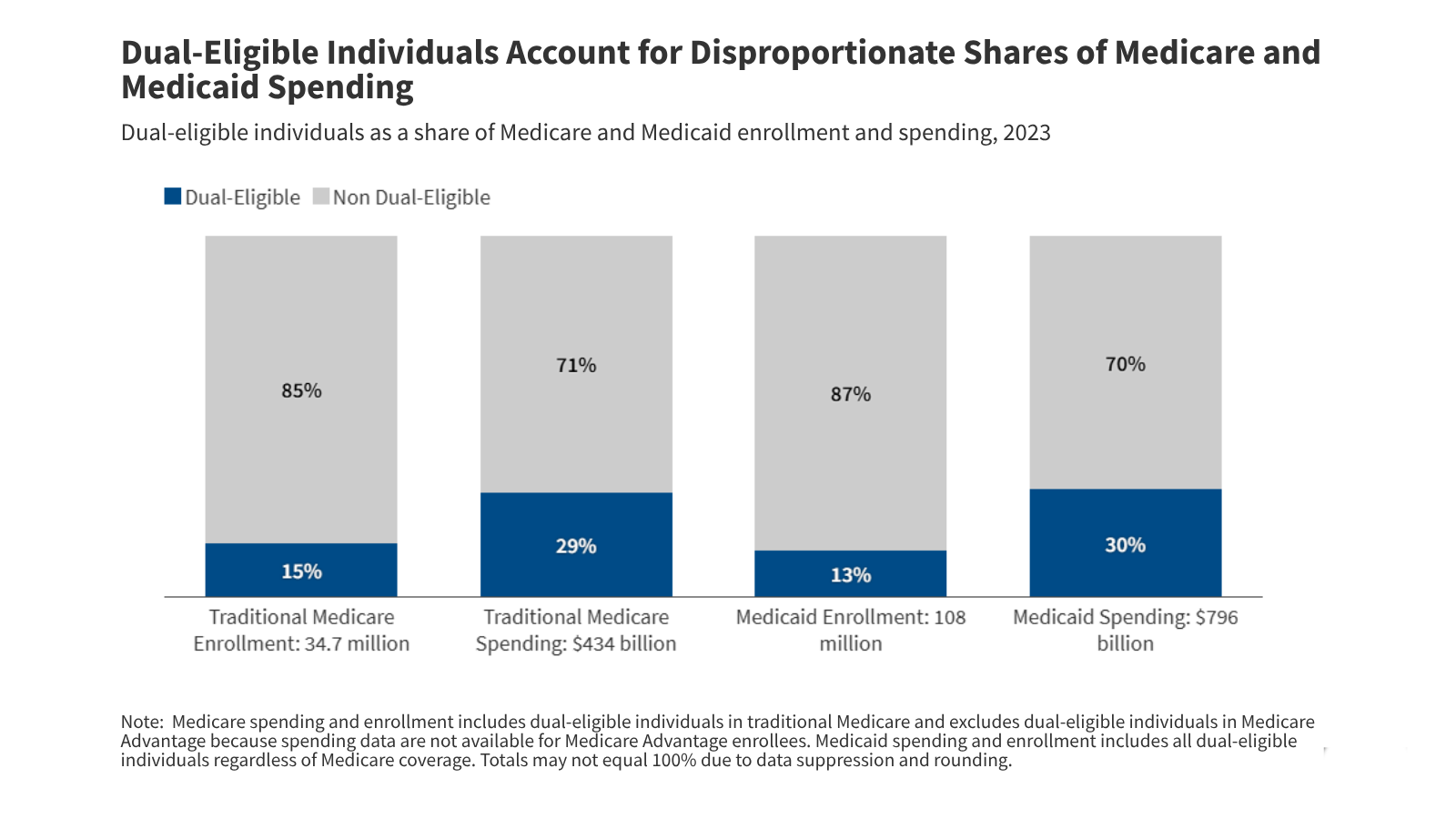
    This brief examines the role of Medicare and Medicaid in the lives of dually eligible beneficiaries – low-income seniors and younger adults with disabilities who are eligible for both programs – through personal profiles. It includes a glossary of eligibility and service delivery system terms and state-level enrollment and expenditure data for dual eligibles.

  • Transitioning Beneficiaries with Complex Care Needs to Medicaid Managed Care: Insights from California

    Issue Brief

    This brief examines how health service providers, plan administrators, and community-based organizations in Contra Costa, Kern, and Los Angeles Counties experienced the transition of Medi-Cal-only seniors and persons with disabilities (SPDs) to managed care as part of the state’s “Bridge to Reform” Medicaid waiver. Findings presented may inform similar transitions of high-need beneficiaries in other states and coverage expansions in 2014 under the Affordable Care Act.

  • Improving the Financial Accountability of Nursing Facilities

    Report

    This report examines nursing facility expenditures to assess relative spending increases in areas such as nursing services, administrative costs, and profits. Using California as a case study, it explores reimbursement by cost category and a standard medical loss ratio (MLR) as potential policy options to improve nursing facility financial accountability and care quality.

  • Health Coverage and Care for Youth in the Juvenile Justice System: The Role of Medicaid and CHIP

    Issue Brief

    This brief provides an overview of the health and mental health needs of girls and boys in the juvenile justice system and the role of Medicaid and CHIP in addressing those needs. It focuses on the circumstances of youth who are placed in juvenile justice residential facilities, the discontinuity of Medicaid coverage for those youth, and the options for improving coverage, continuity of care and access to needed services post-discharge, including new opportunities provided by the Affordable Care Act (ACA).

  • The Louisiana Health Care Landscape

    Fact Sheet

    This fact sheet provides an overview of resident socio-demographic characteristics, population health, health coverage, and the health care delivery system in Louisiana both pre-Hurricane Katrina and in the era of health reform.

  • 2016 Survey of Health Insurance Marketplace Assister Programs and Brokers

    Report

    In its third year, the survey tracks the experiences of assistance programs signing people up for Affordable Care Act coverage during open enrollment and, for consumers who qualify, during special enrollment periods. This year, for the second time, the survey includes health insurance brokers who helped people apply for non-group coverage in an ACA marketplace.

  • Understanding Medicaid Hospital Payments and the Impact of Recent Policy Changes

    Issue Brief

    Medicaid payments to hospitals, which include base and supplemental payments, play an important role in hospital finances and can affect beneficiaries’ access to care.This brief provides an overview of Medicaid payments for hospitals and explores the implications of the ACA Medicaid expansion, including changes in uncompensated care, as well as payment policy changes on hospital finances.

  • Trends in State Medicaid Programs: Looking Back and Looking Ahead

    Issue Brief

    For 15 years, KCMU and HMA have conducted annual surveys of Medicaid programs across the country. The NAMD has formally collaborated on this project since 2014. This brief provides a look back at the enrollment and spending trends as well as the multitude of policy actions taken by states across key areas: eligibility and application processes; provider rates and taxes; benefits, pharmacy and long-term care since as well as highlighting more recent data on managed care and delivery system reforms collected as part of this annual survey. Looking ahead, the survey will continue to capture the evolution of the Medicaid program with a focus program changes during economic cycles as well as innovations in payment and delivery system reform.

  • ACA Coverage Expansions and Low-Income Workers

    Issue Brief

    This brief highlights low-income workers and the impact of ACA coverage expansions on this population. Low-income workers may not have access to jobs that provide full-time, full-year employment or jobs with comprehensive benefit packages, including health insurance. Medicaid plays an important role in providing health coverage for low-income workers, and coverage expansions implemented under the ACA have produced substantial coverage gains for low-income workers and a corresponding reduction in the uninsured. However, low-income workers in non-expansion states with incomes too high for Medicaid but too low for subsidies in the Marketplace do not have an affordable coverage option and will likely remain uninsured.