Poll Finding

Kaiser Family Foundation Survey of Americans about Health Care and the Stock Market

Published: Jan 31, 1998

A survey on Americans’ perceptions of healthcare stocks and the differences between for-profit and nonprofit healthcare organizations. A fact sheet including data on financial trends from the past decade is included. This survey was released at a briefing held jointly by the Kaiser Family Foundation and the National Press Foundation for journalists on February 11 entitled Do Falling Stocks Mean Failing Care? Trends and Implications of Wall Street’s Declining Healthcare Stocks. The event is part of an ongoing series: MarketWatch: A Briefing Series for Journalists on Changes in the Health Care System.


Teen Pregnancy: Key Statistics

Published: Jan 31, 1998

The Henry J. Kaiser Family Foundation

header.gif

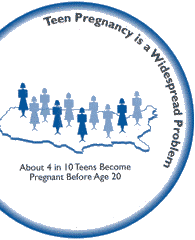
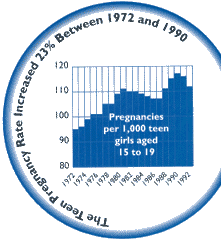
girlin.gifwidespread.gifHow widespread is teen pregnancy in the U.S.? More than four in 10 young women become pregnant at least once before they reach the age of 20 – nearly one million a year. increase.gifAre more teens getting pregnant today than two or three decades ago? The pregnancy rate among all teen girls aged 15-19 rose 23 percent between 1972 and 1990, and then fell slightly in 1992. This increase occurred because of a rise in the proportion of teenagers who have had sexual intercourse. During the same time, the pregnancy rate among sexually experienced teen girls decreased 19 percent, largely due to the fact that many more teens use contraception today than did in the past. Most (71%) sexually active teens use contraception.
Are most teen pregnancies planned?No. The overwhelming majority-78 percent-of pregnancies to 15-19 year old teen girls are not planned. Among younger teens, 15-17 year olds, 83 percent of pregnancies are unplanned. Back Next

Return to top

“The More You Know About Teen Pregnancy Prevention”Press Release Teen Pregnancy Key Statistics

National ADAP Monitoring Project: Interim Technical Report

Published: Jan 30, 1998

National ADAP Monitoring Project: Interim Technical Report

This interim technical report provides an update on the status of ADAP programs as of September 1997. It updates a Kaiser Family Foundation report from July 1997.

Report (.pdf)

Uninsured in America: Key Facts About Gaps in Health Insurance Coverage

Published: Jan 30, 1998

This brochure provides key facts about the uninsured population in American today, and the difference having health insurance makes in access to health services and to a family’s financial security.

State Facts: Health Needs, and Medicaid Financing

Published: Jan 30, 1998

This data book provides a profile of selected indicators of health needs, insurance coverage, and the role of Medicaid in each state with comparative statistics for the United States.

Medicare Beneficiaries and HMOs: Highlights of Los Angeles and New York City Medicare HMO Markets

Published: Jan 30, 1998

A growing number of Medicare beneficiaries are enrolling in Medicare HMOs as an alternative to the traditional Medicare program. However, Medicare HMO enrollment has not grown uniformly in market areas across the country. Case studies conducted by researchers at Mathematica Policy Research, Inc. for The Kaiser Family Foundation describe the evolution of Medicare managed care in the two largest markets in the United States: Los Angeles County and New York City. The reports also discuss the impact of the shift to Medicare managed care on Medicare beneficiaries, plans, and providers in each of the respective markets.

Setting Capitation Rates for HIV/AIDS Care:  A Primer for Ryan White CARE Act Title IV Project

Published: Jan 30, 1998

Setting Capitation Rates for HIV/AIDS Care: A Primer for Ryan White CARE Act Title IV Project

  • Report: Setting Capitation Rates for HIV/AIDS Care: A Primer for Ryan White CARE Act Title IV Projects

Understanding the Impact of New Treatments on HIV Testing: Summary of a Forum

Published: Jan 1, 1998

Recognizing this as a critical time in the HIV epidemic, the Kaiser Family Foundation convened a meeting on January 28 – 30, 1998 to re-examine HIV testing. Participants from community agencies, advocacy groups, national associations, and all levels of government, as well as researchers and legal experts, were brought together. This document summarizes their discussions on current understanding of and new research on HIV testing, identifying key concerns, and discussions on how to enhance HIV testing programs and policies. The primary principle which emerged during the meeting was that knowledge of HIV status is desirable because it allows individuals to make informed treatment and prevention decisions.