KFF designs, conducts and analyzes original public opinion and survey research on Americans’ attitudes, knowledge, and experiences with the health care system to help amplify the public’s voice in major national debates.
This paper describes the nature of employer coverage; its decline, especially among low-wage workers and low-income families; and the factors that are undermining its reach.
16. Do you think sex education courses should ONLY teach abstinence — that is NOT having sex until marriage — OR should courses teach about BOTH abstinence AND give teens enough information to help them prevent unplanned pregnancies and the spread of sexually transmitted diseases if they DO decide to have sex?
18 Only abstinence 81 Both 8 Don’t know/Refused 100
17. Do you think that HIGH SCHOOL health clinics should provide young people with condoms and other forms of birth control if students ask for them?
57 Yes 40 No 3 Don’t know/Refused 100
18. In general, at what age do you think most young people have sexual intercourse for the first time?Teens = (13-18) Perceptions Fall 1997 Survey* 15 12 or younger 2 11 13 5 15 14 12 21 15 18 17 16 29 6 17 16 5 18 or older 14 10 Don’t Know/Refused 4 100 100
*PSRA for The Kaiser Family Foundation and YM Magazine
19. When you were growing up, did you have sex education courses in school?
41 Yes 59 No * Don’t know/Refused 100
20. Still thinking back to when you were growing up, would you say you got a lot of information about sex from (INSERT), some, only a little or no information at all?
A lot Some Only a little No info. at all DK/Ref. Did not have sex education in school (Q19) a.Sex education in school Based on total 6 17 16 1 1 59 =100 Based on those who had sexed. in school; n=510 15 43 39 2 1 NA =100 b.Your parents 13 22 27 38 * NA =100
21. Thinking about your (AGE) year old, have you ever talked with him or her about…
Based on parents with at least one child age 8 to 18, (target child chosenrandomly for those with more than one child in age range); n=329
Yes No DK/Ref. a. The basics of reproduction — that is “the birds and bees” 79 21 0 =100 b. HIV/AIDS and other sexually transmitted diseases 80 20 0 =100 c. Issues about relationships and becoming sexually active 63 37 * =100 d. The importance of using protection, such as condoms, to preventpregnancy or disease if they become sexually active 52 48 0 =100
22. When you were growing up did your parents talk with YOU about (INSERT) or not?
Yes No DK/Ref. a. The basics of reproduction — that is “the birds and bees” 41 58 1 =100 b. Sexually transmitted diseases 21 78 1 =100 c. Issues about relationships and becoming sexually active 31 68 1 =100 d. The importance of using protection, such as condoms, to prevent pregnancy or disease if you became sexually active 25 75 * =100
23. Compared to your parents when you were growing up, do you think, (you were/you are/you would be) more open with your child(ren) about sex and sexual issues in general, less open, or about as open as your parents were with you?
79 More open 2 Less open 17 About as open 2 Don’t know/Refused 100
24. Americans have different views about sexual issues. For each of the following statements, please tell me if you strongly agree, somewhat agree, somewhat disagree, or strongly disagree. (First/Next)
Strongly agree Somewhat agree Somewhat disagree Strongly disagree DK/Ref. a. Americans overall are uptight aboutsex and sexual issues 27 36 21 14 2 =100 b. I personally have a hard time talking aboutsex and sexual issues 11 22 25 41 1 =100 c. If Americans were more OPEN talking aboutsex there would be LESS of a problem with unplanned pregnancy and sexually transmitted diseases in this country 41 27 16 14 2 =100 d. Sexual issues are private and should only bediscussed among intimate couples 26 25 25 23 1 =100
25. When you were growing up, did you have sex education courses in school?
85 Long-term monogamous relationships 9 Several relationships with different partners over a life time 6 Don’t know/Refused 100
26. What is your opinion about a married person having sexual relations with someone other than their marriage partner–is it always wrong, almost always wrong, wrong only sometimes, or not wrong at all?
January 1991* 79 Always 71 12 Almost always 17 6 Sometimes 10 2 Not wrong at all 1 1 Don’t Know/Refused 1 100 100
*PSRA for Troika Productions and Lifetime Television
27. For each of the following statements, please tell me if you strongly agree, somewhat agree, somewhat disagree, or strongly disagree.
Strongly agree Somewhat agree Somewhat disagree Strongly disagree DK/Ref. a. In general Americans have a hard timetalking about sex and sexual issues 27 39 19 13 2 =100 b. Making sex a forbidden subject only encouragesyoung people to want to have sex 36 29 18 16 1 =100 c. Sometimes it is harder for couples to TALKabout sexual issues like birth control and sexually transmitted diseases than to HAVE sex 29 38 17 13 3 =100
READ: Now some questions about you . . .
28. How would you rate your SEX life these days? Please use a ten point scale, where ten means great and one means terrible.
Even when insurance is offered to low-wage workers, its costs to these workers may be substantial, and, for some, a barrier to coverage. In 1996, workers had to contribute an average of $1,615 per year for family coverage, or about 30% of the total premium.5 Thus, a worker who earned $10 an hour in 1996, with annual wages of about $20,000, would have had to spend 8% of earnings to buy family coverage.* A worker who earned just $7 an hour would have had to spend 12% of earnings on health insurance.
* Annual earnings are estimated based on 40 weekly hours worked and 50 weeks of work per year.
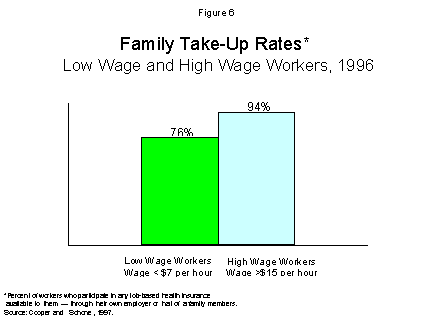
Despite substantial costs, the large majority of low-wage workers take up insurance when it is available to them. High-wage workers, though, are more likely than low-wage workers to participate in employer plans. In 1996, 76% of workers who earned less than $7 an hour participated in employer plans to which they had access (either through their own employer or through a family member’s employer), compared to 94% of workers who earned more than $15 per hour [Figure 6].6
These data do not provide much support for the view that low-income families lack coverage because they are turning down coverage that is available to them. Although high-wage workers are more likely to take up insurance, the limited impact of participation differences for low-wage workers is apparent in the following example. If low-wage workers increased their participation in any job-based plan offered to them from the current rate, 76 percent, to a rate comparable to that of high-wage workers, 94 percent, their coverage rate would only increase from 42 to 51 percent, still far below the rates found among higher wage workers.* In other words, closing the gap in participation would not close the gap in coverage between high-wage and low-wage workers. The primary reason low-income families lack coverage is not failure to participate, it is because they work for employers who do not offer them health benefits.
The Decline in Employer Coverage
The limits to employer coverage, especially for low-wage workers, are widely recognized. The deterioration of that coverage–again, especially for low-wage workers–is a pattern of even greater concern.
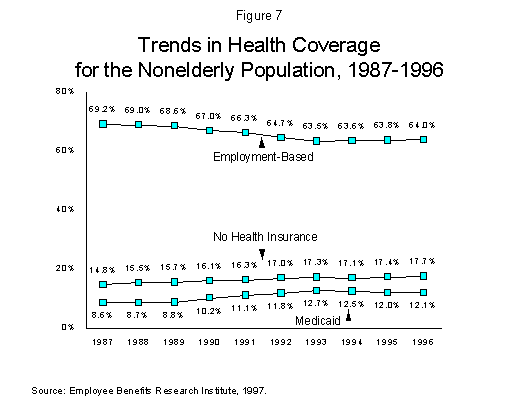
Between 1987 and 1996, the proportion of Americans under age 65 with employer coverage declined from 69.2% to 64%. Although partially offset by an increase in the proportion of the nonelderly population with Medicaid coverage (mostly for children), the proportion of the population without insurance grew from 14.8% in 1987 to 17.7% in 1996 [Figure 7].
* The coverage rate is equal to the participation rate multiplied by the proportion of workers with access to health coverage. Assuming access remains unchanged and 55% of low wage workers have access to employment-related health benefits, the coverage rate would increase from 42% (76% * 55%) to 51% (94% * 55%) if participation rates rose.
These changes in coverage–the drop in employer coverage and the rise in Medicaid– were most pronounced between 1988 and 1993. Since 1993, the deterioration in employer coverage appears to have stabilized, remaining at about 64 percent,7 while the Medicaid coverage rate dropped from 12.7% in 1993 to 12.1% in 1996, and the proportion of uninsured Americans under age 65 continued to rise, despite economic growth and relatively low unemployment.
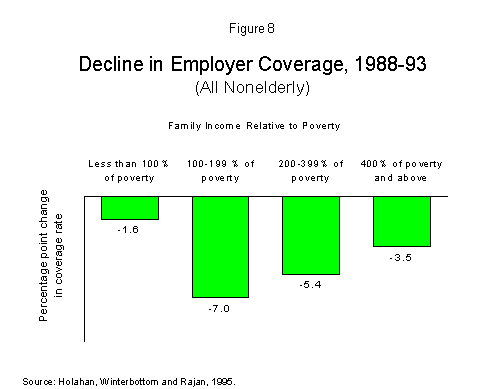
Although the deterioration of employer coverage has affected workers and families across all income levels, the impact has varied with income, with near-poor and modest income families showing the greater losses. From 1988 to 1993, the rate of employer coverage for the near-poor (with incomes between 100-199% of poverty) fell seven percentage points–from 50.9% to 43.9% [Figure 8]. Among individuals in families with incomes between 200 and 399% of poverty, the coverage rate fell from about 77.8 to 72.3 percent, and for those in families with incomes above 400% of poverty, the proportion with employer coverage dropped from 86.0% to 82.4 percent.8
Table 1 illustrates the same phenomenon over a longer period of time, focusing on workers differentiated by a variety of characteristics. Looking first at wages, coverage rates declined across all wage levels, but the drop in coverage was concentrated among low-wage workers. Coverage for workers in the bottom fifth of the wage distribution dropped 13 percentage points from 40% in 1979 to 27% in 1993. That drop is much larger than for workers in the top fifth of the wage distribution. The top wage earners were unaffected by the coverage declines in the early 1980s, but saw a small decline (of 3 percentage points) between 1988 and 1993. The fall in coverage by education level follows a similar pattern: large declines among less educated workers, with some decline in coverage in the most educated groups. Coverage rates fell more among men than women, and although employer coverage declined similarly among blacks and whites, Hispanics suffered a much larger drop.
Table 1
Change in Private Sector Employer-Provided Health Insurance Coverage, Wage and Salary Workers, 1979-1993
Health Insurance CoveragePercentage Point Change
Group*
1979
1988
1993
1979-93
All Workers
71%
69%
64%
-7
Wage (by wage fifth)
Lowest
40
32
27
-13
Second
66
62
59
-7
Middle
79
76
71
-8
Fourth
87
83
80
-7
Top
90
90
87
-3
Gender
Men
76
74
68
-8
Women
61
62
58
-3
Race
White
72
71
66
-6
Black
66
64
61
-5
Hispanic
63
56
47
-16
Education
Less Than High School
63
55
45
-18
High School Graduate
70
67
62
-8
Some College
72
68
63
-9
College
81
82
75
-6
More Than College
80
85
79
-1 *Private wage and salary workers ages 18 to 64, with at least 20 weekly hours and 26 weeks of work. Source: Mishel, Bernstein and Schmitt, 1997.
Rapidly rising health care costs-or, more precisely, employers’ responses to costs-have contributed to the widespread erosion of employer coverage. As employers have shifted costs to workers, participation has dropped. Low-wage workers have been disproportionately affected by rising costs, losing access to coverage as well as finding participation more difficult. Their problems have been exacerbated by structural changes in labor markets, which have weakened the tie between jobs and health insurance.9
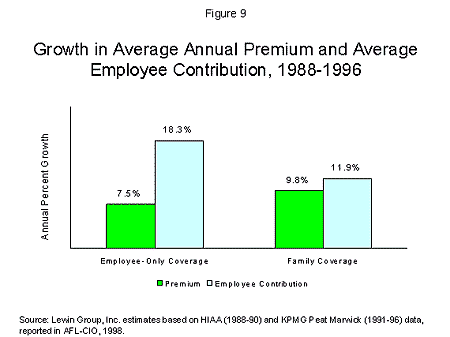
Constrained Employer Spending. A key factor behind the decline in employer coverage has been the rapid rise in health care costs. The cost of health insurance grew rapidly in the 1980s and early 1990s, far exceeding the growth in consumer prices generally. Between 1988 and 1996, the average premium for family coverage rose 9.8% per year, the premium for individual coverage increased 7.5% per year, while prices overall increased about 4% annually.10
Employers’ primary response to rapidly rising health care costs has not been to drop health care coverage for full-time workers. However, employers have constrained spending by requiring workers to pay a larger share of health insurance premiums, by tightening eligibility requirements for part-time workers (whose coverage has long been restricted) and, increasingly, in recent years, by replacing regular full-time employees with part-time and contingent workers.11
Workers’ average monthly contributions for single and family coverage rose steadily between 1988 and 1996 as workers paid a larger share of higher premiums.12 In fact, as shown in Figure 9, workers’ contributions rose more rapidly than premiums as employers shifted more of the costs of health insurance to workers, especially for non-family coverage. While average premiums for non-family coverage rose an average of 7.5% per year between 1988 and 1996, employees’ contributions rose much more rapidly–increasing by 18.3% per year.13
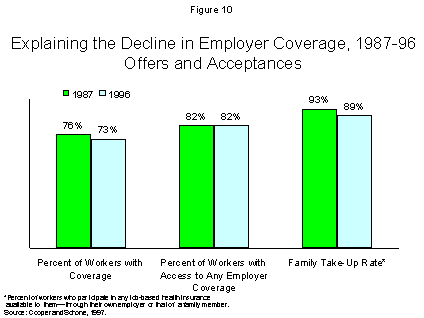
As employers have shifted costs to workers, some workers have dropped coverage, while those who have kept coverage are paying more. As shown in Figure 10, the proportion of workers participating in employer plans to which they had access fell from 93% in 1987 to 89% in 1996. Access to employer coverage was basically unchanged over this period–about 82 percent. Although the fact remains that most (about 70 percent) of the working uninsured lack access to coverage, the decline in coverage between 1987 and 1996 mostly reflects a drop in participation.14
This overall pattern obscures a worsening of access, as well as participation, for low-wage workers. Although participation rates have dropped most rapidly for the lowest wage workers, access to employer coverage has also declined for these workers. For example, among workers earning more than $15 per hour, the proportion with access to employer coverage increased from 92% in 1987 to 96% in 1996. In contrast, the proportion of low-wage workers (those earning less than $7 per hour) with access to employer coverage declined 5 percentage points over this same time period, from 60% to 55% [Table 2]. The large drop in coverage rates for the lowest wages workers is thus explained by a combination of declining participation and a decline in employer offerings.
Changes in Low-wage Labor Markets. For low-wage workers, costs and employer cost containment are not the only factors producing this deterioration. Structural changes in labor markets, that have occurred throughout the 1980s and 1990s, have contributed to the decline in coverage.
The main change in the labor market over the past two decades has been the widespread deterioration of wages, especially for those workers who initially had low wages, were without a college degree, were in blue collar or service occupations, or were in younger age brackets.15 From 1989 to 1996, the real hourly wage of the typical (median) worker fell 5.2%, while the wages of high-wage workers (90th percentile) increased 0.4%, and wages for low-wage workers (20th percentile) declined by 2.3%. Among low-wage men, the wage declines were even greater. Wages for low-wage men fell 6.4% between 1989-96.16 That is, wages for workers at the middle and at the bottom of the pay scale have not only failed to keep up with health care costs, they have declined in real terms. The large drop in participation rates for the lowest wage workers is understandable in light of the deterioration in wages for these workers. Employer actions that have led to coverage declines for all workers have thus had a disproportionate effect on the lowest wage workers.
Table 2 Change in Access, Family Take-up and Coverage, by Wage1987-1996 Wage Level19871996Change 1987-96
Coverage $15 87 90 +3
Access to Employer Coverage* $15 92 96 +4
Family Take-Up Rate** $15 94 94 0 * Percent of workers with access to job-based insurance through their own employer or a family member s employer.** Percent of workers with access to job-based insurance who are actually covered by it.Source: Cooper and Schone, 1997.
The decline in access for low-wage workers also is rooted in structural labor market changes. Shifts in employment to low-paying sectors may account for most of this decline in access. As jobs have shifted from high-paying industries like manufacturing to low-paying sectors like retail trade and services, health insurance coverage has declined.17 In addition, the proportion of the workforce in “nontraditional” work arrangements–such as regular part-time work, contingent work, and self-employment–has grown in the past decade. The expansion of employment in these jobs is not large enough to explain much of the decline in coverage; nevertheless, since these jobs are less likely to come with health insurance benefits, the expansion of nontraditional work has contributed to the overall decline in coverage.18
Conclusion
Over the past decade, there has been a decline in employment-based health insurance coverage. The fall in coverage is a widespread phenomenon that goes beyond low-income families. However, often overlooked is that low-wage workers and low-income families–who started out at a disadvantage, with low rates of coverage–have borne the brunt of the decline. The gap in coverage between low-wage and high-wage workers has grown between 1987 and 1996 because the decline in coverage has been greatest for low-wage workers. Although Medicaid plays an important role in providing insurance coverage for many low-income families, including working families, Medicaid’s eligibility levels are constrained. Workers without children are, for the most part, precluded from coverage. Beyond Medicaid’s reach, therefore, many low-income working families are likely to be uninsured.
This paper was prepared for the Kaiser Commission on Medicaid and the Uninsured by Ellen O’Brien and Judith Feder, Institute for Health Care Research and Policy, Georgetown University.
Notes
1 In this Issue Paper, we rely on Current Population Survey estimates of employer health coverage and trends. Estimates of the proportion of families with various sources of insurance by income level are based on the Urban Institute’s TRIM-II model, which produces a different total estimate because it adjusts for the undercount of Medicaid beneficiaries in the CPS.
3 The tax treatment of employment-based health insurance provides an incentive for employers to provide compensation to workers in the form of health coverage rather than in the form of wages subject to current taxation. The tax preference that the exclusion provides is substantial and has resulted in widespread access to health coverage. Yet, despite this fact–as this Paper describes–coverage rates for the lowest wage workers have traditionally been quite low and have declined significantly in the past two decades. The specific provisions of the exclusion provide a partial explanation. To qualify for the exclusion of employer-provided health coverage, employers’ health plans do not need to cover all workers. Although the tax code requires “non-discrimination”–a self-insured health plan may not discriminate in favor of highly compensated individuals as to ability to participate–employees who have not completed three years of service, those under age 25, and part-time or seasonal employees may be excluded from consideration. Moreover, insured health plans, as opposed to self-insured plans, are generally not subject to non-discrimination rules.
4 According to the Employee Benefits Supplement to the Current Population Survey, 51 million of the nearly 89 million private wage and salary workers in 1993 (or about 57% of private industry workers) had health care coverage through their employer. Of the 38 million workers without such coverage, about 50% were in firms that did not offer coverage, and 40% were in firms that offered benefits to at least some employees. (Information on whether the employer sponsored a health plan was not available for the remaining 10% of workers). See tabulations of the CPS Employee Benefits Supplement in U.S. Department of Labor. Report on the American Workforce (Washington, DC: GPO, 1995).
5 Based on an average premium for family coverage of $5,349 in 1996. KPMG Peat Marwick data cited in AFL-CIO, Paying More and Losing Ground: How Employer Cost-Shifting is Eroding Coverage of Working Families (Washington, DC: AFL-CIO,1998), p. 16.
6 These are “family take-up rates.” They measure the proportion of workers who take-up any employer plan available to them — through their own employer or through a family member’s employer. Workers’ participation rates in their own employer plans are lower (63% of the lowest wage workers and 85% of the highest wage workers participated in own employer plans they were offered) since some workers turn down their employer’s plan and choose to be covered under a family member’s plan.
7 Because of changes to the survey beginning with the March 1995 CPS, however, the estimates of employer coverage rates for 1994-96 are not comparable to data for prior years. The observed increase in employer coverage rates may be an artifact of changes in the survey questions.
8 John Holahan, Colin Winterbottom, and Shruti Rajan, “A Shifting Picture of Health Insurance Coverage,” Health Affairs 14(Winter 1995): 253-264.
9 On the more rapid drop in coverage for less educated workers see Peter Gottschalk, Trends in Wages and Health Insurance Status of Less Educated Workers. Menlo Park, CA: The Henry J. Kaiser Family Foundation; and Sherry Glied and Mark Stabile, “Graduation to Health Insurance Coverage: 1981-1996,” Working Paper 6276. (Cambridge, MA: National Bureau of Economic Research, 1997). Other studies of the decline in employer coverage include: Richard Kronick, “Health Insurance 1979-1989: The Frayed Connection between Employment and Insurance,” Inquiry 28(Winter 1991): 318-332; Deborah Chollet, “Employer-Based Health Insurance in a Changing Workforce,” Health Affairs 13(Spring 1, 1994): 315-26; Gregory Acs, “Trends in Health Insurance Coverage Between 1988 and 1991,” Inquiry 32(Spring 1995): 102-110; and Stephen Long and Joel Rogers, “Do Shifts Toward Service Industries, Part-time Work, and Self-Employment Explain the Rising Uninsured Rate?” Inquiry 32(Spring 1995): 111-117; and Paul Fronstin and Sarah Snider, “An Examination of the Decline in Employer Sponsored Health Insurance Between 1988 and 1993,” Inquiry 33(Winter 1996/1997): 317-325.
10 Data from KPMG Peat Marwick and Health Insurance Association of America, cited in General Accounting Office. “Private Health Insurance: Continued Erosion of Coverage Linked to Cost Pressures.” GAO/HEHS-97-122 (Washington, DC: GPO, 1997).
11 See Arne Kalleberg, Edith Rassell, and Ken Hudson, et. al., Nonstandard Work, Substandard Jobs (Washington, DC: Economic Policy Institute, 1997) and Thomas Rice, Nadereh Pourat, Rebecka Levan, et. al., “Trends in Job-Based Health Insurance Coverage.” (Los Angeles, CA: UCLA Center for Health Policy Research, June 1998).
12 The total nonfederal employer premium contribution fell from 85.1% to 83.9% between 1990 and 1996. In 1996 alone, this 1.2-percentage-point decrease in the employer’s share would represent a cost-shift of $3.6 billion to employees enrolled in employer-sponsored health plans. See Katherine R. Levit, Helen C. Lazenby, Bradley R. Braden, et. al. “National Health Spending Trends in 1996,” Health Affairs 17(January/February 1998), p. 46.
13 KPMG Peat Marwick data for 1991-1996 and HIAA data for 1988-1990 cited in AFL-CIO, “Paying More and Losing Ground: How Employer Cost-Shifting is Eroding Coverage of Working Families” (Washington, DC: AFL-CIO,1998), p. 16.
14 Philip Cooper and Barbara Schone. “More Offers, Fewer Takers for Employment Based Health Insurance: 1987 and 1996,” Health Affairs 16(November/December 1997): 142-149.
15 Lawrence Mishel, Jared Bernstein, and John Schmitt. The State of Working America, 1996-97 (Armonk, NY: M.E. Sharpe, 1997), p. 139.
16 Lawrence Mishel, Jared Bernstein, and John Scmitt. “Finally Real Wage Gains.” Issue Brief #127, July 17, 1998. Washington, DC: Economic Policy Institute.
18 See Arne Kalleberg, Edith Rassell, and Ken Hudson, et. al., Nonstandard Work, Substandard Jobs (Washington, DC: Economic Policy Institute, 1997). Return to top
This paper provides an overview of Medicaid spending growth in 1996. It updates earlier analyses conducted by the Kaiser Commission on Medicaid and the Uninsured.
This paper provides an overview of Medicaid eligibility policy and examines two groups of Americans in particular – low-income children and nondisabled adults under 65 – and summarizes the statutory and regulatory pathways to Medicaid eligibility available to them as individuals. The paper concludes with a discussion of policy options available to states under current law for increasing Medicaid eligibility for these two groups.
How Well Does the Employment-Based Health Insurance System Work for Low-Income Families?
September 1998
Most Americans receive health insurance coverage through the workplace. Unfortunately, however, many workers are left out, especially low-wage workers and their families. Being a low paid worker does not mean just that wages are low. It also means a lower likelihood of receiving health insurance protection on the job. Low-wage workers have never been as likely as the better paid to get coverage from their employers. And, as employers try to limit what they spend on coverage, the gap is growing worse. Although recent employer actions have reduced coverage for workers at all wage levels, low-wage workers have been the hardest hit.
Medicaid has made an enormous difference to health insurance protection for low-income families. But Medicaid eligibility is limited to the poorest of the poor, especially mothers and children. Although Medicaid has been expanded in recent years to reach near-poor pregnant women and children, many low-income working families have not been eligible for coverage. Employer protection is therefore critical for workers with low and modest incomes.
The purpose of this Issue Paper is to describe the nature of employer coverage; its decline, especially among low-wage workers and low-income families; and the factors that are undermining its reach. In summary, this paper documents the following:
Low wage workers are least likely to have employer coverage.
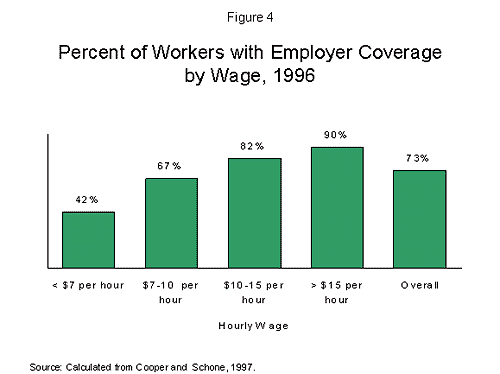
Whether they work in large or small firms, low-wage workers are far less likely than the better paid to have employer coverage. Although 90% of the highest wage workers had employment-based health insurance in 1996, only 42% of the lowest wage workers were covered.
The primary reason low-wage workers lack coverage is that their employers do not offer them health insurance benefits. Despite substantial costs, most low-wage workers (76% in 1996) participate in employer plans to which they have access.
As coverage has declined, the gap between high wage and low wage workers has grown.
Between 1987 and 1996, the proportion of workers with employer coverage fell by 3 percentage points, with the decline in coverage concentrated on the lowest wage workers. Coverage declined by 12 percentage points among the lowest wage workers, while coverage among the top wage earners increased by 3 percentage points. As a result, the gap in coverage between high-wage and low-wage workers has grown.
The decline in coverage for low-wage workers is a function of the decline in employer offerings and participation.
The proportion of low-wage workers with access to employer coverage declined 5 percentage points between 1987 and 1996 and the participation rate dropped by 13 percentage points. By contrast, access for high-wage workers improved.
The fall in participation for the lowest wage workers coincided with the deterioration in wages for these workers. From 1989 to 1996, the real hourly wage of the typical (median) worker fell 5.2%. Among low-wage men (20th percentile), wages declined even more- by 6.4%. Increases in employees’ contributions to premiums have therefore had a disproportionate effect on low wage workers.
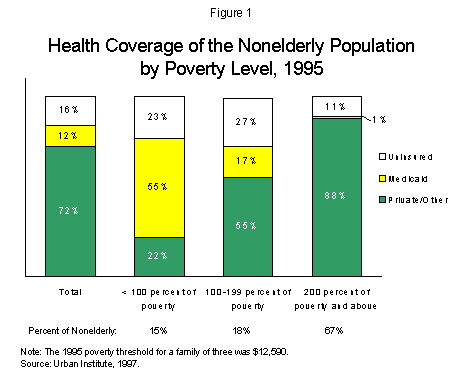
Who’s Covered and Who’s Left Out? The large majority of Americans have some kind of private or public health insurance, but more than 41 million nonelderly Americans are uninsured. Since almost all Americans over age 65 are covered by Medicare, lack of insurance is primarily a problem for working age adults and for children. In 1995, about 72% of the nonelderly had private health insurance (mostly employer coverage and some private, nongroup coverage) and 12% were covered by Medicaid. Approximately 16% of the nonelderly were uninsured [Figure 1].1
Whether individuals have any insurance coverage and what kind of insurance they have are closely related to family income. Over half of the uninsured are in families with incomes below 200% of poverty. In 1995, 88% of individuals in families with incomes above 200% of poverty had private (primarily employer-sponsored) health insurance and only 11% were uninsured. Not surprisingly, health insurance coverage for poor families looks very different. Only a small proportion of poor families (with incomes below 100% of the federal poverty level) have employer coverage. A large proportion are covered by Medicaid, but a substantial proportion remain uninsured. In 1995, 55% of individuals in poor families were covered by Medicaid and only 22% had private insurance. Despite Medicaid’s substantial contribution, however, 23% of the poor lacked health insurance [See Figure 1].
Near-poor families (those with incomes between 100-199% of poverty) are somewhat worse off than poor families with respect to health insurance coverage. Affordable private health insurance is only available to individuals in near-poor families if it is employer-sponsored. Only 55% of individuals in near-poor families had private (primarily employer-sponsored) insurance in 1995, compared to 88% of individuals in families with incomes above 200% of poverty. For certain groups, such as pregnant women and children, Medicaid has played a strong role, but Medicaid’s income and categorical restrictions result in limited coverage of the near-poor–only 17% of individuals in near-poor families had Medicaid coverage. As a result, 27% were uninsured [See Figure 1].
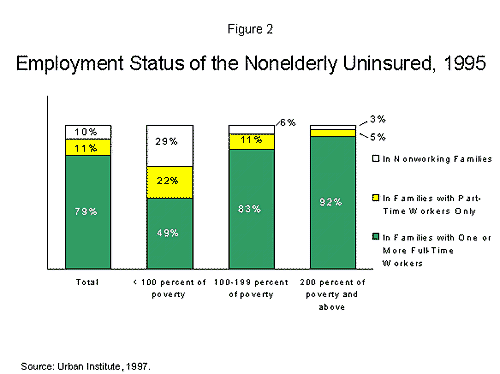
Lack of insurance does not mean that the poor and near-poor are not working. Rather, the vast majority of the uninsured are workers or are in working families. In 1995, most uninsured adults and children–79 percent–lived in families where there was at least one full-time worker. Another 11% lived in families where there was at least one part-time worker. Only 10% of the uninsured lived in families where there were no employed adults [Figure 2]. The same is true even of the poor and near-poor uninsured. Among the near-poor, the proportion of uninsured who are in full-time workers’ families (83 percent) is nearly as high as among higher income workers (92 percent). The differences in their insurance coverage are therefore not explained by substantially different levels of employment.
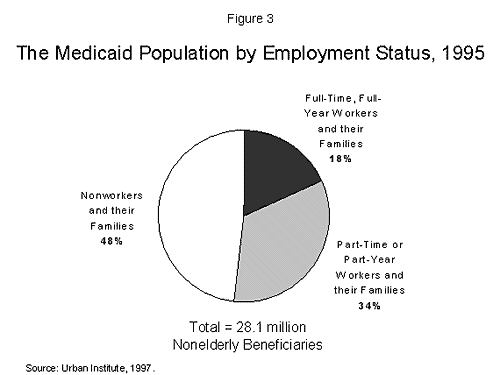
Although Medicaid’s coverage of the near-poor is limited by its eligibility criteria, many working families do qualify for Medicaid. About half of Medicaid’s nonelderly beneficiaries (low-income, working age adults and children) are in working families. In 1995, 18% of Medicaid’s nonelderly beneficiaries were in families where the family head worked full-time and full-year, while 34% were in families where at least one adult worked part-time or part-year [Figure 3].
Why Don’t Low-Income Families Have Employer Coverage?
Since most of the uninsured and half of low-income adults and children with Medicaid coverage are in working families, an important question is why so many low-income working families lack employer coverage. There are a number of factors associated with jobs without health care coverage, but a key factor is low wages. Figure 4 presents data on employer coverage rates for workers differentiated by wage.2 These data show there is a strong positive relationship between wages and health insurance coverage. In 1996, 90% of workers who earned more than $15 per hour had employer coverage, while only 42% of workers who earned less than $7 per hour had employment-related health insurance.
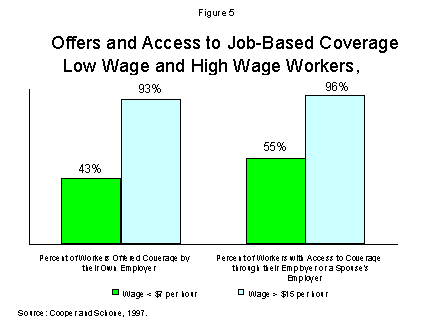
The primary problem for low-wage workers is that their employers not only pay them low wages, but they also offer them lower nonwage compensation-including health insurance and pensions.3 In 1996, only 43% of workers who earned less than $7 per hour were offered health benefits by their employer, compared to 93% of workers who earned more than $15 per hour [Figure 5].
Uninsured low wage workers, like all uninsured workers, are in large as well as small firms, and are in firms that offer coverage to none of their workers as well as firms that offer coverage to some. Although data make it difficult to distinguish precisely between these categories, an estimate from available data suggests that uninsured workers are about equally split between firms that do not offer coverage and firms that offer coverage to some workers.4
Unfortunately, many low-wage employees offered limited benefits do not have alternative access to employment-based coverage through a spouse or other family member. Even when other sources of insurance are taken into account, the gap between low and high-wage workers is still quite large. In 1996, 55% of low-wage workers had access (through their own employer or a family member’s employer) to employer coverage, compared to 96% of high-wage workers [See Figure 5].
30. Are you currently involved in a sexual relationship?
Based on those not currently married or living as married; n=479
38 Yes 60 No 2 Don’t know/Refused 100
CURRENT RELATIONSHIP STATUS (Q29, Q30):60 Married/Living as 15 Unmarried and involved 24 Unmarried and not involved 1 Don’t know/Refused 100
31. How long have you (been married /been together with this person)?
Based on those married, living as married, or involved in a sexual relationship; n=916
20 2 years or less 25 3 to 9 years 20 10 to 19 years 35 20 years or more * Don’t know/Refused 100
32. These next few questions are about your sexual health and behavior. Please keep in mind that all of your answers are private. First, have you had sexual intercourse within the last TWELVE months?
75 Yes 25 No 5 Don’t know/Refused 100
33. Have you ever had sexual intercourse?
98 Yes 2 No * Don’t know/Refused 100
34. When you were growing up, did you have sex education courses in school?
Based on those currently or ever married, n=910
66 Yes 30 No 4 Don’t know/Refused 100
35. Since you become sexually active, about how many sexual partners have you had? Would you say more than twenty, eleven to twenty, seven to ten, three to six, two or one?
29 One 11 Two 24 3 to 6 11 7 to 10 10 11 to 20 9 More than 20 6 Don’t know/Refused 100
36. How often (do you and your spouse /do you and your partner/did you and your most recent partner) have sex . . .
9 Everyday or almost everyday 33 Several times a week 28 About once a week 11 About once a month 10 Less often than that 9 Don’t know/Refused 100
37. In general, how do think you compare with most of Americans your AGE…
a. Are you MORE comfortable talking about sexual issues than most Americans your AGE, LESS comfortable, or about as comfortable?
34 More comfortable 10 Less comfortable 51 About as comfortable 5 Don’t know/Refused 100
a. Do you think (you and your spouse have/you and your partner have/you and your most recent partner had) a BETTER sex life than most of Americans your age, NOT as good as sex life, or about the same?
Based on those who have had intercourse (excluding widows and widowers not currently involved in a relationship); n=1109
29 Better 9 Not as good 53 About the same 9 Don’t know/Refused 100
38. How often do you think the average American couple your AGE has sex . . .
7 Everyday or almost everyday 28 Several times a week 36 About once a week 10 About once a month 4 Less often than that 15 Don’t know /Refused 100
39. Thinking about (your SEXUAL relationship with your spouse, how often do you feel that the SEXUAL relationship is/your SEXUAL relationship with your partner, how often do you feel that the SEXUAL relationship your most recent SEXUAL relationship, how often did you feel that the SEXUAL relationship was) (INSERT) always, often, sometimes, or hardly ever?
Based on those who have had intercourse (excluding widows and widowers not currently involved in a relationship); n=1109
Always Often Sometimes Hardly ever Never (VOL.) DK/Ref. a. Loving 62 17 12 4 1 4 =100 b. Passionate 40 26 21 6 1 6 =100 c. Routine 10 13 32 32 6 7 =100 d. Creative 19 22 37 12 2 8 =100
40. How often (do you and your spouse/do you and your partner/did you and your most recent partner) (INSERT) very often, often, sometimes, or hardly ever?
Based on those who have had intercourse (excluding widows and widowers not currently involved in a relationship); n=1109
Always Often Sometimes Hardly ever Never (VOL.) DK/Ref. a. Do romantic things like eat by candlelight 8 18 35 30 6 3 =100 b. Act out your fantasies together 4 10 28 39 12 7 =100 c. Based on women; n=564Wear sexy lingerie 9 10 28 35 12 6 =100 d. Try different sexual positions 11 19 35 23 4 8 =100 e. Read books or watch videos about improving your sex life 2 3 14 52 26 3 =100 f. Go out on special evenings or “dates” or go away for weekends alone 11 22 37 22 5 3 =100
41. Still thinking about (your sexual relationship with your spouse, your sexual relationship with your partner/your most recent sexual relationship) please tell me whether each of the following topics is something you would (like/have liked) to talk about MORE, something you (talk/talked) about enough, or something that you (don”t/didn”t) need to talk about at all?
Based on those who have had intercourse (excluding widows and widowers not currently involved in a relationship); n=1109
More Enough No need to talk about DK/Ref. a. Concerns about AIDS or HIV or othersexually transmitted diseases 12 34 51 3 =100 b. Birth Control 8 27 62 3 =100 c. Your sex life generally 19 44 33 4 =100 d. Your sexual wants and desires 21 45 30 4 =100
READ: Now I have just a few more questions so we can learn more about the people who took part in our survey . . . 42. RECORD RESPONDENT”S GENDER
44. What is the LAST grade or class you completed in school?
4 None, or grade 1 to 8 13 High school incomplete (Grades 9 – 11) 34 High school graduate (Grade 12), GED 3 Business, technical or vocational school after high school 23 Some college, no four-year degree 14 College graduate, four-year degree 8 Post-graduate or professional schooling, after college 1 Don’t know/Refused 100
45. Are you, yourself, of Hispanic or Latino background, such as Mexican, Puerto Rican, Cuban, or some other Spanish background?
7 Yes 92 No 1 Don’t know/Refused 100
46. What is your race? Are you white, black or African American, Asian or some other race?
84 White 11 Black 1 Asian 3 Other or Mixed race 1 Don’t know/Refused 100
47. Last year, that is in 1997, what was your total family income from all sources, BEFORE taxes? Just stop me when I get to the right category.
6 Less than $10,000 12 $10,000 to under $20,000 18 $20,000 to under $30,000 16 $30,000 to under $40,000 18 $40,000 to under $60,000 13 $60,000 to under $100,000 6 $100,000 or more 11 Don’t know/Refused 100
READ: Thank you very much for taking the time to answer the questions on this survey. We really appreciate it. Have a nice day/evening.
This paper examines Medicaid enrollment and its relation to the rise and fall of enrollment in Aid to Families with Dependent Children (AFDC) or Temporary Assistance to Needy Families (TANF) programs.
This survey takes an in-depth look at Americans’ attitudes about sex and sexual health issues in the 90s, including sex education, sex in the media, sexually transmitted disease and unintended pregnancy, and how we talk (or not) about sexual issues with children and partners.